UPSC IAS 2015 Question Paper for Philosophy Paper-I
Finished viewing? Save it for later —
Download UPSC IAS 2015 Question Paper for Philosophy Paper-I (PDF · 4 pages)About UPSC IAS 2015 Question Paper for Philosophy Paper-I
UPSC IAS 2015 Question Paper for Philosophy Paper-I is available here for free download. Published by UPSC for UPSC CSE (IAS), this question paper can be viewed online or downloaded as a PDF (4 pages). Candidates preparing for UPSC CSE (IAS) can use UPSC IAS 2015 Question Paper for Philosophy Paper-I to understand the exam pattern, the type of questions asked, and the overall difficulty level.
Frequently Asked Questions
How can I download UPSC IAS 2015 Question Paper for Philosophy Paper-I?
Open this page and click the Download button to save UPSC IAS 2015 Question Paper for Philosophy Paper-I as a PDF. It is completely free on AglaSem Docs.
Is UPSC IAS 2015 Question Paper for Philosophy Paper-I free to download?
Yes. UPSC IAS 2015 Question Paper for Philosophy Paper-I can be viewed online and downloaded as a PDF free of cost on AglaSem Docs.
How many pages does UPSC IAS 2015 Question Paper for Philosophy Paper-I have?
UPSC IAS 2015 Question Paper for Philosophy Paper-I contains 4 pages, which you can read online or download together as a single PDF.
Where can I find more UPSC CSE (IAS) study material?
You can find more UPSC CSE (IAS) question papers, sample papers, syllabus, and answer keys on AglaSem Docs.
UPSC IAS 2015 Question Paper for Philosophy Paper-I – Text
Read the full text of this question paper below — useful to quickly search, copy and reference the content online without downloading the PDF.
📄 View text version (4 pages)
Page 1
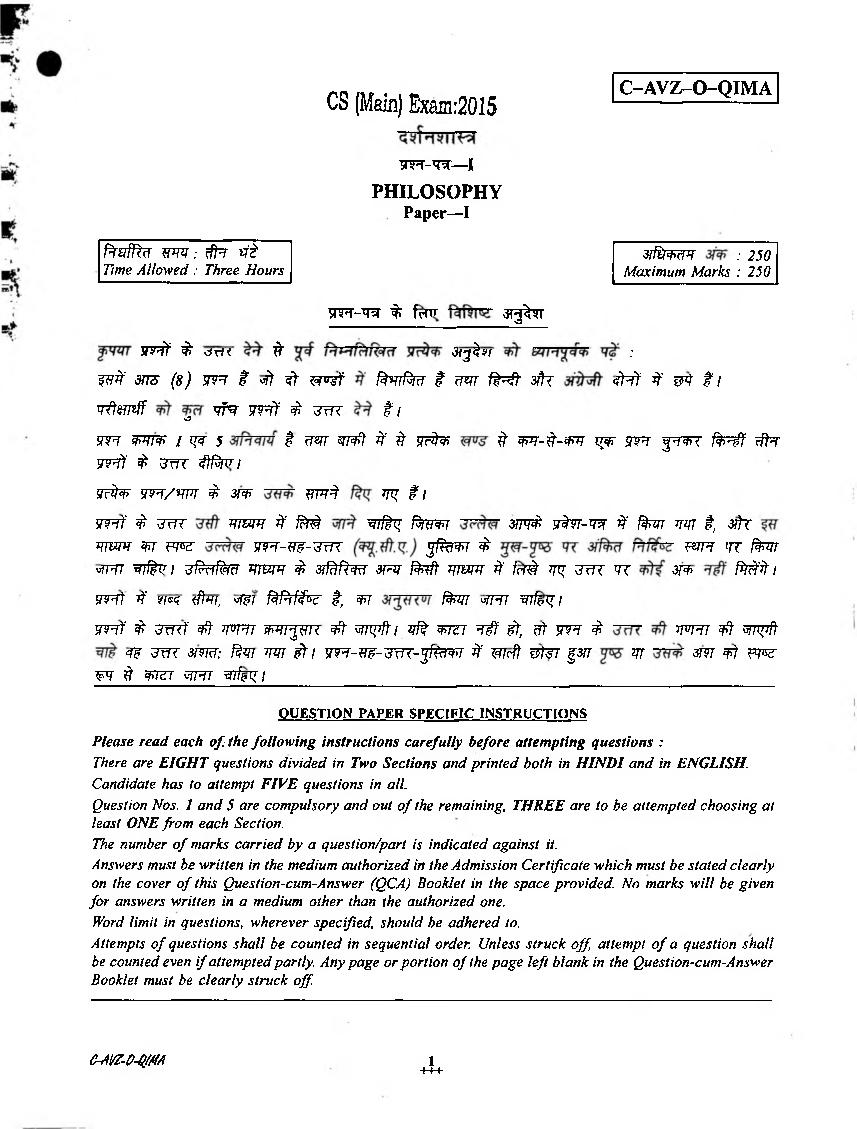
CS (Main) Exam:2015
3TFT-W—I
PHILOSOPHY
Paper—I
firuffcr wm: far *f£ S fffo m : 250
Time Allowed : Three Hours Maximum Marks : 250
^TFT-T^ % frTTT cH^'ST
TFFft ^ drf< ^ 3/^$W ;
fff#' #73" /#,) WFT $ vft it &Wf &Hl$RT $ UW f ^ f sffc <frff $ Wt $ I
w tkm ff o vNr w r f £ u m $i
VFT W 1 ^ 5 # f m WFft #' # Sr^?T # W T -^ -^ T T?F $TFT | W /^ f #?
T F # £ 7WT ^ T T /
9r^W W f / W ! £ 3f¥ WPT^ *[% f I
m f $ urn m m $ fM wffrz fatm 3^ ytw-w ^ t o mr t, 3?fc
m m m ?w T^r-w-^frr sfki+i $ ^ *rr t o
vfPTT ^rffrri jfccif&d m m $ yfdfteu sfh IWt m m #' /cr# ^ tot wz 3R> ftdft 1
WTt *¥ ?/««? {/?**/, vf&l RPlfcfbc $f W f&Tf vfFTT wfj?% I
wwf $ zmf ¥f mm wn^mz ¥t *mpfti vft wizr ^ it, uf wft $ mm ¥f mpft
cfg jx1< 3/W: Rty WOT it I ¥¥W-W~3TTT-Qf<kl<PI $ Weft Wftff JOT VT 3ffl qrf PJs?
Wf & ^IZT v1111 4if(?y I_______________________________________________________________
QUESTION PAPER SPECIFIC INSTRUCTIONS
Please read each o f the following instructions carefully before attempting questions :
There are EIGHT questions divided in Two Sections and printed both in HINDI and in ENGLISH.
Candidate has to attempt FIVE questions in all.
Question Nos. 1 and 5 are compulsory and out o f the remaining, THREE are to be attempted choosing at
least ONE from each Section.
The number of marks carried by a question/part is indicated against it.
Answers must be written in the medium authorized in the Admission Certificate which must be stated clearly
on the cover of this Question-cum-Answer (QCA) Booklet in the space provided. No marks will be given
for answers written in a medium other than the authorized one.
Word limit in questions; wherever specified, should be adhered to.
Attempts o f questions shall be counted in sequential order. Unless struck off attempt o f a question shall
be counted even if attempted partly. Any page or portion of the page left blank in the Question-cum-Answer
Booklet must be clearly struck off
c-Avz-o-nm i
-H -f
Page 2
SECTION—A
Q. 1 fWvTf^RT ^ t W W \W J 150 '?T^f ^ eff 3 rR frf^ftT :—
Write short answers to the following in about 150 words each :— 10*5=50
Q. 1(a) 3R^J 3fhc ImTciRTT' % # et
Aristotle’s distinction between ‘actually’ and ‘potentiality’. 10
Q. 1(b) p q t ^ 3# I
esse est percipi. 10
Q. 1(c) 3T3UTWI
Husserl’s notion of ‘bracketing’. 10
Q. 1(d)
Strawson’s distinction between ‘M’ and ‘P ’ predicates. 10
Q. 1(e) i TJ3TC 3iK5ffc|K I
G.E. Moore’s refutation of idealism. 10
Q. 2(a) W J w f f $ f^ ^P T I
Explain Kant’s division of categories. 20
Q. 2(b) % ^ t^ jk f ^ [ 3Fpft rT W fiW 3 ^TCTT^T ^
Discuss why Heidegger introduces the concept of Dasein in his metaphysics. 15
Q. 2(c) w ^ f^rcT % -q^rfe^ t ^T t , s m f^o; ?Tq ^ ttt i
Elucidate Quine’s arguments to show that analyticity is not synonymity. 15
Q. 3(a) *TM W9T 3TfeT^ I
Bring out the relationship between language games and forms o f life. 20
Q. 3(b) 5tct yfcrqifer 'a rM cnw ^r' c*it w c^ tj
Explain Leibnitz’s principle of ‘identity of indiscemibles’. 15
Q. 3(c) 3TFT W t ? ^ 3T«f ftngM ^ W t ?
I
What do we understand by incomplete symbols ? What role do they play in Russell’s
theory of meaning ? Discuss. 15
C-Af/Z-O-Q/M
Page 3
FtcTT f> ? f^cPT I
Explain Plato’s theory of forms. Does it entail a kind of essentialism ? Discuss. 20
Q. 4(b) w % f ^ r arat 3# jt' ffcgm t ^ «tt ^ tt t
f ? f^ F T ^ f ^ ; i
Does Descartes Cogito principle entail that he is an essentialist ? Discuss. 15
Q. 4(c) * rm ^ ^ afk ^ ^ m t ^rferq i w ^ ^
3 P jm , W tf®TST % ^ f^ ; t o ™ t W H l- Ftcft t ?
Bring out the relationship between existence and essence in the case of human being.
Explain the issues it gives rise to for human beings according to Sartre. 15
^pprs—’sr
SECTION—B
Q. 5 PlHfofvNd W WTW\ 150 TJrR ^ T T :—
Write short answers to the following in about 150 words each :— 10x5=50
Q. 5(a)
Pancavidhabheda 10
Q. 5(b) 31TO I
Jain concept of Dravya 10
Q. 5(c) Sfienrf^TH
Alayavijnana 10
Q. 5(d) W i f e
Satkaryavada 10
Q. 5(e) eft
Sri Aurobindo’s Integral Yoga. 10
Q. 6(a) tk T^ c ro |
Elaborate Nyaya-Mimamsa debate on Pramanyavada. 20
Q. 6(b) “FTTCT ITFf ^ e f Wfi 11” W W T ^ M #
‘Our knowledge is confined to gunas alone’.Examine this statement in the light of
Vaisesika and Buddhist controversy. 15
C-AVZ-D-am 3
+++
Page 4
Is anyathakhyativada an adequate explanation of error ? Elaborate. 15
Q. 7(a) w afk T w p % 3?k t w i
Compare and contrast the notion of Brahman in Sankara and Ramanuja. 20
Q. 7(b) “g w WT $ ferq W ^ I
State and examine the Samkhyaproofs for the existence of Purusa. 15
Q. 7(c) i
Explain the arguments of Carvaka toreject transcendental entities. 15
Q. 8(a) M l ? W^rfcf ^ f^T W t ? W W
^ fX T |
What is bondage according to yoga philosophy ? Explain the method of attaining Kaivalya
in Patanjali’s yogasutra. 20
Q. 8(b) m t sfk f^Nrr ^ ^ ^ rar-ftecr ^ i
What do Samvara and Nirjara mean ? Explain their significance in Jaina theory of
liberation. 15
Q. 8(c) ^ ffeRT # w t ? ^ ^ ^
tfTEpff ^ torFTT I
What is the role of Pratityasamutpada in explaining Dukha ? Elucidate the means to
overcome it. 15
e-AVZ-0-Q.m 4
+++
Document Details
| Board / Org | UPSC |
| Exam | UPSC CSE (IAS) |
| Type | Question Paper |
| Pages | 4 |
| Updated | 30 Apr 2026 |