UPSC IAS 2015 Question Paper for Philosophy Paper-II
Finished viewing? Save it for later —
Download UPSC IAS 2015 Question Paper for Philosophy Paper-II (PDF · 4 pages)About UPSC IAS 2015 Question Paper for Philosophy Paper-II
UPSC IAS 2015 Question Paper for Philosophy Paper-II is available here for free download. Published by UPSC for UPSC CSE (IAS), this question paper can be viewed online or downloaded as a PDF (4 pages). Candidates preparing for UPSC CSE (IAS) can use UPSC IAS 2015 Question Paper for Philosophy Paper-II to understand the exam pattern, the type of questions asked, and the overall difficulty level.
Frequently Asked Questions
How can I download UPSC IAS 2015 Question Paper for Philosophy Paper-II?
Open this page and click the Download button to save UPSC IAS 2015 Question Paper for Philosophy Paper-II as a PDF. It is completely free on AglaSem Docs.
Is UPSC IAS 2015 Question Paper for Philosophy Paper-II free to download?
Yes. UPSC IAS 2015 Question Paper for Philosophy Paper-II can be viewed online and downloaded as a PDF free of cost on AglaSem Docs.
How many pages does UPSC IAS 2015 Question Paper for Philosophy Paper-II have?
UPSC IAS 2015 Question Paper for Philosophy Paper-II contains 4 pages, which you can read online or download together as a single PDF.
Where can I find more UPSC CSE (IAS) study material?
You can find more UPSC CSE (IAS) question papers, sample papers, syllabus, and answer keys on AglaSem Docs.
UPSC IAS 2015 Question Paper for Philosophy Paper-II – Text
Read the full text of this question paper below — useful to quickly search, copy and reference the content online without downloading the PDF.
📄 View text version (4 pages)
Page 1
ri y ~ - 3
W l .*#? wk : 250
3 I^ T - ^ UWEft 3*g ^ T
(3fK ^ ^ frRlcifelti f^ 1 x^)
^ ^^ 3TT3 TO 1^ ^ f *ft f|^t V$ at^xft 3 ^ ||
-znfcm ^ W TOt % 3rR ^ f I
TTR w n 1 3?ft 5 f cWI 3^ 3^ T3*5 $ 3PR"cfkw ft%
i!c^4) ‘TO/'TFI % fcT^ f^cT 3^5 33f% f I
% 3rTC Sllfafxi 3 fcttl 3TN% 3 ‘t e l *1311, sfa W «f»I
^ t o -^-^ tr (^ o ^ o tto) ^ r ^ r % Tpnjs ^ ftSe ww ^ t o ^ht i mfafs w i % sp?
inW 3 f ^ l 7TIJ 3rTC «£j$ 3^5 M^ii
THFft 3ft TO #7T, 3f|tef I, ^ *M ^RT xT#HI
OTi % WSf ¥R1 sH'HIgflR I 3?lto ^ ^ % 3fR ^ *ft ~^Pm eft ^TTTrft ^ "^IZI ^
m\ i\\ 'm-'m-^xR 3 ^ n c ft w t| ^ ^ ^ 3^ ^ % * tft ^
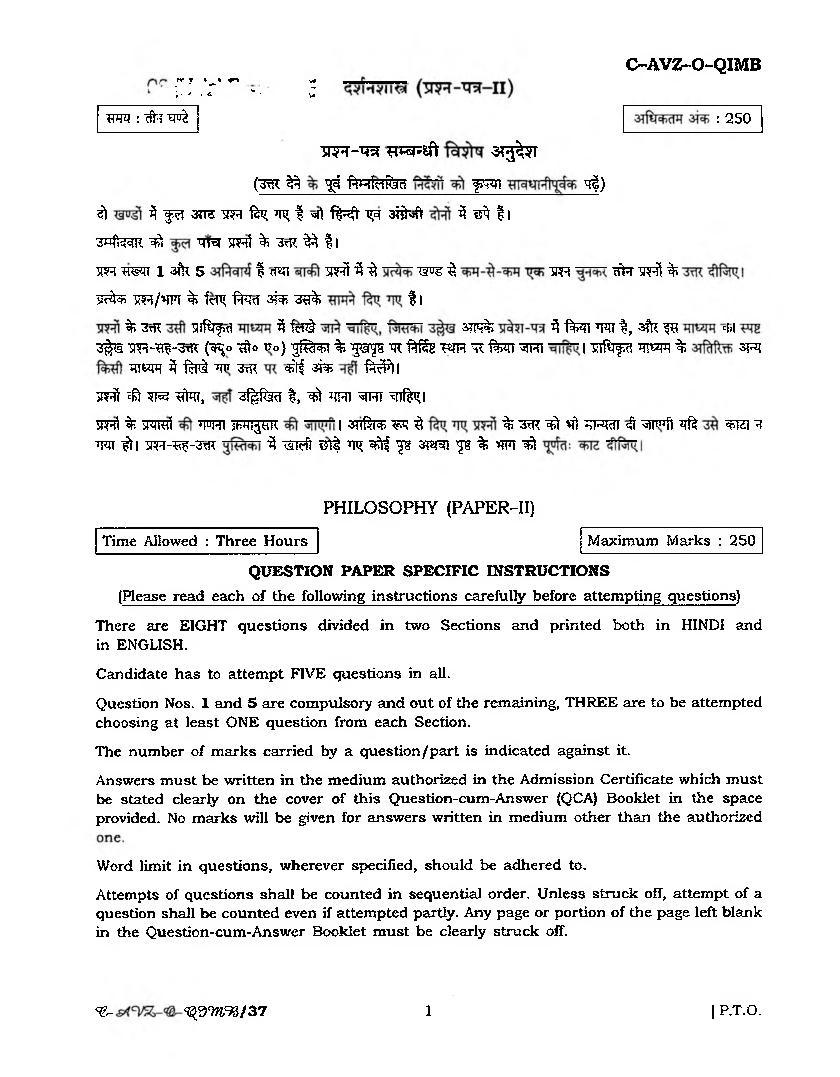
PHILOSOPHY (PAPER-II)
Time Allowed : Three Hours Maximum Marks : 250
QUESTION PAPER SPECIFIC INSTRUCTIONS
(Please read each of the following instructions carefully before attempting questions)
There are EIGHT questions divided in two Sections and printed both in HINDI and
in ENGLISH.
Candidate has to attempt FIVE questions in all.
Question Nos. 1 and 5 are compulsory and out of the remaining, THREE are to be attempted
choosing at least ONE question from each Section.
The number of marks carried by a question/part is indicated against it.
Answers must be written in the medium authorized in the Admission Certificate which must
be stated clearly on the cover of this Question-cum-Answer (QCA) Booklet in the space
provided. No marks will be given for answers written in medium other than the authorized
Word limit in questions, wherever specified, should be adhered to.
Attempts of questions shall be counted in sequential order. Unless struck off, attempt of a
question shall be counted even if attempted partly. Any page or portion of the page left blank
in the Question-cum-Answer Booklet must be clearly struck off.
S £ - <^99^93/37 1 [ P.T.O.
Page 2
1. ftnfclRafl "3tR ePT^FT 150 3 :
Answer the following questions in about 150 words each : 10*5
(a) “iWcTT 3]$ % W* ^ TOR TOT tl” ^
“Equality does not mean treating everyone equal.” Discuss.
(b) ^tt c t a i t e t o 3 t?
Is civil disobedience in a democratic State justifiable? Discuss.
Explain Harold Laski’s critique of sovereignty.
(d) ^ onftn^m ^ f^T y<£R. WTfNR "f^TT ^icll W2 ^ tf^ l
How are individual and group rights reconciled in democracy? Explain.
(e) “ 3THTf5^ «im te TFifrr % wm uwifa* wvft aft 3 ow n
“Inequitable development leads to social conflicts rather than social progress.”
Explain.
2. (a) c1Ich4 ^fT “I ? ^ 7 ^ tWdl 3?R TTTRTf^ ^TFI ^ t>? fpf^TF ^ t f ^ l
What does gender discrimination mean? Is it not a violation of equality and
social justice? Discuss.
(b) I?
Does economic empowerment of women eliminate gender discrimination?
Discuss.
(c) ^Tfct-^WT 3^+1 ^ ^T
Evaluate Ambedkar’s critique of caste system.
3. (a) ^TT ^ R ffrR R STROTkTT
Is multiculturalism a need of global society? Discuss.
(b) T O T 3ftT % ^TTO TOT I T
“The aim of punishment is to defend the moral law and to do justice to
criminal.” Discuss.
(c) dUd* % 3ft
Evaluate the nature and functions of parliamentary democracy.
4. (a) ‘V r % 3TT^7^ t ^ 'trto 3ft 3Tl«TTf^ ^ ^ ^tcTT
^ «FT
“Man must grow materially as well as spiritually.” Evaluate this statement of
Ambedkar.
(b) 3ft W c W d l % t o TRcTT ^Ft| ^ T #TTl” f ^ T f
“Equality will be of no value without fraternity and liberty.” Discuss.
(c) T O % -fcT^ t o WZK -m u flcTT t? TO ^ t f ^ l
How is religious nationalism a threat to secular State? Explain.
2
Page 3
5. M i ( f 'STr^S OT 3rTC W 1 150 ^ :
Answer the following questions in about 150 words each : 10><5=50
(a) iw % m^
Write a critical note on the attributes of God.
(b) M 37totf^TT % im 3 ? f^ ^ ^ t? «
Is existence of God a necessary condition for the survival of religion? Explain.
(c) ^fci'+di m I? f^ rc i ^ tf^ i
Is morality necessarily based on religion? Discuss.
(d) im ‘y r ft e ^r*t I? ^
Is God the cause of natura? ei/tf? Explain.
(e) ^TT ‘37TWI’ sfR ^ f? # f^ t
Do faith and reason go together? Discuss.
6. (a) t o 3^r |? ^ cj^n ^ t m te wn uomftd
ifcft t, ^tf^B ^ ftisjTftcT ^ t o l w m |? to^RT
How can the religious language be verified? Is it correct to say that religious
language is verified because it cannot be falsified? Discuss. 20
(b) 3?R ^TTH 3 ^ tf^ l
Explain the nature of mysticism in Hinduism and Islam. 15
(c) ^TT '^fct *TT ^ W ’ % IRT fo*TT *TI |? to ^ T
Can revelation be justified by reason? Discuss. 15
7. (a) w 3tr% 3 fu f ^ 1 , ^ 3rrarFft ^ t e r
Do you think that evil is a bitter pill which no theist can easily swallow?
Discuss. 15
(b) “ 3TJTTcTT cTTc^f W 3?k SPjqf^rfcl #n t T
“Immortality means absence of Karma and Rebirth ” Discuss. 15
(c) % to 3 ^ ^ ^ tf^ l
Examine the Nyaya arguments in favour of the existence of God. 20
^<9fS^<&-<^ra93/37 3 [ P.T.O.
Page 4
fe^Rl ^ tf^ l
“An atheist may be a better man than a religious person bereft of moral
values.” Discuss. 15
(b) i%K % srf&rci % t o 3 ^ ‘*wi4)HNfor sfa ‘3#g#rkfta’ ^
Examine the ontological and cosmological arguments in favour of the existence
of God. 15
(c) % I? ^ ^ tf^ i
What is liberation? Briefly discuss the ways to attain it as outlined in the
systems of Vedanta. 20
* ★★
4 SB6— 1100
Document Details
| Board / Org | UPSC |
| Exam | UPSC CSE (IAS) |
| Type | Question Paper |
| Pages | 4 |
| Updated | 30 Apr 2026 |