UPSC IAS 2015 Question Paper for Political Science _ International Relations Paper-I
Finished viewing? Save it for later —
Download UPSC IAS 2015 Question Paper for Political Science _ International Relations Paper-I (PDF · 4 pages)About UPSC IAS 2015 Question Paper for Political Science _ International Relations Paper-I
UPSC IAS 2015 Question Paper for Political Science _ International Relations Paper-I is available here for free download. Published by UPSC for UPSC CSE (IAS), this question paper can be viewed online or downloaded as a PDF (4 pages). Candidates preparing for UPSC CSE (IAS) can use UPSC IAS 2015 Question Paper for Political Science _ International Relations Paper-I to understand the exam pattern, the type of questions asked, and the overall difficulty level.
Frequently Asked Questions
How can I download UPSC IAS 2015 Question Paper for Political Science _ International Relations Paper-I?
Open this page and click the Download button to save UPSC IAS 2015 Question Paper for Political Science _ International Relations Paper-I as a PDF. It is completely free on AglaSem Docs.
Is UPSC IAS 2015 Question Paper for Political Science _ International Relations Paper-I free to download?
Yes. UPSC IAS 2015 Question Paper for Political Science _ International Relations Paper-I can be viewed online and downloaded as a PDF free of cost on AglaSem Docs.
How many pages does UPSC IAS 2015 Question Paper for Political Science _ International Relations Paper-I have?
UPSC IAS 2015 Question Paper for Political Science _ International Relations Paper-I contains 4 pages, which you can read online or download together as a single PDF.
Where can I find more UPSC CSE (IAS) study material?
You can find more UPSC CSE (IAS) question papers, sample papers, syllabus, and answer keys on AglaSem Docs.
UPSC IAS 2015 Question Paper for Political Science _ International Relations Paper-I – Text
Read the full text of this question paper below — useful to quickly search, copy and reference the content online without downloading the PDF.
📄 View text version (4 pages)
Page 1
C-AVZ-O-QPMA
: <fa wk
3T^T-XT5T fctfta 3?3^?T
(3tK ^ ^ f^TT j g g j g f o j f )
^1 tau«l 3 3TT3 y^H fo* ^ ^ TJ$ 3^5ft ^^ f I
^ Tfra TOt % *3tR ^ f 1
sm Ws*TT 13fR5 stffaFf | cmi 3 3 TTcBTO <far 3iwt % IrK^tfam
sh/hfi % fcrc; $m m> bfA 1^ tut 11
OTt % 3tTC 3n f ^ *nWT 3 fc # ^ ^Tf^r, -^RT^l 3^ 1- ^ 3 fe n -m % 4 r -RTWT ^T TO
3^3 (^ o ^o tto) 'gf^m % ^ faBe w h ^ fen ^ht ^if^i % stMts sfr
feft ^KTO I
TOt TO tffaT, 3 f^ d t, cFt TTHT ^R] ^Tf^T|
t o } % 3rarat ^
¥R i shhi^ k ^ ^ f t i an te ^ 3 % 3ttc ^ ^ w
■W fit TO-^-3 tTC 3 w ft ^ ^ ^ Y5 ^ % *TFT ^ Tgfa: W ^tf^l
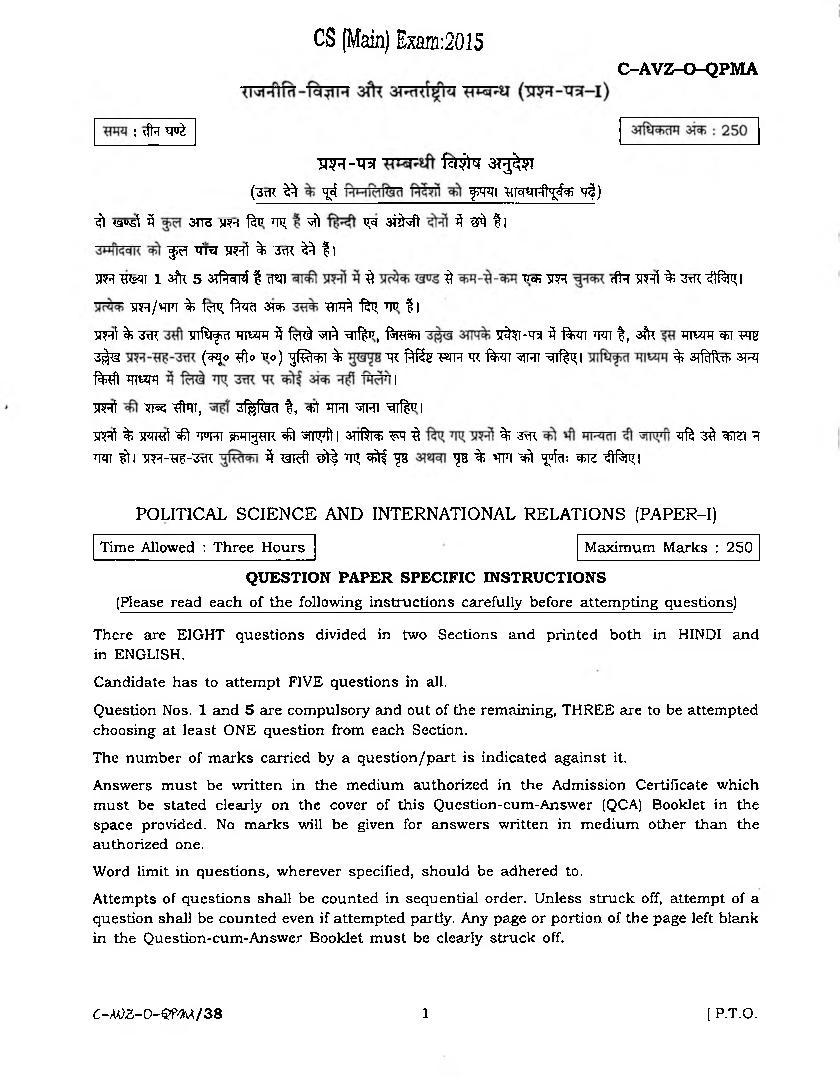
POLITICAL SCIENCE AND INTERNATIONAL RELATIONS (PAPER-I)
Time Allowed : Three Hours Maximum Marks : 250
QUESTION PAPER SPECIFIC INSTRUCTIONS
(Please read each of the following instructions carefully before attempting questions)
There are EIGHT questions divided in two Sections and printed both in HINDI and
in ENGLISH.
Candidate has to attempt FIVE questions in all.
Question Nos. 1 and 5 are compulsory and out of the remaining, THREE are to be attempted
choosing at least ONE question from each Section.
The number of marks carried by a question/part is indicated against it.
Answers must be written in the medium authorized in the Admission Certificate which
must be stated clearly on the cover of this Question-cum-Answer (QCA) Booklet in the
space provided. No marks will be given for answers written in medium other than the
authorized one.
Word limit in questions, wherever specified, should be adhered to.
Attempts of questions shall be counted in sequential order. Unless struck off, attempt of a
question shall be counted even if attempted partly. Any page or portion of the page left blank
in the Question-cum-Answer Booklet must be clearly struck off.
C -A O Z-O -Q P ftA / 3 8 1 [ P.T.O.
Page 2
1. M W # 3 ^ w m 150 3 i\ :
Comment on the following in about 150 words each : 10x5=50
(a) 1cRR
Idea of Natural Rights
(b) M I W H
Aristotle’s Conception of Equality
fcj "fef 3 ‘f^ten t e R i ’
Difference Principle* in Rawls’ Theory of Justice
(d) 3fk 3 3RTC
Difference between Participatory and Deliberative Democracy
(e) IcRK
Gandhi’s Views on State
2. (a) 3 ^ TJ'gffl ^
Examine the challenges to sovereignty of the State in the contemporary world. 20
(b) iiicK?ciic{-^ ^ ^sraf
Discuss the key features of pre-Marxist socialist theory. 15
(c) ^ zfc % "f^Rt 3 WTH'cnsftisfaaI
Compare and contrast the views of Kautilya and Machiavelli on Statecraft. 15
3. (a) 3TOfrT#mTRM^f ^ 1” (?m)
“Plato was an enemy of the open society.” (Popper) Comment. 20
(b) Mtft 3 sum s?K ^ 1^r
Discuss the relationship between base and superstructure in Marxist theory. 15
(c) ^Tfrfc
Distinguish between Power and Authority. 15
4. (a) 3 ‘fafluwddi m w * (fw w )
Discuss the ‘crisis of legitimacy’ in capitalist societies. (Habermas) 20
(b) srcft % (3Tptte ?^op|3Tc^)>% 1 ^ ri
Discuss Gramsci’s notion of ‘organic intellectuals’. 15
(c) tfog i&Z % % "RT^f ^
Discuss David Easton’s model of systems analysis. 15
C -A O Z-O -Q P ^ A / 3 8 2
Page 3
—B / SECTION—B
S. ftRfcffecl m M M fofetr, ^ TTc^S WTO i50 ^ ^ :
Comment on the following in about 150 words each : 10x5=50
(a) Wcffa yfem 3 *j4-i^raT
Secularism in the Indian Constitution
(b) micfk TT$3 3 V& Wftfo % ¥<? 3 wm%
Satyagraha as a Strategy in the Indian National Movement
(c) Weft? 99^!
99th Amendment of the Indian Constitution
(d) W srnh7! ^
Structure and Function of NITI Aayog
(e) ma %
Cooperative Federalism in India
Discuss the efficacy of judicial review in India. 20
(b) Weffa W\ TFW^f ^ TT?H ^ oR
Critically analyze the discretionaiy powers granted to the Governor by the
Indian Constitution. 15
(c) " t o 3 w zR *w4)fci ^ fk*m ^ irm t ^ %\”
“Identity politics has trumped development politics in India.” Comment. 15
7. (a) 1991 3 SRqif ^-^TTfsfqR 3 *TR?foj ^ 3 WZ
^ $1f^i
In the light of neo-economic policies adopted since 1991, examine the
relevance of the term ‘socialist' in the Preamble of the Indian Constitution. 20
Identify the contested areas in Centre-State relations in India. 15
(c) ‘%sn stRpfr’ sfa 33% jm tut wftcwl ^
Discuss the ‘Right to Education* and the concerns raised by it. 15
C-A0Z-0-Q ?4<A/ 3 8 3 { P .T .O .
Page 4
Trftem^fou j
Examine the role of Panchayati Raj Institutions and Urban Local Bodifcs in
deepening of democracy in India. 20
(b) aft pFH I
Compare the Nehruvian and Gandhian models of development. 15
(c) ^ W I TO VKci 3 3 ^ *jfo*T ^
3Tf^FR ^ tf^ l
Account for the rise of regional political parties and assess their role in
contemporary India. 15
★★★
C-AOZ-O-Q P^/38 4 SB6— 1240
Document Details
| Board / Org | UPSC |
| Exam | UPSC CSE (IAS) |
| Type | Question Paper |
| Pages | 4 |
| Updated | 30 Apr 2026 |