UGC NET Human Rights and Duties Question Paper 2018
Finished viewing? Save it for later —
Download UGC NET Human Rights and Duties Question Paper 2018 (PDF · 56 pages)About UGC NET Human Rights and Duties Question Paper 2018
UGC NET Human Rights and Duties Question Paper 2018 is available here for free download. Published by NTA for UGC National Eligibility Test, this question paper can be viewed online or downloaded as a PDF (56 pages). Candidates preparing for UGC National Eligibility Test can use UGC NET Human Rights and Duties Question Paper 2018 to understand the exam pattern, the type of questions asked, and the overall difficulty level.
Frequently Asked Questions
How can I download UGC NET Human Rights and Duties Question Paper 2018?
Open this page and click the Download button to save UGC NET Human Rights and Duties Question Paper 2018 as a PDF. It is completely free on AglaSem Docs.
Is UGC NET Human Rights and Duties Question Paper 2018 free to download?
Yes. UGC NET Human Rights and Duties Question Paper 2018 can be viewed online and downloaded as a PDF free of cost on AglaSem Docs.
How many pages does UGC NET Human Rights and Duties Question Paper 2018 have?
UGC NET Human Rights and Duties Question Paper 2018 contains 56 pages, which you can read online or download together as a single PDF.
Where can I find more UGC National Eligibility Test study material?
You can find more UGC National Eligibility Test question papers, sample papers, syllabus, and answer keys on AglaSem Docs.
UGC NET Human Rights and Duties Question Paper 2018 – Text
Read the full text of this question paper below — useful to quickly search, copy and reference the content online without downloading the PDF.
📄 View text version (56 pages)
Page 1
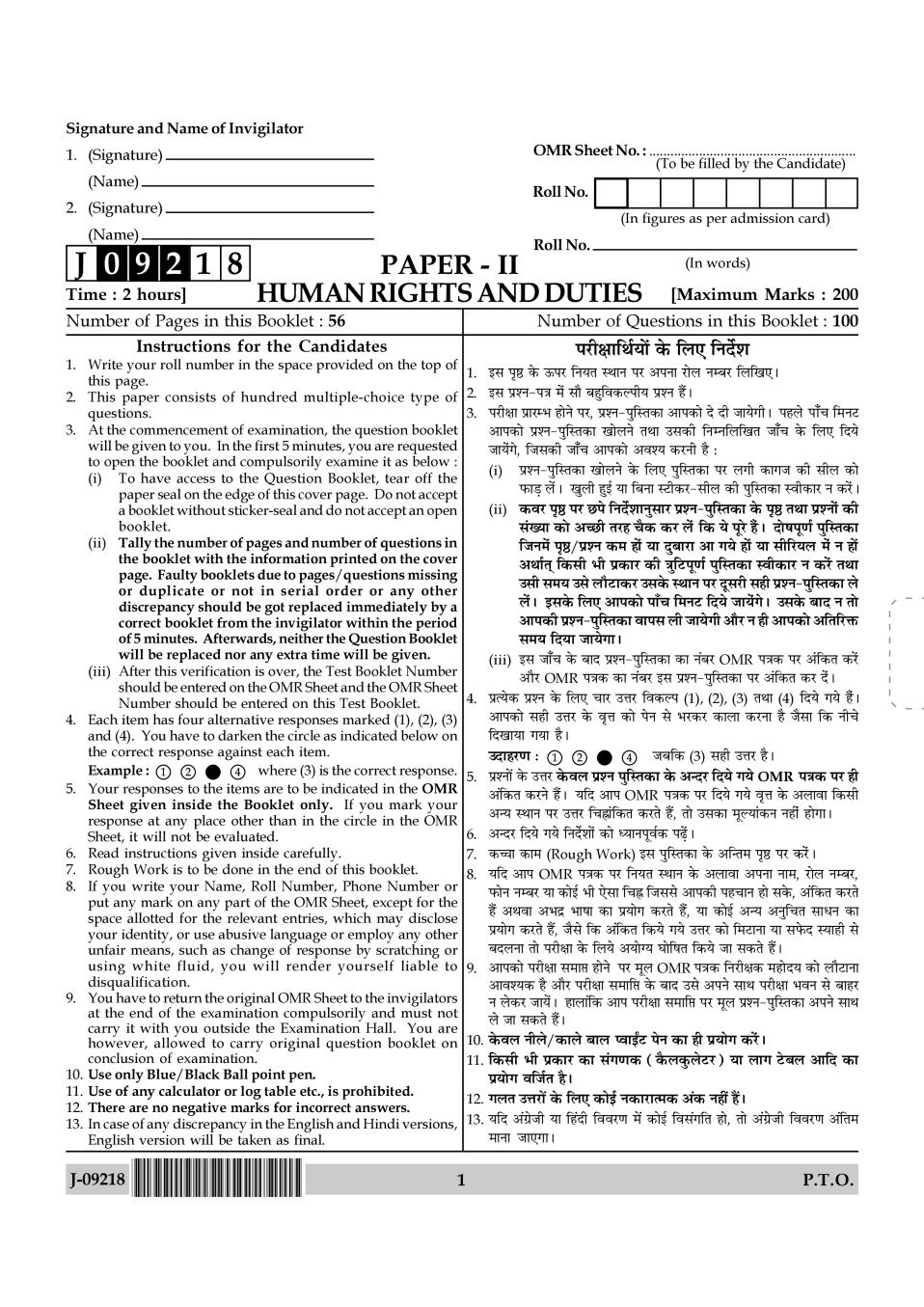
1. (Signature) OMR Sheet No. : ..........................................................
(To be filled by the Candidate)
(Name)
Roll No.
2. (Signature)
(In figures as per admission card)
(Name)
Roll No.
J 0 9 2 1 8 PAPER - II (In words)
Time : 2 hours] HUMAN RIGHTS AND DUTIES [Maximum Marks : 200
Number of Pages in this Booklet : 56 Number of Questions in this Booklet : 100
Instructions for the Candidates ¬⁄UˡÊÊÁÕ¸ÿÙ¢ ∑§ Á‹∞ ÁŸŒ¸‡Ê
1. Write your roll number in the space provided on the top of
1. ß‚ ¬ÎDU ∑§ ™§¬⁄U ÁŸÿà SÕÊŸ ¬⁄U •¬ŸÊ ⁄UÙ‹U Ÿê’⁄U Á‹Áπ∞–
this page.
2. This paper consists of hundred multiple-choice type of 2. ß‚ ¬˝‡Ÿ-¬òÊ ◊¢ ‚ÊÒ ’„ÈÁfl∑§À¬Ëÿ ¬˝‡Ÿ „Ò¥–
questions. 3. ¬⁄UˡÊÊ ¬˝Ê⁄êU÷ „ÙŸ ¬⁄U, ¬˝‡Ÿ-¬ÈÁSÃ∑§Ê •Ê¬∑§Ù Œ ŒË ¡ÊÿªË– ¬„‹U ¬UÊ°ø Á◊Ÿ≈U
3. At the commencement of examination, the question booklet •Ê¬∑§Ù ¬˝‡Ÿ-¬ÈÁSÃ∑§Ê πÙ‹Ÿ ÃÕÊ ©‚∑§Ë ÁŸêŸÁ‹Áπà ¡Ê°ø ∑§ Á‹∞ ÁŒÿ
will be given to you. In the first 5 minutes, you are requested ¡Êÿ¢ª, Á¡‚∑§Ë ¡Ê°ø •Ê¬∑§Ù •fl‡ÿ ∑§⁄UŸË „Ò —
to open the booklet and compulsorily examine it as below :
(i) ¬˝‡Ÿ-¬ÈÁSÃ∑§Ê πÙ‹Ÿ ∑§ Á‹∞ ¬ÈÁSÃ∑§Ê ¬⁄U ‹ªË ∑§Êª¡ ∑§Ë ‚Ë‹ ∑§Ê
(i) To have access to the Question Booklet, tear off the
paper seal on the edge of this cover page. Do not accept »§Ê«∏ ‹¢U– πÈ‹Ë „È߸ ÿÊ Á’ŸÊ S≈UË∑§⁄U-‚Ë‹U ∑§Ë ¬ÈÁSÃ∑§Ê SflË∑§Ê⁄U Ÿ ∑§⁄¢U–
a booklet without sticker-seal and do not accept an open (ii) ∑§fl⁄U ¬ÎDU ¬⁄U ¿U¬ ÁŸŒ¸‡ÊÊŸÈ‚Ê⁄U ¬˝‡Ÿ-¬ÈÁSÃ∑§Ê ∑§ ¬ÎDU ÃÕÊ ¬˝‡ŸÙ¢ ∑§Ë
booklet. ‚¢ÅÿÊ ∑§Ù •ë¿UË Ã⁄U„ øÒ∑§ ∑§⁄U ‹¢U Á∑§ ÿ ¬Í⁄U „Ò¢U– ŒÙ·¬Íáʸ ¬ÈÁSÃ∑§Ê
(ii) Tally the number of pages and number of questions in Á¡Ÿ◊¢ ¬ÎDU/¬˝‡Ÿ ∑§◊ „Ù¢ ÿÊ ŒÈ’Ê⁄UÊ •Ê ªÿ „Ù¢ ÿÊ ‚ËÁ⁄Uÿ‹U ◊¢ Ÿ „Ù¢
the booklet with the information printed on the cover •ÕʸØ Á∑§‚Ë ÷Ë ¬˝∑§Ê⁄U ∑§Ë òÊÈÁ≈U¬Íáʸ ¬ÈÁSÃ∑§Ê SflË∑§Ê⁄U Ÿ ∑§⁄¢U ÃÕÊ
page. Faulty booklets due to pages/questions missing
or duplicate or not in serial order or any other ©‚Ë ‚◊ÿ ©‚ ‹Uı≈UÊ∑§⁄U ©‚∑§ SÕÊŸ ¬⁄U ŒÍ‚⁄UË ‚„Ë ¬˝‡Ÿ-¬ÈÁSÃ∑§Ê ‹
discrepancy should be got replaced immediately by a ‹¢– U ß‚∑§ Á‹∞ •Ê¬∑§Ù ¬Ê°ø Á◊Ÿ≈U ÁŒÿ ¡Êÿ¢ª– ©‚∑§ ’ÊŒ Ÿ ÃÙ
correct booklet from the invigilator within the period •Ê¬∑§Ë ¬˝‡Ÿ-¬ÈÁSÃ∑§Ê flʬ‚ ‹Ë ¡ÊÿªË •ı⁄U Ÿ „Ë •Ê¬∑§Ù •ÁÃÁ⁄UQ§
of 5 minutes. Afterwards, neither the Question Booklet ‚◊ÿ ÁŒÿÊ ¡ÊÿªÊ–
will be replaced nor any extra time will be given. (iii) ß‚ ¡Ê°ø ∑§ ’ÊŒ ¬˝‡Ÿ-¬ÈÁSÃ∑§Ê ∑§Ê Ÿ¥’⁄U OMR ¬òÊ∑§ ¬⁄U •¢Á∑§Ã ∑§⁄¢U
(iii) After this verification is over, the Test Booklet Number
•Uı⁄U OMR ¬òÊ∑§ ∑§Ê Ÿ¥’⁄U ß‚ ¬˝‡Ÿ-¬ÈÁSÃ∑§Ê ¬⁄U •¢Á∑§Ã ∑§⁄U Œ¢–
should be entered on the OMR Sheet and the OMR Sheet
Number should be entered on this Test Booklet. 4. ¬˝ àÿ∑§ ¬˝‡Ÿ ∑§ Á‹∞ øÊ⁄U ©ûÊ⁄U Áfl∑§À¬ (1), (2), (3) ÃÕÊ (4) ÁŒÿ ªÿ „Ò¢–
4. Each item has four alternative responses marked (1), (2), (3) •Ê¬∑§Ù ‚„Ë ©ûÊ⁄U ∑§ flÎûÊ ∑§Ù ¬Ÿ ‚ ÷⁄U∑§⁄U ∑§Ê‹Ê ∑§⁄UŸÊ „Ò ¡Ò‚Ê Á∑§ ŸËø
and (4). You have to darken the circle as indicated below on ÁŒπÊÿÊ ªÿÊ „Ò–
the correct response against each item. ©ŒÊ„⁄UáÊ — ¡’Á∑§ (3) ‚„Ë ©ûÊ⁄U „Ò–
Example : where (3) is the correct response. 5. ¬˝‡ŸÊ¥ ∑§ ©ûÊ⁄U ∑§fl‹ ¬˝‡Ÿ ¬ÈÁSÃ∑§Ê ∑§ •ãŒ⁄U ÁŒÿ ªÿ OMRU ¬òÊ∑§ ¬⁄U „Ë
5. Your responses to the items are to be indicated in the OMR •¥Á∑§Ã ∑§⁄UŸ „Ò¥– ÿÁŒ •Ê¬ OMRU ¬òÊ∑§ ¬⁄U ÁŒÿ ªÿ flÎûÊ ∑§ •‹ÊflÊ Á∑§‚Ë
Sheet given inside the Booklet only. If you mark your
response at any place other than in the circle in the OMR •ãÿ SÕÊŸ ¬⁄U ©ûÊ⁄U ÁøqÊ¢Á∑§Ã ∑§⁄Uà „Ò¥, ÃÙ ©‚∑§Ê ◊ÍÀUÿÊ¢∑§Ÿ Ÿ„Ë¢ „٪ʖ
Sheet, it will not be evaluated. 6. •ãŒ⁄U ÁŒÿ ªÿ ÁŸŒ¸‡ÊÙ¢ ∑§Ù äÿÊŸ¬Ífl¸∑§ ¬…∏¢U–
6. Read instructions given inside carefully. 7. ∑§ìÊÊ ∑§Ê◊ (Rough Work) ß‚ ¬ÈÁSÃ∑§Ê ∑§ •ÁãÃ◊ ¬ÎDU ¬⁄U ∑§⁄¢U–
7. Rough Work is to be done in the end of this booklet. 8. ÿÁŒ •Ê¬ OMR ¬òÊ∑§ ¬⁄U ÁŸÿà SÕÊŸ ∑§ •‹ÊflÊ •¬ŸÊ ŸÊ◊, ⁄UÊ‹ Ÿê’⁄U,
8. If you write your Name, Roll Number, Phone Number or »§ÊŸ Ÿê’⁄U ÿÊ ∑§Ê߸ ÷Ë ∞‚Ê Áøq Á¡‚‚ •Ê¬∑§Ë ¬„øÊŸ „Ê ‚∑§, •¥Á∑§Ã ∑§⁄UÃ
put any mark on any part of the OMR Sheet, except for the
space allotted for the relevant entries, which may disclose „Ò¥ •ÕflÊ •÷Œ˝ ÷Ê·Ê ∑§Ê ¬˝ÿʪ ∑§⁄Uà „Ò¥, ÿÊ ∑§Ê߸ •ãÿ •ŸÈÁøà ‚ÊœŸ ∑§Ê
your identity, or use abusive language or employ any other ¬˝ÿʪ ∑§⁄Uà „Ò¥, ¡Ò‚ Á∑§ •¥Á∑§Ã Á∑§ÿ ªÿ ©ûÊ⁄U ∑§Ê Á◊≈UÊŸÊ ÿÊ ‚»§Œ SÿÊ„Ë ‚
unfair means, such as change of response by scratching or ’Œ‹ŸÊ ÃÊ ¬⁄UˡÊÊ ∑§ Á‹ÿ •ÿÊÇÿ ÉÊÊÁ·Ã Á∑§ÿ ¡Ê ‚∑§Ã „Ò¥–
using white fluid, you will render yourself liable to 9. •Ê¬∑§Ù ¬⁄UˡÊÊ ‚◊Ê# „ÙŸ §¬⁄U ◊Í‹ OMR ¬òÊ∑§ ÁŸ⁄UˡÊ∑§ ◊„ÙŒÿ ∑§Ù ‹Uı≈UÊŸÊ
disqualification. •Êfl‡ÿ∑§ „Ò •ı⁄U ¬⁄UˡÊÊ ‚◊ÊÁ# ∑§ ’ÊŒ ©‚ •¬Ÿ ‚ÊÕ ¬⁄UˡÊÊ ÷flŸ ‚ ’Ê„⁄U
9. You have to return the original OMR Sheet to the invigilators Ÿ ‹∑§⁄U ¡Êÿ¢– „Ê‹Ê¥Á∑§ •Ê¬ ¬⁄UˡÊÊ ‚◊ÊÁ# ¬⁄U ◊Í‹ ¬˝‡Ÿ-¬ÈÁSÃ∑§Ê •¬Ÿ ‚ÊÕ
at the end of the examination compulsorily and must not
carry it with you outside the Examination Hall. You are
‹ ¡Ê ‚∑§Ã „Ò¥–
however, allowed to carry original question booklet on 10. ∑§fl‹ ŸË‹/∑§Ê‹ ’Ê‹U åflÊßZ≈U ¬Ÿ ∑§Ê „Ë ¬˝ÿʪ ∑§⁄¢U–
conclusion of examination. 11. Á∑§‚Ë ÷Ë ¬˝∑§Ê⁄U ∑§Ê ‚¢ªáÊ∑§ (∑Ò§‹∑ȧ‹≈U⁄U) UÿÊ ‹Êª ≈U’‹ •ÊÁŒ ∑§Ê
10. Use only Blue/Black Ball point pen. ¬˝ÿÙª flÁ¡¸Ã „Ò–
11. Use of any calculator or log table etc., is prohibited.
12. ª‹Ã ©ûÊ⁄UÊ¥ ∑§ Á‹∞ ∑§Ê߸ Ÿ∑§Ê⁄UÊà◊∑§ •¥∑§ Ÿ„Ë¥ „Ò¥–
12. There are no negative marks for incorrect answers.
13. In case of any discrepancy in the English and Hindi versions, 13. ÿÁŒ •¥ª˝¡Ë ÿÊ Á„¥ŒË Áflfl⁄UáÊ ◊¥ ∑§Ê߸ Áfl‚¥ªÁà „Ê, ÃÊ •¥ª˝¡Ë Áflfl⁄UáÊ •¥ÁÃ◊
English version will be taken as final. ◊ÊŸÊ ¡Ê∞ªÊ–
J-09218 !J-09218-PAPER-II! 1 P.T.O.
Page 2
PAPER - II
Note : This paper contains Hundred (100) objective type questions of two (2) marks each. All
questions are compulsory.
1. “Human Rights codify moral behaviour which is a human social product developed by a
process of biological and social evolution”. The statement is associated with :
(1) Bentham (2) Mill (3) Hume (4) Karl Marx
2. How do International norms independently impact the advancement of Human Rights ?
(1) They do not, because states are only influenced by the pursuit of power.
(2) Governments feel guilty if they do not try to protect and advance Human Rights.
(3) The UN is able to enforce International Human Rights norms.
(4) None of the options given are correct.
3. On 3rd September 1953 which important convention on human rights entered into force ?
(1) Convention on the Elimination of All forms of Racial Discrimination.
(2) Convention on the Elimination of All forms of Discrimination Against women.
(3) European convention on Human Rights.
(4) Convention on the Rights of the child.
4. The United Nations proclaimed “The second International Decade of the World’s Indigenous
People”. Which of the following periods represents this decade ?
(1) 2008 - 2017 (2) 2005 - 2014 (3) 2010 - 2020 (4) 2005 - 2015
5. Which one of the following was a case of Judicial activism of the Indian supreme court
during the period 1975-1979 ?
(1) ADM Jabalpur Vs. S.K. Shukla (2) Keshavananda Bharati Vs. State of Kerala
(3) Minerva Mills Vs. Union of India (4) Maneka Gandhi Vs. Union of India
J-09218 !J-09218-PAPER-II! 2 Paper-II
Page 3
¬˝‡Ÿ-¬òÊ - II
ÁŸŒ¸‡Ê — ß‚ ¬˝‡Ÿ-¬òÊ ◊¥ ‚ÊÒ (100) ’„È-Áfl∑§À¬UËÿ ¬˝‡Ÿ „Ò¥– ¬˝àÿ∑§ ¬˝‡Ÿ ∑§ ŒÙ (2) •¢∑§ „Ò¥– ‚÷Ë ¬˝‡Ÿ •ÁŸflÊÿ¸ „Ò¥–
1. ““◊ÊŸfl •Áœ∑§Ê⁄U ŸÒÁÃ∑§ √ÿfl„Ê⁄U ∑§Ê ‚¥Á„ÃÊ’h ∑§⁄Uà „Ò¥, ¡Ê ¡ËflËÿ •ÊÒ⁄U ‚Ê◊ÊÁ¡∑§ Áfl∑§Ê‚ ∑§Ë ∞∑§ ¬˝Á∑˝§ÿÊ mÊ⁄UÊ
Áfl∑§Á‚à ∞∑§ ‚Ê◊ÊÁ¡∑§ ©à¬ÊŒ „Ò–”” ÿ„ ∑§ÕŸ Á∑§‚‚ ‚¥’¥ÁœÃ „Ò?
(1) ’ãÕ◊ (2) Á◊‹ (3) sÍ◊ (4) ∑§Ê‹¸ ◊ÊÄ‚¸
2. ◊ÊŸfl •Áœ∑§Ê⁄UÊ¥ ∑§Ë ¬˝ªÁà ∑§Ê •¥Ã⁄Uʸc≈˛UËÿ ÁŸÿ◊ Á∑§‚ ¬˝∑§Ê⁄U ¬˝÷ÊÁflà ∑§⁄Uà „Ò¥?
(1) ÿ ¬˝÷Êfl Ÿ„Ë¥ «UÊ‹Ã ÄÿÊ¥Á∑§ ⁄UÊíÿ ∑§fl‹ •Áœ∑§Ê⁄U ∑§§ ¬˝ÿÊ‚ ‚ ¬˝÷ÊÁflà „Êà „Ò¥–
(2) ÿÁŒ ÿ ◊ÊŸfl •Áœ∑§Ê⁄UÊ¥ ∑§Ë ⁄UˇÊÊ •ÊÒ⁄U ©Ÿ∑§Ë ¬˝ªÁà ∑§ ¬˝ÿÊ‚ Ÿ„Ë¥ ∑§⁄Uà „Ò¥ ÃÊ ‚⁄U∑§Ê⁄U ŒÊ·Ë ◊„‚Í‚ ∑§⁄UÃË „Ò–
(3) ‚¥ÿÈÄà ⁄UÊc≈˛U •¥Ã⁄Uʸc≈˛UËÿ ◊ÊŸfl •Áœ∑§Ê⁄U ∑§ ¬˝ÁÃ◊ÊŸ ¬˝flÎàà ∑§⁄UŸ ∑§ Á‹∞ ‚◊Õ¸ „Ò–
(4) ÁŒ∞ ª∞ Áfl∑§À¬Ê¥ ◊¥ ‚ ∑§Ê߸ ÷Ë ‚„Ë Ÿ„Ë¥ „Ò–
3. ◊ÊŸfl •Áœ∑§Ê⁄U ¬⁄U ∑§ÊÒŸ‚Ê ◊„àfl¬Íáʸ ∑§⁄UÊ⁄U (∑§ãflã‡ÊŸ) 3 Á‚Ã¥’⁄U, 1953 ∑§Ê ‹ÊªÍ „È•Ê ÕÊ?
(1) ŸS‹Ëÿ ÷Œ÷Êfl ∑§ ‚÷Ë M§¬Ê¥ ∑§ ©ã◊Í‹Ÿ ¬⁄U ∑§⁄UÊ⁄U–
(2) ◊Á„‹Ê•Ê¥ ∑§ ¬˝Áà ÷Œ÷Êfl ∑§ ‚÷Ë M§¬Ê¥ ∑§ ©ã◊Í‹Ÿ ¬⁄U ∑§⁄UÊ⁄U–
(3) ◊ÊŸfl •Áœ∑§Ê⁄UÊ¥ ¬⁄U ÿÍ⁄UʬËÿ ∑§⁄UÊ⁄U–
(4) ’Ê‹ •Áœ∑§Ê⁄UÊ¥ ¬⁄U ∑§⁄UÊ⁄U–
4. ‚¥ÿÈÄàÊ ⁄UÊc≈˛U Ÿ ““Áfl‡fl ∑§Ë Œ‡Ê$¡ ¡ŸÃÊ ∑§ ÁmÃËÿ •¥Ã⁄Uʸc≈˛UËÿ Œ‡Ê∑§”” ∑§Ë ÉÊÊ·áÊÊ ∑§Ë– ÁŸêŸÁ‹Áπà ◊¥ ‚ ∑§ÊÒŸ‚Ë
•flÁœ ß‚ Œ‡Ê∑§ ∑§Ê ¬˝ÁÃÁŸÁœàfl ∑§⁄UÃË „Ò?
(1) 2008 - 2017 (2) 2005 - 2014 (3) 2010 - 2020 (4) 2005 - 2015
5. 1975-1979 ∑§Ë •flÁœ ∑§ ŒÊÒ⁄UÊŸ ÷Ê⁄Uà ∑§ ‚flʸìÊ ãÿÊÿÊ‹ÿ ∑§Ë ãÿÊÁÿ∑§ ‚Á∑˝§ÿÃÊ ∑§Ê ÁŸêŸÁ‹Áπà ◊¥ ‚ ∑§ÊÒŸ ‚Ê
∞∑§ ◊Ê◊‹Ê ÕÊ?
(1) ∞.«UË.∞◊. ¡’‹¬È⁄U ’ŸÊ◊ ∞‚.∑§. ‡ÊÈÄ‹Ê (2) ∑§‡ÊflÊŸ¥Œ ÷Ê⁄UÃË ’ŸÊ◊ ∑§⁄U‹ ⁄UÊíÿ
(3) Á◊Ÿflʸ Á◊À‚ ’ŸÊ◊ ÷Ê⁄Uà ‚¥ÉÊ (4) ◊Ÿ∑§Ê ªÊ¥œË ’ŸÊ◊ ÷Ê⁄Uà ‚¥ÉÊ
J-09218 !J-09218-PAPER-II! 3 Paper-II
Page 4
(1) Uniform civil code for citizens
(2) Provision of children below the age of 6 years
(3) Duty of the state to rise the civil of nutrition
(4) Organisation of agriculture and animal husbandry
7. Article 5 of the Universal declaration of Human Rights declare that :
(1) Every one has the right to life, liberty and security of person.
(2) No one shall be subjected to torture or to cruel, inhuman or degrading treatment or
punishment.
(3) Every one has the right to recognition everywhere as a person before the law.
(4) No one shall be subjected to arbitrary arrest, detention or exile.
8. Who among the following is not a member of the committee to recommend appointment of
the chairperson and members of the National Human Rights commission ?
(1) The Prime Minister
(2) Speaker of the House of People
(3) Chairman of the Council of States
(4) Leader of Opposition in the House of the People
9. In which of the following cases the right to privacy which is part of ‘life and personal liberty’
under Article 21 of the constitution was not accepted by the Supreme Court ?
(1) People’s Union for civil Liberties V. G.O.I. (Phone Tapping Case)
(2) R. Rajagopal V. State of T.N. (Auto Shankar Case)
(3) Mr. ‘X’ V. Hospital ‘Z’
(4) State of Maharashtra V. Madhukar Narain
10. The Supreme Court has held in the P.I.L filed by Common cause regarding euthanasia
that :
(1) Passive euthanasia allowing the withdrawal of medicine and life supporting machines
and allowing the patient to die is legal and permissible under medical and judicial
supervision.
(2) Passive euthanasia allowing only the withdrawal of life supporting machine and not
the withdrawal of medicine itself is legal and permissible under medical and judicial
supervision.
(3) Passive euthanasia on the wishes of the patient even without the medical and judicial
report is legal and permissible.
(4) Even active euthanasia by administering medicine and allowing the patient to die under
medical report and judicial supervision is legal and permissible.
J-09218 !J-09218-PAPER-II! 4 Paper-II
Page 5
(1) ŸÊªÁ⁄U∑§Ê¥ ∑§ Á‹∞ ‚◊ÊŸ “Á‚Áfl‹ ∑§Ê«U”
(2) 6 fl·¸ ‚ ∑§◊ •ÊÿÈ ∑§ ’ìÊÊ¥ ∑§Ê ¬˝ÊflœÊŸ
(3) ¬Ê·áÊ SÃ⁄U ◊¥ flÎÁh ‚¥’¥œË ⁄UÊíÿ ∑§Ê ∑§Ã¸√ÿ
(4) ∑ΧÁ· •ÊÒ⁄U ¬‡ÊȬʋŸ ‚¥ª∆UŸ (‚¥SÕÊ)
7. ‚Êfl¸÷ÊÒÁ◊∑§ ◊ÊŸfl •Áœ∑§Ê⁄U ÉÊÊ·áÊʬòÊ ∑§ •ŸÈë¿UŒ - 5 ◊¥ ÉÊÊ·áÊÊ ∑§Ë ªß¸ „Ò Á∑§ —
(1) ¬˝àÿ∑§ √ÿÁÄàÊ ∑§Ê ¡ËflŸ, SflÃ¥òÊÃÊ •ÊÒ⁄U √ÿÁÄàʪà ‚È⁄UˇÊÊ ∑§Ê •Áœ∑§Ê⁄U „Ò–
(2) ∑§Ê߸ ÷Ë √ÿÁÄàÊ ÿÊÃŸÊ ÿÊ ∑˝Í§⁄U, •◊ÊŸflËÿ ÿÊ •¬◊ÊŸ¡∑§ √ÿfl„Ê⁄U ÿÊ Œá«U ∑§ •äÿœËŸ Ÿ„Ë¥ „ʪʖ
(3) ¬˝àÿ∑§ √ÿÁÄàÊ ∑§Ê ‚÷Ë ¡ª„Ê¥ ¬⁄U ∞∑§ √ÿÁÄà ∑§ M§¬ ◊¥ ¬„øÊŸ ∑§Ê •Áœ∑§Ê⁄U „Ò–
(4) ∑§Ê߸ ÷Ë √ÿÁÄàÊ ◊Ÿ◊ʟˬÍfl¸∑§ Áª⁄UçÃÊ⁄UË, Á„⁄UÊ‚Ã ÿÊ ÁŸflʸ‚Ÿ ∑§ •äÿœËŸ Ÿ„Ë¥ „ʪʖ
8. ÁŸêŸÁ‹Áπà ◊¥ ‚ ∑§ÊÒŸ ©‚ ‚Á◊Áà ∑§Ê ∞∑§ ‚ŒSÿ Ÿ„Ë¥ „Ò, ¡Ê ⁄UÊc≈˛UËÿ ◊ÊŸfl •Áœ∑§Ê⁄U •Êÿʪ ∑§ •äÿˇÊ •ÊÒ⁄U ‚ŒSÿÊ¥
∑§Ë ÁŸÿÈÁÄàÊ ∑§Ë •ŸÈ‡Ê¥‚Ê ∑§⁄UÃË „Ò?
(1) ¬˝œÊŸ ◊¥òÊË (2) ‹Ê∑§‚÷Ê ∑§Ê •äÿˇÊ
(3) ⁄UÊíÿÊ¥ ∑§Ë ¬Á⁄U·Œ ∑§Ê •äÿˇÊ (4) ‹Ê∑§‚÷Ê ◊¥ Áfl¬ˇÊ ∑§Ê ŸÃÊ
9. ÁŸêŸÁ‹Áπà ◊¥ ‚ Á∑§‚ ◊Ê◊‹ ◊¥ ÁŸ¡ÃÊ ∑§ •Áœ∑§Ê⁄U ∑§Ê, ¡Ê ÷Ê⁄UÃËÿ ‚¥ÁflœÊŸ ∑§ •ŸÈë¿UŒ-21 ∑§ •¥Ãª¸Ã ¡ËflŸ
•ÊÒ⁄U √ÿÁÄàʪà SflÃ¥òÊÃÊ ∑§Ê •¥ª „Ò, ‚flʸìÊ ãÿÊÿÊ‹ÿ mÊ⁄UÊ SflË∑§Ê⁄U Ÿ„Ë¥ Á∑§ÿÊ ªÿÊ ÕÊ?
(1) ¬Ë¬À‚˜ ÿÈÁŸÿŸ »§Ê⁄U Á‚fl‹ Á‹’≈U˸¡ ’ŸÊ◊ ÷Ê⁄Uà ‚⁄U∑§Ê⁄U (»§ÊŸ ≈ÒUÁ¬¥ª ◊Ê◊‹Ê)
(2) •Ê⁄U. ⁄UÊ¡Ê ªÊ¬Ê‹ ’ŸÊ◊ ÃÁ◊‹ŸÊ«ÈU ⁄UÊíÿ (•ÊÚ≈UÊ ‡Ê¥∑§⁄U ◊Ê◊‹Ê)
(3) Á◊S≈U⁄U ‘X’ ’ŸÊ◊ „ÊÚS¬Ë≈U‹ ‘Z’
(4) ◊„Ê⁄UÊc≈˛U ⁄UÊíÿ ’ŸÊ◊ ◊œÈ∑§⁄U ŸÊ⁄UÊÿáÊ
10. ‚flʸìÊ ãÿÊÿÊ‹ÿ Ÿ ßë¿UÊ ◊ÎàÿÈ ∑§ ’Ê⁄U ◊¥ ∑§ÊÚ◊Ÿ ∑§ÊÚ¡ mÊ⁄UÊ ŒÊÿ⁄U ∑§Ë ªß¸ ∞∑§ ¡ŸÁ„à ÿÊÁø∑§Ê ◊¥ ∑§„Ê Á∑§ —
(1) ◊Á«U∑§‹ •ÊÒ⁄U ãÿÊÁÿ∑§ Œπ⁄Uπ ◊¥ ◊⁄UË$¡ ∑§Ê •ÊÒ·ÁœÿÊ° ŒŸÊ ’¥Œ ∑§⁄U •ÊÒ⁄U ¡ËflŸ-‚◊Õ¸∑§ ◊‡ÊËŸÊ¥ ∑§Ê „≈UÊ∑§⁄U
ÁŸcøc≈U ßë¿UÊ ◊ÎàÿÈ ∑§Ë •ŸÈ◊Áà ÃÕÊ ◊⁄UË¡ ∑§Ê ◊ÎàÿÈ ∑§Ê fl⁄UáÊ ∑§⁄UŸ ∑§Ë •ŸÈ◊Áà ŒŸÊ ÁflÁœ-‚ê◊à •ÊÒ⁄U
•ŸÈ◊ÿ „Ò–
(2) ◊Á«U∑§‹ •ÊÒ⁄U ãÿÊÁÿ∑§ Œπ⁄Uπ ◊¥ ◊⁄UË¡ ‚ ∑§fl‹ ¡ËflŸ-‚◊Õ¸∑§ ◊‡ÊËŸÊ¥ ∑§Ê „≈UÊŸ ∑§Ë •ŸÈ◊Áà Œ∑§⁄U •ÊÒ⁄U
©‚∑§Ê •ÊÒ·ÁœÿÊ° ŒŸÊ ’¥Œ Ÿ ∑§⁄U ÁŸcøc≈U ßë¿Ê ◊ÎàÿÈ ∑§Ë •ŸÈ◊Áà ÁflÁœ-SÊê◊à •ÊÒ⁄U •ŸÈ◊ÿ „Ò–
(3) ◊Á«U∑§‹ •ÊÒ⁄U ãÿÊÁÿ∑§ Á⁄U¬Ê≈¸U ∑§ Á’ŸÊ ÷Ë ◊⁄UË¡ ∑§Ë ßë¿UÊ ∑§ •ÊœÊ⁄U ¬⁄U ÁŸcøc≈U ßë¿UÊ ◊ÎàÿÈ ÁflÁœ-‚ê◊à •ÊÒ⁄U
•ŸÈ◊ÿ „Ò–
(4) ◊Á«U∑§‹ Á⁄U¬Ê≈¸U •ÊÒ⁄U ãÿÊÁÿ∑§ Œπ⁄Uπ ∑§ •¥Ãª¸Ã ◊⁄UË¡ ∑§Ê •ÊÒ·ÁœÿÊ° Œ∑§⁄U ‚øc≈U ßë¿UÊ ◊ÎàÿÈ •ÊÒ⁄U ◊⁄UË¡ ∑§Ê
◊ÎàÿÈ ∑§Ê fl⁄UáÊ ∑§⁄UŸ ∑§Ë •ŸÈ◊Áà ÁflÁœ-‚ê◊à ∞fl¥ •ŸÈ◊ÿ „Ò–
J-09218 !J-09218-PAPER-II! 5 Paper-II
Page 6
(1) Gerald McCallum (2) Charles Taylor
(3) C.B. Macpherson (4) T. Jefferson
12. Globalisation gives primacy to unbriddled.
(1) Welfare means (2) Socialism
(3) Consumerism (4) Regionalism
13. In which year the International convention on the Elimination of all forms of Racial
Discrimination came into force ?
(1) 1959 (2) 1969 (3) 1979 (4) 1989
14. The concept of natural rights is associated with :
(1) Evolutionary theory (2) Divine right theory
(3) Social contract theory (4) Sociological theory
15. Which of the following is not a subject matter of Intellectual Property Rights ?
(1) Books and articles published before 50 years
(2) Traditional knowledge of tribal community
(3) Geographical indicators
(4) Folk music with innovation in cinematographic films
16. In ‘Manava Dharmasastra’ Manu cites :
(1) Two types of Danda (2) Three types of Danda
(3) Four types of Danda (4) Five types of Danda
17. Which slogan was given by the French Revolution ?
(1) Liberty, Authority, Equality (2) Liberty, Equality, Fraternity
(3) Liberty, Law, Fraternity (4) Liberty, Law and Equality
18. The Indian Supreme Court delivered the landmark Judgement on Environment in M.C. Mehta
Vs. Union of India in :
(1) 1986 (2) 1987 (3) 1988 (4) 1989
19. The Protection of Human Rights Act in India came into force on ?
(1) 28 Aug. 1993 (2) 28 Sept. 1993 (3) 10 Dec. 1993 (4) 10 Jan. 1993
J-09218 !J-09218-PAPER-II! 6 Paper-II
Page 7
(1) ¡⁄UÊÀ«U ◊∑§∑§‹Ê◊ (2) øÊÀ‚¸ ≈U‹⁄U
(3) ‚Ë.’Ë. ◊Ò∑§»§‚¸Ÿ (4) ≈UË.¡»§⁄U‚Ÿ
12. flÒ‡flË∑§⁄UáÊ Á∑§‚∑§Ê •ÁŸÿ¥ÁòÊà Ã⁄UË∑§ ‚ ◊„àfl ŒÃÊ „Ò?
(1) ∑§ÀÿÊáÊ∑§Ê⁄UË ‚ÊœŸ (2) ‚◊Ê¡flÊŒ
(3) ©¬÷ÊÄàÊÊflÊŒ (4) ˇÊòÊflÊŒ
13. ŸS‹Ëÿ ÷Œ÷Êfl ∑§ ‚÷Ë M§¬Ê¥ ∑§ ©ã◊Í‹Ÿ ¬⁄U •¥Ã⁄Uʸc≈˛UËÿ ∑§⁄UÊ⁄U (∑§ãflã‡ÊŸ) Á∑§‚ fl·¸ ◊¥ ‹ÊªÍ „È•Ê?
(1) 1959 (2) 1969 (3) 1979 (4) 1989
14. ŸÒ‚Áª¸∑§ •Áœ∑§Ê⁄U Á∑§‚‚ ‚¥’¥ÁœÃ „Ò?
(1) Áfl∑§Ê‚Êà◊∑§ Á‚hʥà (2) ŒÒflËÿ •Áœ∑§Ê⁄U Á‚hÊ¥Ã
(3) ‚Ê◊ÊÁ¡∑§ ‚◊¤ÊÊÒÃÊ Á‚hʥà (4) ‚◊Ê¡‡ÊÊSòÊËÿ Á‚hÊ¥Ã
15. ’ÊÒÁh∑§ ‚¥¬ŒÊ •Áœ∑§Ê⁄UÊ¥ ∑§Ë ÁŸêŸÁ‹Áπà ◊¥ ‚ ∑§ÊÒŸ‚Ë Áfl·ÿ-flSÃÈ Ÿ„Ë¥ „Ò?
(1) 50 fl·¸ ¬Ífl¸ ¬˝∑§ÊÁ‡Êà ¬ÈSÃ∑¥§ •ÊÒ⁄U ‹π
(2) •ÊÁŒflÊ‚Ë ‚◊ÈŒÊÿ ∑§Ê ¬Ê⁄Uê¬Á⁄U∑§ ôÊÊŸ
(3) ÷ÊÒªÊÁ‹∑§ ‚¥∑§Ã∑§
(4) Á‚Ÿ◊Ò≈Uʪ˝ÊÁ»§∑§ Á»§À◊Ê¥ ◊¥ ŸflÊã◊· ∑§ ‚ÊÕ ‹Ê∑§ ‚¥ªËÃ
16. ◊ÊŸfl œ◊¸‡ÊÊSòÊ ◊¥ ◊ŸÈ Ÿ ©h⁄UáÊ ÁŒÿÊ „Ò —
(1) Œá«U ∑§ ŒÊ ¬˝∑§Ê⁄UÊ¥ ∑§Ê (2) Œá«U ∑§ ÃËŸ ¬˝∑§Ê⁄UÊ¥ ∑§Ê
(3) Œá«U ∑§ øÊ⁄U ¬˝∑§Ê⁄UÊ¥ ∑§Ê (4) Œá«U ∑§ ¬Ê°ø ¬˝∑§Ê⁄UÊ¥ ∑§Ê
17. »˝§Ê¥‚Ë‚Ë ∑˝§ÊÁãà mÊ⁄UÊ ∑§ÊÒŸ ‚Ê ŸÊ⁄UÊ ÁŒÿÊ ªÿÊ ÕÊ?
(1) SflÃ¥òÊÃÊ, ¬˝ÊÁœ∑§Ê⁄U, ‚◊ÊŸÃÊ (2) SflÃ¥òÊÃÊ, ‚◊ÊŸÃÊ, ÷˝ÊÃÎàfl
(3) SflÃ¥òÊÃÊ, ∑§ÊŸÍŸ, ÷˝ÊÃÎàfl (4) SflÃ¥òÊÃÊ, ∑§ÊŸÍŸ, ‚◊ÊŸÃÊ
18. ÷Ê⁄UÃËÿ ‚flʸìÊ ãÿÊÿÊ‹ÿ Ÿ ∞◊.‚Ë. ◊„ÃÊ ’ŸÊ◊ ÷Ê⁄UÃËÿ ‚¥ÉÊ ∑§ ◊Ê◊‹ ◊¥ ¬ÿʸfl⁄UáÊ ∑§ ’Ê⁄U ◊¥ Á∑§‚ fl·¸ ◊¥
∞ÁÄÊÁ‚∑§ ÁŸáʸÿ ÁŒÿÊ ÕÊ?
(1) 1986 (2) 1987 (3) 1988 (4) 1989
19. ÷Ê⁄Uà ◊¥ ◊ÊŸfl •Áœ∑§Ê⁄U ‚¥⁄UˇÊáÊ •ÁœÁŸÿ◊ ∑§’ ‚ •ÁSÃàfl ◊¥ •ÊÿÊ?
(1) 28 •ªSà 1993 (2) 28 Á‚Ãê’⁄U 1993 (3) 10 ÁŒ‚ê’⁄U 1993 (4) 10 ¡Ÿfl⁄UË 1993
J-09218 !J-09218-PAPER-II! 7 Paper-II
Page 8
(1) 19 - 21 September, 2015 (2) 22 - 24 September, 2015
(3) 25 - 27 September, 2015 (4) 28 - 30 September, 2015
21. Which of the following comprehensively protects Human Rights in India ?
(1) Cr.P.C. (2) I.P.C.
(3) Indian constitution (4) Statutes of Parliament
22. The first specialised agency of the UN was :
(1) ECOSOC (2) IMF (3) WHO (4) ILO
23. A millstone in the domain of Human Rights is Magna carta which was initiated in :
(1) 1115 (2) 1116 (3) 1215 (4) 1216
24. The International Labour organisation has :
(1) 186 Members (2) 187 Members (3) 188 Members (4) 189 Members
25. Which among the following is not a constitutionally designated National commission ?
(1) National Commission for Scheduled Castes
(2) National Commission for Scheduled Tribes
(3) National Human Rights Commission
(4) Union Public Service Commission
26. Universal Declaration of Human Rights has :
(1) 20 Articles (2) 30 Articles (3) 40 Articles (4) 50 Articles
27. Which case recognised the rights of working women in India ?
(1) Champakam Dorairajan V. State of Madras, 1951
(2) I.C. Golaknath V. State of Punjab, 1967
(3) A.D.M. Jabalpur V. S. Shukla, 1976
(4) Visakha and others V. State of Rajasthan, 1997
J-09218 !J-09218-PAPER-II! 8 Paper-II
Page 9
„È•Ê ÕÊ?
(1) 19 - 21 Á‚Ã¥’⁄U, 2015 (2) 22 - 24 Á‚Ã¥’⁄U, 2015
(3) 25 - 27 Á‚Ã¥’⁄U, 2015 (4) 28 - 30 Á‚Ã¥’⁄U, 2015
21. ÁŸêŸÁ‹Áπà ◊¥ ‚ ∑§ÊÒŸ ÷Ê⁄Uà ◊¥ ◊ÊŸfl •Áœ∑§Ê⁄UÊ¥ ∑§Ë ‚◊ÊÁflc≈U …¥Uª ‚ ⁄UˇÊÊ ∑§⁄UÃË/∑§⁄UÃÊ „Ò?
(1) ‚Ë•Ê⁄U.¬Ë.‚Ë. (2) •Ê߸.¬Ë.‚Ë.
(3) ÷Ê⁄UÃËÿ ‚¥ÁflœÊŸ (4) ‚¥‚Œ ∑§Ë ‚¥ÁflÁœÿÊ°
22. ‚¥ÿÈÄàÊ ⁄UÊc≈˛U ∑§Ê ¬˝Õ◊ ÁflÁ‡Êc≈U •Á÷∑§⁄UáÊ ÕÊ —
(1) ߸.‚Ë.•Ê.∞‚.•Ê.‚Ë. (2) •Ê߸.∞◊.∞»§. (3) «UéÀÿÍ.∞ø.•Ê. (4) •Ê߸.∞‹.•Ê.
23. ◊ÊŸfl •Áœ∑§Ê⁄U ∑§ ˇÊòÊ ◊¥ ∞∑§ ◊Ë‹ ∑§Ê ¬àÕ⁄U ◊ÒÇãÊÊ ∑§Ê≈Uʸ „Ò, ¡Ê Á∑§‚ fl·¸ ◊¥ ¬˝Ê⁄Uê÷ Á∑§ÿÊ ªÿÊ ÕÊ?
(1) 1115 (2) 1116 (3) 1215 (4) 1216
24. •¥Ã⁄Uʸc≈˛UËÿ üÊ◊ ‚¥ª∆UŸ ◊¥ Á∑§ÃŸ ‚ŒSÿ „Ò¥?
(1) 186 ‚ŒSÿ (2) 187 ‚ŒSÿ (3) 188 ‚ŒSÿ (4) 189 ‚ŒSÿ
25. ÁŸêŸÁ‹Áπà ◊¥ ‚ ∑§ÊÒŸ ‚¥flÒœÊÁŸ∑§ M§¬ ‚ ÁŸÁŒ¸c≈U ⁄UÊc≈˛UËÿ •Êÿʪ Ÿ„Ë¥ „Ò?
(1) ⁄UÊc≈˛UËÿ •ŸÈ‚ÍÁøà ¡ÊÁà •Êÿʪ
(2) ⁄UÊc≈˛UËÿ •ŸÈ‚ÍÁøà ¡Ÿ¡ÊÁà •Êÿʪ
(3) ⁄UÊc≈˛UËÿ ◊ÊŸfl •Áœ∑§Ê⁄U •Êÿʪ
(4) ‚¥ÉÊ ‹Ê∑§ ‚flÊ •Êÿʪ
26. ‚Êfl¸÷ÊÒÁ◊∑§ ◊ÊŸfl •Áœ∑§Ê⁄U ÉÊÊ·áÊÊ ¬òÊ ◊¥ Á∑§ÃŸ •ŸÈë¿UŒ „Ò¥?
(1) 20 •ŸÈë¿UŒ (2) 30 •ŸÈë¿UŒ (3) 40 •ŸÈë¿UŒ (4) 50 •ŸÈë¿UŒ
27. Á∑§‚ ◊Ê◊‹ ◊¥ ÷Ê⁄Uà ◊¥ ∑§Ê◊∑§Ê¡Ë ◊Á„‹Ê ∑§ •Áœ∑§Ê⁄UÊ¥ ∑§Ë ◊ÊãÿÃÊ ŒË ªß¸?
(1) øê¬∑§◊ ŒÊ⁄UÊß⁄UÊ¡Ÿ ’ŸÊ◊ ◊Œ˝Ê‚ ⁄UÊíÿ, 1951
(2) •Ê߸.‚Ë. ªÊ‹∑§ŸÊÕ ’ŸÊ◊ ¬¥¡Ê’ ⁄UÊíÿ, 1967
(3) ∞.«UË.∞◊. ¡’‹¬È⁄U ’ŸÊ◊ ∞‚. ‡ÊÈÄ‹Ê, 1976
(4) Áfl‡ÊÊπÊ ∞fl¥ •ãÿ ’ŸÊ◊ ⁄UÊ¡SÕÊŸ ⁄UÊíÿ, 1997
J-09218 !J-09218-PAPER-II! 9 Paper-II
Page 10
Rights ?
(1) A.K. Gopalan Vs. State of Madras
(2) I.C. Golaknath Vs. State of Punjab
(3) Keshavananda Bharati Vs. State of Kerala
(4) Minerva Mills case
29. Which of the following best describes the current status of International Law ?
(1) Increasing globalization has led to the UN Making Human Rights Laws which are
enforceable to all member states.
(2) International law can only be enforced with consent of states who made it.
(3) No Legal measures arise in relation to International Law : Treaties are statements of
intention and the UN has no Legal measures available to alleged breach.
(4) Once tabled in the Indian Parliament, International Laws become incorporated into
Indian domestic Law.
30. Who among the following is not an ex-officio member of the National Human Rights
Commission ?
(1) The Chairperson of the National Commission for Minorities
(2) The Chairpersons of the National Commissions for Scheduled Castes and Scheduled
tribes
(3) The Chairperson of National Commission for women
(4) The National Commission for Backward classes
31. Which one of the following is not a purpose of the United Nations Charter ?
(1) To maintain international peace and security and to that end, to take effective collective
measures.
(2) To develop friendly relations among nations based on respect for equal rights and self-
determination of people.
(3) To take effective steps to suppress terrorism to strengthen global peace.
(4) To achieve international co-operation in solving international problems of an economic,
social, cultural or human character.
32. Which Article of the Universal Declaration of Human Rights states that “Everyone has the
right to life, liberty and security of person” ?
(1) Article 1 (2) Article 2 (3) Article 3 (4) Article 5
J-09218 !J-09218-PAPER-II! 10 Paper-II
Page 11
(1) ∞.∑§. ªÊ¬Ê‹Ÿ ’ŸÊ◊ ◊Œ˝Ê‚ ⁄UÊíÿ
(2) •Ê߸.‚Ë. ªÊ‹∑§ŸÊÕ ’ŸÊ◊ ¬¥¡Ê’ ⁄UÊíÿ
(3) ∑§‡ÊflÊŸ¥Œ ÷Ê⁄UÃË ’ŸÊ◊ ∑§⁄U‹ ⁄UÊíÿ
(4) Á◊Ÿflʸ Á◊À‚ ◊Ê◊‹Ê
29. ÁŸêŸÁ‹Áπà ◊¥ ‚ ∑§ÊÒŸ ‚Ê ∑§ÕŸ •¥Ã⁄Uʸc≈˛UËÿ ∑§ÊŸÍŸ ∑§Ë flø◊ÊŸ ÁSÕÁà ∑§Ê üÊc∆U …¥Uª ‚ fláʸŸ ∑§⁄UÃÊ „Ò?
(1) ’…∏à flÒ‡flË∑§⁄UáÊ ‚ ‚¥ÿÈÄàÊ ⁄UÊc≈˛U mÊ⁄UÊ ◊ÊŸfl •Áœ∑§Ê⁄UÊ¥ ‚¥’¥œË ∑§ÊŸÍŸ ’ŸÊŸ ∑§Ê ◊ʪ¸ ¬˝‡ÊSà „È•Ê „Ò, ¡Ê ‚÷Ë
‚ŒSÿ Œ‡ÊÊ¥ ◊¥ ¬˝fløŸËÿ „Ò¥–
(2) •¥Ã⁄Uʸc≈˛UËÿ ∑§ÊŸÍŸ ∑§Ê ©Ÿ ⁄UÊíÿÊ¥ ∑§Ë ‚„◊Áà ‚ „Ë ‹ÊªÍ Á∑§ÿÊ ¡Ê ‚∑§ÃÊ „Ò, Á¡‚∑§Ê ©ã„Ê¥Ÿ ’ŸÊÿÊ „Ò–
(3) •¥Ã⁄Uʸc≈˛UËÿ ∑§ÊŸÍŸ ∑§ ’Ê⁄U ◊¥ ∑§Ê߸ ÁflÁœ∑§ ©¬Êÿ ©¬ÀÊéœ Ÿ„Ë¥ „Ò — ‚¥ÁœÿÊ° ß⁄UÊŒ ∑§Ê ∑§ÕŸ „ÊÃË „Ò¥ •ÊÒ⁄U ‚¥ÿÈÄàÊ
⁄UÊc≈˛U ∑§ ¬Ê‚ ∑§ÁÕà •fl„‹ŸÊ ¬⁄U ∑§Ê߸ ÁflÁœ∑§ ©¬Êÿ Ÿ„Ë¥ „ÊÖ
(4) ÷Ê⁄UÃËÿ ‚¥‚Œ ◊¥ ∞∑§ ’Ê⁄U ¬˝SÃÈà „ÊŸ ¬⁄U •¥Ã⁄Uʸc≈˛UËÿ ∑§ÊŸÍŸ ÷Ê⁄UÃËÿ ÉÊ⁄U‹Í ∑§ÊŸÍŸ ◊¥ ÁŸªÁ◊à „Ê ¡ÊÃÊ „Ò–
30. ÁŸêŸÁ‹Áπà ◊¥ ‚ ∑§ÊÒŸ ⁄UÊc≈˛UËÿ ◊ÊŸfl •Áœ∑§Ê⁄U •Êÿʪ ∑§Ê ∞∑§ ¬ŒŸ ‚ŒSÿ Ÿ„Ë¥ „Ò?
(1) ⁄UÊc≈˛UËÿ •À¬‚¥Åÿ∑§ •Êÿʪ ∑§Ê •äÿˇÊ
(2) ⁄UÊc≈˛UËÿ •ŸÈ‚ÍÁøà ¡ÊÁà •ÊÒ⁄U •ŸÈ‚ÍÁøà ¡Ÿ¡ÊÁà •Êÿʪ ∑§Ê •äÿˇÊ
(3) ⁄UÊc≈˛UËÿ ◊Á„‹Ê •Êÿʪ ∑§Ê •äÿˇÊ
(4) ⁄UÊc≈˛UËÿ •ãÿ Á¬¿U«∏Ê flª¸ •Êÿʪ
31. ‚¥ÿÈÄàÊ ⁄UÊc≈˛U øÊ≈¸U⁄U ∑§Ê ÁŸêŸÁ‹Áπà ◊¥ ‚ ∑§ÊÒŸ ‚Ê ©g‡ÿ Ÿ„Ë¥ „Ò?
(1) •¥Ã⁄Uʸc≈˛UËÿ ‡ÊÊ¥Áà ∞fl¥ ‚È⁄UˇÊÊ ∑§Ê ’ŸÊ∞ ⁄UπŸÊ •ÊÒ⁄U ß‚ ©g‡ÿ ∑§Ë ¬˝ÊÁåàÊ ∑§ Á‹∞ ¬˝÷ÊflË ∞fl¥ ‚Ê◊ÍÁ„∑§ ∑§Œ◊
©∆UÊŸÊ–
(2) ‚◊ÊŸ •Áœ∑§Ê⁄UÊ¥ ∑§ •ÊŒ⁄U •ÊÒ⁄U ¡ŸÃÊ ∑§ •Êà◊ ÁŸáʸÿ ∑§ •ÊœÊ⁄U ¬⁄U ⁄UÊc≈˛UÊ¥ ∑§ ’Ëø ◊ÒòÊË ‚¥’¥œ Áfl∑§Á‚Ã
∑§⁄UŸÊ–
(3) flÒÁ‡fl∑§ ‡ÊÊ¥Áà ∑§Ë ◊$¡’ÍÃË ∑§ ©g‡ÿ ‚ •ÊÃ¥∑§flÊŒ ∑§ Œ◊Ÿ ∑§ Á‹∞ ¬˝÷ÊflË ∑§Œ◊ ©∆UÊŸÊ–
(4) •ÊÁÕ¸∑§, ‚Ê◊ÊÁ¡∑§, ‚Ê¥S∑ΧÁÃ∑§ ÿÊ ◊ÊŸflËÿ ¬˝∑ΧÁà ∑§Ë •¥Ã⁄Uʸc≈˛UËÿ ‚◊SÿÊ•Ê¥ ∑§ ‚◊ʜʟ ∑§ Á‹∞ •¥Ã⁄Uʸc≈˛UËÿ
‚„ÿʪ ∑§Ë ¬˝ÊÁåàÊ–
32. ‚Êfl¸÷ÊÒÁ◊∑§ ◊ÊŸfl •Áœ∑§Ê⁄U ÉÊÊ·áÊÊ-¬òÊ ∑§ Á∑§‚ •ŸÈë¿UŒ ◊¥ ∑§„Ê ªÿÊ „Ò Á∑§ “¬˝àÿ∑§ √ÿÁÄà ∑§Ê ¡ËflŸ, SflÃ¥òÊÃÊ •ÊÒ⁄U
•¬ŸË ‚È⁄UˇÊÊ ∑§Ê •Áœ∑§Ê⁄U „Ò”?
(1) •ŸÈë¿UŒ 1 (2) •ŸÈë¿UŒ 2 (3) •ŸÈë¿UŒ 3 (4) •ŸÈë¿UŒ 5
J-09218 !J-09218-PAPER-II! 11 Paper-II
Page 12
(1) Only those rights recognised by the state.
(2) Only those rights given under the Constitution.
(3) Only those rights given by the statutes.
(4) Those minimal rights which every individual must have by virtue of his being a
human being.
34. The National Human Rights Commission of India was constituted on :
(1) 12 July, 1993 (2) 12 August, 1993
(3) 12 September, 1993 (4) 12 October, 1993
35. In which of the following cases the supreme court did not hold that the right to live with
dignity does include the right to die with dignity as part of right to life in Article 21 of the
constitution ?
(1) Aruna Shanbag’s Case (2) Common cause case on euthanasia
(3) Gian Kaur’s case (4) P. Rathinam’s case
36. Who was the first scholar to introduce the concept of third generation of Human Rights ?
(1) John Finnis (2) Karel Vasak (3) Tullins Cesero (4) Jeremy Bentham
37. Which of the Article of Indian Constitution stressed maternity relief ?
(1) Article 42 (2) Article 41 (3) Article 40 (4) Article 39
38. Civil society means :
(1) A political group (2) A social organisation
(3) A goal oriented society (4) Community at large
39. In Peoples union for Democratic Rights v. Union of India case (Asiad case) the Supreme
Court held that :
(1) Non payment of minimum wages to the workers is a denial of right to live with basic
human dignity under Art. 21 of the constitution.
(2) Convicted criminals cannot be permitted to contest in democratic elections.
(3) Citizens have a right to clean environment.
(4) Even persons accused in criminal cases cannot contest in general elections.
J-09218 !J-09218-PAPER-II! 12 Paper-II
Page 13
(1) ∑§fl‹ fl •Áœ∑§Ê⁄U, Á¡‚∑§Ê ⁄UÊíÿ ◊ÊãÿÃÊ ŒÃÊ „Ò–
(2) ∑§fl‹ fl •Áœ∑§Ê⁄U, ¡Ê ‚¥ÁflœÊŸ ∑§ •¥Ãª¸Ã ÁŒ∞ ª∞ „Ò¥–
(3) ∑§fl‹ fl •Áœ∑§Ê⁄U, ¡Ê ‚¥ÁflÁœÿÊ¥ mÊ⁄UÊ ¬˝ŒûÊ „Ò¥–
(4) fl •À¬Ã◊ •Áœ∑§Ê⁄U, ¡Ê ¬˝àÿ∑§ √ÿÁÄàÊ ∑§ ¬Ê‚ ∞∑§ ◊ŸÈcÿ „ÊŸ ∑§ ŸÊà „ÊŸ øÊÁ„∞–
34. ÷Ê⁄Uà ◊¥ ⁄UÊc≈˛UËÿ ◊ÊŸfl •Áœ∑§Ê⁄U •Êÿʪ ∑§Ê ª∆UŸ ∑§’ Á∑§ÿÊ ªÿÊ ÕÊ?
(1) 12 ¡È‹Ê߸, 1993 (2) 12 •ªSÃ, 1993
(3) 12 Á‚Ã¥’⁄U, 1993 (4) 12 •Ä≈ÍU’⁄U, 1993
35. ‚flʸìÊ ãÿÊÿÊ‹ÿ Ÿ ÁŸêŸÁ‹Áπà ◊¥ ‚ Á∑§‚ ◊Ê◊‹ ◊¥ Ÿ„Ë¥ ∑§„Ê Á∑§ ªÁ⁄U◊Ê ∑§ ‚ÊÕ ¡ËŸ ∑§ •Áœ∑§Ê⁄U ◊¥ ‚¥ÁflœÊŸ ∑§
•ŸÈë¿UŒ-21 ◊¥ ¡ËflŸ ∑§ •Áœ∑§Ê⁄U ∑§ •¥ª ∑§ M§¬ ◊¥ ªÁ⁄U◊Ê ∑§ ‚ÊÕ ◊ÎàÿÈ ∑§Ê •Áœ∑§Ê⁄U ‚Áê◊Á‹Ã „Ò¥?
(1) •M§áÊÊ ‡ÊŸ’ʪ (2) ßë¿UÊ-◊ÎàÿÈ ∑§ ’Ê⁄U ◊¥ ∑§ÊÚ◊Ÿ ∑§ÊÚ¡ ◊Ê◊‹Ê
(3) ôÊÊŸ ∑§ÊÒ⁄U ∑§Ê ◊Ê◊‹Ê (4) ¬Ë. ⁄UÁÕŸ◊ ∑§Ê ◊Ê◊‹Ê
36. Á∑§‚Ÿ ◊ÊŸfl •Áœ∑§Ê⁄UÊ¥ ∑§Ë ÃË‚⁄UË ¬Ë…∏Ë ∑§Ê ‚fl¸¬˝Õ◊ ¬˝SÃÈà Á∑§ÿÊ ?
(1) ¡ÊÚŸ Á»§ÁŸ‡Ê (2) ∑§Ê⁄U‹ flÊ‚∑§ (3) ÃÈÁ‹ã‚ ‚‚⁄UÊ (4) ¡⁄U◊Ë ’ãÕ◊
37. ÷Ê⁄UÃËÿ ‚¥ÁflœÊŸ ∑§ Á∑§‚ •ŸÈë¿UŒ ◊¥ ◊ÊÃÎàfl ⁄UÊ„Ã ¬⁄U ’‹ ÁŒÿÊ ªÿÊ?
(1) •ŸÈë¿UŒ 42 (2) •ŸÈë¿UŒ 41 (3) •Ÿë¿UŒ 40 (4) •ŸÈë¿UŒ 39
38. Á‚Áfl‹ ‚Ê‚Êÿ≈UË ∑§Ê •Õ¸ „Ò —
(1) ∞∑§ ⁄UÊ¡ŸËÁÃ∑§ ‚◊Í„ (2) ∞∑§ ‚Ê◊ÊÁ¡∑§ ‚¥ª∆UŸ
(3) ∞∑§ ‹ˇÿÊã◊ÈπË ‚◊Ê¡ (4) ‚¥¬Íáʸ ‚◊Ê¡
39. ¬Ë¬ÈÀ‚ ÿÍÁŸÿŸ »§Ê⁄U «U◊Ê∑˝§Á≈U∑§ ⁄UÊß≈˜U‚ ’ŸÊ◊ ÷Ê⁄Uà ‚¥ÉÊ ∑§ ◊Ê◊‹ (∞Á‡ÊÿÊ«U ∑§‚) ◊¥ ‚flʸìÊ ãÿÊÿÊ‹ÿ Ÿ ∑§„Ê
Á∑§ —
(1) üÊÁ◊∑§Ê¥ ∑§Ê ãÿÍŸÃ◊ ◊$¡ŒÍ⁄UË ∑§Ê ÷ȪÃÊŸ Ÿ„Ë¥ ∑§⁄UŸÊ ‚¥ÁflœÊŸ ∑§ •ŸÈë¿UŒ-21 ∑§ •¥Ãª¸Ã ◊Í‹ ◊ÊŸfl ªÁ⁄U◊Ê ∑§
‚ÊÕ ¡ËŸ ∑§ •Áœ∑§Ê⁄U ‚ ߥ∑§Ê⁄U ∑§⁄UŸÊ „Ò–
(2) ŒÊ·Á‚h •¬⁄UÊÁœÿÊ¥ ∑§Ê ‹Ê∑§ÃÊ¥ÁòÊ∑§ øÈŸÊfl ∑§Ê ‹«∏Ÿ ∑§Ë •ŸÈ◊Áà Ÿ„Ë¥ ŒË ¡Ê ‚∑§ÃË–
(3) ŸÊªÁ⁄U∑§Ê¥ ∑§Ê Sflë¿U flÊÃÊfl⁄UáÊ ∑§Ê •Áœ∑§Ê⁄U „Ò¥–
(4) •Ê¬⁄UÊÁœ∑§ ◊Ê◊‹Ê¥ ∑§ •Ê⁄UÊ¬Ë √ÿÁÄàÊ ÷Ë •Ê◊ øÈŸÊfl ∑§Ê Ÿ„Ë¥ ‹«∏ ‚∑§Ã–
J-09218 !J-09218-PAPER-II! 13 Paper-II
Page 14
(1) The citizens have a Fundamental Right to have clean environment under Art. 21 of the
Constitution.
(2) Children below the age of 14 years cannot be employed in any hazardous industry or
mines.
(3) Prisoners cannot be put under solitary confinement for more than fourteen years
continuously.
(4) Industries which cannot avoid pollution to the environment and harm to national
heritages should be stopped.
Question Nos. 41 - 60 contain two statements one labelled as Assertion (A) and the other as
Reason (R). Examine whether the statements are correct and related to each other with the
help of the code given below :
41. Assertion (A) : Human rights and sustainable development are inextricably linked, only if
development is defined to make this relationship tautological.
Reason (R) : Sustainable human development redefines human rights, along with
democracy, peace and justice as subsets of development.
Code :
(1) Both (A) and (R) are correct, and (R) is the correct explanation of (A).
(2) Both (A) and (R) are correct, but (R) is not the correct explanation of (A).
(3) (A) is correct, but (R) is incorrect.
(4) (A) is incorrect, but (R) is correct.
42. Assertion (A) : All human rights are universal, indivisible, interdependent and inter-related.
Reason (R) : During Cold War human rights were divided as first or second generation
rights on ideological grounds.
Code :
(1) Both (A) and (R) are correct, and (R) is the correct explanation of (A).
(2) Both (A) and (R) are correct, but (R) is not the correct explanation of (A).
(3) (A) is correct, but (R) is incorrect.
(4) (A) is incorrect, but (R) is correct.
43. Assertion (A) : Universal human rights should be applied to all without distinction or
discrimination.
Reason (R) : ‘Positive discrimination’ or ‘Special measures’ of temporary nature are
allowed under CEDAW.
Code :
(1) Both (A) and (R) are correct, and (R) is the correct explanation of (A).
(2) Both (A) and (R) are correct, but (R) is not the correct explanation of (A).
(3) (A) is correct, but (R) is incorrect.
(4) (A) is incorrect, but (R) is correct.
J-09218 !J-09218-PAPER-II! 14 Paper-II
Page 15
(1) ŸÊªÁ⁄U∑§Ê¥ ∑§Ê ‚¥ÁflœÊŸ ∑§ •ŸÈë¿UŒ - 21 ∑§ •¥Ãª¸Ã Sflë¿U flÊÃÊfl⁄UáÊ ∑§Ê ◊ÊÒÁ‹∑§ •Áœ∑§Ê⁄U „Ò–
(2) 14 fl·¸ ∑§ ∑§◊ •ÊÿÈ ∑§ ’ìÊÊ¥ ∑§Ê πÃ⁄UŸÊ∑§ ©lʪ ÿÊ πÊŸÊ¥ ◊¥ ⁄UÊ$¡ªÊ⁄U ¬⁄U Ÿ„Ë¥ ⁄UπÊ ¡Ê ‚∑§ÃÊ „Ò–
(3) √ÿÁÄàÊÿÊ¥ ∑§Ê ÁŸ⁄¥UÃ⁄U 14 fl·¸ ‚ •Áœ∑§ ‚◊ÿ Ã∑§ ∞∑§Ê¥Ã ◊¥ ’¥œ∑§ Ÿ„Ë¥ ⁄UπÊ ¡Ê ‚∑§ÃÊ–
(4) ¡Ê ©lʪ ¬ÿʸfl⁄UáÊ ∑§Ê ¬„È°øŸ flÊ‹ ¬˝ŒÍ·áÊ ∑§Ê ŒÍ⁄U Ÿ„Ë¥ ∑§⁄U ‚∑§Ã „Ò¥ •ÊÒ⁄U ⁄UÊc≈˛UËÿ œ⁄UÊ„⁄UÊ¥ ∑§Ê „ÊÁŸ ¬„È°øÊà „Ò¥,
©ã„¥ ’¥Œ Á∑§ÿÊ ¡ÊŸÊ øÊÁ„∞–
¬˝‡Ÿ ‚¥ÅÿÊ 41 ‚ 60 Ã∑§ ◊¥ ŒÊ ∑§ÕŸ ÁŒ∞ ª∞ „Ò¥, ∞∑§ ∑§Ê •Á÷∑§ÕŸ (A) •ÊÒ⁄U ŒÍ‚⁄U ∑§Ê ∑§Ê⁄UáÊ (R) ∑§Ê ŸÊ◊ ÁŒÿÊ
ªÿÊ „Ò– ∑§ÊÒŸ ‚Ê ∑§ÕŸ ‚„Ë „Ò •ÊÒ⁄U ∞∑§-ŒÍ‚⁄U ‚ ‚¥’¥ÁœÃ „Ò¥, ß‚∑§Ë ŸËø ÁŒ∞ ª∞ ∑ͧ≈U ∑§Ë ‚„ÊÿÃÊ ‚ ¡Ê°ø ∑§ËÁ¡∞–
41. •Á÷∑§ÕŸ (A) : ◊ÊŸfl •Áœ∑§Ê⁄U •ÊÒ⁄U ‚Ãà Áfl∑§Ê‚ Ã÷Ë ∑§fl‹ ¡Á≈U‹ M§¬ ‚ ¡È«∏ „È∞ „Êà „Ò¥, ¡’ ß‚ ‚¥’¥œ ◊¥
Áfl∑§Ê‚ ∑§Ê ÿÁŒ ‚◊ÊŸÊÕ¸∑§ M§¬ ‚ ¬Á⁄U÷ÊÁ·Ã Á∑§ÿÊ ¡ÊÃÊ „Ò–
∑§Ê⁄UáÊ (R) : ‚Ãà ◊ÊŸfl Áfl∑§Ê‚ ◊ÊŸfl •Áœ∑§Ê⁄UÊ¥ ∑§Ê Áfl∑§Ê‚ ∑§ ©¬-‚◊ÈìÊÿ ∑§ M§¬ ‹Ê∑§Ã¥òÊ, ‡ÊÊ¥Áà •ÊÒ⁄U
ãÿÊÿ ∑§ ‚ÊÕ ¬ÈŸ¬¸Á⁄U÷ÊÁ·Ã ∑§⁄UÃÊ „Ò–
∑ͧ≈U —
(1) (A) ∞fl¥ (R) ŒÊŸÊ¥ ‚„Ë „Ò¥, •ÊÒ⁄U (R), (A) ∑§Ë ‚„Ë √ÿÊÅÿÊ „Ò–
(2) (A) ∞fl¥ (R) ŒÊŸÊ¥ ‚„Ë „Ò¥, ‹Á∑§Ÿ (R), (A) ∑§Ë ‚„Ë √ÿÊÅÿÊ Ÿ„Ë¥ „Ò–
(3) (A) ‚„Ë „Ò, ‹Á∑§Ÿ (R) ª‹Ã „Ò–
(4) (A) ª‹Ã „Ò, ‹Á∑§Ÿ (R) ‚„Ë „Ò–
42. •Á÷∑§ÕŸ (A) : ‚÷Ë ◊ÊŸfl •Áœ∑§Ê⁄U ‚Êfl¸÷ÊÒÁ◊∑§, •Áfl÷Êíÿ, SflÃ¥òÊ •ÊÒ⁄U •¥Ã⁄U-‚¥’¥ÁœÃ „Ò¥–
∑§Ê⁄UáÊ (R) : ‡ÊËà ÿÈh ∑§ ŒÊÒ⁄UÊŸ ◊ÊŸfl •Áœ∑§Ê⁄UÊ¥ ∑§Ê flÒøÊÁ⁄U∑§ •ÊœÊ⁄UÊ¥ ¬⁄U ¬„‹Ë ÿÊ ŒÍ‚⁄UË ¬Ë…∏Ë ∑§ •Áœ∑§Ê⁄UÊ¥
∑§ M§¬ ◊¥ Áfl÷ÄàÊ Á∑§ÿÊ ªÿÊ ÕÊ–
∑ͧ≈U —
(1) (A) ∞fl¥ (R) ŒÊŸÊ¥ ‚„Ë „Ò¥, •ÊÒ⁄U (R), (A) ∑§Ë ‚„Ë √ÿÊÅÿÊ „Ò–
(2) (A) ∞fl¥ (R) ŒÊŸÊ¥ ‚„Ë „Ò¥, ‹Á∑§Ÿ (R), (A) ∑§Ë ‚„Ë √ÿÊÅÿÊ Ÿ„Ë¥ „Ò–
(3) (A) ‚„Ë „Ò, ‹Á∑§Ÿ (R) ª‹Ã „Ò–
(4) (A) ª‹Ã „Ò, ‹Á∑§Ÿ (R) ‚„Ë „Ò–
43. •Á÷∑§ÕŸ (A) : ‚Êfl¸÷ÊÒÁ◊∑§ ◊ÊŸfl •Áœ∑§Ê⁄UÊ¥ ∑§Ê ‚÷Ë ◊Ê◊‹Ê¥ ◊¥ Á’ŸÊ ÷Œ ÿÊ ÷Œ÷Êfl ∑§ ¬˝ÿÈÄàÊ Á∑§ÿÊ ¡ÊŸÊ
øÊÁ„∞–
∑§Ê⁄UáÊ (R) : “‚∑§Ê⁄UÊà◊∑§ ÷Œ÷Êfl” ÿÊ •SÕÊÿË ¬˝∑ΧÁà ∑§ Áfl‡Ê· ©¬ÊÿÊ¥ ∑§Ë ‚Ë.߸.«UË.∞.«UéÀÿÍ. ∑§ •¥Ãª¸Ã
•ŸÈ◊Áà ŒË ªß¸ „Ò–
∑ͧ≈U —
(1) (A) ∞fl¥ (R) ŒÊŸÊ¥ ‚„Ë „Ò¥, •ÊÒ⁄U (R), (A) ∑§Ë ‚„Ë √ÿÊÅÿÊ „Ò–
(2) (A) ∞fl¥ (R) ŒÊŸÊ¥ ‚„Ë „Ò¥, ‹Á∑§Ÿ (R), (A) ∑§Ë ‚„Ë √ÿÊÅÿÊ Ÿ„Ë¥ „Ò–
(3) (A) ‚„Ë „Ò, ‹Á∑§Ÿ (R) ª‹Ã „Ò–
(4) (A) ª‹Ã „Ò, ‹Á∑§Ÿ (R) ‚„Ë „Ò–
J-09218 !J-09218-PAPER-II! 15 Paper-II
Page 16
Reason (R) : The right of everyone to education has been recognized in the UDHR.
Code :
(1) Both (A) and (R) are correct, and (R) is the correct explanation of (A).
(2) Both (A) and (R) are correct, but (R) is not the correct explanation of (A).
(3) (A) is correct, but (R) is incorrect.
(4) (A) is incorrect, but (R) is correct.
45. Assertion (A) : By preserving a sphere of humanity in the very heart of armed conflict,
International Humanitarian Law (IHL) keeps open the path towards
reconciliation.
Reason (R) : IHL contributes not only to restoring peace among the belligerents but also
to fostering harmony among people.
Code :
(1) Both (A) and (R) are correct, and (R) is the correct explanation of (A).
(2) Both (A) and (R) are correct, but (R) is not the correct explanation of (A).
(3) (A) is correct, but (R) is incorrect.
(4) (A) is incorrect, but (R) is correct.
46. Assertion (A) : Right to information is the oxygen of democracy.
Reason (R) : Vigilant journalists are guardians of democracy.
Code :
(1) Both (A) and (R) are correct and (R) is the correct explanation of (A).
(2) Both (A) and (R) are correct, but (R) is not the correct explanation of (A).
(3) (A) is correct, but (R) is incorrect.
(4) (A) is incorrect, but (R) is correct.
47. Assertion (A) : The European convention on Human Rights is the most effective regional
human rights treaty in the world.
Reason (R) : In 2012 the European Court registered 65,200 applications from the
individuals alleging violation of their Convention rights.
Code :
(1) Both (A) and (R) are correct and (R) is the correct explanation of (A).
(2) Both (A) and (R) are correct, but (R) is not the correct explanation of (A).
(3) (A) is correct, but (R) is incorrect.
(4) (A) is incorrect, but (R) is correct.
J-09218 !J-09218-PAPER-II! 16 Paper-II
Page 17
„Ò–¥
∑§Ê⁄UáÊ (R) : ¬˝àÿ∑§ √ƒÊÁÄàÊ ∑§ Á‡ÊˇÊÊ ∑§ •Áœ∑§Ê⁄U ∑§Ê ÿÍ.«UË.∞ø.•Ê⁄U. ◊¥ ◊ÊãÿÃÊ ŒË ªß¸ „Ò–
∑ͧ≈U —
(1) (A) ∞fl¥ (R) ŒÊŸÊ¥ ‚„Ë „Ò¥, •ÊÒ⁄U (R), (A) ∑§Ë ‚„Ë √ÿÊÅÿÊ „Ò–
(2) (A) ∞fl¥ (R) ŒÊŸÊ¥ ‚„Ë „Ò¥, ‹Á∑§Ÿ (R), (A) ∑§Ë ‚„Ë √ÿÊÅÿÊ Ÿ„Ë¥ „Ò–
(3) (A) ‚„Ë „Ò, ‹Á∑§Ÿ (R) ª‹Ã „Ò–
(4) (A) ª‹Ã „Ò, ‹Á∑§Ÿ (R) ‚„Ë „Ò–
45. •Á÷∑§ÕŸ (A) : •¥Ã⁄Uʸc≈˛UËÿ ◊ÊŸflËÿ ∑§ÊŸÍŸ (•Ê߸.∞ø.∞‹.) ‚‡ÊSòÊ ‚¥ÉÊ·¸ ∑§ ∆UË∑§ ∑§ãŒ˝ ◊¥ ◊ÊŸflÃÊ ∑§ ∑§Êÿ¸-
ˇÊòÊ ∑§Ê ‚¥⁄UˇÊáÊ ∑§⁄U ◊‹-Á◊‹Ê¬ ∑§Ë ÁŒ‡ÊÊ ◊¥ ⁄UÊSÃÊ πÈ‹Ê ⁄UπÃÊ „Ò–
∑§Ê⁄UáÊ (R) : •Ê߸.∞ø.∞‹. Ÿ ∑§fl‹ ‹«∏Ê∑ȧ•Ê¥ ∑§ ’Ëø ‡ÊÊ¥Áà ∑§Ë ’„Ê‹Ë ◊¥, ’ÁÀ∑§ ¡ŸÃÊ ∑§ ’Ëø ‚ÊÒ„ÊŒ¸
’…∏ÊŸ ◊¥ ÷Ë ÿʪŒÊŸ ŒÃÊ „Ò–
∑ͧ≈U —
(1) (A) ∞fl¥ (R) ŒÊŸÊ¥ ‚„Ë „Ò¥, •ÊÒ⁄U (R), (A) ∑§Ë ‚„Ë √ÿÊÅÿÊ „Ò–
(2) (A) ∞fl¥ (R) ŒÊŸÊ¥ ‚„Ë „Ò¥, ‹Á∑§Ÿ (R), (A) ∑§Ë ‚„Ë √ÿÊÅÿÊ Ÿ„Ë¥ „Ò–
(3) (A) ‚„Ë „Ò, ‹Á∑§Ÿ (R) ª‹Ã „Ò–
(4) (A) ª‹Ã „Ò, ‹Á∑§Ÿ (R) ‚„Ë „Ò–
46. •Á÷∑§ÕŸ (A) : ‚ÍøŸÊ ∑§Ê •Áœ∑§Ê⁄U ‹Ê∑§Ã¥òÊ ∑§Ë •ÊÚÄ‚Ë¡Ÿ „Ò–
∑§Ê⁄UáÊ (R) : ‚Ã∑¸§ ¬òÊ∑§Ê⁄U ‹Ê∑§Ã¥òÊ ∑§ ‚¥⁄UˇÊ∑§ „Êà „Ò¥–
∑ͧ≈U —
(1) (A) ∞fl¥ (R) ŒÊŸÊ¥ ‚„Ë „Ò¥, •ÊÒ⁄U (R), (A) ∑§Ë ‚„Ë √ÿÊÅÿÊ „Ò–
(2) (A) ∞fl¥ (R) ŒÊŸÊ¥ ‚„Ë „Ò¥, ‹Á∑§Ÿ (R), (A) ∑§Ë ‚„Ë √ÿÊÅÿÊ Ÿ„Ë¥ „Ò–
(3) (A) ‚„Ë „Ò, ‹Á∑§Ÿ (R) ª‹Ã „Ò–
(4) (A) ª‹Ã „Ò, ‹Á∑§Ÿ (R) ‚„Ë „Ò–
47. •Á÷∑§ÕŸ (A) : ◊ÊŸfl •Áœ∑§Ê⁄UÊ¥ ¬⁄U ÿÍ⁄UʬËÿ ∑§⁄UÊ⁄U Áfl‡fl ◊¥ ‚flʸÁœ∑§ ¬˝÷ÊflË ˇÊòÊËÿ ◊ÊŸfl •Áœ∑§Ê⁄U ‚¥Áœ „Ò–
∑§Ê⁄UáÊ (R) : ÿÍ⁄UʬËÿ ãÿÊÿÊ‹ÿ Ÿ 2012 ◊¥ √ÿÁÄÃÿÊ¥ ‚ ∑§⁄UÊ⁄U ◊¥ ©Ÿ∑§ •Áœ∑§Ê⁄UÊ¥ ∑§ ©ÀÀÊ¥ÉÊŸ ∑§ •Ê⁄Uʬ ‚
‚¥’¥ÁœÃ 65,200 •ÊflŒŸÊ¥ ∑§Ê ¬¥¡Ë∑Χà Á∑§ÿÊ–
∑ͧ≈U —
(1) (A) ∞fl¥ (R) ŒÊŸÊ¥ ‚„Ë „Ò¥, •ÊÒ⁄U (R), (A) ∑§Ë ‚„Ë √ÿÊÅÿÊ „Ò–
(2) (A) ∞fl¥ (R) ŒÊŸÊ¥ ‚„Ë „Ò¥, ‹Á∑§Ÿ (R), (A) ∑§Ë ‚„Ë √ÿÊÅÿÊ Ÿ„Ë¥ „Ò–
(3) (A) ‚„Ë „Ò, ‹Á∑§Ÿ (R) ª‹Ã „Ò–
(4) (A) ª‹Ã „Ò, ‹Á∑§Ÿ (R) ‚„Ë „Ò–
J-09218 !J-09218-PAPER-II! 17 Paper-II
Page 18
Reason (R) : Some of the civil rights are subject to many restrictions in the right of national
security, public order, public health or morals or the rights of others.
Code :
(1) Both (A) and (R) are correct and (R) is the correct explanation of (A).
(2) Both (A) and (R) are correct, but (R) is not the correct explanation of (A).
(3) (A) is correct, but (R) is incorrect.
(4) (A) is incorrect, but (R) is correct.
49. Assertion (A) : Inter-American Commission on Human Rights has jurisdiction to investigate
violations of rights in all OAS members.
Reason (R) : Inter-American Commission on Human Rights has jurisdiction to deal with
human rights situations of only those OAS members who have ratified the
American Convention of Human Rights.
Code :
(1) Both (A) and (R) are correct and (R) is the correct explanation of (A).
(2) Both (A) and (R) are correct, but (R) is not the correct explanation of (A).
(3) (A) is correct, but (R) is incorrect.
(4) (A) is incorrect, but (R) is correct.
50. Assertion (A) : All people have the right to self-determination.
Reason (R) : Right to secession has not been recognized as a component of
self-determination.
Code :
(1) Both (A) and (R) are correct and (R) is the correct explanation of (A).
(2) Both (A) and (R) are correct, but (R) is not the correct explanation of (A).
(3) (A) is correct, but (R) is incorrect.
(4) (A) is incorrect, but (R) is correct.
J-09218 !J-09218-PAPER-II! 18 Paper-II
Page 19
∑§Ê⁄UáÊ (R) : ∑ȧ¿U ŸÊªÁ⁄U∑§ •Áœ∑§Ê⁄U ⁄UÊc≈˛UËÿ ‚È⁄UˇÊÊ, ‚Êfl¸¡ÁŸ∑§ √ÿflSÕÊ, ‚Êfl¸¡ÁŸ∑§ SflÊSâÿ ÿÊ ŸÒÁÃ∑§ÃÊ ÿÊ
•ãÿ ∑§ •Áœ∑§Ê⁄UÊ¥ ∑§ ¬Á⁄U¬˝ˇÿ ◊¥ •Ÿ∑§ ¬Ê’¥ÁŒÿÊ¥ ∑§ •äÿœËŸ „Êà „Ò¥–
∑ͧ≈U —
(1) (A) ∞fl¥ (R) ŒÊŸÊ¥ ‚„Ë „Ò¥ •ÊÒ⁄U (R), (A) ∑§Ë ‚„Ë √ÿÊÅÿÊ „Ò–
(2) (A) ∞fl¥ (R) ŒÊŸÊ¥ ‚„Ë „Ò¥, ‹Á∑§Ÿ (R), (A) ∑§Ë ‚„Ë √ÿÊÅÿÊ Ÿ„Ë¥ „Ò–
(3) (A) ‚„Ë „Ò, ‹Á∑§Ÿ (R) ª‹Ã „Ò–
(4) (A) ª‹Ã „Ò, ‹Á∑§Ÿ (R) ‚„Ë „Ò–
49. •Á÷∑§ÕŸ (A) : ◊ÊŸfl •Áœ∑§Ê⁄UÊ¥ ¬⁄U •¥Ã⁄U-•◊Á⁄U∑§Ë •Êÿʪ ∑§Ê •Ê.∞.∞‚. ∑§ ‚÷Ë ‚ŒSÿÊ¥ ∑§Ê •Áœ∑§Ê⁄UÊ¥ ∑§
©ÀÀÊ¥ÉÊŸ ∑§Ë ¡Ê°ø ∑§⁄UŸ ∑§Ê ˇÊòÊÊÁœ∑§Ê⁄U ¬˝ÊåàÊ „Ò–
∑§Ê⁄UáÊ (R) : ◊ÊŸfl •Áœ∑§Ê⁄UÊ¥ ¬⁄U •¥Ã⁄U-•◊Á⁄U∑§Ë •Êÿʪ ∑§Ê •Ê.∞.∞‚. ∑§ ∑§fl‹ ©Ÿ ‚ŒSÿ ⁄UÊíÿÊ¥ ◊¥ ◊ÊŸfl
•Áœ∑§Ê⁄UÊ¥ ∑§Ë ÁSÕÁÃÿÊ¥ ‚ ÁŸ¬≈UŸ ∑§Ê ˇÊòÊÊÁœ∑§Ê⁄U ¬˝ÊåàÊ „Ò, Á¡ã„Ê¥Ÿ ◊ÊŸfl •Áœ∑§Ê⁄UÊ¥ ‚¥’¥œË
•◊Á⁄U∑§Ë ∑§⁄UÊ⁄U ∑§Ë •Á÷¬ÈÁc≈U ∑§Ë „Ò–
∑ͧ≈U —
(1) (A) ∞fl¥ (R) ŒÊŸÊ¥ ‚„Ë „Ò¥ •ÊÒ⁄U (R), (A) ∑§Ë ‚„Ë √ÿÊÅÿÊ „Ò–
(2) (A) ∞fl¥ (R) ŒÊŸÊ¥ ‚„Ë „Ò¥, ‹Á∑§Ÿ (R), (A) ∑§Ë ‚„Ë √ÿÊÅÿÊ Ÿ„Ë¥ „Ò–
(3) (A) ‚„Ë „Ò, ‹Á∑§Ÿ (R) ª‹Ã „Ò–
(4) (A) ª‹Ã „Ò, ‹Á∑§Ÿ (R) ‚„Ë „Ò–
50. •Á÷∑§ÕŸ (A) : ‚÷Ë-√ÿÁÄàÊÿÊ¥ ∑§Ê •Êà◊-ÁŸáʸÿ ∑§Ê •Áœ∑§Ê⁄U „Ò–
∑§Ê⁄UáÊ (R) : •‹ªÊfl ∑§ •Áœ∑§Ê⁄U ∑§Ê •Êà◊-ÁŸáʸÿ ∑§ ∞∑§ ÉÊ≈U∑§ ∑§ M§¬ ◊¥ ◊ÊãÿÃÊ Ÿ„Ë¥ ŒË ªß¸ „Ò–
∑ͧ≈U —
(1) (A) ∞fl¥ (R) ŒÊŸÊ¥ ‚„Ë „Ò •ÊÒ⁄U (R), (A) ∑§Ë ‚„Ë √ÿÊÅÿÊ „Ò–
(2) (A) ∞fl¥ (R) ŒÊŸÊ¥ ‚„Ë „Ò, ‹Á∑§Ÿ (R), (A) ∑§Ë ‚„Ë √ÿÊÅÿÊ Ÿ„Ë¥ „Ò–
(3) (A) ‚„Ë „Ò, ‹Á∑§Ÿ (R) ª‹Ã „Ò–
(4) (A) ª‹Ã „Ò, ‹Á∑§Ÿ (R) ‚„Ë „Ò–
J-09218 !J-09218-PAPER-II! 19 Paper-II
Page 20
and all are equal before law.
Reason (R) : Equals are to be treated equally and unequals unequally. Injustice arises
when equals are treated unequally and also when unequals are treated
equally.
Code :
(1) Both (A) and (R) are correct and (R) is the correct explanation of (A).
(2) Both (A) and (R) are correct, but (R) is not the correct explanation of (A).
(3) (A) is correct, but (R) is incorrect.
(4) (A) is incorrect, but (R) is correct.
52. Assertion (A) : War should always be waged with a view to peace.
Reason (R) : Wars will cause largescale destruction and human lives if laws of war are
not respected and followed by waring states.
Code :
(1) Both (A) and (R) are correct and (R) is the correct explanation of (A).
(2) Both (A) and (R) are correct, but (R) is not the correct explanation of (A).
(3) (A) is correct, but (R) is incorrect.
(4) (A) is incorrect, but (R) is correct.
53. Assertion (A) : Protection of minorities include both protection from discrimination and
protection against assimilation.
Reason (R) : Today there is perhaps no country in the world that does not have minorities
of one or the other kind.
Code :
(1) Both (A) and (R) are correct and (R) is the correct explanation of (A).
(2) Both (A) and (R) are correct, but (R) is not the correct explanation of (A).
(3) (A) is correct, but (R) is incorrect.
(4) (A) is incorrect, but (R) is correct.
54. Assertion (A) : Rights and duties of the individual are two sides of the same coin.
Reason (R) : Everyone has duties to the community in which alone the free and full
development of his personality is possible.
Code :
(1) Both (A) and (R) are correct and (R) is the correct explanation of (A).
(2) Both (A) and (R) are correct, but (R) is not the correct explanation of (A).
(3) (A) is correct, but (R) is incorrect.
(4) (A) is incorrect, but (R) is correct.
J-09218 !J-09218-PAPER-II! 20 Paper-II
Page 21
∑§ÊŸÍŸ ∑§ ‚◊ˇÊ ‚◊ÊŸ „Ò¥–
∑§Ê⁄UáÊ (R) : ‚◊ÊŸ √ÿÁÄàÊÿÊ¥ ∑§ ‚ÊÕ ‚◊ÊŸ √ÿfl„Ê⁄U •ÊÒ⁄U •‚◊ÊŸ √ÿÁÄàÊÿÊ¥ ∑§ ‚ÊÕ •‚◊ÊŸ √ÿfl„Ê⁄U Á∑§ÿÊ
¡ÊŸÊ øÊÁ„∞– •ãÿÊÿ Ã’ „ÊÃÊ „Ò, ¡’Á∑§ ‚◊ÊŸ √ÿÁÄàÊÿÊ¥ ∑§ ¬˝Áà •‚◊ÊŸ √ÿfl„Ê⁄U •ÊÒ⁄U
•‚◊ÊŸ-√ƒÊÁÄàÊÿÊ¥ ∑§ ¬˝Áà ‚◊ÊŸ √ÿfl„Ê⁄U Á∑§ÿÊ ¡ÊÃÊ „Ò–
∑ͧ≈U —
(1) (A) ∞fl¥ (R) ŒÊŸÊ¥ ‚„Ë „Ò¥ •ÊÒ⁄U (R), (A) ∑§Ë ‚„Ë √ÿÊÅÿÊ „Ò–
(2) (A) ∞fl¥ (R) ŒÊŸÊ¥ ‚„Ë „Ò¥, ‹Á∑§Ÿ (R), (A) ∑§Ë ‚„Ë √ÿÊÅÿÊ Ÿ„Ë¥ „Ò–
(3) (A) ‚„Ë „Ò, ‹Á∑§Ÿ (R) ª‹Ã „Ò–
(4) (A) ª‹Ã „Ò, ‹Á∑§Ÿ (R) ‚„Ë „Ò–
52. •Á÷∑§ÕŸ (A) : ÿÈh ‚ŒÒfl ‡ÊÊ¥Áà ∑§Ë ŒÎÁc≈U ‚ ‹«∏ ¡ÊŸ øÊÁ„∞–
∑§Ê⁄UáÊ (R) : ÿÁŒ ÿÈh⁄Uà ⁄UÊíÿ ÿÈh ∑§ ÁŸÿ◊Ê¥ ∑§Ê ‚ê◊ÊŸ •ÊÒ⁄U ©Ÿ∑§Ê •ŸÈ‚⁄UáÊ Ÿ„Ë¥ ∑§⁄¥Uª ÃÊ ÿÈh ‚ Áfl‡ÊÊ‹
SÃ⁄U ¬⁄U Áfläfl¥‚ „ÊªÊ •ÊÒ⁄U ◊ÊŸfl „ÃÊ„Ã „Ê¥ª–
∑ͧ≈U —
(1) (A) ∞fl¥ (R) ŒÊŸÊ¥ ‚„Ë „Ò¥ •ÊÒ⁄U (R), (A) ∑§Ë ‚„Ë √ÿÊÅÿÊ „Ò–
(2) (A) ∞fl¥ (R) ŒÊŸÊ¥ ‚„Ë „Ò¥, ‹Á∑§Ÿ (R), (A) ∑§Ë ‚„Ë √ÿÊÅÿÊ Ÿ„Ë¥ „Ò–
(3) (A) ‚„Ë „Ò, ‹Á∑§Ÿ (R) ª‹Ã „Ò–
(4) (A) ª‹Ã „Ò, ‹Á∑§Ÿ (R) ‚„Ë „Ò–
53. •Á÷∑§ÕŸ (A) : •À¬‚¥Åÿ∑§Ê¥ ∑§Ë ⁄UˇÊÊ ◊¥ ÷Œ÷Êfl ‚ ⁄UˇÊÊ •ÊÒ⁄U •Êà◊‚ÊÃË∑§⁄UáÊ ∑§ ÁflL§h ⁄UˇÊÊ ŒÊŸÊ¥ SÊÁê◊Á‹Ã „Ò¥–
∑§Ê⁄UáÊ (R) : flø◊ÊŸ ◊¥ Áfl‡fl ◊¥ ∑§Ê߸ ∞‚Ê Œ‡Ê Ÿ„Ë¥ „Ò, ¡„Ê° ∞∑§ ÿÊ •ãÿ ¬˝∑§Ê⁄U ∑§ •À¬‚¥Åÿ∑§ Ÿ „Ê¥–
∑ͧ≈U —
(1) (A) ∞fl¥ (R) ŒÊŸÊ¥ ‚„Ë „Ò¥ •ÊÒ⁄U (R), (A) ∑§Ë ‚„Ë √ÿÊÅÿÊ „Ò–
(2) (A) ∞fl¥ (R) ŒÊŸÊ¥ ‚„Ë „Ò¥, ‹Á∑§Ÿ (R), (A) ∑§Ë ‚„Ë √ÿÊÅÿÊ Ÿ„Ë¥ „Ò–
(3) (A) ‚„Ë „Ò, ‹Á∑§Ÿ (R) ª‹Ã „Ò–
(4) (A) ª‹Ã „Ò, ‹Á∑§Ÿ (R) ‚„Ë „Ò–
54. •Á÷∑§ÕŸ (A) : •Áœ∑§Ê⁄U •ÊÒ⁄U ∑§Ã¸√ÿ ∞∑§ „Ë Á‚Ä∑§ ∑§ ŒÊ ¬„‹Í „Ò¥–
∑§Ê⁄UáÊ (R) : ¬˝àÿ∑§ √ÿÁÄàÊ ∑§ ‚◊ÈŒÊÿ ∑§ ¬˝Áà ∑§Ã¸√ÿ „Ò¥, Á¡‚◊¥ ©‚∑§ √ÿÁÄàÊàfl ∑§Ê ∑§fl‹ SflÃ¥òÊ •ÊÒ⁄U ¬Íáʸ
Áfl∑§Ê‚ ‚¥÷fl „Ò–
∑ͧ≈U —
(1) (A) ∞fl¥ (R) ŒÊŸÊ¥ ‚„Ë „Ò¥ •ÊÒ⁄U (R), (A) ∑§Ë ‚„Ë √ÿÊÅÿÊ „Ò–
(2) (A) ∞fl¥ (R) ŒÊŸÊ¥ ‚„Ë „Ò¥, ‹Á∑§Ÿ (R), (A) ∑§Ë ‚„Ë √ÿÊÅÿÊ Ÿ„Ë¥ „Ò–
(3) (A) ‚„Ë „Ò, ‹Á∑§Ÿ (R) ª‹Ã „Ò–
(4) (A) ª‹Ã „Ò, ‹Á∑§Ÿ (R) ‚„Ë „Ò–
J-09218 !J-09218-PAPER-II! 21 Paper-II
Page 22
Reason (R) : Women’s rights are violated globally.
Code :
(1) Both (A) and (R) are correct and (R) is the correct explanation of (A).
(2) Both (A) and (R) are correct, but (R) is not the correct explanation of (A).
(3) (A) is correct, but (R) is incorrect.
(4) (A) is incorrect, but (R) is correct.
56. Assertion (A) : The contemporary discourse on rights not only concerns human beings as
bearer of rights, but includes the non-human world, animate and inanimate.
Reason (R) : Environmentalists and ecologists have expanded the field of rights in many
ways by including the rights of future generation, members of biotic
community, and even the inanimate world.
Code :
(1) Both (A) and (R) are correct and (R) is the correct explanation of (A).
(2) Both (A) and (R) are correct, but (R) is not the correct explanation of (A).
(3) (A) is correct, but (R) is incorrect.
(4) (A) is incorrect, but (R) is correct.
57. Assertion (A) : Every country should integrate the principles of sustainable development
into its policies and programmes.
Reason (R) : Environmental resources are a nation’s wealth.
Code :
(1) Both (A) and (R) are correct and (R) is the correct explanation of (A).
(2) Both (A) and (R) are correct, but (R) is not the correct explanation of (A).
(3) (A) is correct, but (R) is incorrect.
(4) (A) is incorrect, but (R) is correct.
J-09218 !J-09218-PAPER-II! 22 Paper-II
Page 23
∑§Ê⁄UáÊ (R) : ◊Á„‹Ê•Ê¥ ∑§ •Áœ∑§Ê⁄UÊ¥ ∑§Ê flÒÁ‡fl∑§ SÃ⁄U ¬⁄U ©ÀÀÊ¥ÉÊŸ Á∑§ÿÊ ¡ÊÃÊ „Ò–
∑ͧ≈U —
(1) (A) ∞fl¥ (R) ŒÊŸÊ¥ ‚„Ë „Ò¥ •ÊÒ⁄U (R), (A) ∑§Ë ‚„Ë √ÿÊÅÿÊ „Ò–
(2) (A) ∞fl¥ (R) ŒÊŸÊ¥ ‚„Ë „Ò¥, ‹Á∑§Ÿ (R), (A) ∑§Ë ‚„Ë √ÿÊÅÿÊ Ÿ„Ë¥ „Ò–
(3) (A) ‚„Ë „Ò, ‹Á∑§Ÿ (R) ª‹Ã „Ò–
(4) (A) ª‹Ã „Ò, ‹Á∑§Ÿ (R) ‚„Ë „Ò–
56. •Á÷∑§ÕŸ (A) : •Áœ∑§Ê⁄UÊ¥ ∑§ ’Ê⁄U ◊¥ ‚◊∑§Ê‹ËŸ Áfl◊‡Ê¸ Ÿ ∑§fl‹ œÊ⁄U∑§ ∑§ M§¬ ◊¥ ◊ŸÈcÿÊ¥ ‚ ‚¥’¥ÁœÃ „Ò, ’ÁÀ∑§
ß‚◊¥ ◊ÊŸfl⁄UÁ„à ¡ªÃ, ‚¡Ëfl •ÊÒ⁄U ÁŸ¡Ë¸fl ∑§Ê ÷Ë SÊÁê◊Á‹Ã Á∑§ÿÊ ªÿÊ „Ò–
∑§Ê⁄UáÊ (R) : ¬ÿʸÿfl⁄UáÊÁflŒ˜Ê¥ •ÊÒ⁄U ¬ÊÁ⁄UÁSÕÁÃ∑§ËÁflŒ˜Ê¥ Ÿ ÷ÊflË ¬ËÁ…∏ÿÊ¥, ¡ËflËÿ ‚◊ÈŒÊÿ ∑§ ‚ŒSÿÊ¥ •ÊÒ⁄U ÁŸ¡Ë¸fl
∑§ •Áœ∑§Ê⁄UÊ¥ ∑§Ê •Ÿ∑§ Ã⁄UË∑§Ê¥ ‚ SÊÁê◊Á‹Ã ∑§⁄U •Áœ∑§Ê⁄UÊ¥ ∑§ ˇÊòÊ ∑§Ê ÁflSÃÎà Á∑§ÿÊ „Ò–
∑ͧ≈U —
(1) (A) ∞fl¥ (R) ŒÊŸÊ¥ ‚„Ë „Ò¥ •ÊÒ⁄U (R), (A) ∑§Ë ‚„Ë √ÿÊÅÿÊ „Ò–
(2) (A) ∞fl¥ (R) ŒÊŸÊ¥ ‚„Ë „Ò¥, ‹Á∑§Ÿ (R), (A) ∑§Ë ‚„Ë √ÿÊÅÿÊ Ÿ„Ë¥ „Ò–
(3) (A) ‚„Ë „Ò, ‹Á∑§Ÿ (R) ª‹Ã „Ò–
(4) (A) ª‹Ã „Ò, ‹Á∑§Ÿ (R) ‚„Ë „Ò–
57. •Á÷∑§ÕŸ (A) : ¬˝àÿ∑§ ⁄UÊc≈˛U ∑§Ê •¬ŸË ŸËÁÃÿÊ¥ •ÊÒ⁄U ∑§Êÿ¸∑˝§◊Ê¥ ◊¥ ‚Ãà Áfl∑§Ê‚ ∑§ Á‚hÊ¥ÃÊ¥ ∑§Ê ‚◊Ê∑§‹Ÿ ∑§⁄UŸÊ
øÊÁ„∞–
∑§Ê⁄UáÊ (R) : ¬ÿʸfl⁄UáÊËÿ ‚¥‚ÊœŸ ⁄UÊc≈˛U ∑§Ë ‚ê¬ÁûÊ „Ò¥–
∑ͧ≈U —
(1) (A) ∞fl¥ (R) ŒÊŸÊ¥ ‚„Ë „Ò¥ •ÊÒ⁄U (R), (A) ∑§Ë ‚„Ë √ÿÊÅÿÊ „Ò–
(2) (A) ∞fl¥ (R) ŒÊŸÊ¥ ‚„Ë „Ò¥, ‹Á∑§Ÿ (R), (A) ∑§Ë ‚„Ë √ÿÊÅÿÊ Ÿ„Ë¥ „Ò–
(3) (A) ‚„Ë „Ò, ‹Á∑§Ÿ (R) ª‹Ã „Ò–
(4) (A) ª‹Ã „Ò, ‹Á∑§Ÿ (R) ‚„Ë „Ò–
J-09218 !J-09218-PAPER-II! 23 Paper-II
Page 24
Reason (R) : Religious beliefs, discriminatory beliefs and Khap Panchayat decisions lead
to more Honour Killings.
Code :
(1) Both (A) and (R) are correct and (R) is the correct explanation of (A).
(2) Both (A) and (R) are correct, but (R) is not the correct explanation of (A).
(3) (A) is correct, but (R) is incorrect.
(4) (A) is incorrect, but (R) is correct.
59. Assertion (A) : Human Rights defenders also have human rights.
Reason (R) : When the rights of human rights defenders are violated all our rights are
put in jeopardy and all of us are made less safe.
Code :
(1) Both (A) and (R) are correct and (R) is the correct explanation of (A).
(2) Both (A) and (R) are correct, but (R) is not the correct explanation of (A).
(3) (A) is correct, but (R) is incorrect.
(4) (A) is incorrect, but (R) is correct.
60. Assertion (A) : According to International Bill of Human Rights, everyone charged with a
penal offence has the right to be presumed innocent until proved guilty
according to law in a public trial.
Reason (R) : In dowry death cases, the husband or his relatives do not have this right in
certain circumstances.
Code :
(1) Both (A) and (R) are correct and (R) is the correct explanation of (A).
(2) Both (A) and (R) are correct, but (R) is not the correct explanation of (A).
(3) (A) is correct, but (R) is incorrect.
(4) (A) is incorrect, but (R) is correct.
J-09218 !J-09218-PAPER-II! 24 Paper-II
Page 25
∑§Ê⁄UáÊ (R) : œÊÁ◊¸∑§ •ÊSÕÊ•Ê¥, ÷Œ÷Êfl¬Íáʸ •ÊSÕÊ•Ê¥ •ÊÒ⁄U πʬ ¬¥øÊÿÃÊ¥ ∑§ ÁŸáʸÿÊ¥ ‚ •Áœ∑§ “•ÊÚŸ⁄U
Á∑§Á‹¥Ç‚” „ÊÃË „Ò¥–
∑ͧ≈U —
(1) (A) ∞fl¥ (R) ŒÊŸÊ¥ ‚„Ë „Ò¥ •ÊÒ⁄U (R), (A) ∑§Ë ‚„Ë √ÿÊÅÿÊ „Ò–
(2) (A) ∞fl¥ (R) ŒÊŸÊ¥ ‚„Ë „Ò¥, ‹Á∑§Ÿ (R), (A) ∑§Ë ‚„Ë √ÿÊÅÿÊ Ÿ„Ë¥ „Ò–
(3) (A) ‚„Ë „Ò, ‹Á∑§Ÿ (R) ª‹Ã „Ò–
(4) (A) ª‹Ã „Ò, ‹Á∑§Ÿ (R) ‚„Ë „Ò–
59. •Á÷∑§ÕŸ (A) : ◊ÊŸfl •Áœ∑§Ê⁄UÊ¥ ∑§ ⁄UˇÊ∑§Ê¥ ∑§ ÷Ë •¬Ÿ •Áœ∑§Ê⁄U „Ò¥–
∑§Ê⁄UáÊ (R) : ¡’ ◊ÊŸfl •Áœ∑§Ê⁄UÊ¥ ∑§ ⁄UˇÊ∑§Ê¥ ∑§ •Áœ∑§Ê⁄UÊ¥ ∑§Ê ©ÀÀÊ¥ÉÊŸ Á∑§ÿÊ ¡ÊÃÊ „Ò ÃÊ „◊Ê⁄U ‚÷Ë •Áœ∑§Ê⁄U
‚¥∑§≈U ◊¥ ¬«∏ ¡Êà „Ò¥ •ÊÒ⁄U „◊ ‚÷Ë ∑§◊ ‚È⁄UÁˇÊà „Ê ¡Êà „Ò¥–
∑ͧ≈U —
(1) (A) ∞fl¥ (R) ŒÊŸÊ¥ ‚„Ë „Ò¥ •ÊÒ⁄U (R), (A) ∑§Ë ‚„Ë √ÿÊÅÿÊ „Ò–
(2) (A) ∞fl¥ (R) ŒÊŸÊ¥ ‚„Ë „Ò¥, ‹Á∑§Ÿ (R), (A) ∑§Ë ‚„Ë √ÿÊÅÿÊ Ÿ„Ë¥ „Ò–
(3) (A) ‚„Ë „Ò, ‹Á∑§Ÿ (R) ª‹Ã „Ò–
(4) (A) ª‹Ã „Ò, ‹Á∑§Ÿ (R) ‚„Ë „Ò–
60. •Á÷∑§ÕŸ (A) : ◊ÊŸfl •Áœ∑§Ê⁄UÊ¥ ¬⁄U •¥Ã⁄Uʸc≈˛UËÿ Áflœÿ∑§ ∑§ •ŸÈ‚Ê⁄U ∞∑§ Œá«UŸËÿ •¬⁄UÊœ ∑§ ¬˝àÿ∑§ •Ê⁄UʬË
∑§Ê Ã’ Ã∑§ ÁŸŒÊ¸· ◊ÊŸ ¡ÊŸ ∑§Ê •Áœ∑§Ê⁄U „Ò, ¡’ Ã∑§ Á∑§ fl„ ‚Êfl¸¡ÁŸ∑§ ◊È∑§Œ◊ ◊¥ ∑§ÊŸÍŸ ∑§
•ŸÈ‚Ê⁄U ŒÊ·Ë Á‚h Ÿ„Ë¥ „Ê ¡ÊÃÊ–
∑§Ê⁄UáÊ (R) : Œ„$¡ ◊ÎàÿÈ ∑§ ◊Ê◊‹Ê¥ ◊¥ ∑ȧ¿U ¬Á⁄UÁSÕÁÃÿÊ¥ ◊¥ ¬Áà ÿÊ ©‚∑§ ‚¥’¥ÁœÿÊ¥ ∑§Ê ÿ„ •Áœ∑§Ê⁄U Ÿ„Ë¥ „Ò–
∑ͧ≈U —
(1) (A) ∞fl¥ (R) ŒÊŸÊ¥ ‚„Ë „Ò¥ •ÊÒ⁄U (R), (A) ∑§Ë ‚„Ë √ÿÊÅÿÊ „Ò–
(2) (A) ∞fl¥ (R) ŒÊŸÊ¥ ‚„Ë „Ò¥, ‹Á∑§Ÿ (R), (A) ∑§Ë ‚„Ë √ÿÊÅÿÊ Ÿ„Ë¥ „Ò–
(3) (A) ‚„Ë „Ò, ‹Á∑§Ÿ (R) ª‹Ã „Ò–
(4) (A) ª‹Ã „Ò, ‹Á∑§Ÿ (R) ‚„Ë „Ò–
J-09218 !J-09218-PAPER-II! 25 Paper-II
Page 26
(a) Inserted Socialism and Secularism in the preamble of Indian Constitution
(b) Right to property deleted from the list of Fundamental Rights
(c) Voting age reduced from 21 to 18
(d) Introduction of Nagarpalikas and Municipalities
Code :
(1) (a), (b), (c), (d) (2) (b), (c), (d), (a) (3) (c), (d), (a), (b) (4) (d), (a), (b), (c)
62. Arrange the following schedules of the Indian Constitution in correct sequence order and
choose the correct answer :
(a) Forms of oaths or affirmations
(b) Union list, State list and Concurrent list
(c) Languages
(d) Provisions as to disqualification on ground of defection
Code :
(1) (a), (b), (c), (d) (2) (b), (c), (d), (a) (3) (c), (d), (a), (b) (4) (d), (a), (b), (c)
63. Arrange the following Constitutional Rights and Legal Rights of women in India according
to the sequence in chronological order :
(a) Sexual Harassment of women at workplace (Prevention, Prohibition and Redressal) Act
(b) Commission of SATI (Prevention) Act
(c) Bonded Labour System (abolition) Act
(d) Protection of women from Domestic Violence Act
Code :
(1) (a), (b), (c), (d) (2) (b), (c), (a), (d) (3) (c), (b), (d), (a) (4) (d), (a), (b), (c)
64. Arrange the following objectives of the Universal Periodic Review of the Human Rights Council
according to the sequence :
(a) Sharing the best practice among States
(b) Cooperation in the promotion and protection of Human Rights
(c) Improvement of the Human Rights Situation on the ground
(d) Enhancement of the capacity of the State to protect Human Rights
Code :
(1) (a), (b), (c), (d) (2) (b), (a), (d), (c) (3) (c), (d), (a), (b) (4) (d), (c), (b), (a)
J-09218 !J-09218-PAPER-II! 26 Paper-II
Page 27
(a) ÷Ê⁄UÃËÿ ‚¥ÁflœÊŸ ∑§Ë ¬˝SÃÊflŸÊ ◊¥ ‚◊Ê¡flÊŒ •ÊÒ⁄U œ◊¸ÁŸ⁄UˇÊÃÊ ∑§Ê ¡Ê«∏Ê ªÿÊ–
(b) ◊ÊÒÁ‹∑§ •Áœ∑§Ê⁄UÊ¥ ∑§Ë ‚ÍøË ‚ ‚ê¬ÁûÊ ∑§ •Áœ∑§Ê⁄U ∑§Ê „≈UÊÿÊ ªÿÊ–
(c) ◊Ìʟ ∑§Ë •ÊÿÈ ∑§Ê 21 fl·¸ ‚ ÉÊ≈UÊ ∑§⁄U 18 fl·¸ Á∑§ÿÊ ªÿÊ–
(d) Ÿª⁄U¬ÊÁ‹∑§Ê•Ê¥ •ÊÒ⁄U êÿÍÁŸÁ‚¬ÊÁ‹≈UË¡ ∑§Ê ‚◊ÊÁflc≈U Á∑§ÿÊ ªÿÊ–
∑ͧ≈U —
(1) (a), (b), (c), (d) (2) (b), (c), (d), (a) (3) (c), (d), (a), (b) (4) (d), (a), (b), (c)
62. ÷Ê⁄UÃËÿ ‚¥ÁflœÊŸ ∑§Ë ÁŸêŸÁ‹Áπà •ŸÈ‚ÍÁøÿÊ¥ ∑§Ê ©Ÿ∑§ ‚„Ë ∑˝§◊ ◊¥ √ÿflÁSÕà ∑§ËÁ¡∞ •ÊÒ⁄U ‚„Ë ©ûÊ⁄U ∑§Ê øÈÁŸ∞ —
(a) ‡Ê¬Õ ÿÊ ¬˝ÁÃôÊÊŸ ∑§ ¬˝ÊM§¬
(b) ‚¥ÉÊ ‚ÍøË, ⁄UÊíÿ ‚ÍøË •ÊÒ⁄U ‚◊flÃ˸ ‚ÍøË
(c) ÷Ê·Ê∞°
(d) Œ‹-’Œ‹ ∑§ •ÊœÊ⁄U ¬⁄U ÁŸÿʸÇÿÃÊ ∑§ ‚¥’¥œ ◊¥ ¬˝ÊflœÊŸ
∑ͧ≈U —
(1) (a), (b), (c), (d) (2) (b), (c), (d), (a) (3) (c), (d), (a), (b) (4) (d), (a), (b), (c)
63. ÷Ê⁄Uà ◊¥ ◊Á„‹Ê•Ê¥ ∑§ ‚¥flÒœÊÁŸ∑§ •ÊÒ⁄U ∑§ÊŸÍŸË •Áœ∑§Ê⁄UÊ¥ ∑§Ê ©Ÿ∑§ ∑§Ê‹∑˝§◊ÊŸÈ‚Ê⁄U √ÿflÁSÕà ∑§ËÁ¡∞ —
(a) ∑§Êÿ¸SÕ‹ ¬⁄U ◊Á„‹Ê•Ê¥ ∑§Ê ÿÊÒŸ ©à¬Ë«∏Ÿ (ÁŸflÊ⁄UáÊ, ÁŸ·œ •ÊÒ⁄U ‚◊ʜʟ) •ÁœÁŸÿ◊
(b) ‚ÃË •Êÿʪ (ÁŸflÊ⁄UáÊ) •ÁœÁŸÿ◊
(c) ’¥œÈ•Ê üÊÁ◊∑§ ¬˝ÕÊ (©ã◊Í‹Ÿ) •ÁœÁŸÿ◊
(d) ÉÊ⁄U‹Í Á„¥‚Ê ‚ ◊Á„‹Ê ‚¥⁄UˇÊáÊ •ÁœÁŸÿ◊
∑ͧ≈U —
(1) (a), (b), (c), (d) (2) (b), (c), (a), (d) (3) (c), (b), (d), (a) (4) (d), (a), (b), (c)
64. ◊ÊŸfl •Áœ∑§Ê⁄U ¬Á⁄U·Œ ∑§Ë ‚Êfl¸÷ÊÒÁ◊∑§ •ÊflÁœ∑§ ‚◊ˡÊÊ ∑§ ©g‡ÿÊ¥ ∑§Ê ∑˝§◊ÊŸÈ‚Ê⁄U √ÿflÁSÕà ∑§ËÁ¡∞ —
(a) ⁄UÊíÿÊ¥ ∑§ ’Ëø ‚flʸûÊ◊ ÃÊÒ⁄U Ã⁄UË∑§Ê¥ ∑§Ê ‚ʤÊÊ ∑§⁄UŸÊ–
(b) ◊ÊŸfl •Áœ∑§Ê⁄UÊ¥ ∑§Ë ⁄UˇÊÊ •ÊÒ⁄U ©Ÿ∑§Ê ¬˝Êà‚Ê„Ÿ ŒŸ ◊¥ ‚„ÿʪ ∑§⁄UŸÊ –
(c) ¡◊ËŸË SÃ⁄U ¬⁄U ◊ÊŸfl •Áœ∑§Ê⁄UÊ¥ ∑§Ë ÁSÕÁà ◊¥ ‚ÈœÊ⁄U ‹ÊŸÊ–
(d) ◊ÊŸfl •Áœ∑§Ê⁄UÊ¥ ∑§Ë ⁄UˇÊÊ ∑§ Á‹∞ ⁄UÊíÿ ∑§Ë ˇÊ◊ÃÊ ∑§Ê ‚¥flœ¸Ÿ ∑§⁄UŸÊ–
∑ͧ≈U —
(1) (a), (b), (c), (d) (2) (b), (a), (d), (c) (3) (c), (d), (a), (b) (4) (d), (c), (b), (a)
J-09218 !J-09218-PAPER-II! 27 Paper-II
Page 28
sequence in chronological order :
(a) Convention on the Rights of the child
(b) Optional protocol to CRC on involvement of children in Armed Conflict
(c) Convention on the rights of persons with disabilities
(d) Convention on the prevention and punishment of the Crime of Genocide
Code :
(1) (a), (b), (c), (d) (2) (b), (c), (d), (a) (3) (c), (d), (a), (b) (4) (d), (a), (b), (c)
66. Arrange chronologically the following Indian Judges appointed to the International Court of
Justice :
(a) Sir Benegal Narsing Rau
(b) Nagendra Singh
(c) Raghunandan Swarup Pathak
(d) Dalveer Bhandari
Code :
(1) (a), (b), (c), (d) (2) (b), (a), (c), (d) (3) (c), (b), (a), (d) (4) (b), (a), (d), (c)
67. Arrange the following Acts on Higher Education according to the sequence in chronological
order :
(a) Indira Gandhi National Open Universities Act
(b) The Central Universities Act
(c) The University Grants Commission Act
(d) The National Commission for Minority Educational Institutions Act
Code :
(1) (a), (b), (c), (d) (2) (b), (a), (d), (c) (3) (c), (a), (d), (b) (4) (d), (c), (b), (a)
68. Arrange the following in the chronological order of their adoption by the United Nations :
(a) Basic Principles for the Treatment of Prisoners
(b) Body of Principles for the Protection of All persons under any form of Detention or
Imprisonment
(c) Declaration on the Rights of Disabled Persons
(d) Declaration on the Granting of Independence to colonial Countries and peoples
Code :
(1) (a), (c), (b), (d) (2) (d), (c), (b), (a) (3) (a), (b), (c), (d) (4) (c), (a), (d), (b)
J-09218 !J-09218-PAPER-II! 28 Paper-II
Page 29
(a) ’Ê‹∑§ ∑§ •Áœ∑§Ê⁄U ‚¥’¥œË ∑§⁄UÊ⁄U (∑§ãflã‡ÊŸ)
(b) ‚‡ÊSòÊ ‚¥ÉÊ·¸ ◊¥ ’ìÊÊ¥ ∑§Ë ÷ʪˌÊ⁄UË ‚¥’¥œË ‚Ë.•Ê⁄U.‚Ë. ∑§Ê flÒ∑§ÁÀ¬∑§ ¬˝Ê≈UÊ∑§ÊÚ‹
(c) ÁŒ√ÿÊ¥ª √ÿÁÄàÊÿÊ¥ ∑§ •Áœ∑§Ê⁄U ‚¥’¥œË ∑§⁄UÊ⁄U
(d) Ÿ⁄U‚¥„Ê⁄U ∑§ •¬⁄UÊœ ∑§Ë ⁄UÊ∑§ÕÊ◊ •ÊÒ⁄U Œá«U ‚¥’¥œË ∑§⁄UÊ⁄U
∑ͧ≈U —
(1) (a), (b), (c), (d) (2) (b), (c), (d), (a) (3) (c), (d), (a), (b) (4) (d), (a), (b), (c)
66. •¥Ã⁄Uʸc≈˛UËÿ ãÿÊÿÊ‹ÿ ◊¥ ÁŸÿÈÄàÊ Á∑§∞ ª∞ ÁŸêŸÁ‹Áπà ÷Ê⁄UÃËÿ ãÿÊÿʜˇÊÊ¥ ∑§Ê ∑§Ê‹∑˝§◊ÊŸÈ‚Ê⁄U √ÿflÁSÕà ∑§ËÁ¡∞ —
(a) ‚⁄U ’Ÿª‹ Ÿ⁄UÁ‚¥ª ⁄UÊfl (b) ŸªãŒ˝ Á‚¥„
(c) ⁄UÉÊÈŸ¥ŒŸ SflM§¬ ¬Ê∆U∑§ (d) Œ‹flË⁄U ÷¥«UÊ⁄UË
∑ͧ≈U —
(1) (a), (b), (c), (d) (2) (b), (a), (c), (d) (3) (c), (b), (a), (d) (4) (b), (a), (d), (c)
67. ©ìÊ Á‡ÊˇÊÊ ¬⁄U ÁŸêŸÁ‹Áπà •ÁœÁŸÿ◊Ê¥ ∑§Ê ©Ÿ∑§ ∑§Ê‹∑˝§◊ÊŸÈ‚Ê⁄U √ÿflÁSÕà ∑§ËÁ¡∞ —
(a) ߥÁŒ⁄UÊ ªÊ¥œË ⁄UÊc≈˛UËÿ πÈ‹Ê Áfl‡flÁfllÊ‹ÿ •ÁœÁŸÿ◊
(b) ∑§ãŒ˝Ëÿ Áfl‡flÁfllÊ‹ÿ •ÁœÁŸÿ◊
(c) Áfl‡flÁfllÊ‹ÿ •ŸÈŒÊŸ •Êÿʪ •ÁœÁŸÿ◊
(d) ⁄UÊc≈˛UËÿ •À¬‚¥Åÿ∑§ Á‡ÊˇÊÊ ‚¥SÕÊŸ •Êÿʪ •ÁœÁŸÿ◊
∑ͧ≈U —
(1) (a), (b), (c), (d) (2) (b), (a), (d), (c) (3) (c), (a), (d), (b) (4) (d), (c), (b), (a)
68. ÁŸêŸÁ‹Áπà ∑§Ê ‚¥ÿÈÄàÊ ⁄UÊc≈˛U mÊ⁄UÊ ©Ÿ∑§Ê •¥ªË∑§Ê⁄U Á∑§∞ ¡ÊŸ ∑§ ∑§Ê‹∑˝§◊ÊŸÈ‚Ê⁄U √ÿflÁSÕà ∑§ËÁ¡∞ —
(a) ’¥ÁŒÿÊ¥ ∑§ ¬˝Áà √ÿfl„Ê⁄U ∑§ ◊Í‹ Á‚hÊ¥Ã
(b) Ÿ¡⁄U’¥ŒË ÿÊ ’¥ŒË ⁄UπŸ ∑§ Á∑§‚Ë ÷Ë M§¬ ∑§ •¥Ãª¸Ã ‚÷Ë √ÿÁÄàÊÿÊ¥ ∑§Ë ⁄UˇÊÊ ∑§ Á‚hÊ¥ÃÊ¥ ∑§Ë ‚¥„ÁÃ
(c) ÁŒ√ÿÊ¥ª √ÿÁÄàÊÿÊ¥ ∑§ •Áœ∑§Ê⁄UÊ¥ ¬⁄U ÉÊÊ·áÊʬòÊ
(d) •ÊÒ¬ÁŸflÁ‡Ê∑§ Œ‡ÊÊ¥ •ÊÒ⁄U ¡ŸÃÊ ∑§Ë SflÃ¥òÊÃÊ ŒŸ ‚¥’¥œË ÉÊÊ·áÊʬòÊ
∑ͧ≈U —
(1) (a), (c), (b), (d) (2) (d), (c), (b), (a) (3) (a), (b), (c), (d) (4) (c), (a), (d), (b)
J-09218 !J-09218-PAPER-II! 29 Paper-II
Page 30
to the sequence in chronological order :
(a) The National Commission for Women Act
(b) The Mental Health Act
(c) The National Commission for Minorities Act
(d) The Persons with Disabilities (Equal Opportunities, Protection of Right and Full
Participation) Act
Code :
(1) (a), (c), (b), (d) (2) (b), (a), (c), (d) (3) (c), (d), (a), (b) (4) (d), (c), (b), (a)
70. Arrange the following sustainable development goals according to the sequence in
chronological order :
(a) Reduce inequality within and among Countries
(b) Achieve gender equality and empower all women and girls
(c) Ensure healthy lives and promote well-being for all at all ages
(d) End poverty in all its forms everywhere
Code :
(1) (a), (b), (c), (d) (2) (b), (c), (d), (a) (3) (a), (d), (c), (b) (4) (d), (c), (b), (a)
71. Arrange the following laws relating to children in India according to the sequence in
chronological order :
(a) Protection of Children from Sexual Offences Act
(b) Transplantation of Human Organ Act
(c) National Policy for Children
(d) Hindu Adoption and Maintenance Act
Code :
(1) (d), (c), (b), (a) (2) (c), (d), (a), (b) (3) (a), (b), (c), (d) (4) (b), (d), (a), (c)
72. Arrange the following Women Specific Legislations in India according to the sequence in
chronological order :
(a) The Dowry Prohibition Act
(b) The Immoral Traffic (Prevention) Act
(c) The Protection of Women from Domestic Violence Act
(d) The Hindu Marriage Act
Code :
(1) (a), (c), (d), (b) (2) (b), (d), (c), (a) (3) (c), (d), (b), (a) (4) (d), (b), (a), (c)
73. Arrange the following laws relating to children in India according to the sequence in
chronological order :
(a) Child Labour (Prohibition and Regulation) Act
(b) Juvenile Justice (Care and Protection of Children) Act
(c) Prohibiton of Child Marriage Act
(d) Right of Children to Free and Compulsory Education Act
Code :
(1) (a), (b), (c), (d) (2) (b), (c), (d), (a) (3) (c), (d), (a), (b) (4) (d), (a), (b), (c)
J-09218 !J-09218-PAPER-II! 30 Paper-II
Page 31
∑§ËÁ¡∞ —
(a) ⁄UÊc≈˛UËÿ ◊Á„‹Ê •Êÿʪ •ÁœÁŸÿ◊
(b) ◊ÊŸÁ‚∑§ SflÊSâÿ •ÁœÁŸÿ◊
(c) ⁄UÊc≈˛UËÿ •À¬‚¥Åÿ∑§ •Êÿʪ •ÁœÁŸÿ◊
(d) ÁŒ√ÿÊ¥ª √ÿÁÄàÊ (‚◊ÊŸ •fl‚⁄U, •Áœ∑§Ê⁄U ∑§Ë ⁄UˇÊÊ •ÊÒ⁄U ¬Íáʸ ÷ʪˌÊ⁄UË) •ÁœÁŸÿ◊
∑ͧ≈U —
(1) (a), (c), (b), (d) (2) (b), (a), (c), (d) (3) (c), (d), (a), (b) (4) (d), (c), (b), (a)
70. ÁŸêŸÁ‹Áπà ‚Ãà Áfl∑§Ê‚ ‹ˇÿÊ¥ ∑§Ê ©Ÿ∑§ ∑§Ê‹∑˝§◊ÊŸÈ‚Ê⁄U √ÿflÁSÕà ∑§ËÁ¡∞ —
(a) Œ‡ÊÊ¥ ∑§ ÷ËÃ⁄U •ÊÒ⁄U ©Ÿ∑§ ’Ëø •‚◊ÊŸÃÊ ◊¥ ∑§◊Ë ‹ÊŸÊ–
(b) ‹Ò¥Áª∑§ ‚◊ÊŸÃÊ ∑§Ë ¬˝ÊÁåàÊ •ÊÒ⁄U ‚÷Ë ◊Á„‹Ê•Ê¥ ∞fl¥ ’ÊÁ‹∑§Ê•Ê¥ ∑§Ê ‚‡ÊÄàÊË∑§⁄UáÊ ∑§⁄UŸÊ–
(c) SflSÕ ¡ËflŸ ∑§Ê ‚ÈÁŸÁ‡øà ∑§⁄UŸÊ •ÊÒ⁄U ‚÷Ë ©◊˝ ∑§ √ÿÁÄàÊÿÊ¥ ∑§ Á‹∞ •Ê¡ËflŸ Ã¥ŒÈL§SÃË ∑§Ê ’…∏ÊflÊ ŒŸÊ–
(d) ‚÷Ë ¡ª„Ê¥ ◊¥ ª⁄UË’Ë ∑§ ‚÷Ë M§¬Ê¥ ∑§Ê ‚◊ÊåàÊ ∑§⁄UŸÊ–
∑ͧ≈ —
(1) (a), (b), (c), (d) (2) (b), (c), (d), (a) (3) (a), (d), (c), (b) (4) (d), (c), (b), (a)
71. ÷Ê⁄Uà ◊¥ ’ìÊÊ¥ ‚ ‚¥’¥ÁœÃ ÁŸêŸÁ‹Áπà ∑§ÊŸÍŸÊ¥ ∑§Ê ©Ÿ∑§ ∑§Ê‹∑˝§◊ÊŸÈ‚Ê⁄U √ÿflÁSÕà ∑§ËÁ¡∞ —
(a) ÿÊÒŸ •¬⁄UÊœ ‚ ’Ê‹ ‚¥⁄UˇÊáÊ •ÁœÁŸÿ◊ (b) ◊ÊŸfl •¥ª ¬˝àÿÊ⁄Uʬ •ÁœÁŸÿ◊
(c) ⁄UÊc≈˛UËÿ ’Ê‹ ŸËÁà (d) Á„ãŒÍ ŒûÊ∑§ ª˝„áÊ •ÊÒ⁄U •ŸÈ⁄UˇÊáÊ •ÁœÁŸÿ◊
∑ͧ≈U —
(1) (d), (c), (b), (a) (2) (c), (d), (a), (b) (3) (a), (b), (c), (d) (4) (b), (d), (a), (c)
72. ÷Ê⁄Uà ◊¥ ÁŸêŸÁ‹Áπà ◊Á„‹Ê ‚¥’¥œË ÁflœÊŸÊ¥ ∑§Ê ©Ÿ∑§ ∑§Ê‹∑˝§◊ÊŸÈ‚Ê⁄U √ÿflÁSÕà ∑§ËÁ¡∞ —
(a) Œ„¡ ÁŸ·œ •ÁœÁŸÿ◊ (b) ◊ÊŸfl ŒÈ√ÿʸ¬Ê⁄U (ÁŸflÊ⁄UáÊ) •ÁœÁŸÿ◊
(c) ÉÊ⁄U‹Í Á„¥‚Ê ‚ ◊Á„‹Ê ‚¥⁄UˇÊáÊ •ÁœÁŸÿ◊ (d) Á„ãŒÍ ÁflflÊ„ •ÁœÁŸÿ◊
∑ͧ≈U —
(1) (a), (c), (d), (b) (2) (b), (d), (c), (a) (3) (c), (d), (b), (a) (4) (d), (b), (a), (c)
73. ÷Ê⁄Uà ◊¥ ’ìÊÊ¥ ‚ ‚¥’¥ÁœÃ ÁŸêŸÁ‹Áπà ∑§ÊŸÍŸÊ¥ ∑§Ê ©Ÿ∑§ ∑§Ê‹∑˝§◊ÊŸÈ‚Ê⁄U √ÿflÁSÕà ∑§ËÁ¡∞ —
(a) ’Ê‹ üÊ◊ (¬˝Á÷œ •ÊÒ⁄U ÁflÁŸÿ◊Ÿ) •ÁœÁŸÿ◊
(b) Á∑§‡ÊÊ⁄U ãÿÊÿ (’Ê‹∑§ ∑§Ë Œπ⁄Uπ ∞fl¥ ‚¥⁄UˇÊáÊ) •ÁœÁŸÿ◊
(c) ’Ê‹ ÁflflÊ„ ÁŸ·œ •ÁœÁŸÿ◊
(d) ’Ê‹∑§ ∑§Ë ÁŸ—‡ÊÈÀ∑§ ∞fl¥ •ÁŸflÊÿ¸ Á‡ÊˇÊÊ ‚¥’¥œË •Áœ∑§Ê⁄U •ÁœÁŸÿ◊
∑ͧ≈U —
(1) (a), (b), (c), (d) (2) (b), (c), (d), (a) (3) (c), (d), (a), (b) (4) (d), (a), (b), (c)
J-09218 !J-09218-PAPER-II! 31 Paper-II
Page 32
their sequence in chronological order :
(a) The African Charter on Human and Peoples’ Rights for Africa
(b) The American Convention on Human Rights for the Americas
(c) The European Convention on Human Rights for Europe
(d) The Arab Charter on Human Rights
Code :
(1) (a), (b), (c), (d) (2) (b), (a), (d), (c) (3) (c), (b), (a), (d) (4) (d), (c), (b), (a)
75. Arrange the following in the chronological order of their adoption by the United Nations :
(a) Declaration on the Rights of Persons belonging to National or Ethnic, Religious and
Linguistic Minorities
(b) Declaration on the Elimination of Violence against Women
(c) Guiding Principles on Internal Displacement
(d) Declaration on the Right and Responsibility of Individuals, Groups and organs of society
to promote and protect Universally Recognized Human Rights and Fundamental
Freedom
Code :
(1) (a), (b), (c), (d) (2) (d), (c), (b), (a) (3) (c), (a), (d), (b) (4) (b), (c), (d), (a)
Directions : Match the List - I with List - II and select the correct answer with the help of code
given in questions from 76 to 95.
76. List - I List - II
(a) Golaknath case (i) 1950
(b) Keshavanand Bharati case (ii) 1967
(c) Maneka Gandhi case (iii) 1973
(d) A.K. Gopalan case (iv) 1978
Code :
(a) (b) (c) (d)
(1) (ii) (iii) (iv) (i)
(2) (i) (ii) (iii) (iv)
(3) (i) (iii) (ii) (iv)
(4) (ii) (iv) (iii) (i)
J-09218 !J-09218-PAPER-II! 32 Paper-II
Page 33
∑§ËÁ¡∞ —
(a) •»˝§Ë∑§Ê ∑§ Á‹∞ ◊ÊŸfl ∞fl¥ ¡Ÿ-•Áœ∑§Ê⁄UÊ¥ ‚¥’¥œË •»˝§Ë∑§Ë øÊ≈¸U⁄U
(b) •◊Á⁄UÁ∑§ÿÊ¥ ∑§ Á‹∞ ◊ÊŸfl •Áœ∑§Ê⁄U ‚¥’¥œË •◊Á⁄U∑§Ë ∑§⁄UÊ⁄U (∑§ãflã‡ÊŸ)
(c) ÿÍ⁄Uʬ ∑§ Á‹∞ ◊ÊŸfl •Áœ∑§Ê⁄U ‚¥’¥œË ÿÍ⁄UʬËÿ ∑§⁄UÊ⁄U (∑§ãflã‡ÊŸ)
(d) ◊ÊŸfl •Áœ∑§Ê⁄UÊ¥ ¬⁄U •⁄U’ øÊ≈¸U⁄U
∑ͧ≈U —
(1) (a), (b), (c), (d) (2) (b), (a), (d), (c) (3) (c), (b), (a), (d) (4) (d), (c), (b), (a)
75. ÁŸêŸÁ‹Áπà ∑§Ê ‚¥ÿÈÄàÊ ⁄UÊc≈˛U mÊ⁄UÊ ©ã„¥ •¥ªË∑§Ê⁄U Á∑§∞ ¡ÊŸ ∑§ ∑§Ê‹∑˝§◊ÊŸÈ‚Ê⁄U √ÿflÁSÕà ∑§ËÁ¡∞ —
(a) ⁄UÊc≈˛UËÿ ÿÊ ‚¥¡ÊÃËÿ, œÊÁ◊¸∑§ •ÊÒ⁄U ÷Ê·ÊÿË •À¬‚¥Åÿ∑§Ê¥ ‚ ‚¥’¥ÁœÃ √ÿÁÄàÊ ∑§ •Áœ∑§Ê⁄UÊ¥ ‚ ‚¥’¥ÁœÃ ÉÊÊ·áÊʬòÊ
(b) ◊Á„‹Ê•Ê¥ ∑§ ¬˝Áà Á„¥‚Ê ∑§ ©ã◊Í‹Ÿ ‚¥’¥œË ÉÊÊ·áÊʬòÊ
(c) •Ê¥ÃÁ⁄U∑§ ÁflSÕʬŸ ‚¥’¥œË ◊ʪ¸Œ‡Ê¸∑§ Á‚hÊ¥Ã
(d) ‚Êfl¸÷ÊÒÁ◊∑§ M§¬ ‚ ◊Êãÿ ◊ÊŸfl •Áœ∑§Ê⁄UÊ¥ •ÊÒ⁄U ◊ÊÒÁ‹∑§ •Áœ∑§Ê⁄UÊ¥ ∑§Ê ’…∏ÊflÊ ŒŸ ÃÕÊ ©Ÿ∑§Ë ⁄UˇÊÊ ∑§ Á‹∞
√ÿÁÄàÊÿÊ¥, ‚◊Í„Ê¥ ∞fl¥ ‚◊Ê¡ ∑§ •¥ªÊ¥ ∑§ •Áœ∑§Ê⁄U •ÊÒ⁄U ©ûÊ⁄UŒÊÁÿàfl ‚¥’¥œË ÉÊÊ·áÊʬòÊ
∑ͧ≈U —
(1) (a), (b), (c), (d) (2) (d), (c), (b), (a) (3) (c), (a), (d), (b) (4) (b), (c), (d), (a)
ÁŸŒ¸‡Ê — ‚ÍøË - I ∑§Ê ‚ÍøË - II ‚ ‚È◊Á‹Ÿ ∑§ËÁ¡∞ •ÊÒ⁄U ÁŒ∞ ª∞ ∑ͧ≈U ∑§Ë ‚„ÊÿÃÊ ‚ ¬˝‡Ÿ ‚¥. 76 ‚ 95 ∑§ Á‹∞ ‚„Ë ©ûÊ⁄U
∑§Ê øÈÁŸ∞–
76. ‚ÍøË - I ‚ÍøË - II
(a) ªÊ‹∑§ŸÊÕ ◊Ê◊‹Ê (i) 1950
(b) ∑§‡ÊflÊŸ¥Œ ÷Ê⁄UÃË ◊Ê◊‹Ê (ii) 1967
(c) ◊Ÿ∑§Ê ªÊ¥œË ∑§Ê ◊Ê◊‹Ê (iii) 1973
(d) ∞.∑§. ªÊ¬Ê‹Ÿ ∑§Ê ◊Ê◊‹Ê (iv) 1978
∑ͧ≈U —
(a) (b) (c) (d)
(1) (ii) (iii) (iv) (i)
(2) (i) (ii) (iii) (iv)
(3) (i) (iii) (ii) (iv)
(4) (ii) (iv) (iii) (i)
J-09218 !J-09218-PAPER-II! 33 Paper-II
Page 34
(a) Convention Relating to the status of Refugees (i) 1954
(b) Convention Relating to the status of statesless person (ii) 1951
(c) Convention on the Reduction of stateless person (iii) 1966
(d) International Convention on the Elimination of (iv) 1961
all forms of Racial Discrimination
Code :
(a) (b) (c) (d)
(1) (i) (ii) (iii) (iv)
(2) (ii) (i) (iii) (iv)
(3) (ii) (i) (iv) (iii)
(4) (i) (ii) (iv) (iii)
78. List - I List - II
(Authors) (Books)
(a) John Rawls (i) Asian Drama
(b) Gunnar Myrdal (ii) A Theory of Justice
(c) Upendra Baxi (iii) Judicial Activism in India
(d) S.P. Sathe (iv) The Future of Human Rights
Code :
(a) (b) (c) (d)
(1) (ii) (i) (iv) (iii)
(2) (i) (ii) (iii) (iv)
(3) (ii) (i) (iii) (iv)
(4) (i) (ii) (iv) (iii)
79. List - I List - II
(International Human (Monitoring bodies)
Rights Instruments)
(a) International Covenant on Civil and Political Rights (i) CCPR
(b) Convention on the Rights of child (ii) CRPD
(c) Convention on the Rights of Persons with Disables (iii) CRC
(d) International Convenant on Economic, Social and (iv) CESCR
Cultural Rights
Code :
(a) (b) (c) (d)
(1) (i) (iii) (ii) (iv)
(2) (ii) (iv) (iii) (i)
(3) (iii) (ii) (i) (iv)
(4) (iv) (i) (ii) (iii)
J-09218 !J-09218-PAPER-II! 34 Paper-II
Page 35
(a) ‡Ê⁄UáÊÊÁÕ¸ÿÊ¥ ∑§Ë ÁSÕÁà ‚ ‚¥’¥ÁœÃ ‚¥Áœ (i) 1954
(b) ⁄UÊíÿ Áfl„ËŸ √ÿÁÄàÊ ∑§Ë ÁSÕÁà ‚ ‚¥’¥ÁœÃ ‚¥Áœ (ii) 1951
(c) ⁄UÊíÿ Áfl„ËŸ √ÿÁÄàÊ ∑§Ê ∑§◊ ∑§⁄UŸ ‚¥’¥œË ‚¥Áœ (iii) 1966
(d) ‚÷Ë ¬˝∑§Ê⁄U ∑§ ŸS‹Ëÿ ÷Œ-÷Êfl ∑§Ê ©ã◊Í‹Ÿ ‚¥’¥œË ‚¥Áœ (iv) 1961
∑ͧ≈U —
(a) (b) (c) (d)
(1) (i) (ii) (iii) (iv)
(2) (ii) (i) (iii) (iv)
(3) (ii) (i) (iv) (iii)
(4) (i) (ii) (iv) (iii)
78. ‚ÍøË - I ‚ÍøË - II
(‹π∑§) (¬ÈSÃ∑¥§)
(a) ¡ÊÚŸ ⁄UÊÚÀ‚ (i) ∞Á‡ÊÿŸ «˛UÊ◊Ê
(b) ªÈãŸÊ⁄U Á◊«¸U‹ (ii) ∞ âÿÊ⁄UË •ÊÚ»§ ¡ÁS≈U‚
(c) ©¬ãŒ˝ ’ŇÊË (iii) ¡ÍÁ«UÁ‡Êÿ‹ ∞ÁÄ≈UÁflí◊ ߟ ߥÁ«UÿÊ
(d) ∞‚.¬Ë. ‚Ê∆U (iv) Œ çÿÍø⁄U •ÊÚ»§ sÍ◊Ÿ ⁄UÊß≈˜U‚
∑ͧ≈U —
(a) (b) (c) (d)
(1) (ii) (i) (iv) (iii)
(2) (i) (ii) (iii) (iv)
(3) (ii) (i) (iii) (iv)
(4) (i) (ii) (iv) (iii)
79. ‚ÍøË - I ‚ÍøË - II
(•¥Ã⁄Uʸc≈˛UËÿ ◊ÊŸfl •Áœ∑§Ê⁄U ¬˝¬òÊ) (ÁŸª⁄UÊŸË ÁŸ∑§Êÿ)
(a) Á‚Áfl‹ •ÊÒ⁄U ⁄UÊ¡ŸËÁÃ∑§ •Áœ∑§Ê⁄UÊ¥ ‚¥’¥œË •¥Ã⁄Uʸc≈˛UËÿ ¬˝‚¥ÁflŒÊ (i) ‚Ë.‚Ë.¬Ë.•Ê⁄U.
(b) ’Ê‹ •Áœ∑§Ê⁄UÊ¥ ‚¥’¥œË ¬˝‚¥ÁflŒÊ (ii) ‚Ë.•Ê⁄U.¬Ë.«UË.
(c) ÁŸ—‡ÊÄàÊ √ÿÁÄàÊÿÊ¥ ∑§ •Áœ∑§Ê⁄UÊ¥ ‚¥’¥œË ¬˝‚¥ÁflŒÊ (iii) ‚Ë.•Ê⁄U.‚Ë.
(d) •ÊÁÕ¸∑§, ‚Ê◊ÊÁ¡∑§ •ÊÒ⁄U ‚Ê¥S∑ΧÁÃ∑§ •Áœ∑§Ê⁄UÊ¥ ‚¥’¥œË •¥Ã⁄Uʸc≈˛UËÿ (iv) ‚Ë.߸.∞‚.‚Ë.•Ê⁄U.
¬˝‚¥ÁflŒÊ
∑ͧ≈U —
(a) (b) (c) (d)
(1) (i) (iii) (ii) (iv)
(2) (ii) (iv) (iii) (i)
(3) (iii) (ii) (i) (iv)
(4) (iv) (i) (ii) (iii)
J-09218 !J-09218-PAPER-II! 35 Paper-II
Page 36
(Constitution of India provisions) (Articles)
(a) Special provision for women and children (i) Article 15 (4)
(b) Special provision for Backward classes and (ii) Article 15 (3)
S.C./S.T.
(c) Protection against double jeopardy (iii) Article 20 (2)
(d) Right to know the ground of arrest and (iv) Article 22 (1)
detention and to be defended by a lawyer
of one’s choice if arrested
Code :
(a) (b) (c) (d)
(1) (ii) (i) (iii) (iv)
(2) (i) (ii) (iii) (iv)
(3) (i) (ii) (iv) (iii)
(4) (ii) (i) (iv) (iii)
81. List - I List - II
(a) P. Rathinam’s Case (i) Division Bench of the S.C. held ‘right to die’ is inclusive of
‘right to live with dignity’ under Art. 21 and so S. 309 of
I.P.C penalising attempt to commit suicide is violative of
Articles 14 and 21 of Constitution
(b) Gian Kaur Case (ii) ‘Right to life’ under Art. 21 does not include right to die
and S. 309 of I.P.C is Constitutional and euthanasia cannot
be permitted, held by Constitution Bench
(c) Anuna Shanbag’s (iii) ‘Right to live with dignity include ‘right to die with dignity’
Case and gave exhaustive guidelines to allow passive euthanasia
under medical and judicial supervision with drawing
medicine and life support machine
(d) Common Case (iv) Reiterated the decision of Shanbag’s case holding that
passive euthanasia can be permitted under medical and
judicial supervision, but active euthanasia in the sense of
administering medicine and allowing the patient to die
cannot be permitted
Code :
(a) (b) (c) (d)
(1) (i) (ii) (iii) (iv)
(2) (ii) (i) (iii) (iv)
(3) (ii) (i) (iv) (iii)
(4) (i) (ii) (iv) (iii)
J-09218 !J-09218-PAPER-II! 36 Paper-II
Page 37
(÷Ê⁄Uà ∑§ ‚¥ÁflœÊŸ ∑§ ©¬’¥œ) (•ŸÈë¿UŒ)
(a) ◊Á„‹Ê•Ê¥ •ÊÒ⁄U ’Ê‹∑§Ê¥ ∑§ Á‹∞ Áfl‡Ê· ©¬’¥œ (i) •ŸÈë¿UŒ 15 (4)
(b) Á¬¿U«∏ flªÊZ •ÊÒ⁄U •.¡Ê./•.¡.¡Ê. ∑§ Á‹∞ Áfl‡Ê· ©¬’¥œ (ii) •ŸÈë¿UŒ 15 (3)
(c) ŒÊ„⁄U ‚¥∑§≈U ∑§ ¬˝Áà ‚¥⁄UˇÊáÊ (iii) •ŸÈë¿UŒ 20 (2)
(d) Áª⁄UçÃÊ⁄UË •ÊÒ⁄U ÁŸL§h Á∑§∞ ¡ÊŸ ∑§Ê •ÊœÊ⁄U ¡ÊŸŸ (iv) •ŸÈë¿UŒ 22 (1)
ÃÕÊ Áª⁄UçÃÊ⁄U Á∑§∞ ¡ÊŸ ∑§Ë ÁSÕÁà ◊¥ fl∑§Ë‹ mÊ⁄UÊ
¬˝ÁÃflÊŒ Á∑§∞ ¡ÊŸ ∑§Ê •Áœ∑§Ê⁄U
∑ͧ≈U —
(a) (b) (c) (d)
(1) (ii) (i) (iii) (iv)
(2) (i) (ii) (iii) (iv)
(3) (i) (ii) (iv) (iii)
(4) (ii) (i) (iv) (iii)
81. ‚ÍøË - I ‚ÍøË - II
(a) ¬Ë.⁄UÁß◊ ∑§Ê ◊Ê◊‹Ê (i) ©ìÊÃ◊ ãÿÊÿÊ‹ÿ ∑§ π¥«U¬Ë∆U Ÿ ÿ„ ÁŸáʸÿ ÁŒÿÊ Á∑§ •ŸÈë¿UŒ 21 ∑§
•¥Ãª¸Ã Á∑§ ◊⁄UŸ ∑§ •Áœ∑§Ê⁄U ◊¥ ¬˝ÁÃc∆UÊ ∑§ ‚ÊÕ ¡ËŸ ∑§Ê •Áœ∑§Ê⁄U
‡ÊÊÁ◊‹ „Ò •ÊÒ⁄U ß‚Á‹∞ •Êà◊„àÿÊ ∑§⁄UŸ ∑§ ¬˝ÿÊ‚ ∑§Ê Œ¥Á«Uà ∑§⁄UŸ flÊ‹Ë
÷Ê⁄UÃËÿ Œ¥«U ‚¥Á„ÃÊ ∑§Ë œÊ⁄UÊ 309 ÷Ê⁄Uà ∑§ ‚¥ÁflœÊŸ ∑§ •ŸÈë¿UŒ 14 •ÊÒ⁄U
21 ∑§Ê ©ÀÀÊ¥ÉÊŸ „Ò–
(b) ôÊÊŸ ∑§ÊÒ⁄U ◊Ê◊‹Ê (ii) •ŸÈë¿UŒ 21 ∑§ •¥Ãª¸Ã ¡ËŸ ∑§ •Áœ∑§Ê⁄U ◊¥ ◊⁄UŸ ∑§Ê •Áœ∑§Ê⁄U ‡ÊÊÁ◊‹
Ÿ„Ë¥ „Ò •ÊÒ⁄U ÷Ê⁄UÃËÿ Œ¥«U ‚¥Á„ÃÊ ∑§Ë œÊ⁄UÊ 309 ‚¥flÒœÊÁŸ∑§ „Ò •ÊÒ⁄U ßë¿UÊ
◊ÎàÿÈ ∑§Ë •ŸÈ◊Áà Ÿ„Ë¥ ŒË ¡Ê ‚∑§ÃË, ÿ„ ÁŸáʸÿ ‚¥ÁflœÊŸ ¬Ë∆U Ÿ ÁŒÿÊ–
(c) •ŸÈŸÊ ‡ÊÊÚŸ’ʪ ◊Ê◊‹Ê (iii) ¬˝ÁÃc∆UÊ ∑§ ‚ÊÕ ¡ËŸ ∑§ •Áœ∑§Ê⁄U ◊¥ ¬˝ÁÃc∆UÊ ∑§ ‚ÊÕ ◊⁄UŸ ∑§Ê •Áœ∑§Ê⁄U
‡ÊÊÁ◊‹ „Ò •ÊÒ⁄U ÁøÁ∑§à‚Ëÿ ÃÕÊ ãÿÊÁÿ∑§ ¬ÿ¸flˇÊáÊ ◊¥-ŒflÊ߸ •ÊÒ⁄U ¡ËflŸ
⁄UˇÊ∑§ ◊‡ÊËŸ „≈UÊ∑§⁄U-¬⁄UÊˇÊ ßë¿UÊ◊ÎàÿÈ ∑§Ë •ŸÈ◊Áà ŒŸ ∑§Ê √ÿʬ∑§ ÁŒ‡ÊÊÁŸŒ¸‡Ê
ÁŒÿÊ–
(d) ∑§ÊÚ◊Ÿ ∑§‚ (iv) ‡ÊÊÚŸ’ʪ ∑§ ◊Ê◊‹ ∑§ ÁŸáʸÿ ∑§Ê ŒÊ„⁄UÊà „È∞ ÿ„ ÁŸáʸÿ ÁŒÿÊ Á∑§ ÁøÁ∑§à‚Ëÿ
•ÊÒ⁄U ãÿÊÁÿ∑§ ¬ÿ¸flˇÊáÊ ◊¥ ¬⁄UÊˇÊ ßë¿UÊ◊ÎàÿÈ ∑§Ë •ŸÈ◊Áà ŒË ¡Ê ‚∑§ÃË „Ò
Á∑§ãÃÈ ŒflÊ߸ Œ∑§⁄U •ÊÒ⁄U ◊⁄UË¡ ∑§Ê ◊⁄UŸ ∑§Ë •ŸÈ◊Áà ŒŸ ∑§ •Õ¸ ◊¥ ¬˝àÿˇÊ
ßë¿UÊ ◊ÎàÿÈ ∑§Ë •ŸÈ◊Áà Ÿ„Ë¥ ŒË ¡Ê ‚∑§ÃË–
∑ͧ≈U —
(a) (b) (c) (d)
(1) (i) (ii) (iii) (iv)
(2) (ii) (i) (iii) (iv)
(3) (ii) (i) (iv) (iii)
(4) (i) (ii) (iv) (iii)
J-09218 !J-09218-PAPER-II! 37 Paper-II
Page 38
(a) Convention Against Discrimination in Education, 1960 (i) ILO
(b) Forced Labour Convention, 1930 (ii) UNESCO
(c) Geneva Convention, 1946 (iii) I.C.R.C
(d) Convention on the Political Rights of women, 1953 (iv) U.N. General Assembly
Code :
(a) (b) (c) (d)
(1) (i) (ii) (iii) (iv)
(2) (ii) (i) (iii) (iv)
(3) (iv) (ii) (iii) (i)
(4) (i) (ii) (iv) (iii)
83. List - I List - II
(Constitution of India) (Part)
(a) Fundamental Rights (i) Part IV
(b) Directive Principles of State Policy (ii) Part III
(c) Panchayats (iii) Part X
(d) The Scheduled and Tribal Areas (iv) Part IX
Code :
(a) (b) (c) (d)
(1) (iii) (i) (iv) (ii)
(2) (ii) (iv) (iii) (i)
(3) (ii) (i) (iv) (iii)
(4) (i) (ii) (iii) (iv)
J-09218 !J-09218-PAPER-II! 38 Paper-II
Page 39
(a) Á‡ÊˇÊÊ ◊¥ ÷Œ-÷Êfl ∑§ ÁflL§h ‚¥Áœ, 1960 (i) •Ê߸.∞‹.•Ê.
(b) ’‹ÊØ üÊ◊ ‚¥Áœ, 1930 (ii) ÿÍŸS∑§Ê
(c) ¡ŸflÊ ‚¥Áœ, 1946 (iii) •Ê߸.‚Ë.•Ê⁄U.‚Ë.
(d) ◊Á„‹Ê•Ê¥ ∑§ ⁄UÊ¡ŸËÁÃ∑§ •Áœ∑§Ê⁄UÊ¥ ‚¥’¥œË ‚¥Áœ, 1953 (iv) ‚¥ÿÈÄàÊ ⁄UÊc≈˛U ◊„Ê‚÷Ê
∑ͧ≈U —
(a) (b) (c) (d)
(1) (i) (ii) (iii) (iv)
(2) (ii) (i) (iii) (iv)
(3) (iv) (ii) (iii) (i)
(4) (i) (ii) (iv) (iii)
83. ‚ÍøË - I ‚ÍøË - II
(÷Ê⁄Uà ∑§Ê ‚¥ÁflœÊŸ) (÷ʪ)
(a) ◊Í‹ •Áœ∑§Ê⁄U (i) ÷ʪ IV
(b) ⁄UÊíÿ ∑§ ŸËÁà ÁŸŒ¸‡Ê∑§ Ãàfl (ii) ÷ʪ III
(c) ¬¥øÊÿà (iii) ÷ʪ X
(d) •ŸÈ‚ÍÁøà •ÊÒ⁄U ¡Ÿ¡ÊÃËÿ ˇÊòÊ (iv) ÷ʪ IX
∑ͧ≈U —
(a) (b) (c) (d)
(1) (iii) (i) (iv) (ii)
(2) (ii) (iv) (iii) (i)
(3) (ii) (i) (iv) (iii)
(4) (i) (ii) (iii) (iv)
J-09218 !J-09218-PAPER-II! 39 Paper-II
Page 40
(a) Raja Ram Mohan Ray (i) Sati abolition under British Raj
(b) M.K. Gandhi (ii) Dalits to join Budhism for caste abolition
(c) Ambedkar (iii) Gram swaraj and removal of untouchability
(d) Narayan Guru (iv) Monotheism for mankind to remove caste and
religious conflicts
Code :
(a) (b) (c) (d)
(1) (i) (ii) (iii) (iv)
(2) (i) (iii) (ii) (iv)
(3) (ii) (iv) (iii) (i)
(4) (i) (iii) (iv) (ii)
85. List - I List - II
(a) Pain and Pleasure doctrine (i) Bentham
(b) Liberalism (ii) Hobbs
(c) Leviathan (iii) Locke
(d) Evolution (iv) Hegal
Code :
(a) (b) (c) (d)
(1) (i) (ii) (iii) (iv)
(2) (i) (iii) (ii) (iv)
(3) (ii) (i) (iii) (iv)
(4) (iv) (iii) (ii) (i)
J-09218 !J-09218-PAPER-II! 40 Paper-II
Page 41
(a) ⁄UÊ¡Ê ⁄UÊ◊ ◊Ê„Ÿ ⁄UÊÿ (i) Á’˝Á≈U‡Ê ‡ÊÊ‚Ÿ ∑§ •œËŸ ‚ÃË ∑§Ê ©ã◊Í‹Ÿ
(b) ∞◊.∑§. ªÊ¥œË (ii) ¡ÊÁà ©ã◊Í‹Ÿ ∑§ Á‹∞ ŒÁ‹ÃÊ¥ ∑§Ê ’ÊÒh◊à SflË∑§Ê⁄U ∑§⁄UŸÊ
(c) •ê’«U∑§⁄U (iii) ª˝Ê◊ Sfl⁄UÊ¡ •ÊÒ⁄U •S¬Î‡ÿÃÊ ∑§Ê ‚◊ÊåàÊ ∑§⁄UŸÊ
(d) ŸÊ⁄UÊÿáÊ ªÈL§ (iv) ¡ÊÁà •ÊÒ⁄U œ◊¸ ‚¥ÉÊ·ÊZ ∑§Ê ‚◊ÊåàÊ ∑§⁄UŸ ∑§ Á‹∞ ◊ÊŸflÃÊ „ÃÈ
∞∑§‡fl⁄UflÊŒ
∑ͧ≈U —
(a) (b) (c) (d)
(1) (i) (ii) (iii) (iv)
(2) (i) (iii) (ii) (iv)
(3) (ii) (iv) (iii) (i)
(4) (i) (iii) (iv) (ii)
85. ‚ÍøË - I ‚ÍøË - II
(a) ‚Èπ-ŒÈ—π ∑§Ê Á‚hÊãà (i) ’ãÕ◊
(b) ©ŒÊ⁄UflÊŒ (ii) „ÊÚé‚
(c) ‹Áfl•ÊÕŸ (iii) ‹ÊÚ∑§
(d) Áfl∑§Ê‚ (iv) „˪‹
∑ͧ≈U —
(a) (b) (c) (d)
(1) (i) (ii) (iii) (iv)
(2) (i) (iii) (ii) (iv)
(3) (ii) (i) (iii) (iv)
(4) (iv) (iii) (ii) (i)
J-09218 !J-09218-PAPER-II! 41 Paper-II
Page 42
(a) Golaknath Case (i) Procedure of law should be fair, just and reasonable.
(b) Keshavanand Bharati Case (ii) Fundamental Rights being inalienable cannot be
amended.
(c) Maneka Gandhi Case (iii) Basic features of the Constitution cannot be amended
and judicial review being basic feature cannot be
taken away.
(d) A.K. Gopalan Case (iv) Deprivation of even constitutional rights is valid as
per a validly enacted law without enquiring into the
fair and reasonableness of law.
Code :
(a) (b) (c) (d)
(1) (ii) (iii) (i) (iv)
(2) (ii) (i) (iii) (iv)
(3) (i) (ii) (iii) (iv)
(4) (i) (ii) (iv) (iii)
87. List - I List - II
(a) A.R. Anthulay Case (i) Right to privacy
(b) R. Rajgopal Case (ii) Education is a fundamental right
(c) Mohini Jain Case (iii) Right to speedy trial
(d) Olga Tellis Case (iv) Right to livelihood of the pavement dwellers
Code :
(a) (b) (c) (d)
(1) (iii) (i) (ii) (iv)
(2) (iii) (iv) (ii) (i)
(3) (i) (ii) (iii) (iv)
(4) (i) (iii) (iv) (ii)
J-09218 !J-09218-PAPER-II! 42 Paper-II
Page 43
(a) ªÊ‹∑§ŸÊÕ ◊Ê◊‹Ê (i) ∑§ÊŸÍŸ ∑§Ë ¬˝Á∑˝§ÿÊ ÁŸc¬ˇÊ, ãÿÊÿÊÁøà •ÊÒ⁄U Ã∑¸§‚¥ªÃ „ÊŸË øÊÁ„∞–
(b) ∑§‡ÊflÊŸ¥Œ ÷Ê⁄UÃË ◊Ê◊‹Ê (ii) ◊Í‹ •Áœ∑§Ê⁄U •‚¥∑˝§Êêÿ „ÊŸ ∑§ ∑§Ê⁄UáÊ ‚¥‡ÊÊÁœÃ Ÿ„Ë¥ Á∑§ÿÊ ¡Ê
‚∑§ÃÊ–
(c) ◊Ÿ∑§Ê ªÊ¥œË ∑§Ê ◊Ê◊‹Ê (iii) ‚¥ÁflœÊŸ ∑§Ë ◊Í‹ Áfl‡Ê·ÃÊ•Ê¥ ∑§Ê ‚¥‡ÊÊÁœÃ Ÿ„Ë¥ Á∑§ÿÊ ¡Ê ‚∑§ÃÊ
•ÊÒ⁄U ãÿÊÁÿ∑§ ‚◊ˡÊÊ ◊Í‹ Áfl‡Ê·ÃÊ „ÊŸ ∑§ ∑§Ê⁄UáÊ •‹ª Ÿ„Ë¥ Á∑§ÿÊ
¡Ê ‚∑§ÃÊ–
(d) ∞.∑§. ªÊ¬Ê‹Ÿ ∑§Ê ◊Ê◊‹Ê (iv) ÁflÁœflà M§¬ ‚ •ÁœÁŸÿÁ◊à ∑§ÊŸÍŸ, ß‚ ∑§ÊŸÍŸ ∑§Ë ÁŸc¬ˇÊÃÊ
ÃÕÊ •ÊÒÁøàÿ ∑§Ë ¡Ê°ø Á∑§∞ Á’ŸÊ „Ë, ∑§ •ŸÈ‚Ê⁄U ‚¥ÁflœÊŸ ◊¥ ÁŒ∞
ª∞ •Áœ∑§Ê⁄UÊ¥ ‚ ÷Ë fl¥Áøà Á∑§ÿÊ ¡Ê ‚∑§ÃÊ „Ò–
∑ͧ≈U —
(a) (b) (c) (d)
(1) (ii) (iii) (i) (iv)
(2) (ii) (i) (iii) (iv)
(3) (i) (ii) (iii) (iv)
(4) (i) (ii) (iv) (iii)
87. ‚ÍøË - I ‚ÍøË - II
(a) ∞.•Ê⁄U. •¥ÃÈ‹ ∑§Ê ◊Ê◊‹Ê (i) ÁŸ¡ÃÊ ∑§Ê •Áœ∑§Ê⁄U
(b) •Ê⁄U. ⁄UÊ¡ªÊ¬Ê‹Ÿ ∑§Ê ◊Ê◊‹Ê (ii) Á‡ÊˇÊÊ ◊Í‹ •Áœ∑§Ê⁄U „Ò
(c) ◊ÊÁ„ŸË ¡ÒŸ ∑§Ê ◊Ê◊‹Ê (iii) ‡ÊËÉÊ˝ ÁfløÊ⁄UáÊ ∑§Ê •Áœ∑§Ê⁄U
(d) •ÊÀªÊ ≈U‹Ë¡ ◊Ê◊‹Ê (iv) »È§≈U¬ÊÕ ¬⁄U ⁄U„Ÿ flÊ‹Ê¥ ∑§Ë •Ê¡ËÁfl∑§Ê ∑§Ê •Áœ∑§Ê⁄U
∑ͧ≈U —
(a) (b) (c) (d)
(1) (iii) (i) (ii) (iv)
(2) (iii) (iv) (ii) (i)
(3) (i) (ii) (iii) (iv)
(4) (i) (iii) (iv) (ii)
J-09218 !J-09218-PAPER-II! 43 Paper-II
Page 44
(a) American Declaration of the Rights and Duties of man (i) 1948
(b) African Charter on Human and Peoples Rights (ii) 1986
(c) Arab Charter on Human Rights (iii) 1981
(d) Declaration on the Right to Development (iv) 1994
Code :
(a) (b) (c) (d)
(1) (i) (ii) (iii) (iv)
(2) (i) (iii) (iv) (ii)
(3) (ii) (iii) (iv) (i)
(4) (i) (ii) (iv) (iii)
89. List - I List - II
(Amendments to the Constitution of India) (Year of the amendment to
Indian Constitution)
(a) Introduction of Panchayati Raj (i) 1985
(b) Defection to another party after election made (ii) 1989
illegal
(c) Voting age reduced from 21 to 18 (iii) 1993
(d) Right to property deleted from the list of (iv) 1978
Fundamental Rights
Code :
(a) (b) (c) (d)
(1) (i) (ii) (iii) (iv)
(2) (ii) (iii) (iv) (i)
(3) (iii) (i) (ii) (iv)
(4) (iv) (iii) (ii) (i)
J-09218 !J-09218-PAPER-II! 44 Paper-II
Page 45
(a) •◊Á⁄U∑§Ÿ Á«UÄ‹⁄U‡ÊŸ •ÊÚ»§ Œ ⁄UÊß≈U ∞¥«U «KÍ≈UË$¡ •ÊÚ»§ ◊ÒŸ (i) 1948
(b) •»˝§Ë∑§Ÿ øÊ≈¸U⁄U •ÊÚŸ sÍ◊Ÿ ∞¥«U ¬Ë¬ÈÀ‚ ⁄UÊß≈˜U‚ (ii) 1986
(c) •⁄U’ øÊ≈¸U⁄U •ÊÚŸ sÍ◊Ÿ ⁄UÊß≈˜U‚ (iii) 1981
(d) Á«UÄ‹⁄U‡ÊŸ •ÊÚŸ Œ ⁄UÊß≈U ≈ÍU «Ufl‹¬◊¥≈U (iv) 1994
∑ͧ≈U —
(a) (b) (c) (d)
(1) (i) (ii) (iii) (iv)
(2) (i) (iii) (iv) (ii)
(3) (ii) (iii) (iv) (i)
(4) (i) (ii) (iv) (iii)
89. ‚ÍøË - I ‚ÍøË - II
(÷Ê⁄Uà ∑§ ‚¥ÁflœÊŸ ◊¥ ‚¥‡ÊÊœŸ) (‚¥ÁflœÊŸ ◊¥ ‚¥‡ÊÊœŸ ∑§Ê fl·¸)
(a) ¬¥øÊÿÃË⁄UÊ¡ √ÿflSÕÊ (i) 1985
(b) Œ‹ ’Œ‹ Áfl⁄UÊœË ¬˝ÊflœÊŸ (ii) 1989
(c) ◊ÃÊÁœ∑§Ê⁄U ∑§Ë •ÊÿÈ 21 fl·¸ ‚ ÉÊ≈UÊ∑§⁄U 18 fl·¸ ∑§Ë ªß¸ (iii) 1993
(d) ‚ê¬ÁûÊ ∑§ ◊ÊÒÁ‹∑§ •Áœ∑§Ê⁄U ∑§Ë ‚◊ÊåàÊË (iv) 1978
∑ͧ≈U —
(a) (b) (c) (d)
(1) (i) (ii) (iii) (iv)
(2) (ii) (iii) (iv) (i)
(3) (iii) (i) (ii) (iv)
(4) (iv) (iii) (ii) (i)
J-09218 !J-09218-PAPER-II! 45 Paper-II
Page 46
(Human Rights Conventions) (Year of Adoption)
(a) UN Convention on Suppression and Punishment (i) 2008
of the Crime of Apartheid
(b) International Convention on the Protection of the (ii) 1973
Rights of All Migrant Workers and Members of
their Families
(c) Optional Protocol to the International Covenant (iii) 1990
on Economic, Social and Cultural Rights
(d) International Convention for the Protection of All (iv) 2006
Persons from Enforced Disappearance
Code :
(a) (b) (c) (d)
(1) (iv) (iii) (ii) (i)
(2) (i) (ii) (iii) (iv)
(3) (iii) (ii) (iv) (i)
(4) (ii) (iii) (i) (iv)
91. List - I List - II
(Exponents) (Perspectives)
(a) Habermas (i) Liberal
(b) Ruskin (ii) Dalit Perspective
(c) Thomas Paine (iii) Gandhian Perspective
(d) Phule (iv) Critical Perspective
Code :
(a) (b) (c) (d)
(1) (i) (ii) (iii) (iv)
(2) (iv) (iii) (i) (ii)
(3) (ii) (i) (iii) (iv)
(4) (iv) (i) (iii) (ii)
J-09218 !J-09218-PAPER-II! 46 Paper-II
Page 47
(◊ÊŸfl •Áœ∑§Ê⁄U ‚¥Áœ) (SflË∑§Ê⁄U ∑§⁄UŸ ∑§Ê fl·¸)
(a) ŸS‹Ëÿ ÷Œ ∑§ •¬⁄UÊœ ∑§ Œ◊Ÿ •ÊÒ⁄U Œ¥«U ‚¥’¥œË ‚¥ÿÈÄàÊ ⁄UÊc≈˛U ‚¥Áœ (i) 2008
(b) ‚÷Ë ¬˝flÊ‚Ë ∑§Ê◊ªÊ⁄UÊ¥ •ÊÒ⁄U ©Ÿ∑§ ¬Á⁄UflÊ⁄UÊ¥ ∑§ ‚ŒSÿÊ¥ ∑§ (ii) 1973
•Áœ∑§Ê⁄UÊ¥ ∑§Ê ‚¥⁄UˇÊáÊ ‚¥’¥œË •¥Ã⁄Uʸc≈˛UËÿ ‚¥Áœ
(c) •ÊÁÕ¸∑§, ‚Ê◊ÊÁ¡∑§ •ÊÒ⁄U ‚Ê¥S∑ΧÁà •Áœ∑§Ê⁄UÊ¥ ‚¥’¥œË (iii) 1990
•¥Ã⁄Uʸc≈˛UËÿ ¬˝‚¥ÁflŒÊ ∑§Ê flÒ∑§ÁÀ¬∑§ ¬˝Ê≈UÊ∑§Ê‹
(d) ‚÷Ë √ÿÁÄàÊÿÊ¥ ∑§ ’‹ÊØ Áfl‹ÈåàÊ „ÊŸ ‚ ‚¥⁄UˇÊáÊ (iv) 2006
∑§ Á‹∞ •¥Ã⁄Uʸc≈˛UËÿ ‚¥Áœ
∑ͧ≈U —
(a) (b) (c) (d)
(1) (iv) (iii) (ii) (i)
(2) (i) (ii) (iii) (iv)
(3) (iii) (ii) (iv) (i)
(4) (ii) (iii) (i) (iv)
91. ‚ÍøË - I ‚ÍøË - II
(¬˝Áìʌ∑§) (ŒÎÁc≈U∑§ÊáÊ)
(a) „Ò’⁄U◊Ê‚ (i) ©ŒÊ⁄UflÊŒË
(b) ⁄UÁS∑§Ÿ (ii) ŒÁ‹Ã ŒÎÁc≈U∑§ÊáÊ
(c) ÕÊÚ◊‚ ¬ÒŸ (iii) ªÊ¥œËflÊŒË ŒÎÁc∑§ÊáÊ
(d) »È§‹ (iv) ‚◊ˡÊÊà◊∑§ ŒÎÁc≈U∑§ÊáÊ
∑ͧ≈U —
(a) (b) (c) (d)
(1) (i) (ii) (iii) (iv)
(2) (iv) (iii) (i) (ii)
(3) (ii) (i) (iii) (iv)
(4) (iv) (i) (iii) (ii)
J-09218 !J-09218-PAPER-II! 47 Paper-II
Page 48
(Provisions of I.C.C.P.R.) (Articles of I.C.C.P.R.)
(a) States to ensure the equal rights of men and women (i) Article 7
to enjoy civil and political rights.
(b) No one shall be subjected to cruel, inhuman or (ii) Article 3
degrading punishment.
(c) No one shall be held in slavery. (iii) Article 8
(d) Everyone has the right liberty and security of (iv) Article 9
person - no arbitrary arrest or detention.
Code :
(a) (b) (c) (d)
(1) (i) (ii) (iii) (iv)
(2) (ii) (i) (iii) (iv)
(3) (ii) (i) (iv) (iii)
(4) (i) (iv) (iii) (ii)
93. List - I List - II
(Provisions of Universal Declaration on the Human Genome (Articles)
and Human Rights)
(a) Everyone has a right to respect for their dignity and for (i) Article 4
their rights regardless of their genetic characteristics.
(b) The Human genome in its natural state shall not give rise (ii) Article 2
to financial gains.
(c) No one shall be subjected to discrimination on genetic (iii) Article 6
characteristics that is intended to infringe human rights.
(d) Compensation to the individual for any damage sustained (iv) Article 8
as a result of an intervention affecting his/her genome.
Code :
(a) (b) (c) (d)
(1) (ii) (i) (iii) (iv)
(2) (i) (ii) (iii) (iv)
(3) (i) (ii) (iv) (iii)
(4) (iii) (iv) (i) (ii)
J-09218 !J-09218-PAPER-II! 48 Paper-II
Page 49
(•Ê߸.‚Ë.‚Ë.¬Ë.•Ê⁄U. ∑§ ¬˝ÊflœÊŸ) (•Ê߸.‚Ë.‚Ë.¬Ë.•Ê⁄U. ∑§ •ŸÈë¿UŒ)
(a) ⁄UÊíÿ ŸÊªÁ⁄U∑§ ∞fl¥ ⁄UÊ¡ŸËÁÃ∑§ •Áœ∑§Ê⁄UÊ¥ ∑§ ©¬÷ʪ ∑§ Á‹∞ (i) •ŸÈë¿UŒ-7
¬ÈL§·Ê¥ •ÊÒ⁄U ◊Á„‹Ê•Ê¥ ∑§ ‚◊ÊŸ •Áœ∑§Ê⁄U ‚ÈÁŸÁ‡øà ∑§⁄UªÊ–
(b) Á∑§‚Ë ÷Ë √ÿÁÄàÊ ∑§Ê ∑˝Í§⁄U, •◊ÊŸflËÿ •ÊÒ⁄U •¬◊ÊŸ¡Ÿ∑§ (ii) •ŸÈë¿UŒ-3
Œá«U Ÿ„Ë¥ ÁŒÿÊ ¡Ê∞ªÊ–
(c) Á∑§‚Ë ÷Ë √ÿÄàÊË ∑§Ê ŒÊ‚ Ÿ„Ë¥ ’ŸÊÿÊ ¡Ê∞ªÊ– (iii) •ŸÈë¿UŒ-8
(d) ¬˝àÿ∑§ √ÿÁÄàÊ ∑§Ê SflÃ¥òÊÃÊ •ÊÒ⁄U √ÿÁÄàʪà ‚È⁄UˇÊÊ ∑§Ê •Áœ∑§Ê⁄U „Ò (iv) •ŸÈë¿UŒ-9
- ∑§Ê߸ ◊Ÿ◊ʟˬÍfl¸∑§ Áª⁄UçÃÊ⁄UË ÿÊ Á„⁄UÊ‚Ã Ÿ„Ë¥–
∑ͧ≈U —
(a) (b) (c) (d)
(1) (i) (ii) (iii) (iv)
(2) (ii) (i) (iii) (iv)
(3) (ii) (i) (iv) (iii)
(4) (i) (iv) (iii) (ii)
93. ‚ÍøË - I ‚ÍøË - II
(‚Êfl¸÷ÊÒÁ◊∑§ ◊ÊŸfl Á¡ŸÊ◊ ∞fl¥ ◊ÊŸfl •Áœ∑§Ê⁄U ¬˝ÊflœÊŸ) (•ŸÈë¿UŒ)
(a) ¬˝àÿ∑§ √ÿÁÄàÊ ∑§Ê •¬ŸË ªÁ⁄U◊Ê •ÊÒ⁄U •¬Ÿ •Áœ∑§Ê⁄UÊ¥ ∑§ ‚ê◊ÊŸ (i) •ŸÈë¿UŒ-4
∑§Ê •Áœ∑§Ê⁄U „Ò, øÊ„ ©‚∑§Ë •ÊŸÈfl¥Á‡Ê∑§ Áfl‡Ê·ÃÊ∞° ∑§Ê߸ ÷Ë „Ê¥–
(b) •¬ŸË ŸÒ‚Áª¸∑§ ÁSÕÁà ◊¥ ◊ÊŸfl Á¡ŸÊ◊ ‚ ÁflûÊËÿ ‹Ê÷ ¬˝ÊåàÊ Ÿ„Ë¥ „Ê¥ª– (ii) •ŸÈë¿UŒ-2
(c) ∑§Ê߸ ÷Ë √ÿÄàÊË •ÊŸÈfl¥Á‡Ê∑§ Áfl‡Ê·ÃÊ•Ê¥ ∑§ •ÊœÊ⁄U ¬⁄U ©‚ ÷Œ÷Êfl (iii) •ŸÈë¿UŒ-6
∑§ •äÿœËŸ Ÿ„Ë¥ „ʪÊ, Á¡‚‚ ◊ÊŸfl •Áœ∑§Ê⁄UÊ¥ ∑§Ë •fl„‹ŸÊ
„ÊÃË „Ê–
(d) Á∑§‚Ë „SìˇÊ ∑§ ¬˝÷Êfl ∑§ ¬Á⁄UáÊÊ◊SflM§¬ „ÊŸ flÊ‹Ë ˇÊÁà ∑§ Á‹∞ ˇÊÁìÍÁø– (iv) •ŸÈë¿UŒ-8
∑ͧ≈U —
(a) (b) (c) (d)
(1) (ii) (i) (iii) (iv)
(2) (i) (ii) (iii) (iv)
(3) (i) (ii) (iv) (iii)
(4) (iii) (iv) (i) (ii)
J-09218 !J-09218-PAPER-II! 49 Paper-II
Page 50
(Provision of I.C.E.S.C.R.) (Articles of I.C.E.S.C.R.)
(a) Equal right of men and women to the enjoyment (i) Article 3
of all economic, social and cultural rights
(b) Widest protection to the family (ii) Article 9
(c) Right of everyone to social security and social (iii) Article 10
insurance
(d) Right of everyone to take part in cultural life (iv) Article 15
Code :
(a) (b) (c) (d)
(1) (i) (iii) (ii) (iv)
(2) (i) (ii) (iii) (iv)
(3) (iv) (iii) (ii) (i)
(4) (ii) (i) (iii) (iv)
95. List - I List - II
(a) A.V. Dicey (i) General will
(b) Montesque (ii) Rule of law
(c) Rousseau (iii) Separation of powers
(d) Marx (iv) Withering away of the State
Code :
(a) (b) (c) (d)
(1) (ii) (iii) (i) (iv)
(2) (i) (ii) (iii) (iv)
(3) (iv) (i) (ii) (iii)
(4) (i) (ii) (iv) (iii)
J-09218 !J-09218-PAPER-II! 50 Paper-II
Page 51
(•Ê߸.‚Ë.߸.∞‚.‚Ë.•Ê⁄U. ∑§ ¬˝ÊflœÊŸ) (•Ê߸.‚Ë.߸.∞‚.‚Ë.•Ê⁄U. ∑§ •ŸÈë¿UŒ)
(a) ‚÷Ë •ÊÁÕ¸∑§, ‚Ê◊ÊÁ¡∑§ ∞fl¥ ‚Ê¥S∑ΧÁÃ∑§ •Áœ∑§Ê⁄UÊ¥ ∑§ (i) •ŸÈë¿UŒ-3
©¬÷ʪ ◊¥ ¬ÈL§·Ê¥ •ÊÒ⁄U ◊Á„‹Ê•Ê¥ ∑§ ‚◊ÊŸ •Áœ∑§Ê⁄U
(b) ¬Á⁄UflÊ⁄U ∑§Ë √ÿʬ∑§Ã◊ ‚È⁄UˇÊÊ (ii) •ŸÈë¿UŒ-9
(c) ¬˝àÿ∑§ √ÿÁÄàÊ ∑§Ê ‚Ê◊ÊÁ¡∑§ ‚È⁄UˇÊÊ •ÊÒ⁄U ‚Ê◊ÊÁ¡∑§ ’Ë◊Ê ∑§Ê •Áœ∑§Ê⁄U (iii) •ŸÈë¿UŒ-10
(d) ¬˝àÿ∑§ √ÿÁÄàÊ ∑§Ê ‚Ê¥S∑ΧÁÃ∑§ ¡ËflŸ ◊¥ ÷ʪ ‹Ÿ ∑§Ê •Áœ∑§Ê⁄U (iv) •ŸÈë¿UŒ-15
∑ͧ≈U —
(a) (b) (c) (d)
(1) (i) (iii) (ii) (iv)
(2) (i) (ii) (iii) (iv)
(3) (iv) (iii) (ii) (i)
(4) (ii) (i) (iii) (iv)
95. ‚ÍøË - I ‚ÍøË - II
(a) ∞.flË. «UÊß‚Ë (i) ‚Ê◊Êãÿ ßë¿UÊ
(b) ◊Êã≈USÄÿÍ (ii) ∑§ÊŸÍŸ ∑§Ê ‡ÊÊ‚Ÿ
(c) M§‚Ê (iii) •Áœ∑§Ê⁄UÊ¥ ∑§Ê ¬ÎâÊÄ∑§Ë∑§⁄UáÊ
(d) ◊ÊÄ‚¸ (iv) ⁄UÊíÿ ∑§Ê Áfl‹ÈåàÊ „ÊŸÊ
∑ͧ≈U —
(a) (b) (c) (d)
(1) (ii) (iii) (i) (iv)
(2) (i) (ii) (iii) (iv)
(3) (iv) (i) (ii) (iii)
(4) (i) (ii) (iv) (iii)
J-09218 !J-09218-PAPER-II! 51 Paper-II
Page 52
of the passage (Question no. 96-100) :
Almost all States have one or more minority groups within their national territories,
characterized by their own ethnic, linguistic or religious identity which differs from that of the
majority population. Harmonious relations among minorities and between minorities and majorities
and respect for each group’s identity are a great asset to the multi-ethnic and multicultural diversity
of our global society. Meeting the aspirations of national, ethnic, religious and linguistic groups
and ensuring the rights of persons belonging to minorities acknowledges the dignity and equality
of all individuals, furthers participatory development, and thus contributes to the lessening of
tensions among groups and individuals. These factors are a major determinant of stability and
peace.
The protection of minorities has not, until recently, attracted the same level of attention as
that accorded other rights which the United Nations considered as having a greater urgency. In
recent years, however, there has been a heightened interest in issues affecting minorities as ethnic,
racial and religious tensions have escalated, threatening the economic, social and political fabric of
States, as well as their territorial integrity.
In 1947, the system for the protection of minorities, as groups, established under the League
of Nations and considered by the United Nations to have outlived its political expendiency, was
replaced by the Charter of the United Nations and the Universal Declaration of Human Rights.
These instruments were based on the protection of individual human rights and freedoms and the
principles of non-discrimination and equality. The view was that if the non-discrimination
provisions were effectively implemented, special provisions for the rights of minorities would not
be necessary. It was very soon evident, however, that further measures were needed in order to
better protect persons belonging to minorities from discrimination and to promote their identity.
To this end, special rights for minorities were elaborated and measures adopted to supplement the
non-discrimination provisions in international human rights instruments.
96. What is a great asset to the multi-ethnic and multi-cultural diversity of our global society ?
(1) Almost all states have one or more minority groups within their national territories.
(2) Minority is characterised by their own ethnic, linguistic or religious identity.
(3) Minority differs from that of majority population on several respects.
(4) Harmonious relations among minorities and between minorities and majorities and
respect for each group’s identity.
97. Which one of the following factors is not a major determinant of stability and peace ?
(1) Meeting the aspirations of national, ethnic, religious and linguistic groups
(2) Ensuring the rights of persons belonging to minorities
(3) Acknowledging the dignity and equality of all individuals and furthers participatory
development
(4) Tensions among groups and individuals are on the increase globally
J-09218 !J-09218-PAPER-II! 52 Paper-II
Page 53
96 - 100) ∑§ ©ûÊ⁄U Œ¥–
‹ª÷ª ‚÷Ë ⁄UÊíÿÊ¥ ∑§ ⁄UÊc≈˛UËÿ ÷Í÷ʪʥ ∑§ ÷ËÃ⁄U ∞∑§ ÿÊ •Áœ∑§ •À¬‚¥Åÿ∑§ ‚◊Í„ „Ò¥, Á¡Ÿ∑§Ë ©‚ ‚¥¡ÊÃËÿ, ÷Ê·ÊÿË
ÿÊ œÊÁ◊¸∑§ ¬„øÊŸ ∑§ M§¬ ◊¥ fláʸŸ Á∑§ÿÊ ªÿÊ „Ò, ¡Ê ’„È‚¥Åÿ∑§ ¡Ÿ‚¥ÅÿÊ ‚ Á÷ÛÊ „Ò– •À¬‚¥Åÿ∑§Ê¥ ∑§ ’Ëø •ÊÒ⁄U
•À¬‚¥Åÿ∑§Ê¥ ∞fl¥ ’„È‚¥Åÿ∑§Ê¥ ∑§ ’Ëø ‚ÊÒ„ÊŒ¸¬Íáʸ ‚¥’¥œ ÃÕÊ ¬˝àÿ∑§ ‚◊Í„ ∑§Ë ¬„øÊŸ ∑§ ¬˝Áà ‚ê◊ÊŸ ÷Êfl „◊Ê⁄U flÒÁ‡fl∑§
‚◊Ê¡ ∑§ ’„È-‚¥¡ÊÃËÿ •ÊÒ⁄U ’„È-‚Ê¥S∑ΧÁÃ∑§ ÁflÁflœÃÊ ∑§ Á‹∞ ∞∑§ Áfl‡ÊÊ‹ ¬Á⁄U‚ê¬ÁûÊ „Ò– ⁄UÊc≈˛UËÿ, ‚¥¡ÊÃËÿ, œÊÁ◊¸∑§ •ÊÒ⁄U
÷Ê·ÊÿË •Ê∑§Ê¥ˇÊÊ•Ê¥ ∑§Ë ¬ÍÁø ÃÕÊ •À¬‚¥Åÿ∑§ √ÿÁÄàÊÿÊ¥ ∑§ •Áœ∑§Ê⁄UÊ¥ ∑§Ê ‚ÈÁŸÁ‡øà ∑§⁄UŸÊ ‚÷Ë √ÿÁÄàÊÿÊ¥ ∑§Ë ªÁ⁄U◊Ê ∞fl¥
‚◊ÊŸÃÊ ∑§Ê ◊ÊŸŸÊ „Ò, Á¡‚‚ ÷ʪˌÊ⁄UË-•ÊœÊÁ⁄Uà Áfl∑§Ê‚ ∑§Ê ’‹ Á◊‹ÃÊ „Ò– ß‚ ¬˝∑§Ê⁄U, ß‚‚ ‚◊Í„Ê¥ •ÊÒ⁄U √ÿÁÄàÊÿÊ¥ ∑§ ’Ëø
ßÊfl ÉÊ≈UÃÊ „Ò– ÿ SÕÊÁÿàfl •ÊÒ⁄U ‡ÊÊ¥Áà ∑§ ÁŸœÊ¸⁄U∑§ ∑§Ê⁄U∑§ „Ò¥–
∑ȧ¿U ‚◊ÿ ¬„‹ Ã∑§ •À¬‚¥Åÿ∑§Ê¥ ∑§Ë ⁄UˇÊÊ ¬⁄U ©ÃŸÊ äÿÊŸ Ÿ„Ë¥ ÁŒÿÊ ªÿÊ, Á¡ÃŸÊ Á∑§ •ãÿ •Áœ∑§Ê⁄UÊ¥ ¬⁄U äÿÊŸ ÁŒÿÊ
ªÿÊ, ß‚Á‹∞ ‚¥ÿÈÄàÊ ⁄UÊc≈˛U ß‚∑§Ê •àÿÊfl‡ÿ∑§ ◊ÊŸÃÊ „Ò– „Ê‹ ∑§ fl·ÊZ ◊¥ •À¬‚¥Åÿ∑§Ê¥ ‚ ‚¥’¥ÁœÃ ◊‚‹Ê¥ ◊¥ L§Áø •àÿÁœ∑§
’…∏Ë „Ò ÄÿÊ¥Á∑§ ‚¥¡ÊÃËÿ, ŸS‹Ëÿ (⁄¥Uª÷ŒË) •ÊÒ⁄U œÊÁ◊¸∑§ ßÊfl ◊¥ flÎÁh „È߸ „Ò, Á¡‚‚ ⁄UÊíÿÊ¥ ∑§ •ÊÁÕ¸∑§, ‚Ê◊ÊÁ¡∑§ ∞fl¥
⁄UÊ¡ŸËÁÃ∑§ SflM§¬ ∑§ •‹ÊflÊ ¬˝ÊŒÁ‡Ê∑§ •π¥«UÃÊ ∑§Ê πÃ⁄UÊ ¬ÒŒÊ „Ê ⁄U„Ê „Ò–
⁄UÊc≈˛U ‚¥ÉÊ ◊¥ ‚◊Í„Ê¥ ∑§ M§¬ •À¬‚¥Åÿ∑§Ê¥ ∑§Ë ⁄UˇÊÊ ∑§Ë √ÿflSÕÊ ∑§Ë SÕʬŸÊ ∑§Ê ⁄UÊ¡ŸËÁÃ∑§ ¡ËflŸ ¬Í⁄UÊU „Ê øÈ∑§Ê ÕÊ •ÊÒ⁄U
1947 ◊¥ ‚¥ÿÈÄàÊ ⁄UÊc≈˛U mÊ⁄UÊ ◊ÊŸŸ ∑§ ø‹Ã ©‚∑§Ê ‚Êfl¸÷ÊÒÁ◊∑§ ◊ÊŸfl •Áœ∑§Ê⁄U ÉÊÊ·áÊʬòÊ ‚ ¬˝ÁÃSÕÊÁ¬Ã Á∑§ÿÊ ªÿÊ– ÿ ¬˝¬òÊ
√ÿÁÄàʪà ◊ÊŸfl •Áœ∑§Ê⁄UÊ¥ ∞fl¥ SflÃ¥òÊÃÊ•Ê¥ •ÊÒ⁄U ªÒ⁄U-÷Œ÷Êfl ∞fl¥ ‚◊ÊŸÃÊ ∑§ Á‚hÊ¥ÃÊ¥ ¬⁄U •ÊœÊÁ⁄Uà Ֆ ß‚ ’Ê⁄U ◊¥ ŒÎÁc≈U∑§ÊáÊ
ÿ„ ÕÊ Á∑§ ÿÁŒ ªÒ⁄U-÷Œ÷Êfl¬Íáʸ ¬˝ÊflœÊŸÊ¥ ∑§Ê ¬˝÷ÊflË Ã⁄UË∑§ ‚ ∑§Êÿʸãflÿ Á∑§ÿÊ ¡ÊÃÊ ÃÊ •À¬‚¥Åÿ∑§Ê¥ ∑§ •Áœ∑§Ê⁄UÊ¥ ‚¥’¥œË
Áfl‡Ê· ¬˝ÊflœÊŸ •Êfl‡ÿ∑§ Ÿ„Ë¥ „Ê¥ª– ‹Á∑§Ÿ, ‡ÊËÉÊ˝ „Ë ÿ„ S¬c≈U „Ê ªÿÊ Á∑§ ÷Œ÷Êfl ‚ •À¬‚¥Åÿ∑§Ê¥ ∑§Ë ’„Ã⁄U …¥Uª ‚ ⁄UˇÊÊ
•ÊÒ⁄U ©Ÿ∑§Ë ¬„øÊŸ ∑§Ê ’…∏ÊflÊ ŒŸ ∑§ Á‹∞ ÷Áflcÿ ◊¥ ©¬Êÿ •Êfl‡ÿ∑§ Õ– ß‚ ©g‡ÿ ∑§Ë ¬˝ÊÁåàÊ ∑§ Á‹∞ •À¬‚¥Åÿ∑§Ê¥ ∑§
Áfl‡Ê· •Áœ∑§Ê⁄UÊ¥ ∑§Ê ÁflSÃÊ⁄U Á∑§ÿÊ ªÿÊ •ÊÒ⁄U •¥Ã⁄Uʸc≈˛UËÿ ◊ÊŸfl •Áœ∑§Ê⁄U ¬˝¬òÊÊ¥ ◊¥ ªÒ⁄U-÷Œ÷Êfl¬Íáʸ ¬˝ÊflœÊŸÊ¥ ◊¥ ¬Í⁄U∑§ ∑§ M§¬
◊¥ ©¬Êÿ •¬ŸÊ∞ ª∞–
96. „◊Ê⁄U flÒÁ‡fl∑§ ‚◊Ê¡ ∑§ ’„È-‚¥¡ÊÃËÿ •ÊÒ⁄U ’„È-‚Ê¥S∑ΧÁÃ∑§ ÁflÁflœÃÊ ∑§ Á‹∞ ÄÿÊ ∞∑§ Áfl‡ÊÊ‹ ¬Á⁄USÊê¬ÁûÊ „Ò?
(1) ‹ª÷ª ‚÷Ë ⁄UÊíÿÊ¥ ∑§ ⁄UÊc≈˛UËÿ ÷Í-÷ʪʥ ∑§ ÷ËÃ⁄U ∞∑§ ÿÊ •Áœ∑§ ‚◊Í„ „Ò¥–
(2) •À¬‚¥Åÿ∑§Ê¥ ∑§Ê ©Ÿ∑§Ë ‚¥¡ÊÃËÿ, ÷Ê·ÊÿË ÿÊ œÊÁ◊¸∑§ ¬„øÊŸ ∑§ M§¬ ◊¥ fláʸŸ Á∑§ÿÊ ¡ÊÃÊ „Ò–
(3) •À¬‚¥Åÿ∑§ •Ÿ∑§ ŒÎÁc≈U ‚ ’„È‚¥Åÿ∑§ ¡Ÿ‚¥ÅÿÊ ‚ Á÷㟠„Ò¥–
(4) •À¬‚¥Åÿ∑§Ê¥ ∑§ ’Ëø •ÊÒ⁄U •À¬‚¥Åÿ∑§Ê¥ ∞fl¥ ’„È‚¥Åÿ∑§Ê¥ ∑§ ’Ëø ‚ÊÒ„ÊŒ¸¬Íáʸ ‚¥’¥œ ÃÕÊ ¬˝àÿ∑§ ‚◊Í„ ∑§Ë
¬„øÊŸ ∑§ ¬˝Áà ‚ê◊ÊŸ ÷Êfl–
97. SÕÊÁÿàfl •ÊÒ⁄U ‡ÊÊ¥Áà ∑§ Á‹∞ ÁŸêŸÁ‹Áπà ◊¥ ‚ ∑§ÊÒŸ‚Ê ∞∑§ ¬˝◊Èπ ÁŸœÊ¸⁄U∑§ ∑§Ê⁄U∑§ Ÿ„Ë¥ „Ò¥?
(1) ⁄UÊc≈˛UËÿ, ‚¥¡ÊÃËÿ, œÊÁ◊¸∑§ •ÊÒ⁄U ÷Ê·ÊÿË ‚◊Í„Ê¥ ∑§Ë •Ê∑§Ê¥ˇÊÊ•Ê¥ ∑§Ë ¬ÍÁø ∑§⁄UŸÊ–
(2) •À¬‚¥Åÿ∑§ √ÿÁÄàÊÿÊ¥ ∑§ •Áœ∑§Ê⁄UÊ¥ ∑§Ê ‚ÈÁŸÁ‡øà ∑§⁄UŸÊ–
(3) ‚÷Ë √ÿÁÄàÊÿÊ¥ ∑§Ë ªÁ⁄U◊Ê •ÊÒ⁄U ‚◊ÊŸÃÊ ∑§Ê ◊ÊŸŸÊ •ÊÒ⁄U ÿ„ ÷ʪˌÊ⁄UË-•ÊœÊÁ⁄Uà Áfl∑§Ê‚ ∑§Ê ’‹ ŒÃÊ „Ò–
(4) ‚◊Í„Ê¥ •ÊÒ⁄U √ÿÁÄÃÿÊ¥ ∑§ ’Ëø ßÊfl ◊¥ flÒÁ‡fl∑§ M§¬ ‚ flÎÁh–
J-09218 !J-09218-PAPER-II! 53 Paper-II
Page 54
of minorities as a matter of greater urgency ?
(1) No other organisation in taking interest on minorities.
(2) Protection of minorities has not, until recently attracted the same level of attention as
that accorded to other rights.
(3) Ethnic, racial and religious tensions have escalated in recent years.
(4) These minority tensions are threatening the economic, social and political fabric of
States.
99. Which one of the following is not a reason for replacing the system for protection of minorities,
as groups established under the League of Nations by the U.N. Charter and U.D.H.R. ?
(1) The system of protection of minorities adopted by the League of Nations has outlived
its political utility.
(2) Special provisions for the rights of the minorities would not be necessary, if
non-discrimination provisions were effectively implemented.
(3) It was evident that further measures were necessary in order to better protect persons
belonging to minority.
(4) It was a wrong view of the League of Nations that special provisions for the rights of
minorities would not be necessary.
100. What is not one of the purposes of the United Nations in adopting the new approach to
protect the minorities ?
(1) Better meeting the aspirations of national, ethnic, religious and linguistic groups.
(2) Harmonious relations among minorities and between minorities and majorities.
(3) To encourage self determination of minorities.
(4) To elaborate special rights for minorities and adopt measures to supplement the
non-discrimination provisions in international human rights documents.
-oOo-
J-09218 !J-09218-PAPER-II! 54 Paper-II
Page 55
•À¬‚¥Åÿ∑§Ê¥ ∑§Ë ⁄UˇÊÊ ¬⁄U ÁfløÊ⁄U Á∑§ÿÊ?
(1) •À¬‚¥Åÿ∑§Ê¥ ∑§ ’Ê⁄U ◊¥ Á∑§‚Ë ‚¥ª∆UŸ ∑§Ê L§Áø Ÿ ‹ŸÊ–
(2) ∑ȧ¿U ‚◊ÿ ¬„‹ Ã∑§ •À¬‚¥Åÿ∑§Ê¥ ∑§ ◊‚‹Ê¥ ◊¥ ©ÃŸÊ äÿÊŸ Ÿ ŒŸÊ, Á¡ÃŸÊ Á∑§ •ãÿ •Áœ∑§Ê⁄UÊ¥ ¬⁄U äÿÊŸ ÁŒÿÊ
ªÿÊ–
(3) „Ê‹ ∑§ fl·ÊZ ◊¥ ‚¥¡ÊÃËÿ, ãÊS‹Ëÿ •ÊÒ⁄U œÊÁ◊¸∑§ ßÊfl ◊¥ flÎÁh–
(4) •À¬‚¥Åÿ∑§ ‚¥’¥œË ÿ ßÊfl ⁄UÊíÿÊ¥ ∑§ •ÊÁÕ¸∑§, ‚Ê◊ÊÁ¡∑§ •ÊÒ⁄U ⁄UÊ¡ŸËÁÃ∑§ SflM§¬ ∑§ ¬˝Áà πÃ⁄UÊ ¬ÒŒÊ ∑§⁄U ⁄U„
„Ò–¥
99. ⁄UÊc≈˛U ‚¥ÉÊ ∑§ •¥Ãª¸Ã ‚◊Í„Ê¥ ∑§ M§¬ ◊¥ •À¬‚¥Åÿ∑§Ê¥ ∑§Ë ⁄UˇÊÊ ∑§Ë √ÿflSÕÊ ∑§Ê ‚¥ÿÈÄàÊ ⁄UÊc≈˛U øÊ≈¸U⁄U •ÊÒ⁄U ÿÍ.«UË.∞ø.•Ê⁄U.
mÊ⁄UÊ ¬˝ÁÃSÕÊÁ¬Ã Á∑§∞ ¡ÊŸ ∑§Ê ÁŸêŸÁ‹Áπà ◊¥ ‚ ∑§ÊÒŸ ‚Ê ∑§Ê⁄UáÊ Ÿ„Ë¥ „Ò?
(1) ⁄UÊc≈˛U ‚¥ÉÊ mÊ⁄UÊ •¥ªË∑§Ê⁄U ∑§Ë ªß¸ •À¬‚¥Åÿ∑§Ê¥ ∑§Ë ⁄UˇÊÊ ∑§Ë √ÿflSÕÊ •¬ŸÊ ⁄UÊ¡ŸËÁÃ∑§ ¡ËflŸ ¬Í⁄UÊ ∑§⁄U øÈ∑§Ë ÕË–
(2) ÿÁŒ ªÒ⁄U-÷Œ÷Êfl¬Íáʸ ¬˝ÊflœÊŸÊ¥ ¬⁄U ¬˝÷ÊflË …¥Uª ‚ ∑§ÊÿʸãflÿŸ Á∑§ÿÊ ¡ÊÃÊ ÃÊ •À¬‚¥Åÿ∑§Ê¥ ∑§ •Áœ∑§Ê⁄UÊ¥ ∑§
Áfl‡Ê· ¬˝ÊflœÊŸ •Êfl‡ÿ∑§ Ÿ„Ë¥ Õ–
(3) ÿ„ S¬c≈U „Ò Á∑§ •À¬‚¥Åÿ∑§Ê¥ ∑§Ë ’„Ã⁄U …¥Uª ‚ ⁄UˇÊÊ ∑§ Á‹∞ ÷Áflcÿ ◊¥ ©¬Êÿ •Êfl‡ÿ∑§ Õ–
(4) ⁄UÊc≈˛UÊ¥ ∑§Ë ÿ„ ª‹Ã œÊ⁄UáÊÊ ÕË Á∑§ •À¬‚¥Åÿ∑§Ê¥ ∑§ •Áœ∑§Ê⁄UÊ¥ ∑§ Á‹∞ Áfl‡Ê· ¬˝ÊflœÊŸ •Êfl‡ÿ∑§ Ÿ„Ë¥ „Ê¥ª–
100. ‚¥ÿÈÄàÊ ⁄UÊc≈˛U mÊ⁄UÊ •À¬‚¥Åÿ∑§Ê¥ ∑§Ë ⁄UˇÊÊ ∑§ ’Ê⁄U ◊¥ Ÿ∞ ŒÎÁc≈U∑§ÊáÊ ∑§Ê •¬ŸÊŸ ∑§Ê ÁŸêŸÁ‹Áπà ◊¥ ‚ ∑§ÊÒŸ‚Ê ∞∑§ ©g‡ÿ
Ÿ„Ë¥ „Ò?
(1) ⁄UÊc≈˛UËÿ, ‚¥¡ÊÃËÿ, œÊÁ◊¸∑§ •ÊÒ⁄U ÷Ê·ÊÿË ‚◊Í„Ê¥ ∑§Ë •Ê∑§Ê¥ˇÊÊ•Ê¥ ∑§Ë ’„Ã⁄U …¥Uª ‚ ¬ÍÁø ∑§⁄UŸÊ–
(2) •À¬‚¥Åÿ∑§Ê¥ ∑§ ’Ëø •ÊÒ⁄U •À¬‚¥Åÿ∑§Ê¥ ∞fl¥ ’„È‚¥Åÿ∑§Ê¥ ∑§ ’Ëø ‚ÊÒ„ÊŒ¸¬Íáʸ ‚¥’¥œ–
(3) •À¬‚¥Åÿ∑§Ê¥ ∑§ •Êà◊-ÁŸáʸÿ ∑§Ê ’…∏ÊflÊ ŒŸÊ–
(4) •À¬‚¥Åÿ∑§Ê¥ ∑§ Áfl‡Ê· •Áœ∑§Ê⁄UÊ¥ ∑§Ê ÁflSÃÊ⁄U ∑§⁄UŸÊ •ÊÒ⁄U •¥Ã⁄Uʸc≈˛UËÿ ◊ÊŸfl •Áœ∑§Ê⁄U ŒSÃÊfl¡Ê¥ ◊¥ Áfl÷Œ ∑§Ë
⁄UÊ∑§ÕÊ◊ ∑§ ¬Í⁄U∑§ ©¬Êÿ •¬ŸÊŸÊ–
-oOo-
J-09218 !J-09218-PAPER-II! 55 Paper-II
Page 56
J-09218 !J-09218-PAPER-II! 56 Paper-II
Document Details
| Board / Org | NTA |
| Exam | UGC National Eligibility Test |
| Type | Question Paper |
| Pages | 56 |
| Updated | 30 Apr 2026 |