ISC Class 12 Sample Paper Indian Music Hindustani
Finished viewing? Save it for later —
Download ISC Class 12 Sample Paper Indian Music Hindustani (PDF · 12 pages)About ISC Class 12 Sample Paper Indian Music Hindustani
ISC Class 12 Sample Paper Indian Music Hindustani is available here for free download. Published by CISCE for Class 12, this sample paper can be viewed online or downloaded as a PDF (12 pages). Candidates preparing for Class 12 can use ISC Class 12 Sample Paper Indian Music Hindustani to understand the exam pattern, the type of questions asked, and the overall difficulty level.
Frequently Asked Questions
How can I download ISC Class 12 Sample Paper Indian Music Hindustani?
Open this page and click the Download button to save ISC Class 12 Sample Paper Indian Music Hindustani as a PDF. It is completely free on AglaSem Docs.
Is ISC Class 12 Sample Paper Indian Music Hindustani free to download?
Yes. ISC Class 12 Sample Paper Indian Music Hindustani can be viewed online and downloaded as a PDF free of cost on AglaSem Docs.
How many pages does ISC Class 12 Sample Paper Indian Music Hindustani have?
ISC Class 12 Sample Paper Indian Music Hindustani contains 12 pages, which you can read online or download together as a single PDF.
Where can I find more Class 12 study material?
You can find more Class 12 question papers, sample papers, syllabus, and answer keys on AglaSem Docs.
ISC Class 12 Sample Paper Indian Music Hindustani – Text
Read the full text of this sample paper below — useful to quickly search, copy and reference the content online without downloading the PDF.
📄 View text version (12 pages)
Page 1
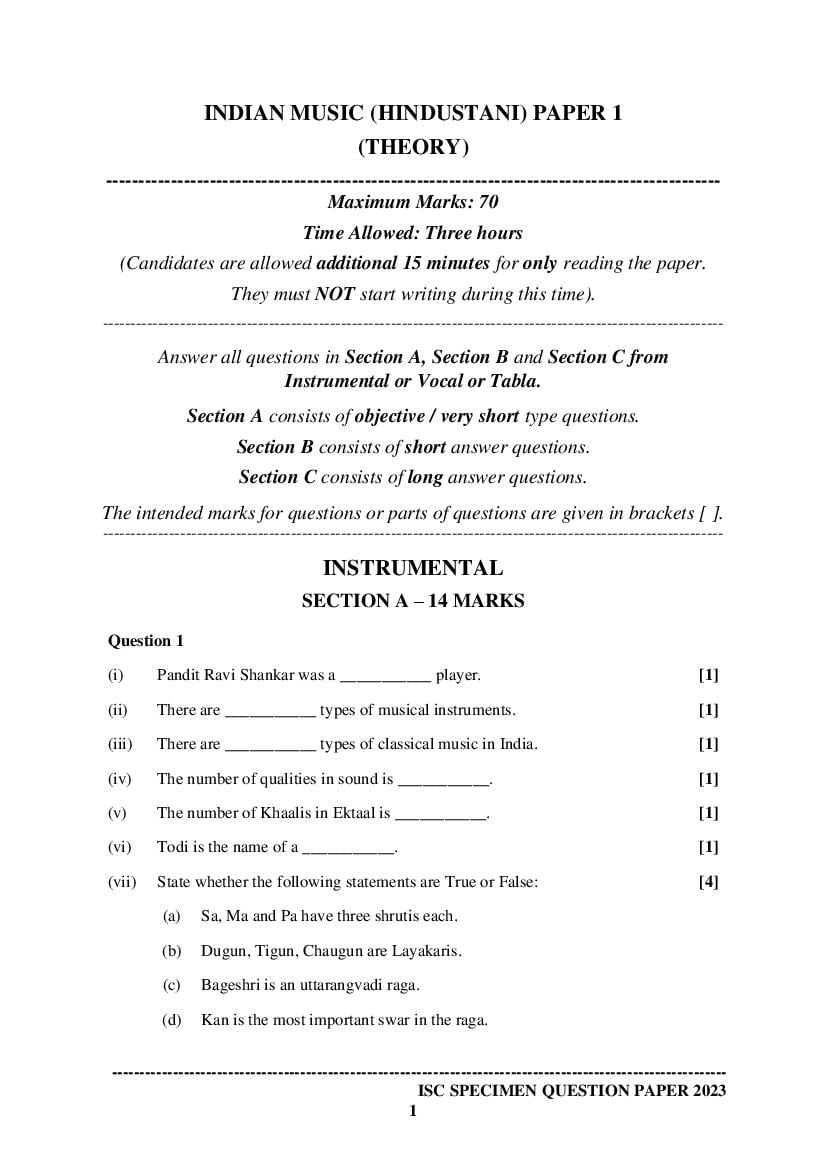
(THEORY)
-----------------------------------------------------------------------------------------------
Maximum Marks: 70
Time Allowed: Three hours
(Candidates are allowed additional 15 minutes for only reading the paper.
They must NOT start writing during this time).
----------------------------------------------------------------------------------------------------------------
Answer all questions in Section A, Section B and Section C from
Instrumental or Vocal or Tabla.
Section A consists of objective / very short type questions.
Section B consists of short answer questions.
Section C consists of long answer questions.
The intended marks for questions or parts of questions are given in brackets [ ].
----------------------------------------------------------------------------------------------------------------
INSTRUMENTAL
SECTION A – 14 MARKS
Question 1
(i) Pandit Ravi Shankar was a ___________ player. [1]
(ii) There are ___________ types of musical instruments. [1]
(iii) There are ___________ types of classical music in India. [1]
(iv) The number of qualities in sound is ___________. [1]
(v) The number of Khaalis in Ektaal is ___________. [1]
(vi) Todi is the name of a ___________. [1]
(vii) State whether the following statements are True or False: [4]
(a) Sa, Ma and Pa have three shrutis each.
(b) Dugun, Tigun, Chaugun are Layakaris.
(c) Bageshri is an uttarangvadi raga.
(d) Kan is the most important swar in the raga.
1
Page 2
(a) sound.
(b) taal.
(c) drum.
(d) alaap.
(ix) The number of swars in Hindustani Music is: [1]
(a) 22
(b) 10
(c) 12
(d) 7
(x) The taal which has khali on its sam is: [1]
(a) Ektaal
(b) Rupak
(c) Kaharwa
(d) Chartaal
(xi) Chartaal is played on: [1]
(a) Tabla and Pakhawaj
(b) Dholak and Tabla
(c) Mridang and Dholak
(d) Pakhawaj and Mridang
SECTION B – 28 MARKS
Question 2 [4]
Briefly explain sushir-vadya with the help of two examples.
Question 3 [4]
How are the swars of Hindustani Music placed on the shrutis?
2
Page 3
(i) Give a brief description of Carnatic Music.
OR
(ii) Mention the names of any two Ashray ragas. Why are they called Ashray ragas?
Question 5 [4]
Write the theka of chartaal with dugun.
Question 6 [4]
(i) Write the aroha, avaroha and pakad of any four ragas.
OR
(ii) Write the theka of any two taals with their description.
Question 7 [4]
Write the notation of antara of a razakhani gat.
Question 8 [4]
Briefly explain why thaats do not have avarohis.
SECTION C – 28 MARKS
Question 9 [7]
Write the ten thaats with their swars.
Question 10 [7]
(i) Discuss any two qualities of sound.
OR
3
Page 4
Question 11 [7]
A famous instrumentalist was born in India in 1920. He became the world’s best-known
exponent of Hindustani Music and inspired many musicians in India and abroad.
(i) Give a short introduction of this instrumentalist’s guru.
(ii) State any two achievements of this instrumentalist in the domain of Indian
music.
Question 12 [7]
The experts of Indian music believed that one could become an expert in music only
by learning music from a guru. Give your opinion on this statement with seven valid
points.
4
Page 5
SECTION A – 14 MARKS
Question 1
(i) Pandit Ravi Shankar was a ___________ player. [1]
(ii) There are ___________ types of musical instruments. [1]
(iii) There are ___________ types of classical music in India. [1]
(iv) The number of qualities in sound is ___________. [1]
(v) The number of Khaalis in Ektaal is ___________. [1]
(vi) Todi is the name of a ___________. [1]
(vii) State whether the following statements are True or False: [4]
(a) Sa, Ma and Pa have three shrutis each.
(b) Dugun, Tigun, Chaugun are Layakaris.
(c) Bageshri is an uttarangvadi raga.
(d) Kan is the most important swar in the raga.
(viii) Naad is a type of: [1]
(a) sound.
(b) taal.
(c) drum.
(d) alaap.
(ix) The number of swars in Hindustani Music is: [1]
(a) 22
(b) 10
(c) 12
(d) 7
5
Page 6
(a) Ektaal
(b) Rupak
(c) Kaharwa
(d) Chartaal
(xi) Chartaal is played on: [1]
(a) Tabla and Pakhawaj
(b) Dholak and Tabla
(c) Mridang and Dholak
(d) Pakhawaj and Mridang
SECTION B – 28 MARKS
Question 2 [4]
Briefly explain sushir-vadya with the help of two examples.
Question 3 [4]
How are the swars of Hindustani Music placed on the shrutis?
Question 4 [4]
(i) Give a brief description of Carnatic Music.
OR
(ii) Give the names of at least two Ashray ragas. Why are they called Ashray ragas?
Question 5 [4]
Write the theka of chartaal with dugun.
6
Page 7
(i) Write the aroha, avaroha and pakad of any four ragas.
OR
(ii) Write the theka of any two taals with their description.
Question 7 [4]
Write the notation of antara of a Chhota khayal.
Question 8 [4]
Briefly explain why thaats do not have avarohis.
SECTION C – 28 MARKS
Question 9 [7]
Write the ten thaats with their swars.
Question 10 [7]
(i) Explain any two qualities of sound.
OR
(ii) Draw any instrument and label it. Briefly explain the usage of its parts.
Question 11 [7]
A famous instrumentalist was born in India in 1920. He became the world’s
best-known exponent of Hindustani Music and inspired many musicians in India and
the world.
(i) Give a short introduction of this instrumentalist’s guru.
(ii) State any two achievements of this instrumentalist in the domain of Indian
music.
7
Page 8
The experts of Indian music believed that one could become an expert in music only
by learning music from a guru. Give your opinion on this statement with seven valid
points.
8
Page 9
SECTION A – 14 MARKS
Question 1
(i) There are ___________ prans of taal. [1]
(ii) There are ___________ types of musical instruments. [1]
(iii) Dhamar taal is always played in ___________ laya. [1]
(iv) There are ___________ types of Tihai. [1]
(v) Teentaal has ___________ khali(s). [1]
(vi) Tabla is tuned with the help of a ___________. [1]
(vii) State whether the following statements are True or False: [4]
(a) The origin of tabla is pakhawaj.
(b) A taal can be played without laya.
(c) Usually, a learner of tabla begins by learning Kayada.
(d) Jhaptaal and Dadrataal have the same number of vibhags.
(viii) Jaati of a taal is related to: [1]
(a) the number of matras.
(b) the taal being used for classical music or folk music.
(c) type of instrument (tabla/ pakhawaj) used for playing the taal.
(d) the taal is being played for vocal / instrumental music or dance
performance.
(ix) Tabla falls in the category of: [1]
(a) Tat-Vitat.
(b) Sushir.
(c) Avanadh.
(d) Ghan.
9
Page 10
(a) Jhaptaal
(b) Dhamar
(c) Teentaal
(d) Kaharwa
(xi) A taal can have: [1]
(a) 2 sams
(b) 3 sams
(c) 1 sam
(d) No Sam
SECTION B – 28 MARKS
Question 2 [4]
Which taal is played on pakhawaj? Why?
Question 3 [4]
State the difference between ekal and sangat playing of tabla.
Question 4 [4]
(i) Briefly trace the history of tabla.
OR
(ii) With reference to vocal and dance, what are the type of compositions in which
Dhamar taal is used?
Question 5 [4]
Write the theka of teentaal with dugun.
10
Page 11
(i) Give a brief explanation of graha and its types.
OR
(ii) State the differences between lehra (Nagma) and theka.
Question 7 [4]
Write one bedam tihai and one damdar tihai.
Question 8 [4]
What is a chakkardar tukda? Explain with an example.
SECTION C – 28 MARKS
Question 9 [7]
Explain laya and its variations by giving examples of different types of layas.
Question 10 [7]
(i) Write the theka of Jhaptaal and Kaharwa taal with dugun , tigun and chougun.
OR
(ii) Draw the sketches of Tabla and Bayan and label them. Briefly explain usage
of their various parts.
Question 11
Pandit Kishan Maharaj is considered the doyen of tabla in the modern era. He was born
into a famous family of musicians. He could play pakhawaj, mridangam, dhol and many
other instruments. He was multi-talented as he could sing and dance as well.
(i) What was the place, date of birth and date of death of Pandit Kishan Maharaj? [3]
(ii) State any four achievements of Pandit Kishan Maharaj. [4]
11
Page 12
Tabla is considered the backbone of music and dance. Give your opinion on this
statement with seven valid points.
12
Document Details
| Board / Org | CISCE |
| Exam | Class 12 |
| Type | Sample Paper |
| Pages | 12 |
| Updated | 29 Aug 2026 |