UPSC IAS 2015 Question Paper for Psychology Paper-I
Finished viewing? Save it for later —
Download UPSC IAS 2015 Question Paper for Psychology Paper-I (PDF · 5 pages)About UPSC IAS 2015 Question Paper for Psychology Paper-I
UPSC IAS 2015 Question Paper for Psychology Paper-I is available here for free download. Published by UPSC for UPSC CSE (IAS), this question paper can be viewed online or downloaded as a PDF (5 pages). Candidates preparing for UPSC CSE (IAS) can use UPSC IAS 2015 Question Paper for Psychology Paper-I to understand the exam pattern, the type of questions asked, and the overall difficulty level.
Frequently Asked Questions
How can I download UPSC IAS 2015 Question Paper for Psychology Paper-I?
Open this page and click the Download button to save UPSC IAS 2015 Question Paper for Psychology Paper-I as a PDF. It is completely free on AglaSem Docs.
Is UPSC IAS 2015 Question Paper for Psychology Paper-I free to download?
Yes. UPSC IAS 2015 Question Paper for Psychology Paper-I can be viewed online and downloaded as a PDF free of cost on AglaSem Docs.
How many pages does UPSC IAS 2015 Question Paper for Psychology Paper-I have?
UPSC IAS 2015 Question Paper for Psychology Paper-I contains 5 pages, which you can read online or download together as a single PDF.
Where can I find more UPSC CSE (IAS) study material?
You can find more UPSC CSE (IAS) question papers, sample papers, syllabus, and answer keys on AglaSem Docs.
UPSC IAS 2015 Question Paper for Psychology Paper-I – Text
Read the full text of this question paper below — useful to quickly search, copy and reference the content online without downloading the PDF.
📄 View text version (5 pages)
Page 1
ip frf^ T H
I
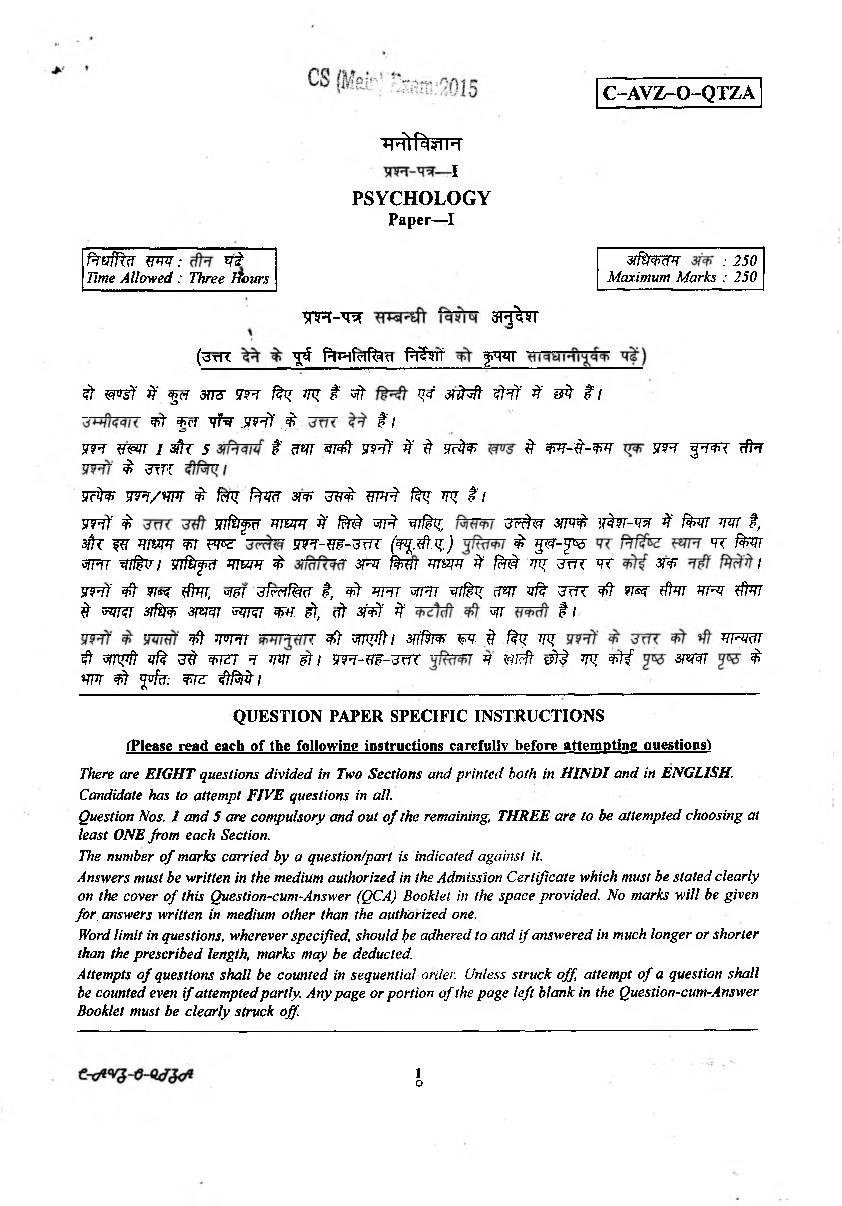
PSYCHOLOGY
Paper—I
Proffer w w : wi yffcp m ; 250
Time Allowed : Three Hours Maximum Marks : 250
S P R -W 3FJ%T?T
ferR ^ f^H frTf^id M w f fW
it msf #' <gcr 5/73- w*r ftq vy #' ^ qqf 3rM* sW #' ^ #/
¥ t &cr
W vfcr w' t f /.$.
-"/ ft
¥ft tmr i zih s f mr m¥t w^f #' # w& f # mr-d-mr sm fT ^ r ?frr
£ ^ rr
yrfor 5wr/wr $ fcPt firm snu -&?$ mw$ fcq m f /
mf # snf&fw mm $ fM wrf *n&i 3?#^ 3 ^ jt#w-w $ faw m #,
3^r w m*m w ?w wn-w-^fn: (?%.&.?.) £ 5 # -^ ^ tor
wrm ^nffrri mfttfd mm £ sfv fcm wtm #' /M w jw t vr w 1
j^rt ¥t wist tftwr, *m zfwjf&u ff # mm wm W7^r <w vfe ^nr ¥t mr rffcr rn^r rftm
# o w 3# ^ 3 m r w ^ ^ eft 3 ^ ‘ #' ^ #/
^ mm r ^ ^ / 3^%^ ^7 # % ^ mmr
it ^wff vfe u i wzr *r mr wt1 w^r-tm-^m n witft tfti m ¥tf smi $
wr # j^T ; wrz i t f i f ii
QUESTION PAPER SPECIFIC INSTRUCTIONS
(Please read each of the following instructions carefuHv before attempting questions)
There are EIGHT questions divided in Two Sections and printed both in HINDI and in ENGLISH.
Candidate has to attempt FIVE questions in all
Question Nos. 1 and 5 are compulsory and out o f the remaining; THREE are to be attempted choosing at
least ONE from each Section.
The number of marks carried by a question/part is indicated against it.
Answers must be written in the medium authorized in the Admission Certificate which must be stated clearly
on the cover of this Question-cum-Answer (QCA) Booklet in the space provided. No marks will be given
for, answers written in medium other than the authorized one.
Word limit in questions, wherever specified\ should be adhered to and if answered in much longer or shorter
than the prescribed length, marks may be deducted.
Attempts o f questions shall be counted in sequential order. Unless struck off, attempt o f a question shall
be counted even if attempted partly. Any page or portion o f the page left blank in the Question-cum-Answer
Booklet must be clearly struck off.
1
o
Page 2
Q. 1 faR fofeffl 3HFT '3rTC W Tm 150 :—
Answer the following questions each in about 150 words :— 10x5=50
q . i(a) jR ttsnfaP w w n t e ferR ^ wMT3?t' $ t ?
Why is it important to understand psychological processes for other disciplines of social
science ? 10
Q. 1(b) # 3 ft w gs 3^?T3ff % t Fffer-srte % w N $ w rite 'zr&ti
f^epT # f ^ |
Discuss the role of socio-cultural factors in promotion of well-being across major stages
o f life-span. 10
Q. 1(c)
-15^3I_5RT ^TRT ^ % fciHWI «fT ^fWT t ?
How far is it correct to state that most of the problems o f psychology can beaddressed
more adequately by adopting quasi-experimental designs ? 10
Q; 1(d) wfeTTO mm w ^t
g ^ if ^»N i
Evaluate the notion of programmed learning and describe its relevance for modem day
education with suitable examples* 10
Q. 1(e) j f ^ n , T& WT % JTSSTT 3 W5T I
Bring out the disruption in retrieval processes due to anxiety, context and repression.
10
Q. 2(a) #fTPT WTilvf^ f^ d M ^ 3T& 3TWT tm 3s p,
^ W R R f % fcpr TfEq#7 ^ if ^cTT 11
Keeping in view the strife in current social situation, discuss how apsychologist can
contribute towards providing interventions for such problems. 15
Q. 2(b) q& m i g*r w %
to tott fV-r f i
Citing studies on amnesia show how the explicit and implicit memory systems are separate,
20
fet#*Z^0-Qdg<ft 2
o
Page 3
t gl t ?
Demonstrate with suitable examples how the signal detection theory has helped in modifying
the process of vigilance. 15
Q. 3(a) f t ^ W R sft ^TTaff $ 3 T R ^ ?t W f t ?
f^rPT ^[^1^ I
Under what kind of research conditions does the use of factor analysis become necessary ?
Discuss. 20
Q. 3(b) 3tft w w ^ wf ^ t f t frrej ar^igrT yiPVwf ^ fM ^
^ r#r w p t ^tjcf f ? ^
How far do you agree with the contention that research findings on infant memory can
present novel approaches toward analyzing adult memories ? Corroborate your answer
with examples. 15
Q. 3(c) t"f*T % 3rf^TfPT m 5=rff^R ^W r cf^T ^TT $ qf^TPRWT
sn^pr^TT ^ ^ ^>r i j m o
Review Bandura’s social learning theory and evaluate its impact on understanding aggression
as a result of media generated violence. 15
Q. 4(a) ^ fftm ftm w t f t Ik -m tfW arf^FFr, P r f e ^ ^ *ttcct
^ 75 ^ ¥<T % fasflf I, '3‘^ t CUM ^ w fW f I I
It is believed that non-experimental designs are more relevant for explaining the emerging
issues like social evils that are seen prominently in India. Discuss. 20
Q. 4(b) 3t^ sipt iFqrftr w ft ^ w
With suitable examples, discuss the logic behind following the systematic steps in conducting
psychological research. 15
Q. 4(c) W «nfJ % snff # ^T5T cTCT W ^F ^ t ?
-3TR ^ fvf^ VI ^tjuT^ |
Do the cultural settings influence the understanding and evaluation of meanings of external
stimuli ? Provide suitable justification for your answer. 15
Page 4
Q. 5 PiHlclRHd 'STFT "StR WJWJ 150 ^ :—
Answer the following questions each in about 150 words :— 10x5=50
Q. 5(a) 3 ^TT3Tf w f^ P T I
Discuss the brain mechanisms underlying hunger motive. 10
Q. 5(b) ^ 3TCT $ *H¥cT I
Evaluate the utility of J.P. Das’ model in understanding the concept of intelligence. 10
Q. 5(c) % ymilM % snrr ^ ^ wwT3ff tr m i sriM i
Highlight the problems in assessment of personality using the pencil-paper tests. 10
Q. 5(d) ^f^cT '&ZWV*lf WT ^ f^T R % I
Illustrate with suitable examples the non-verbal process of communication. 10
Q. 5(e) w m \ w s t f t ^ i£ m \d # *ncfr p m g to n w t ? w t
to W K f^ T M f ?
What are the general strategies used in problem solving ? How do these differ from
domain-specific procedures ? 10
Q. 6(a) *rf§«rfa # r sRRfa ^ «fto f^rcR- ^rf ^ - 1 ^ ^ t c t ?ito7PT t aftr
^rf ?
Distinguish between extrinsic and intrinsic motivation. Which one is more powerful and
why ? 20
Q. 6(b) W httW ^ ^ ^ tf^ r i f ^ M sfr *m r#^rr i
Describe Piaget’s stages of cognitive development. Critique his theory. 15
Q. 6(c) F fajw r, 3fk ^ ^ ^ f^ M % F f^ f
I
Discuss briefly the evolution of factor theory of intelligence in the works of Spearman,
Thurstone and Guilford. 15
Q. 7(a) cqfadc4 % 3^T W T (Z J^ ) ^ I W M T ( ^ t c M ) T*,
tot ^ tM i
Describe the trait and type approaches to personality. Highlight Jung’s typology with its
weaknesses. 20
Page 5
WTOT $, ^ WZ # li|
Why are we awake at certain times and asleep at others ? Explain this with help of
opponent process model. 15
Q. 7(c) srfoeTOT W Fltfr t ? I
What is an aptitude ? Describe the various testsof aptitudes. 15
Q. 8(a) $ WQ Hfi ^ 3FT% (#T?f) ^frf^n ^
w r % 11" f ttw
“Children are not bom with stereotypes; they learn them from their family, peers, media
and society.”—Discuss. 20
Q. 8(b) w t fa ro 3>t f^ M ^ %ft^ w : f ^ r t
How does Chomsky’s Theory differ from that of Skinner in language development ?
Discuss. 15
Q. 8(c) 'c*jftic*r fSmrtt $ w r i ^ sfjt
M M $ ttpTT '3TMT t ?
State the components of Big-5 factor theoryof personality.Why is it considered superior
to other factor theories of personality ? 15
Document Details
| Board / Org | UPSC |
| Exam | UPSC CSE (IAS) |
| Type | Question Paper |
| Pages | 5 |
| Updated | 30 Apr 2026 |