UPSC IAS 2015 Question Paper for Sanskrit Paper-I
Finished viewing? Save it for later —
Download UPSC IAS 2015 Question Paper for Sanskrit Paper-I (PDF · 6 pages)About UPSC IAS 2015 Question Paper for Sanskrit Paper-I
UPSC IAS 2015 Question Paper for Sanskrit Paper-I is available here for free download. Published by UPSC for UPSC CSE (IAS), this question paper can be viewed online or downloaded as a PDF (6 pages). Candidates preparing for UPSC CSE (IAS) can use UPSC IAS 2015 Question Paper for Sanskrit Paper-I to understand the exam pattern, the type of questions asked, and the overall difficulty level.
Frequently Asked Questions
How can I download UPSC IAS 2015 Question Paper for Sanskrit Paper-I?
Open this page and click the Download button to save UPSC IAS 2015 Question Paper for Sanskrit Paper-I as a PDF. It is completely free on AglaSem Docs.
Is UPSC IAS 2015 Question Paper for Sanskrit Paper-I free to download?
Yes. UPSC IAS 2015 Question Paper for Sanskrit Paper-I can be viewed online and downloaded as a PDF free of cost on AglaSem Docs.
How many pages does UPSC IAS 2015 Question Paper for Sanskrit Paper-I have?
UPSC IAS 2015 Question Paper for Sanskrit Paper-I contains 6 pages, which you can read online or download together as a single PDF.
Where can I find more UPSC CSE (IAS) study material?
You can find more UPSC CSE (IAS) question papers, sample papers, syllabus, and answer keys on AglaSem Docs.
UPSC IAS 2015 Question Paper for Sanskrit Paper-I – Text
Read the full text of this question paper below — useful to quickly search, copy and reference the content online without downloading the PDF.
📄 View text version (6 pages)
Page 1
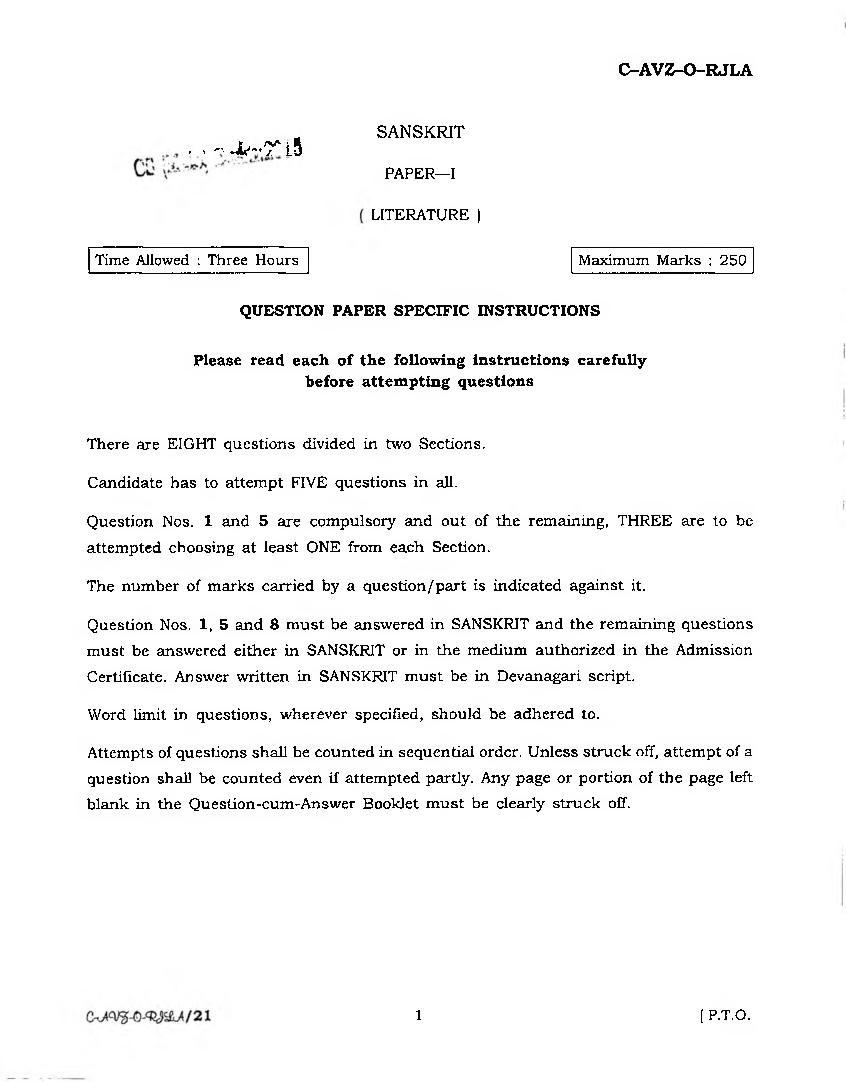
SANSKRIT
. . -■- ic '- T i.S
PAPER—I
LITERATURE )
Time Allowed : Three Hours Maximum Marks : 250
QUESTION PAPER SPECIFIC INSTRUCTIONS
Please read each of the following instructions carefully
before attempting questions
There are EIGHT questions divided in two Sections.
Candidate has to attempt FIVE questions in all.
Question Nos. 1 and 5 are compulsory and out of the remaining, THREE are to be
attempted choosing at least ONE from each Section.
The number of marks carried by a question/part is indicated against it.
Question Nos. 1, 5 and 8 must be answered in SANSKRIT and the remaining questions
must be answered either in SANSKRIT or in the medium authorized in the Admission
Certificate. Answer written in SANSKRIT must be in Devanagari script.
Word limit in questions, wherever specified, should be adhered to.
Attempts of questions shall be counted in sequential order. Unless struck off, attempt of a
question shall be counted even if attempted partly. Any page or portion of the page left
blank in the Question-cum-Answer Booklet must be clearly struck off.
1 [ P.T.O.
Page 2
1. 5HPTT: —
(a) STCVPtfei: 9^'ii: ^°T 2-3 xrf^| W^TT: — 1 1x10=10
(i) % 3T,
(ii) W T W l f : %?
(iii) -JlrMI$KM']<1l: ^Flf: ^ # T T : j
(iv) V -TRFT ^ts«f:
M 'IT + 3T^:,~
(vi) 'fa[ + m ' —
( vii) ' W ^ ' — # * r f Nk : w f: I
(viii) ^ t T : TM *I^f< t'— 4 M M R # i f^ d lH J
/« ; 'w f i : w ftv (— w^ t f M ^ i
(x) ' ^ M r ^ 7— W^T-TR- t e r I
(b) 3NTfM^3 \^lfedM<H*l MxFOTtWT ^ r T 3-4
2x5=10
(i) I
(ii) f^TWT I
(iii) sP frtffe cE T ^tl
(iv)
fW
fcj ^TFTT^ 3T*il<l£<ullA — 2x5=10
d) i
(ii) |W M s W i\l
(iii) +$lf4MdM 3flfl
(iv) ^ iR i I
(v) m tfn j
2
Page 3
(e) ^ ^ T t e p r M V m srf^TN^I 10
2. a^foR'Ktl: # m r: f l l k : —
faj ^ ^T:? f^ f: to fot *T^PJ? 15
How many Vedas are there? What is their subject matter? What is their importance?
Explain.
15
Explain, with reason, whose definition of Kavya is more relevant from your point of
view among the following—Anandavardhana, Mammata, Viswanatha and Panditaraja
Jagannatha.
(c) WNTPMTGPA 20
Describe the contribution of Sanskrit language in linguistics studies.
3. 3NtfM^cTT: ^ WT: OT^TT: —
(a) # ?O T TTW FftfcTT?
^I^IM dl^l 15
Has the story of Maryada-Purusottama Rama as described in Valmlki Ramayana been
equally accepted in different religions (Hindu, Jaina and Bauddha)? Present your
viewpoint.
(b) T O fiR nf^ t e t t , 10
Is Mahabharata a historic Mahakavya? Discuss how the Sanskrit literature evolved
since Mahabharata.
(c) "«3W ^Tf^TCTH” MK\^\ 10
“3 W ^Tf^RTFT” —Examine critically this statement with examples.
(d) "TO ^#Tt f% *pfr#TT? % JP^jlT: TO+M+Kl: s filw i 15
"TO ^41'i!—Is this statement true? Who are the famous authors of
Gadyakavyas in Sanskrit literature? Describe.
C-JW$-0-<$MA/21 3 [ P.T.O.
Page 4
Define Roopaka and describe any Sanskrit Roopaka of your choice.
(b) WT 3 ^ : TOTcft I
ftTo5T->ISTf^T^Tfo ^ ^T T ^ir'
1% ^ftTOT^I
Is the following statement of Mahakavi Rajasekhara correct? Discuss.
^ ST ^ ||"
(cj l^ r w r f ^ r q f^ to r ^ WWftcHHK: f^cf^T: l" W T
“ Ksemendra’s Brhatkathamanjan and Somadeva’s Kathasaritsagara are based on
Gunadhya’s Brhatkatha” Describe the importance of these Kavyas in Sanskrit Katha
(story) literature.
— B / S e ct io n — B
5. # 5OT: H ^ I W 150 Hftf% TT% W^T: —
fa; 'HK^-FrRrq^T' ^ ^WTTtoT f^RI: f^pqcTT^!
fb; jrfrFnf^
fcj <ik}T ^ K F T t f% f^T fcrF j^T C Sff^TOTT^I
fwaa I
(e) '^T fir^T R^k: ST^THT:, Rw\ul tfHltf MdlHJ
6. 3tWM^RTI: ^ J^TT: ^PTT^TF: — .
(a) ^ f 4 w n yftnNdnjj
How can you establish ‘^ n t ^ K : ’? Describe how Bandha, Moksa and freedom of soul
are possible.
4
Page 5
Explain the following statement according to Samkhya Philosophy
“Wfil 3 ^ ^ HHTOT 5fffcT: l"
(c) WTFT 20
What was the condition of Medical Science in ancient India? Explain with proof.
7. # wn: w f t o j — -
(a) 15
What is the concept of the God described and accepted in Indian Philosophy? Write
an essay.
(b) W PM T' t e l l 15
Explain Epistemology in Nyaya Philosophy.
(c) *RFTT # ^ f t «FF W M ? cf^ g sfcrFTT SffrT:
TO W 10
What are the four types of Purusartha in Indian culture? Why is Kama (sex) included as
a Purusartha when it is a natural behaviour of living beings?
(d) ^ f&SHTC? 10
What are the principles of Mimamsa Philosophy? Explain.
8. (a) ^FFTWf KrfHT mFfl^rR #T
3-4 5x5=25
m vfom , irfw : ^ —#
WfT^R: I
^ ^ t o * ftrFT ^
FRfcTI c R T O ^ IW 3 f F ^ *T *TT to ft,
W tf:W T : WT:;; ¥T W frW M ^ ^ W ^T
#n-T O i^ tj?t amftfefct i w : i ^M rf^r-w rrfk-
^ 3 ^ 7 f^rT:}
(j) 3?T#£?
(ii) f%
(hi) ^r? ^fr t r(
(iv) Jpf
(v) 3 ^ F n ^ f^
5 [ P.T.O.
Page 6
> 4 4f^3 5x5=25
w ft HR(fK-^f#r ^ * r w t w w ^ ^ ^ s rw w ft w m ^# rft
WTF^T *FTOTFTT ffa*HT W ^T P^ 'aTTsft f| ^ ^ftfct:' # W <fot Jfft f ^ t a
f f a f i T T =T = W W t e g r * r f t ^ W I # fr f^ r r : ^ ftT F T T ^ till 3 T T f^
3 ^ f T O ^ g iJ T ^ 7 ^ S T T f ^ T W f ^ l ^ P T f^ T T S J T C ft: *T ^ T r*T T W§ (T F T
tw ft^ ftWT ^TrfTI ffetfT: ^HT: # 3TTCTf% TPT«TTI ^ ^M'MlR^'f:
v m R \m : m ^ W rfrr ftw fH i i f^R F T
■3TFJ *TFT Pi^4: ^ %^TTI
(i) f t ^T T ^MT?
(ii) 3TTWNI: t f W l : %^T $ M ftf:?
(iii) ^FT 5fWT
(iv) j f ^ T - ^d i: ^ T
(v) 3 ^ dmt^lW^f: ^ $ m : ^ R : ^ frq :?
* ★*
C ^ A ^ - ^ £ U /2 1 6 SB6—310
Document Details
| Board / Org | UPSC |
| Exam | UPSC CSE (IAS) |
| Type | Question Paper |
| Pages | 6 |
| Updated | 30 Apr 2026 |