UPSC IAS 2015 Question Paper for Sociology Paper-II
Finished viewing? Save it for later —
Download UPSC IAS 2015 Question Paper for Sociology Paper-II (PDF · 4 pages)About UPSC IAS 2015 Question Paper for Sociology Paper-II
UPSC IAS 2015 Question Paper for Sociology Paper-II is available here for free download. Published by UPSC for UPSC CSE (IAS), this question paper can be viewed online or downloaded as a PDF (4 pages). Candidates preparing for UPSC CSE (IAS) can use UPSC IAS 2015 Question Paper for Sociology Paper-II to understand the exam pattern, the type of questions asked, and the overall difficulty level.
Frequently Asked Questions
How can I download UPSC IAS 2015 Question Paper for Sociology Paper-II?
Open this page and click the Download button to save UPSC IAS 2015 Question Paper for Sociology Paper-II as a PDF. It is completely free on AglaSem Docs.
Is UPSC IAS 2015 Question Paper for Sociology Paper-II free to download?
Yes. UPSC IAS 2015 Question Paper for Sociology Paper-II can be viewed online and downloaded as a PDF free of cost on AglaSem Docs.
How many pages does UPSC IAS 2015 Question Paper for Sociology Paper-II have?
UPSC IAS 2015 Question Paper for Sociology Paper-II contains 4 pages, which you can read online or download together as a single PDF.
Where can I find more UPSC CSE (IAS) study material?
You can find more UPSC CSE (IAS) question papers, sample papers, syllabus, and answer keys on AglaSem Docs.
UPSC IAS 2015 Question Paper for Sociology Paper-II – Text
Read the full text of this question paper below — useful to quickly search, copy and reference the content online without downloading the PDF.
📄 View text version (4 pages)
Page 1
C-AVZ-O-RNBB
w i r a (^ - - q jr - n )
SftecR m i : 250
T T ^ T -^ fcf^fa 3T3^T
ferR ^ ^ PiHfclfeld g M ^ fW g g ffig fo ^1)
^ Her 37M 13ft t i
<J«■)]<;eix ^ MT*! TO^ % 3xH ^ 1?|
to 1 sfR 5 f cim t o ! 3 $ 3r3|cp 7n*g $ w $ --£ R to rfhr TOt % 3tr
•STc^ TO/'HFT % f ™ 3 ^ -&&> -f^TT Tfti f |
TOl % 3tR TrRffcT M 3 ftfRi ^ 3 ^ 3TN% 3 ^ - ^ 3 f^TT ?M v* THTWT TO
"3^1 "TO -^-^rR (~ ^ ° Xio) tR "Ptf?2 W R t a l “^fHT ^if^M.1 TTTf^cl 'RTWT % Sff^ftrf; 3R[
M *n«R? 3 % l irR ^ ^ -ft^n
TOft ^ 3I®< ^frRT, *IFf ^f^fecT ^RFTT «fFTT
Tf^Tt % MR?f ^ ¥ R I sbHl^tfK I 3jii^|ch ^ f^J Tpr % 3xR *ft TfRRTT ^l^fl ^ li! *T
t \to -^ -^ tR 3 m^\ ^ ^\i ^ sw^n ^ % w f ^ ^ tti
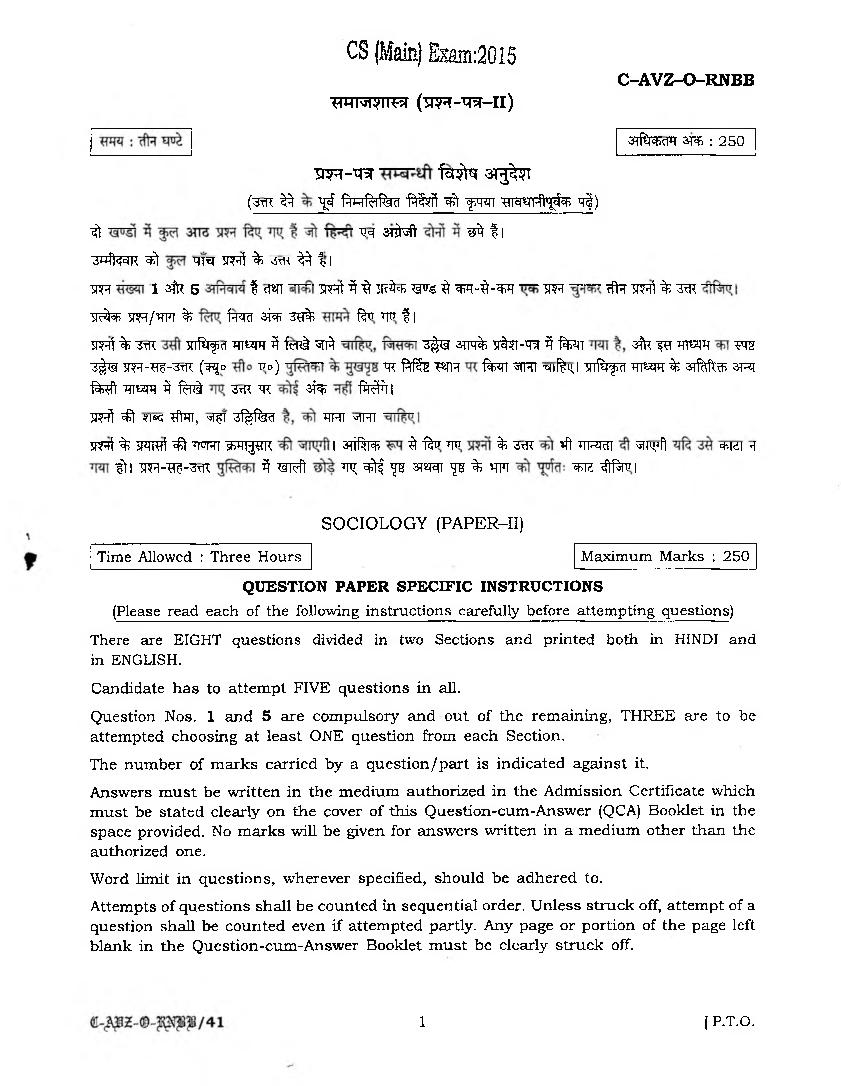
SOCIOLOGY (PAPER-II)
Time Allowed : Three Hours Maximum Marks : 250
QUESTION PAPER SPECIFIC INSTRUCTIONS
(Please read each of the following instructions carefully before attempting questions)
There are EIGHT questions divided in two Sections and printed both in HINDI and
in ENGLISH.
Candidate has to attempt FIVE questions in all.
Question Nos. 1 and 5 are compulsory and out of the remaining, THREE are to be
attempted choosing at least ONE question from each Section.
The number of marks carried by a question/part is indicated against it.
Answers must be written in the medium authorized in the Admission Certificate which
must be stated clearly on the cover of this Question-cum-Answer (QCA) Booklet in the
space provided. No marks will be given for answers written in a medium other than the
authorized one.
Word limit in questions, wherever specified, should be adhered to.
Attempts of questions shall be counted in sequential order. Unless struck off, attempt of a
question shall be counted even if attempted partly. Any page or portion of the page left
blank in the Question-cum-Answer Booklet must be clearly struck off.
1 [ P.T.O.
Page 2
% trf&api 1^qf¥n W fa cTWT 150 $$ :
(a) W lfcRl ^ Wcfadl % x % to R
Verrier Elwin’s views on freedom for the tribals
(b) swgs 'qlUr&qpfl % ^
Jyotirao Phule as an agrarian radical
(c) *TTTcfta *TTfcf-o33FH ^ ^ ^1
Louis Dumont’s perspective on Indian caste system
(d) h^ichi nftfj m mteTt o wz «n?
How far Gandhi was trusted by the untouchables?
(e) ?lM HPftwi (^RTphF?)
Feminization of poverty
2. (a) i\ t, ^ t ^ I?
Is caste system changing, weakening or disintegrating in India? 20
Give some of the important studies relating to the structural changes in the
Indian family system. 20
(c) 3tr ^K?i ^ 3fk wm Hi % n mrf\ Hi ^ 3 ^ rt
Broadly compare the kinship system of North and South India. 10
3. (a) 3 wRite; 'qtech ^ mm % m
Discuss the paradigm of modernization of Indian tradition in analyzing social
change in India, 20
(b) WX |? VTKcT3 ^ t o T O WFS Tltef eft SHTfeci W f I?
What is patriarchy? How does it affect the child socialization pattern in India? 20
(c) 3 f i t H\ m m w. %mm*
f?
Discuss the problems of elderly in India. What are the different perspectives to
solve their problems? 10
2
Page 3
Discuss Marxist approach to the analysis of Indian nationalism. 20
(b) I? ^ ^ aronfef I?
What are the basic tenets of Hindu religion? Is Hinduism based on
monotheism or polytheism? 20
(c)3 Do t\o Do TJ^o ito ^ C&31 -atfl 3TTOT^ |?
Why is it necessary to implement PCPNDT Act in India? 10
'WTg—B / SECTION—B
s. % w m sM m iftm t o f t r a f mm i s o 3# :
(a) ^ TH-fbl Dfcl %
Important components of National Education Policy in India
(b) *H*!ic{to (t o T^o Do) % ip?? ^
Main objectives of Tribal Sub-Plan (TSP)
(c) fasm % w m 3 ^ wfr\ tffak -&STR1
Effect of displacement through development on the rural landless and
marginal farmers
(d) wrfm hkci 3 m~wm $ ^
Issues relating to the informal labour market in urban India
(e) ^rfcr-'^cj^l 3 qfteRfal oft iRfcftWT tffar cF$
How far Srinivas* Sanskritization is modernizing force or traditionalizing force
in understanding the changes in caste system?
6. (a) PW ^ 3tR-1970 ^a-^chl^lcn 3TR>cR % m^ i
Discuss the impact of post-1970 feminist movement on Indian middle class. 20
(b) 3 fan#* srpfcn cror ^ f?
What are the major concerns of ethnic identity and religious identity in India? 20
(c) *TM 3 TTcf ^ % 'gs^fqu (£ fa fe ) ^ TRFO ‘f e f l |?
How serious is the problem of trafficking against women and children in India? 10
3 [ P.T.O.
Page 4
Discuss B. R. Ambedkar as a wise democrat. 20
(b) vnrcT3 t o n aiwldHl % ^ eft ^§37
Discuss the main features of farmers’ movements in Independent India. 20
(c) Id <=614^(1 ^ 1?3 cR> ti^Hd
To what extent the Muslim Personal Law Board is in agreement with Islamic
feminist agenda? 10
8. (a) ^ ^ ^TR’ %^ 3 I
Analyze Gandhi as a moralist, ascetic and man of action through his Hind
Swaraj. 20
(b) 3 W ftSxRij^F» ^TT | % 3TTfife eft f$T$n ^ ffe
s i t e ^ 1 W 5 f %w m ^ I
Human development approach affirms that education and health-care
growth are more important than economic growth. Discuss this issue in the
light of post-liberalized Indian society. 20
(c) WRT^cl!
Write a brief note on the Freedom of Press. 10
★★★
4 SB6— 1750
Document Details
| Board / Org | UPSC |
| Exam | UPSC CSE (IAS) |
| Type | Question Paper |
| Pages | 4 |
| Updated | 30 Apr 2026 |