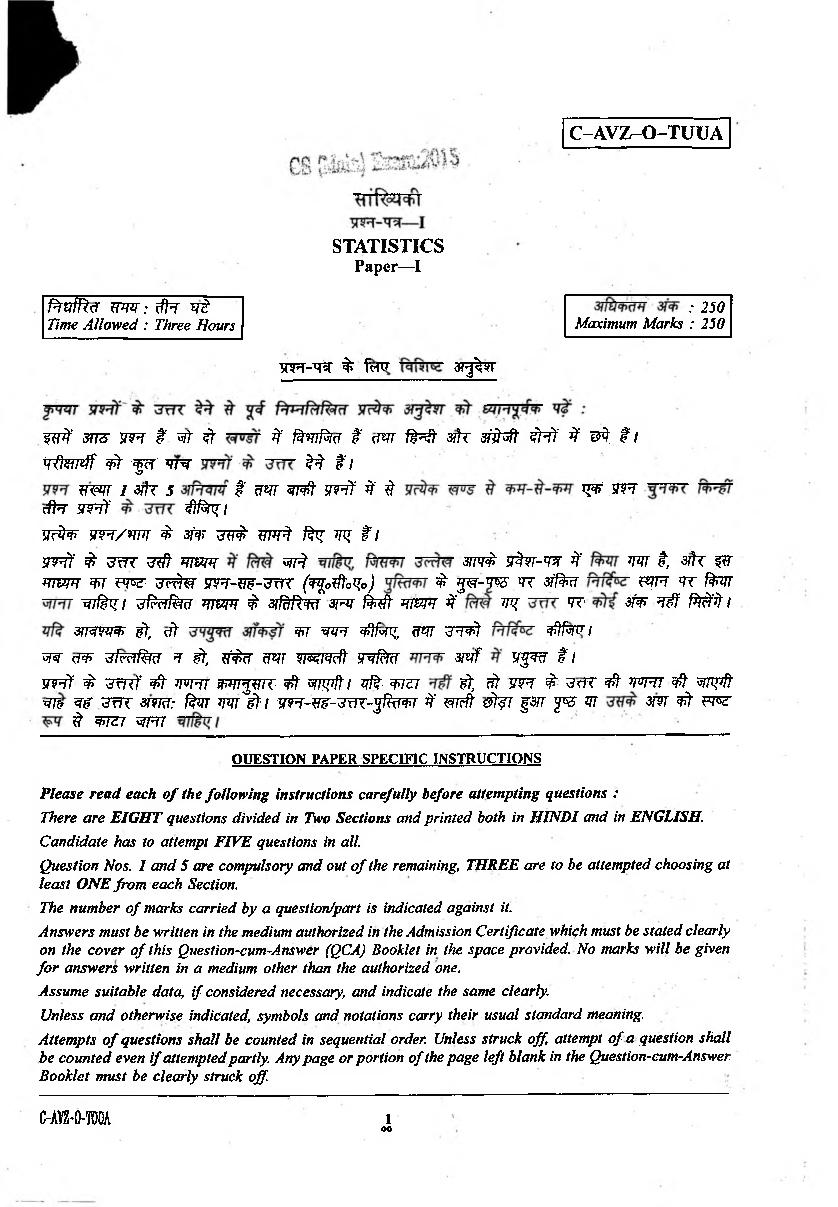
UPSC IAS 2015 Question Paper for Statistics Paper-I
Finished viewing? Save it for later —
Download UPSC IAS 2015 Question Paper for Statistics Paper-I (PDF · 10 pages)About UPSC IAS 2015 Question Paper for Statistics Paper-I
UPSC IAS 2015 Question Paper for Statistics Paper-I is available here for free download. Published by UPSC for UPSC CSE (IAS), this question paper can be viewed online or downloaded as a PDF (10 pages). Candidates preparing for UPSC CSE (IAS) can use UPSC IAS 2015 Question Paper for Statistics Paper-I to understand the exam pattern, the type of questions asked, and the overall difficulty level.
Frequently Asked Questions
How can I download UPSC IAS 2015 Question Paper for Statistics Paper-I?
Open this page and click the Download button to save UPSC IAS 2015 Question Paper for Statistics Paper-I as a PDF. It is completely free on AglaSem Docs.
Is UPSC IAS 2015 Question Paper for Statistics Paper-I free to download?
Yes. UPSC IAS 2015 Question Paper for Statistics Paper-I can be viewed online and downloaded as a PDF free of cost on AglaSem Docs.
How many pages does UPSC IAS 2015 Question Paper for Statistics Paper-I have?
UPSC IAS 2015 Question Paper for Statistics Paper-I contains 10 pages, which you can read online or download together as a single PDF.
Where can I find more UPSC CSE (IAS) study material?
You can find more UPSC CSE (IAS) question papers, sample papers, syllabus, and answer keys on AglaSem Docs.
UPSC IAS 2015 Question Paper for Statistics Paper-I – Text
Read the full text of this question paper below — useful to quickly search, copy and reference the content online without downloading the PDF.
📄 View text version (10 pages)
Page 1
STATISTICS
Paper—I
ftru fR x r w w : # f n i ; 250
Time Allowed : Three Hours Maximum Marks : 250
SPH-W % feTTT 3T^%?T
^ 3m w r f wt it #' ^/5rcf f <m i^ t 3jh siitet itif #' ^ #i
t r ft e w ff # w
o vnr ^ f /
w i s rk 5 $ u m w r it snri? #' # ^ j tf t
c#T 5^7t' ^ r /
5 ^ - W F T /W T # 3far ^ 7 # ^77^ f t ? W 9 1
srpff $ 3W ttft m m ^ 3 ^ J7#W-W #* mr i, yh w
m m m ?w v r d ® s n F r - w - :3 m (w%otfto?o) $ j * r - t o *7T ^ ? r ^ ^ /^ tt
w#^/ o#d/^rf m&m $ sifdRw 3p3r /Wf wrm #' w ^ sfa ^ ft#? /
3tm?& it, <ft ^7 w ? ffifvfiz, urn o r# ^fffvfTT1
w cr^r 'd frd R ia ? ^ ??^cf m r w i4 < $ u ^ ffc r m f s jw f i
wrif # zm f # 37W smrgm ¥t mrfti -ift-werit, it m # sr?r # nmr $t mrft
*m? W0- m 3/to:- fcm mr iti jm -w -’ZTTT-jjftxr+i $ mft tfijr f ^ y5? ^ 3?w ^ ? w
# ttJ WFTT
QUESTION PAPER SPECIFIC INSTRUCTIONS
Please read each of the following instructions carefully before attempting questions :
There are EIGHT questions divided in Two Sections and printed both in HINDI and in ENGLISH.
Candidate has to attempt FIVE questions in all.
Question Nos. 1 and 5 are compulsory and out of the remaining, THREE are to be attempted choosing at
least ONE from each Section.
The number of marks carried by a question/part is indicated against it.
Answers must be written in the medium authorized in the Admission Certificate which must be stated clearly
on the cover of this Question-cum-Answer (QCA) Booklet in the space provided. No marks will be given
for answers written in a medium other than the authorized one.
Assume suitable data, if considered necessary, and indicate the same clearly.
Unless and otherwise indicated, symbols and notations carry their usual standard meaning:
Attempts of questions shall be counted in sequential order. Unless struck off, attempt of a question shall
be counted even if attempted partly. Any page or portion of the page left blank in the Question-cum-Answer
Booklet must be clearly struck off.
C-AYZ-O-TOOA l
oo
Page 2
SECTION—A
Q. 1(a) ^TFTT f t f t # ^ n r % n eft g if ta l a pn (a > 0, 0 < p < 1) 11
^nf^TTT f t f t # cT?^T ?JT FfcT «fTRT srrfJfaiflT $ BT«T 11
(i) Tr^^cTT W f t f t # trf^lT *f k (> 1) ef?% t I
(ii) ftjT TO t f t T^> ^ T X *f *R % ^ cf^R t , eft ^ ^ it %
3 f e «T£% W W ftefl t ?
Let the probability that a family has exactly n children be a pn (a > 0,0 < p < I). Assume
that a child can be a boy or a girl with equal probability.
(i) Obtain the probability that a family has ^exactly k (> 1) boys.
(ii) Given that a family has at least one boy, what is the probability that there are two
or more children in that family ? 10
Q. 1(b) 3 aft* TTTOT 3d^n^T I t5RPTT f t {X }*_i ^T
spgtm t f t
Xn =■n3, \ snftw r % - m
XT
"= •0, 1—nL2 xnfi^rlT $ * m
ft # x n -> o i
Define convergence in distribution and in mean. Let {Xn}“_1 be a sequence of independent
random variables such that
. 1
Xn = n** with probability —
n
=■0 with probability 1
n2
Show that Xn -> 0 in distribution. 10
Q. 1(c) i
^ Xj $ tx x 2 (p) f cfr Tj ^ i t 2 4 p % ferq ^ r fw r
^ rr T, = x , + x 2 ^ t T2 - Xj. + SXj. ;
Define a sufficient statistic.
If X, and X2 are Bernoulli (p) random variables, examine the sufficiency of Tj and T2
for p where T j - X, + X2 and T2 = X, + 5X2. 10
Page 3
o2
gfcTCsf t i - J L # leftr i _ a ftwu-fUirfi *rc, f ^ r t k s r 3r r i ?j w
2.
Let X j, ...... Xmand Yj. Y2....... ..., Yn be independent random samples from N(3, a^) and
A
_2
N(2, of) respectively. Find a confidence Interval for — at confidence level 1- a. 10
2
Q. 1(e) n Xj, X2, ....... . Xn B (l, 0) % I e % fen? FTfa W % ST^rfcT
u ra 0 ^ r t ft 1
Consider n observations Xj . X2....... ..., Xn from B(l, 0). Obtain the Bayes estimator for
0 under quadratic loss function when a conjugate prior is assumed for 0. 10
Q. 2(a) ^ % m tm f, ^ sn w t
cTOT <(>(t)fofT W | ? 3RT: X ,fe m .W W f -(l;+ e * + 2e2it)
t , ^ ^.^T.xrqj. ^
How can you find out the discontinuity points of distribution of a random variable if the
characteristic function <|>(t) is given to you ? Hence find the c.d.f. of a randomvariable
X whose characteristic function is —(i+e**+ 2e2it) - 20
4
Q. 2(b) TfTTT fa Xn ^TOT P(n0), n £ 1, 0 > 0 11 n ^PT
/
Xn V ol
n 0 <— > .99
V n 10
y
Let Xn be a Poisson P(n0), n £ 1, 0 > Oi Use the Central Limit Theorem to find the
smallest n such that
/
xn
n 0 k £ l 2s .99 15
n 10 J
Q. 2(c) ft nfW m i $ x^i 1 , 2 , .... , 1 0 ^ w t h p t afrt
% 3P=?nfa P{X = k} = 0, k = 1, 2, 3, 4 $ fat*, P{X = k} = - , k = 5, 6, 7, 8, 9 %
8
feftr 3fk P{X —10}= — t I 0,15 3TRN ^ifePT PT TOT ^tfarr 3 ^ XT^ 3TFM
8
^ yRksf % 3TTsnx ^r :, ^ ct i
C-AVZ-0-T00A 3
DO
Page 4
the alternative hypothesis, the distribution is given by P{X = k} = 0, for k = 1, 2, 3, 4,
1
P{X = k} = - for k = 5, 6, 7, 8, 9 and P{X —10} ——. Obtain most powerful test of size
0.15 arid find its power, based on a sample of size one. If
Q. 3(a) 3 pj, p2 p3 (pr + p2 +.p3 == i) $ #r mR^tFit
3TT ^K fr't I H *n =n = - ^ ^ yitefiR i ^ f ^ T
0 * 3 3
t, ^ Mftsrr ^ fcR 3TJTO v f \ m fttfo | TfteTT % n (Trials)
^ r f 11
A trial can result,in one of three possible outcomes with probabilities p 1? p2 and p3
. .if" '■ •■■■-■ •• t
(Pj 4 p2 + p3 = 1) respectively. Construct the Likelihood Ratio test of :p1= p 2 = -
against the alternative that these probabilities are different from - . The test needs to be
constructed on the basis of n-trials. 20
Q. 3(b) 3jryf ^ w<\ t ?
^ X ^ f i t, ■
<x-p) '■ '
fv( x ) = —e 0 , 0<P<x<oo, 0>O
x 0 •
alk 50 c ffM
50 50
£ x .= 8200 3fft x ?= 20,00,000
i=l i=l
t , tft 0 aftr 3TT^f W
How does one obtain moment estimators ? If X has the pdf
x <*-P)
f ( x ) = — e e , 0<p<x<oo, 0>O
0
and a sample of size 50 yields
’ 50 50
V Xj =8200 and ^ x ? = 20,00,000
i-1 i=l •'
find moment estimators of 0 and p. .1 5
C -A V Z -0 -T 0 0 A 4
00
Page 5
1 —l-x2
Q. 3(c) Ha:f(x)
«o = - 7= e 2 , -co<x<oo
V2n
H,:f(x) = - e _M) -oo<x<oo
^ ^ fcTtr KiftoifH <£r n strtH ^ t ii j l^ o S t e f $ stran:
'TT W I TI5Tf(x) x 11
Find a Most Powerful test for testing
1 -ix 2
Hn :f(x) = - j = e 2 , -co<x<co
V2 it
versus
Hpf(x)=^e - go< x< 00
on the basis of a random sample of size n. Here f(x) is the pdf of the random variable
x '. : V '.' - V 15
Q. 4(a) W fa F( ) ■.•
0 Tjftx<l
l *^r l ) ^lS x < 2
2 4
F(x) =
7 + (x -2 )
^2<x<3
8 8
1 *lftx>3
STTCT f^T W %I F ^ f^r|3Tf
3ltT F ^ ftR«td 3?|T ^RRT W ft $ f t w ^ I
Let F(-) be the cumulative distribution function (cdf) given by
0 if x < l
I + £ — !2 if 1< x < 2
2 4
F(x) =
7 (x -2 ) ,
—+ -------- i f 2 < x < 3
8 8
1 if x £ 3
Find the set o f discontinuity points of F and express F as a mixture of its discrete and
continuous parts. 20
C-AVZ-O-TOOA 5
00
Page 6
Q. 4(b) # .#.x?cP. W9T; F3fk G t l Mz^i t mgfW*
(Xj, X2, ..... Xm) 3^C (y p y2, ........ yn) f^ T '^ T ^ # H Q : F(t) - G(t) r t t i ^ ^ M rW
F(t) > G(t) ffc S $ feU* ^TFT-c^^fT ^STf f^TRfq
^rqi ttw F (t)* G (t)^ p t # %q *r$w *ft # c r ^ fc ri f^ r^ t
I
Suppose that X and Y have cdf F and G respectively. Given independent random samples
(Xj, x2, ..... xm) and ( y v y2, ..... yn) from these distributions, construct ftfann-Whitney test
of H0 : F(t) = G(t) for all t against the aitemative that F(t) > G(t) for at least one t. Also
indicate the test when the alternativei ts ®(t) ^ G(t) for some t. State the test you would
use when m and n are large. 15
Q. 4(c) x <n$ ^ # | H0 : A, = XQ H{ : A, = M 0, k > 1 %
^T&OT ¥*3 $ fciTT 3T pft¥ W gm (SPRT) f t W ^feT'l OC
ASN w r f w ^rri
Consider observations from Poisson distribution with parameter X. Develop a Sequential
ProbabilityfetioTest (SPRT) to te$£!$l0 :-X •- 4 0 against Hj : X = kX0, k > !. Obtain OC
and ASN functions. .1 5
SECTION—B
^ x i w 3fk s wife n w sn^- 3PTf¥w aii+et+ # i 'rfl+t-mi
A random sample of size 4 ftom; a biyaiiate normal population provide^ the following
statistics
[ 4 ' r 6 ~ 2 y
, s =
OS
, - 2 h
where X is the sample mean and S is an unbiased estimator of the population dispersion
matrix.
Test the hypothesis HQ:ji=(5,5)' where ^ is the population mean vector.
(F 05 ,, 3 = 10.13, F 05 2 2 = 19.00, F 05 3 , = 2 15.7) 10
O6O
C -A I-0 -T 0 0 A
Page 7
A x 2 ^ ^ 3rfftm> ^ r ^ p s r y r f a Pi2(3 if t ^ rf^ r fa
2 = .(g . )
P12.(3....p) o ll a 22
w f a ji I " 1 (i, j)3T sjcPFT 11
Let X = (Xj, X 2 ..... Xp) 1 be a p-dimensional random vector with E(X) = 0, V(X) - Z.
Define partial correlation coefficient p 12 (3 p) between Xj, X2. Show that
2 = (q )
J2.(3—p) o n a 22
where a 1-* is the (i, j)th element of S-1. 10
Q. 5(c) ,W a 2 3 fk E(Yj) - Pj + p3, E(Y2) = p, + p2, E(Y3) « p, + p 3
#T Yp Y2 3ftr Y3 I W T rp % 3M+d-(VkU.
■^TT ^ 7 f^rgf^T flWH. FcT 3ffc grf.TftiT W I
Consider three independent random variables Y{, Y2 and Y3 having common variance a 2
and E(Yt) - Pj + P3, E(Y2) = Pj + p2, E(Y3) =* Pj + P3. Determine the condition of
estimability of the linear parametric function Tp. Obtain a solution of the normal equation
and the S.S. due to error. 10
Q. 5(d) ^Tf^t fa
v =v + -2 L JL _
ran prop „N (N -1)
h h .
^ V ran ^ % rop W 9T:' ^ ^rfcfWT # T 3 T T ^ lf ^ ftsrfo T $
^TTff^F $ 3F^fcT 3 n ^ ? f ^TTSTf % WOT f I 3FS ^ 3PT^ wivm
3pf ftcfx|*i f |
Show that
V =V
p™p
+ - N—
nN(N-l)
S Nh(Yh-Y)2~ £ ( N - N h)S2
- h h .
where Vran and Vprop are respectively the variances of the estimated means under simple
random sampling and stratified random sampling with proportional allocation. All other
notations have their usual interpretations. 10
C-AVZ-O-TOOA 7
00
Page 8
(^ 3(T^:) ^T
Describe the layout of a 33 experiment in 4 replicates (with 3 blocks per replicate) using
complete confounding. 10
Q. 6(a) SKTc^ fttfar W r z H Plf^^d 3rf^VmT
% feR, ^frf^RT-^nrffe ^ WR^W-emWT £ T O W\ cjfq-'i
3^T 3RT; 3PTf^m 3n^eT^ I
For an arbitrary fixed effective size sampling design with positive second order inclusion
probabilities, derive the Yates-Grundy form of the variance of the Horvitz-Thompson
estimator of a finite population total and hence obtain the Yates-Grundy unbiased estimator
of this variance. ' 20
Q. 6(b) w x « (X,, X2 , X3)' t i f t t 3n^fvm> w r ( 3 n .^ .) :
Mx (t) = exp t.1- 2U + 2t,3 + t f1 +. 0^ - + 2t?3 o 11,
13
t =(tirt2, t3)r eft
(i) x w w t s n ^ ' ^hc . . .> •
(ii) .C W W K W ^TtT, P(2Xj - 3X2 + X3 > C) = 0.95 1
(iii) Xj ^T, f^T TO t fa X2 = x2 3^T X3 - x3, ^ ?TM I
( ^ 3TFmwr Ft eft 3 m P(x > 1.645) = 0.05 3?hc P(x > 1.96) - O.Oly^TFT WRTT^T
■^r f?, t) ■
Let X - (Xj, X2, X3)' have the joint moment generating function (mgf)
Mx (t) = exP t.1 -2t?+2t~+t?+^+2t2-
3 1 o 3 ^o- t . t13
-
where V * ^ en :
(i) Obtain the covariance matrix and the mean vector o f X .
(ii) Find a constant C such that P(2Xj - 3X2 + X3 > C) = 0.95.
(iii)' Derive the conditional distribution of Xr given X2 = x2 and X3 “ x3. ..
(If necessary, you can use P(t > 1.645) = 0.05 and P(x > 1.96) = 0.01where x is a
standard1normal variate) 15
C-AVZ-0-T00A
o8o
Page 9
(BLUE) %^TcT aft* <T*ft t ^ t ’Y ^ 3T#PTcT Sti^cT^ t
t I
^5 For the Gauss Markov Model (Y, X p, o I ) , the estimator t' Y is the best linear unbiased
estimator (BLUE) for E(t'Y) iff t'Y is uncorrelated with all unbiased estimators of
zero. 15
Q. 7(a). tfgfcfiT {k^f R f h w ^H T I 3RT:-^ ^ TJTT
Wun? i
Define a balanced incomplete block design (BIBD). Carry out its intrablock analysis.
20
3 1 1
1 3 1
1 1 5
3 1 1
Suppose a random vector X has the covariance matrix 1 = 1 3 1 . Find the principal
115
components o f X and obtain the proportion o f the total variance accounted for by the
first two principal components. , : 15
Q. 7(c) BT9RW ^ffecf yj = P0 + P jXj +.ci# i = 1 , 2, ........ , n. fa ^ Xj W
^ *rc fer?r (smfej;. Xj = u + i v , u v % f ¥ ^ r % teR), ^ y i - y 0 + y l l +
y n r f ^ f a ^ r 11 3ttc^ ^cF^r t % art if)
Consider the simple linear regression model yj = po + pjXj + eiy i - 1, 2 ,....... , n. Show
■ that if the XjS* are equally spaced (i.e. x{ = u + iv for fixed values of u and v), then
Yi = Y0 + Yji + Cj is an equivalent reparametrization (in the sense that both the design
matrices have the same column space). 15
C-AVZ-0-T00A 9
oo
i
Page 10
|
g t o f xp x2, .... xn I TOU ^T ^ P T H0 : 2 = CT2Ip % ■'T^tOT % frH? ^f^rr^T 3TJW
Trf^rr (LRT) ^ t f¥rW ^ r r r 11 n afk a 2 $ w ^ r- (MLE) Pmfeii» i
-2IogcA% feR c ? ^ f p, n, x ^ v fe tf W T 3fT ^ S % SfWTf ^ ^ 3, ferf^; |
Consider a random sample Xj,x2, .... xn from a p-dimensional normal population with
i
i •
mean vector fi and dispersion matrix £. The purpose of the problem is to construct the
likelihood ratio test (LRT) for testing MQ : I = a 2Ip. Find the maximum likelihood
estimate (MLE) of fi and a 2. Write down the expression for -21ogeA in terms of p, n, x
and the elements of the sample covariance matrix S. 20
Q. 8(b) ^ WTUT m I ? ^ ^W 3!T %
WTTjt if?ff FtcIT t ? ^Jf T & m ’ W I' I
What is meaiit by confounding in a factorial experiment ? Why is confounding used even
at the cost of loss of information on the confounded effects ? Explain the terms ^complete
Confounding’ and ‘partial confounding’. 15
Q. 8(c) %, n ^ # ’, t, ^ ^7
W t aftt Tjufc M ^ 11 ^rsq- ^ ^ sn^eT^
3lk WTf^T 3TR>e^ % W ^T % tcR, ^ 3RT:^f W F ^ tT
% T<=ff cjrq^
A simple random sample of ri clusters, each containing M elements, is drawn from the
N clusters; of the population and the clusters sampled are enumerated completely. Suggest
an unbiased estimator of the population mean per element and derive the expression for
the variance of the proposed estimator in terms o f the population intraclass correlation
i
coefficient. 15
C-AYZ-O-T00A
oio
o
Document Details
| Board / Org | UPSC |
| Exam | UPSC CSE (IAS) |
| Type | Question Paper |
| Pages | 10 |
| Updated | 30 Apr 2026 |