UPSC IAS 2015 Question Paper for Urdu
Finished viewing? Save it for later —
Download UPSC IAS 2015 Question Paper for Urdu (PDF · 8 pages)About UPSC IAS 2015 Question Paper for Urdu
UPSC IAS 2015 Question Paper for Urdu is available here for free download. Published by UPSC for UPSC CSE (IAS), this question paper can be viewed online or downloaded as a PDF (8 pages). Candidates preparing for UPSC CSE (IAS) can use UPSC IAS 2015 Question Paper for Urdu to understand the exam pattern, the type of questions asked, and the overall difficulty level.
Frequently Asked Questions
How can I download UPSC IAS 2015 Question Paper for Urdu?
Open this page and click the Download button to save UPSC IAS 2015 Question Paper for Urdu as a PDF. It is completely free on AglaSem Docs.
Is UPSC IAS 2015 Question Paper for Urdu free to download?
Yes. UPSC IAS 2015 Question Paper for Urdu can be viewed online and downloaded as a PDF free of cost on AglaSem Docs.
How many pages does UPSC IAS 2015 Question Paper for Urdu have?
UPSC IAS 2015 Question Paper for Urdu contains 8 pages, which you can read online or download together as a single PDF.
Where can I find more UPSC CSE (IAS) study material?
You can find more UPSC CSE (IAS) question papers, sample papers, syllabus, and answer keys on AglaSem Docs.
UPSC IAS 2015 Question Paper for Urdu – Text
Read the full text of this question paper below — useful to quickly search, copy and reference the content online without downloading the PDF.
📄 View text version (8 pages)
Page 1
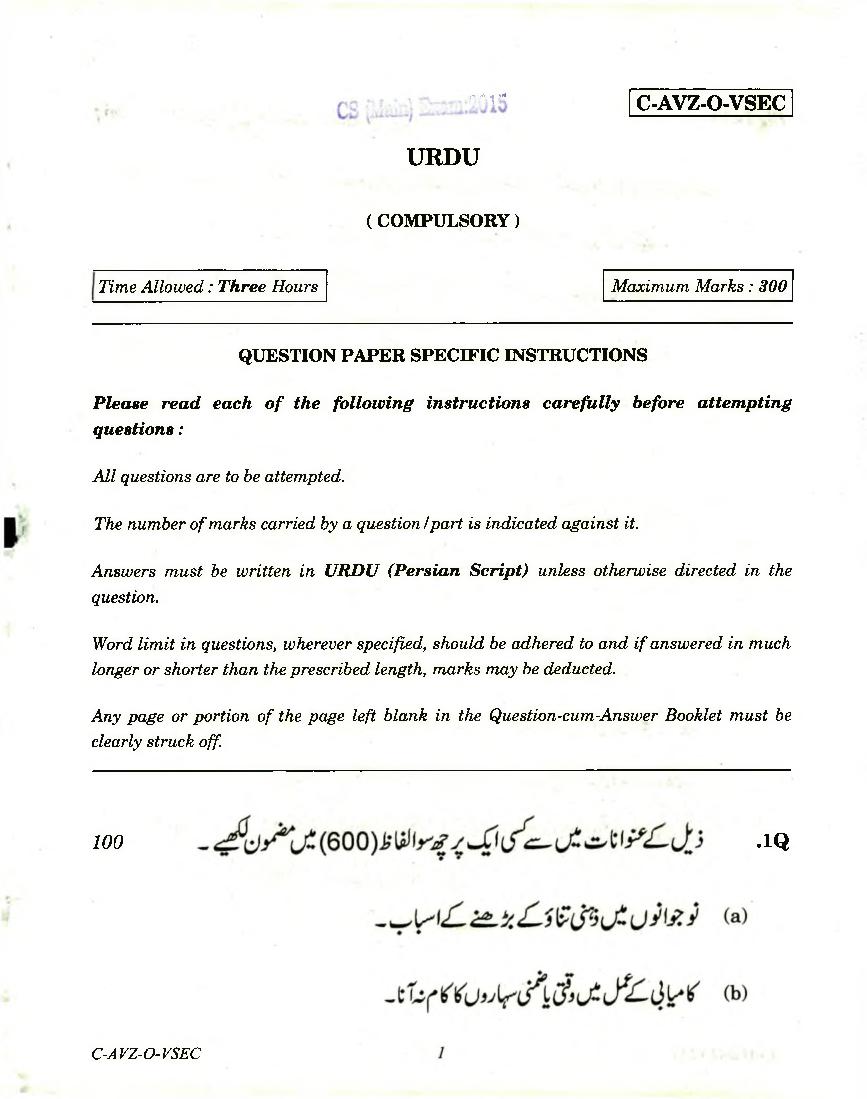
C-AVZ-O-VSEC
URDU
( COMPULSORY)
Time Allowed: Three Hours Maximum M arks: 300
QUESTION PAPER SPECIFIC INSTRUCTIONS
Please read each o f the following instructions carefully before attempting
questions:
All questions are to be attempted.
The number o f marks carried by a question Ipart is indicated against it.
Answers must be written in URDU (Persian Script) unless otherwise directed in the
question.
Word limit in questions, wherever specified, should be adhered to and if answered in much
longer or shorter than the prescribed length, marks may be deducted.
Any page or portion o f the page left blank in the Question-cum-Answer Booklet must be
clearly struck off.
100 -IQ
C-AVZ-O-VSEC
Page 2
12x5=60
^ ^ J u b l {J^£L J X tL -jk j'iZC-k yi ejttltL - iJ J jJ
?; ijh L -tf& \ s jZ U^>s
V
J^rbeL* J J I£ A jJ i? 2—\etjj Hj) jL~ (JlJt (QO)(jTle~ijZ jjlJ Z J l—b
Jl - \j}\£ y‘c / ^ c/t Z - U9vv'(j*j L~ ^ l Z l <L- ^ 0 U*» 3/£jsIlj‘fjs 11
\J% jt
d J<~C £ -< z -£ -d \ £ H f t h f u t db)i<z~ jIjJ
j& ijltjr fle L r jjlijr
C-AVZ-O-VSEC 2
Page 3
l£ f\-Z- I f) j (J/i^(3>4 (> lf
- m f 1^ ( A ^ g Ji»J * * jz {/ [/ '- ^ y £ j ,» j u* f
j u0!/3iZl ^ (>jyyl / iJ•r'Zl 6 ,A /(^ *t#Z^yO/^^L£u*j&
A - l/ 1- jf\j>’>(jC,‘i£|f6 JStt yjf-t$S u /t/(
\J\f^\j$% *-&0h wiJj^ljfJ^L\Jt 2Llr & Ik$£IIbfeI^Jlr>7£ll£y ^
Zli_l^£Qfc^lc£Z_UKjjU2l«^>Zl
v& ^ i/dF ifJuy»* y^1
u j lT ^ J zj* x& 1^ 1ITfc.i- <
f< —£ k _ . v ( b (>^i ; . J\s£~ djz& Z* ^ t o
/u $ >u^ (?!?
i&i / j t SjuA & ?£- w iz .ii/w /L uif y ^ (jy i^yZl &T
'' t * M *
C-AVZ-O-VSEC 3
Page 4
< ^ & y j t J - i j 2 - i r ^ j A A £ < J i / i . ----------------------------
i / l {J?J?ji\BsiktC L - f l j c J ) ) J*UL' t f j 1 U i *J/*')L~ iA
\ ? L <L yG< if^ 6vIj!j>/ l’y (^ I (Jv* £*>4 ( / w toL . \Jf4 -
:& lH s
12 ? i £ \ / L ^ i £ L - W M j f j j j 4 -{fu J & J (a)
^2 (b)
12 ^ 4 ** * & & ) » * * J. (c)
i2 (d)
J /< ^ « £ Jlj? J ji b u < ( P re cis ) >U2>f ^ j p f c£> <?-/>*> . 3Q
60 -^ W r f< ^ p (£ i(jL f& > t f;y /P r e c is .^
ijjjj i f Ifj < iJ*L ^ Vst (Jjij (Jjltf l/Z Jlr& jy'iJ']& i
/& \Lci\s /<£- t W (( / v 1 J L / " y &(^
C^l <-*j^I X t j T L L~ UUj U > l U ; J f L^( c/Uj
-JzilftfJiyie*AtSjbijgiSflf16/»■»1^ ^x**k.\^S^C-Jfel U-ji ^jr“tS\ jtI
& > A /! J ^ - 1 & i / 1& ^ k ->J ^ cJkf
C-AVZ-O-VSEC
Page 5
J ^ L ( ,/L ( jif A -£ * Z l ./< £ <)biJib^7>
c ~ ' t f j U 4 / < J y ^ i : y f t / j I t / f / 0 i/iS^lS^^U^iA ^
Jj i/tL-/‘)}J\Jyt J^^k^&B)UjZ<L- i^ Z l (J.V iSb U^
ji) F . D . I. I i^ Z l b j t k t 1C~c ^ i :y ^ v toUTwI
f £«<i_ J^l J c ^ l l - . ^ l f Uj U<j i
^ lf o<y*
i / l ^ L <£Lo fj$ s £ t siJL..L1 \ j f } $
jt {JjU 7JL^jf!*})’'*£(J^L
F.D.I.
J i - liiy j2 < f(J J .y fc£y> IL-6fjjtfd’*i /*<~fe u t f £ Ik - & tfj fJ'Jr'L 1 *C T
(Jjf i - k A—*** I U 11 - (/ t/J-<f- c s ji/ 'c ^ '
Jl. iy< £ i/ l-c - /-£ 5 ? J ^ 1&
~ £ - {Jfj\f ( J t jJlfJL 'JflZ L j t \J»/&tjj))*Lcj£\jj)\*Jjg j t
(486 £*0
C-AVZ-O-VSEC 5
Page 6
-^L-trUtU
t « ♦
£i U>CJ>i JjU t i X & \ e \ j \ £ \ j i \ \ jt c - 6 i'*/ cJ >u -Uj[
L J i j j U<L-/ )jji\ jijj£ jy jl< j£ jl'(j!vujl\jf'[pU?iJ~'bl<L~f))G-
_ j^'[p4L - (3 1 *l / u Q -
u^AJ Uvj it f t / ^ u ^ 2 -J 'ijiy C jd iifz/j O jfls/ ' i tZ j*
M j /<z~ 0 ) j/ ‘ ^ A - £ L o i / c L > - u t < £ jy j/ L J ’ S j 4 ,jjI^ ty A jr fs f
L~yi b )^ t)[,h 5 \ J £ fs iJ ^ & ^ )\ j'A -\ J \ ~ j1 L -tfJ.
l/ L J t !-J'tJ*'[$j\y'j51 ijt Z - j I) C & i/ fjljU £ - O * ^
c f / ft i f J ‘d rL 'J ’ U'^LP \ -U l I#14 *j£ ji)j» j t (J t^fv 9J^y^
C-AVZ-O-VSEC 6
Page 7
Language and communication are something that children learn by
talking to one another. But schools consider this an act of indiscipline.
Instead, we have a special grammar class to learn language ! One
educationist remarked, ‘It is nice that children spend just a few hours at
school. If they spend all 24 hours in schools, they will turn out to be dumb !’
In most schools, teachers talk, children listen. The same is true for other
skills also. Children learn a great deal without being taught, by tinkering
and pottering on their own.
Changes in the school system, if they are to be of lasting significance,
must spring from the actions of teachers in their classrooms, teachers who
are able to help children collectively. New programmes, new materials and
even basic changes in organisational structure will not necessarily bring
about healthy growth. A dynamic and vital atmosphere can develop when
teachers are given the freedom and support to innovate. One must depend
ultimately upon the initiative and respectfulness of such teachers and this
cannot be promoted by prescribing continuously and in detail what is to be
done.
In education we can cry too much about money. Sure, we could use
more, but some of the best classrooms and schools I have seen or heard of,
spend far less per pupil than the average in our schools today. We often
don’t spend well what money we have. We waste large sums on fancy
buildings, unproductive administrative staff, on diagnostic and remedial
specialists, on expensive equipment that is either not needed, or underused
or badly misused, on tons of identical and dull textbooks, readers and
workbooks, and now on latest devices like computers. For much less than
what we do spend, we could make our classrooms into far better learning
environments than most of them are today.
C-AVZ-O-VSEC 7
Page 8
.6Q
(^ 0 (i)
M
( A J ^ y ^ L i f Itjf(( X 9^!/^bU^i/*^*" (*—^0 (ii)
< *♦
-^ c f^ 3/ ^ C- 0
(jy»j jT^uffz C t d 'i J ^ ^ (uJJl) (iii)
iji! .j U^I (f ^ i X > i f c Ly: (£('^ »a> Uj J u ^
« f)\ f^ ^ l,J \ / ^ f-jiS J iij^ J t^ ^ \ S ^ / ( * » (iv)
-c£ .& > Ui J c /1 (jV <L- itO T^-u ^*/
Vl/ ? 2 L T ^ U £ ^ ^ a P ( /
C-AVZ-O-VSEC 8
Document Details
| Board / Org | UPSC |
| Exam | UPSC CSE (IAS) |
| Type | Question Paper |
| Pages | 8 |
| Updated | 30 Apr 2026 |