UPSC IAS 2015 Question Paper for Zoology Paper-II
Finished viewing? Save it for later —
Download UPSC IAS 2015 Question Paper for Zoology Paper-II (PDF · 8 pages)About UPSC IAS 2015 Question Paper for Zoology Paper-II
UPSC IAS 2015 Question Paper for Zoology Paper-II is available here for free download. Published by UPSC for UPSC CSE (IAS), this question paper can be viewed online or downloaded as a PDF (8 pages). Candidates preparing for UPSC CSE (IAS) can use UPSC IAS 2015 Question Paper for Zoology Paper-II to understand the exam pattern, the type of questions asked, and the overall difficulty level.
Frequently Asked Questions
How can I download UPSC IAS 2015 Question Paper for Zoology Paper-II?
Open this page and click the Download button to save UPSC IAS 2015 Question Paper for Zoology Paper-II as a PDF. It is completely free on AglaSem Docs.
Is UPSC IAS 2015 Question Paper for Zoology Paper-II free to download?
Yes. UPSC IAS 2015 Question Paper for Zoology Paper-II can be viewed online and downloaded as a PDF free of cost on AglaSem Docs.
How many pages does UPSC IAS 2015 Question Paper for Zoology Paper-II have?
UPSC IAS 2015 Question Paper for Zoology Paper-II contains 8 pages, which you can read online or download together as a single PDF.
Where can I find more UPSC CSE (IAS) study material?
You can find more UPSC CSE (IAS) question papers, sample papers, syllabus, and answer keys on AglaSem Docs.
UPSC IAS 2015 Question Paper for Zoology Paper-II – Text
Read the full text of this question paper below — useful to quickly search, copy and reference the content online without downloading the PDF.
📄 View text version (8 pages)
Page 1
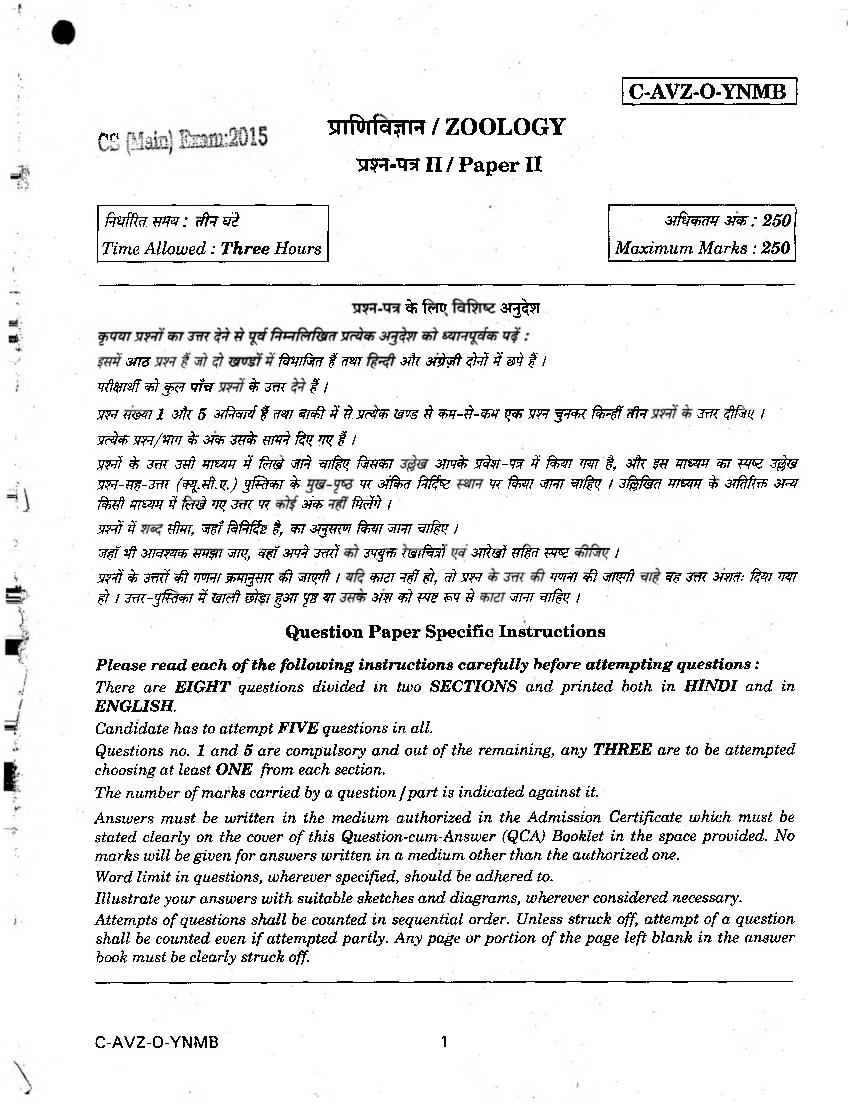
Art y |[Orfe|^R / Z O O L O G Y
3 ^ - ^ II / P a p e r II
f i w f f c r m v : rffr w i: 3i$m m 3m :250
Time Allowed: Three Hours Maximum Marks: 250
% frTTi 3?3^T
3m farftm f wm Jfk snfaft'&rf $&$$’ /
vfi&TZff^ J5cf wfw & JrK f I
JfFT H<94/1 &fk 5 3i&Qi4 f WWT WT^f $ & xc*}<b IsPrg $ W f-3 -W f ^5T 377? ^ 7 ^ 7 f a 0 r ffl JffT cfffjy i
w&z w r /m $ m ; && w ti % w i f
wFtf & im M mm # fast zd w?ffc fimm w& v&r-w # fan mr t, &fk m mm w ?w j$w
w r-w -tt (H-tft-V-) J ^ 7 ^ w 3ffar ftfife t?" fan wn w&? / 5 ® ^ mm $> 37Mm 3^r
‘faff m m $ frf<sl vy jvr w 3/^ fifcfif /
wff $ tffcr, w f fefifftt i, w &$&vnfan wwi *nf& i
Wtff *ff &/c/tyet> HH&i ZITl?, oftff 3fq$ 3ffff JV^rS <<s//fej) Sfffrsft h /$<1 ? W /
wff &3rn? €t whj wn^m <&*m?ft i <mzi wtf& wfwr mu <£t *m?ff w 3rn &m: f&r w
^ / ifK-yfed'bi # weft utergw ys m am # fgg ¥? i wn w1& j
Question Paper Specific Instructions
Please read each o f the following instructions carefully before attempting questions:
There are EIGHT questions divided in two SECTIONS and printed both in HINDI and in
ENGLISH.
Candidate has to attempt FIVE questions in all.
Questions no. 1 and 5 are compulsory and out of the remaining, any THREE are to be attempted
choosing at least ONE from each section.
The number of marks carried by a question /part is indicated against it.
Answers must be written in the medium authorized in the Admission Certificate which must be
stated clearly on the cover o f this Question-cum-Answer (QCA) Booklet in the space provided. No
marks will be given for answers written in a medium other than the authorized one.
Word limit in questions, wherever specified, should be adhered to.
Illustrate your answers with suitable sketches and diagrams, wherever considered necessary.
Attempts of questions shall be counted in sequential order. Unless struck off, attempt of a question
shall be counted even if attempted partly. Any page or portion of the page left blank in the answer
book must be clearly struck off.
C-AVZ-O-YNMB 1
Page 2
SECTION A
Ql. (a) t fo * %f^rf % % fcRrw, v ^ lfM % a q m 3 wfzrtt afk
W T Tief W H W I *t 3R^St *jsft 3Tk 3cflfOTt % £TCI
List and illustrate the components of biological membranes in terms of .
their arrangement, role in the maintenance of feudicity, permeability
and signal reception and translation. 10
(b) ulrlf'frl'MH 3 3FpF>ft^ T^3n?jfl *TFfP=jf| oSIcR^n I Jtrfo;
3 fc|(S(^ ^51 cffa eftforr |
Arrange the sequential enzymatic participations in DNA replication.
Describe their specific role in each step. 10
(c) . 3TIW-1 WnftcT i vrsn sftfa-ira srwnrr % ^ tmrniari w
^ i, d^<«l ^ % f% ^ I
Define operon. Give the similarities and differences between tryptophan
and arabinose operon, with a focus on attenuation. 10
(d) Irq’t echm I ? % SrqftcftfrR fer 3TI5^F
■qft^T ^ t I
What is mutagenesis ? Explain with diagrams how mutagens cause
genetic changes. 10
(e) cisn % sW r cpfa i
Narrate, with suitable examples the use of ribozymes in health care and
agriculture. * 10
Q2. (a) Rb9 P5; ? ^ ^ w | ?t
W f ? .
What are Rb andproteins ? How do they regulate the cell cycle ?
How do they protect the cell from carcinogenesis ? 15
(b) ^sftcR % tj^ sp? ■# fa p ftM
I
Illustrate the different'theories regarding the origin of life with special
reference to protein evolution. 20
C-AVZ-O-YNMB 2
Page 3
(c) ^ irf^nf^r «Stf^ I % *wi6<*> faifast f^rfM 3
f%H 3WR *FPf f I
Define the characters of DNA vectors. Explain with diagrams how these
vectors function in a variety of situations. 15
Q3. (a) (I^TRr ) f l” iMfrPS W ^FR ’JSISTDI %
' 1 ^ r r ff ^ sr gf^ i
“Isolation is the key factor in evolution.” Justify the statement giving
suitable examples from geographical and reproductive isolation. 15
(b) fifspff % Tjjfcff % fsiftre atfiraa^ cTSTT
eren I ftra% w w w % ?r*ft f o f e farc I , 3 * ^
tff i
Give the characteristic features of ancestors of elephants and give
progressive evolutions that have occurred during various geological
times resulting in the emergence of the modem day elephant. 20
(c) sijfiTJT (fafasO) =st W n f^r i ^ fe ? '5ra5R t ? s # r ^Fm 3
3np?JT ^ |3tt t ? si<!^i i
Define mimicry. How does it occur ? How has mimicry evolved in the
animal kingdom ? Give examples. 15
Q4. (a) ^ 35 ^1 ftnRiRsId t :
2n + XhY x 2n + X0xh
% gura? (M s) «Ft*t afk crera fjrcr <rt
^ tt i ^ *ft c^il^u. f t wr clinch ijPt ft'bK % 5 ® I
W cPT!^ :
(i) cTT^f ^ illcWlddl I
(ii) gaf cTSfTj f M yfcMddl I
(iii) MIHH ^F3ft ilfrl?rddl I
jClMilfyfaqi wr I ? % b s r «rtt^ i a n g ^ te
gWlUr'fea 3TOR W t I ?
C-AVZ-O-YNMB 3
Page 4
2n + XhY x 2n + XQxh
. Indicate the type of Gametes that will be formed and character
represented by their Offsprings. Also indicate whether the parents are
carriers or free from disorder.
Find out:
(i) Percentage of carriers.
(ii) Percentage of haemophilic sons and daughters.
(iii) Percentage of normal offsprings.
Why does haemophilia occur ? Give the symptoms of haemophilia. How
is haemophilia genetically inherited ? 20
(b) | i 33% rm w h
i% m ^ | ?
What are giant chromosomes ? Name them. State their locations and
illustrate their structures. How do they function ? 15
(c) snitftits.tnt. cRn ^trtT % ? cnfan 3 if
What is ICZN ? Explain the principle, scope and limitations in the
present day scenario of nomenclature. 15
C-AVZ-O-YNMB 4
Page 5
W B
SECTION B
Q5. (a) c -Am p % ^ ■ # 3qgrf;f%3f i
C-AMP ft*T WIT 3M h ^FT?^t Hf^T ^ t I
Describe with suitable diagrams the role of G-protein in the synthesis of
C-AMP. Demonstrate how C-AMP activate protein kinase. 10
(b) fedfirc w 'f ? fadlM cpfa I
What are vitamins and co-enzymes ? Describe fat soluble vitamins with
examples. 10
(c) if ^rm fofau; sffc Rnidfi^d ^ % 3rrc :
\ • \ 3
(i) *TFff ^1 I
(ii) I
(iii) ^ff^rar % wit -tw i
(iv) ^1 3PT |?
(v) fe? £RT % ?JT ( ^ ) % 3PT "blftR>l3Tt it
3nim ^ft<r f ?
Label the figure and answer the following questions :
(i) Name the parts.
(ii) Name the inner ossicles.
(iii) Name the parts of cochlea.
(iv) What is the organ of corti ?
(v)' What are the steps by which sound waves at the ear drum cause
impulse generation in the cells of organ of corti ? 10
C-AVZ-O-YNMB 5
Page 6
Differentiate between saturated and unsaturated fatty acids and their
functions. 10
(e) W 3g^rft 3rfcR8JT % I 3^5® ^r^ufj ^ra 3T^ 3tTC
^>t tt4>wid I
Differentiate between Innate and Adaptive immunity. Justify your
answer with suitable examples. 10
Q6. (a) % anfocp?; i|i(*t>c«l % BT«J I
M wfER 3 sim f ark ^ <£t f^-cHi ^ r o ;
vjfR<l41 cFTT^ ^ sfiTT^i I .
Explain with diagrams the molecular mechanism of contraction of
skeletal muscles. Discuss the role of ions and bioenergetics in muscle
contraction. Attribute the cause(s) for muscle cramps. 20
(b) SFRROT qpSTT % ? W 3c^rff sJTCT, yftsWufl cfSIT cfsftTFt cb|i|M<U| 3
fcr^q i t o -gcRR t ?
What is metamorphosis ? Differentiate between retrogressive and
progressive metamorphosis, with figures and examples. How are they
regulated ? 15
(c) ff# r f WnftrT I ^RTg rtm fc$^? I
^ Ca+2 w a t V*0<ii£W wf|<<ta
% ^T. ^ ^ f I
Define hormones. Distinguish between Steroid and Peptide hormones.
Give the name of the hormones and its mechanism of action that uses
Ca+2 and/or Calcitonin as second messenger. 15
Q7. (a) T^fT^r M f ? ijrg 3 I
What are caspase enzymes ? Narrate their crucial role in cell death. 15
(b) ('dlfdMl&) ?Rrr ^ ir P ^p t \
M 3 ^ (^t?) % im p ] w i
Differentiate between totipotent and multipotent cells with suitable
examples. Explain the use of stem cells in human diseases. 20
w m ¥l i
What is an active site ? How does enzyme catalysis take placein an
active site ? Explain with suitable examples. 15
C-AVZ-O-YNMB 6
Page 7
(i) ^ s p % % ff sfr 3 Ad'fl'fl ^ra, ?Tc=ft cp w «w -fi cMfejPW sfcft f ?
** >
(ii) ^ W | ?
;(iii): TJjf ftlrf'T % ^ fcT%!; I
* (iv) rWT MysTl^ M cR % ^T?f TT w 3TOW ^PTT t
(v). .Trg^si tj^ pi eft t o ^fRn cf«rr ip % % xj;
^ ^Fi ihn | ?
C-AVZ-O-YNMB 7
Page 8
* ■*s " i
(i) Which region of the kidney contains malpighian body, loop of
Henle and collecting ducts $ —
(ii) What is Glomerular filtration rate ?
(iii) Write the steps, of urine formation.
(iv) What is the effect of vasopressin, oxytocin and aldosterone in renal-
^function? /
(v) What is the holding capacity, of urinary bladder in man and the y :
term used for the discharge of urine ? '/■,00
(b) -srfJtT, ott stM ^Tr cfarf
=bi=fT?i^i it i . . . . ,,„v
.y-. " 1'■ %• , ’.. • -ff
Explain the role of salivary glands, liver, pancreas and intestinal1,glands
;■ infat and'carbohydrate digestion. \ V; 15
(c) yil«l4i % TrMI<q i[ fasblfl # SFTPST ii? # #
Which stage of the development is used to produce*, the transgenic "
animals ? How is it done ? ^5
C-AVZ-OYNMB i;’ 8
Document Details
| Board / Org | UPSC |
| Exam | UPSC CSE (IAS) |
| Type | Question Paper |
| Pages | 8 |
| Updated | 30 Apr 2026 |