ISC Class 12 Sample Paper Music Western
Finished viewing? Save it for later —
Download ISC Class 12 Sample Paper Music Western (PDF · 5 pages)About ISC Class 12 Sample Paper Music Western
ISC Class 12 Sample Paper Music Western is available here for free download. Published by CISCE for Class 12, this sample paper can be viewed online or downloaded as a PDF (5 pages). Candidates preparing for Class 12 can use ISC Class 12 Sample Paper Music Western to understand the exam pattern, the type of questions asked, and the overall difficulty level.
Frequently Asked Questions
How can I download ISC Class 12 Sample Paper Music Western?
Open this page and click the Download button to save ISC Class 12 Sample Paper Music Western as a PDF. It is completely free on AglaSem Docs.
Is ISC Class 12 Sample Paper Music Western free to download?
Yes. ISC Class 12 Sample Paper Music Western can be viewed online and downloaded as a PDF free of cost on AglaSem Docs.
How many pages does ISC Class 12 Sample Paper Music Western have?
ISC Class 12 Sample Paper Music Western contains 5 pages, which you can read online or download together as a single PDF.
Where can I find more Class 12 study material?
You can find more Class 12 question papers, sample papers, syllabus, and answer keys on AglaSem Docs.
ISC Class 12 Sample Paper Music Western – Text
Read the full text of this sample paper below — useful to quickly search, copy and reference the content online without downloading the PDF.
📄 View text version (5 pages)
Page 1
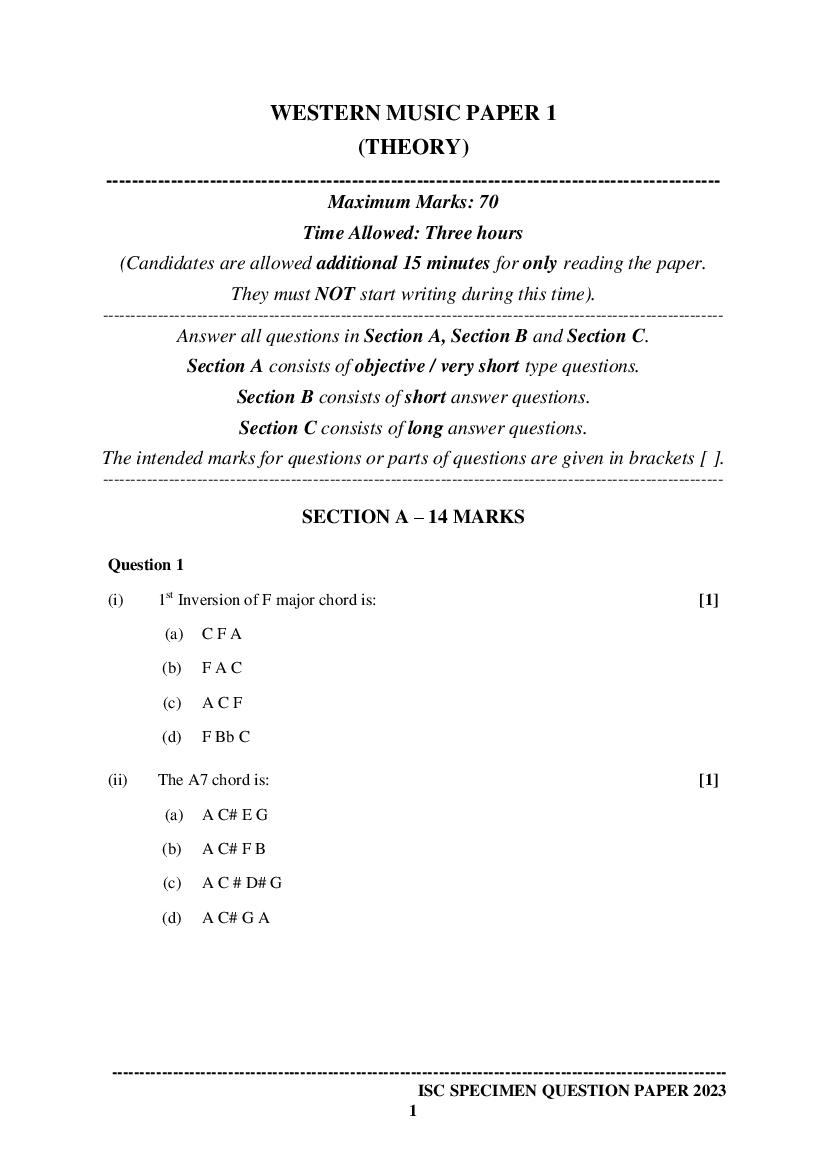
(THEORY)
-----------------------------------------------------------------------------------------------
Maximum Marks: 70
Time Allowed: Three hours
(Candidates are allowed additional 15 minutes for only reading the paper.
They must NOT start writing during this time).
----------------------------------------------------------------------------------------------------------------
Answer all questions in Section A, Section B and Section C.
Section A consists of objective / very short type questions.
Section B consists of short answer questions.
Section C consists of long answer questions.
The intended marks for questions or parts of questions are given in brackets [ ].
----------------------------------------------------------------------------------------------------------------
SECTION A – 14 MARKS
Question 1
(i) 1st Inversion of F major chord is: [1]
(a) CFA
(b) FAC
(c) ACF
(d) F Bb C
(ii) The A7 chord is: [1]
(a) A C# E G
(b) A C# F B
(c) A C # D# G
(d) A C# G A
1
Page 2
(a) uppercase roman numerals.
(b) lowercase roman numerals.
(c) alphabets.
(d) none of the above.
(iv) Which one of the following composers belongs to Baroque era? [1]
(a) Beethoven
(b) Bach
(c) Schubert
(d) Caesar Frank
(v) Which one of the following is a type of modulation? [1]
(a) Circle of fifth
(b) Sub-Dominant
(c) Diminished
(d) Chord Progression
(vi) State whether the following statements are True or False:
(a) The G minor scale has 1 flat in its scale. [1]
(b) Figured bass is associated with inversions. [1]
(c) First inversion starts on the root note. [1]
(vii) S A T B is referred to as _____________ of music. [1]
(viii) Beethoven’s Symphony number 2 was written in the year ___________. [1]
(ix) A piece of solo instrumental music is called ________________. [1]
(x) Which instrument uses figured bass in general? [1]
(xi) Who wrote Violin Sonata? [1]
(xii) What is the other name for Unessential notes? [1]
2
Page 3
Question 2 [4]
(i) Write a brief note on Harmonic modulations.
OR
(ii) Write a brief note on Prelude and its nature.
Question 3 [4]
Unessential notes add progressive aspects to a melody. Justify.
Question 4 [4]
Briefly explain Dominant 7th chord and the forms of Inversions.
Question 5 [4]
(i) What are the advantages of using Figured bass?
OR
(ii) What are inversions? Mention its three positions.
Question 6 [4]
Explain parts of music. How are they used in Harmonic Progression?
Question 7 [4]
Mention any two types of Rhythm positions. Briefly explain how these positions can
be structured in bars.
Question 8 [4]
Write the chord progression for C major scale and its relative minor.
3
Page 4
Question 9 [7]
The image given below shows the rhythm structure. Complete the melody for the
lyrics.
Hush little baby, don’t say a word,
Mama’s going to buy you a mockingbird.
And if that mockingbird doesn’t sing,
Mama’s going to buy you a diamond ring.
And if the diamond ring turns bass,
Mama’s going to buy you a looking glass.
Question 10 [7]
Write four parts harmony in a simple pianoforte style for the given melody.
4
Page 5
Mark the appropriate figured bass numbers for the melody given below.
Question 12 [7]
(i) Analyse the compositions given below.
(a) Beethoven’s Symphony no.2 sin major op36
(b) Schubert’s Erl Kenig (Earl King)
OR
(ii) Analyse Caesar Frank’s last movement in Piano and Violin Sonata.
5
Document Details
| Board / Org | CISCE |
| Exam | Class 12 |
| Type | Sample Paper |
| Pages | 5 |
| Updated | 29 Aug 2026 |