PU CET PG 2019 Question Paper Masters in Disaster Management
Finished viewing? Save it for later —
Download PU CET PG 2019 Question Paper Masters in Disaster Management (PDF · 8 pages)About PU CET PG 2019 Question Paper Masters in Disaster Management
PU CET PG 2019 Question Paper Masters in Disaster Management is available here for free download. Published by Panjab University for PU CET PG, this question paper can be viewed online or downloaded as a PDF (8 pages). Candidates preparing for PU CET PG can use PU CET PG 2019 Question Paper Masters in Disaster Management to understand the exam pattern, the type of questions asked, and the overall difficulty level.
Frequently Asked Questions
How can I download PU CET PG 2019 Question Paper Masters in Disaster Management?
Open this page and click the Download button to save PU CET PG 2019 Question Paper Masters in Disaster Management as a PDF. It is completely free on AglaSem Docs.
Is PU CET PG 2019 Question Paper Masters in Disaster Management free to download?
Yes. PU CET PG 2019 Question Paper Masters in Disaster Management can be viewed online and downloaded as a PDF free of cost on AglaSem Docs.
How many pages does PU CET PG 2019 Question Paper Masters in Disaster Management have?
PU CET PG 2019 Question Paper Masters in Disaster Management contains 8 pages, which you can read online or download together as a single PDF.
Where can I find more PU CET PG study material?
You can find more PU CET PG question papers, sample papers, syllabus, and answer keys on AglaSem Docs.
PU CET PG 2019 Question Paper Masters in Disaster Management – Text
Read the full text of this question paper below — useful to quickly search, copy and reference the content online without downloading the PDF.
📄 View text version (8 pages)
Page 1
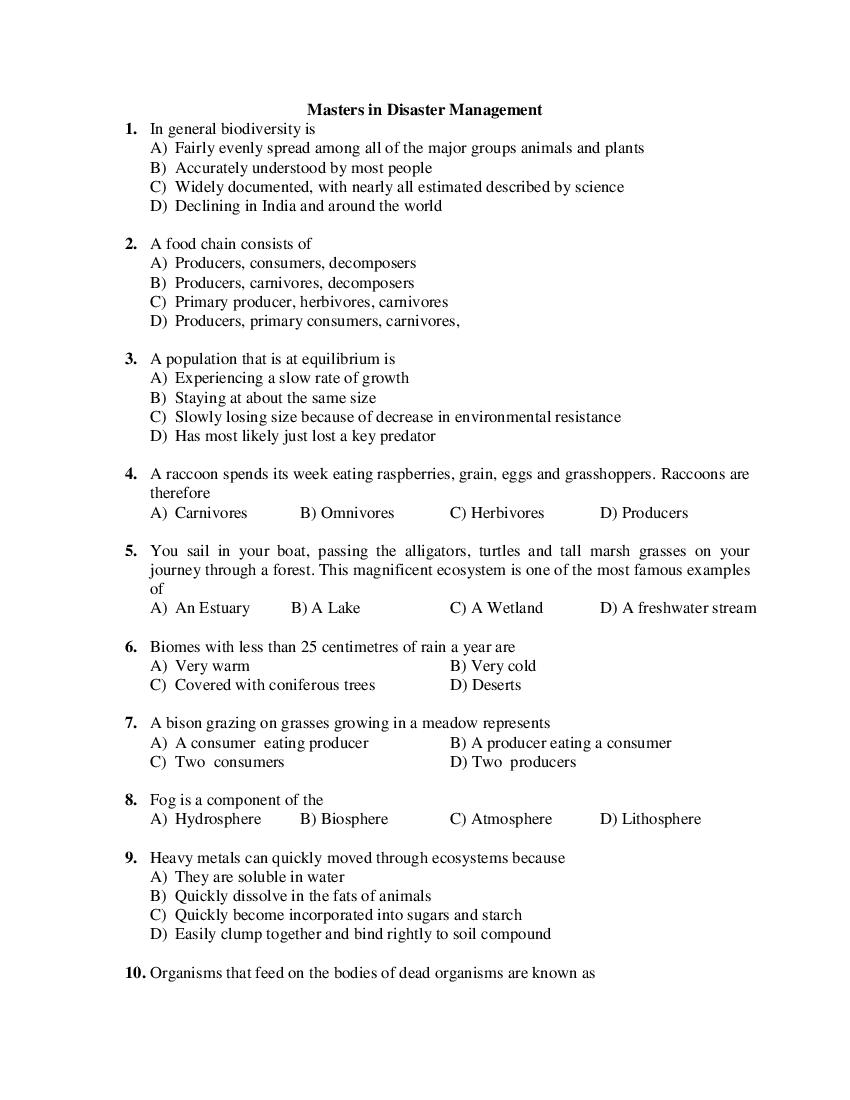
1. In general biodiversity is
A) Fairly evenly spread among all of the major groups animals and plants
B) Accurately understood by most people
C) Widely documented, with nearly all estimated described by science
D) Declining in India and around the world
2. A food chain consists of
A) Producers, consumers, decomposers
B) Producers, carnivores, decomposers
C) Primary producer, herbivores, carnivores
D) Producers, primary consumers, carnivores,
3. A population that is at equilibrium is
A) Experiencing a slow rate of growth
B) Staying at about the same size
C) Slowly losing size because of decrease in environmental resistance
D) Has most likely just lost a key predator
4. A raccoon spends its week eating raspberries, grain, eggs and grasshoppers. Raccoons are
therefore
A) Carnivores B) Omnivores C) Herbivores D) Producers
5. You sail in your boat, passing the alligators, turtles and tall marsh grasses on your
journey through a forest. This magnificent ecosystem is one of the most famous examples
of
A) An Estuary B) A Lake C) A Wetland D) A freshwater stream
6. Biomes with less than 25 centimetres of rain a year are
A) Very warm B) Very cold
C) Covered with coniferous trees D) Deserts
7. A bison grazing on grasses growing in a meadow represents
A) A consumer eating producer B) A producer eating a consumer
C) Two consumers D) Two producers
8. Fog is a component of the
A) Hydrosphere B) Biosphere C) Atmosphere D) Lithosphere
9. Heavy metals can quickly moved through ecosystems because
A) They are soluble in water
B) Quickly dissolve in the fats of animals
C) Quickly become incorporated into sugars and starch
D) Easily clump together and bind rightly to soil compound
10. Organisms that feed on the bodies of dead organisms are known as
Page 2
C) Decomposers D) Omnivores
11. Populations of species that occupy the same Geographic area and interact with each
others are collectively called
A) An ecosystem B) A community C) A drift D) A biosphere
12. Sustainable populations
A) Are often near their carrying capacity
B) Have exceeded their biotic potential
C) Have grown beyond all types of environmental resistance
D) Are characterized by high emigration and low recruitment
13. The ability of an ecosystem to replenish itself leads to
A) Sustainability
B) Decreasing consumptive use
C) The conversion of ecosystem capital from one form to another
D) Increasing natural resources but declining ecosystem capital
14. The graphical representation of the interrelation of producer and consumer in an
ecosystem is termed as
A) Ecological Niche B) Ecological pyramid
C) Trophic levels D) Food web
15. Importance of ecosystem lies in
A) Transfer of food B) Flow of energy
C) Cycling of materials D) Both B and C
16. The interdependence of the living organisms among themselves and their environment is
called
A) Ecology B) Ecosystem C) Biology D) Anthology
17. The population of a particular species that an ecosystem can sustain indefinitely is called
its
A) Habitat distribution B) Climax community
C) Carrying capacity D) Environmental range
18. The sequence of organisms which feed on one another for their survival is known as
A) Passage of nutrients from one organism to other
B) Food chain
C) Trophic level
D) Biodiversity
19. In Kolkata, major air pollution is caused by
A) Fungal spores B) Algae C) Hydrocarbons D) Sulphur Dioxide
Page 3
A) Cloudy skies
B) Atmospheric pressure in that area is lower than that in the surrounding areas
C) Heavy weather causing a feeling of depression
D) Low atmospheric pressure over a large area
21. Burning fossil fuels in a low oxygen environment will most likely produce
A) Carbon monoxide B) Hydrogen peroxide
C) Sulphuric acid D) Radon gases
22. DDT is a
A) Biochemical pollutant B) Biodegradable pollutant
C) Non-Biodegradable Pollutant D) Non pollutant
23. Most of the air pollution that we experience is located in the
A) Mesosphere B) Thermosphere C) Stratosphere D) Troposphere
24. The largest variety of plants and animals is found in the
A) Temperate forests B) Monsoon forests
C) Tropical forests D) Tropical grasslands
25. Ozone Layer can be destroyed by pollutants such as
A) Halons and CFCs B) Sulphur dioxide
C) Carbon monoxide D) Hydrocarbons and nitrogen oxides
26. Deep underground reservoirs of water are called
A) Eutrophic zones B) Aquifers
C) Non phototrophic zones D) Seismic buffers
27. Most of the water on Earth is found in
A) Lakes and rivers B) Polar ice caps C) Glaciers D) Oceans
28. The greatest threat to groundwater supplies are
A) Groundwater pollution and depletion
B) Global warming and the construction of dams
C) Increased Evaporation And Increased Precipitation
D) Evapo-transpiration and runoff
29. The largest reserves of freshwater on earth are found in
A) Lakes and wetlands B) Rivers and groundwater
C) Aquifers D) Polar ice caps and glaciers
30. Species with very restricted distribution over relatively small ranges is called
A) Endangered species B) Extinct species
C) Endemic species D) None of the above
Page 4
A) F.P. Odum B) Norman Myers C) James lovelock D) Rachel Carson
32. If you travel through the Himalayas, you are likely to see which of the following plants
naturally growing there
1. Oak
2. Rhododendron
3. Sandalwood
select the correct answer using the codes given below
A) 1 and 2 B) Only 3 C) 1 and 3 D) All of these
33. The most important strategy for the conservation of biodiversity together with traditional
human life is the establishment of
A) Biosphere Reserves B) Botanical gardens
C) National parks D) Wildlife sanctuaries
34. In which of the following states is Lion tailed macaque found in its natural habitat
1. Tamil Nadu
2. Kerala
3. Karnataka
4. Andhra Pradesh
Select the correct answer using the codes given below
A) 1, 2 and 3 B) Only 1 C) 1, 3 and 4 D) All of these
35. Which one of the following is not a site for in situ method of conservation of flora?
A) Biosphere reserve B) Botanical garden
C) National Park D) wildlife Sanctuary
36. Diversity and productivity of the coral reef is most similar to that of.
A) Desert environments B) A natural prairie
C) Tropical rainforests D) A river system
37. Although the Green Revolution has greatly reduced world hunger and malnutrition, it has
A) Doubled the amount of land used to raise crops
B) Not significantly increased the productivity of modern agriculture
C) Required high levels of fertilizers and pesticides
D) Contributed significantly to the destruction of ozone layer
38. Around the world, the greatest health risk to children under the age of 5 is
A) Infectious disease B) Lack of immunizations
C) Being underweight D) The loss of both parents
39. Global climate change may increase the number of worldwide famines by
A) Shifting the types of crops grown in a region
B) Causing the spread of infectious disease
Page 5
D) Requiring the use of alternate forms of energy
40. In the subcontinent of India the region frequently affected by tropical cyclone is
A) Gujarat coast B) Coromandel Coast
C) Konkan Coast D) Malabar Coast
41. The Vale of Kashmir is the only level strip of land in the Himalayas, which river has laid
its deposits to form this land
A) Ravi B) Satluj C) Beas D) Jhelum
42. In the context of CO emission and global warming, what is the name of a market driven
device under the UNFCC that allows developing countries to get funds incentive from the
developed countries to adopt better technologies that reduce Greenhouse gas emissions
A) Carbon footprint B) Carbon credit rating
C) Clean development mechanism D) Emission reduction norm
43. From which one of the following did the concept of Carbon Credit originate
A) Earth Summit B) Kyoto Protocol
C) Montreal Protocol D) G8 Summit
44. The rate of energy at consumer’s level is known as
A) Net primary productivity B) Total primary productivity
C) Primary productivity D) Productivity
45. What is not an external factor to control an ecosystem
A) Altitude B) Microbes C) Type of soil D) Topography
46. Which of the following region is the highest seismic domain in India
A) The Deccan Plateau B) The Western Ghats
C) The Indo Gangetic Plain D) The Himalayas
47. Which of the following is the first National Park established in India
A) Kanha National Park B) Gir National Park
C) Hazaribagh National Park D) Jim Corbett National Park
48. How do the 'western disturbances' affect the crops in north India?
A) They cause heavy damage to the standing crops
B) They bring in locusts which destroy the crops
C) They are beneficial to the crops by causing winter rain
D) They help in keeping the plants warm to some extent in winter
49. Which of the following is responsible for hardness of water
A) Sodium and chloride ions B) Potassium and nitrite ions
C) Calcium and magnesium ions D) Strontium and nitrate ions
Page 6
A) 1755 B) 1952 C) 1972 D) 1970
51. Sahyadri mountains refer to
A) Western Ghats B) Eastern Ghats C) Satpura Range D) Siwaliks
52. In 2007, heavy rains contributed to an outbreak of Cholera in children living in war torn
Iraq. What was the likely cause of the spread of this disease?
A) Pollution of waterways by raw sewage
B) Outbreaks of mosquitoes
C) Lack of protection from the rain caused children to be very cold
D) Rain soaked roads prevented the distribution of much needed food supplies
53. Most of the weather of the world is based upon changes in the moisture, pressure, and/or
temperature of the:
A) Mesosphere B) Thermosphere C) Stratosphere D) Troposphere
54. Nutrients essential for plant growth are returned to the soil by
A) Decomposers B) Herbivores C) Producers D) Carnivores
55. Oral Rehydration Therapy (ORT) is the process of:
A) Continuous replacement of essential body fluids and salt in proper quantities during
the attacks of diarrhea
B) Providing mineral water and fruit juice by railway during journey
C) Taking saline injection
D) None of the above
56. Take a big breath of air, you have mostly inhaled
A) Nitrogen B) Oxygen C) Carbon dioxide D) Water
57. The Chemistry Professor warned the students that you never store acids in metal
containers because acids demonstrate the high level of
A) Ignitability B) Toxicity C) Reactivity D) Corrosivity
58. The fossil fuels are considered non renewable sources of energy because
A) Their formation is so slow
B) They release carbon dioxide when they are burnt
C) People are cutting down too many forests to allow trees to turn into coal
D) Carbon dioxide levels in the atmosphere are too low to allow fossil fuels to form
59. The greatest Public Health concerns about the H5N1 bird flu virus is that it will
A) Be spread from one bird to another B) Be spread from Birds to people
C) Spread out of the country of Australia D) Spread from person to person
60. In 1984, the worst gas tragedy in India took place in
Page 7
61. Ramsar Convention, 1971 aimed at the conservation of
A) Waste land B) Wetlands C) Desert D) All of these
62. The term eutrophication stands for
A) The pollution of oceans by seepage of crude oil
B) Pollution of water by invading plants
C) Climax vegetation and succession
D) A body of water rich in nutrients and supporting a dense plant population
63. The term Green-Shield stands for
A) Boreal forests B) Equatorial forests
C) Estuarine ecosystem D) Mangrove forests
64. The agenda 21 of the Earth Summit was about
A) Climate change
B) Biodiversity conservation
C) Earth Charter
D) Sustainable development
65. Which one of the following is not a suitable technique to control soil erosion in a desert
or semi desert area
A) Afforestation B) Contour ploughing
C) Stubble mulching D) Terracing
66. Consider the following statements and select the correct answer using the code given
below
1. The arrival of Tsunami in the coastal zone is heralded by sudden recession of
seawater
2. Tsunami sometimes generate specular waves called as edge waves which move back
and forth and parallel to the coast
A) Only 1 is correct B) Both 1 and 2 are correct
C) Only 2 is correct D) Neither 1 nor 2 is correct
67. The term regolith stands for
A) A blanket of soil and loose rock fragments overlying Bedrock
B) A large body of intrusive igneous rock
C) Rock that commonly have high permeability
D) A depositional landform in a desert
68. The term Erg stands for
A) High altitude desert B) Rocky desert C) Semi desert D) Sandy desert
69. The term cryosphere stands for
A) The area in which the gravitational force of the moon and the sun is predominant
B) The region below the lithosphere rocks are less rigid
Page 8
D) The portion of the Earth's surface where water is in a solid form
70. Consider the following statements and select the correct answer using the code given
below
1. A sharp release of energy that produce shaking in Earth's crust is known as
earthquake
2. Earthquake is a universal phenomenon recorded in all the parts of the world
A) Only 1 is correct B) Only 2 is correct
C) Both 1 and 2 are correct D) Neither 1 nor 2 correct
71. Which one of the following statements is not correct
A) Thunderstorm is the resulting sound from the violent expansion of air close to the
lightning
B) Lightning is an integral part of severe Storms and is itself a distinction hazard
C) Most of the fatalities from lightning are in the forenoon
D) Lightning is an electrical charge resulting from separation of positive and negative
charges within clouds and the ground
72. Consider the following statements and select the correct answer using the codes given
below
1. Hailstones consists of concentric layers of ice
2. Hailstones developed when there is strong updraft of air in cumulus-Nimbus clouds
3. Hailstones occur only in the tropical and temperate latitudes
A) Only 1 and 2 are correct B) Only 2 and 3 are correct
C) Only 1 and 3 are correct D) 1, 2 and 3 are correct
73. Which one of the following statements is not correct
A) The tropical cyclones only develop over large bodies of warm water
B) Tropical cyclones develop when both the air and water temperatures are higher than
normal
C) Tropical cyclones only develop in summer in tropical oceans
D) Hurricane are associated with atmospheric fronts
74. The distribution of rainfall in India is not influenced by
A) Himalayan mountains B) Indian Ocean
C) Western Ghats D) Thar desert
75. Out of the following the highest salinity of the oceans is found in the
A) Dead Sea B) Mediterranean sea C) Caribbean Sea D) Black Sea
x-x-x
Document Details
| Board / Org | Panjab University |
| Exam | PU CET PG |
| Type | Question Paper |
| Pages | 8 |
| Updated | 22 Jul 2026 |