GATE 2012 Question Paper for XE - Engineering Sciences
Finished viewing? Save it for later —
Download GATE 2012 Question Paper for XE - Engineering Sciences (PDF · 36 pages)About GATE 2012 Question Paper for XE - Engineering Sciences
GATE 2012 Question Paper for XE - Engineering Sciences is available here for free download. Published by IIT for GATE, this question paper can be viewed online or downloaded as a PDF (36 pages). Candidates preparing for GATE can use GATE 2012 Question Paper for XE - Engineering Sciences to understand the exam pattern, the type of questions asked, and the overall difficulty level.
Frequently Asked Questions
How can I download GATE 2012 Question Paper for XE - Engineering Sciences?
Open this page and click the Download button to save GATE 2012 Question Paper for XE - Engineering Sciences as a PDF. It is completely free on AglaSem Docs.
Is GATE 2012 Question Paper for XE - Engineering Sciences free to download?
Yes. GATE 2012 Question Paper for XE - Engineering Sciences can be viewed online and downloaded as a PDF free of cost on AglaSem Docs.
How many pages does GATE 2012 Question Paper for XE - Engineering Sciences have?
GATE 2012 Question Paper for XE - Engineering Sciences contains 36 pages, which you can read online or download together as a single PDF.
Where can I find more GATE study material?
You can find more GATE question papers, sample papers, syllabus, and answer keys on AglaSem Docs.
GATE 2012 Question Paper for XE - Engineering Sciences – Text
Read the full text of this question paper below — useful to quickly search, copy and reference the content online without downloading the PDF.
📄 View text version (36 pages)
Page 1
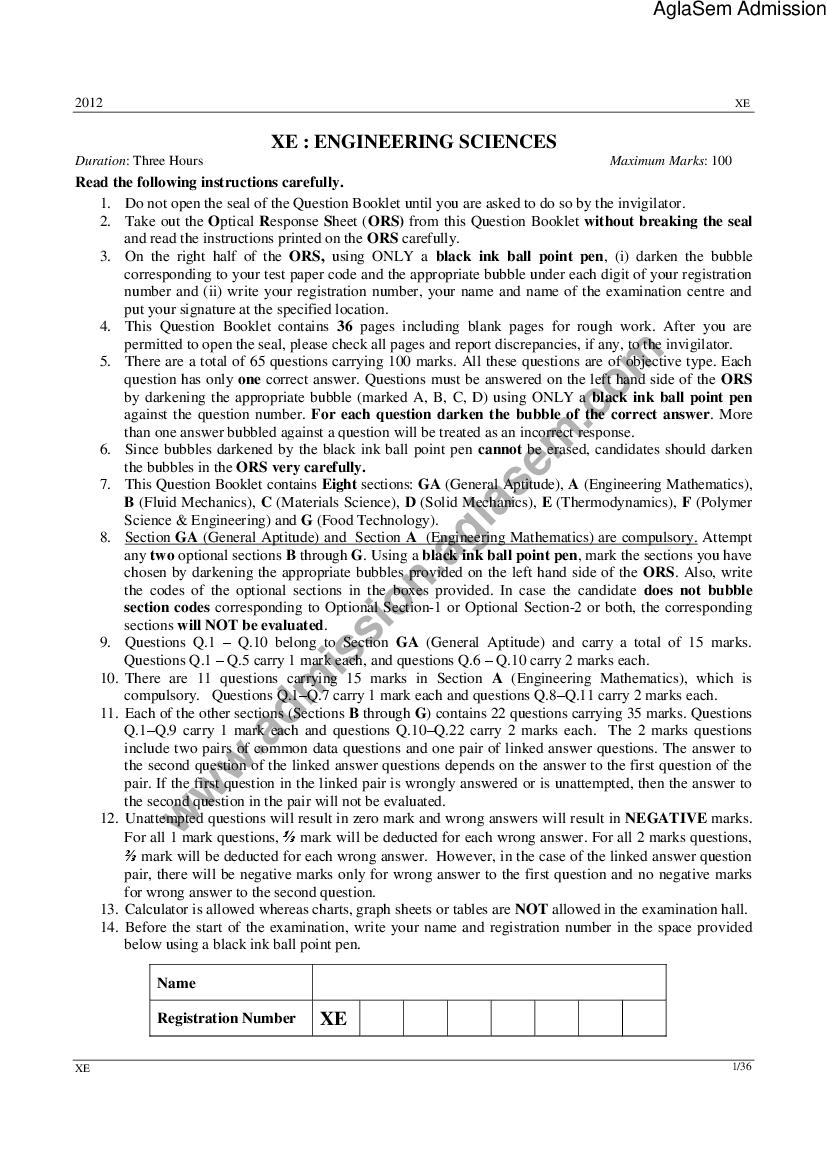
XE : ENGINEERING SCIENCES
Duration: Three Hours Maximum Marks: 100
Read the following instructions carefully.
1. Do not open the seal of the Question Booklet until you are asked to do so by the invigilator.
2. Take out the Optical Response Sheet (ORS) from this Question Booklet without breaking the seal
and read the instructions printed on the ORS carefully.
3. On the right half of the ORS, using ONLY a black ink ball point pen, (i) darken the bubble
corresponding to your test paper code and the appropriate bubble under each digit of your registration
number and (ii) write your registration number, your name and name of the examination centre and
put your signature at the specified location.
4. This Question Booklet contains 36 pages including blank pages for rough work. After you are
permitted to open the seal, please check all pages and report discrepancies, if any, to the invigilator.
o m
5. There are a total of 65 questions carrying 100 marks. All these questions are of objective type. Each
question has only one correct answer. Questions must be answered on the left hand side of the ORS
.c
by darkening the appropriate bubble (marked A, B, C, D) using ONLY a black ink ball point pen
against the question number. For each question darken the bubble of the correct answer. More
m
than one answer bubbled against a question will be treated as an incorrect response.
6. Since bubbles darkened by the black ink ball point pen cannot be erased, candidates should darken
the bubbles in the ORS very carefully.
s e
7. This Question Booklet contains Eight sections: GA (General Aptitude), A (Engineering Mathematics),
l a
B (Fluid Mechanics), C (Materials Science), D (Solid Mechanics), E (Thermodynamics), F (Polymer
g
Science & Engineering) and G (Food Technology).
8. Section GA (General Aptitude) and Section A (Engineering Mathematics) are compulsory. Attempt
. a
any two optional sections B through G. Using a black ink ball point pen, mark the sections you have
n
chosen by darkening the appropriate bubbles provided on the left hand side of the ORS. Also, write
the codes of the optional sections in the boxes provided. In case the candidate does not bubble
o
sections will NOT be evaluated.
s i
section codes corresponding to Optional Section-1 or Optional Section-2 or both, the corresponding
is
9. Questions Q.1 – Q.10 belong to Section GA (General Aptitude) and carry a total of 15 marks.
Questions Q.1 – Q.5 carry 1 mark each, and questions Q.6 – Q.10 carry 2 marks each.
10. There are 11 questions carrying 15 marks in Section A (Engineering Mathematics), which is
d m
compulsory. Questions Q.1–Q.7 carry 1 mark each and questions Q.8–Q.11 carry 2 marks each.
11. Each of the other sections (Sections B through G) contains 22 questions carrying 35 marks. Questions
.a
Q.1–Q.9 carry 1 mark each and questions Q.10–Q.22 carry 2 marks each. The 2 marks questions
include two pairs of common data questions and one pair of linked answer questions. The answer to
w
the second question of the linked answer questions depends on the answer to the first question of the
w
pair. If the first question in the linked pair is wrongly answered or is unattempted, then the answer to
the second question in the pair will not be evaluated.
w
12. Unattempted questions will result in zero mark and wrong answers will result in NEGATIVE marks.
For all 1 mark questions, ⅓ mark will be deducted for each wrong answer. For all 2 marks questions,
⅔ mark will be deducted for each wrong answer. However, in the case of the linked answer question
pair, there will be negative marks only for wrong answer to the first question and no negative marks
for wrong answer to the second question.
13. Calculator is allowed whereas charts, graph sheets or tables are NOT allowed in the examination hall.
14. Before the start of the examination, write your name and registration number in the space provided
below using a black ink ball point pen.
Name
Registration Number XE
XE 1/36
Page 2
General Aptitude (GA) Questions (Compulsory)
Q. 1 – Q. 5 carry one mark each.
Q.1 One of the parts (A, B, C, D) in the sentence given below contains an ERROR. Which one of the
following is INCORRECT?
I requested that he should be given the driving test today instead of tomorrow.
(A) requested that
(B) should be given
(C) the driving test
(D) instead of tomorrow
Q.2
o m
Which one of the following options is the closest in meaning to the word given below?
Latitude
.c
em
(A) Eligibility (B) Freedom (C) Coercion (D) Meticulousness
Q.3
s
Choose the most appropriate word from the options given below to complete the following
sentence:
a
g l
Given the seriousness of the situation that he had to face, his ___ was impressive.
(A) beggary (B) nomenclature
. a
(C) jealousy (D) nonchalance
Q.4
o n
Choose the most appropriate alternative from the options given below to complete the following
sentence:
s i
If the tired soldier wanted to lie down, he ___ the mattress out on the balcony.
(A) should take
(B) shall take is
(C) should have taken
(D) will have taken
d m
Q.5 .a
If (1.001)1259 = 3.52 and (1.001)2062 = 7.85, then (1.001)3321 =
(A) 2.23 w (B) 4.33 (C) 11.37 (D) 27.64
w
w
Q. 6 - Q. 10 carry two marks each.
Q.6 A and B are friends. They decide to meet between 1 PM and 2 PM on a given day. There is a
condition that whoever arrives first will not wait for the other for more than 15 minutes. The
probability that they will meet on that day is
(A) 1/4 (B) 1/16 (C) 7/16 (D) 9/16
XE 2/36
Page 3
Q.7 The data given in the following table summarizes the monthly budget of an average household.
Category Amount (Rs.)
Food 4000
Clothing 1200
Rent 2000
Savings 1500
Other expenses 1800
The approximate percentage of the monthly budget NOT spent on savings is
(A) 10% (B) 14% (C) 81% (D) 86%
Q.8
m
There are eight bags of rice looking alike, seven of which have equal weight and one is slightly
o
heavier. The weighing balance is of unlimited capacity. Using this balance, the minimum number
.c
of weighings required to identify the heavier bag is
(A) 2 (B) 3 (C) 4 (D) 8
Q.9
e m
Raju has 14 currency notes in his pocket consisting of only Rs. 20 notes and Rs. 10 notes. The total
s
money value of the notes is Rs. 230. The number of Rs. 10 notes that Raju has is
a
(A) 5 (B) 6 (C) 9
g l (D) 10
Q.10
a
One of the legacies of the Roman legions was discipline. In the legions, military law prevailed
.
and discipline was brutal. Discipline on the battlefield kept units obedient, intact and fighting,
n
even when the odds and conditions were against them.
o
i
Which one of the following statements best sums up the meaning of the above passage?
s
is
(A) Thorough regimentation was the main reason for the efficiency of the Roman legions even in
adverse circumstances.
(B) The legions were treated inhumanly as if the men were animals.
d m
(C) Discipline was the armies’ inheritance from their seniors.
(D) The harsh discipline to which the legions were subjected to led to the odds and conditions being
against them.
.a
w
w
w
XE 3/36
Page 4
A : ENGINEERING MATHEMATICS (Compulsory)
Q. 1 – Q. 7 carry one mark each.
1 4 5
Q.1 For the matrix M 0 2 6 , consider the following statements:
0 0 3
4 4
Q: 1 is an eigenvector of M. R: 2 is an eigenvector of M.
P: 3 is an eigenvalue of M.
0 0
Which of the above statements are TRUE?
o m
.c
(A) P and Q, but not R (B) Q and R, but not P
(C) P and R, but not Q (D) P, Q, and R
Taylor series of f ( x )
1
e m
about x 0 is given as TS f 1 x x 2 x 3 . This series can
Q.2
1 x
be used to evaluate f (x ) for
a s
(A) x 1 (B) x 1
g
(C) x 1
l (D) 1 x 1
. a
Q.3
F / y is
on
Let f (u, v) u ln(v) and F ( x, y) f (u( x, y), v( x, y)) , where u x / y and v x y . Then
x x
s i x u
is
(A) ln ( x y ) (B) ln v
y 2
y ( x y) y 2
v
y
x
(C) 2 ln v
u
v
d m x
(D) 2 ln v
y
x
yv
Q.4 .a
Consider two functions f ( z ) z and g ( z ) z (conjugate of z). Using Cauchy-Riemann
w
conditions, choose the correct answer
w
(A) Both f and g are analytic (B) f is analytic but g is not analytic
w
(C) g is analytic but f is not analytic (D) Neither f nor g is analytic
Q.5 For f x 4 5 xy 2 , the direction of maximum increase of f ( x, y ) at the point (2, 2) is along
(A) 3iˆ 10 ˆj (B) 12iˆ 40 ˆj (C) 3iˆ 10 ˆj (D) 12iˆ 40 ˆj
Q.6 Suppose 50% of the population of a village like oranges, 70% of the population like apples, and
40% like both. If a person is picked at random who likes at least one of these fruits, what is the
probability that the person likes oranges?
(A) 1/8 (B) 5/12 (C) 1/2 (D) 5/8
XE 4/36
Page 5
Q.7 For the solution of 2u 0 , the domain and boundary conditions are shown below.
y u 20
u 10
2u 0 u 30
u 40 x
Which of the following statements is TRUE?
is non-separable.
o m
(A) The solution cannot be obtained using separation of variables because the governing equation
.c
(B) The solution cannot be obtained using separation of variables because all the boundary values
are non-zero.
are along constant coordinate lines.
(D) The solution can be obtained by separation of variables. e m
(C) The solution cannot be obtained using separation of variables because not all the boundaries
Q. 8 - Q. 11 carry two marks each.
a s
Q.8 If f ( x) x sin( x) and g ( x) x sin( x) , then
g l
(A) g ( x) f ( x)
. a
(B) g ( x) is an even function
o n
g ( x)
s i
(C) The x-coordinates corresponding to the various local maxima are identical for both f ( x) and
(D) g ( x) is differentiable at x 0
d4y
is
d3y d2y
Q.9 The general solution of
dx
d m4
2
dx 3
2
dx 2
2
dy
dx
y 0 is
.a
(A) c1e x c2 xe x c3 cosh( x) c4 sinh( x) (B) c1e x c2e x c3eix c4eix
w
(C) c1e x c2 xe x c3 cos( x) c4 sin( x) (D) c1e x c2 xe x c3eix c4eix
Q.10 Evaluation ofw
e x iˆ 3 y ˆj z e x kˆ nˆ dA over a surface S : x 2 y 2 z 2 1 , using Gauss
w S
divergence theorem, gives
(A) 0 (B) 4π (C) 4π / 3 (D) 12π
4
Q.11
The exact solution of the integral ( x 2 4) dx is denoted by I E . The same integral evaluated
0
numerically by the trapezoidal rule and the Simpson’s 1/3 rule are denoted by IT and I S ,
respectively. The subinterval used in the numerical methods is h 2 . Then
(A) I E I S IT (B) I E I S IT (C) I E I S IT (D) I E I S IT
END OF SECTION - A
XE 5/36
Page 6
B : FLUID MECHANICS
Q. 1 – Q. 9 carry one mark each.
Q.1 In a two-dimensional flow field, the velocities in the x- and y- directions are u and v, respectively.
The shear stress for a Newtonian fluid having dynamic viscosity µ is given by
v u v u v u
(A) (B) 2 (C) 2 (D)
x y y x x y
Q.2 In a potential flow, the superposition of the stream functions of a uniform flow and a line source
gives rise to a dividing streamline representing
(A) Rankine’s half-body
(C) infinite rotating circular cylinder
(B) infinite circular cylinder
(D) infinite elliptical cylinder
o m
.c
Q.3 Given that V, L and g are the characteristic velocity, characteristic length and acceleration due to
V
gravity, respectively, the expression represents
Lg
e m
Q.4
(A) Weber number (B) Euler number
a s
(C) Cavitation number
Match the devices in Column I with the characteristics in Column II.
(D) Froude number
Column I
P. orifice meter g l
Column II
1. high head loss and low cost
Q. venturi meter
. a
2. high head loss and high cost
o n
3. low head loss and high cost
4. low head loss and low cost
(A) P − 2; Q − 4 (B) P − 1; Q − 2
s i (C) P − 3; Q − 1 (D) P − 1; Q − 3
is
Q.5 Identify the visualization method that shows a PATHLINE in an unsteady flow, assuming that the
camera covers the required field of view.
d m
(A) A dye is continuously injected and a snap shot is taken
(B) A dye is continuously injected and a long-exposure picture is taken
.a
(C) A blob (or drop) of dye is injected and a snap shot is taken
(D) A blob (or drop) of dye is injected and a long-exposure picture is taken
Q.6
w
In the case of a fully developed flow through a pipe, the shear stress at the centerline is
w
(A) a function of the axial distance (B) a function of the centerline velocity
Q.7
(C) zero
w (D) infinite
The velocity in a one-dimensional unsteady flow is given by (x2 − t), where x is the position and t is
the time. The total acceleration at any x and t is
(A) −1 + x t + x3 (B) −1 + x t + 2 x3 (C) −1 − x t − x3 (D) −1 − 2 x t + 2 x3
Q.8 If is the stream function, the Laplace’s equation 2 0 is true when the flow is
(A) incompressible (B) incompressible and irrotational
(C) irrotational (D) compressible
Q.9 A fully developed laminar flow is taking place through a pipe. If the flow velocity is doubled
maintaining the flow laminar, the pressure loss would be
(A) halved (B) unaltered (C) doubled (D) trebled
XE 6/36
Page 7
Q. 10 - Q. 22 carry two marks each.
Q.10 In the following equations, u and v are the velocities in the x- and y- directions, respectively and t is
time. The flow field that CANNOT be termed as incompressible is
(A) u = x3 + x y 2 , v = y 3 + y x 2 (B) u = 10 xt , v = 10 yt
(C) u = y / , v = 0 constant (D) u = 2 y, v = 2 x
1/7
Q.11 A U-tube mercury (Hg) manometer as shown below is employed to measure the pressure of an
oil-filled vessel. The densities of Hg and oil are 13600 kg/m3 and 800 kg/m3, respectively.
The gravitational acceleration may be taken as 10 m/s2. The gauge pressure (in Pa) at point A when
h1 = 0.5 m and h2 = 0.9 m, is approximately
Atmosphere
o m
.c
Hg
e m
s h
la h
2
a g 1
n .
i o
s
is
(A) 118.4 103 (B) 118.4 (C) 11.84 (D) 1.184
Water is supplied to a tank at the rate of 0.02 m3/s, as shown in the figure below. The cross-
Q.12
m
sectional area of the tank is 1 m2 and the inner diameter of the outlet pipe is 60 mm. At a time when
d
the water level in the tank is increasing at the rate of 5 mm/s, the average velocity (in m/s) of water
.a
in the outlet pipe is approximately
w Water supply
w Tank
w water
level
Outlet
pipe
(A) 0.005 (B) 0.06 (C) 5.3 (D) 20
XE 7/36
Page 8
Q.13 The water level in a gas-pressurized tank with a large cross-sectional area is maintained constant as
shown in the figure below. The water level in the tank is 4.2 m above the pipe centerline as
indicated in the figure. The gas pressure is 130 kPa. The atmospheric pressure, gravitational
acceleration and density of water may be taken as 100 kPa, 10 m/s2 and 1000 kg/m3, respectively.
Neglecting losses, the maximum velocity (in m/s) of water at any location in the horizontal portion
of the delivery pipe for the pressure NOT to drop below atmospheric pressure, is
o m
.c
e m
a s
(A) 1.3 (B) 4.2 (C) 10
g l (D) 12
Q.14
. a
The figure given below shows typical non-dimensional velocity profiles for fully developed laminar
n
flow between two infinitely long parallel plates separated by a distance a along y-direction. The
upper plate is moving with a constant velocity U in the x-direction and the lower plate is stationary.
o
1
s i
y is II
d m
a
I
.a
III
0
w -3 -2 -1 0 1 2 3
w u/U
w
Match the non-dimensional velocity profiles in Column I with the pressure gradients in Column II.
Column I Column II
p
P. profile I 1. 0
x
p
Q. profile II 2. 0
x
p
R. profile III 3. 0
x
(A) P − 2; Q − 3; R − 1 (B) P − 3; Q − 2; R − 1
(C) P − 3; Q − 1; R − 2 (D) P − 1; Q − 2; R − 3
XE 8/36
Page 9
Q.15 Air flows over a spherical storage vessel of diameter 4 m at a speed of 1 m/s. To find the drag force
on the vessel, a test run is to be carried out in water using a sphere of diameter 100 mm. The
density and dynamic viscosity of air are 1.2 kg/m3 and 1.8 ×10⁻⁵ Pa.s, respectively. The density and
dynamic viscosity of water are 1000 kg/m3 and 10-3 Pa.s, respectively. The drag force on the model
is 4 N under dynamically similar conditions. The drag force (in N) on the prototype is
approximately
(A) 0.25 (B) 0.93 (C) 1.08 (D) 4
Q.16 The velocity of an air stream is 20 m/s. The densities of mercury and air are 13600 kg/m3 and
1.2 kg/m3, respectively. The gravitational acceleration may be taken as 10 m/s 2. When a Pitot-static
tube is placed in the stream, assuming the flow to be incompressible and frictionless, the difference
(A) 1760 (B) 1.76 (C) 0.57
m
between the stagnation and static pressure in the flow field (in mm Hg) would approximately be
o
(D) 0.57 × 10⁻⁵
Common Data Questions
.c
Common Data for Questions 17 and 18:
e m
s
A vessel containing water (density 1000 kg/m3) and oil (density 800 kg/m3), pressurized by gas, is shown
a
l
in the figure below. Assume that the gravitational acceleration is 10 m/s2.
g
. a
o n
s i
Gas (2 bar)
is
d m
a
.Gate
w Water
w
Q.17
w
The pressure (in bar) exerted on the bottom wall inside the vessel is approximately
(A) 0.238 (B) 2.38 (C) 23.8 (D) 238
Q.18 The gate is 1 m wide perpendicular to the plane of the paper. The force (in N) exerted on the gate is
approximately
(A) 2.23 ×10³ (B) 2.23 ×10⁴ (C) 2.23 ×10⁵ (D) 2.23 ×10⁶
XE 9/36
Page 10
Common Data for Questions 19 and 20:
A boat is propelled in still water at a velocity of 5 m/s by taking water at the rate of 1 m3/s from the aft side
and discharging it through the stern using a pump, as shown in the figure below. The velocity of the
discharge jet relative to the boat is 9 m/s. The effect of pressure at the intake and discharge can be
neglected. The density of water may be taken as 1000 kg/m3.
Q.19 The power (in kW) required to propel the boat is
o m
(A) 10 (B) 20 (C) 50 .c
(D) 90
Q.20
e m
The total kinetic energy imparted to the water per second (in kW) by the pump is
(A) 10 (B) 25 (C) 28
a s (D) 81
g l
Linked Answer Questions
. a
Statement for Linked Answer Questions 21 and 22:
o n
s i
The hydrodynamic boundary layer over a flat plate is shown in the figure below. The velocity in the
x-direction is approximated as u a by cy 2 , where a, b and c are constants. U is the free stream
is
velocity and is the boundary-layer thickness at any point x on the plate.
U y
d m
.a (x)
w x
w
Q.21
w
The dimensionless velocity profile is
2 2
u y y u y y
(A) 2 (B) 2
U U
2 2
u y y u y y
(C) 1.5 0.5 (D) 1.5 0.5
U U
Q.22 The displacement thickness (in mm) when = 6 mm, is
(A) 2.25 (B) 2 (C) −2 (D) −2.25
END OF SECTION - B
XE 10/36
Page 11
C : MATERIALS SCIENCE
Useful data
Boltzmann’s constant : 1.38 10–23 J K–1
Charge on an electron : 1.602 10–19 C
Gas Constant : 8.314 J mol–1 K–1
Electron rest mass : 9.1 10–31 kg
Permittivity of vacuum (o) : 8.854 10–12 F m–1
Bohr Magneton : 9.274 10–24 A/m2
Q. 1 – Q. 9 carry one mark each.
Q.1 Which of the following is NOT a Bravais lattice?
o m
(A) Simple tetragonal
(B) Body centred tetragonal .c
(C) Base centred orthorhombic
(D) Face centred tetragonal
e m
Q.2 A Schottky defect in an ionic crystal is a stochiometric defect of
a s
(A) Cation vacancy
(B) Anion vacancy
g l
(C) Cation and anion vacancy
(D) Cation and anion interstitial
. a
Q.3
o n
Which of the following techniques is NOT used to grow single crystals of semiconductors?
(A) Calendering (B) Czochralski
s i (C) Float zone (D) Bridgman
is
Q.4 Which of the following signals is produced due to the elastic scattering of electrons by a material?
(A) Secondary electron
(B) Backscattered electron
(C) Auger electron
d m
.a
(D) Photoelectron
Q.5 The best magnetostrictive material is
(A) Nd2Fe14B w (B) Fe3O4 (C) Cu2MnAl (D) ZnFe2O4
Q.6 w
Of the following materials, which is the most suitable for an LED emitting at around 380 nm?
w
(A) Direct bandgap material with a small bandgap
(B) Indirect bandgap material with a large bandgap
(C) Direct bandgap material with a large bandgap
(D) Indirect bandgap material with a small bandgap
Q.7 Which material has the lowest specific heat capacity at room temperature?
(A) Water (B) Mercury (C) Copper (D) Silver
Q.8 Microstrain can be measured by X-ray diffraction using peak
(A) Area and intensity
(B) Position and area
(C) Broadening and intensity
(D) Position and broadening
XE 11/36
Page 12
Q.9 The Pilling-Bedworth ratio is defined as the ratio of
(A) Volume of oxide to volume of metal
(B) Weight of oxide to weight of metal
(C) Density of oxide to density of metal
(D) Surface area of oxide to surface area of metal
Q. 10 - Q. 22 carry two marks each.
Q.10 Match the properties in Column I with the appropriate units in Column II
Column I Column II
P. Thermal diffusivity 1. Hm–1
Q. Fracture toughness
R. Surface energy
2. m2s–1
3. Fm–1
4. Nm–3/2 o m
.c
S. Magnetic permeability
5. Jm–2
(A) P-2, Q-5, R-4, S-1
(C) P-3, Q-5, R-4, S-3
e m
(B) P-2, Q-4, R-5, S-1
(D) P-5, Q-4, R-2, S-3
Q.11
a s
Match the characterization techniques in Column I with the options in Column II
Column I
P. Scanning tunneling microscopy
Column II
g l
1. No vacuum required
Q. Scanning electron microscopy
. a
2. Backscattered electrons
R. Transmission electron microscopy
S. Atomic force microscopy
o n
3. Photoelectrons
4. Atomically sharp tip
(A) P-4, Q-2, R-5, S-1 s i 5. Sub-Angstrom resolution
(B) P-1, Q-3, R-4, S-5
(C) P-2, Q-4, R-1, S-5
is (D) P-5, Q-1, R-2, S-4
Q.12
Column I
d m
Match the materials in Column I with the applications in Column II
Column II
P. Titanium diboride
.a
Q. Molybdenum disilicide
1. Photocatalyst
2. Furnace heating element
R. Hydroxyapatite
w 3. Ultra high temperature material
w
S. Nanocrystalline titanium oxide 4. Tough ceramic
5. Artificial bone implant
w
(A) P-3, Q-4, R-5, S-1
(C) P-4, Q-3, R-1, S-5
(B) P-5, Q-3, R-2, S-1
(D) P-3, Q-2, R-5, S-1
Q.13 Match the properties in Column I with the options in Column II
Column I Column II
P. Toughness 1. Resistance to plastic deformation
Q. Resilience 2. Time dependent permanent deformation under constant load
R. Creep 3. Total elongation at failure
S. Hardness 4. Area under the stress-strain curve
5. Area under the elastic part of the stress-strain curve
(A) P-5, Q-1, R-3, S-2 (B) P-4, Q-3, R-2, S-1
(C) P-4, Q-5, R-2, S-1 (D) P-5, Q-4, R-3, S-2
XE 12/36
Page 13
Q.14 Determine the mole fraction of vinyl chloride in a copolymer of vinyl chloride (CH 2CHCl) and
vinyl acetate (CH2-CH-OCOCH3) having molecular weight of 10520 g/mol and degree of
polymerization of 160.
(A) 0.14 (B) 0.30 (C) 0.70 (D) 0.86
Q.15 The electron concentration in an n-type semiconductor is 5 1018/m3. If the drift velocity of
electrons is 100 m/s in an electric field of 500 V/m, calculate the conductivity of the semiconductor.
(A) 0.16 10–1 S/m (B) 1.60 10–1 S/m (C) 2.50 10–1 S/m (D) 30.05 10–1 S/m
Q.16 Calculate the saturation magnetization (Msat) for bcc iron of lattice parameter 2.866 Å.
(A) 0.79 106 A/m (B) 1.5 106 A/m (C) 3.15 106 A/m (D) 4.73 106 A/m
Common Data Questions o m
.c
Common Data for Questions 17 and 18: A plain 0.45 wt.% carbon steel is cooled slowly from 900°C to
γ (0.8 wt.% C) ↔ α (0.02 wt.% C) + Fe3C (6.67 wt.% C)
e m
just below the eutectoid temperature (723°C) so that the following reaction occurs:
Q.17
a s
During cooling from 900°C to 723°C, the proeutectoid α forms from γ. Find the volume % of
proeutectoid α just below 723°C for the steel.
(A) 44.9% (B) 66.1% (C) 55.1%
g l (D) 34.9%
Q.18
. a
Find the volume % of pearlite for the steel just below 723°C for 0.45 wt.% carbon steel.
(A) 44.9% (B) 55.1%
o n(C) 40.9% (D) 59.1%
s i
Common Data for Questions 19 and 20: A 20 kN tensile load is applied axially to a steel bar of cross-
sectional area 8 cm2 and 1m length. The Young’s modulus of steel (Esteel) is 200 GPa, and of aluminium
is
(EAl) is 70 GPa. The Poisson’s ratio (ν) can be taken as 0.3.
Q.19
m
When the same load is applied to an aluminium bar, it is found to give same elastic strain as the
d
steel. Calculate the cross-sectional area of the aluminium bar.
(A) 11.43 cm2 (B) 14.93 cm2 (C) 18.26 cm2 (D) 22.86 cm2
Q.20 .a
Calculate the final area of the steel bar after the deformation under the applied load of 20 kN.
(A) 7.9 cm2 w (B) 9.7 cm2 (C) 7.0 cm2 (D) 8.1 cm2
w
w
Linked Answer Questions
Statement for Linked Answer Questions 21 and 22: Chromium has the bcc structure with atomic
diameter of 2.494 Å.
Q.21 Calculate the lattice parameter of chromium assuming tight atomic bonding.
(A) 1.442 Å (B) 2.880 Å (C) 4.323 Å (D) 5.764 Å
Q.22 Find the first diffraction peak position (2) for Cu K radiation with a wavelength of 1.54 Å
(A) 21.76o (B) 33.05o (C) 44.43o (D) 66.10o
END OF SECTION - C
XE 13/36
Page 14
D : SOLID MECHANICS
Q. 1 – Q. 9 carry one mark each.
Q.1 The axial force diagram for the weightless beam subjected to the inclined force P = 5 kN is
P = 5 kN
4
A B 3 C
(A)
5m 5m
o m
.c
A B C
3 kN
e m
(B) A B
a s C
g l
(C)
n .a 3 kN
1.5 kN
o
A
si B
C
is
(D)
1.5 kN
A
d m B C
.a
w 3 kN
w
Q.2
w
A block of weight W, connected to two springs with spring constants k1 and k 2 , rests initially on a
horizontal frictional surface. The coefficient of static friction between the block and the surface
is . Both springs are initially undeformed. The magnitude of force F, applied to the second
spring, is now gradually increased. The block will start to slide when F becomes
k1 k2
W F
(A) W (B) k1W /(k1 k2 )
(C) k2 W /(k1 k2 ) (D) k2 W / k1
XE 14/36
Page 15
Q.3 Three connected railway coaches A, B and C of masses mA , mB and mC , respectively are being
pulled by a locomotive with force F over a horizontal track. The coaches may be assumed to move
on frictionless wheels with negligible air resistance. The tension in the connector between coaches
A and B is
C B A F
(A) F (B) FmA /(mA mB mC )
(C) FmB /(mA mB mC ) (D) F (mB mC ) /(mA mB mC )
o m
.c
Q.4 For the beam-column configurations shown in figure, the minimum Euler buckling load is obtained
for the case (Young’s modulus and second moment of cross-sectional area are as indicated)
E, I P
e m
K
a sE, 2.0 I P
(i) g l 0.7L (ii)
L
. a
E, I
o n E, I P
P
s i
is
0.51 L (iii)
(iv)
L
d m
.a
(A) (i) (B) (ii) (C) (iii) (D) (iv)
Q.5
w
A disk of mass m 0.25 g and radius r 10 mm is at rest relative to a mass-less horizontal
w
turntable spinning about a vertical axis at an angular speed of 2 rad / s . The turntable is
w
assumed to be mounted on frictionless bearings. Another identical, initially non-rotating disk is
dropped onto the spinning disk. Friction causes both disks (and the turntable) to eventually rotate at
the same angular speed. The eventual angular speed of the disks is
(A) 0.15 rad/s (B) 1 rad/s (C) 2 rad/s (D) 4 rad/s
Q.6 A rocket in the atmosphere is accelerating upwards with acceleration a m/s2. The natural
frequency of a spring-mass system (with mass m kg and spring constant k N/m), suspended
vertically inside the rocket, is (take g m/s2 to be the acceleration due to gravity)
k k
k k kg k a
(A) ; (B) (C) (D) (1 )
m m ma m g
XE 15/36
Page 16
Q.7 An irregular planar body in space is acted upon by a force F (2i j ) N at position
r1 (i 2 j )m and a moment M 3kNm at position r2 (2i )m . The corresponding equivalent
force FO and moment M O at the origin are
(A) FO (2i j ) N ; M O (3k ) Nm
(B) FO (2i j ) N ; M O 0 Nm
(C) FO (2i j ) N ; M O (6k ) Nm
(D) FO (2i j ) N ; M O (6k ) Nm
Q.8 A hollow shaft and a solid shaft constructed of the same material have the same length and the
o m
same outer radius R. The inner radius of the hollow shaft is 0.6 R. Assuming that both shafts are
subjected to the same torque, the ratio of the maximum shear stress in the hollow shaft to that in the
solid shaft is
(A) 1.1 (B) 1.2 (C) 1.15 .c
(D) 0.95
Q.9
e m
A point in a beam experiences a tensile stress (due to bending) of 50 N/mm2 and a shear stress of
20 N/mm2. The principal stresses are
a s
(A) 17 N/mm2 tension, 67 N/mm2 compression
(B) 0, 0
(C) 57 N/mm2 tension, 7 N/mm2 compression g l
(D) 52 N/mm2 compression, 15 N/mm2 tension
. a
Q. 10 - Q. 22 carry two marks each.
o n
Q.10
s i
Consider a simply supported beam loaded either by a uniformly distributed transverse load or by a
is
concentrated transverse load applied at the center such that the maximum bending stress in both
cases is the same. The ratio of the strain energy for the two cases is
Q.11
(A) 4/5
d m
(B) 5/8 (C) 8/5 (D) 1
A small railway bridge is constructed from identical steel truss members, each of length l , cross-
.a
sectional area A and Young’s modulus E . A train stops on the bridge. The loads applied by the
train on the truss on one side of the bridge may be assumed to act at pins A, B and C, as shown. The
w
displacement of the support C due to this loading is
w
w Q Q Q
A B C
(A) 0 (B) Ql /( AE )
(C) 3Ql /(4 AE ) (D) Ql /( 3 AE )
Q.12 A vertical pole, cantilevered at the bottom, has a solid circular cross-section of diameter
d = 49.21 mm. It is loaded by a horizontal force P = 6675 N at the top end. The maximum shear
stress in the pole is
(A) 4.25 N/mm2 (B) 5.68 N/mm2 (C) 4.68 N/mm2 (D) 7.50 N/mm2
XE 16/36
Page 17
Q.13 A striker with mass m=20 kg is attached to the end of a mass-less rigid bar of length R=0.3m. The
bar is hinged to support A, and swings down from an initial horizontal position such that the striker
hits mass M= 5kg elastically. The mass M slides (in a straight line) along the table, from point B
towards the spring located at point C, 0.2 m away from B. Assume that the coefficient of friction
in the region BC is d 0.4 ; the region CD frictionless. Let the spring constant of the spring be
k = 4000 N/m. If the striker rises to a maximum height of 0.1m below its starting location, then the
maximum compression of the spring is (let acceleration due to gravity g = 10 m/s2, the dimensions
of the striker and mass are small)
0.3 m
A m
0.3 m
o m
K
M .c
D C 0.2 m B
e m
a s
Q.14
(A) 0.000 m (B) 0.100 m (C) 0.089 m
g l (D) 0.109 m
A cube, made of aluminum, of dimension 0.1 m 0.1 m 0.1 m, rests against a rigid wall (with
normal in the y-direction), as shown in the figure. Another parallel rigid wall is located at
. a
a clearance of 0.2 mm from the block. Assuming all contacts to be frictionless, if the block
E 70 GPa ; 0.3 ; 20 106 / C)
o n
is heated by T 150 C, the normal stress yy induced in the block is (for aluminum
s i Z
is
Wall
d m Aluminum Wall
X
Y
.a
cube
w 0.2 mm
w
(A) yy 7 MPa
w
(B) yy 7 MPa
(C) yy 70 MPa
(D) yy 0
Q.15 A thin walled spherical pressure vessel made of a linear elastic isotropic material has inner radius
r and thickness t before pressurization. When subjected to internal pressure p , elements of the
pressure vessel wall experience a state of stress described by a single point ( , ) ( pr /(2t ),0) in
Mohr’s circle. The reduction of the wall thickness due to pressurization
(A) increases with t
(B) remains independent of t
(C) decreases with t
(D) depends on the elastic properties.
XE 17/36
Page 18
Q.16 For small oscillations, the natural frequency of the system in terms of K, a , b and M is (assuming
ideal joints and mass-less rigid rod ABC)
K B
a b
C
A
M
K Ka Kb 2 Ka 2
(A) (B) (C) (D)
M Mb Ma 2
o m
Mb 2
Common Data Questions .c
Common Data for Questions 17 and 18:
e m
a s
A steel cylindrical pressure vessel has an inner radius of 1.8 m and a wall thickness of 20 mm.
Q.17
g l
For an internal pressure of 800 kPa the maximum shear stress for the cylindrical part of the vessel is
(A) 16 MPa (B) 18 MPa
a
(C) 20 MPa
.
(D) 0
Q.18
n
At which of the following internal pressures will the cylindrical vessel yield as per the Tresca
o
criterion if the yield strength of the material in tension is 320 MPa
(A) 3.55 MPa (B) 7.1 MPa
s i (C) 1.775 MPa (D) 4.0 MPa
Common Data for Questions 19 and 20: is
d m
A steel beam, of rectangular cross-section 25 mm wide and 75 mm deep, is pinned to supports at points
.a
A and B, where the support B is on rollers. The Young’s modulus of steel may be assumed as
2.0 x 10⁵ N/mm2. The ends of the beam are loaded with 5 kN loads.
w
5 kN 5 kN
w
w A B
0.3 m 1.5 m 0.3 m
Q.19 The maximum bending stress in the beam is
(A) 0 (B) 64 MN/m2 (C) 128 MN/m2 (D) 32 MN/m2
Q.20 The vertical deflection at the ends is
(A) 4.92 mm (B) 4.58 mm (C) 9.31 mm (D) 9.84 mm
XE 18/36
Page 19
Linked Answer Questions
Statement for Linked Answer Questions 21 and 22:
A cantilevered beam of unknown material (which is homogeneous, linearly elastic and isotropic) and an
unknown cross-section (which is uniform and symmetric) is given in the figure. The stiffness of the end
spring is k = 2000 N/m and end load P = 1000 N; length of the beam L = 1m.
A P
E, I M
k
L = 1m
o m
Q.21
flexural rigidity EI for the beam is (in N m2) .c
If the deflection at the free-end (under load P, with end moment M=0) is measured as = 5 mm, the
(A) 66,666 (B) 66,000 (C) 67,300
e m (D) 64,000
Q.22
s
The value of the additional end moment M (in N.m) required to obtain an upward deflection of
a
1 mm at the free end, is (moment is positive in counterclockwise direction)
(A) 533.33 (B) 533.33
g
(C) 528 l (D) 528
. a
o n
s i
END OF SECTION - D
is
d m
.a
w
w
w
XE 19/36
Page 20
E : THERMODYNAMICS
Note: Usual notations have been used for thermodynamic variables.
Useful Data:
Unless otherwise specified, the following data may be assumed.
Universal gas constant, R =8.314 kJ/kmol.K; Acceleration due to gravity, g = 9.81 m/s2
Molecular mass of air, Mair = 29 kg/kmol; Specific heat of air at constant pressure, c p = 1.005 kJ/kg.K
Ratio of specific heats of air, 1.4. Assume air to be a perfect gas unless specified otherwise.
Q. 1 – Q. 9 carry one mark each.
Q.1 Consider a piston-cylinder arrangement containing a gas. This system is heated by placing it on the
top of a burner. The system undergoes
(A) a constant volume process
o m
.c
(B) a constant pressure process
(C) an adiabatic process
(D) an isothermal process
Q.2 For a pure substance, at the triple point
e m
(A) only solid and liquid phases co-exist in equilibrium
a s
(B) only liquid and vapour phases co-exist in equilibrium
(C) only solid and vapour phases co-exist in equilibrium
g
(D) solid, liquid and vapour phases co-exist in equilibrium
l
Q.3 . a
In a saturated liquid-vapour mixture, the property quality, x is defined as
n
io
mvapour mvapour
(A) x (B) x
mliquid mvapour
s s mliquid
(C) x
mliquid
mliquid mvapour i (D) x
mliquid
mvapour
Q.4
d m
The slope of a Mollier diagram at constant pressure indicates
(A) enthalpy
.a (B) entropy
(C) internal energy
w (D) temperature
Q.5
w
If QL represents the magnitude of heat transfer from a low temperature reservoir to a cyclic device
w
and QH represents the magnitude of heat transfer from a cyclic device to a high temperature
reservoir, then for the same QL and QH , the coefficient performance of a refrigerator COPR and
the coefficient performance of a heat pump COPHP can be related as
(A) COPR 1 COPHP (B) COPHP COPR 1
(C) COPR. COPHP 1 (D) COPHP COPR 1
Q.6 Clausius inequality is written as
(A) Q 0 (B) Q 0
Q Q
(C) 0 (D) 0
T T
XE 20/36
Page 21
Q.7 In a Diesel cycle, the ratio of cylinder volumes after and before combustion process is called
(A) cut-off ratio (B) back work ratio (C) pressure ratio (D) compression ratio
Q.8 The exergy (or availability) of a system at a specified state
(A) depends on the conditions of the system alone
(B) depends on the conditions of the environment alone
(C) depends on the conditions of both the system and environment
(D) depends neither on the conditions of the system nor the environment
Q.9 In each of the following choices, there are two expressions given. Select the choice that gives, first,
the defining expression of volume expansivity and second, the expression of volume expansivity
for ideal gases
1 v 1 1 v 1
o m
.c
(A) , (B) ,
v T P T v P T T
1 v 1 1 v 1
(C) ,
v P T P
(D) ,
v T P P
e m
a s
Q. 10 - Q. 22 carry two marks each.
o
g l
Q.10
a
A certain mass of gas at 0 C is expanded to 81 times its original volume under adiabatic conditions.
.
If ratio of specific heats of the gas, 1.25 , the final temperature of the gas is
(A) – 235 C o
(B) – 182 C o
o n(C) – 91 oC (D) 0 oC
Q.11
s i
A sample of gas with initial average kinetic energy, E is heated from 27 oC to 327 oC. The average
is
kinetic energy after heating is
(A) E (B) 2E (C) 27E (D) 327E
Q.12
d m
Helium in a piston/cylinder assembly at 20oC and 100 kPa is brought to 400 K in a reversible
.a
polytropic process with exponent n = 1.25. Assume helium to be an ideal gas. The molecular mass
of helium is 4.003 kg/kmol. The specific work in the process is approximately
(A) – 800 kJ/kg
w (B) – 788 kJ/kg (C) 788 kJ/kg (D) – 888 kJ/kg
Q.13 w
32 kg of oxygen is mixed with 28 kg of nitrogen at the same temperature. The gases are at the same
w
pressure of 103 kPa before and after mixing. If R is the universal gas constant in kJ/kmol.K, the
change in entropy of the mixture is
(A) 1.38R (B) 0.69R (C) R (D) 0.34R
Q.14 Consider two Carnot heat engines A and B operating in series. Engine A receives heat from a
reservoir at 1750 K and rejects heat to another reservoir at temperature T. Engine B receives an
amount of energy same as that rejected by Engine A from the reservoir at temperature T. Engine B
then rejects heat to another reservoir at 320 K. In both cases, the engines produce some amount of
work. If the thermal efficiencies of both the engines are the same, then the temperature T is
approximately
(A) 848 K (B) 748 K (C) 648 K (D) 548 K
XE 21/36
Page 22
Q.15 Joule-Thomson coefficient for a gas, j obeying the relation p v b RT is
cp b b cp
(A) j (B) j (C) j (D) j
b cp cp b
Q.16 The correct expression representing Z to be a thermodynamic property is
(A) Z pdv
(B) Z vdp
(C) Z pdv vdp
(D) Z pdv vdp
Common Data Questions
o m
Common Data for Questions 17 and 18:
.c
The vapour pressure of liquid ammonia (in atmosphere) in the vicinity of the triple point can be expressed
as
ln p
3063
15.16 e m
T
a s
where temperature T is expressed in K.
l
In a similar manner, the vapour pressure of solid ammonia can be expressed as
3754 g
ln p
T a
18.7
.
Take the molecular mass of ammonia to be 17 kg/kmol.
o n
Q.17
(A) 295.2 K, 0.69 atm
s i
The temperature and pressure at the triple point are
(B) 295.2 K, 0.59 atm
(C) 195.2 K, 0.69 atm
is (D) 195.2 K, 0.59 atm
Q.18
(A) 1298 kJ/kg
m
The latent heat of vapourization is
d
(B) 1398 kJ/kg (C) 1498 kJ/kg (D) 1698 kJ/kg
.a
Common Data for Questions 19 and 20:
w
Consider an ideal reheat cycle utilizing steam. Steam leaves the boiler and enters the turbine at 3 MPa,
w
400oC (state 3) and then expands to 0.8 MPa (state 4). It is then reheated at constant pressure 0.8 MPa to
400oC (state 5) and expands to 10 kPa in the low pressure turbine (state 6). The entry to the pump
w
corresponds to saturated liquid state (state 1), and state 2 represents inlet to the boiler. The following data
are given:
h1 191.81 kJ / kg , h3 3230.82 kJ / kg , h4 2891.6 kJ / kg , h5 3267.97 kJ / kg ,
hg 2584.63 kJ / kg , x6 0.92285, v f 0.00101m3 / kg
10 kPa 10 kPa
Q.19 The heat transfer in the boiler is approximately
(A) 4411 kJ/kg (B) 3412 kJ/kg
(C) 3230 kJ/kg (D) 2892 kJ/kg
Q.20 The net workdone in the cycle is approximately
(A) 1004 kJ/kg (B) 1104 kJ/kg
(C) 1204 kJ/kg (D) 2004 kJ/kg
XE 22/36
Page 23
Linked Answer Questions
Statement for Linked Answer Questions 21 and 22:
A piston-cylinder arrangement as shown in the figure initially contains air at 150 kPa and 400 oC. The
arrangement is allowed to cool to the ambient temperature of 20oC. The characteristic gas constant for air is
0.287 kJ/kg.K. The cylinder wall has stops of negligible thickness that can prevent the piston from moving
down. The stops are 1 m from the inner side of the base surface of the cylinder. At the initial state, the
piston is resting 1 m above the stops.
piston
Stop
1m
o m
Air .c
1m
e m
a s
Q.21 The final pressure in the cylinder is
(A) 130.7 kPa g l
(B) 150 kPa
(C) 200.7 kPa
. a
(D) 230.7 kPa
Q.22
o n
The specific work done by the air during the process is
(A) –26.67 kJ/kg
s i (B) 26.67 kJ/kg
(D) –96.67 kJ/kg
is
(C) 49.5 kJ/kg
d m
.a END OF SECTION - E
w
w
w
XE 23/36
Page 24
F : POLYMER SCIENCE AND ENGINEERING
Q. 1 – Q. 9 carry one mark each.
Q.1 The diamine used for the synthesis of nylon 6,4 is
(A) tetramethylene diamine (B) hexamethylene diamine
(C) phenylene diamine (D) cyclohexane-1,4-diamine
Q.2 A small amount of hydroquinone is added to methyl methacrylate monomer in order to
(A) improve its thermal stability
(B) improve its hydrolytic stability
(C) inhibit polymerization
(D) regulate molecular weight
o m
.c
Q.3 Which of the following compounds is used in Zeigler-Natta catalyst?
(A) TiCl3 (B) CaCl2
(C) ZnCl2 (D) NaCl
e m
Q.4 The z-average molecular weight, M z can be estimated using
a s
(A) End group analysis
(C) Viscometry
g l
(B) Osmometry
(D) Ultracentrifugation
Q.5 The unit of intrinsic viscosity is . a
(A) dl/g (B) g/dl
on (C) poise (D) g/mol
Q.6 Heat dissipation is most inefficient in
s i
(A) Emulsion polymerization
(C) Bulk polymerization is (B) Solution polymerization
(D) Suspension polymerization
Q.7
d m
The crystalline melting temperature of the polymers high density polyethylene (HDPE), isotactic
.a
polypropylene (iPP), nylon 6 (PA6) and poly(ethylene terephthalate) (PET) can be arranged as
(A) THDPE > TPET > TiPP > TPA6
w
(B) TPET > TPA6 > TiPP > THDPE
w
(C) TPA6 > THDPE > TPET > TiPP
(D) TiPP > TPA6 > TPET > THDPE
Q.8 w
Which of the following polymers is sensitive to moisture absorption?
(A) Polyethylene (B) Polystyrene (C) Polyamide 6 (D) Polybutadiene
Q.9 Most engineering polymers have heat distortion temperature (HDT) in excess of
(A) –80C (B) 0C (C) 20C (D) 80C
Q. 10 - Q. 22 carry two marks each.
Q.10 Two miscible polymers A and B are blended in weight ratio of 30:70. If the glass transition
temperature, Tg of polymer A is -50C and that of polymer B is 100C, then the Tg of the blend is
(A) –10.5C (B) 25.0C (C) 37.5C (D) 74.8C
XE 24/36
Page 25
Q.11 If the flow curves of two viscous fluids are represented by
Shear Stress
a
b
Shear Rate
then, the viscosity plots of the fluids will be
(A) (B)
a
m
Viscosity
Viscosity
a
b
o
.c
b
Shear Rate
m
Shear Rate
s e
(C) (D)
l a
g b
Viscosity
b
a
Viscosity
a
n . a
Shear Rate
s io Shear Rate
Q.12 is
Match the following compounding ingredients in plastic technology with their respective
functions:
Compounding ingredients
d m Functions
.a
P. Tricresyl phosphate 1. Filler
Q. Calcium carbonate 2. UV stabilizer
R. Azodicarbonamide
w
S. o-Hydroxybenzophenone
3. Plasticizer
4. Blowing agent
(A) P-3, Q-1, R-4, S-2 w (B) P-1, Q-4, R-3, S-2
w
(C) P-4, Q-1, R-2, S-3 (D) P-3, Q-4, R-1, S-2
Q.13 In a three-point bending mode for flexural test of a polymer sample with the following data:
load applied in the mid-span = 80 kg
width of the specimen = 3 cm
depth of the specimen = 2 cm
length of the specimen = 30 cm
the flexural strength will be
(A) 17.5 MPa (B) 29.4 MPa (C) 35.7 MPa (D) 41.3 MPa
Q.14 How many stereo isomers are possible in total on polymerization of butadiene?
(A) 2 (B) 3 (C) 4 (D) 5
XE 25/36
Page 26
Q.15 Match the following processing operations with their respective tools:
Processing operations Tools
P. Injection molding 1. Parison mold
Q. Twin screw extrusion 2. Sprue-runner system
R. Blow molding 3. Mixing head
S. Reaction injection molding 4. Kneading blocks
(A) P-1, Q-2, R-3, S-4 (B) P-2, Q-4, R-1, S-3
(C) P-2, Q-1, R-4, S-3 (D) P-4, Q-1, R-2, S-3
Q.16 If a solid elastomer ball of weight 100 g is allowed to free fall from a height of 10 m and it
rebounds back to a height of 8 m, the hysteresis loss is
(A) 19.60 J (B) 9.80 J (C) 1.96 J
o m
(D) 0.98 J
.c
Common Data Questions
e m
Common Data for Questions 17 and 18:
a s
A polymer mixture contains three monodisperse polystyrene samples A, B and C of molecular weights
10000, 20000 and 30000 g mol-1, respectively.
Q.17 g l
If the mixture contains equal number of molecules of A, B and C, the weight average molecular
weight, Mw will be
. a
(A) 1.93 10 g mol
4 –1
o n(B) 2.13 104 g mol–1
(C) 2.33 104 g mol–1
s i (D) 2.53 104 g mol–1
is
Q.18 If the mixture contains equal masses of A, B and C, then the number average molecular weight,
M n will be
(A) 1.64 104 g mol–1
(C) 1.84 104 g mol–1 d m (B) 1.74 104 g mol–1
(D) 1.94 104 g mol–1
.a
w
Common Data for Questions 19 and 20:
w
The stress relaxation equation for polymers is given by, σ = σ0 e–t/τ, where σ is the stress at any time instant
w
t, σ0 is the initial stress and τ is the relaxation time. The relaxation process is temperature dependent and
follows the Arrhenius law. For a rubber sample, the relaxation time is 60 days at 25C.
Q.19 If the above sample is stressed to 2 MPa initially, then the time required to relax the stress to 1 MPa
will be
(A) 31.6 days (B) 41.6 days
(C) 51.6 days (D) 61.6 days
Q.20 If the activation energy for relaxation is 30 KJ/mol, the relaxation time at 35C will be
(A) 30.5 days (B) 35.5 days
(C) 40.5 days (D) 45.5 days
XE 26/36
Page 27
Linked Answer Questions
Statement for Linked Answer Questions 21 and 22:
In tensile testing of carbon fiber reinforced epoxy composite samples, the following data were recorded:
gauge length = 4 cm
cross-section = 0.8 cm 0.3 cm
increase in gauge length at the break point = 0.03 cm
breaking load = 50 kg
Q.21 Considering the stress-strain curve to be linear up to the break point, the tensile strength is
(A) 191.2 kg/cm2 (B) 208.3 kg/cm2
(C) 312.1 kg/cm2 (D) 535.5 kg/cm2
Q.22 The Young’s modulus of the composite is
o m
(A) 1.77 104 kg/cm2
(C) 2.34 104 kg/cm2
(B) 1.99 104 kg/cm2
(D) 2.77 104 kg/cm2 .c
e m
a s
END OF SECTION - F
g l
. a
o n
s i
is
d m
.a
w
w
w
XE 27/36
Page 28
G : FOOD TECHNOLOGY
Q. 1 – Q. 9 carry one mark each.
Q.1 Among the following fatty acids, which group is known as essential fatty acids?
(A) 9,11-Octadecadienoic and 9,11,13-Octadecatrienoic
(B) 9,12-Octadecadienoic and 9,12,15-Octadecatrienoic
(C) 9-Octadecenoic and 9,11-Octadecadienoic
(D) 9,11-Octadecadienoic and 9-Eicosenoic
Q.2 Cellulose, the structural polysaccharide of plant, is a polymer of
(A) -D-Glucose
(B) -D-Glucose
(C) -D-Galactose
o m
(D) -D-Galcturonic acid
.c
Q.3
(A) Vitamin C (B) Vitamin D (C) Vitamin A m
The important role of carotenoids in the human diet is their ability to serve as precursors of
e (D) Vitamin K
Q.4
a s
Which one of the following microorganisms is used in the preparation of bread?
(A) Candida utilis
(C) Saccharomyces cevarum g l
(B) Saccharomyces cerevisiae
(D) Aspergilus niger
Q.5 . a
Which one of the microorganisms given below is NOT RESPONSIBLE for ropy or stringy
fermentation of milk?
o n
(A) Alcaligenes viscolactis
(B) Enterobacter aerogenes
s i
(C) Streptococcus cremoris
(D) Streptococcus lactis is
Q.6 m
A mild heat treatment of foods that destroys pathogens and extends its shelf life is called
d
.a
(A) Baking (B) Blanching
(C) Sterilization (D) Pasteurization
Q.7 w
The most common and least expensive plastic film used for packaging of solid food materials is
w
(A) Polyethylene (B) Polystyrene
Q.8
w
(C) Polypropylene (D) Polyvinylchloride
Reassociation of amylose and formation of crystalline structure upon cooling of cooked starch
solution is termed as
(A) Synersis (B) Gelatinization
(C) Retrogradation (D) Denaturation
Q.9 Thermal destruction of microorganisms follows a kinetics of
(A) Zero order
(B) First order
(C) Second order
(D) Fractional order
XE 28/36
Page 29
Q. 10 - Q. 22 carry two marks each.
Q.10 Which one of the following is NOT A CORRECT statement?
(A) Meatiness is the taste produced by compounds such as glutamate in products like cheese, soy
sauce.
(B) Astringency is a dry mouth feel in the oral cavity that is most associated with phenolic
compounds.
(C) Saltiness is a taste that is mainly produced by chloride ions.
(D) Sourness is related to acidity and is sensed by hydrogen ion channels in the human tongue.
Q.11 The following plot represents the Lineweaver-Burk equation of an enzymatic reaction both in the
presence and the absence of inhibitor. Here, V is the velocity of reaction and S is the substrate
concentration.
o m
V–1 Inhibition
.c
e m
No inhibition
a s
g l
. a S–1
The nature of inhibition shown in the plot is
o n
(A) Non-competitive
(B) Anti-competitive
s i
is
(C) Competitive
(D) Mixed type
Q.12
m
Make the correct match of the food constituents in Group I with their nature given in Group II.
d
.a
Group I Group II
P) Ascorbic Acid 1) Sugar
w
Q) Phenyl alanine 2) Chelate
w R) Dextrose
S) Haemoglobin
3) Amino Acid
4) Antioxidant
w
(A) P-4, Q-3, R-1, S-2
(C) P-3, Q-4, R-2, S-1
(B) P-4, Q-1, R-3, S-2
(D) P-4, Q-2, R-1, S-3
Q.13 Make the correct match of the fermented food products in Group I with the microorganisms in
Group II.
Group I Group II
P) Yoghurt 1) Lactobacillus acidophilus and Lactobacillus delbrueckii
Q) Cheese 2) Leuconostoc mesenteroides and Lactobacillus plantarum
R) Sauerkraut 3) Lactobacillus delbrueckii and Streptococcus thermophillus
S) Kefir 4) Lactobacillus casei and Streptococcus thermophillus
(A) P-1, Q-4, R-2, S-3 (B) P-4, Q-3, R-1, S-2
(C) P-3, Q-4, R-2, S-1 (D) P-3, Q-2, R-4, S-1
XE 29/36
Page 30
Q.14 Match the following between organelle or cellular components of a bacterium cell in Group I with
the constituents and functionalities in Group II.
Group I Group II
P) Cytoplasmic membrane 1) Protein synthesis
Q) Flagellum 2) Peptidoglycan
R) Cell wall 3) Phospholipid bilayer
S) Ribosome 4) Motility of cell
(A) P-3, Q-2, R-4, S-1
(B) P-4, Q-2, R-1, S-3
(C) P-3, Q-4, R-2, S-1
(D) P-2, Q-3, R-4, S-1
Q.15
o m
Thermal death time (TDT) of Clostridium botulinum at 121 C is 2.78 min with a z-value of 10 C.
.c
The TDT of the microorganism at 116 C (in min) is
(A) 5.270 (B) 8.791 (C) 1.390 (D) 0.712
Q.16
e m
Make the correct match between specific food processing operations in Group I with their
mechanism of action in Group II.
a s
Group I
P) Ball Mill
g l
Group II
1) Compression and shear
Q) Roller Mill
R) Flash Peeling . a
2) Pressure bursting
3) Friction and shear
S) Abrasive Peeling
o n 4) Impact and shear
(A) P-4, Q-2, R-1, S-3
(C) P-4, Q-3, R-2, S-1
s i (B) P-4, Q-1, R-2, S-3
(D) P-3, Q-1, R-4, S-2
is
Common Data Questions
d m
.a
Common Data for Questions 17 and 18:
650 g of a wet food containing 405 g water is dried in a tray dryer to a final moisture content of 6.8 % (dry
w
basis). It is observed that the drying process occurs under constant rate period and it takes 8 h.
Q.17 w
Initial moisture content (in percentage) of the food on wet basis is
(A) 62.31w (B) 70.45 (C) 162.31 (D) 165.31
Q.18 The rate of drying (in kg/h) is
(A) 128.79 (B) 126.35 (C) 77.81 (D) 0.0485
XE 30/36
Page 31
Common Data for Questions 19 and 20:
Air at 1 atmospheric pressure (101.325 kPa) and 30 C with absolute humidity of 0.0218 kg/kg of dry air is
flowing in a drying chamber. The saturated vapor pressure of water ( pw0 , in kPa) is related to temperature
(T, in C) as given below
5217.635
ln pw0 18.6556
T 273
Heat capacities of dry air (average molecular weight 29) and that of water vapor (molecular weight 18) are
1.005 and 1.884 kJ/kg.K, respectively. Latent heat of vaporization of water at reference temperature (0 C)
is 2502.3 kJ/kg.
Q.19 The relative humidity of air (in percentage) is
o m
.c
(A) 62.82 (B) 68.22 (C) 86.62 (D) 81.80
Q.20 The enthalpy (in kJ/kg) of moist air is
(A) 85.93 (B) 54.55 (C) 31.38
e m (D) 99.38
a s
Linked Answer Questions
g l
Statement for Linked Answer Questions 21 and 22:
. a
o n
The total solids content in a milk sample is 18 %. It is desired to produce 1000 kg of sweetened condensed
milk (SCM) having 40 % sugar, 25 % moisture and rest milk solids.
Q.21
final product? s i
What is the ‘Sugar Ratio’ (in percentage) in the SCM in terms of sugar and water content in the
(A) 48.19 (B) 61.54
is (C) 54.16 (D) 56.14
Q.22
d m
If the ‘Concentration Degree’ is 2.5, the amount of sugar added in kg in the milk sample is
.a
(A) 246.16 (B) 216.64 (C) 192.76 (D) 224.56
w END OF THE QUESTION PAPER
w
w
XE 31/36
Page 32
Space for Rough Work
o m
.c
e m
a s
g l
. a
on
s i
is
d m
.a
w
w
w
XE 32/36
Page 33
Space for Rough Work
o m
.c
e m
a s
g l
. a
on
s i
is
d m
.a
w
w
w
XE 33/36
Page 34
Space for Rough Work
o m
.c
e m
a s
g l
. a
on
s i
is
d m
.a
w
w
w
XE 34/36
Page 35
Space for Rough Work
o m
.c
e m
a s
g l
. a
on
s i
is
d m
.a
w
w
w
XE 35/36
Page 36
Space for Rough Work
o m
.c
e m
a s
g l
. a
on
s i
is
d m
.a
w
w
w
XE 36/36
Document Details
| Board / Org | IIT |
| Exam | GATE |
| Type | Question Paper |
| Pages | 36 |
| Updated | 22 Jul 2026 |