ISC Class 12 Sample Paper 2023 Physical Education
Finished viewing? Save it for later —
Download ISC Class 12 Sample Paper 2023 Physical Education (PDF · 9 pages)About ISC Class 12 Sample Paper 2023 Physical Education
ISC Class 12 Sample Paper 2023 Physical Education is available here for free download. Published by CISCE for Class 12, this sample paper can be viewed online or downloaded as a PDF (9 pages). Candidates preparing for Class 12 can use ISC Class 12 Sample Paper 2023 Physical Education to understand the exam pattern, the type of questions asked, and the overall difficulty level.
Frequently Asked Questions
How can I download ISC Class 12 Sample Paper 2023 Physical Education?
Open this page and click the Download button to save ISC Class 12 Sample Paper 2023 Physical Education as a PDF. It is completely free on AglaSem Docs.
Is ISC Class 12 Sample Paper 2023 Physical Education free to download?
Yes. ISC Class 12 Sample Paper 2023 Physical Education can be viewed online and downloaded as a PDF free of cost on AglaSem Docs.
How many pages does ISC Class 12 Sample Paper 2023 Physical Education have?
ISC Class 12 Sample Paper 2023 Physical Education contains 9 pages, which you can read online or download together as a single PDF.
Where can I find more Class 12 study material?
You can find more Class 12 question papers, sample papers, syllabus, and answer keys on AglaSem Docs.
ISC Class 12 Sample Paper 2023 Physical Education – Text
Read the full text of this sample paper below — useful to quickly search, copy and reference the content online without downloading the PDF.
📄 View text version (9 pages)
Page 1
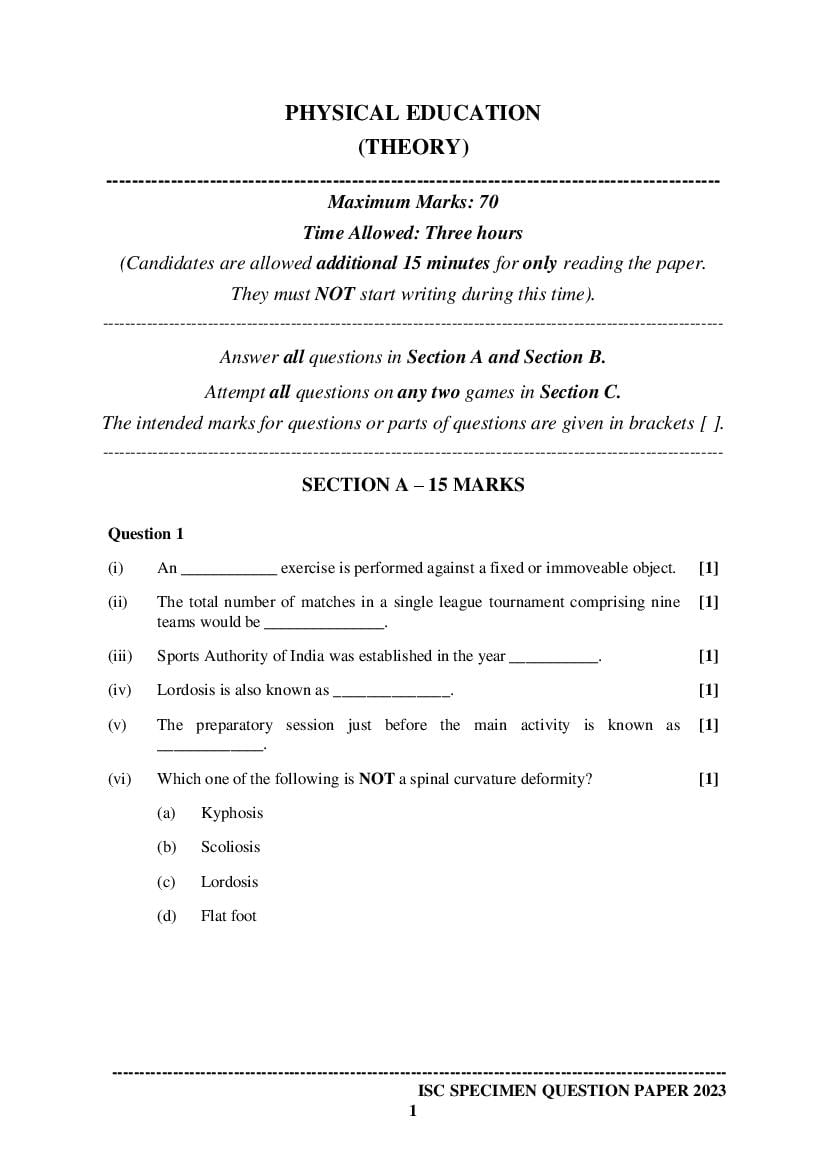
(THEORY)
-----------------------------------------------------------------------------------------------
Maximum Marks: 70
Time Allowed: Three hours
(Candidates are allowed additional 15 minutes for only reading the paper.
They must NOT start writing during this time).
Answer all questions in Section A and Section B.
Attempt all questions on any two games in Section C.
The intended marks for questions or parts of questions are given in brackets [ ].
SECTION A – 15 MARKS
Question 1
(i) An ____________ exercise is performed against a fixed or immoveable object. [1]
(ii) The total number of matches in a single league tournament comprising nine [1]
teams would be _______________.
(iii) Sports Authority of India was established in the year ___________. [1]
(iv) Lordosis is also known as ______________. [1]
(v) The preparatory session just before the main activity is known as [1]
_____________.
(vi) Which one of the following is NOT a spinal curvature deformity? [1]
(a) Kyphosis
(b) Scoliosis
(c) Lordosis
(d) Flat foot
---------------------------------------------------------------------------------------------------------------
1
Page 2
(a) Ballistic
(b) Static Stretching
(c) PNF
(d) Fartlek
(viii) Which method is used to draw the fixture of single league tournament? [1]
(a) Cyclic Method
(b) Tabular Method
(c) Staircase Method
(d) All of the above
(ix) Interval training method was introduced by: [1]
(a) Gosta Holmer
(b) J.F. Williams
(c) Charles A. Bucher
(d) J. Alfred
(x) The purpose of conditioning in sports is to: [1]
(a) reduce injury.
(b) deteriorate the performance.
(c) decrease familiarity.
(d) weaken athletes.
(xi) Who is also known as the father of Modern Olympic? [1]
(xii) What is first aid? [1]
(xiii) Define health. [1]
(xiv) Briefly explain the term rehabilitation. [1]
(xv) Which training method is also known as ‘Speed Play’? [1]
2
Page 3
Question 2 [5]
Briefly describe the objectives of NSNIS.
Question 3 [5]
(i) Write short notes on the following:
(a) Isometric Exercise
(b) Sprain
OR
(i) Answer the following:
(a) How does weight training help in enhancing the performance of a sports
person?
(b) Enlist any two demerits of a knockout tournament.
Question 4 [5]
Enumerate the role of physical education in building the character of an individual.
Question 5 [5]
Draw the fixture of a tournament consisting of seven teams in cyclic method.
Question 6 [5]
(i) List various types of factures. Explain any two of them.
OR
(ii) Circuit training is generally used for bringing about specific changes in fitness
level. Discuss.
3
Page 4
Attempt all questions on any two games from this section
FOOTBALL
Question 7
(a) Explain goal kick. When is a goal kick awarded? [3]
(b) During the start of the match, a footballer kicks the ball with a first touch [1]
and the ball hits the net. What will be the decision of the referee?
(c) A football player marks a throw-in, and the ball hits the player’s own [1]
goal net without touching anyone. State the consequence of this action.
(ii) (a) Mention any five duties of assistant referee. [5]
OR
(b) What is meant by wall formation in the game of football? With the help
of a diagram, show any one defensive formation and any one offensive
formation in the game.
(a) Off-side
(b) Dropped ball
CRICKET
Question 8
(a) State any three ways of trapping the ball by various body parts. [3]
(b) If the umpire taps his left shoulder repeatedly with his right hand, what [1]
is the umpire trying to signal?
(c) What will be the consequence of a fast full toss at the batsman which [1]
misses his head?
(ii) (a) Mention any five situations when a no ball is called by an umpire. [5]
OR
4
Page 5
positions on the offside of the field.
(a) DRS
(b) Power play
HOCKEY
Question 9
(a) List three cups and trophies associated with the game of hockey in India. [3]
(b) A player hits the ball from outside the striking circle which goes inside [1]
the opponents’ goal after being deflected by the opponent goal tender.
What will be the decision of the referee?
(c) A player strikes the ball with the rounded back of the hockey stick. What [1]
will be the decision of the referee?
(ii) (a) List any five steps to be followed while taking a free hit. [5]
OR
(b) State any five duties of a captain.
(a) Flick
(b) Scoop
BASKETBALL
Question 10
(a) What is the duration of a basketball match? What happens if the match [3]
ends in a tie?
(b) During a throw-in, the player does not pass the ball within six seconds. [1]
What will be the decision of the referee?
5
Page 6
already in a stationery position. What will be the decision of the referee?
(ii) (a) Explain the procedure of substitution in a basketball match. [5]
OR
(b) Draw a neat and well labelled diagram of backboard with all dimensions.
(a) Baseball pass
(b) Overhead pass
VOLLEYBALL
Question 11
(a) Write any three skills a volleyball player should possess. [3]
(b) A server jumps in the air for serving the ball and lands inside his own [1]
court. What will be the decision of the referee?
(c) During a serve, the ball hits the top of the net and rolls over onto the [1]
opponent’s side. What will be the decision of the referee?
(ii) (a) Explain the system of rotation in the game of volleyball. Mention any [5]
three rotation faults a player may commit during the game.
OR
(b) Draw a neat diagram of a volleyball court. Mark the zones and the
positions of players.
(a) Smash
(b) Rally
6
Page 7
Question 12
(a) Explain the pattern of scoring in the game of tennis. [3]
(b) A player performs an under arm service in a match. What will be the [1]
decision of the umpire?
(c) After the first serve, the server’s racket slips out of his hand and hits the [1]
net before the ball bounces into the correct service box. What will be the
decision of the umpire?
(ii) (a) Draw a neat diagram of the tennis court, with its dimensions. [5]
OR
(b) List various situations under which a player, while serving during a game
of tennis may make foot foul.
(a) Drive
(b) Half Volley
BADMINTON
Question 13
(a) Explain the method of testing the speed of a shuttle. [3]
(b) During a double match, a player accidently hits the racket of his [1]
teammate while returning the shuttle. What will be the decision of the
umpire?
(c) What will be the decision of the umpire if a player switches his racket [1]
from right hand to left hand?
(ii) (a) Write any five duties of the service judge. [5]
OR
(b) Name any five tournaments associated with badminton.
7
Page 8
(b) Drive
SWIMMING
Question 14
(a) Explain synchronised swimming and marathon swimming. [3]
(b) While taking a turn in a breaststroke event, a swimmer touches the wall [1]
with one hand. What will be the decision of the judges?
(c) A swimmer stays under water up to 10 meters at the start of the race. [1]
What will be the decision of the judges?
(ii) (a) Mention any five duties of a Referee in an international level swimming [5]
competition.
OR
(b) What is the difference between individual medley race and medley relay?
(a) Backstroke
(b) Butterfly
ATHLETICS
Question 15
(a) What is decathlon? List the events and their order in the Decathlon [3]
competition.
(b) In a combined event an athlete commits a false start. What will be the [1]
consequence?
(c) During a shot put, event an athlete throws the shot that lands on the sector [1]
line. What will be the decision of the judge?
(ii) (a) Draw a net diagram of standard 400m track, with all its dimension. [5]
OR
8
Page 9
field events:
(1) Javelin for women
(2) Discus for men
(3) Shot put for women
(4) Hammer for men
(5) Relay Batton
(a) Steeple-chase race
(b) Marathon
9
Document Details
| Board / Org | CISCE |
| Exam | Class 12 |
| Type | Sample Paper |
| Pages | 9 |
| Updated | 30 Apr 2026 |