RTU 2015 Question Paper Semester VIII Civil Engineering Geotechnical Engineering II
Finished viewing? Save it for later —
Download RTU 2015 Question Paper Semester VIII Civil Engineering Geotechnical Engineering II (PDF · 4 pages)About RTU 2015 Question Paper Semester VIII Civil Engineering Geotechnical Engineering II
RTU 2015 Question Paper Semester VIII Civil Engineering Geotechnical Engineering II is available here for free download. Published by Default for Semester Exams, this question paper can be viewed online or downloaded as a PDF (4 pages). Candidates preparing for Semester Exams can use RTU 2015 Question Paper Semester VIII Civil Engineering Geotechnical Engineering II to understand the exam pattern, the type of questions asked, and the overall difficulty level.
Frequently Asked Questions
How can I download RTU 2015 Question Paper Semester VIII Civil Engineering Geotechnical Engineering II?
Open this page and click the Download button to save RTU 2015 Question Paper Semester VIII Civil Engineering Geotechnical Engineering II as a PDF. It is completely free on AglaSem Docs.
Is RTU 2015 Question Paper Semester VIII Civil Engineering Geotechnical Engineering II free to download?
Yes. RTU 2015 Question Paper Semester VIII Civil Engineering Geotechnical Engineering II can be viewed online and downloaded as a PDF free of cost on AglaSem Docs.
How many pages does RTU 2015 Question Paper Semester VIII Civil Engineering Geotechnical Engineering II have?
RTU 2015 Question Paper Semester VIII Civil Engineering Geotechnical Engineering II contains 4 pages, which you can read online or download together as a single PDF.
Where can I find more Semester Exams study material?
You can find more Semester Exams question papers, sample papers, syllabus, and answer keys on AglaSem Docs.
RTU 2015 Question Paper Semester VIII Civil Engineering Geotechnical Engineering II – Text
Read the full text of this question paper below — useful to quickly search, copy and reference the content online without downloading the PDF.
📄 View text version (4 pages)
Page 1
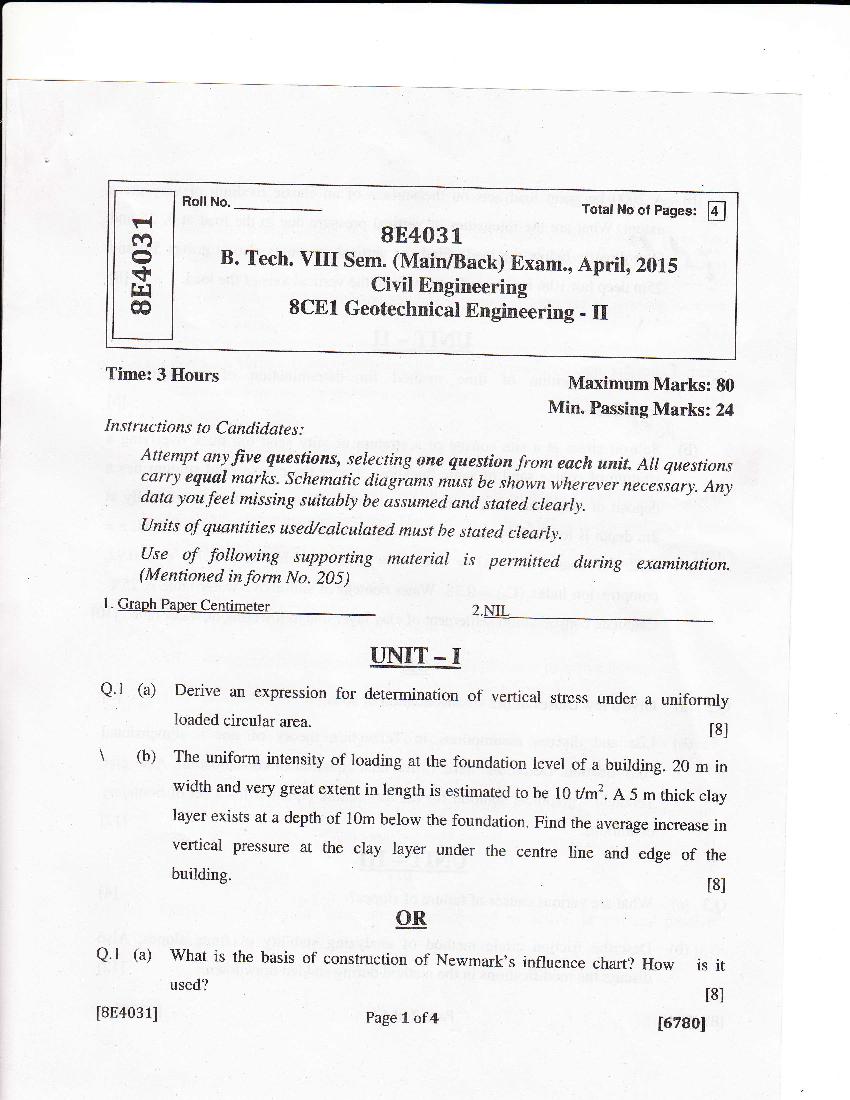
TotatNootPages: []
F{
CN 8E403 1
o
tt B. Tech. VIII Sem. (Nlain/Back) Exam., April, 20ls
EI Civil Engineering
€ 8CB1 Geotechnical Engineering - II
Time: 3 Hours Maximum Marks: 80
Min, Passing Marks: 24
Instructions to Candidates :
Attempt any five questions, selecting one question
from each unit. All questions
carry equal marks, schematic diagrams must be shown wherever
nrrrriory. Any
datayoufeel missing suitably be assumed and stated clearly.
units of quantities used./calculated must be stated clearly.
U:: of following supporting material is permitted during examination.
(Mentioned inform No. 205)
l. Graph Paper Centimeter 2.NIL
UNIT - I
Q.l (a) Derive an expression for determination of vertical stress under a uniformly
loaded circular area.
t8I
(b) The uniform intensity of loading at the foundarion level of a building. 20
m in
width and very great extent in length is estimated to be l0 tlm2.A
5 m thick clay
layer exist: at a depth of 10m below the foundation. Find
the average increase in
vertical pressure at the clay layer under the centre line
and edge of the
building. t8I
Q.l (a) what is the basis of construction of Newmark,s influence chart? How is it
used?
t8l
[8E4031] page 1 of4
Page 2
very great
extent' What are the intensities of vertical pressure
due to the load at 5,25 and,
50m directly below the load? Find the vertical pressures
also at points 5m and
25m deep but 10m horizontally away from the vertical
axis of the load. t8I
Q.2 (a) Explain logarithm of time method for determination of coefficient of
consolidation.
t6l
O) Subsoil strata at a site consist of a stratum of silty sand 6m thick overlying a
stratum of coarse sand of same thickness. Under the
coarse sand stratum lies a
deposit of clay 14m thick with rock at bottom. Water
table that is originally at
2m depth is lowered by drainage to a depth of 6m.
For silty sand, G = 2.64, e =
0'72, for coarse sand,. G = 2.6g, e = 0.6g, for clay G
= 2.72, e = 0.92,
compression index (c.) = 0.38. water content of soil
above water table is 25vo.
Calculate consolidation settlement of clay layer due
to lowering of water table. [10]
OR
Q.2 (a) Give a few causes of pre - consolidation of soils.
Vl
(b) List and discuss assumptions in Terzaghi's theory of one
- dimensional
consolidation. Derive the basic differential equation
of consolidation. Also give
Terzaghi's graphical solution for the differential equation
for a set of boundary
conditions. lrl/l
UNIT - III
Q.3 (a) What are various causes of failure of slopes? Vl
(b) Describe'friction circle method of analyzing stability
of finite slopes. Also
discuss the modifications in the method during sudden
drawdown . uzl
[8E4031] Page2 of4
Page 3
Q.3 (a) How would you decide the depth and lateral extent of exploration? Give two
empirical guidelines that enable the determination of depth of exploration. t41
(b) Explain with a neat sketch the stationary piston sampler for recovering samples
from subsurface. t4l
(c) What are various types of samples that could be recovered from subsoil? Explain
various factors causing disturbance of sample. I8l
UNIT - IV
Q.4 (a) A retaining wall with a smooth vertical back has to retain a backfill of c - Q soil
up to 5m above ground surface. The surface of backfill is horizontal and it has
following properties: UZI
0 = I2', c = 1.5tlm2 ,T = L8t/m3
(i) Plot the distribution of active earth pressure on the wall.
(ii) Determine the magnitude and point of application of active thrust.
(iii) Determine the depth of the zone of tension cracks.
(iv) Determine the intensity of a fictitious uniform surcharge, which, if placed
over the backfill can prevent the formation of tension cracks.
(b) Draw Mohr circles for Rankine's active and passive states of plastic equilibrium
showing directions of failure planes. t4l
OR
Q.4 (a) Define earth pressure. What do you understand by active, at rest and passive
earth pressure? Give examples. t6l
lBE4031l Page 3 of4 [67801
Page 4
(5)
following properties: c = 0, Q = 32", Y = 17.5kN/m3. The angle of wall friction
angle of 15'' If
= 10o. The back of retaining wall is inclined at a positive batter
the surface of the backfill slopes upwards at a surcharge angle of 15o,
calculate
the total active thrust per, unit length of the wall and its line of action using
Rebhann' s graPhical construction. t10l
UNIT. V
Q.s (a) How would you interpret for net loading intensity for a
given permissible
settlement in case of sands from the results of plate load test? t4l
on
(b) What is the effect of rise of water table on bearing capacity of footings resting
sands and clays? t4l
(c) A square footing l.2mx I.2m, rests at a depth of 1m in a saturated clay layer 4m
deep. The clay is normally consolidated having an unconfined compressive
strength of 40kN/m'. The soil has the following propefiies.
Liquid limit = 30vo, water content = 287o' Tsat = 17'8kN/m3' G = 2'68' using
Terzaghi's equation, determine net safe bearing capacity. Compute the settlement
that would result if this load intensity were allowed to act on the footing.
Natural
water tables is quite close to the ground surface' t8l
OR
on sand
e,5 (a) How would you estimate allowable bearing pressure of a footing resting
using SPT - value as Per IS code? t6l
(b) What are relative advantages and disadvantages of well foundations over the pile
foundations? t6l
(c) What are the criteria for satisfactory action of machine foundations? t4l
Page 4 of 4 [67801
lBE4o31l
Document Details
| Board / Org | Default |
| Exam | Semester Exams |
| Type | Question Paper |
| Pages | 4 |
| Updated | 15 Jul 2026 |