ISC Class 12 Specimen Paper 2022 Biotechnology Paper Semester 1
Finished viewing? Save it for later —
Download ISC Class 12 Specimen Paper 2022 Biotechnology Paper Semester 1 (PDF · 15 pages)About ISC Class 12 Specimen Paper 2022 Biotechnology Paper Semester 1
ISC Class 12 Specimen Paper 2022 Biotechnology Paper Semester 1 is available here for free download. Published by CISCE for Class 12, this sample paper can be viewed online or downloaded as a PDF (15 pages). Candidates preparing for Class 12 can use ISC Class 12 Specimen Paper 2022 Biotechnology Paper Semester 1 to understand the exam pattern, the type of questions asked, and the overall difficulty level.
Frequently Asked Questions
How can I download ISC Class 12 Specimen Paper 2022 Biotechnology Paper Semester 1?
Open this page and click the Download button to save ISC Class 12 Specimen Paper 2022 Biotechnology Paper Semester 1 as a PDF. It is completely free on AglaSem Docs.
Is ISC Class 12 Specimen Paper 2022 Biotechnology Paper Semester 1 free to download?
Yes. ISC Class 12 Specimen Paper 2022 Biotechnology Paper Semester 1 can be viewed online and downloaded as a PDF free of cost on AglaSem Docs.
How many pages does ISC Class 12 Specimen Paper 2022 Biotechnology Paper Semester 1 have?
ISC Class 12 Specimen Paper 2022 Biotechnology Paper Semester 1 contains 15 pages, which you can read online or download together as a single PDF.
Where can I find more Class 12 study material?
You can find more Class 12 question papers, sample papers, syllabus, and answer keys on AglaSem Docs.
ISC Class 12 Specimen Paper 2022 Biotechnology Paper Semester 1 – Text
Read the full text of this sample paper below — useful to quickly search, copy and reference the content online without downloading the PDF.
📄 View text version (15 pages)
Page 1
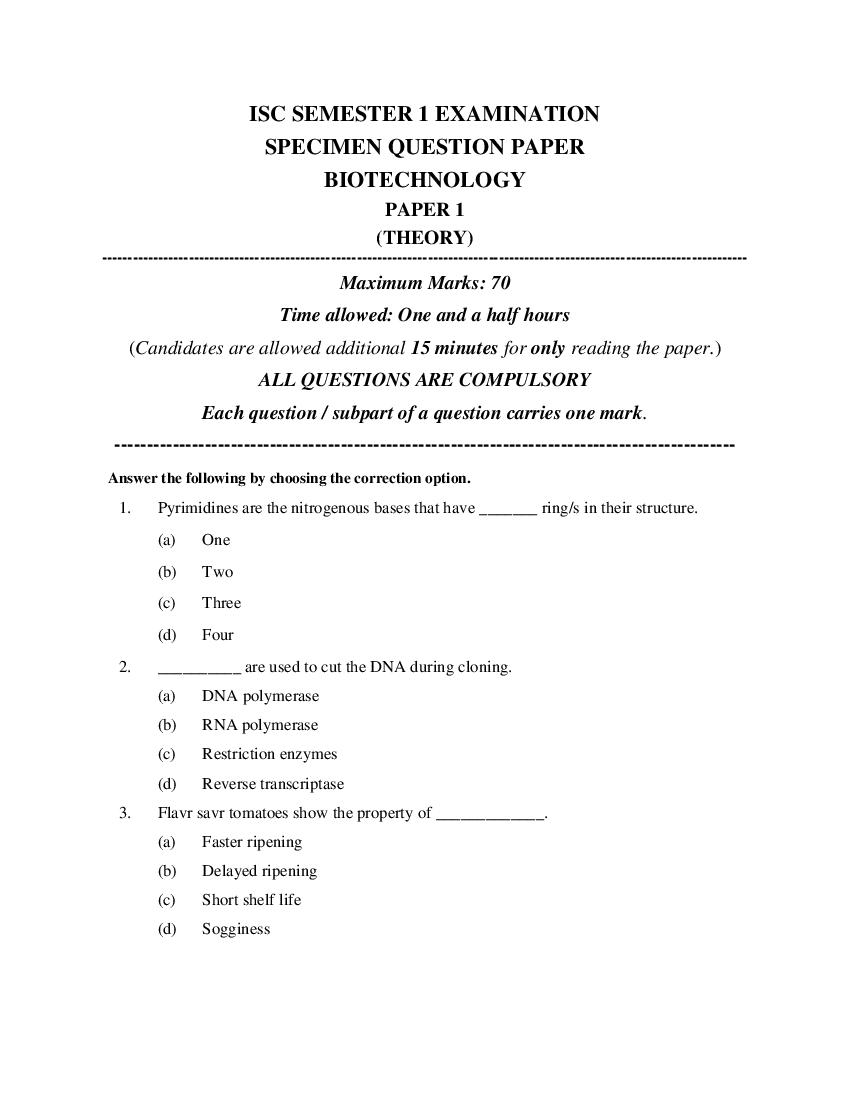
SPECIMEN QUESTION PAPER
BIOTECHNOLOGY
PAPER 1
(THEORY)
-------------------------------------------------------------------------------------------------------------------------------
Maximum Marks: 70
Time allowed: One and a half hours
(Candidates are allowed additional 15 minutes for only reading the paper.)
ALL QUESTIONS ARE COMPULSORY
Each question / subpart of a question carries one mark.
------------------------------------------------------------------------------------------------
Answer the following by choosing the correction option.
1. Pyrimidines are the nitrogenous bases that have _______ ring/s in their structure.
(a) One
(b) Two
(c) Three
(d) Four
2. __________ are used to cut the DNA during cloning.
(a) DNA polymerase
(b) RNA polymerase
(c) Restriction enzymes
(d) Reverse transcriptase
3. Flavr savr tomatoes show the property of _____________.
(a) Faster ripening
(b) Delayed ripening
(c) Short shelf life
(d) Sogginess
Page 2
(a) Binding to the amino acid.
(b) Binding to the enzyme – t-RNA – Aminoacyl synthetase complex.
(c) Recognition of the complementary codons on m-RNA.
(d) Binding t-RNA to ribosomes.
5. The nucleic acids are made up of ___________.
(a) Nucleotides
(b) Nucleosides
(c) Nitrogenous bases
(d) Pentose sugars and bases
6. DNA: DNA hybridization is done in ________blotting technique.
(a) Southern
(b) Northern
(c) Western
(d) Eastern
7. In Hershey and Chase experiment, the protein coat had _______ while DNA had
__________.
(a) N14, P32
(b) S32, P32
(c) S35, P32
(d) S35, P31
8. The method used for identifying the recombinant host cells is:
(a) Green fluorescent protein.
(b) Blue white method.
(c) Both (a) and (b).
(d) Bergman’s Plating method.
9. The bond which is broken by the action of restriction enzyme is:
(a) Phospho-diester bond
(b) Hydrogen bond
(c) Peptide bond
(d) Glycosidic bond
Page 3
(a) pMA56
(b) Insulin
(c) Interferon
(d) HBsAg
11. The first mammalian clone Dolly was made from:
(a) The egg cell from clone mother.
(b) Mammary gland cell from clone mother.
(c) Egg cell from surrogate mother.
(d) Mammary gland cell from surrogate mother.
12. What is the technique used to create point mutation?
(a) Chemical mutagenesis.
(b) Physical mutagenesis.
(c) Site directed mutagenesis.
(d) Irradiation.
13. The process of reverse transcription is with the help of ____________ enzyme
which is also known as _____________.
(a) Reverse transcriptase, DNA dependent RNA polymerase.
(b) Reverse transcriptase, DNA dependent DNA polymerase.
(c) Reverse transcriptase, RNA dependent RNA polymerase.
(d) Reverse transcriptase, RNA dependent DNA polymerase.
14. Which of the following factors associates to RNA polymerase during the process
of formation of RNA on DNA template?
(a) TATA box
(b) Sigma factor
(c) Rho factor
(d) DNA polymerase
Page 4
(a) DNA from RNA with the help of DNA dependent RNA polymerase.
(b) RNA from DNA with the help of DNA dependent DNA polymerase.
(c) DNA from RNA with the help of RNA dependent DNA polymerase.
(d) DNA from RNA with the help of RNA dependent RNA polymerase.
16. The inducing substance in Lac Operon is:
(a) Lactose
(b) Galactosidase
(c) Permease
(d) Transacetylase
17. ___________ enzyme is used in PCR technique.
(a) DNA polymerase
(b) RNA polymerase
(c) Taq polymerase
(d) DNA ligase
18. In __________ method of transfer of recombinant DNA into host cells, high
voltage electric pulses are given:
(a) Electrophoresis
(b) Electroporation
(c) Electrofusion
(d) Electrolysis
19. Humulin has been obtained from:
(a) E. coli
(b) Yeast cells
(c) B. subtilis
(d) Agrobacterium
Page 5
(a) DNA template, labelled dNTPs, primer, DNA polymerase.
(b) DNA template, dNTPs, labelled primer, DNA polymerase.
(c) DNA template, NTPs, labelled primer, DNA polymerase.
(d) DNA template, labelled ddNTPs, primer, DNA polymerase.
21. With respect to the semi – conservative mode of replication of DNA, which of the
following statement is incorrect?
(a) One of the parent DNA strands is completely utilized in forming one DNA
molecule.
(b) Each one of the parent DNA strands is retained in each new daughter DNA
strand.
(c) Both parent DNA strands are retained in one new daughter DNA strand.
(d) The parent DNA strand is conserved in the DNA strand in fragment.
22. Which of the following options shows the correct sequence of Lac operon?
(a) A regulator gene, a structural gene, a promoter gene, an operator gene.
(b) A regulator gene, three structural genes, two promoter genes, one operator
gene.
(c) A regulator gene, a promoter gene, an operator gene, three structural genes.
(d) A regulator gene, two promoter genes, two operator genes, three structural
genes.
23. DNA is separated from a mixture of DNA, RNA and proteins using _________.
(a) Southern blotting technique.
(b) Gel electrophoresis.
(c) Sanger’s DCT method.
(d) Both (a) and (c)
24. The chemicals used for DNA isolation from plant cells are:
(a) Macerase, SDS, extraction buffer, isopropanol
(b) Extraction buffer, SDS, macerase, NaCl
(c) SDS, extraction buffer, NaCl, isoamylalcohol,
(d) Extraction buffer ,CsCl, SDS, phenol
Page 6
screening of transformed host cells, while __________ is a plasmid vector which
has lac Z genes for screening of the transformed host cells.
(a) pUC, pBR322
(b) pBR322, pUC
(c) pUC, Bacteriophage lambda
(d) pBR322, M13
26. After cutting the DNA with restriction enzyme, if the ends have no free bases, then
they are called ______ ends, while if there is at least one base free then they are
called ______ ends.
(a) Sticky, blunt
(b) Flush, blunt
(c) Blunt, sticky
(d) Cohesive, flush
27. Stem cells obtained from ________ are called adult stem cells, while stem cells
obtained from ________ are called embryonic stem cells.
(a) Bone marrow, young embryo
(b) Young embryo, bone marrow
(c) Young embryo, umbilical cord
(d) Totipotent, pluripotent
28. _____________ technique/s is/are used to amplify the DNA.
(a) PCR
(b) DNA fingerprinting
(c) DNA footprinting
(d) Both (a) and (b)
29. With respect to the 3 – D form of DNA model, which of the following stands
incorrect?
(a) One helix has 10 base pairs.
(b) The length of the helix is 34 Å.
(c) The two strands run parallel in same polarity to each other.
(d) The distance between the two strands is 20 Å.
Page 7
milk in dairy industry.
(a) Papain, rennet
(b) Rennet , amylase
(c) Rennet, subtilisin
(d) Subtilisin, rennet
31. Which of the following enzymes is used to cut the Plasmid DNA in recombinant
DNA technology?
(a) DNA ligase.
(b) Restriction endonuclease.
(c) Recognition enzyme.
(d) Primase.
32. The enzyme that is responsible for elongation of new DNA strand over the parent
DNA strand is:
(a) Primase
(b) Helicase
(c) DNA ligase
(d) DNA polymerase
33. The probe used in DNA fingerprinting is/are:
(a) STR
(b) VNTR
(c) Minisatellite
(d) All of the above
34. The unique nutrient found in golden rice endosperm is:
(a) Starch
(b) Protein
(c) Beta carotene
(d) None of the above
Page 8
(a) Saccharomyces cerevisiae
(b) Agrobacterium tumefaciens
(c) Bacillus thuringiensis
(d) Rhizobium
36. The enzyme that brings an RNA oligonucleotide at the origin of replication during
DNA replication is:
(a) Helicase
(b) Primase
(c) Topoisomerase
(d) DNA ligase
37. Which among the following is involved in initiating the process of transcription?
(a) TATA box
(b) Initiating codons
(c) Rho factor
(d) All of these
38. Super bug is made by using plasmids containing genes to digest:
(a) Octane, xylene, phenolphthalein and naphthalene.
(b) Octane, xylene, phenolphthalein and camphor.
(c) Octane, xylene, naphthalene and camphor.
(d) Octane, xylolite, naphthalene and camphor.
39. ___________ hybridization is done in Northern blotting.
(a) RNA: DNA
(b) RNA :protein
(c) RNA:DNA
(d) Protein: antibody
40. The enzyme that uncoils the DNA molecule is:
(a) Topoisomerase
(b) Helicase
(c) Primase
(d) Ligase
Page 9
(a) In making the hydrogen bond between free nucleotide and the exposed
nitrogen base of the template.
(b) In releasing excess heat from the deoxyribonucleotides.
(c) In producing energy in the form ATP.
(d) All of the above.
42. Assertion: Gene for chain A and chain B of human insulin are inserted in two
different bacteria in two different cultures to produce Humulin.
Reason: Post translational modifications to make changes in protein do not take
place in prokaryotic cells.
(a) Both assertion and reason are true, and reason is the correct explanation of
assertion.
(b) Both assertion and reason are true, but reason is not the correct explanation
of assertion.
(c) Assertion is true but reason is false.
(d) Both assertion and reason are false.
43. Assertion: The desired gene is recombined with the vector DNA by using the
enzyme DNA ligase.
Reason: DNA ligase joins the DNA fragments by making the phosphodiester
bond.
(a) Both assertion and reason are true, and reason is the correct explanation of
assertion.
(b) Both assertion and reason are true, but reason is not the correct explanation
of assertion.
(c) Assertion is true but reason is false.
(d) Both assertion and reason are false.
44. Assertion: Sanger’s method uses ddNTPs.
Reason: ddNTPs are the nucleotides that form DNA.
(a) Both assertion and reason are true, and reason is the correct explanation of
assertion.
(b) Both assertion and reason are true, but reason is not the correct explanation
of assertion.
(c) Assertion is true but reason is false.
(d) Both assertion and reason are false.
Page 10
Reason: Genomic DNA of a mouse is used to produce recombinant interferons.
(a) Both assertion and reason are true, and reason is the correct explanation of
assertion.
(b) Both assertion and reason are true, but reason is not the correct explanation
of assertion.
(c) Assertion is true but reason is false.
(d) Both assertion and reason are false.
46. Assertion: During gel electrophoresis, DNA fragments move towards the anode.
Reason: DNA molecules are negatively charged.
(a) Both assertion and reason are true, and reason is the correct explanation of
assertion.
(b) Both assertion and reason are true, but reason is not the correct explanation
of assertion.
(c) Assertion is true but reason is false.
(d) Both assertion and reason are false.
47. Observe carefully the diagram given and answer the questions that follow.
(a) The diagram indicates:
(i) Semi conservative mode of replication.
(ii) Semi discontinuous mode of replication.
(iii) Continuous mode replication.
(iv) Conservative mode of replication.
Page 11
(i) In 3’ – 5’ direction
(ii) In 5’ – 3’ direction..
(iii) In any direction.
(iv) None of these.
(c) The enzyme that unzips the parent DNA strands is:
(i) Polymerase
(ii) Primase
(iii) Topoisomerase
(iv) Helicase
(d) The enzyme that joins the fragments on the lagging strand is:
(i) Polymerase
(ii) Ligase
(iii) Topoisomerase
(iv) Helicase
48. Observe the diagram given below and then answer the questions that follow.
(a) Which method of gene transfer in shown in the diagram aboveS?
(i) Gene gun
(ii) Liposome mediated gene transfer
(iii) Microinjection
(iv) Transfection
Page 12
desired gene into the host cell?
(i) Gene gun.
(ii) Liposome mediated gene transfer.
(iii) Both (i) and (ii).
(iv) Blue white method.
(c) Does the method depicted in the diagram above use any vector?
(i) Yes
(ii) No
(iii) Cannot be determined
(iv) Vectors are never used for gene transfer
(d) What term is used for the gene transfer by temperature shock?
(i) Transfection
(ii) Transformation
(iii) Electroporation
(iv) Gene gun
49. At a crime spot, the police discovered that the murder victim had some hair in his
closed fist. They sent it to the forensic laboratory for testing. Based on this
information, answer the following questions:
(a) Which technique will be used at the beginning to get the sample for testing?
(i) PCR
(ii) DNA fingerprinting
(iii) DNA extraction
(iv) Gel electrophoresis
(b) The sample collected was found to be too less. Which technique would be
used for increasing its amount?
(i) PCR
(ii) DNA fingerprinting
(iii) DNA extraction
(iv) Gel electrophoresis
(c) Two suspects were caught by the police for the murder. By using which
technique would they confirm who committed the crime?
(i) PCR
(ii) DNA fingerprinting
(iii) DNA extraction
(iv) Gel electrophoresis
Page 13
(i) A piece of blood soaked cloth from the crime spot
(ii) A shirt button
(iii) A crumpled piece of paper
(iv) Mark of shoes on the mud
50. A group of scientists from a laboratory wanted to make a clone of a dog. For that,
they chose the mammary gland cells of a Labrador female and took the egg cell
from an Alsatian female. Later they used a Doberman female for the development
of the embryo to obtain the clone. Based on this information, answer the following
questions:
(a) The resulting clone will resemble which dog breed?
(i) Labrador
(ii) Alsatian
(iii) Doberman
(iv) None of the above
(b) Out of the three dog breeds used, which one would serve as the surrogate
mother?
(i) Labrador
(ii) Alsatian
(iii) Doberman
(iv) All of the above
(c) What is / are the principle/s of this experiment?
(i) Nuclear transfer
(ii) Totipotency
(iii) Both (i) and (ii)
(iv) Cellular differentiation
(d) Which technique was used for the fusion of the mammary gland cell and the
egg cell?
(i) Microinjection
(ii) Electrofusion
(iii) Electrophoresis
(iv) None of the above
Page 14
information, answer the following questions:
(a) Which technique was used to carry out this experiment?
(i) Transfection
(ii) Biolistic
(iii) Agrobacterium mediated gene transfer
(iv) None of the above
(b) Which plasmid is used to carry the disease - resistant gene in the plant?
(i) Ti plasmid
(ii) pBR322
(iii) pUC
(iv) Bacteriophage lambda
(c) The desired gene integrates with which region of the plasmid for the
transfer?
(i) cDNA
(ii) T-DNA
(iii) ssDNA
(iv) ds DNA
(d) Which condition of the plant confirms that the gene has been successfully
transferred?
(i) Formation of crown gall
(ii) Chlorosis of leaves
(iii) Necrosis of leaf
(iv) Marginal chlorosis
52. A team of research scholars are asked to create a clone of a calf. They followed the
steps mentioned below:
The gamete of female calf “A” was selected and was enucleated. The cell was used
and, nucleus was discarded.
The liver cell of another calf “B” was selected and was enucleated. The cell was
discarded and the nucleus was used.
The team worked in a proper and sequential manner and obtained a viable embryo.
This embryo is implanted in a third calf “C”.
Page 15
(i) Calf “A” because the gamete is the egg cell which is totipotent.
(ii) Calf “B” because the nucleus of liver cell is the somatic cell and will
carry the genetic composition similar to the calf “B”.
(iii) Calf “A” because the gamete cell has haploid number of
chromosomes.
(iv) Calf “B” because liver cell is totipotent.
(b) Which of the following methods is used to make a zygote?
(i) Electric stimulation
(ii) Electroporation
(iii) Electrophoresis
(iv) Electric spark
(c) Which cell / nucleus is subjected to starvation?
(i) The gamete cell of calf “A”.
(ii) The nucleus of liver cell of calf “B”.
(iii) The liver cell of calf “B”.
(iv) The nucleus of egg cell of calf “A”.
(d) At what stage can the embryo be implanted in the uterus of the calf “C”?
(i) Zygote.
(ii) Morula.
(iii) Blastula.
(iv) Gastrula.
Document Details
| Board / Org | CISCE |
| Exam | Class 12 |
| Type | Sample Paper |
| Pages | 15 |
| Language | english |
| Updated | 22 Jul 2026 |