TBSE Class 12 Model Question Paper 2021 Chemistry
Finished viewing? Save it for later —
Download TBSE Class 12 Model Question Paper 2021 Chemistry (PDF · 8 pages)About TBSE Class 12 Model Question Paper 2021 Chemistry
TBSE Class 12 Model Question Paper 2021 Chemistry is available here for free download. Published by Tripura Board for Class 12, this sample paper can be viewed online or downloaded as a PDF (8 pages). Candidates preparing for Class 12 can use TBSE Class 12 Model Question Paper 2021 Chemistry to understand the exam pattern, the type of questions asked, and the overall difficulty level.
Frequently Asked Questions
How can I download TBSE Class 12 Model Question Paper 2021 Chemistry?
Open this page and click the Download button to save TBSE Class 12 Model Question Paper 2021 Chemistry as a PDF. It is completely free on AglaSem Docs.
Is TBSE Class 12 Model Question Paper 2021 Chemistry free to download?
Yes. TBSE Class 12 Model Question Paper 2021 Chemistry can be viewed online and downloaded as a PDF free of cost on AglaSem Docs.
How many pages does TBSE Class 12 Model Question Paper 2021 Chemistry have?
TBSE Class 12 Model Question Paper 2021 Chemistry contains 8 pages, which you can read online or download together as a single PDF.
Where can I find more Class 12 study material?
You can find more Class 12 question papers, sample papers, syllabus, and answer keys on AglaSem Docs.
TBSE Class 12 Model Question Paper 2021 Chemistry – Text
Read the full text of this sample paper below — useful to quickly search, copy and reference the content online without downloading the PDF.
📄 View text version (8 pages)
Page 1
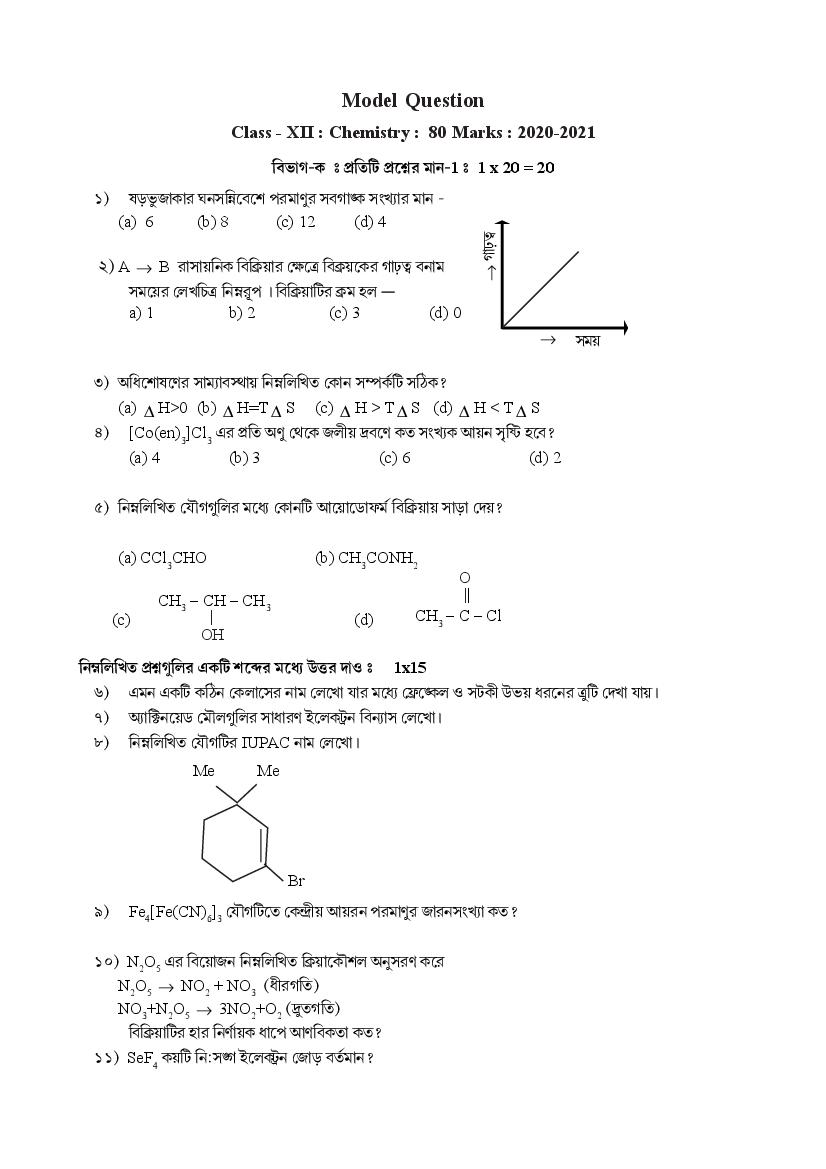
Class - XII : Chemistry : 80 Marks : 2020-2021
!Ó˲yàÈüÈܲ / ≤Ã!ï˛!ê˛ ≤Èϟ¿Ó˚ ÙylÈüÈ1 / 1 x 20 = 20
1ä £Ïí˛¸Ë%˛çyܲyÓ˚ âl§!ߨˆÏӈϢ ˛õÓ˚Ùyî%Ó˚ §ÓàyAܲ §ÇáƒyÓ˚ Ùyl ÈüÈ
(a) 6 (b) 8 (c) 12 (d) 4
→ àyì˛¸c
2ä A → B Ó˚y§yÎ˚!lܲ !Ó!ܲÎ˚yÓ˚ ˆ«˛ˆÏe !ÓܲÎ˚ˆÏܲÓ˚ àyì˛¸c ÓlyÙ
§ÙˆÏÎ˚Ó˚ ˆ°á!ã˛e !l¡¨Ó˚)˛õ – !Ó!ܲÎ˚y!ê˛Ó˚ Ü˛Ù •° û
a) 1 b) 2 (c) 3 (d) 0
→ §ÙÏÎ˚
3ä x!ôˆÏ¢y£ÏˆÏîÓ˚ §yÙƒyÓfiÌyÎ˚ !l¡¨!°!áï˛ ˆÜ˛yl §¡õÜ≈˛!ê˛ §!ë˛Ü˛⁄
(a) ∆ H>0 (b) ∆ H=T ∆ S (c) ∆ H > T ∆ S (d) ∆ H < T ∆ S
4ä [Co(en)3]Cl3 ~Ó˚ ≤Ã!ï˛ xî% ˆÌˆÏܲ ç°#Î˚ oÓˆÏî Ü˛ï˛ §ÇáƒÜ˛ xyÎ˚l §,!T˛ •ˆÏÓ⁄
(a) 4 (b) 3 (c) 6 (d) 2
5ä !l¡¨!°!áï˛ ˆÎÔàà%!°Ó˚ ÙˆÏôƒ ˆÜ˛yl!ê˛ xyˆÏÎ˚yˆÏí˛yÊ˛Ù≈ !Ó!ܲÎ˚yÎ˚ §yí˛¸y ˆòÎ˚⁄
(a) CCl3CHO (b) CH3CONH2
O
CH3 – CH – CH3 ||
(c) | (d) CH3 – C – Cl
OH
!l¡¨!°!áï˛ ≤ß¿à%!°Ó˚ ~ܲ!ê˛ ¢ˆÏ∑Ó˚ ÙˆÏôƒ í˛z_Ó˚ òyG / 1x15
6ä ~Ùl ~ܲ!ê˛ Ü˛!ë˛l ˆÜ˛°yˆÏ§Ó˚ lyÙ ˆ°ˆÏáy ÎyÓ˚ ÙˆÏôƒ ˆÊ˛ˆÏAܲ° G §ê˛Ü˛# í˛z˲Î˚ ôÓ˚ˆÏlÓ˚ e%!ê˛ ˆòáy ÎyÎ˚–
7ä xƒy!QlˆÏÎ˚í˛ ˆÙÔ°à%!°Ó˚ §yôyÓ˚î •zˆÏ°Ü˛ê˛∆l !Ólƒy§ ˆ°ˆÏáy–
8ä !l¡¨!°!áï˛ ˆÎÔà!ê˛Ó˚ IUPAC lyÙ ˆ°ˆÏáy–
Me Me
Br
9ä Fe4[Fe(CN)6]3 ˆÎÔà!ê˛ˆÏï˛ ˆÜ˛w#Î˚ xyÎ˚Ó˚l ˛õÓ˚Ùyî%Ó˚ çyÓ˚l§Çáƒy ܲï˛⁄
10ä N2O5 ~Ó˚ !ÓˆÏÎ˚yçl !l¡¨!°!áï˛ !ܲÎ˚yˆÏÜ˛Ô¢° xl%§Ó˚î ܲˆÏÓ˚
N2O5 → NO2 + NO3 åô#Ó˚à!ï˛ä
NO3+N2O5 → 3NO2+O2 åo%ï˛à!ï˛ä
!Ó!ܲÎ˚y!ê˛Ó˚ •yÓ˚ !lî≈yÎ˚ܲ ôyˆÏ˛õ xyî!Óܲï˛y ܲï˛⁄
11ä SeF4 ܲÎ˚!ê˛ !lı§Aà •zˆÏ°Üê˛∆l ˆçyí˛¸ Óï≈˛Ùyl⁄
Page 2
13ä !•l§‰Óyà≈ !ÓܲyÓ˚ܲ ܲ#⁄
14ä !l¡¨!°!áï˛ xyÎ˚Ó˚là%!°ˆÏܲ Fe(OH)3 §ˆÏ°Ó˚ ï˛M˛ˆÏlÓ˚ ˆ«˛ˆÏe ï˛M˛l «˛Ùï˛yÓ˚ í˛zôÁ≈ܲˆÏÙ §yçyG ÈüÈ
SO42–, Cl–, [Fe(CN)6]4–, PO43 –
15ä !l¡¨!°!áï˛ ˆÎÔàà%!°ˆÏܲ xy!¡‘ܲôˆÏÙ≈Ó˚ í˛zôÁ≈ܲÙyl%§yˆÏÓ˚ §yçyG û
ˆ≤Ãy˛õylÈüÈ1-x°ó 2, 4, 6 ê˛∆y•zly•zˆÏê˛∆yˆÏÊ˛l°ó 3 ly•zˆÏê˛∆yˆÏÊ˛l°ó 3,5 í˛y•zly•zˆÏê˛∆yˆÏÊ˛l°ó ˆÊ˛l°–
16ä ˆÊ˛!°Ç§ oÓˆÏîÓ˚ í˛z˛õyòylà%!° ܲ# ܲ# ⁄
17ä
CONH2 Br2/KOH
A
HI
18ä (CH3)3C–O–CH3 A+B
∆
19ä !l¡¨!°!áï˛ ˆÙԈϰÓ˚ xî%à%!°ˆÏܲ Órôl !ÓˆÏÎ˚yçl ≤ÃÓîï˛yÓ˚ í˛zôÁ≈ܲˆÏÙ §yçyG
F2, Cl2, Br2, I2
20ä ˆÏÎ ˆÜ˛yl ˆ◊!îÓ˚ ≤ÃÌÙ ˆÙԈϰÓ˚ xfl∫y˲y!Óܲ xyã˛Ó˚ˆÏîÓ˚ çlƒ òyÎ˚# ò%!ê˛ Ü˛yÓ˚î !°á–
!Ó˲yàÈüÈá / ≤Ã!ï˛!ê˛ ≤Èϟ¿Ó˚ Ùyl 2 / 2 x 7 = 14
21ä §ÇK˛y òyG / ܲä xyò¢≈ oÓî åáä ˆÙy°y° flø%ê˛lyAܲ í˛zߨÎ˚l ô%Óܲ
22ä x!ôˆÏ¢y£Ïî §Ù˛ï˛y˛õ#Î˚ ܲ# ⁄ Freundlich ~Ó˚ x!ôˆÏ¢y£Ïî §Ùï˛y˛õ#Î˚!ê˛ !ÓÓ,ï˛ Ü˛Ó˚–
23ä ܲyÓ˚î ò¢≈yG / Ü˛ä §!rôàï˛ ôyï%˛à%!° Ó˚!.l ˆÎÔà àë˛l ܲˆÏÓ˚–
áä La(OH)3, Lu(OH)3 xˆÏ˛õ«˛y x!ôܲ «˛yÓ˚#Î˚–
24ä Ó˚y§yÎ˚!lܲ ˛õÓ˚#«˛yÓ˚ §y•yˆÏ΃ ˛õyÌ≈ܲƒ ܲÓ˚ / !ÙÌy•z° xƒy!Ùl G xƒy!l!°l–
25ä [Co(en)2Cl2] ~Ó˚ §Ω˛yÓƒ àë˛l§ÇˆÏÜ˛ï˛ ˆ°ˆÏáy–
D xÌÓy
xyÎ˚l#Î˚ §ÙyÓÎ˚Óï˛y ܲyˆÏܲ ӈϰ⁄ í˛zòy•Ó˚î òyG–
26ä ˛åܲä @’%ˆÏܲyˆÏçÓ˚ §ˆÏAà ê˛ˆÏ°™ !ÓܲyÓ˚ˆÏܲÓ˚ !Ó!ܲÎ˚yÓ˚ §Ù#ܲÓ˚î òyG–
áä ~!˛õÙyÓ˚ ܲ# ⁄
D xÌÓy
ܲä ç%•zê˛yÓ˚ xyÎ˚l ܲ#⁄
áä DNA G RNA ~Ó˚ ÙˆÏôƒ ò%!ê˛ ˛õyÌ≈ܲƒ ˆ°ˆÏáy–
27ä ~ܲ!ê˛ ˆÙÔ° ÎyÓ˚ xyî!Óܲ à%Ó˚%c 2.7 x 10⁻² kg/mo1 âlܲyܲyÓ˚ ~ܲܲ ˆÜ˛y¢ àë˛l ܲˆÏÓ˚Ï– ÎyÓ˚ !ܲlyÓ˚y ˜òâ≈ƒ 405pm–
Î!ò ~Ó˚ âlc 2.7x10³kg/m3 •Î˚ ï˛y•ˆÏ° âlܲyܲyÓ˚ ~ܲܲ ˆÜ˛yˆÏ¢Ó˚ ≤ÃÜ,˛!ï˛ !ܲÓ˚)˛õ⁄
!Ó˲yàÈüÈà / ≤Ã!ï˛!ê˛ ≤Èϟ¿Ó˚ Ùyl 3 / 3 x 7 = 21
28ä ܲä x!˲flÀyÓî ã˛y˛õ ܲyˆÏܲ ӈϰ⁄
áä 79g xƒy!§!ê˛Ü˛ xƒy!§ˆÏí˛ !ܲ ˛õ!Ó˚Ùyî xƒy§ˆÏܲyÓ˚!Óܲ xƒy!§í˛ å!˲ê˛y!Ùl C, C6H8O6) oÓ#Ë)˛ï˛ ܲÓ˚ˆÏï˛ •ˆÏÓ ÎyˆÏï˛
•z•yÓ˚ !•ÙyAܲ 1.50C •…y§ ˛õyÎ˚– kf = 3.9k kg mol–1 1+2
Page 3
áä 318 K í˛z£÷Ïï˛yÎ˚ CCl4 ~ N2O5 ~Ó˚ !ÓˆÏÎ˚yçl oÓˆÏî N2O5 ~Ó˚ àyì˛¸c ˛õÎ≈ˆÏÓ«˛î ܲˆÏÓ˚ xôƒÎ˚l ܲÓ˚y •ˆÏÎ˚ˆÏSÈ–
≤ÃyÌ!Ùܲ xÓfiÌyÎ˚ N2O5 ~Ó˚ àyì˛¸c 2.33 mol L–1 ~ÓÇ 184 !Ù!lê˛ ˛õˆÏÓ˚ í˛z•yÓ˚ àyì˛¸c 2.08 moL–1 – !Ó!ܲÎ˚y!ê˛ !l¡¨!°!áï˛
§Ù#ܲÓ˚î xl%ÎyÎ˚# âˆÏê˛ 2N2O5 → 4NO2+O2 !Ó!ܲÎ˚y!ê˛Ó˚ •yÓ˚ àîly ܲÓ˚– ~ÓÇ ~•z §ÙˆÏÎ˚ NO2 ~Ó˚ í˛zͲõyòl •yÓ˚ ܲï˛⁄
30ä ܲä !l¡¨!°!áï˛ xyÎ˚là%!°Ó˚ ÙˆÏôƒ ˆÜ˛yl!ê˛ Ó˚!.l ˆÎÔà àë˛l ܲˆÏÓ˚ G ˆÜ˛l⁄ Cu+, Ti4+, Fe3+, Zn2+
áä ܲyÓ˚î Óƒyáƒy ܲÓ˚ / çyÓ˚ˆÏܲy!lÎ˚yÙ ~Ó˚ ˛õyÓ˚Ùyî!Óܲ Óƒy§yô≈ •Ê˛!lÎ˚yÙ xˆÏ˛õ«˛y Ü˛Ù ˆÜ˛l⁄
31ä [Fe(CN)6]3– ç!ê˛° xyÎ˚l!ê˛ˆÏï˛ ˆÜ˛w#Î˚ ˛õÓ˚Ùyî%Ó˚ §ÇܲyÓ˚Î˚l ò¢yñ xyÎ˚l!ê˛Ó˚ àë˛lyÜ,˛!ï˛ ~ÓÇ ˆã˛Ô¡∫ܲ ºyÙܲ !lî≈Î˚ ܲÓ˚–
1+1+1
OR
ܲä K3 [Al(C2OH)3] ˆÎÔà!ê˛Ó˚ IUPAC lyÙ ˆ°ˆÏáy–
áä ~ܲ!ê˛ ˆÜ˛yx!í≈˛ˆÏl¢l ˆÎÔà CrCl3.4H2O, !§°Ë˛yÓ˚ ly•zˆÏê˛∆ê˛ oÓˆÏîÓ˚ §ˆÏAà !Ó!ܲÎ˚yÎ˚ AgCl ~Ó˚ xôıˆ«˛˛õ ˆòÎ˚–
ˆÎÔà!ê˛Ó˚ ç°#Î˚ oÓˆÏîÓ˚ xyî!Óܲ ˛õ!Ó˚Óy•#ï˛y ~Ó˚ Ùyl 2 mol xyÎ˚ˆÏlÓ˚ §ˆÏAà §Aà!ï˛˛õ)î≈– ˆÎÔà!ê˛Ó˚ àë˛l §ÇˆÏÜ˛ï˛ G lyÙ
ˆ°ˆÏÏáy–
32ä åxä ܲyÓ˚î Óƒyáƒy ܲÓ˚ / ó
Ü˛ä •ƒyˆÏ°yxƒy!Ó˚ˆÏlÓ˚ §!ܲÎ˚ï˛y •ƒyˆÏ°yÈüÈxƒy°ˆÏܲl xˆÏ˛õ«˛y Ü˛Ù–
áä R– x ~Ó˚ §ˆÏAà AgCN !Ó!ܲÎ˚yÎ˚ R– NC Ù%რ˛õÎ≈yÎ˚Ó˚)ˆÏ˛õ ˛õyGÎy ÎyÎ˚–
xyä xƒyÙ!ÓˆÏí˛rê˛ !lí˛z!Üœ˛GÊ˛y•z° ܲ#⁄ 1+1+1
33ä ܲä Ó˚)˛õyhs˝Ó˚ ܲÓ˚ / ˆÏÊ˛l° → xƒy!l!°l
ˆÓOy•z° ˆÜœ˛yÓ˚y•zí˛ È → ˆÓOy•z° xƒy°ˆÏܲy•°–
áä Ó˚y•zÙyÓ˚ !ê˛Ùƒyl !Ó!ܲÎ˚yÓ˚ ~ܲ!ê˛ í˛zòy•Ó˚î òyG– 1+1+1
D xÌÓy
OH
ܲä
(CH3CO)2O A AlCl3
B
∆
áä °%ܲy§ !ÓܲyÓ˚ܲ ܲ#⁄
34ä ܲä @’y•zˆÏܲy§y•z!í˛Ü˛ Órôl ܲyˆÏܲ ӈϰ⁄
áä §%ˆÏܲyçˆÏܲ invert Sugar Ó°y •Î˚ ˆÏܲl⁄
àä !Ùí˛zê˛yˆÏÓ˚yˆÏê˛¢yl ܲ#⁄ 1+1+1
!Ó˲yà È üÈâ / ≤Ã!ï˛!ê˛ ≤Èϟ¿Ó˚ Ùyl 5 / 5 x 3 = 15
35ä åÜ˛ä ˆÜ˛y°Ó˚yˆÏ§Ó˚ fl∫yô#l xyÎ˚ˆÏlÓ˚ !Óã˛Ó˚î §Çܲyhs˝ §)e!ê˛ !ÓÓ,ï˛ Ü˛Ó˚–
áä x§#Ù °â%ï˛yÎ˚ ˆÙy°yÓ˚ ˛õ!Ó˚Óy•#ï˛y Ó°ˆÏï˛ Ü˛# Ó%V˛⁄
àä ˆòGÎ˚y xyˆÏSÈ λ 0 (HCl) = 426.8 Scm2 mol–1
2 –1
λ 0 (NaCl)=126 Scm mol
λ 0 (CH3COONa)=91 Scm2 mol–1
λ 0 (CH3COOH) !lî≈Î˚ ܲÓ˚– 1+2+1
xÌÓy
xä °Óî ˆ§ï%˛ ܲ#⁄ ~Ó˚ ò%!ê˛ ÓƒÓ•yÓ˚ ˆ°ˆÏáy–
Page 4
MglMg2+(aq) || Ag+(aq)/Ag
≤Ãò_ E0Mg2+/Mg = –2.36v E0Ag+/Ag=+0.80v 1+1+2+1
•zä Zn+2Ag+ → 2Ag+Zn2+ !Ó!ܲÎ˚y!ê˛Ó˚ §Ω˛yÓƒï˛y !Óã˛yÓ˚ ܲˆÏÓ˚y–
36ä xä l#ˆÏã˛Ó˚ !Ó!ܲÎ˚yà%!° §¡õ)î≈ ܲÓ˚/
ܲä H2S + HNO3 →
áä 4P + NaOH+H2O →
xyä !l¡¨!°!áï˛ à%!°Ó˚ ÙˆÏôƒ àë˛lyÜ,˛!ï˛ ˆ°ˆÏáy–
SF4, XeOF4
•zä !l!‹;˛Î˚ àƒy§à%!°Ó˚ ÙˆÏôƒ ˆÜ˛Ó°Ùye ˆçll•z ˆÎÔà àë˛l ܲˆÏÓ˚–
D xÌÓy
xä ܲyÓ˚î Óƒyáƒy ܲÓ˚ /
ܲä Êœ%˛!Ó˚l x!:xƒy!§í˛ àë˛l ܲˆÏÓ˚ ly–
áä H2S ï˛Ó˚° H2O àƒy§–
àä §yòy Ê˛§Ê˛Ó˚y§ °y° Ê˛§Ê˛Ó˚y§ xˆÏ˛õ«˛y x!ôܲ §!ܲÎ˚ –
xyä !l¡¨!°!áï˛ ˆÎÔàà%!°Ó˚ àë˛l §ÇˆÏÜ˛ï˛ ˆ°ˆÏáy–
H2S2O8, H4P2O7
37ä ܲä
NH 2 − NH 2 C2 H 5ONa
CH 3 − C = O
CH 3COONa
→ A →B
| HCl
CH 3
áä !l¡¨!°!áï˛ ˆÎÔà%!°ˆÏܲ xy!¡‘ܲôˆÏÙ≈Ó˚ í˛zôÁ≈ܲˆÏÙ §yçyG /
ˆÊ˛l°ñ ˆÓˆÏOy!Î˚ܲ xƒy!§í˛ñ CH3COOH, CH3OH
àä Ó˚)˛õyhs˝Ó˚ ܲÓ˚ / åxäˆ≤Ãy˛õylÈüÈ2ÈüÈGl → 2 !ÙÌy•z° ˆ≤Ãy˛õylÈüÈ 2üÈx°‰–
xyä •zÌyˆÏly!Î˚ܲ xƒy!§í˛ ZnH/ SO 2- ˆÓyˆÏÙy •zÌyˆÏly!Î˚ܲ xƒy!§í˛–
2 4
D xÌÓy
ܲä A G B ò%!ê˛ ˜ÏçÓ ˆÎÔˆÏàÓ˚ fiÌ)° §ÇˆÏÜ˛ï˛ CH2O ~ÓÇ ï˛yˆÏòÓ˚ Óy‹õâlc ÎÌyܲˆÏÙ 15 ~ÓÇ 30– A ˆê˛yˆÏ°™
!ÓܲyÓ˚ܲˆÏܲ !Óçy!Ó˚ï˛ Ü˛ˆÏÓ˚ !ܲv NaHCO3 oÓî ˆÌˆÏܲ CO2 !là≈ï˛ Ü˛ˆÏÓ˚ ly– xlƒ!òˆÏܲ B ê˛ˆÏ°™ !ÓܲyÓ˚ܲˆÏܲ !Óçy!Ó˚ï˛ Ü˛ˆÏÓ˚
ly !ܲv NaHCO3 ˆÌˆÏܲ CO2 Ù%=˛ ܲˆÏÓ˚– A G B §ly=˛ ܲÓ˚ ~ÓÇ §Ç!Ÿ’T˛ !Ó!ܲÎ˚y ˆ°ˆÏáy–
áä !l¡¨!°!áï˛ ˆçyí˛¸!ê˛Ó˚ Ó˚y§yÎ˚!lܲ !Ó!ܲÎ˚yÓ˚ §y•yˆÏ΃ ˛õyÌ≈ܲƒ˛ ˆòáyG / !ÙÌyˆÏly!Î˚ܲ G •zÌyˆÏly!Î˚ܲ xƒy!§í˛
àä COOH – COOH Zn / H 2 SO4 A
D x!ï˛!Ó˚=˛ ≤ß¿yÓ°#
Page 5
Class - XII : Chemistry : 70 Marks : 2020-201
Group-A : Each Question Carries 1 mark : 1 x 20 = 20
1. What is the Co-ordination no. of atom in h.c.p arragement
a) 6 (b) 8 (c) 12 (d) 4
2. Following graph is a plot of concentration
→ Concentration
of the reactant vrs. time. What is the order of the reaction ?
a) 1 (b) 2 (c) 3 (d) zero
→ Time
3. Which of the folowing relation at the state of aolsorption equilibrium is correct.
(a) ∆ H>0 (b) ∆ H=T ∆ S (c) ∆ H > T ∆ S (d) ∆ H < T ∆ S
4. How many ions can be generated from the molecule of [Co(en)3Cl3 in aquous solution?
a) 4 (b) 3 (c) 6 (d) 2
5. Which one of the following compound responds to iodoform test ?
a) CCl3CHO (b) CH3CONH2
O
||
(c) CH3 – CH – CH3 (d) CH – C – Cl
3
|
OH
b) Answer the questions no. 6 to 13 in a word/ sentence : 1X15
6. Give the name of a crystalline solid in which both the Sckottky and Frenkel efect are possible.
7. Write the general electronic configuration of actinoids.
8. Write the IUPAC name of the following.
Me Me
Br
9. What is the oxidation no. of the central Iron atom in the compound Fe4[Fe(CN)6]3
10. Dissociation of N2O5 follows the mechanism given below :-
N2O5 → NO2 + NO3 slow
NO3+N2O5 → 3NO2+O2 fast
What is the molecularity in the rate determining step ?
11. How many lone pairs are possible in SeF4 ?
12. Give the name of the component present in nueleotide.
Page 6
14. Arrange the following ions according to the coagulating power in ascending order.
SO42–, Cl–, [Fe(CN)6]4–, PO43–
15. Arrange the following compounds in ascending order on the basis of their acidic property.
Propan-1-ol; 2,4,6-Trinitrophenol; 3 Nitrophenol; 3,5-d, dinitrophenol; phenol.
16. What are the components present in Fehling Solution?
17. CONH2 Br2/KOH
A
HI
18. (CH3)3C–O–CH3 A+B
∆
19. Arrange the following in assending order on the basis of dissociation energy F2, Cl2, Br2, I2
20. Name two factors in support of the abnormal behaviour of the first member of each Periodic
group.
Group-B : Each Question Carries 2 Marks : 2 x 7 = 14
21. Define : (i) ideal solution (ii) Molal boiling point elevation constant.
22. What is adsorption isotherm ? What is Freundlich adsorption isothern ?
23. Explain reason : i) Transition element form coloured compound.
ii) La(OH)3 is more basic than Lu(OH)3
24. Distinguish by chemical test : Methyl amine and aniline.
25. Write the structure and name of the isomer possible with the given formula.
[CO(en)2Cl2]
* OR
Define Ionization isomer . Give example
26. Write the equation of the reaction between (i) Glucose and Tollen’s reagent.
(ii) What is epimer.
* OR
i) What is zwitter ion.
ii) Write two differences between DNA and RNA.
27. Molar mass of an element is 2.7x10⁻² kg/mol. It forms cubic unit cell of length of the edge
405pm. If its density is 2.7x10³kg/m3 what is the nature of the cell.
Group-C : Each Question Carries 3 Marks : 3 x 7 = 21
28. (i) Define Osmotic pressure.
ii) Which amount of ascorbic acid (vitamin-C C6H8O6) is to be dissolved in 76gm acetic acid in
order to decrease the frezing point by 1.50c kf =3.9k kg/mol
Page 7
(ii) Decompostion of N2O5 in CCl4 is observef by measuring the concentration of N2O5 at 318 K.
Concentration of N2O5 initially 2.33 mol L– and 2.08 mol L– after 184min. The reaction are as follows
2N2O5 → 4NO2+O2
(iii) Calculate the rate of reaction (ii) Also Calculate the rate of appearance of NO2 .... the same
time.
30. (i) Which one of the following forms coloured compound and why ? Cu+, Ti4+, Fe3+, Zn2+
(ii) Explain : atomic radii of Hoffnium is less than Zarconium.
31. Determine state of Hybridization of Cenitral atom, shape of the complex ion and also calculate
magnetic moment of [Fe(CN)6]3–
OR
(i) Write the IUPAC name of the K3[(Al(C2O4)3]
(ii) CrCl3.4H2O, a Co-ordination compound, preciptitates when reacts with AgNO3 to give
AgCl. Molar conductivity of the compound in aq. Solution is equivalent to 2 mole ion. Write the
name and structural formula of the compound.
32. Explain :(a) (i) Reactivity of Haloarenes is less than Haloalkenes.
(ii) R-NC is the Major product with R-X react with Define :alcholic AgCH
(b) Ambident nueleophile.
33. (a) Conversion : (i) Phenol → aniline.
(ii) Benzylchloride → Benzyl alcohol.
(b) Give an example of Riemer Tieman reaction.
OR
OH
a)
(CH3O)2O A AlCl3
B
∆
b) What is Lucas reagent ?
34. Define- (i) Glycosidic Bond.
(ii) Why sucrose is called invert sugar.
(iii) What is Mutarotaion ?
Group-D : Each Question Carries 5 Marks : 5x 3= 15
35. (a) State and explain Kohlrausch’s law of independent migration of ions.
(b) What is molar conductance at infinite dilution.
(c) Given λ 0 (HCl) = 426.8 Scm2 mol–1
λ 0 (NaCl)=126 Scm2 mol–1
λ 0 (CH3COONa)=91 Scm2 mol–1
Calculate λ 0 (CH3COOH)
OR
i) What is salt bridge ? Write two uses of salt bridge .
(ii) Calculate electric work obtained from the given Galvanic Cell.
Mg | Mg2+ (aq) || Ag+(aq)Mg
E0Mg2+/Mg = –2.36v; E0 Ag+/Ag= +0.80v.
Page 8
Zn + 2Ag+ → 2Ag +Zn2+
36) (a) Complete the following Reactions :
i) H2S + HNO3 →
(ii) 4P + NaOH+H2O →
b) Draw the structure of the following compound : SF4, XeOF4
c) only xenon form compound among all noble gases – explain.
OR
a) Explain : (i) Flourine never forms oxyacid.
(ii) H2S is gaseous, H2O is liquid.
(iii) White phosphorus is more reactive than Red Phosphorus.
b) Write the structural formala of the following.
H2S2O8, H4P2O7
NH 2 − NH 2 C2 H 5ONa
CH 3 − C = O → A →B
37) a) |
CH 3COONa
HCl
CH 3
b) Arrange the following compound in assending order on the basis of acidic character.
phenol, benzoic acid, acetic acid, methyl alcohol.
c) Conversion : i) Propan-2-one → 2 Methlyl propan -2-0l
ii) Ethanoic acid → 2 Bromo ethanoic acid.
OR
a) The empirical formula of two organic compounds is CH2O and their vapour density are 15 and 30
respectively. A reduce Tollens reagent but can’t evolve CO2 from NaHCO3. The compound B cannot
reduce Tollens reagent but it can evolve CO2 from NaHCO3. Identify A and B. Give all the involved
reaction.
b) Distinguish the following pair by chemical test– Methanoic and Ethanoic acid.
c) COOH – COOH Zn / H 2 SO4 A
* Extra Questions.