MAHA SET 2026 Paper II Psychology Set A Question Paper
Finished viewing? Save it for later —
Download MAHA SET 2026 Paper II Psychology Set A Question Paper (PDF · 40 pages)About MAHA SET 2026 Paper II Psychology Set A Question Paper
MAHA SET 2026 Paper II Psychology Set A Question Paper is available here for free download. Published by Maharashtra Exams for MAHA SET, this question paper can be viewed online or downloaded as a PDF (40 pages). Candidates preparing for MAHA SET can use MAHA SET 2026 Paper II Psychology Set A Question Paper to understand the exam pattern, the type of questions asked, and the overall difficulty level.
Frequently Asked Questions
How can I download MAHA SET 2026 Paper II Psychology Set A Question Paper?
Open this page and click the Download button to save MAHA SET 2026 Paper II Psychology Set A Question Paper as a PDF. It is completely free on AglaSem Docs.
Is MAHA SET 2026 Paper II Psychology Set A Question Paper free to download?
Yes. MAHA SET 2026 Paper II Psychology Set A Question Paper can be viewed online and downloaded as a PDF free of cost on AglaSem Docs.
How many pages does MAHA SET 2026 Paper II Psychology Set A Question Paper have?
MAHA SET 2026 Paper II Psychology Set A Question Paper contains 40 pages, which you can read online or download together as a single PDF.
Where can I find more MAHA SET study material?
You can find more MAHA SET question papers, sample papers, syllabus, and answer keys on AglaSem Docs.
MAHA SET 2026 Paper II Psychology Set A Question Paper – Text
Read the full text of this question paper below — useful to quickly search, copy and reference the content online without downloading the PDF.
📄 View text version (41 pages)
Page 1
MAHA SET 2026 Paper
II Psychology Set A
Question Paper
EXAM YEAR TYPE
MAHA SET 2026 Question Paper
Notes · Sample Papers · Previous Year Papers · Mock Tests
Page 2
. s e
em l a
as LLLLLLLLLLLLLLLLLLLLLL
LLLLLLLLLLLLLLLLLLLLLLLLLLLLL a g
LLLLLLLLLLLLLLLLLLLLLLLLLLLLL
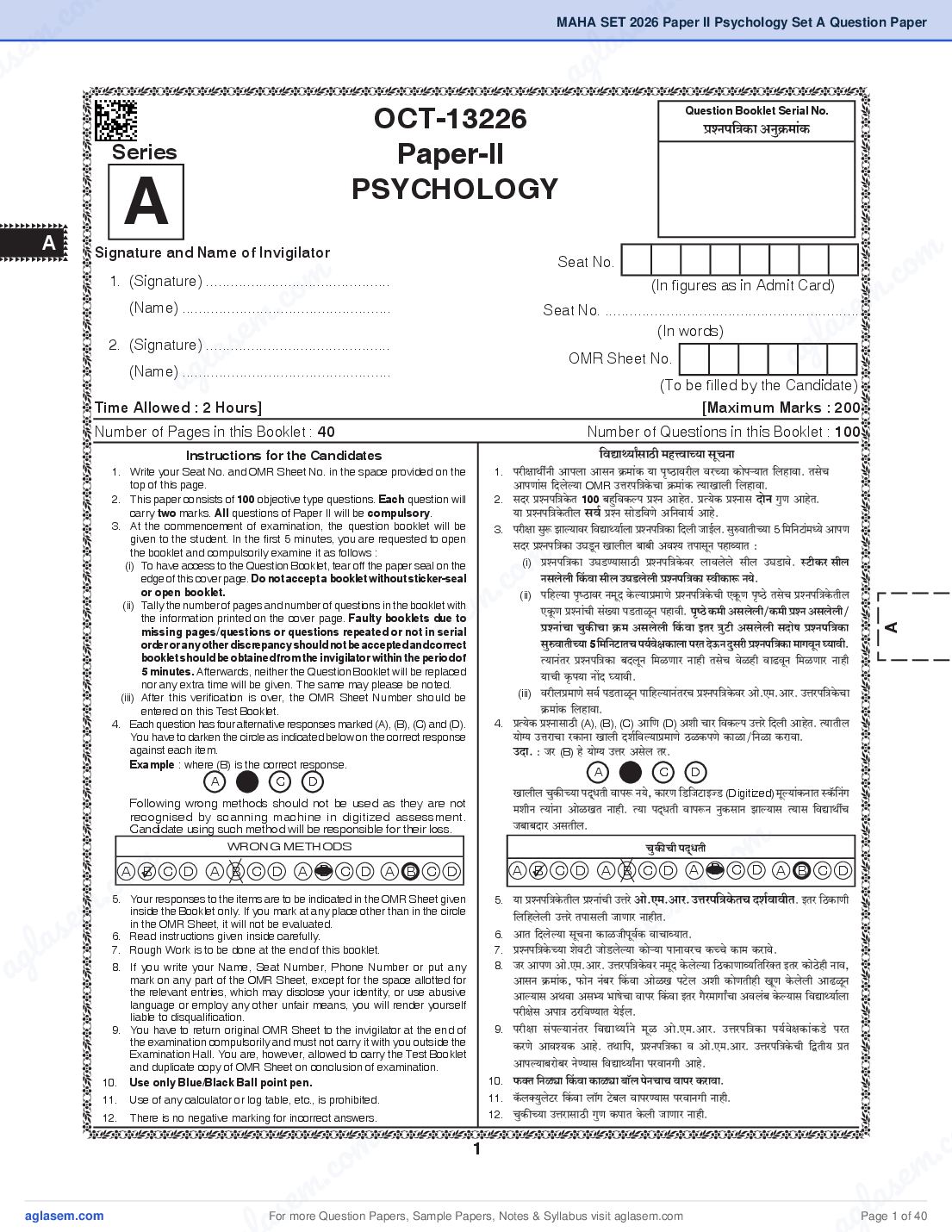
OCT-13226 Question Booklet Serial No.
àíZn{ÌH$m AZwH«$_m§H$
Series Paper-II
A Psychology
m
uuuuuuuuuuuu
uuuuuuu
co
A
om
Signature and Name of Invigilator
.
uuuuuuuuuuuu
Seat No.
.c e m
1. (Signature) ............................................. (In figures as in Admit Card)
e m
(Name) ...................................................
l a s
Seat No. ..............................................................
l a s (In words)
a g
ag
2. (Signature) .............................................
OMR Sheet No.
(Name) ...................................................
(To be filled by the Candidate)
Time Allowed : 2 Hours] [Maximum Marks : 200
Number of Pages in this Booklet : 40 Number of Questions in this Booklet : 100
Instructions for the Candidates {dÚmÏ`mªgmR>r _hÎdmÀ`m gyMZm
1. Write your Seat No. and OMR Sheet No. in the space provided on the 1.narjmWvZr Amnbm AmgZ H«$_m§H$ `m n¥îR>mdarb daÀ`m H$monè`mV {bhmdm. VgoM
top of this page. AmnUm§g {Xboë`m OMR CÎman{ÌHo$Mm H«$_m§H$ Ë`mImbr {bhmdm.
2. This paper consists of 100 objective type questions. Each question will 2. gXa àíZn{ÌHo$V 100 ~hþ{dH$ën àíZ AmhoV. àË`oH$ àíZmg XmoZ JwU AmhoV.
carry two marks. All questions of Paper II will be compulsory. `m àíZn{ÌHo$Vrb gd© àíZ gmoS>{dUo A{Zdm`© Amho.
3. At the commencement of examination, the question booklet will be 3. narjm gwê$ Pmë`mda {dÚmÏ`m©bm àíZn{ÌH$m {Xbr OmB©b. gwédmVrÀ`m 5 {_{ZQ>m_
§ Ü`o AmnU
m
given to the student. In the first 5 minutes, you are requested to open
co
the booklet and compulsorily examine it as follows :
gXa àíZn{ÌH$m CKSy>Z Imbrb ~m~r Adí` VnmgyZ nhmì`mV :
.
(i) To have access to the Question Booklet, tear off the paper seal on the (i) àíZn{ÌH$m CKS>Ê`mgmR>r àíZn{ÌHo$da bmdbobo grb CKS>mdo. ñQ>rH$a grb
em
edge of this cover page. Do not accept a booklet without sticker-seal Zgbobr {H§$dm grb CKS>bobr àíZn{ÌH$m ñdrH$mê$ Z`o.
or open booklet.
s
(ii) n{hë`m n¥îR>mda Z_yX Ho$ë`mà_mUo àíZn{ÌHo$Mr EHy$U n¥îR>o VgoM àíZn{ÌHo$Vrb
a
(ii) Tally the number of pages and number of questions in the booklet with
l
EHy$U àíZm§Mr g§»`m nS>VmiyZ nhmdr. n¥îR>o H$_r Agbobr/H$_r àíZ Agbobr/
the information printed on the cover page. Faulty booklets due to
g
A
missing pages/questions or questions repeated or not in serial àíZm§Mm MwH$sMm H«$_ Agbobr {H§$dm BVa ÌwQ>r Agbobr gXmof àíZn{ÌH$m
a
order or any other discrepancy should not be accepted and correct gwédmVrÀ`m 5 {_{ZQ>mVM n`©dojH$mbm naV XoD$Z Xwgar àíZn{ÌH$m _mJdyZ ¿`mdr.
booklet should be obtained from the invigilator within the period of Ë`mZ§Va àíZn{ÌH$m ~XbyZ {_iUma Zmhr VgoM doihr dmT>dyZ {_iUma Zmhr
5 minutes. Afterwards, neither the Question Booklet will be replaced `mMr H¥$n`m Zm|X ¿`mdr.
nor any extra time will be given. The same may please be noted.
(iii) After this verification is over, the OMR Sheet Number should be (iii) darbà_mUo gd© nS>VmiyZ nm{hë`mZ§VaM àíZn{ÌHo$da Amo.E_.Ama. CÎman{ÌHo$Mm
entered on this Test Booklet. H«$_m§H$ {bhmdm.
4. Each question has four alternative responses marked (A), (B), (C) and (D). 4. àË`oH$ àíZmgmR>r (A), (B), (C) Am{U (D) Aer Mma {dH$ën CÎmao {Xbr AmhoV. Ë`mVrb
You have to darken the circle as indicated below on the correct response `mo½` CÎmamMm aH$mZm Imbr Xe©{dë`mà_mUo R>iH$nUo H$mim/{Zim H$amdm.
against each item. CXm. : Oa (B) ho `mo½` CÎma Agob Va.
Example : where (B) is the correct response.
A B C D
A B C D
Imbrb MwH$sÀ`m nX²²YVr dmnê$ Z`o, H$maU {S>{OQ>mBÁS> (Digitized) _yë`m§H$ZmV ñH°${Z§J
Following wrong methods should not be used as they are not
_erZ Ë`m§Zm AmoiIV Zmhr. Ë`m nX²YVr dmnê$Z ZwH$gmZ Pmë`mg Ë`mg {dÚmWuM
m
recognised by scanning machine in digitized assessment.
c. o
Candidate using such method will be responsible for their loss. O~m~Xma AgVrb.
m
wrong methods MwH$sMr nX²²YVr
c. o e m
A
B C D A B C D A B C D A B C D A
B C D A B C D A B C D A B C D
em
5. Your responses to the items are to be indicated in the OMR Sheet given
la s
`m àíZn{ÌHo$Vrb àíZm§Mr CÎmao Amo.E_.Ama. CÎman{ÌHo$VM Xe©dmdrV. BVa {R>H$mUr
s
5.
la ag
inside the Booklet only. If you mark at any place other than in the circle
in the OMR Sheet, it will not be evaluated.
{b{hbobr CÎmao Vnmgbr OmUma ZmhrV.
g
6. Read instructions given inside carefully. 6. AmV {Xboë`m gyMZm H$miOrnyd©H$ dmMmì`mV.
a
7. Rough Work is to be done at the end of this booklet. 7. àíZn{ÌHo$À`m eodQ>r OmoS>boë`m H$moè`m nmZmdaM H$ÀMo H$m_ H$amdo.
8. If you write your Name, Seat Number, Phone Number or put any 8. Oa AmnU Amo.E_.Ama. CÎman{ÌHo$da Z_yX Ho$boë`m {R>H$mUmì`{V{aŠV BVa H$moR>ohr Zmd,
mark on any part of the OMR Sheet, except for the space allotted for AmgZ H«$_m§H$, \$moZ Z§~a {H§$dm AmoiI nQ>ob Aer H$moUVrhr IyU Ho$bobr AmT>iyZ
the relevant entries, which may disclose your identity, or use abusive Amë`mg AWdm Agä` ^mfoMm dmna {H§$dm BVa J¡a_mJmªMm Adb§~ Ho$ë`mg {dÚmÏ`m©bm
language or employ any other unfair means, you will render yourself
liable to disqualification. narjog AnmÌ R>a{dÊ`mV `oB©b.
9. You have to return original OMR Sheet to the invigilator at the end of 9. narjm g§në`mZ§Va {dÚmÏ`m©Zo _yi Amo.E_.Ama. CÎman{ÌH$m n`©dojH$m§H$S>o naV
the examination compulsorily and must not carry it with you outside the H$aUo Amdí`H$ Amho. VWm{n, àíZn{ÌH$m d Amo.E_.Ama. CÎman{ÌHo$Mr {ÛVr` àV
Examination Hall. You are, however, allowed to carry the Test Booklet
and duplicate copy of OMR Sheet on conclusion of examination. Amnë`m~amo~a ZoÊ`mg {dÚmÏ`mªZm nadmZJr Amho.
10. Use only Blue/Black Ball point pen. 10. \$ŠV {Ziçm {H§$dm H$miçm ~m°b noZMmM dmna H$amdm.
11. Use of any calculator or log table, etc., is prohibited. 11. H°$bŠ`wboQ>a {H§$dm bm°J Q>o~b dmnaÊ`mg nadmZJr Zmhr.
12. MwH$sÀ`m CÎmamgmR>r JwU H$nmV Ho$br OmUma Zmhr.
c
12. There is no negative marking for incorrect answers.
m .
LLLLLLLLLLLLLLLLLLLLLL
c. o m
1
m s e
se
For more Question Papers, Sample Papers, Notes & Syllabus visit
g l a Page 1 of 40
Page 3
For more Question Papers, Sample Papers, Notes & Syllabus visit Page 2 of 40
Page 4
. s e
em l a
as a g
Psychology
Paper II
_mZgemñÌ
o m
m
àíZn{ÌH$m II
. c
.co [Maximum Marks : 200em
m Hundred (100) multiple choice questions. Each question las
Time Allowed : 120 Minutes]
e
sTwo (2) marks. Attempt All questions. g
l a a
Note : This Paper contains
ag
carrying
gyMZm : `m àíZn{ÌHo$V e§^a (100) ~hþ{dH$ën àíZ {Xbobo AmhoV. àË`oH$ àíZmbm XmoZ (2) JwU AmhoV.
gd© àíZ gmoS>dm.
1. ________ is a sharp wave related with 1. ________ hm EH$ Vrd« Va§J Omo {ZÐoÀ`m
the temporary inhibition of neuronal n{hë`m Q>ßß`mV Vm§{Ì{H$` àÁdbZ VmËnwaVo
firing during the stage I sleep. à{V~§{YV H$aVo.
m
(A) Sleep spindle
c. o (A) PmonoMo AmdV©Z
s em
(B) K-Complex
g l a (B) H$-J§S>
(C) PGO wave
a (C) {n.{O.Amo. Va§J
(D) Alpha wave (D) Amë\$m Va§J
2. Which among the following schedules of 2. Imbrbn¡H$s H$moUË`m à~brH$aUmÀ`m loUr
reinforcement provides reinforcement
à~brH$aU H$aVmV ? .co
m
`m ZŠH$s H$moUË`m/{H$Vr `mo½` à{V{H«$`m§Z§Va
m
co responses ? em
after an exact number of correct
. s
s em (A) Fixed interval schedule a
(A) {Z`VmZwnlmVr
la ag
H$mbm§Var AZwgyMr
ag (B) pñWa JwUmoÎma AZwgyMr
(B) Fixed ratio schedule
(C) Variable interval schedule (C) nardV©H$ H$mbm§Var AZwgyMr
(D) Variable ratio schedule (D) nardV©H$ JwUmoÎma AZwgyMr
m . c
3
c. o s e m
m a
se
For more Question Papers, Sample Papers, Notes & Syllabus visit
g l
Page 3 of 40
Page 5
inoculation therapy. AdñWm Zmhr.
(A) Biological feedback
(A) O¡{dH$ à{V^aU
(B) Conceptual education
(B) g§H$ënZmË_H$ {ejU
(C) Skills acquisition and
consolidation (C) H$m¡eë` àmßVrH$aU Am{U EH$ÌrH$aU
(D) Application and follow through (D) Cn`moOZ Am{U AmT>mdm
4. Which of the following is a study of 4. g_mOOrdemñÌ hm H$emMm Aä`mg Amho ?
sociobiology ?
(A) The influence of genes on social (A) gm_m{OH$ dV©Zmda OZwH$m§Mm à^md
behavior
(B) dmVmdaUmMm g_mOmda hmoUmam n{aUm_
(B) The effects of climate on society
(C) Political structures in different (C) doJdoJù`m g§ñH¥$Vt_Yrb amOH$s`
cultures g§aMZm
(D) The role of technology in social
change (D) gm_m{OH$ ~XbmV V§ÌkmZmMr ^y{_H$m
5. A broad theoretical framework 5. EH$ ì`mnH$ g¡Õm§{VH$ Mm¡H$Q> Or
that seeks to explain how children
bhmZnUmnmgyZ nm¡J§S>mdñWon`ªV _wbm§Mm
develop from infancy through
adolescence in terms of observable {dH$mg H$gm hmoVmo ho {ZarjU H$aÊ`m `mo½`
behavior and environmental dV©Z Am{U n`m©daUr` à^mdm§À`m ~m~VrV
influences is called
ñnîQ> H$aVo Ë`mbm åhUVmV
(A) Behavioral development theory
(A) dV©UwH$s` {dH$mg {gÕm§V
(B) Psychoanalytical development
theory
(B) _Zmo{díbofUmË_H$ {dH$mg {gÕm§V
(C) Cognitive development theory
(C) g§kmZmË_H$ {dH$mg {gÕm§V
(D) Psychosocial development
theory (D) _Zmogm_m{OH$ {dH$mg {gÕm§V
4
For more Question Papers, Sample Papers, Notes & Syllabus visit Page 4 of 40
Page 6
. s e
em l a
as a g
6. Humanistic approaches to personality 6. ì`pŠV_Ëd _mnZmgmR>r _mZdVmdmXr ÑîQ>rH$moZ
assessment are designed to find ì`pŠVMo H$moUË`m ~m~r dñVw{ZîR>[aË`m
objective ways of assessing a
m
emoYÊ`mgmR>r Amho ?
co
person’s
m
(A) Unconsciousomotives
m .
c.
(A) A~moY àoaUm
se
s em experience (B) ì`pŠV{ZîR> AZw^d
g l a
la tendencies
(B) Subjective
g a
a
(C) Altruistic (C) namonH$mar àd¥Îmr
(D) Free will (D) BÀN>m ñdmV§Í`
7. According to the functional matching 7. _Z didÊ`mÀ`m H$m`m©Ë_H$ OwiUr
hypothesis in persuasion, high self- J¥hrVH$mZwgma, CÀM ñd-{ZarjH$m§da
monitors are more influenced by H$emMm A{YH$ à^md nS>Vmo ?
m
(A) Logical reasoning and factual
c. o (A) Vm{H© $H$ `wpŠVdmX Am{U VÏ`mË_H$
s em
arguments `wpŠVdmX
g l a
(B) Messages that align with social
norms and relationships a (B) gm_m{OH$ {Z`_ Am{U ZmVog§~§Ym§er
OwiUmao g§Xoe
(C) Arguments that emphasize (C) d¡`pŠVH$ _yë`o Am{U {dídmgmda ^a
personal values and beliefs XoUmao `wpŠVdmX
(D) Emotionally charged messages (D) `wpŠVdmXmÀ`m VmH$XrH$S>o Xwb©j H$ê$Z
m
c. o
regardless of argument strength ^md{ZH$[aË`m ^abobo g§Xoe
m
c. o8. Which one of the following is not a m Hy$b dV©Z
Imbrbn¡H$s H$moUVosegm_mOmZw
em prosocial behavior ? Zmhr ? gla
8.
las a
ag (A) Donating to charity (A) Y_m©Xm` g§ñWm§Zm XmZ H$aUo
(B) Sacrifice (B) Ë`mJ
(C) Gaining something valuable (C) H$mhrVar _m¡ë`dmZ {_idUo
(D) Volunteering (D) ñd`§godm
m . c
5
c. o s e m
m a
se
For more Question Papers, Sample Papers, Notes & Syllabus visit
g lPage 5 of 40
Page 7
for people who experience intense ì`pŠV_Ëd {dH$mamZo J«ñV Agboë`m bmoH$m§gmR>r
emotions and suffer from borderline
personality disorder ? H$moUVr Woanr gm_mÝ`V: dmnabr OmVo ?
(A) Dialectical Behavior Therapy (A) X²d§XmË_H$ dV©Z CnMma nÕVr (DBT)
(DBT)
(B) H$bm CnMma
(B) Art therapy
(C) Transactional analysis (C) ì`dhma {díbofU
(D) REBT (D) VH©$ g§JV ^md{ZH$ CnMma nÕVr
10. In family therapy, the therapist must 10. Hw$Qw>§~ CnMmam§_Ü`o CnMmamH$mZo ________
attend to all of the following except {edm` Imbrb gd© JmoîQ>tH$S>o bj {Xbo
(A) Each member of the family as an nm{hOo.
isolated individual (A) Hw$Qw>§~mVrb àË`oH$ gXñ` EH$ ñdV§Ì
(B) Each member of the family ì`ŠVr åhUyZ
interaction with each other family (B) Hw$Qw>§~mVrb àË`oH$ gXñ`mMm
member EH$_oH$m§er Hw$Qw>§~mVrb gXñ`m§er g§dmX
(C) Subgroups within the family in (C) Hw$Qw>§~mVrb Cng_yh EH$_oH$m§er
interaction with each other g§dmX gmYV
(D) The family as a whole (D) g§nyU© Hw$Qw>§~
11. Which among the following statement/s 11. Am`ZmoQ´>m°{nH$ Am{U _oQ>m~moQ´>m°{nH$ J«mhtÀ`m
is/are true about the ionotropic and {R>H$mUm~Ôb H$moUVo {dYmZ ~amo~a Amho ?
metabotropic receptor sites ?
1. Am`ZmoQ´>m°{nH$ J«mhr H$_r J{VZo H$m_
1. Ionotropic receptors work very
slow H$aVmV
2. Ionotropic receptors are located 2. Am`ZmoQ´m°{nH$ J«mhr OoWo MoVmdmhH$
near the site of neurotransmitter ñÌdVmV VoWo pñWV AgVmV
release
3. Metabotropic receptors have 3. _oQ>m~moQ´>m°{nH$ J«mhtMm Am`ZmoQ´>m°{nH$
longer lasting impact as J«m{h§nojm H$_r H$m`_ñdê$nr à^md
compared to the ionotropic nS>Vmo
receptors
4. AMPA J«mhr _oQ>m~moQ´>m°{nH$ J«mhr
4. AMPA receptor is a metabotropic
receptor (A) \$ŠV 2
(A) Only 2 (B) \$ŠV 1
(B) Only 1 (C) 2 Am{U 3 XmoÝhrhr
(C) Both 2 and 3
(D) Both 1 and 4 (D) 1 Am{U 4 XmoÝhrhr
6
For more Question Papers, Sample Papers, Notes & Syllabus visit Page 6 of 40
Page 8
. s e
em l a
as a g
12. Which among the following 12. Imbrbn¡H$s H$moUVo MoVmnmaofH$ AÜ``ZmV
neurotransmitters plays a crucial role _hËdmMr ^w{_H$m nma nmS>Vo ?
in learning ?
m
co
(A) ½byQ>m_oQ>
m .
(A) Glutamate
(B) Serotonin co m
. e
(B) goamoQ>m°ZrZ
e m l a s
l a s
(C) Dopamine (C) S>m°nm_mB©Z
ag
ag
(D) Histamine (D) {hñQ>`m_rZ
13. As per ________ theory of emotion, 13. ________ `m§À`m ^mdZoÀ`m {gÕm§VmZwgma
our bodies react automatically to Amnbo eara ho H$mhr n`m©daUr` CÔrnH$m§Zm
certain environmental stimuli and these ñd`§MbrV à{V{H«$`m XoVo Am{U `m à{V{H«$`m§Mm
reactions result in the experience of
m
narUm_ hm ^mdZm AZw^dÝ`mV hmoVmo.
c. o (A) Ooåg - b±J
emotion.
em
(A) James – Lange
l a s
g
(B) Cannon – Bard (B) H°$ZmZ - ~mS>©
(C) Schachter – Singer a (C) g°ŠQ>a - {g§Ja
(D) Walk – Roman (D) dmH$ - amo_Z
14. Which of the following is explained by 14. Imbrbn¡H$s H$moUVo gm_m{OH$ Apñ_Vm {gÕm§V
social identity theory ? ñnîQ> H$aVmo ?
m
m
(A) How people define themselves
c. o
c. o
(A) JQ> gXñ`ËdmÀ`m AmYmao bmoH$
s emH$er H$aVmV
based on group membership
em (B) How individual behave in a
ñdV:Mr ì`m»`m
s (B) ì`ŠVr g l
gla a EH$mH$snUmV H$go dmJVmV
a
isolation
(C) ~w{Õ_ËVm gm_m{OH$ dV©Zmda H$gm
(C) How intelligence affects social
behavior n[aUm_ H$aVo
(D) How emotions control decision- (D) ^mdZm {ZU©` KoÊ`mda H$go {Z`§{ÌV
making H$aVmV
m . c
7
c. o s e m
m a
se
For more Question Papers, Sample Papers, Notes & Syllabus visit
g lPage 7 of 40
Page 9
development, when the child believes Ooìhm _wbmbm Ago dmQ>Vo H$s Oa EImX²`m
that if the consequence for an action
H¥$VrMm n[aUm_ {ejm Agob Va Vr H¥$Vr
is punishment, then the action was
wrong. This is called as
MwH$sMr hmoVr `mbm Ago åhUVmV ?
(A) Level One – Preconventional (A) ñVa EH$ – nyd©-nma§nm[aH$ Z¡{VH$Vm
Morality
(B) ñVa XmoZ – nma§nm[aH$ Z¡{VH$Vm
(B) Level Two – Conventional
Morality (C) ñVa VrZ – nma§nm[aH$ Z¡{VH$Vm
(C) Level Three – Postconventional Z§Va
Morality
(D) Level Four – Law and order (D) ñVa Mma – H$m`Xm Am{U gwì`dñWoMr
morality Z¡{VH$Vm
16. In which of the counseling paradigm 16. H$moUË`m g_wnXoeZ nÕVrV ""g§dmX ~m§YUr''
“Rapport Building” will be emphasized ? da ^a {Xbm OmB©b ?
(A) Person-centered
(A) ì`ŠVr-H|${ÐV
(B) Rational counseling
(B) VH©$ g§JV g_wnXoeZ
(C) Behavioristic counseling
approach (C) dV©ZdmXr g_wnXoeZ ÑpîQ>H$moZ
(D) Directive counseling (D) {ZX}emË_H$ g_wnXoeZ
17. The cognitive process known as 17. Ooìhm ì`ŠVr doJù`m H$bmË_H$, gm{hpË`H$,
________ thinking occurs when an emñÌr` {H§$dm àmË`{jH$ g_ñ`mMm nyU©V:
individual freely considers a variety of
potential solutions to artistic, literary,
_wŠVnUo {dMma H$aVmo. Voìhm `m ~moYZrH$
scientific or practical problems. àH«$s`obm ________ Ago _mZbo OmVo.
(A) Heuristic (A) ZdJm_r
(B) Creative (B) g¥OZ
(C) Convergent (C) g§bjr
(D) Divergent (D) ~hþbjr
8
For more Question Papers, Sample Papers, Notes & Syllabus visit Page 8 of 40
Page 10
. s e
em l a
as a g
18. The concept of ‘Anatta’ in Buddhism 18. ~m¡ÕY_m©V "AZÎmm' nwT>rb JmoîQ>rbm gy{MV
refers to H$aVo
(A) Impermanence (A) A{ZË`Vm
(B) Suffering
m
(B) Xw:I
. c om
(C) Non-self
c. o (C) A-ñd
s e m
s em la
la ag
(D) Mindfulness (D) _ZZ
ag
19. What are the attributes of sample 19. Z_wZm gm§p»`H$sMo JwUY_© H$m` AmhoV ?
statistics ?
1. kmV AgVo
1. Known
2. A§Xm{OV AgVo
2. Estimated
3. JUZm Ho$bobo AgVo
3. Calculated
m
4. AkmV AgVo
c. o (A) 1 \$ŠV
4. Unknown
(A) 1 only
s em
g l a (B) 1 Am{U 2 \$ŠV
a
(B) 1 and 2 only
(C) 1 and 3 only (C) 1 Am{U 3 \$ŠV
(D) 2, 3 and 4 only (D) 2, 3 Am{U 4 \$ŠV
20. Which of the following is/are used 20. àíZ/KQ>H$ ^oXH$Vm _yë`m§Mm Aä`mg H$aVm§Zm
as techniques to find out the item Imbrbn¡H$s H$moUVo V§Ì/V§Ìo dmnaVmV ?
m
discrimination value ?
m
I. Q>mH
c. o
o $mÀ`m g_whm§Mm Cn`moJ
c. o II. Point biserial correlation m
I. Use of extreme groups
s e
em la
II. nm°BQª > ~m`goar`b ghg§~Y
§
las ag
g
(A) \$ŠV I
a
(A) I only
(B) II only (B) \$ŠV II
(C) Both I and II (C) I Am{U II XmoÝhrhr
(D) Neither I nor II (D) I Am{U II `mn¡H$s Zmhr
m . c
9
c. o s e m
m a
se
For more Question Papers, Sample Papers, Notes & Syllabus visit
g l
Page 9 of 40
Page 11
21.
the correct answer using the codes Imbr {Xbobr AÚmjao dmnê$Z `mo½` CÎma
given below the list.
{ZdS>m.
List – I List – II
`mXr – I `mXr – II
P. Fissure 1. A protuberance on P. {dXa 1. _|XÀy `m n¥îR>^mJmda Ambobo
the surface of the
brain Q>|Jyi
Q. Gyrus 2. A set of axons within Q. g§d{b 2. _Ü`dVu MoVmg§ñWoVrb
the CNS Aj§V§VyMm g§M`
R. Tract 3. A long deep sulcus R. MoVm_mJ© 3. bm§~ Imob grVm
S. Ganglion 4. A cluster of neuron S. J§{S>H$m 4. MoVmnoer noerH$m` Mm
cell bodies g_yh
(A) P – 3, Q – 1, R – 2, S – 4 (A) P – 3, Q – 1, R – 2, S – 4
(B) P – 1, Q – 3, R – 2, S – 4 (B) P – 1, Q – 3, R – 2, S – 4
(C) P – 1, Q – 2, R – 4, S – 3 (C) P – 1, Q – 2, R – 4, S – 3
(D) P – 2, Q – 3, R – 1, S – 4 (D) P – 2, Q – 3, R – 1, S – 4
22. Match List – I with List – II and select 22. `mXr – I Am{U `mXr – II _Yrb OmoS>çm bmdm
the correct answer using the codes d Ë`m Imbrb {Xboë`m g§Ho$Vm§H$mÀ`m dmna
given below the list.
H$ê$Z AMyH$ CÎmamMr {ZdS> H$am.
List – I List – II
(Type of memory) (Task)
`mXr – I `mXr – II
(ñ_¥VrMo àH$ma) (H$m`})
P. Semantic 1. Free recall
P. AW©na ñ_¥Vr 1. _wŠV àË`mdhZ
Q. Sensory 2. Sentence
verification task Q. doXZ ñ_¥Vr 2. dmŠ` nS>VmiUr
R. Episodic 3. Priming H$m`©
S. Implicit 4. Scanning R. KQ>Zm ñ_¥Vr 3. àW_rH$aU
S. Aì`ŠV ñ_¥Vr 4. VnmgUr
(A) P – 2, Q – 4, R – 1, S – 3
(A) P – 2, Q – 4, R – 1, S – 3
(B) P – 4, Q – 2, R – 1, S – 3
(B) P – 4, Q – 2, R – 1, S – 3
(C) P – 3, Q – 1, R – 2, S – 4
(C) P – 3, Q – 1, R – 2, S – 4
(D) P – 1, Q – 3, R – 4, S – 2 (D) P – 1, Q – 3, R – 4, S – 2
10
For more Question Papers, Sample Papers, Notes & Syllabus visit Page 10 of 40
Page 12
. s e
em l a
as a g
23. According to Selye’s ‘General Adaptation 23. eoboÀ`m "gm_mÝ` à{V`moOZ g§bjU' VmU
Syndrome’ model of stress, out of àmê$nmZwgma Imbrbn¡H$s H$moUË`m VrZ AdñWm
following which is correct sequence of
`m àmê$nmZwgma `mo½` H«$_mV `oVmV ?
m
co
three stages of model ?
om .
(A) Alarm reaction; exhaustion;
c m
(A) gmdYmZ à{V{H«$`m; Šbm§Vr; à{VH$ma
. e
resistance
e m
(B) Resistant; alarm reaction;
l a s
l a s
exhaustion (B) à{VH$ma; gmdYmZ à{V{H«$`m; Šbm§Vr
ag
ag
(C) Exhaustion; resistance; alarm
reaction (C) Šbm§Vr; à{VH$ma; gmdYmZ à{V{H«$`m
(D) Alarm reaction; resistance;
exhaustion (D) gmdYmZ à{V{H«$`m; à{VH$ma; Šbm§Vr
24. According to __________ the emotions 24. _________ Zwgma AmnU Á`m ^mdZm
we feel result from appraisals, or AZw^dVmo Ë`m n`m©daUr` n[apñWVr Am{U
evaluations of information coming from
o mearamVyZ `oUmè`m _mhrVrÀ`m AdbmoH$ZmMm
the environmental situation and from
m .c {H§$dm _yë`m§H$ZmMo \$brV Amho.
s e
within body.
gla
(A) g°ŠQ>a – {g§Ja
a
(A) Schachter – Singer
(B) Richard – Lazarus (B) {aMS>© – bmPmag
(C) James – Lange (C) Ooåg – b±J
(D) Cannon – Bard (D) H°$ZmZ – ~mS>©
m {gÕm§VmZo
25. Which of the following theory explains 25. BVam§Mr CnpñWVr à^mdr à{VgmX àd¥Îmr
dmT>dVo ho Imbrbn¡H$s H$moUoË`m
m c
m.
‘the presence of others increases the
c. o dominant response tendency’ ?
ñnîQ> hmoVo ?
s e
s em (A) Social exchange theory la
gla ag
(A) gm_m{OH$ XodmUKodmU {gÕm§V
a (B) Social cognition theory (B) gm_m{OH$ ~moYZ {gÕm§V
(C) Social facilitation theory (C) gm_m{OH$ gwb^rH$aU {gÕm§V
(D) Social constructionist theory (D) gm_m{OH$ aMZmdmXr {gÕm§V
m . c
11
c. o s e m
m a
se
For more Question Papers, Sample Papers, Notes & Syllabus visit
g l
Page 11 of 40
Page 13
are conceptually not overlapping g§H$ënZmË_H$ ÑîQ²>`m RIASEC MmMÊ`m_Ü`o
RIASEC scales ?
g_m{dîQ> Zmhr ?
(A) Leadership
(A) brS>a{en
(B) Creativity (B) {H«$E{Q>pìhQ>r
(C) Analysis (C) AZ{b{gg
(D) Erudition (D) Bê${S>eZ
27. The Kluver-Bucy syndrome is a 27. Šbyìha-~wgr MoVm_mZ{gH$ {dH$ma H$moUË`m
neuropsychiatric disorder due to I§S>mbm XwImnV Pmë`mZo hmoVmo ?
lesions in _______ lobe.
(A) D$Üd©I§S>
(A) Parietal
(B) Pre-frontal (B) nyd©bbmQ> I§S>
(C) Bilateral temporal (C) {Ûnmeu Hw§$^I§S>
(D) Secondary occipital (D) Xþæ`_ níMI§S>
28. The law of readiness primarily 28. gÁOVm {Z`_ hm àmW{_H$[aË`m
explains __________ {dfX H$aVmo.
(A) The speed of learning (A) JVrMo AÜ``Z
(B) Physical and mental preparedness (B) AÜ``ZmMr emar[aH$ Am{U _mZ{gH$
for learning V`mar
(C) Impact of learning (C) AÜ``ZmMm à^md
(D) Depth of learning (D) AÜ``ZmMr Imobr
29. Out of following, __________ is not a 29. Imbrbn¡H$s __________ ho ^mdZm§Mo d¡{eîQ>
characteristic of emotions. Zmhr.
(A) Emotions are perpetual (A) ^mdZm `m A{daV AgVmV
(B) Emotions can be either positive or (B) ^mdZm `m gH$mamË_H$ {H§$dm ZH$mamË_H$
negative Agw eH$VmV
(C) Emotions affect the perception and (C) ^mdZm§Mm g§doXZ d ñ_¥Vrda n[aUm_
memory H$aVmV
(D) emotions tend to alter thought (D) ^mdZm `m {dMma à{H«$`m ~Xbm§Mr
process eŠ`Vm AgVo
12
For more Question Papers, Sample Papers, Notes & Syllabus visit Page 12 of 40
Page 14
. s e
em l a
as a g
30. Which of the following is a function of 30. Imbrbn¡H$s H$moUVo b‹T>m {H§$dm nbm`Z
epinephrine during the fight or flight à{VgmXmXaå`mZ E{nZo{\«$ZMm n[aUm_ Amho ?
response ?
m
(A) öX` JVr Am{U aŠVXm~ dmT>Uo
co
(A) Increases heart rate and blood
m .
co
pressure
em
(B) ñZm`y§Zm D$Om© XoUo
m .
(B) Energies the muscle
s
e la
(C) Ma~rMo CO}_Ü`o ê$nm§Va H$aUo
s (D) aŠVàdmhmV Am°pŠgOZ {_idUog
(C) Converts fat into energy
l a a
ag
(D) Gets oxygen into bloodstream
31. After learning to drive one can 31. JmS>r Mmbdm`bm {eH$ë`mZ§Va ì`pŠV g§~§YrV
perform the tasks like shifting gears H$m`© H$aVmo, Ago JoAa Q>mH$Uo, gwH$mUy MmbdUo
and maneuvering the steering
BË`mXr H$aV AgVm§Zm Vmo àË`oH$ H$m`m©da nyU©
without paying focus on each
individually. This is because of bj Z XoVm hr JmS>r Mmb{dVmo. ho gd© Vmo
m
______ ñ_¥Vr _wio nma nmSVmo.
c. o (A) KmofUmË_H$
______ memory.
em
(A) Declarative
l a s
g
(B) Acoustic (B) Üd{ZH$
(C) Procedural a (C) à{H«$`mË_H$
(D) Serial (D) AZwH«$_
32. In active and aroused emotional 32. {H«$`merb Am{U CÔrnrV ^mdZrH$ nmVirV
states _______ part of the nervous ________ hm MoVm g§ñWoMm ^mJ emar{aH$
system control bodily functions and
H$m`m©Mo {Z`§ÌU H$aVmo Am{U em§m
o
V Am{U {dlm§V
m nmVirV ________ hr Mo.cVm g§ñWm {Z`§ÌUmMo
c. o
in calm and relaxed states ________
m
se
part of the nervous system controls
s em the functioning. H$m`© H$aVo.
g la
gla (A) namZwHa§$nr; AZwH§$nr
a
(A) Parasympathetic; sympathetic
(B) Sympathetic; parasympathetic (B) AZwH§$nr; namZwH§$nr
(C) Peripheral; sympathetic (C) narYr`; AZwH§$nr
(D) Sympathetic; peripheral (D) AZwH§$nr; narYr`
m . c
13
c. o s e m
m a
se
For more Question Papers, Sample Papers, Notes & Syllabus visit
g l
Page 13 of 40
Page 15
fatty levels in the blood leads to kidney nmVirMr Ma~r/\°$Q> hr _wÌ{n§S>mMo H$m`©
malfunction and leads to accumulation {dñH$irV H$ê$Z e{aamV ZH$mo AgUmè`m
of waste in the body. nXmW©Mr dmT> hmoVo, Ë`mg Imbrbn¡H$s
________ Ago åhUVmV.
(A) Hyperglycemia
(A) hm`na½bm`go_r`m
(B) Ketoacidosis
(B) Ho$Q>moAm°grS>mogrg
(C) Gluconeogenesis (C) ½bwH$moZrAmoOoÝgrg
(D) Hypoglycemia (D) hm`nmo½bm`go_r`m
34. According to the triarchic theory of 34. ~w{Õ_ÎmoÀ`m {Ì{_Vr` {gÕm§VmZwgma, Oa Vwåhr
intelligence, if you were a renowned à{gÕ A_yV© {MÌH$ma Agmb, Va Vwåhr `mV
abstract painter, you would be high in
CÀM Agmb.
(A) Innate intelligence
(A) OÝ_OmV ~w{Õ_Îmm
(B) Contextual intelligence (B) g§X{^©V ~w{Õ_Îmm
(C) Componential intelligence (C) KQ>H$s` ~w{Õ_Îmm
(D) Experiential intelligence (D) AZw^dmË_H$ ~w{Õ_Îmm
35. Recent researches show that 35. AbrH$S>rb g§emoYZo X{e©dVmV H$s g¥OZ{ebVm
creativity is correlated with hr ______ `mÀ`mer g§~§{YV Amho.
1. Intelligence 1. ~w{Õ_Îmm
2. Psychoticism 2. Xw_©ZñH$Vm
3. Openness to experience 3. AZw^dmMr {dd¥Îmr
4. Agreeableness 4. _Z^mdZ
Codes : g§Ho$Vm§H$ :
(A) 1 only (A) \$ŠV 1
(B) 1 and 4 (B) 1 Am{U 4
(C) 1, 3 and 4 (C) 1, 3 Am{U 4
(D) 1, 2 and 3 (D) 1, 2 Am{U 3
14
For more Question Papers, Sample Papers, Notes & Syllabus visit Page 14 of 40
Page 16
. s e
em l a
as a g
36. Which of the following is not true Imbrbn¡H$s H$moUVo {dYmZ ~moYmË_H$ $
36.
regarding cognitive thinking styles ?
{dMmae¡br ~m~V Iao Zmhr ?
(A) Vo _mZ{gH$ _mJ©Xe©H$ AmhoV Ooo
om
(A) They are mental guides which help
m . c
us process information Amnë`mbm _m{hVrda à{H«$`m H$aÊ`mV
co guides which
(B) They are .mental
_XV H$aVmV
s e m
help s
m
use problem solve in specific l a
g
(B) Vo _mZ{gH$ _mJ©Xe©H$ AmhoV Oo {d{eîQ>
g la g§X^m©V Amnë`mbm g_ñ`m gmoaS>{dÊ`mg
a
contexts
_XV H$aVmV
(C) They are important to the way (C) Amnë`m X¡Z§{XZ gm_m{OH$ A§V{H«©$`m§_Ü`o
we think, perceive and organize AmnU Á`m àH$mao {dMma H$aVmo, g_OVmo
information in our daily social
Am{U _m{hVrMo g§KQ>Z H$aVmo Ë`mgmR>r
interactions
Vo _hÎdmMo AgVmV
m H$m¡eë`o _moOÊ`mMm EH$ AMyH$ _mJ©
(D) They are an accurate way to (D) Vo ~w{Õ_Îmm Am{U g_ñ`m gmoS>{dÊ`mMr
c o
m.
measure intelligence and problem
s e
solving skills AmhoV
g l a
37. According to Herbert Kelman (1961), a
which of the following is an additional
37. h~©Q>© Ho$ë_Z (1961) `m§À`m _Vo, AZwnmbZ
Am{U A§VJ©VrH$aUmgmo~V Imbrbn¡H$s H$moUVr
process of opinion change alongside
compliance and internalization ? _V ~XbÊ`mMr A{V[aŠV à{H«$`m Amho ?
(A) Persuasion (A) _Z didUo
(B) Identification (B) VmXmËå`
m
(C) Conformity (C) AZwg[aVm
m co .
co
(D) Social facilitation (D) gm_m{OH$ gwb^rH$aU
. e m
em 38. According to behavior therapy, what l a sgma _mZdr dV©ZmMm {H$Vr
las 38.
Q>ŠHo$ ^mJ aO¡g{dH$ aMZoX²dmao ~Zbm Amho ?
dV©Z CnMma nÕVrZw
ag
percentage of human behavior is
accounted for by biological makeup ?
(A) 70%
(A) 70%
(B) 50% (B) 50%
(C) 30% (C) 30%
(D) 90% (D) 90%
m . c
15
c. o s e m
m a
se
For more Question Papers, Sample Papers, Notes & Syllabus visit
g l
Page 15 of 40
Page 17
39.
(A) Developing virtues and long-term H$aVmV
personal growth
(A) gX²JwUm§Mm {dH$mg Am{U XrK©H$mbrZ
(B) Indulgence in pleasure and
the satisfaction of appetites and d¡`pŠVH$ dmT>
needs (B) AmZ§XmV a_Uo Am{U ^yH$ Am{U
(C) Cultivating resilience through JaOm nyU© H$aUo
adversity
(D) Seeking meaning over momentary (C) à{VHy$bVoVyZ bd{MH$Vm OmonmgUo
enjoyment (D) j{UH$ AmZ§Xmnojm AW© emoYUo
40. Which of the following states scientific 40. Imbrbn¡H$s H$moUVo d¡km{ZH$ VËd gm§JVo H$s
principle that simple and economical gmÜ`m Am{U {H$\$m`Vera ñnîQ>rH$aUmbm
explanations are preferred ?
àmYmÝ` {Xbo OmVo ?
(A) Badness of fit
(A) V§XwéñVrMr dmB©Q>Vm
(B) Parsimony (B) n{g©_Zr
(C) Avoidance of simple explanation (C) gmoß`m ñnîQ>rH$aU Q>miUo
(D) Goodness of fit (D) V§XwéñVrMr Mm§JbrVm
41. Which of the following is mechanism 41. Imbrbn¡H$s H$moUVr n{aì`` Am{U bm^
for producing the link between cost `m§À`mVrb Xwdm {Z_m©U H$aÊ`mMr `§ÌUm
and benefit ?
Amho ?
(A) Artificial learning
(A) H¥${Ì_ {ejU
(B) Organizational learning (B) g§KQ>ZmË_H$ {ejU
(C) Social learning (C) gm_m{OH$ {ejU
(D) Affective learning (D) ^mdZmË_H$ {ejU
42. All the following are therapeutic 42. Imbrb gd©YmoaUmË_H$ aMZm Hw$Qw>§~ CnMma
techniques in Structural-strategic nÕVr_Ü`o ________ dJiVm CnMmamË_H$
Family therapy EXCEPT
V§Ìo AmhoV.
(A) Joining
(A) gm_rb hmoUo
(B) Directives (B) {ZX}e
(C) Identification of family secrets (C) H$m¡Qw>§{~H$ Jw{nVm§Mr AmoiI
(D) Probes (D) Mm¡H$er
16
For more Question Papers, Sample Papers, Notes & Syllabus visit Page 16 of 40
Page 18
. s e
em l a
as a g
43. Eudaimonia, as a concept of 43. H$ë`mUmMr g§H$ënZm åhUyZ `wS>m`_mo{Z`mMo
well-being, is best described by dU©Z Imbrbn¡H$s H$moUË`m gyÌmZo Ho$bo OmVo ?
which of the following formulas ?
m
co
(A) Well-being = Happiness + (A) H$ë`mU = AmZ§X + AW©
om .
Meaning
.c e m
s
(B) Well-being = Pleasure + Absence
m
(B) H$ë`mU = AmZ§X + doXZm§Mm A^md
s
of Pain
e l a
(C) H$ë`mU = g§nËVr + gm_m{OH$ gpñWVr
l a a
ag
(C) Well-being = Wealth + Social
Status
(D) Well-being = Emotional Stability (D) H$ë`mU = ^md{ZH$ pñWaVm +
+ Popularity bmoH${à`Vm
44. Which Indian Philosophical system 44. H$moUVr ^maVr` VËdkmZmË_H$ àUmbr
emphasizes the cessation of thoughts AmË_-gmjmËH$mamMm _mJ© åhUyZ {dMmamÀ`m
mg_mßVrda ^a XoVo ?
co
as the Path to Self-realization ?
.
(A) Nyaya
s em (A) Ý`m`
g l a
a
(B) Samkhya (B) gm§»`
(C) Yoga (C) `moJ
(D) Mimansa (D) _r_m§gm
45. Which of the following is/are the 45. ÑpîQ>H$moZ _mnZmÀ`m AW©na {d^oXr V§ÌmMo
Imbrbn¡H$s H$moUVr/Vo d¡{eîQ>mço AmhoV ?
co
feature/s of semantic differential
m .
c. o I. Denotative meaning
technique of attitude measurement ?
em
I. AW©Xe©H$
em la s
s
II. AW©nyU©
la r`g{deofUo
III. {ÛY«wda
II. Connotative meaning
ag III. Bipolar adjectives
(A) \$ŠV I
(A) I only
(B) II only (B) \$ŠV II
(C) II and III only (C) \$ŠV II Am{U III
(D) I and II only (D) \$ŠV I Am{U II
m . c
17
c. o s e m
m a
se
For more Question Papers, Sample Papers, Notes & Syllabus visit
g l
Page 17 of 40
Page 19
paragraph. Read following paragraph and AmhoV. CVmam dmMyZ nwT>rb àíZm§Mr CÎmao Úm.
answer five questions that follow.
EH$m g§emo{YHo$Zo à{VJ_Z {díbofU Ho$bo. {Vbm
A researcher carried out regression analysis.
She wanted to predict Organization
Om°~ g°{Q>ñ\°$ŠeZ (JS), dH©$ EÝìhm`Z©_|Q> (WE),
Commitment (OC) using Job Satisfaction (JS), brS>a{en (L) Am{U Eåßbm°`r E§JoO_|Q (EE) >dmnê$Z
Work Environment (WE), Leadership(L), and Am°J©Zm`PoeZ H${_Q>_|Q> (OC) Mo nyd©H$WZ H$am`Mo
Employee Engagement (EE). On a sample hmoVo. 100 à{VgmXH$Ë`mªÀ`m Z_wÝ`mda, {VZo gd©
of 100 respondents, she measured all the n[adV©H$m§Mo _mZgemñÌr` MmMUr dmnê$Z _moO_mn
variables using psychological scales. JS and Ho$bo. JS Am{U EE `m§À`mVrb ghg§~§{YV 0.80
EE correlated 0.80 VIF for both of them is 7. Ambm Am{U XmoÝhrgmR>r VIF 7 Ambo. {VZo EH$m
She consulted a colleague who suggested to
ghH$mè`mMm gëbm KoVbm Á`mZo JS {H§$dm EE
drop either JS or EE and indicated problem
of imperfect measurement of variables.
dJiÊ`mMm gëbm {Xbm Am{U n[adV©H$m§À`m gXmof
She dropped JS and carried out multiple _mnZmMr g_ñ`m Xe©{dbr. {VZo JS dJibo Am{U
regression. Overall model has F = 24 (p<.01) EH$m{YH$ à{VJ_Z Ho$bo. EHy$U _m°S>ob_Ü`o F = 24
and R2 = 0.36. (p<.01) Am{U R2 = 0.36 Amho.
46. What is df of multiple regression model 46. darb CXmhaUmV EH$m{YH$ à{VJ_Z àmê$nmMm
in above example ? df H$m` Amho ?
(A) 2, 96 (A) 2, 96
(B) 2, 97 (B) 2, 97
(C) 3, 96 (C) 3, 96
(D) 3, 99 (D) 3, 99
47. What is percentage variance explained 47. ñdV§Ì n[adË`m©X²dmao OC _Yrb {H$Vr
by IV’s in OC ? Q>ŠHo${dMbZ ñnîQ> Ho$bo OmVo ?
(A) 36% (A) 36%
(B) 6% (B) 6%
(C) 12% approx. (C) 12% approx.
(D) 24% (D) 24%
48. Which of the following is indicated by 48. JS Am{U EE _Yrb ghg§~§Y Am{U VIF
correlation between JS and EE and Imbrbn¡H$s H$moUVr ~m~ Xe©{dVmo ?
VIF ?
(A) hmo_mogoS>opñQ>{gQ>r
(A) Homoscedasticity
(B) Heteroscedasticity (B) hoQ>oamogoS>opñQ>{gQ>r
(C) Multicollinearity (C) _pëQ>H$mo{b{Z`m[aQ>r
(D) Autocorrelation (D) Am°Q>moH$mo[aboeZ
18
For more Question Papers, Sample Papers, Notes & Syllabus visit Page 18 of 40
Page 20
. s e
em l a
as a g
49. What is the solution for problem of 49. n[adV©H$m§À`m gXmof _mnZmÀ`m g_ñ`oda Cnm`
imperfect measurement of variables ? H$m` Amho ?
m
(A) Use standardized psychological
co
(A) à_m{UV _mZgemñÌr` _mnZo dmnaUo
m .
scales
.c o e m
s
(B) Use structural equations
em
(B) ñQ´>ŠMab BŠdoeZ _m°S>o{b§J dmnaUo
s
modeling
g l a
g lamoderated regression (C) _m°S>aoQ>oS> à{VJ_Z dmnam
a
a
(C) Use
(D) Use VIF (D) VIF dmnaUo
50. Which of the following suggests that 50. EH$m{YH$ à{VJ_Z _Ü`o Imbrbn¡H$s H$moUVr
the distribution of errors across the IVs JmoîQ>r gy{MV H$aVo H$s IV gmR>r ÌwQ>tMo
is uniform and stochastic in multiple
{dVaU EH$g_mZ Am{U `mÑpÀN>H$ Amho ?
m
regression ?
c. o (A) _ëQ>rH$mobrZrAmarQ>r Mr MmMUr
em
(A) Testing multicollinearity
l a s
g
(B) Testing singularity (B) {g§½`wbm°[aQ>r Mr MmMUr
(C) Testing 1 – R2
a (C) 1 – R2 Mr MmMUr
(D) Testing heteroscedasticity (D) hoQ>oamogoS>opñQ>{gQ>r Mr MmMUr
51. According to goal theorists, individuals 51. Ü`o` {gÕm§VH$mam§À`m _Vo, ì`ŠVr
achieve subjective well-being when ì`pŠV{ZîR>H$ë`mU àmßV H$aVmV Ooìhm Vo
m
c. o
they
m(A) Avoid challenges and maintain a
c. o stable routine
(A) AmìhmZo Q>miVmV Am{U pñWa {XZM`m©
amIVmV
s em
s em (B) Move toward an ideal state or g la o dmQ>Mmb H$aVmV {H§$dm
la a Ü`o` gmÜ` H$aVmV
(B) AmXe© pñWVrH$S>
ag accomplish a valued aim _m¡ë`dmZ
(C) àoaUogmR>r Ho$di ~mô` ~{jgm§da
(C) Rely solely on external rewards for
motivation Adb§~yZ AgVmV
(D) Prioritize short-term pleasure over (D) XrK©H$mbrZ Ü`o`m§nojm AënH$mbrZ
long-term goals gwImbm àmYmÝ` XoVmV
m . c
19
c. o s e m
m a
se
For more Question Papers, Sample Papers, Notes & Syllabus visit
g l
Page 19 of 40
Page 21
organizing, representing knowledge X{e©V H$aUo, {df` joÌ {H§$dm joÌmVrb
and method of investigating the
structure of reality, concepts and dmñVd, g§H$ënZm Am{U loUtMr aMZm
categories in a subject area or domain VnmgÊ`mMr nÕV, Ë`m§Mo JwUY_© Am{U
that shows their properties and the Ë`m§À`mVrb g§~§Y Xe©{dUmao Amho ?
relations between them ?
(A) gËVmemñÌ (Am°ÝQ>mobm°Or)
(A) Ontology
(B) Epistemology (B) kmZemñÌ
(C) Positivism (C) àË`jmW©dmX
(D) Post-positivism (D) CËVa-àË`jmW©dmX
53. What is 1 – beta in hypothesis testing ? 53. J¥hrVH$ MmMUr_Ü`o 1 - ~rQ>m åhUOo H$m` ?
(A) Effect size (A) n[aUm_ AmH$ma (B.\o$ŠQ> gmB©O)
(B) Power (B) nm°da
(C) Type II error (C) àH$ma II ÌwQ>r
(D) Type I error (D) àH$ma I ÌwQ>r
54. Which of the following is not correct for 54. ñQ>onb loUrgmR>r Imbrbn¡H$s H$moUVo n`m©`
staples scale ? `mo½` Zmhr ?
(A) Unipolar (A) EH$Y«wdr`
(B) Closed-Ended (B) ŠbmoO E§S>oS>
(C) No Neutral Point (C) VQ>ñW {~§Xy Zmhr
(D) Measuring abilities (D) j_Vm§Mo _mnZ
55. Which among the following brain cells 55. Imbrbn¡H$s H$moUË`m _o§XyÀ`mnoer, _¥Vnoer
regulate the immune system of the Am{U amoJOZH$m§Zm H$mTy>Z Q>mH²$Z _|XyÀ`m
brain by removing the dead cells and
pathogens ?
amoJà{VH$maH$ eŠVrMo {Z`_Z H$aVmV ?
(A) Schwann cells (A) ídmZ noer
(B) Microglia (B) _m`H«$mop½b`m
(C) Astrocytes (C) A°ñQ´>mogm`{Q>g
(D) Oligodendrocytes (D) Am°{bJmoS>|S´>mogm`{Q>g
20
For more Question Papers, Sample Papers, Notes & Syllabus visit Page 20 of 40
Page 22
. s e
em l a
as a g
56. Which of the following is useful nwZamd¥Îmr _mnZrÀ`m àm`mo{JH$ aMZo_Ü`o nyU©
56.
for balancing practice effects in aMZo_Ü`o gamd n[aUm_m§Mo g§Vb
w Z gmYÊ`mgmR>r
the complete design of repeated
Imbrbn¡H$s H$moUVo Cn`wŠV Amho ?
om
measures ?
m . c
1. {ZdS>bobo Am°S>©a
co
1. Selected orders
. e m
s
2. ãbm°H$ a±S>_m`PoeZ
m
2. Block randomization
a se
3. ABBA counter balancing 3. E~r~rE H$mC§Q>a ~°b|{g§J
g la
g l a
(A)a1 only
4. All possible orders 4. gd© íŠ` Am°S>©a
(A) 1 \$ŠV
(B) 1 and 4 only (B) 1 Am{U 4 \$ŠV
(C) 2 and 3 only (C) 2 Am{U 3 \$ŠV
(D) 1, 3 and 4 only (D) 1, 3 Am{U 4 \$ŠV
m
c. 57.o Imbrbn¡H$s H$moUVo {Jb\$S>©À`m ~wÕr_Îmm
em àmê$nmMm ^mJ Zmhr ?
57. Which of the following is not a part of
s
Guilforld’s model of intelligence ?
g l a
a
(A) Operations (A) à{H«$`m
(B) Content (B) Ame`
(C) Synthesis (C) g§íbofU
(D) Products (D) àm°S>ŠQ²>g
A{^`§Vmbm ZdrZ Q>obrpìhOZMr aMZm
H$aVm§Zm Ago bjmV `oVo H$som
58. An engineer designing a new 58.
c
television finds that for the middle
m Q>ßnm`mMr àH$me g§doXrV. Vrd«VoMr R>iH$Vm
_Ü`_
c. o em
ranges of light intensity a perceived
hr pñWa Am§{eH$ sVrd«
em
change in brightness is a constant
s l a VoMo _wi Amho, ho
ag `mMo CXmhaU Amho.
fraction of the original intensity. This
la
is an example of
g
___________
a (A) Wundt’s law (A) dwÝS²>Q> {Z`_
(B) Weber’s law (B) do~a {Z`_
(C) Young’s law (C) `§JMm {Z`_
(D) Helmholtz’s law (D) hoë_mohmoëQ>P²Mm {Z`_
m . c
21
c. o s e m
m a
se
For more Question Papers, Sample Papers, Notes & Syllabus visit
g l
Page 21 of 40
Page 23
59.
process theories of work motivation ? {gÕm§V AmhoV ?
1. McClelland’s theory of needs.
1. _°H${bb±S>Mm JaOm§Mm {gÕmÝV.
2. Herzberg’s two-factor theory of
2. H$m`© àoaUoMm hO©~J©Mm {Û-KQ>H$
work motivation.
3. Porter-Lawler’s performance
{gÕmÝV.
satisfaction theory. 3. nmoQ>©a-bm°daMm {ZdV©Z-g_mYmZ
4. Vroom’s expectancy theory. {gÕmÝV.
4. d«y_Mm Anojm {gÕmÝV.
Codes :
g§Ho$Vm§H$ :
(A) 4 only
(A) \$ŠV 4
(B) 1 and 3 only
(B) 1 Am{U 3 \$ŠV
(C) 2 and 4 only (C) 2 Am{U 4 \$ŠV
(D) 3 and 4 only (D) 3 Am{U 4 \$ŠV
60. According to Festinger, what is the 60. \o$pñQ>§JaÀ`m _Vo, ì`ŠVr JQ>m§_Ü`o AZwê$n
primary reason individuals conform amhÊ`mMo _w»` H$maU H$m` Amho ?
within groups ?
(A) To establish dominance over (A) BVam§da dM©ñd àñWm{nV H$aUo
others (B) d¡`pŠVH$ O~m~Xmar H$_r H$aUo
(B) To reduce personal responsibility
(C) gm_m{OH$ _mÝ`Vm {_idUo Am{U _Vo
(C) To seek social approval and verify
opinions nS>VmiUo
(D) To avoid cognitive overload (D) g§kmZmË_H$ AmoìhabmoS> Q>miÊ`mgmR>r
61. In which approach a goal treatment is 61. é½Umbm Ë`m§À`m ñdV:À`m g§gmYZm§Mr AmoiI
to help the patient recognize their own nQ>dyZ Ë`m§Zm J{V_mZ g_Vmob gmYÊ`mÀ`m
resources and mobilize them with the
goal of bringing them into dynamic
CÔoemZo EH${ÌV H$aÊ`mg _XV H$aUo Am{U
equilibrium ? Ë`m§Zm _XV H$aUo ho CnMmamMo Ü`o` H$moUË`m
(A) Positive psychotherapy approach ÑpîQ>H$moZmVyZ Amho ?
(B) Existential psychotherapy (A) gH$mamË_H$ _mZgmonMma ÑpîQ>H$moZ
approach
(B) ApñVËdmË_H$ _mZgmonMma ÑpîQ>H$moZ
(C) Dialectic behavior therapy
approach (C) Û§ÛmË_H$ dV©Z Woanr ÑpîQ>H$moZ
(D) Person centered approach (D) ì`ŠVr H|${ÐV ÑpîQ>H$moZ
22
For more Question Papers, Sample Papers, Notes & Syllabus visit Page 22 of 40
Page 24
. s e
em l a
as ag
62. Match List – I (Psychological approach) 62. `mXr – I (_mZ{gH$ ÑpîQ>H$moZ) Am{U `mXr – II
with List – II (Main focus) and select the (_w»` bj) _Yrb OmoS>çm bmdm d Imbrb
m
correct answer using the codes given
co
{Xboë`m g§Ho$Vm§H$mMm Cn`moJ H$ê$Z ~amo~a
om m .
below.
.c e
CÎmamMr {ZdS> H$am.
e m `mXr – II la
s
s g
List – I List – II
l a a
`mXr – I
g
(Psychological (Main focus)
a
approach)
(_mZ{gH$ ÑpîQ>H$moZ) (_w»` bj)
P. nmíMmË` 1. g§ñH¥$Vrer g§~§YrV
P. Western 1. Culture-bound
psychology concepts _mZgemñÌ g§H$ënZ
Q. Indian 2. Integration of Q. ^maVr` 2. MoVZoMo EH$ÌrH$aU
m
co
psychology consciousness _mZgemñÌ
R. Indigenous 3. Neutral theoretical em
.
s
la _mZgemñÌ ÑpîQ>H$moZ
R. ñdXoer 3. VQ>ñW g¡Õm§{VH$
psychology approach
a g
S. Positivist 4. Empirical S. gH$mamË_H$Vm 4. AZw^dOÝ` {ZarjUo
science observations
{dkmZ àmê$n
model
g§Ho$Vm§H$ :
m
Codes :
m c. o S
c. o em
P Q R S P Q R
em (A) s
l1a 4
las 3 1 4 2 (A) 3
ag
2
ag (B) 4 2 1 3 (B) 4 2 1 3
(C) 1 3 2 4 (C) 1 3 2 4
(D) 2 4 3 1 (D) 2 4 3 1
m . c
23
c. o s e m
m a
se
For more Question Papers, Sample Papers, Notes & Syllabus visit
g l
Page 23 of 40
Page 25
63.
‘True’ for the statement of Assertion (A) Imbrbn¡H$s AMyH$ n`m©` H$moUVm Amho ?
and Reason (R) ?
à{VnmXZ (A) : AOw©ZmÀ`m _Zm_Ü`o g§^«_
Assertion (A) : Arjuna’s mind is {Z_m©U Ambobm Amho, H$maU Ë`mbm dmQ>Vo
confused because he thinks Sri
H$s lrH¥$îUmMr {eH$dUr EH$_oH$m§À`m
Krishna’s teaching contradict each
other. {damoYmV AmhoV.
Reason (R) : Sri Krishna presents
H$maU (R) : lrH¥$îU AmË_-n{adV©ZmMo
different aspects of self-transformation, doJdoJio n¡by _m§S>VmV, Oo nañna {damoYr
which appear contradictory but are {XgVmV na§Vw àË`jmV nwaH$ AmhoV.
actually complementary.
g§Ho$Vm§H$ :
Codes :
(A) (A) Am{U (R) ho XmoÝhr Iao AmhoV Am{U
(A) Both (A) and (R) are true and (R)
(R) ho (A) Mo `mo½` ñnîQ>rH$aU Amho
is the correct explanation of (A)
(B) Both (A) and (R) are true but (R) is (B) (A) Am{U (R) ho XmoÝhr Iao AmhoV na§Vw
not the correct explanation of (A) (R) ho (A) Mo `mo½` ñnîQ>rH$aU Zmhr
(C) (A) is true but (R) is false (C) (A) Iao Amho na§Vw (R) ImoQ>o Amho
(D) (A) is false but (R) is true (D) (A) ImoQ>o Amho na§Vw (R) ho gË` Amho
64. Which of the following is a result of 64. Imbrbn¡H$s H$moUVo Z_wÝ`mÀ`m AmH$mamV dmT>
increase in sample size ? Pmë`m_wio hmoVo ?
1. Reduced standard error 1. _mZH$ ÌwQ>r_Ü`o KQ>
2. Inflation of standard error 2. _mZH$ ÌwQ>r_Ü`o dmT>
3. Increase in df 3. df _Ü`o dmT>
4. Increase power 4. nm°daMr dmT>Vo
(A) Only 1 (A) \$ŠV 1
(B) Only 4 (B) \$ŠV 4
(C) Only 2 and 4 (C) \$ŠV 2 Am{U 4
(D) Only 1, 3 and 4 (D) \$ŠV 1, 3 Am{U 4
24
For more Question Papers, Sample Papers, Notes & Syllabus visit Page 24 of 40
Page 26
. s e
em l a
as a g
65. Distinction between verbal and 65. empãXH$ ~wÜ`m§H$ Am{U H¥$Vr ~wÜ`m§H$ `m_Ü`o
performance IQ was first brought àW_ \$aH$ `m§Zr Ho$bm
in by
m
co
(A) {~Zo
om .
(A) Binet
.c e m
e m
(B) {Jb\$moS>©
l a s
s
(B) Guilford
l a a g
ag
(C) Wechsler (C) doMíba
(D) Cattell (D) H°$Q>ob
66. Character strengths are best 66. Mm[aÍ` eŠVrMo gdm}Îm_ dU©Z Ago Ho$bo OmD$
described as
eH$Vo
m
c. o
(A) Psychological processes and (A) gX²JwU n[a^m{fV H$aUmè`m _mZ{gH$
mechanisms that define virtues
e m à{H«$`m Am{U `§ÌUm
l a s
g
(B) Temporary emotional states that
(B) H$mbm§VamZo MT>-CVma hmoUmè`m
a
fluctuate over time
VmËnwaË`m ^md{ZH$ AdñWm
(C) Genetic traits that cannot be
developed or changed (C) {dH${gV {H§$dm ~XbVm `oV ZmhrV Ago
AZwdm§{eH$ JwUY_©
(D) External rewards that motivate
behaviour (D) dV©Zmbm ào[aV H$aUmao ~mø ~jrg
m
o _Ü`o V`ma
g¥OZerb {dMma H$moUË`m.cAdñWo
m
c. o em
67. During which stage most of the creative 67.
em (A) Preparation s
thinking occurs ?
a
hmoVmV ?
s (A) V`marag
l
gla
a (B) Incubation (B) A§V:nmofU
(C) Illumination (C) XrnZ
(D) Evaluation (D) _yë`_mnZ
m . c
25
c. o s e m
m a
se
For more Question Papers, Sample Papers, Notes & Syllabus visit
g l
Page 25 of 40
Page 27
68.
of emotional intelligence as described `m§Zr dU©Z Ho$boë`m ^md{ZH$> ~wÕr_ÎmoMm
by Mayer and Salovey ? KQ>H$ Zmhr ?
1. The ability to use emotions to 1. ^mdZoMm dmna {dMmamMo gwb^rH$aUmMr
facilitate thinking j_Vm
2. The ability to perceive, appraise 2. ^mdZoMo AMyH$ g§doXZ, {ZYm©aU Am{U
and express emotions accurately ì`ŠVrH$aUmMr j_Vm
3. The ability to perceive, appraise 3. ^mdZoMo C{MV g§doXZ, {ZYm©aU Am{U
and express emotions
ì`ŠVrH$aUmMr j_Vm
appropriately
4. ZdrZ d {d{dY g§X^m©er OwidyZ KoUo,
4. The ability to adapt to new and
`mo½` g§X^m©Mr {ZdS> H$ê$Z ñdV:À`m
different contexts, select
appropriate contexts and
JaOmZwgma ñdV:À`m dmVmdaUmer
effectively shape one’s n[aUm_H$maH$[aË`m ñdV:bm AmH$ma
environment to suit one’s needs XoÊ`mMr j_Vm
Codes : g§Ho$Vm§H$ :
(A) 4 only (A) \$ŠV 4
(B) 1 and 4 (B) 1 Am{U 4
(C) 1, 2 and 4 (C) 1, 2 Am{U 4
(D) 1, 3 and 4 (D) 1, 3 Am{U 4
69. If a researcher has collected the data 69. Oa g§emoYH$mZo àXÎm Jmoim H$aVmZm, A§Va
by following between groups design g_yh AmamIS>m dmnabm Am{U ñdV§Ì
and by varying IV at three levels, n[adV©H$mMr VrZ nmVù`m§da _m§S>Ur Ho$br
participants were randomly assigned gd© gh^mJtMr `mÑpÀN>H$ nÕ{VZo VrZ
three conditions, then which of the
JQ>mV {d^mJUr Jobr. Va `m pñWVr _Ü`o
following is the best tool for data
analysis ?
àXÎm {díbofUmgmR>r Imbrbn¡H$s H$moUVr
nÕVr OmñV `mo½` Amho ?
(A) F-test
(A) E\$-Q>oñQ>
(B) T-test (B) Q>r-Q>oñQ>
(C) Two-way anova (C) Qw>-do A°Zmoìhm
(D) Z-test (D) PoS>-Q>oñQ>
26
For more Question Papers, Sample Papers, Notes & Syllabus visit Page 26 of 40
Page 28
. s e
em l a
as a g
70. Which of the following is characteristic 70. Imbrbn¡H$r H$moUVo g¥OZerb d¡Mm[aH$m§Mo
of creative thinkers ? d¡{eîQ>ç Amho ?
m
(A) Inner motivation (A) Am§V[aH$ àoaUm
om . co
c m
(B) Functional fixedness (B) H$m`m©Ë_H$ {ZpíMVVm
m . se
s
(C) Fixation
e (C) AmgŠVr
g l a
l a a
ag
(D) Available heuristic (D) CnbãY ZdJm_r
71. Which of the following is/are not 71. Imbrbn¡H$s H$moUË`m g¡ÕmpÝVH$ `WmW©VM
o r/À`m
method/s of construct validation ? nÕVr ZmhrV ?
1. Differentiation between groups. 1. JQ>m§_Yrb \$aH$.
2. Factor analysis. 2. KQ>H$ {díbofU.
m 3. ~hþJw{UV-_ëQ>r _oWS> _°{Q´>Šg.
3. Multi trait-multi method matrix.
. co
4. Expert ratings.
s em 4. Vk ao{Q>§½O.
g l a
a
(A) 4 only (A) 4 \$ŠV
(B) 3 and 4 only (B) 3 Am{U 4 \$ŠV
(C) 1 and 4 only (C) 1 Am{U 4 \$ŠV
(D) 2, 3 and 4 only (D) 2, 3 Am{U 4 \$ŠV
m
co
72. According to Asanga in Abhidharma 72. A{^Y_©g_wŠ`mVrb Ag§JmÀ`m _Vo, Xw:I
m .
c. o (A) The inherent nature of
samuccaya, what causes suffering ? H$em_wio hmoVo ?
m
e^d ñdê$n
em la s
s
(A) A§V{Z©{hV AZw
la g
experiences
(B) gVVa~XbUmè`m gmVË`nyU© AZw^dm§Zm
ag (B) Clinging to experiences in an ever-
changing continuum {MH$Qy>Z amhUo
(C) The absence of a permanent self
(C) H$m`_ñdê$nr "ñd' Mm A^md
(D) The bliss experienced in
samadhi (D) g_mYr _Yrb AmZ§XXm`r AZw^d
m . c
27
c. o s e m
m a
se
For more Question Papers, Sample Papers, Notes & Syllabus visit
g l
Page 27 of 40
Page 29
73.
Assertion (A) and Reason (R). nwT>rb {dYmZo {Xbr AmhoV. Imbr {Xboë`m
Answer them with the help of the g§Ho$Vm§H$mÀ`m gmhmæ`mZo CÎmao Úm.
following code.
{dYmZ (A) : gm§ñH¥${VH$ _mZgemñÌ ho XmoÝhr
Assertion (A) : Cultural psychology E{Q>H$-E{_H$ ÑpîQ>H$moZm§Mm dmna H$ê$Z Ho$bo
using both etic-emic perspectives. OmVo.
Reason (R) : Cultural psychology is a H$maU (R) : gm§ñH¥${VH$ _mZgemñÌmMm Aä`mg
study of emic, that is cultural universals hm E{_H$ åhUOoM d¡pídH$ gm§ñH¥${VH$ gmd©{ÌH$
behaviour that are consistent across dV©Z Oo gd© g§ñH¥$Vt_Ü`o EH$gmaIo Amho, VgoM
cultures as well as etics, that are
E{Q>H$, åhUOo, gm§ñH¥${VH$gmnoj d¡{eîQ>ço,
cultural specifics, that is behaviours
that are specific to cultures. åhUOoM g§ñH¥$VtgmR>r {d{eîQ> dV©Z AmhoV,
`m§Mm Aä`mg Amho.
(A) Both (A) and (R) are true and (R)
is the correct explanation of (A) (A) (A) Am{U (R) ho XmoÝhr gË` AmhoV Am{U
(R) ho (A) Mo ~amo~a H$maU Amho
(B) Both (A) and (R) are true and (R) is
(B) (A) Am{U (R) ho XmoÝhr gË` AmhoV nU
not the correct explanation of (A)
(R) ho (A) Mo ~amo~a H$maU Zmhr
(C) (A) is true but (R) is false (C) (A) gË` Amho nU (R) AgË` Amho
(D) (A) is false but (R) is true (D) (A) AgË` Amho nU (R) gË` Amho
74. Which of the following is a correct 74. \w$H$mopëS>`Z g§^mfU {díbofUmV g§^mfUmÀ`m
order for procedural guidelines
{díbofUmgmR>r à{H«$`mË_H$ _mJ©Xe©H$ VÎdm§gmR>r
for the analysis of discourse in
Foucauldian discourse analysis ? Imbrbn¡H$s H$moUVm H«$_ `mo½` Amho ?
1. Positionings 1. pñWVr
2. Action orientation 2. H¥$Vr A{^_wIVm
3. Discursive constructions 3. g§^mfUmË_H$ aMZm
4. Practice
4. gamd
5. Subjectivity
5. ì`pŠV{ZîR>Vm
6. Discourses
6. g§^mfUo
(A) 3 – 6 – 2 – 1 – 4 – 5
(A) 3 – 6 – 2 – 1 – 4 – 5
(B) 1 – 2 – 4 – 3 – 5 – 6
(B) 1 – 2 – 4 – 3 – 5 – 6
(C) 2 – 1 – 4 – 3 – 6 – 5 (C) 2 – 1 – 4 – 3 – 6 – 5
(D) 3 – 1 – 4 – 6 – 5 – 2 (D) 3 – 1 – 4 – 6 – 5 – 2
28
For more Question Papers, Sample Papers, Notes & Syllabus visit Page 28 of 40
Page 30
. s e
em l a
as a g
75. The middle meninges of brain and 75. _|Xy Am{U nm{R>À`m H$Ê`mVrb _Yë`m _o{Z§Oog
spinal cord is referred to as
(meninges) bm H$emZo g§~moYbo OmVo ?
(A) Dura Matter (A) S>çyam _°Q>a
(B) Arachnoid
m
(B) AmamH$Zm°B©S>
. c om
(C) Pia
.co (C) {nAm
s e m
e m la
a s
(D) Basilar (D) ~°{gba
a g
gl phenomenon is an
76. TheaPhi 76. \$m` àË`` ho _________ `mMo CXmhaU
example of Amho.
(A) Motion parallex (A) JVr ÑîQ>r^oX
(B) Sensory adaptation (B) doXZ g_m`moOZ
(C) Illusionary motion perception (C) ^mg_mZ JVr g§doXZ
m
(D) Figure and ground perception (D) AmH¥$Vr Am{U nmíd©^mJ g§doXZ
c. 77.o Imbrbn¡H$s H$moUVo gmoeb bmo{\§$J dV©Z
em Amho ?
77. Which of the following is social loafing
behaviour ?
l a s
(A) Work harder in a group
a g (A) JQ>mV OmñV H$m_ H$aVmV
(B) Put in less effort in a group when (B) EH$Q>o AgVmZm JQ>mV H$_r à`ËZ
alone H$aVmV
(C) Compete with each other (C) EH$_oH$m§er ñnYm© H$aVmV
(D) Avoid working with others (D) BVam§gmo~V H$m_ H$aUo Q>miVmV
m
bd{MH$VoMo gdm}Îm_ dU©Z Ago Ho$bo OmVo
c. oU Omo {dH${gV
78. Resilience is best described as 78.
o m(A) A fixed personality trait that cannot
c H$aVm `oV Zmhrem
(A) EH$ pñWa ì`pŠV_ËdJw
. s {H§$dm OmoIr_ AgVmZm
em (B) The ability to adapt positively in a
be developed
s l
la ag OwidyZ KoÊ`mMr j_Vm
(B) à{VHy$b n[apñWVr
ag the face of adversity or risk gH$mamË_H$nUo
(C) Avoidance of difficult situations to (C) ^md{ZH$ pñWaVm amIÊ`mgmR>r H$R>rU
maintain emotional stability n[apñWVr Q>miUo
(D) Complete immunity to stress and (D) VmUVUmd Am{U ZH$mamË_H$ AZw^dm§Zm
negative experiences nyU© à{VH$maeŠVr
m . c
29
c. o s e m
m a
se
For more Question Papers, Sample Papers, Notes & Syllabus visit
g l
Page 29 of 40
Page 31
up with many different solutions; you àH$maÀ`m Cnm`m§da nmohMVm Voìhm Vwåhr
are using ___________ which is a ___________ `mMm dmna H$aVm, Omo
form of creative thinking; Contrarily g¥OZerb {dMmamMo EH$ ê$n Amho; `mCbQ>
sometimes you come up with correct H$mhr doim Vwåhr ___________ `m {dMma
solution by using ________ thinking. àH«$s`oMm dmna H$ê$Z `mo½` Ë`m Cn`m§da
nmohMVm.
(A) Convergent, inductive
(A) g§bjr, AmZw_mZmË_H$
(B) Convergent, deductive
(B) g§bjr, {ZJ_ZmË_H$
(C) Convergent, divergent (C) g§bjr, ~{h:gaU
(D) Divergent, convergent (D) ~{h:gaU, g§bjr
80. Thinking consists of the cognitive 80. _______ {dMmaà{H«$`o_Ü`o ~moYmË_H$
rearrangement or manipulation nwZa©MZm {H§$dm n`m©daUmVrb _m{hVr Am{U
of both information from the
environment and the symbols Ë`m_Ü`o gmR>dbobr {MÝho `m Xmohm|Mr \o$a\$ma
stored in AgVo.
(A) Short-term memory (A) AënH$m{bZ ñ_¥Vr
(B) Long-term memory (B) XrK©H$m{bZ ñ_¥Vr
(C) Unconscious (C) A~moY
(D) Subconscious (D) AY©~moY
81. What is the primary focus of variable- 81. bd{MH$VoÀ`m n[adV©Zerb - H|${ÐV
focused models of resilience ? àmê$nm§Mo àmW{_H$ bj H$m` Amho ?
(A) Understanding how specific (A) {d{eîQ> g§ajUmË_H$ Am{U OmoIr_
protective and risk factors KQ>H$ AZwHy$bZmda H$gm à^md
influence adaptation nmS>VmV ho g_OyZ KoUo
(B) Studying individual case histories (B) à{VHy$b n{apñWVrV bd{MH$VoÀ`m
of resilience in adversity d¡`pŠVH$ ì`ŠVo{VhmgmMm Aä`mg
H$aUo
(C) Exploring cultural narratives of
resilience across societies (C) g_mOm§_Yrb bd{MH$VoÀ`m gm§ñH¥${VH$
H$Wm§Mm emoY KoUo
(D) Emphasizing fixed personality
(D) bd{MH$VoMm EH$_od {ZYm©aH$ åhUyZ
traits as the sole determinant of
resilience {ZpíMV ì`pŠV_Îd d¡{eîQ>çm§da ^a XoUo
30
For more Question Papers, Sample Papers, Notes & Syllabus visit Page 30 of 40
Page 32
. s e
em l a
as a g
82. Fluid general intelligence (gf) includes 82. Vab gm_mÝ` ~w{Õ_Îmo_Ü`o (gf) `m j_Vm§Mm
the abilities g_mdoe hmoVmo
m
1. To perceive relationship among
co
1. CÔrnH$mVrb AmH¥$Vr~§Ym§_Yrb g§~§Y
om .
stimulus patterns
c m
OmUUo
m . se
e l a
2. To comprehend implications
l a s 2. Ame` g_OyZ KoUo
ag
g
arelationships
3. To draw inferences from
3. ghg§~§YmVyZ AZw_mZ H$mT>Uo
4. To acquire quantitative 4. n[a_mUmË_H$ kmZ {_idUo
knowledge
(A) \$ŠV 1 Am{U 2
(A) 1 and 2 only
(B) \$ŠV 3 Am{U 4
m
c. o (C) \$ŠV 1, 2 Am{U 3
(B) 3 and 4 only
em
(C) 1, 2 and 3 only
l a s
a g (D) \$ŠV 2, 3 Am{U 4
(D) 2, 3 and 4 only
83. The concept of ‘Tariqa’ in Sufism is 83. gw\$sdmXmVrb "V{aH$m' hr g§H$ënZm
anologous to which of the following ? Imbrbn¡H$s H$moUË`m (n`m©`mer) gmYå`©
gmYUmar Amho ?
m
(A) The road that traveler follows
m c. o
(A) àdmgr Á`m _mJm©da {dMbZ Z H$aVm
c. o
without deviation
OmVmo Vmo _mJ© em
em (B) A solid and fixed set of rules l a s
las (B) {Z`_m§aMgm EH$ R>mog Am{U {ZpíMV g§M
ag
(C) A spiritual path requiring guidance
(C) JwéH$Sy>Z _mJ©Xe©Z Agbobm AÜ`mpË_H$
from a master
_mJ©
(D) A divine decree (D) X¡dr AmXoe
m . c
31
c. o s e m
m a
se
For more Question Papers, Sample Papers, Notes & Syllabus visit
g l
Page 31 of 40
Page 33
on ‘criterion keying’ ? `m V§ÌmMm dmna H$ê$Z V`ma Ho$bobr Amho ?
(A) 16 PF (A) 16 nr. E\$.
(B) NEO-FFI (B) {ZAmo-E\$. E\$. Am`.
(C) EPPS (C) B. nr. nr. Eg.
(D) MMPI (D) E_. E_. nr. Am`.
85. Which among the following brain 85. Imbrbn¡H$s _|XyMm H$moUVm ^mJ _mZdm_Ü`o
structures is involved in enhancing the ^rVr {Z_m©U H$aÊ`mg Am{U ^` {Z_m©U
startle response and generating fear H$aÊ`mg H$maUr^yV Amho ?
response in humans ?
(A) A{_J‹S>mbm
(A) Amygdala
(B) _Ü`m§J
(B) Medulla
(C) Fornix (C) \$mo{Z©Šg
(D) Hypothalamus (D) AYíMoVmjonH$
86. JB is a 28 year old man who has 86. Oo. ~r. hm 28 dfm©Mm VéU Amho. Ë`mbm
experienced life long difficulty in H$m`_ ñdê$nr Mohoao AmoiIÊ`mV A‹S>MU `oV
recognizing faces. He is unable to
Amho. Vmo ñdV:À`m nmbH$m§Mm, ^md§S>mM
§ m Am{U
recognize his parents, sibblings and
even himself in the mirror. Which
EdT>oM Zìho Va ñdV:Mm Mohoamhr AmaemV
among the following syndromes best AmoiI² eH$V Zmhr. Imbrbn¡H$s H$moUVr
explains this condition ? bjUo ({g§S´>mo_) `m n[apñWVrMo ñnîQ>rH$aU
XoVmV ?
(A) Alexia
(A) AbopŠg`m
(B) Achromatopia
(B) A°H«$mo_°Q>mo{n`m
(C) Prosopagnosia
(C) àmogmon°JZmo{g`m
(D) Capgrass syndrome (D) H°$nJ«mg bjUo
32
For more Question Papers, Sample Papers, Notes & Syllabus visit Page 32 of 40
Page 34
. s e
em l a
as a g
87. Which of the following statements 87. ‘Ad{g_r` g§doXZ’ `m g§X^m©V Imbrbn¡H$s
are true with reference to ‘Subliminal H$moUVoo {dYmZ gË` Amho ?
Perception’ ?
a. ‘Ad{g_r`’ åhUOo {g_m Imbr
o m
om
a. ‘Subliminal’ means below
b. ‘Ad{g_r`’ CÔrnH$mMo g§doXZ ~moYZ m
. c
threshold
.c s e
e m l a
l a s
b. ‘Subliminal’ stimuli are not hmoV Zmhr
a g
ag
perceived consciously
c. ‘Ad{g_r`’ g§doXZ ho àW_rH$aUmH$S>o
c. ‘Subliminal’ perception can lead to ZoVo
priming
d. nyd© AmÀN>mXZ ho ‘Ad{g_r`’ g§doXZmMo
d. Back masking is an example of
CXmhaU Amho
‘Subliminal’ perception
om
(A) a, b Am{U c
.c
(A) a, b and c
e m
s
(B) b, c Am{U d
a
(B) b, c and d
g l
(C) a, c and d
a (C) a, c Am{U d
(D) a, b, c and d (D) a, b, c Am{U d
88. A series of games that are organized 88. Aem Ioim§Mr _m{bH$m Or dma§dma `oUmè`m
into a recurring theme, which makes
m ~ZdVo,
Wr__Ü`o Am`mo{OV Ho$br OmVo, Or ì`ŠVrbm
~ir ~ZdVo Am{U n[aUm_rcoAghmæ`
m .
the person a victim and consequently
c. o helpless is called as Ë`mbm Ago åhUVmVem
s
s em (A) Script analysis l a
gla ag fU
(A) nQ>H$Wm{díbo
a (B) Relationship analysis
(B) ZmVog§~§Y{díbofU
(C) Confrontation
(C) g§Kf©
(D) Specification (D) Vnerb
m . c
33
c. o s e m
m a
se
For more Question Papers, Sample Papers, Notes & Syllabus visit
g l
Page 33 of 40
Page 35
are related to Alfred Adler’s theory of A°S>baÀ`m ì`pŠV_Ëd {gÕm§Vmer g§~§YrV
personality ? AmhoV ?
1. Organ inferiority 1. Ad`d Ý`yZJ§S>
2. Psychoticism 2. gm`H$m°Q>rgrP_
3. Archetypes 3. AmXr_ê$n
4. Masculine protest 4. nm¡éfr {damoY
(A) 1 and 4 only (A) 1 Am{U 4 \$ŠV
(B) 2 and 3 only (B) 2 Am{U 3 \$ŠV
(C) 1 and 2 only (C) 1 Am{U 2 \$ŠV
(D) 4 and 3 only (D) 4 Am{U 3 \$ŠV
90. Creative thinking is said to proceed in 90. gO©Zerb {dMma nmM AdñWm§_YyZ nwT>o
five stages. These stages are OmVmV.
(A) Preparation, Accommodation,
Assimilation, Centration and (A) V`mar, g§`moOZ, g§_rbZ, H|$ÐrH$aU
Egocentricism Am{U Ah§Ho$ÝÐrH$Vm
(B) Accommodation, Centration,
(B) g§`moOZ, H|$ÐrH$aU, Ah§H|${ÐH$Vm,
Egocentricism, Incubation and
Revision
A§V:nmofU Am{U nwZarjU (COiUr)
(C) Preparation, Incubation, (C) V`mar, A§V:nmofU, XrnZ, _yë`_mnZ
Illumination, Evaluation and Am{U nwZarjU (COiUr)
Revision
(D) Incubation, Preparation, Revision, (D) A§V:nmofU, V`mar, nwZarjU (COiUr),
Accommodation and Centration g§`moOZ Am{U H|$ÐrH$aU
34
For more Question Papers, Sample Papers, Notes & Syllabus visit Page 34 of 40
Page 36
. s e
em l a
as a g
91. Match list – I with List – II and select 91. `mXr – I Am{U `mXr – II _Yrb OmoS²>`m
the correct answer using the codes bmdm Am{U nwT>rb g§Ho$Vm§H$mÀ`m AmYmao
m
given below the list. CÎma Úm.
om . co
c (Characteristics) m
List – I List – II
. `mXr – I `mXr – II
se
s em (d¡{eîQ²>`o) la
ag
(Concept)
la
(g§H$ënZm)
a g
P. Scientific 1. Argument
P. d¡km{ZH$ 1. {díbofUdmXm{déÕ
Realism against
dmñVddmX `wpŠVdmX
analyticity
Q. AgË`H$aU 2. J¥hrVH$m§ZmAmìhmZ
Q. Falsification 2. Challenging
XoUmao
m R. AZw^ddmXmMm 3. gr_m§H$ZmMr
assumptions
. c o
empiricism demarcationse
R. Dogmas of 3. Problem of
m
a
_VJ«h g_ñ`m
g l
S. Critical
a S. {M{H$ËgmË_H$ 4. {gÕm§V gË` AmhoV
4. Theories as
perspective true ÑîQ>rH$moZ
Codes : g§Ho$Vm§H$ :
m
c. o
P Q R S P Q R S
m
c. o (A) s em3
em la
2 4 3 1 (A) 2 4 1
las ag 1
ag (B) 2 1 4 3 (B) 2 4 3
(C) 4 2 1 3 (C) 4 2 1 3
(D) 4 3 1 2 (D) 4 3 1 2
m . c
35
c. o s e m
m a
se
For more Question Papers, Sample Papers, Notes & Syllabus visit
g l
Page 35 of 40
Page 37
correct answer using the codes given Am{U nwT>rb g§Ho$Vm§H$mÀ`m AmYmao CÎma Úm.
below the list.
`mXr – I `mXr – II
List – I List – II
(Statistical (Utility (g§»`memñÌr` (dmnaÊ`mÀ`m
Tests) Condition) MmMUr) pñWVr)
P. Shapiro Wilk 1. Correlation P. em{namo {dëH$ 1. a±H$ àXÎmmgmR>r
test for Rank data
MmMUr ghg§~§Y
Q. Chi-square 2. Goodness of
test fit test Q. H$m`-ñŠdoAa 2. JwS>Zog Am°\$
R. Wilcoxon sum- 3. Normality MmMUr {\$Q>Mr MmMUr
Rank test testing R. {dëH$moŠgZ 3. gm_mÝ` {dVaU
S. Kendal’s tau 4. Testing
g_-a±H$ MmMUr MmMUr
independent
S. H|$S>bMo Q>mD$ 4. ñdV§Ì JQ>m§Mr
groups
MmMUr
Codes :
g§Ho$Vm§H$ :
P Q R S
P Q R S
(A) 2 4 1 3
(A) 2 4 1 3
(B) 3 2 4 1
(B) 3 2 4 1
(C) 4 2 1 3
(C) 4 2 1 3
(D) 1 3 4 2
(D) 1 3 4 2
36
For more Question Papers, Sample Papers, Notes & Syllabus visit Page 36 of 40
Page 38
. s e
em l a
as a g
93. Hogan personality inventory is useful 93. hmoJZ ng©Zm°{bQ>r BÝìh|Q>ar Imbrbn¡H$s
in which of the following purposes ? H$moUË`m CX²Xoem§gmR>r Cn`wŠV Amho ?
1. Identifying managerial skills
m
1. ì`dñWmnH$s` H$m¡eë`o AmoiIUo
om
2. Screening for pathology
. co
c m
2. n°Wm°bm°OrgmR>r VnmgUr
m . se
e a
3. Talent acquisition
a s
3. à{V^m g§nmXZ
g l
g l
4. Measuring social prejudice
a
(A)a1 only
4. gm_m{OH$ nyd©J«h _moOUo
(A) 1 \$ŠV
(B) 2 only
(B) 2 \$ŠV
(C) 1 and 3 only (C) 1 Am{U 3 \$ŠV
(D) 1, 3 and 4 only (D) 1, 3 Am{U 4 \$ŠV
o m
c
. 94. A~moY X_U øm àoaUm {dñ_¥VrMm àH$ma
94. Repression as a form of motivated
e m
forgetting was given by
l a s _________ `m§Zr {Xbm Amho.
(A) Carl Rogers a g (A) H$mb© am°Og©
(B) Peterson and Peterson (B) {nQ>agZ Am{U {nQ>agZ
(C) Sigmund Freud (C) {g½_§S> \«$m°B©S>
(D) Endel Tulving (D) EÝS>ob Qw>bìhtJ
m KQ>Zm§Mo
Imbrbn¡H$s H$moUË`m ñ_¥Vcr oàH$mamV
m .
c. o
95. Which among the following memory 95.
àË`mdhZ, dñVw Am{UmOmJoMo àË`mdhZ
types involves recall of facts, objects
A§V^y©V hmoVmV l?as
e
s em
ag
and places ?
gla
a
(A) Semantic (A) AW©na ñ_¥Vr
(B) Episodic (B) KQ>Zm ñ_¥Vr
(C) Implicit (C) Aì`ŠV ñ_¥Vr
(D) Sensory (D) doXZ ñ_¥Vr
m . c
37
c. o s e m
m a
se
For more Question Papers, Sample Papers, Notes & Syllabus visit
g l
Page 37 of 40
Page 39
make what you predict will happen will nÕVrZo H¥$Vr H$aÊ`mMr àd¥ËVr åhUOo
come true is called as
(A) ñd`§nyU© ^m{H$Vo
(A) Self-fulfilling prophecy
(B) AmË_-dmñV{dH$Vm
(B) Self-actualization
(C) Self-conceptualization (C) ñd-g§H$ënZm
(D) Self-efficacy (D) ñd-H$m`©j_Vm
97. Who among the following Psychologists 97. Imbrb _mZgemñÌm§n¡H$s H$moUr ^maVr`
criticized Indian Psychology for being _mZgemñÌmda nmíMmË` g§emoYZmMo AZwH$aU
imitative of Western research ? Ho$ë`m~Ôb Q>rH$m Ho$br ?
(A) Freud (A) \«$m°BS>
(B) Jung (B) `w§J
(C) Asthana (C) AñWmZm
(D) Skinner (D) pñH$Za
98. Which of the following is an equation for 98. Imbrbn¡H$s H$moUVo _mnZmÀ`m _mZH$ ÌwQ>rMo
the standard error of measurement ? `mo½` g_rH$aU Amho ?
(A) σX 1− ρXX′ (A) σX 1− ρXX′
(B) σX ρXX′ − 1
2
(B) σX ρXX′ − 1
2
(C) σX 1− ρXX′
2
(C) σX 1− ρXX′
2
(D) σX × (1 − ρXX′ ) (D) σX × (1 − ρXX′ )
38
For more Question Papers, Sample Papers, Notes & Syllabus visit Page 38 of 40
Page 40
. s e
em l a
as a g
99. Which among the following is true 99. {Zanoj AndV©Z H$mbmdYr~Ôb Imbrbn¡H$s
about absolute refractory period ? H$moUVo {dYmZ ~amo~a Amho ?
m
co
(A) The cell goes in the
om .
(A) noer WmoS>çmH$mbmdYrgmR>r
.c e m
hyperpolarization state for a brief
m s
hm`nanmobam`PoeZ AdñWoV OmVo
period
s e g l a
g a
lsecond action potential is a
atriggered in response to a normal
(B) A (B) gm_mÝ` CÎmoOZmÀ`m à{VgmXmV Xwgar
{H«$`m j_Vm gwê$ hmoVo
stimulus
(C) CÎmoOH$mMr eŠVr Iyn OmñV Agbr
(C) A second action potential cannot
Varhr Xwgar {H«$`m j_Vm gwê$ hmoD$
be triggered even if the strength of
eH$V Zmhr
the stimulus is very high
o m
c
. (D) noer nyU©nUo {H§$dm H$mhrhr Zmhr Aem
e m
s
(D) The cell goes in an all or none
state
g l a pñWVrV OmVo
a
100. In Sternberg’s triarchic theory, the type 100. ñQ>Z©~J© `m§À`m {Ì{_Vr` {gÕm§VmZwgma,
of intelligence that involves the ability ~w{Õ_ÎmoÀ`m {díbofUmË_H$ {dMma Am{U
to think critically and analytically is {ZUm©`H$ àH$mambm H$m` åhUVmV ?
m
called
m c. o
c. o (A) Componential intelligence
(A) KQ>H$s` ~w{Õ_Îmm
e m
em (B) Contextual intelligence la s
s g
(B) g§X{^©V ~w{Õ_Îmm
gla a
a (C) Crystallized intelligence (C) ñ\${Q>H$s` ~w{Õ_Îmm
(D) Experiential intelligence (D) AZw^dmË_H$ ~w{Õ_Îmm
m . c
39
c. o s e m
m a
se
For more Question Papers, Sample Papers, Notes & Syllabus visit
g l
Page 39 of 40
Page 41
uuuuuuuuuuuu
uuuuuuu
uuuuuuuuuuuu
40
For more Question Papers, Sample Papers, Notes & Syllabus visit Page 40 of 40
Document Details
| Board / Org | Maharashtra Exams |
| Exam | MAHA SET |
| Type | Question Paper |
| Pages | 40 |
| Updated | 17 Nov 2026 |