NCERT Book Class 8 Maths Chapter 3 Understanding Quadrilaterals
Finished viewing? Save it for later —
Download NCERT Book Class 8 Maths Chapter 3 Understanding Quadrilaterals (PDF · 20 pages)About NCERT Book Class 8 Maths Chapter 3 Understanding Quadrilaterals
NCERT Book Class 8 Maths Chapter 3 Understanding Quadrilaterals is available here for free download. Published by NCERT for Class 8, this books can be viewed online or downloaded as a PDF (20 pages). Candidates preparing for Class 8 can use NCERT Book Class 8 Maths Chapter 3 Understanding Quadrilaterals to understand the exam pattern, the type of questions asked, and the overall difficulty level.
Frequently Asked Questions
How can I download NCERT Book Class 8 Maths Chapter 3 Understanding Quadrilaterals?
Open this page and click the Download button to save NCERT Book Class 8 Maths Chapter 3 Understanding Quadrilaterals as a PDF. It is completely free on AglaSem Docs.
Is NCERT Book Class 8 Maths Chapter 3 Understanding Quadrilaterals free to download?
Yes. NCERT Book Class 8 Maths Chapter 3 Understanding Quadrilaterals can be viewed online and downloaded as a PDF free of cost on AglaSem Docs.
How many pages does NCERT Book Class 8 Maths Chapter 3 Understanding Quadrilaterals have?
NCERT Book Class 8 Maths Chapter 3 Understanding Quadrilaterals contains 20 pages, which you can read online or download together as a single PDF.
Where can I find more Class 8 study material?
You can find more Class 8 question papers, sample papers, syllabus, and answer keys on AglaSem Docs.
NCERT Book Class 8 Maths Chapter 3 Understanding Quadrilaterals – Text
Read the full text of this books below — useful to quickly search, copy and reference the content online without downloading the PDF.
📄 View text version (1 page)
Page 1
CHAPTER
Understanding
Quadrilaterals
3
3.1 Introduction
You know that the paper is a model for a plane surface. When you join a number of
points without lifting a pencil from the paper (and without retracing any portion of the
drawing other than single points), you get a plane curve.
3.1.1 Convex and concave polygons
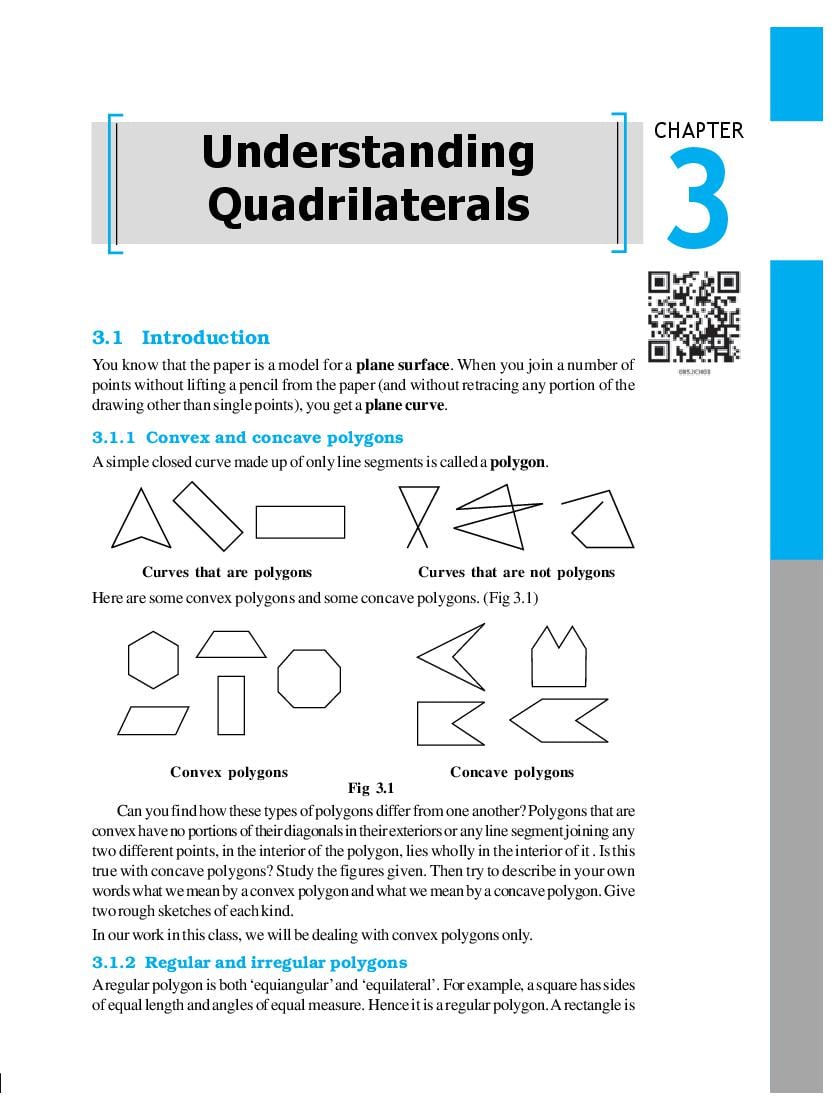
A simple closed curve made up of only line segments is called a polygon.
Curves that are polygons Curves that are not polygons
Here are some convex polygons and some concave polygons. (Fig 3.1)
Convex polygons Concave polygons
Fig 3.1
Can you find how these types of polygons differ from one another? Polygons that are
convex have no portions of their diagonals in their exteriors or any line segment joining any
two different points, in the interior of the polygon, lies wholly in the interior of it . Is this
true with concave polygons? Study the figures given. Then try to describe in your own
words what we mean by a convex polygon and what we mean by a concave polygon. Give
two rough sketches of each kind.
In our work in this class, we will be dealing with convex polygons only.
3.1.2 Regular and irregular polygons
A regular polygon is both ‘equiangular’ and ‘equilateral’. For example, a square has sides
of equal length and angles of equal measure. Hence it is a regular polygon. A rectangle is
Showing the first page only. Download the PDF above for the complete document.
Document Details
| Board / Org | NCERT |
| Exam | Class 8 |
| Type | Books |
| Pages | 20 |
| Updated | 22 Jul 2026 |