TBSE Class 9 Sample Paper 2023 Science (Half Yearly)
Finished viewing? Save it for later —
Download TBSE Class 9 Sample Paper 2023 Science (Half Yearly) (PDF · 6 pages)About TBSE Class 9 Sample Paper 2023 Science (Half Yearly)
TBSE Class 9 Sample Paper 2023 Science (Half Yearly) is available here for free download. Published by Tripura Board for Class 9, this sample paper can be viewed online or downloaded as a PDF (6 pages). Candidates preparing for Class 9 can use TBSE Class 9 Sample Paper 2023 Science (Half Yearly) to understand the exam pattern, the type of questions asked, and the overall difficulty level.
Frequently Asked Questions
How can I download TBSE Class 9 Sample Paper 2023 Science (Half Yearly)?
Open this page and click the Download button to save TBSE Class 9 Sample Paper 2023 Science (Half Yearly) as a PDF. It is completely free on AglaSem Docs.
Is TBSE Class 9 Sample Paper 2023 Science (Half Yearly) free to download?
Yes. TBSE Class 9 Sample Paper 2023 Science (Half Yearly) can be viewed online and downloaded as a PDF free of cost on AglaSem Docs.
How many pages does TBSE Class 9 Sample Paper 2023 Science (Half Yearly) have?
TBSE Class 9 Sample Paper 2023 Science (Half Yearly) contains 6 pages, which you can read online or download together as a single PDF.
Where can I find more Class 9 study material?
You can find more Class 9 question papers, sample papers, syllabus, and answer keys on AglaSem Docs.
TBSE Class 9 Sample Paper 2023 Science (Half Yearly) – Text
Read the full text of this sample paper below — useful to quickly search, copy and reference the content online without downloading the PDF.
📄 View text version (6 pages)
Page 1
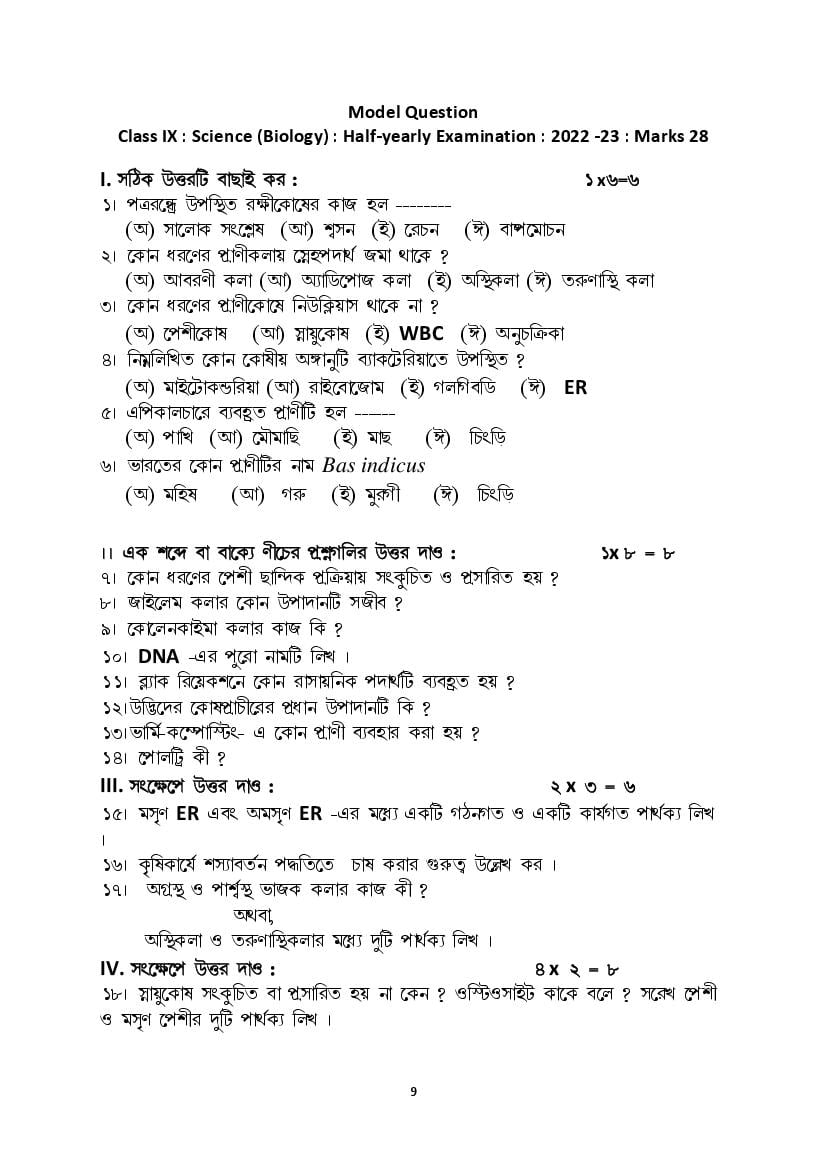
Class IX : Science (Biology) : Half-yearly Examination : 2022 -23 : Marks 28
I. p¢WL Ešl¢V h¡R¡C Ll : 1 x6=6
1z fœl−åÊ Ef¢ÙÛa lr£−L¡−ol L¡S qm --------
(A) p¡−m¡L pw−nÔo (B) nÄpe (C) −lQe (D) h¡×f−j¡Qe
2z −L¡e dl−Zl fË¡Z£Lm¡u −pÀqfc¡bÑ Sj¡ b¡−L ?
(A) BhlZ£ Lm¡ (B) AÉ¡¢X−f¡S Lm¡ (C) A¢ÙÛLm¡ (D) al¦Z¡¢ÙÛ Lm¡
3z −L¡e dl−Zl fË¡Z£−L¡−o ¢eE¢LÓu¡p b¡−L e¡ ?
(A) −fn£−L¡o (B) pÀ¡u¤−L¡o (C) WBC (D) Ae¤Q¢œ²L¡
4z ¢ejÀ¢m¢Ma −L¡e −L¡o£u A‰¡e¤¢V hÉ¡L−V¢lu¡−a Ef¢ÙÛa ?
(A) j¡C−V¡Lä¢lu¡ (B) l¡C−h¡−S¡j (C) Nm¢Nh¢X (D) ER
5z H¢fL¡mQ¡−l hÉhqÊÊa fË¡Z£¢V qm ------
(A) f¡¢M (B) −j±j¡¢R (C) j¡R (D) ¢Qw¢s
6z i¡l−al −L¡e fË¡Z£¢Vl e¡j Bas indicus
(A) j¢qo (B) Nl¦ (C) j¤lN£ (D) ¢Qw¢s
zz HL n−ë h¡ h¡−LÉ Z£−Ql fËnÀN¢ml Ešl c¡J : 1x 8 = 8
7z −L¡e dl−Zl −fn£ R¡¢¾cL fË¢œ²u¡u pwL¥¢Qa J fËp¡¢la qu ?
8z S¡C−mj Lm¡l −L¡e Ef¡c¡e¢V pS£h ?
9z −L¡−meL¡Cj¡ Lm¡l L¡S ¢L ?
10z DNA -Hl f¤−l¡ e¡j¢V ¢mM z
11z hÔÉ¡L ¢l−uLn−e −L¡e l¡p¡u¢eL fc¡bÑ¢V hÉhqÊÊa qu ?
12zE¢á−cl −L¡ofË¡Q£−ll fËd¡e Ef¡c¡e¢V ¢L ?
13zi¡¢jÑ-L−Çf¡¢ØVw- H −L¡e fË¡Z£ hÉhq¡l Ll¡ qu ?
14z −f¡m¢VÊ L£ ?
III. pw−r−f Ešl c¡J : 2x 3 = 6
15z jpªZ ER Hhw AjpªZ ER -Hl j−dÉ HL¢V NWeNa J HL¢V L¡kÑNa f¡bÑLÉ ¢mM
z
16z L«¢oL¡−kÑ npÉ¡haÑe fÜ¢a−a Q¡o Ll¡l …l¦aÆ E−õM Ll z
17z ANËÙÛ J f¡nÄÑÙÛ i¡SL Lm¡l L¡S L£ ?
Abh¡,
A¢ÙÛLm¡ J al¦Z¡¢ÙÛLm¡l j−dÉ c¤¢V f¡bÑLÉ ¢mM z
IV. pw−r−f Ešl c¡J : 4x 2 = 8
18z pÀ¡u¤−L¡o pwL¥¢Qa h¡ fËp¡¢la qu e¡ −Le ? J¢ØVJp¡CV L¡−L h−m ? p−lM −fn£
J jpªZ −fn£l c¤¢V f¡bÑLÉ ¢mM z
9
Page 2
¢mE−L¡fÔ¡ØV ¢L ?
Abh¡,
−L¡e −L¡o£u A‰¡Z¤−L BaÈO¡a£ b¢m hm¡ qu ?−Le Hl©f h¡m¡ qu ? j¡C−V¡¢pp J
¢j−u¡¢pp −L¡o ¢hi¡S−el j−bÉ c¤¢V f¡bÑLÉ ¢mM z
English Version
I. Choose the correct answer: (1X6)=6
1. The function of guard cells present in stomata is-
a. Photosynthesis b. Respiration c. Excretion d. Transpiration
2. In which animal tissue fat is deposited?
a. Epithelial tissue b. Adipose tissue c. Bone tissue d. Cartilase
tissue
3. In which animal cell nucleus is absent?
a. Muscle cell b. Nerve c. WBC D. Platelets
4. Which of the following cellular organelle is present in bacteria?
a. Mitochondria b. Ribosome c. Golgi Body d. ER
5. Name the animal which is used in apiculture?
a. Bird b. Honey bee c. Fish d. Prawn
6. Boss indicus is the scientific name of which animal of India?
a. Buffalo b. Cow c. Hen d. Prawn
II. Answer the following in one word / sentence: (1X8)=8
7. Name the type of tissue which contracts and relaxes rhythmically.
8. Which component of xylem tissue is living part within it?
9. Mention the function of cholenchyma tissue.
10. Write down the full form of DNA.
11. Which chemical is used in Black reaction?
12. What is the main component of plant cell wall?
13. Name the animal which is used in vermicomposting.
14. What is poultry?
III. Answers of the following questions briefly (2X3)=6
15. Write down a structural and a functional difference between smooth ER and
rough ER.
16. Mention the significance of crop rotation process in agriculture.
17. Write down the functions of apical meristem and lateral meristem.
Or,
Write down two differences between bone and cartilage.
IV. Write down the answers of the following questions: (4X2)=8
18. Why nerves do not contract or relaxed? What is an osteocyte? Write down
two differences between striated muscle and smooth muscle.
19. Write down the names of two semi-autonomous organelles. Why they are
called so? What is leucoplast?
Or,
Which cell organelle is called suicidal bag and why? Write down two
differences between mitosis and meiosis cell division.
10
Page 3
Class IX : Science (Chemistry) : Half-yearly Examination : 2022 -23 : Marks 25
I. p¢WL Ešl¢V h¡R¡C Ll : 1 x4=4
1z e£−Ql −L¡e fc¡bÑ¢V−a B¿¹xBZ¢hL BLoÑZ hm ph−Q−u −hn£ ?
(A) Sm (B) QL (C) h¡u¤ (D) t A¢„−Se
2z 25 C = ------ K
0
(A) 300 (B) 298 (C) 398 (D) 198
3z c¤d qm -------------S¡a£u LmuX£u âhZ z
(A) pm (B) −Sm (C) Cj¡mpe (D) H−l¡pm
4z e£−Ql −L¡e¢V −k±¢NL fc¡bÑ ?
(A) NË¡g¡CV (B) ¢fam (C) Sm (D) f¡lc
zz HL n−ë h¡ h¡−LÉ Z£−Ql fËnÀN¢ml Ešl c¡J : 1x7 = 7
5z hl−gl Nme¡ˆ La −Lm¢ie ?
6z i−ll S I HLL L£ ?
7z FdÑf¡ae qu Hl©f HL¢V fc¡−bÑl e¡j ¢mM ?
8z HL¢V alm d¡a¥l e¡j ¢mM z
9z ¢VeXÉ¡m fËi¡−hl HL¢V fË¡L«¢aL Ec¡qlZ c¡J z
10z ¢VwQ¡l Ah B−u¡¢Xe L£ ?
11z fyQ¡ ¢X−jl Nåk¤š²² NÉ¡p¢Vl e¡j ¢mM z
III. pw−r−f Ešl c¡J : 2x 3 = 6
12z h¡×f¡u−el q¡l −L¡e −L¡e ¢ho−ul Efl ¢eiÑl L−l ?
13z −i±a f¢lhaÑe J l¡p¡u¢eL f¢lhaÑ−el c¤¢V f¡bÑLÉ ¢mM z
14z −a¡j¡−L HL¢V hZÑq£e alm −cJu¡ qm z a¥¢j ¢Ll©−f fËj¡Z Ll−h −k alm¢V
Sm?
IV. pw−r−f Ešl c¡J : 4x 2 = 8
15z (L) g¥V¿¹ Sm J h¡−×fl j−dÉ −L¡e¢V −hn£ −f¡s¡−h ? −Me ?
(M) NË£×jL¡−m j¡¢Vl Lmp£−a l¡M¡ Sm W¡™¡ b¡−L −Le ?
16z (L) ¢jnËZ J −k±−Nl c¤¢V f¡bÑLÉ ¢mM z
(M) 293 Eo·a¡u 36 NË¡j M¡cÉmhZ−L 100 NËj S−m âh£i¨a L−l HL¢V
pbfªš² âhZ °al£ Ll¡ qm z HC Eo·a¡u âhZ¢Vl N¡ aÆ ¢eZÑu Ll z
11
Page 4
Class-IX : SCIENCE (PHYSICS) : Half-Yearly Exam. : 2022-23 : Marks - 27
I. §!ë˛Ü˛ í˛z_Ó˚!ê˛ ÓySÈy•z ܲÓ˚ ıÈüÈ 1x5=5
1. ~ܲ!ê˛ Ó›Ü˛îy ‘r’ Óƒy§yˆÏô≈Ó˚ Ó,_yܲyÓ˚ ˛õˆÏÌ à!ï˛¢#°– ~ܲ!ê˛ §¡õ)î≈ xyÓï≈˛ˆÏl ܲîy!ê˛Ó˚ §Ó˚î •ˆÏÓ Èüü
(a) 2πr (b) πr
(c) zero (d) 2r
2. l#ˆÏã˛Ó˚ ˆÜ˛yl‰!ê˛ cÓ˚ˆÏîÓ˚ ~ܲܲ lÎ˚ Èüü
(a) km/s² (b) cm/s²
(c) km/s (d) m/s²
3. !lí˛zê˛ˆÏlÓ˚ ï,˛ï˛#Î˚ à!ï˛§)e xl%§yˆÏÓ˚ !ܲÎ˚y G ≤Ã!ï˛!ܲÎ˚y Èüü
åaä §Ó≈òy ~ܲ•z Ó›Ó˚ í˛z˛õÓ˚ !Ó˛õÓ˚#ï˛ x!˲Ù%ˆÏá !ܲÎ˚y¢#°
åbä §Ó≈òy !˲ߨ Ó›Ó˚ í˛z˛õÓ˚ !Ó˛õÓ˚#ï˛ x!˲Ù%ˆÏá !ܲÎ˚y¢#°
åcä ˛õ!Ó˚ÙyˆÏî §Ùyl ~ÓÇ ~ܲ•z x!˲Ù%ˆÏá !ܲÎ˚y¢#°
ådä ~ܲ!ê˛ x˛õÓ˚!ê˛Ó˚ í˛z˛õÓ˚ °¡∫˲yˆÏÓ !ܲÎ˚y¢#°
4. !lí˛zê˛ˆÏlÓ˚ ≤ÃÌÙ à!ï˛§)e!ê˛ ˛õ!Ó˚!ã˛ï˛ Èüü
åaä ˲Ó˚ˆÏÓˆÏàÓ˚ §)e !•§yˆÏÓ åbä ӈϰÓ˚ §)e !•§yˆÏÓ
åcä ˛õ!Ó˚ÙyˆÏ˛õÓ˚ §)e !•§yˆÏÓ ådä çyˆÏí˛ƒÓ˚ §)e !•§yˆÏÓ
5. Ó˚ˆÏÜ˛ê˛ ˆÜ˛yl‰ §ÇÓ˚«˛î l#!ï˛Ó˚ G˛õÓ˚ ܲyç ܲˆÏÓ˚ ⁄
åaä ˲Ó˚ åbä ¢!=˛
åcä ˲Ó˚ˆÏÓà ådä ˆÓà
II. l#ˆÏã˛Ó˚ ≤ß¿à%!°Ó˚ í˛z_Ó˚ òyG å~ܲ!ê˛ ¢ˆÏ∑‡ÓyˆÏܲƒä ıÈüÈ 1x6=6
6. ˆÜ˛yl‰ ˆË˛Ôï˛ Ó˚y!¢Ó˚ SI ~ܲܲ !Ùê˛yÓ˚‡ˆ§ˆÏܲu˛ ⁄
7. ày!í˛¸Ó˚ GˆÏí˛y!Ùê˛yˆÏÓ˚ ܲ# ˛õ!Ó˚Ùy˛õ ܲÓ˚y •Î˚ ⁄
8. ܲál §Ó˚î G x!ï˛Ü˛yhs˝ ò)Ó˚c §Ùyl •Î˚ ⁄
9. ˆÜ˛yˆÏly Ó›Ó˚ ˲Ó˚ G à!ï˛ˆÏÓˆÏàÓ˚ à%îÊ˛° ܲ# lyˆÏÙ ˛õ!Ó˚!ã˛ï˛ ⁄
10É ~ܲ!ê˛ Ó› ‘A’ÈüÈ~Ó˚ ˲Ó˚ 6 kgñ x˛õÓ˚ ~ܲ!ê˛ Ó› ‘B’ ÎyÓ˚ ˲Ó˚ 34 kg – ~•z ò%!ê˛ Ó›Ó˚ ÙˆÏôƒ çyí˛ƒ ܲyÓ˚ ˆÓ!¢
•ˆÏÓ ⁄
11É ≤Ã!ï˛!Ùï˛ ÓˆÏ°Ó˚ §ÇK˛y òyG–
III. l#ˆÏã˛Ó˚ ≤ß¿à%!°Ó˚ í˛z_Ó˚ òyG ıÈüÈ 2x4=8
12. o%!ï˛ G ˆÓˆÏàÓ˚ 2!ê˛ ˛õyÌ≈ܲƒ ˆ°á–
13. Ù®lˆÏܲ }îydܲ cÓ˚î ӈϰ ˆÜ˛l ⁄
xÌÓyñ
~ܲ!ê˛ ày!í˛¸Ó˚ ≤ÃyÌ!Ùܲ ˆÓà !lî≈Î˚ ܲÓ˚ Îy 10 second §ÙÎ˚ ôˆÏÓ˚ ˆÓܲ ܲˆÏ£Ï !fiÌÓ˚ •Î˚– ˆÓܲ ܲ£ÏyˆÏï˛ Ù®l
§,!T˛ •ˆÏÎ˚ˆÏSÈ 2.5 m/s².
[ Contd...P/2 ]
Page 5
14. ~ܲçl òÙܲ°Ü˛Ù#≈ ˆ•y§ ˛õy•z˛õ !òˆÏÎ˚ ï˛#Ó ˆÓˆÏà ç° ˆòGÎ˚yÓ˚ §ÙÎ˚ ˆ•y§ ˛õy•z˛õ!ê˛ ˆ˛õSȈÏlÓ˚ !òˆÏܲ ã˛ˆÏ°
ˆÎˆÏï˛ ã˛yÎ˚– Èüü ˆÜ˛l ~Ùlê˛y •Î˚ Óƒyáƒy ܲÓ˚–
15. 10 kg ˲ˆÏÓ˚Ó˚ ~ܲ!ê˛ Ó› 2 m/s² cÓ˚î !lˆÏÎ˚ à!ï˛¢#°ñ ï˛yˆÏï˛ ≤ÃÎ%=˛ ӈϰÓ˚ ˛õ!Ó˚Ùyî Ü˛ï˛ ï˛y !lî≈Î˚ ܲÓ˚– å§)e
ÓƒÓ•yÓ˚ ܲˆÏÓ˚ä
IV. l#ˆÏã˛Ó˚ ≤ß¿à%!°Ó˚ í˛z_Ó˚ òyG ıÈüÈ 4x2=8
16. åiä !lí˛zê˛ˆÏlÓ˚ !mï˛#Î˚ à!ï˛§)e!ê˛ !ÓÓ,ï˛ Ü˛Ó˚–
åiiä ï˛y ˆÌˆÏܲ ܲ#˲yˆÏÓ ÓˆÏ°Ó˚ ˛õ!Ó˚Ùy˛õ ܲÓ˚y •Î˚ ⁄
xÌÓyñ
F = ma §)e!ê˛ ≤Ã!ï˛¤˛y ܲÓ˚– å!ã˛•´à%!° ≤Ãã˛!°ï˛ xˆÏÌ≈ ÓƒÓ•,ï˛ä
17. åiä ~ܲ!ê˛ Ó›Ó˚ ò)Ó˚cÈüü§ÙÎ˚ ˆ°á!ã˛e (Fig - 1) Î!ò §ÙÎ˚ xˆÏ«˛Ó˚ §Ùyhs˝Ó˚y° •Î˚ñ ï˛ˆÏÓ Ó›Ó˚ à!ï˛ §¡õˆÏÜ≈˛
ܲ# Ó°y ÎyÎ˚ ⁄
––––––––––––––––>
ò)Ó˚c →
––––––––––––––––––––>
§ÙÎ˚ →
(Fig - 1)
åiiä §%£ÏÙ à!ï˛ ~ÓÇ x§Ù à!ï˛Ó˚ §ÇK˛y òyG–
ENGLISH VERSION
I. Choose the correct answer :– 1x5=5
1. A particle is moving in a circular path of radius ‘r’. The displacement after a complete
rotation is –
(a) 2πr (b) πr (c) zero (d) 2r
2. Which of the following is not a unit of acceleration ?
(a) km/s² (b) cm/s² (c) km/s (d) m/s²
3. According to Newton’s third law of motion action and reaction –
(a) always act on the same body but in opposite direction
(b) always act on different bodies in opposite direction
(c) have same magnitudes and directions
(d) act on either body at normal to each other
4. Newton’s first law of motion is known as –
(a) Law of momentum (b) Law of force
(c) Law of measurement (d) Law of inertia
5. On which principle of conservation rockets work ?
(a) mass (b) energy (c) momentum (d) velocity
[ Contd...P/3 ]
Page 6
II. Answer the following questions (in a word/sentence) :– 1x6=6
6. Name the physical quantity whose SI unit is m/s.
7. What is measured by odometer of a car ?
8. When the displacement and distance travelled become equal ?
9. What name is given to the product of mass and velocity of a body ?
10. The mass of an object ‘A’ is 6 kg, whereas that of another object ‘B’ is 34 kg. Which
of the two object ‘A’ or ‘B’ has more inertia ?
11. Define balanced force.
III. Answer the following questions :– 2x4=4
12. Write two differences between speed and velocity.
13. Why retardation is known as negative acceleration ?
‘Or’
Find the initial velocity of a car which is stopped in 10 seconds by applying brakes.
The retardation due to brakes is 2.5 m/s².
14. Explain why, when a fireman directs a powerful stream of water on a fire from a
hosepipe, the hosepipe tends to go backward.
15. An object of mass 10 kg is moving with 2m/s² acceleration. Calculate the force acting
on it. (using formula)
IV. Answer the following questions :– 4x2=8
16. (i) State Newton’s second law of motion.
(ii) How the measurement of force can be done using it ?
‘Or’
Derive the formula F = ma. (When the symbols have usual meaning)
17. (i) From the (fig - 1) what can you say about the motion of an object whose distance-
time graph is a straight line parallel to the time-axis ?
––––––––––––––––>
Distance →
––––––––––––––––––––>
Time →
(Fig - 1)
(ii) Define uniform motion and non-uniform motion.
–––––––––––––––