NCERT Book Class 8 Maths Chapter 4 Data Handling
Finished viewing? Save it for later —
Download NCERT Book Class 8 Maths Chapter 4 Data Handling (PDF · 12 pages)About NCERT Book Class 8 Maths Chapter 4 Data Handling
NCERT Book Class 8 Maths Chapter 4 Data Handling is available here for free download. Published by NCERT for Class 8, this books can be viewed online or downloaded as a PDF (12 pages). Candidates preparing for Class 8 can use NCERT Book Class 8 Maths Chapter 4 Data Handling to understand the exam pattern, the type of questions asked, and the overall difficulty level.
Frequently Asked Questions
How can I download NCERT Book Class 8 Maths Chapter 4 Data Handling?
Open this page and click the Download button to save NCERT Book Class 8 Maths Chapter 4 Data Handling as a PDF. It is completely free on AglaSem Docs.
Is NCERT Book Class 8 Maths Chapter 4 Data Handling free to download?
Yes. NCERT Book Class 8 Maths Chapter 4 Data Handling can be viewed online and downloaded as a PDF free of cost on AglaSem Docs.
How many pages does NCERT Book Class 8 Maths Chapter 4 Data Handling have?
NCERT Book Class 8 Maths Chapter 4 Data Handling contains 12 pages, which you can read online or download together as a single PDF.
Where can I find more Class 8 study material?
You can find more Class 8 question papers, sample papers, syllabus, and answer keys on AglaSem Docs.
NCERT Book Class 8 Maths Chapter 4 Data Handling – Text
Read the full text of this books below — useful to quickly search, copy and reference the content online without downloading the PDF.
📄 View text version (1 page)
Page 1
CHAPTER
Data Handling
4
4.1 Looking for Information
In your day-to-day life, you might have come across information, such as:
(a) Runs made by a batsman in the last 10 test matches.
(b) Number of wickets taken by a bowler in the last 10 ODIs.
(c) Marks scored by the students of your class in the Mathematics unit test.
(d) Number of story books read by each of your friends etc.
The information collected in all such cases is called data. Data is usually collected in
the context of a situation that we want to study. For example, a teacher may like to know
the average height of students in her class. To find this, she will write the heights of all the
students in her class, organise the data in a systematic manner and then interpret it
accordingly.
Sometimes, data is represented graphically to give a clear idea of what it represents.
Do you remember the different types of graphs which we have learnt in earlier classes?
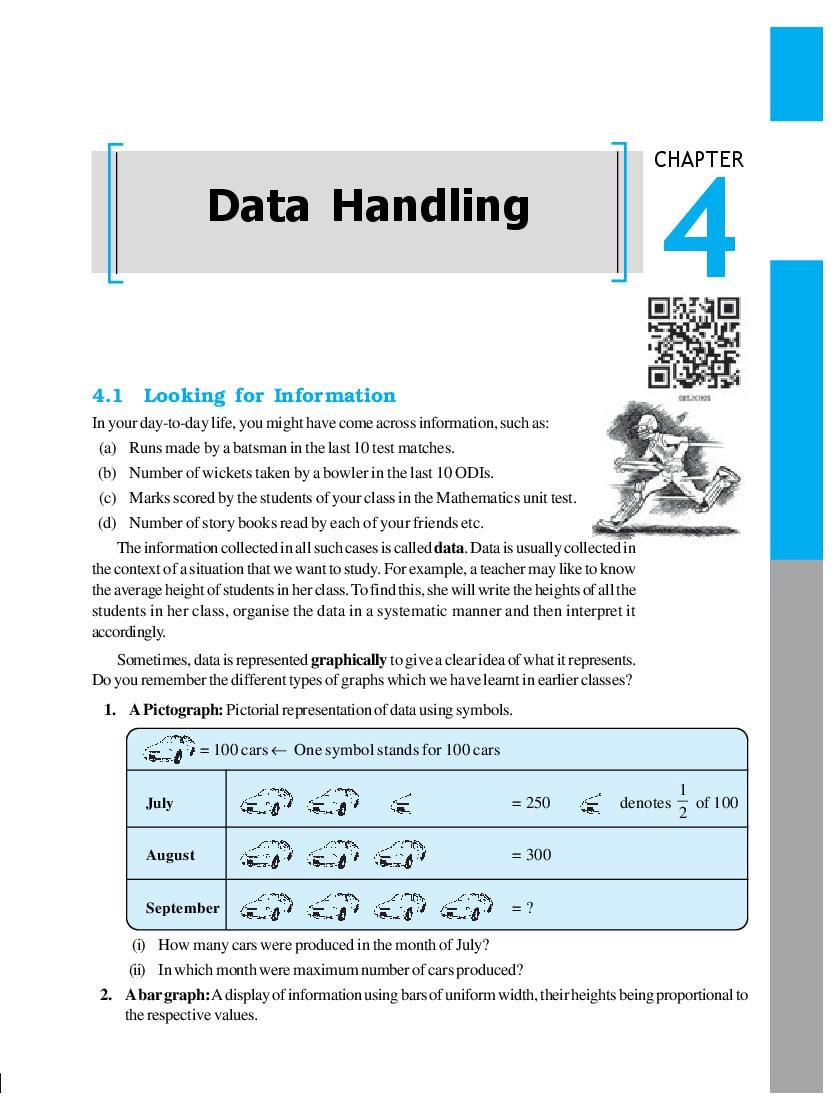
1. A Pictograph: Pictorial representation of data using symbols.
= 100 cars ← One symbol stands for 100 cars
1
July = 250 denotes of 100
2
August = 300
September =?
(i) How many cars were produced in the month of July?
(ii) In which month were maximum number of cars produced?
2. A bar graph: A display of information using bars of uniform width, their heights being proportional to
the respective values.
Showing the first page only. Download the PDF above for the complete document.
Document Details
| Board / Org | NCERT |
| Exam | Class 8 |
| Type | Books |
| Pages | 12 |
| Updated | 22 Jul 2026 |