CREST Science Olympiad (CSO) Class 10 Sample Paper
Finished viewing? Save it for later —
Download CREST Science Olympiad (CSO) Class 10 Sample Paper (PDF · 7 pages)About CREST Science Olympiad (CSO) Class 10 Sample Paper
CREST Science Olympiad (CSO) Class 10 Sample Paper is available here for free download. Published by Default for CREST, this sample paper can be viewed online or downloaded as a PDF (7 pages). Candidates preparing for CREST can use CREST Science Olympiad (CSO) Class 10 Sample Paper to understand the exam pattern, the type of questions asked, and the overall difficulty level.
Frequently Asked Questions
How can I download CREST Science Olympiad (CSO) Class 10 Sample Paper?
Open this page and click the Download button to save CREST Science Olympiad (CSO) Class 10 Sample Paper as a PDF. It is completely free on AglaSem Docs.
Is CREST Science Olympiad (CSO) Class 10 Sample Paper free to download?
Yes. CREST Science Olympiad (CSO) Class 10 Sample Paper can be viewed online and downloaded as a PDF free of cost on AglaSem Docs.
How many pages does CREST Science Olympiad (CSO) Class 10 Sample Paper have?
CREST Science Olympiad (CSO) Class 10 Sample Paper contains 7 pages, which you can read online or download together as a single PDF.
Where can I find more CREST study material?
You can find more CREST question papers, sample papers, syllabus, and answer keys on AglaSem Docs.
CREST Science Olympiad (CSO) Class 10 Sample Paper – Text
Read the full text of this sample paper below — useful to quickly search, copy and reference the content online without downloading the PDF.
📄 View text version (7 pages)
Page 1
10
SAMPLE PAPER
CREST Science Olympiad (CSO)
Syllabus for CSO is available at https://www.crestolympiads.com/cso-syllabus
Pattern And Marking Scheme
Class Topic/Section No. of Questions Marks per Questions Total Marks
Practical Science 25 1 25
1st to 4th Achiever’s Section 10 2 20
Grand Total 35 - 45
Practical Science 40 1 40
5th to 10th Achiever’s Section 10 2 20
Grand Total 50 - 60
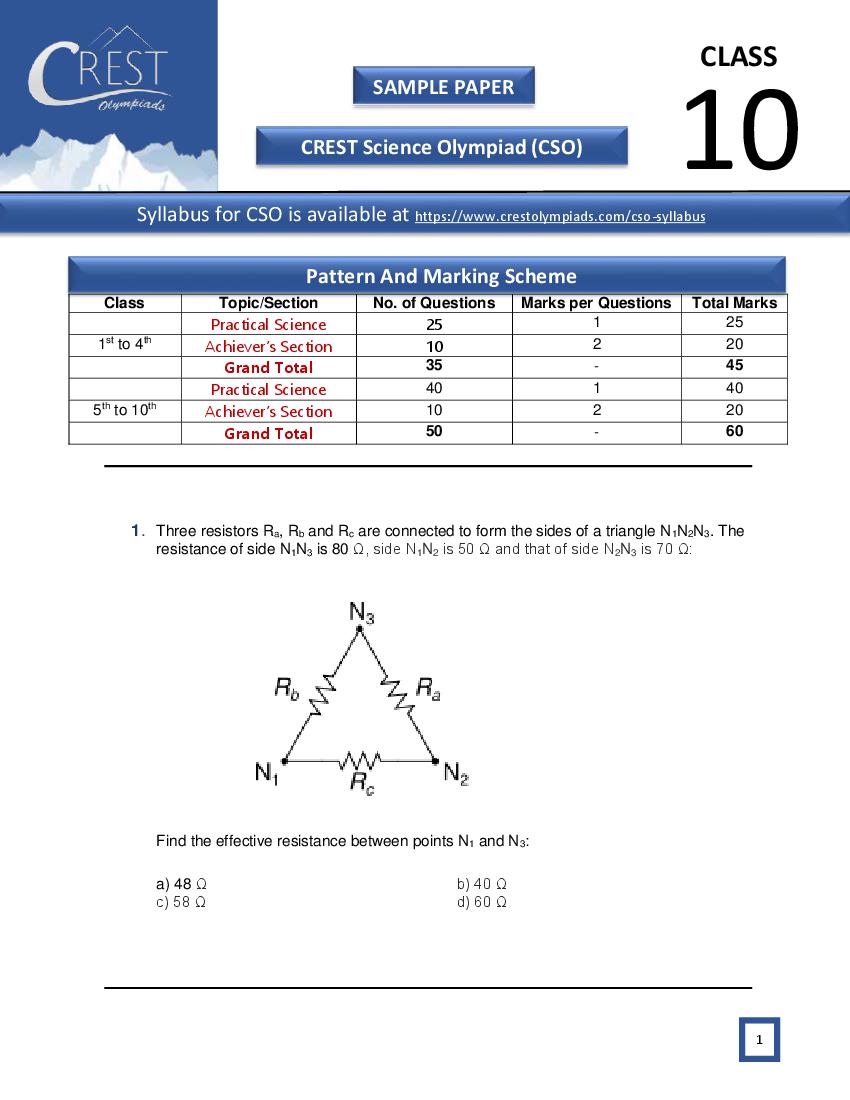
1. Three resistors Ra, Rb and Rc are connected to form the sides of a triangle N1N2N3. The
resistance of side N1N3 is 80 Ω, side N1N2 is 50 Ω and that of side N2N3 is 70 Ω:
Find the effective resistance between points N 1 and N3:
a) 48 Ω b) 40 Ω
c) 58 Ω d) 60 Ω
1
Page 2
the bottom of the tank is measured to be 7.5 cm:
i. What is the refractive index of water?
ii. If water is replaced by a liquid of refractive index 1.6 up to same height, what will be
the new apparent depth of the stone?
a) i: 1.43, ii: 6.25 cm b) i: 1.33, ii: 8.25 cm
c) i: 1.33, ii: 6.25 cm d) i: 1.43, ii: 9.25 cm
3. Which of the following sequences is in the correct order to know the steps involved to
test the presence of starch in a leaf?
P - Boil the leaf in alcohol in a water bath
Q - Add iodine solution
R - Wash the leaf in water
S - Boil the leaf in water
a) S, Q, R and P b) P, S, Q and R
c) Q, R, P and S d) S, P, R and Q
2
Page 3
speed v.
What is the magnetic pole induced at the portion A and B of the solenoid and the
direction of the induced current into the galvanometer (G)?
a) Polarity at A: N, Polarity at B: S, Direction of the induced current: From the left
b) Polarity at A: S, Polarity at B: N, Direction of the induced current: From the left
c) Polarity at A: S, Polarity at B: N, Direction of the induced current: From the right
d) Polarity at A: N, Polarity at B: S, Direction of the induced current: From the right
5. In a lab experiment, four students Sam, Sarah, Rayan and James were given
colourless liquids W (water), X (lemon juice), Y (mixture of water and lemon juice). The
students tested the liquids with pH paper and reported the following sequences in
colour change of pH paper:
Students W X Y
Sam Blue Red Green
Sarah Red Green Green
Rayan Orange Green Green
James Green Red Red
Which of the following student reported the colour change of the pH paper correctly?
a) Sam b) Sarah
c) Rayan d) James
3
Page 4
amount of sodium sulphate solution was taken in another test tube B. In another
beaker, solutions from test tube A and B were added together, and the colour of the
precipitate formed was noted.
Which of the following observation is correct?
a) Reaction: Double displacement reaction, Precipitate: BaSO4 (white)
b) Reaction: Double displacement reaction, Precipitate: Sodium chloride (white)
c) Reaction: Displacement reaction, Precipitate: Sodium chloride (yellow)
d) Reaction: Displacement reaction, Precipitate: BaSO 4 (white)
7. Consider the following experiment:
A small amount of sodium bicarbonate is taken in a test tube and a sufficient amount of
acetic acid is added to it. In the reaction, a gas is evolved. The evolved gas is then
passed through the lime water.
Which of the following is the correct observation of the above experiment?
a) The evolved gas is hydrogen and it does not change the colour of lime water.
b) The evolved gas is carbon dioxide and it does not change the colour of lime water.
c) The evolved gas is hydrogen and it turns the lime water milky.
d) The evolved gas is carbon dioxide and it turns the lime water milky.
4
Page 5
option:
(i) The leaves of the mimosa plant fold up quickly, when touched with a finger. This is
h an example of chemotropism.
(ii) Thigmotropism is a nastic movement of a plant part (like petals of flower) in
n response to light.
(iii) Cytokinins are the plant hormones which causes the bending of the root of the
m plant away from a source of light.
(iv) Most of the plant hormones promotes the plant growth. Ascorbic acid is a plant
b hormone which inhibits the plant growth.
a) i-Thigmonasty, ii-Photonasty, iii-Auxins, iv-Abscisic acid
b) i-Chemotropism, ii-Photonasty, iii-Gibberellin, iv-Ethene
c) i-Hydrotropism, ii-Chemotropism, iii- Abscisic acid, iv-Ethene
d) i- Thigmonasty, ii-Chemotropism, iii- Auxins, iv-Ethene
5
Page 6
9. Four test tubes were taken and marked 1, 2, 3 and 4 respectively. 20 ml solution of
ZnSO4, CuSO4, Al2(SO4)3, FeSO4 was taken in each beaker and the initial colour of
these solutions was noted. Fe rod was inserted in each solution and left undisturbed for
2 hours, the colour of each solution was again noted.
Which of the following correctly shows the change of colour of each solution?
a) 1 2 3 4
Change in Colourless Light blue No change Colourless
colour
b) 1 2 3 4
Change in No change Green No change No change
colour
c) 1 2 3 4
Change in Colourless No change No change Colourless
colour
d) 1 2 3 4
Change in Colourless Light green No change Colourless
colour
6
Page 7
(i) The part labelled ‘P’ contains the female reproductive cell of plants.
(ii) The part labelled ‘Q’ contains ovules which develops into seed upon fertilization.
(iii) The part labelled ‘R’ is the tube through which cells produced by pollen grain
k reaches the ovary.
(iv) The part labelled ‘S’ is the part of the pistil where fertilization takes place.
Which of the above statements is/are incorrect?
a) Only (i) b) Only (iii)
b) Both (i) and (iv) d) (ii), (iii) and (iv)
Answers
1.(a), 2. (c), 3. (d), 4. (a), 5. (d), 6. (a), 7. (d), 8. (a), 9 (b), 10. (b)
7
Document Details
| Board / Org | Default |
| Exam | CREST |
| Type | Sample Paper |
| Pages | 7 |
| Language | english |
| Updated | 22 Jul 2026 |