NCERT Book Class 8 Maths Chapter 6 Cubes and Cube Roots
Finished viewing? Save it for later —
Download NCERT Book Class 8 Maths Chapter 6 Cubes and Cube Roots (PDF · 20 pages)About NCERT Book Class 8 Maths Chapter 6 Cubes and Cube Roots
NCERT Book Class 8 Maths Chapter 6 Cubes and Cube Roots is available here for free download. Published by NCERT for Class 8, this books can be viewed online or downloaded as a PDF (20 pages). Candidates preparing for Class 8 can use NCERT Book Class 8 Maths Chapter 6 Cubes and Cube Roots to understand the exam pattern, the type of questions asked, and the overall difficulty level.
Frequently Asked Questions
How can I download NCERT Book Class 8 Maths Chapter 6 Cubes and Cube Roots?
Open this page and click the Download button to save NCERT Book Class 8 Maths Chapter 6 Cubes and Cube Roots as a PDF. It is completely free on AglaSem Docs.
Is NCERT Book Class 8 Maths Chapter 6 Cubes and Cube Roots free to download?
Yes. NCERT Book Class 8 Maths Chapter 6 Cubes and Cube Roots can be viewed online and downloaded as a PDF free of cost on AglaSem Docs.
How many pages does NCERT Book Class 8 Maths Chapter 6 Cubes and Cube Roots have?
NCERT Book Class 8 Maths Chapter 6 Cubes and Cube Roots contains 20 pages, which you can read online or download together as a single PDF.
Where can I find more Class 8 study material?
You can find more Class 8 question papers, sample papers, syllabus, and answer keys on AglaSem Docs.
NCERT Book Class 8 Maths Chapter 6 Cubes and Cube Roots – Text
Read the full text of this books below — useful to quickly search, copy and reference the content online without downloading the PDF.
📄 View text version (1 page)
Page 1
CHAPTER
Cubes and Cube Roots
6
6.1 Introduction
This is a story about one of India’s great mathematical geniuses, S. Ramanujan. Once
another famous mathematician Prof. G.H. Hardy came to visit him in a taxi whose number
was 1729. While talking to Ramanujan, Hardy described this number
“a dull number”. Ramanujan quickly pointed out that 1729 was indeed Hardy – Ramanujan
Number
interesting. He said it is the smallest number that can be expressed
as a sum of two cubes in two different ways: 1729 is the smallest Hardy–
Ramanujan Number. There
1729 = 1728 + 1 = 123 + 13
are an infinitely many such
1729 = 1000 + 729 = 103 + 93 numbers. Few are 4104
1729 has since been known as the Hardy – Ramanujan Number, (2, 16; 9, 15), 13832 (18, 20;
even though this feature of 1729 was known more than 300 years 2, 24), Check it with the
before Ramanujan. numbers given in the brackets.
How did Ramanujan know this? Well, he loved numbers. All
through his life, he experimented with numbers. He probably found
numbers that were expressed as the sum of two squares and sum of
two cubes also.
There are many other interesting patterns of cubes. Let us learn about cubes, cube
roots and many other interesting facts related to them.
Figures which have
6.2 Cubes 3-dimensions are known as
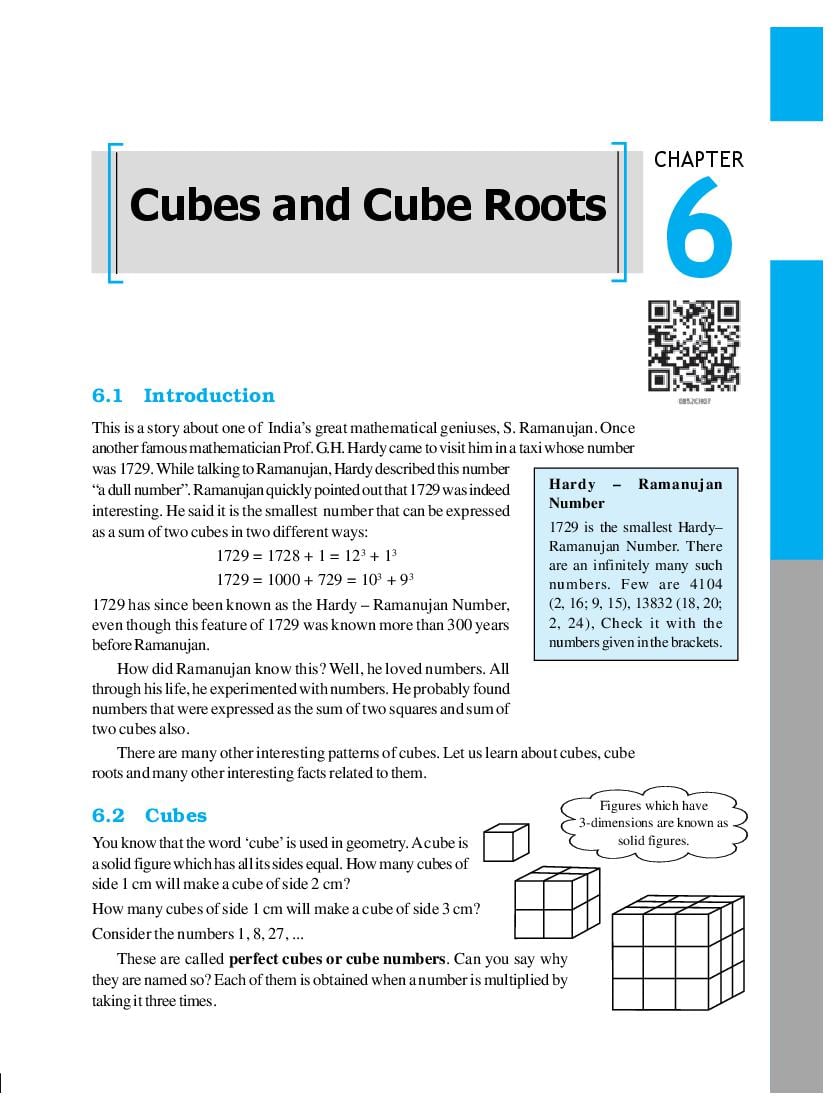
You know that the word ‘cube’ is used in geometry. A cube is solid figures.
a solid figure which has all its sides equal. How many cubes of
side 1 cm will make a cube of side 2 cm?
How many cubes of side 1 cm will make a cube of side 3 cm?
Consider the numbers 1, 8, 27, ...
These are called perfect cubes or cube numbers. Can you say why
they are named so? Each of them is obtained when a number is multiplied by
taking it three times.
Showing the first page only. Download the PDF above for the complete document.
Document Details
| Board / Org | NCERT |
| Exam | Class 8 |
| Type | Books |
| Pages | 20 |
| Updated | 22 Jul 2026 |