ISC Class 12 Specimen Paper 2022 Carnatic Music Semester 1
Finished viewing? Save it for later —
Download ISC Class 12 Specimen Paper 2022 Carnatic Music Semester 1 (PDF · 16 pages)About ISC Class 12 Specimen Paper 2022 Carnatic Music Semester 1
ISC Class 12 Specimen Paper 2022 Carnatic Music Semester 1 is available here for free download. Published by CISCE for Class 12, this sample paper can be viewed online or downloaded as a PDF (16 pages). Candidates preparing for Class 12 can use ISC Class 12 Specimen Paper 2022 Carnatic Music Semester 1 to understand the exam pattern, the type of questions asked, and the overall difficulty level.
Frequently Asked Questions
How can I download ISC Class 12 Specimen Paper 2022 Carnatic Music Semester 1?
Open this page and click the Download button to save ISC Class 12 Specimen Paper 2022 Carnatic Music Semester 1 as a PDF. It is completely free on AglaSem Docs.
Is ISC Class 12 Specimen Paper 2022 Carnatic Music Semester 1 free to download?
Yes. ISC Class 12 Specimen Paper 2022 Carnatic Music Semester 1 can be viewed online and downloaded as a PDF free of cost on AglaSem Docs.
How many pages does ISC Class 12 Specimen Paper 2022 Carnatic Music Semester 1 have?
ISC Class 12 Specimen Paper 2022 Carnatic Music Semester 1 contains 16 pages, which you can read online or download together as a single PDF.
Where can I find more Class 12 study material?
You can find more Class 12 question papers, sample papers, syllabus, and answer keys on AglaSem Docs.
ISC Class 12 Specimen Paper 2022 Carnatic Music Semester 1 – Text
Read the full text of this sample paper below — useful to quickly search, copy and reference the content online without downloading the PDF.
📄 View text version (16 pages)
Page 1
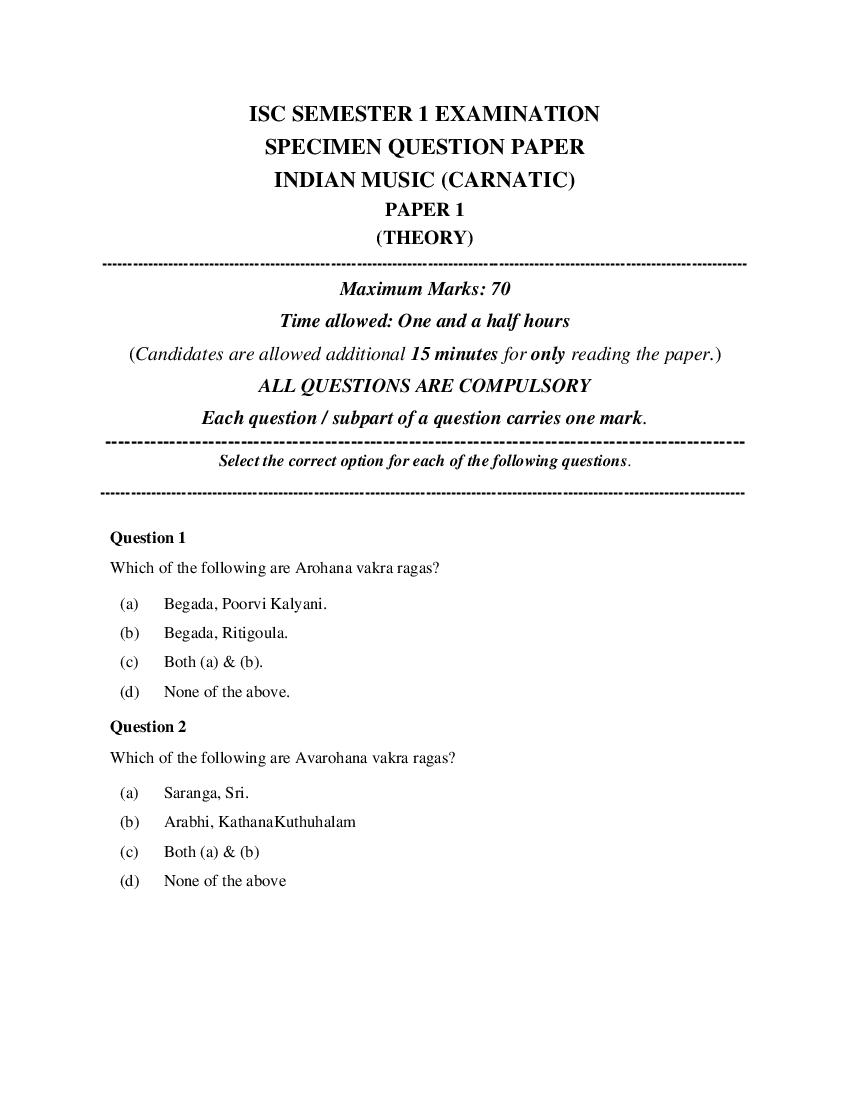
SPECIMEN QUESTION PAPER
INDIAN MUSIC (CARNATIC)
PAPER 1
(THEORY)
-------------------------------------------------------------------------------------------------------------------------------
Maximum Marks: 70
Time allowed: One and a half hours
(Candidates are allowed additional 15 minutes for only reading the paper.)
ALL QUESTIONS ARE COMPULSORY
Each question / subpart of a question carries one mark.
---------------------------------------------------------------------------------------------------
Select the correct option for each of the following questions.
-------------------------------------------------------------------------------------------------------------------------------
Question 1
Which of the following are Arohana vakra ragas?
(a) Begada, Poorvi Kalyani.
(b) Begada, Ritigoula.
(c) Both (a) & (b).
(d) None of the above.
Question 2
Which of the following are Avarohana vakra ragas?
(a) Saranga, Sri.
(b) Arabhi, KathanaKuthuhalam
(c) Both (a) & (b)
(d) None of the above
Page 2
Which of the following are Ubhaya vakra ragas?
(a) Ritigoula, Bangala, Sahana.
(b) Kedaragoula, Naryanagoula, Goula.
(c) Nata, Gambhira Nata, Chaya nata.
Question 4
Identify the Audava Sampurna raga.
(a) Bilahri
(b) Garudadhwani
(c) Hamsadhwani
(d) None of the above
Question 5
Identify the Sampurna Audava raga.
(a) Garudadhwani
(b) Desya Todi
(c) Sriranjani
(d) Mararanjani
Question 6
Identify the Shadava Shadava raga.
(a) Sriranjani
(b) Hamsanandam
(c) Both (a) & (b)
(d) Hindola
Question 7
Identify the Shadava Audava raga.
(a) Bahudari
(b) Malayamarutham
(c) Both (a) & (b)
(d) None of the above
Page 3
Identify, which of the following is Shadava Sampurna raga.
(a) Desya Todi, Kambhoji.
(b) Malayamarutham, Bahudari.
(c) Both (a) & (b).
Question 9
Which of the following is the Varja raga where one or two svaras are deleted?
(a) Mohana, Hamsadhwani, Nagaswarali.
(b) Suryakantam, Chakravakam ,Charukesi.
(c) Salagam, Jhalarnavam, Jhalavarali.
(d) Both (a) & (c).
Question 10
Identify the Bhashanga raga that takes anya swara.
(a) Saranga, Kambhoji, Begada, Atana.
(b) Salagam, Jhalarnavam, Jhalavarali, Navaneetam.
(c) Both (a) & (b).
Question 11
Find the Ekanyaswara Bhashanga raga from the following options.
(a) Kamas, Kambhoji, Saranga.
(b) Sindhubhairavi, Atana, Kapi.
(c) Saranga, Mecha Kalyani, Eesa Manohari.
(d) Both (a) & (c).
Question 12
Which of the following is Nishadantya raga?
(a) Chittaranjani, Nadanamakriya, Saindavi.
(b) Kuranji, Navroj, Kapijhingla.
(c) Both (a) & (b).
Page 4
Which of the following is Swasthana visada raga?
(a) Hamsadhwani
(b) Todi
(c) Hamir Kalyani
(d) None of the above
Question 14
In __________ a star on the top of the note indicates anya swara.
(a) Upanga raga.
(b) Raganga raga.
(c) Bhashanga raga.
(d) Varja raga.
Question 15
___________ are the Mitra ragas.
(a) Shankarabharana, Asaveri, Gourimanohari
(b) Ramapriya, Kharaharapriya, Varunapriya
(c) Gangeyabhushani, Nasikabhushani, Kosalam
(d) Sri Ranjani, Janaranjani, Shanmukhapriya
Question 16
Statement I : Nyasa svara is the ending note of a sanchara.
Statement II : Amsa svara is the ending note of a sanchara.
(a) Statement I and II both are correct.
(b) Statement I and II both are incorrect.
(c) Statement I is correct and II is incorrect.
(d) Statement I is incorrect and II is correct.
Page 5
Which of the following is a group of Audava – Audava?
(a) Mohana, Hamsadhwani, Hindola, Madhyamavathi.
(b) Hemavathy, Kedaragoula, Bilahari, Sankarabharana.
(c) Harikambhoji, Saveri, Anandabhairavi, Pantuvarali.
Question 18
Which one of the following options in anya swara sanchara?
(a) P D N P D P M GR – Bilahari.
(b) G P N GP G R S – Hamsadhwani.
(c) G M D N S- MD N S -Hindola.
Question 19
Janya ragas are derived from ______________.
(a) Mother raga
(b) Bhashanga raga
(c) Vakra raga
(d) None of the above
Question 20
Graha svara is _________________.
(a) The beginning note
(b) The ending note
(c) Both (a) & (b)
(d) None of above
Question 21
The Datu svara prayogas are _______________.
(a) mdpd mpgm
(b) mm pp dd nn
(c) Both (a) & (b)
(d) None of above
Page 6
___________ notation is used to write Western Music.
(a) Solfa
(b) Staff
(c) Both (a) & (b)
(d) None of the above
Question 23
__________ is a group of Vakra raga where notes are in zig zag patterns.
(a) Mohana, Hamsadhwani, Nagaswarali, Hindola
(b) Saranga, Ritigoula, Sri, Begada
(c) Dhatuvardhani, Saranga, Charukesi, Shankarabharana
(d) Both (b) & (c)
Question 24
_________ is Gamakasruthi visada raga.
(a) Hamsadhwani
(b) Todi
(c) All of the above
(d) None of the above
Question 25
Statement I: All Bhashanga ragas are Janya ragas
Statement II: All Janya ragas are not Bhashanga ragas
(a) Statement I and II both are correct.
(b) Statement I and II both are incorrect.
(c) Statement I is correct and II is incorrect.
(d) Statement I is incorrect and II is correct.
Question 26
Upanga raga __________.
(a) takes only the svaras from the mother raga.
(b) takes anya svara.
(c) Both (a) & (b).
Page 7
The traditional 5 Ghana ragas of Thyagaraja’s Pancharatnam are _____________.
(a) Arabhi, Saveri, Goula, Kharaharapriya, Varali
(b) Varali, Arabhi, Devagandhari, Sri, Nata
(c) Nata, Goula, Arabhi, Sri, Varali
(d) Goula, Ritigoula, Narayanagoula, Kannadagoula, Kedaragoula
Question 28
Who is the Karnataka Sangitha Pitha Maha?
(a) Jayadeva
(b) Thyagaraja
(c) Purandara Dasa
(d) Annamacharya
Question 29
Who is the composer of Paluke bangaramayana in the raga Ananda Bhairavi, set to Adi
tala?
(a) Annamacharya
(b) Thyagaraja
(c) Bhadrachala Ramadasa
(d) Muthuswami Dikshitar
Question 30
Gita Govinda-The Sringara maha kavya was composed by __________.
(a) Thyagaraja
(b) Jayadeva
(c) Narayana Tirta
(d) Syama Sastri
Question 31
Who was known as Navakoti Narayana?
(a) Patnam Subramanya Iyer
(b) Annamayya
(c) Purandara dasa
(d) Sadasiva Brahmendra
Page 8
Which composer has Bahunama mudra?
(a) Thyagaraja
(b) Muthuswami Dikshitar
(c) Syama Sastri
(d) Bhadrachala Ramadasa
Question 33
_________ is the language used by Puradaradasa in his Kirtanas.
(a) Kannada
(b) Telugu
(c) Marathi
(d) Malayalam
Question 34
Which of the following is the treatise by Ramamatya?
(a) Chaturdandi Prakasika
(b) Sangita Sudha
(c) Sangita Ratnakaram
(d) Svaramelakalanidhi
Question 35
Narayana Tirta took Aapatsanyasa ________.
(a) While crossing the river the current swept him off.
(b) When he saw his wife.
(c) While composing Krishna Leela Tarangini.
Question 36
Krishna Leela Tarangini consists of _____________ Tarangas.
(a) Ekadasa
(b) Dvadasa
(c) Ashta
(d) Nava
Page 9
__________ is the signature of Bhadrachala Ramadas.
(a) Padumanabha, Pankajanabha, Sarasijanabha.
(b) Bhadradri, Bhadrasaila, Bhadragiri.
(c) Ramadasan, Kumara, Guruguha.
(d) None of the above.
Question 38
Given below are the Arohana and Avarohana. Identify the name of the raga from the
options that follow:
(i) SGRGMNDMNNS–SNDMGMPMGRS
(a) Mukhari
(b) Shri Ranjani
(c) Ritigoula
(d) Ananda Bhairavi
(ii) SRMPDS–SNDPMGRS
(a) Todi
(b) Chakravakam
(c) Saveri
(d) None of the above
(iii) SRMPN S–SNDPMGRS
(a) Harikambhoji
(b) Natakurunji
(c) Kedaragoula
(d) None of the above
Question 39
The visesha sanchara of __________ is G M R S – S R G M PM D.
(a) Chakravakam
(b) Kedaragoula
(c) Both (a) & (b)
(d) None of the above
Page 10
Kambhoji is the Janya of __________.
(a) Harikambhoji
(b) Dhira Sankarabharanam
(c) Both (a) & (b)
(d) None of the above
Question 41
Which one of the following is a melakarta that takes only the suddha svaras?
(a) Kanakangi
(b) Ratnangi
(c) Vanaspathy
(d) Ganamoorthy
Question 42
Which one of the following statements is correct?
(a) Bhashanga raga takes only Anya svara.
(b) Bhashanga raga takes only Swakiya svara.
(c) Bhashanga raga takes both Swakiya and Anya svara.
(d) None of above
Question 43
Which of the following options are Vivadi melas?
(a) Nasikabhushani, Kosalam, Rasikhapriya.
(b) Kiravani, Gowrimanohari, Dhenuka.
(c) Both (a) & (b).
Question 44
Which of the following are the Amurchanakaraka melas?
(a) 29, 15, 64, 20
(b) 31, 39, 52, 67
(c) Both (a) & (b)
(d) None of the above
Page 11
__________ are the melas with symmentrical tetrachords (where purvanga and uttaranga
are of similar patterns).
(a) 1,8,15,22
(b) 16, 23, 56 and 64
(c) Both (a) & (b)
(d) None of the above
Question 46
Statement I : Ri-Ga changes occurs chakra to chakra
Statement II : Dha-Ni changes occurs mela to mela
(a) Statement I and II both are correct.
(b) Statement I and II both are incorrect.
(c) Statement I is correct and II is incorrect.
(d) Statement I is incorrect and II is correct.
Question 47
__________ are svara mnemonics of Kharaharapriya.
(a) Sa Ra Gu Ma Pa Dha Nu
(b) Sa Ri Gi Ma Pa Dhi Ni
(c) Sa Ru Gu Ma Pa Dhu Nu
(d) None of the above
Question 48
Which of the following is mela mnemonics?
(a) Sa Ri Ga Ma Pa Ni
(b) Pa Sri Go Bhu Ma sha
(c) Ri Ga Ma Pa Dha Ni
(d) Ga Ma Pa Dha Ni Sa
Page 12
Katapayadi formula helps to find out the _________.
(a) Serial number of the melakarta.
(b) Serial number of the chakra.
(c) Bhuta Sankhya.
Question 50
The four characteristic features of a Janaka raga are ____________.
(a) Sampurna, Krama Sampura, Ashtaka and Homogeneous.
(b) Shadava, Vakra Sampurna, Audava and Homogeneous.
(c) Swarasthanra,Ashtaka,Ubhaya vakra and Homogeneous.
(d) All of the above.
Question 51
Ma is the bisecting line of The Scheme of 72 melakartas as ____________.
(a) Purva group consists 1-36 takes suddha ma, Uttara group consists 37-72 takes
prati ma.
(b) Purva group takes prati ma and uttara group takes suddha ma.
(c) Both (a) & (b).
Question 52
By knowing the serial number of the melakarta one can find ___________.
(a) The name of melakarta.
(b) The svara sthanas of melakarta.
(c) Both (a) & (b).
Page 13
Who wrote the Chaturdandi prakasika?
(a) Thyagaraja
(b) Venkatamakhi
(c) Syama Sastri
(d) Ramamatya
Question 54
Sa Ru Gu Mi Pa Dhu Nu are the svarasthanas of __________.
(a) Kanakangi
(b) Rasikahapriya
(c) Chalanata
(d) Salagam
Question 55
___________ are having dual names.
(a) Rishabha, Gandhara, Dhaivata and Nishada
(b) Rishabha, Gandhara, Madhyama and Panchama
(c) Both (a) & (b)
(d) None of the above
Question 56
There are _____________ in one sthayi.
(a) 12 swarasthanas
(b) 7 swarasthanas
(c) Both (a) & (b)
Page 14
The kriya of a beat, Patakam, Krushya and Sarpini, each consisiting of 4 aksharakala is
called _________.
(a) Anudrutam
(b) Drutam
(c) Laghu
(d) Kakapadam
Question 58
Among the Shadangas ___________ admits of Jhati Bheda.
(a) Drutam
(b) Anudrutam
(c) Laghu
(d) Plutam
Question 59
ndp, - mpdg,,- rgmpdn,, ġṙṡ,,,--ṡṡndpm-ppmgrs are the sancharas of ___________.
(a) Saveri
(b) Mukhari
(c) Kharaharapriya
(d) None of the above
Question 60
A new raga results by the mode of shift of tonic in a melakarta called as _____________.
(a) Murchanakaraka mela
(b) Amurchanakaraka mela
(c) Vivadi mela
(d) None of the above
Page 15
The divisions of raga alapana are ____________.
(a) Sangraha Alapana and Sampurna Alapana
(b) Hrsva Alapana and Deergha Alapana
(c) Both (a) & (b)
(d) None of the above
Question 62
Anumandra sthayi is denoted by __________.
(a) Two dots above the note
(b) Two dots below the note
(c) One dot above the note
(d) None of the above
Question 63
Ata tala, the sixth of the seven principle tala consists of ______________.
(a) Two laghus and two drutams – 1 1 O O
(b) One laghu one drutam one anudrutam – 1 O U
(c) One anudrutam one laghu one dtutam – U 1 O
(d) One drutam one anudrutam one laghu
Question 64
The kriya of Sarpini, one of the modes of counting musical time is ______________.
(a) Waving right hand from left to right
(b) Waving left hand from right to left
(c) Waving right hand to left
(d) Waving left hand to right
Question 65
The Shadangas are ___________.
(a) Plutam, Guru, Patakam, Sarpini, krishya,kakapadam
(b) Anu drutam, Drutam, Laghu, Guru, Plutam, Kakapadam
(c) Sarpini, Laghu, Guru, Patakam, Krishya and Kakapadam
(d) Krishya, Sarpini, Patakam, Kakapadam, Plutam, Guru
Page 16
The Avkrita Svaras also called Achala svaras are ____________.
(a) Sa Ma Pa Dha.
(b) Sa and Pa.
(c) Sa Ga Ma Ni.
Question 67
The phenomenon of setting the other string to vibrate automatically, which is close
proximity with identical pitch is called _______________.
(a) Timber.
(b) Sympathetic vibration.
(c) Pitch.
Question 68
Kriti, Kirtana, Varna and Geetha are ____________.
(a) Kalpitha Sangita.
(b) Manodharma Sangita.
(c) Both (a) & (b).
Document Details
| Board / Org | CISCE |
| Exam | Class 12 |
| Type | Sample Paper |
| Pages | 16 |
| Language | english |
| Updated | 22 Jul 2026 |