Goa Board Class 12 Question Paper June 2019 History
Finished viewing? Save it for later —
Download Goa Board Class 12 Question Paper June 2019 History (PDF · 6 pages)About Goa Board Class 12 Question Paper June 2019 History
Goa Board Class 12 Question Paper June 2019 History is available here for free download. Published by Goa Board for Class 12, this question paper can be viewed online or downloaded as a PDF (6 pages). Candidates preparing for Class 12 can use Goa Board Class 12 Question Paper June 2019 History to understand the exam pattern, the type of questions asked, and the overall difficulty level.
Frequently Asked Questions
How can I download Goa Board Class 12 Question Paper June 2019 History?
Open this page and click the Download button to save Goa Board Class 12 Question Paper June 2019 History as a PDF. It is completely free on AglaSem Docs.
Is Goa Board Class 12 Question Paper June 2019 History free to download?
Yes. Goa Board Class 12 Question Paper June 2019 History can be viewed online and downloaded as a PDF free of cost on AglaSem Docs.
How many pages does Goa Board Class 12 Question Paper June 2019 History have?
Goa Board Class 12 Question Paper June 2019 History contains 6 pages, which you can read online or download together as a single PDF.
Where can I find more Class 12 study material?
You can find more Class 12 question papers, sample papers, syllabus, and answer keys on AglaSem Docs.
Goa Board Class 12 Question Paper June 2019 History – Text
Read the full text of this question paper below — useful to quickly search, copy and reference the content online without downloading the PDF.
📄 View text version (6 pages)
Page 1
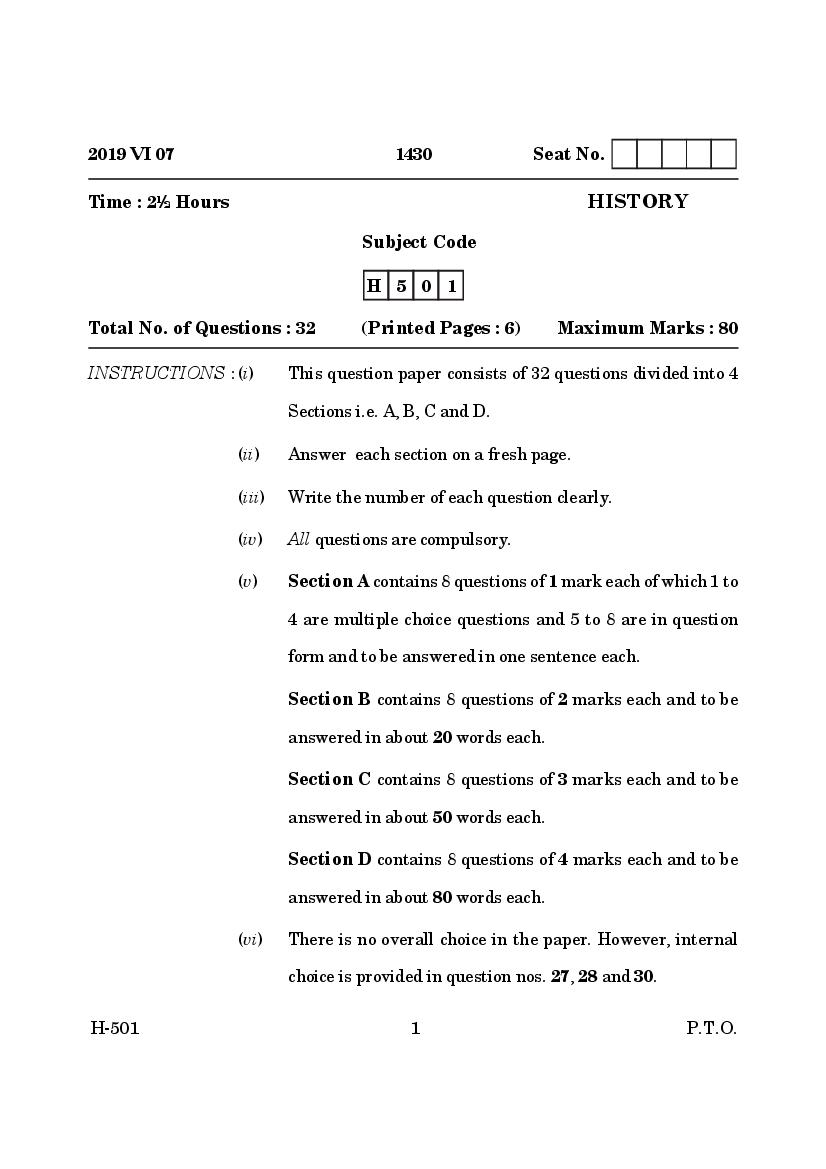
Time : 2½ Hours HISTORY
Subject Code
H 5 0 1
Total No. of Questions : 32 (Printed Pages : 6) Maximum Marks : 80
INSTRUCTIONS : (i) This question paper consists of 32 questions divided into 4
Sections i.e. A, B, C and D.
(ii) Answer each section on a fresh page.
(iii) Write the number of each question clearly.
(iv) All questions are compulsory.
(v) Section A contains 8 questions of 1 mark each of which 1 to
4 are multiple choice questions and 5 to 8 are in question
form and to be answered in one sentence each.
Section B contains 8 questions of 2 marks each and to be
answered in about 20 words each.
Section C contains 8 questions of 3 marks each and to be
answered in about 50 words each.
Section D contains 8 questions of 4 marks each and to be
answered in about 80 words each.
(vi) There is no overall choice in the paper. However, internal
choice is provided in question nos. 27, 28 and 30.
H-501 1 P.T.O.
Page 2
1. The Harappans procured lapis lazuli from .................. .
(a) Rajasthan
(b) Lothal
(c) Shortughai
2. Gautam Buddha attained enlightenment at .................... .
(a) Bodh Gaya
(b) Sarnath
(c) Lumbini
3. The form of Bhakti without attributes is known as .................... .
(a) Tantrik
(b) Nirguna
(c) Saguna
4. In 1565, the Chief Minister Rama Raya led the Vijaynagara army into the
battle at .................... .
(a) Orissa
(b) Gujarat
(c) Talikota
H-501 2
Page 3
Shahjahan.
6. Who took the leadership to establish the Azad Gomantak Dal in April,
1947 ?
7. Which province was called the 'Nursery of the Bengal Army' ?
8. Where did the Jallianwalla Bagh massacre of April, 1919 take place ?
Section B
9. How were the exchanges at Harappa regulated by the system of weights ?
10. State the principles of Ashoka's dhamma.
11. What was Al-Biruni's description of the Indian caste system ?
12. Describe the ceremonies performed on the occasion of Mahanavami in the
Vijayanagara Empire.
13. Why were painted images introduced in Mughal manuscripts ?
14. How did the Goan emigration improve the economic conditions in Goa during
the Portuguese regime ?
15. What were the causes for the British in the annexation of Awadh ?
H-501 3 P.T.O.
Page 4
Section C
17. Why chanhudaro considered as an important centre of craft production ?
18. How have the early sculptors shown the presence of Buddha, through different
symbols ?
19. Explain the religious beliefs of the Sufis.
20. Explain the development of Trade and Commerce in the Vijayanagara
empire.
21. Explain the factors responsible for the expansion of agriculture in the Mughal
empire.
22. Why was the year 1937 proved to be the most significant in the history of
repression in Goa ?
23. Why did the discontentment of the Sepoys become a major cause for the Revolt
of 1857 ?
24. Explain the features of Quit India Movement of 1942.
H-501 4
Page 5
25. Describe the Domestic Architecture of the Harappan Civilisation.
26. Explain the system of Coinage that developed in the sixth century BCE.
27. Describe the Mughal Empire as observed by François Bernier.
Or
What were the observations of the foreign travellers in reference to the
condition of women and slaves in India ?
28. Write a note on the Temple building in the Vijayanagara empire.
Or
Mention the features of the Amara-nayaka system of administration of the
Vijaynagara empire.
29. How does Abul Fazl describe the ideal of Sulh-i-kul implemented by the
Mughal Emperors ?
30. What were the causes for the rise of Nationalism in Goa during the Portuguese
rule ?
H-501 5 P.T.O.
Page 6
Describe the Movement of 18th June, 1946 initiated by Dr. Ram Manohar
Lohia in Goa.
31. Explain the significance of the Revolt of 1857.
32. Describe the course of events of the Non-Cooperation Movement in India
during 1920-1922.
H-501 6
Document Details
| Board / Org | Goa Board |
| Exam | Class 12 |
| Type | Question Paper |
| Pages | 6 |
| Updated | 22 Jul 2026 |