MAHA SET 2025 Paper II Sociology Set A Question Paper
Finished viewing? Save it for later —
Download MAHA SET 2025 Paper II Sociology Set A Question Paper (PDF · 44 pages)About MAHA SET 2025 Paper II Sociology Set A Question Paper
MAHA SET 2025 Paper II Sociology Set A Question Paper is available here for free download. Published by Maharashtra Exams for MAHA SET, this question paper can be viewed online or downloaded as a PDF (44 pages). Candidates preparing for MAHA SET can use MAHA SET 2025 Paper II Sociology Set A Question Paper to understand the exam pattern, the type of questions asked, and the overall difficulty level.
Frequently Asked Questions
How can I download MAHA SET 2025 Paper II Sociology Set A Question Paper?
Open this page and click the Download button to save MAHA SET 2025 Paper II Sociology Set A Question Paper as a PDF. It is completely free on AglaSem Docs.
Is MAHA SET 2025 Paper II Sociology Set A Question Paper free to download?
Yes. MAHA SET 2025 Paper II Sociology Set A Question Paper can be viewed online and downloaded as a PDF free of cost on AglaSem Docs.
How many pages does MAHA SET 2025 Paper II Sociology Set A Question Paper have?
MAHA SET 2025 Paper II Sociology Set A Question Paper contains 44 pages, which you can read online or download together as a single PDF.
Where can I find more MAHA SET study material?
You can find more MAHA SET question papers, sample papers, syllabus, and answer keys on AglaSem Docs.
MAHA SET 2025 Paper II Sociology Set A Question Paper – Text
Read the full text of this question paper below — useful to quickly search, copy and reference the content online without downloading the PDF.
📄 View text version (45 pages)
Page 1
MAHA SET 2025
Paper II Sociology
Set A Question Paper
EXAM YEAR TYPE
MAHA SET 2025 Question Paper
Notes · Sample Papers · Previous Year Papers · Mock Tests
Page 2
m .co s e m
l a
ag
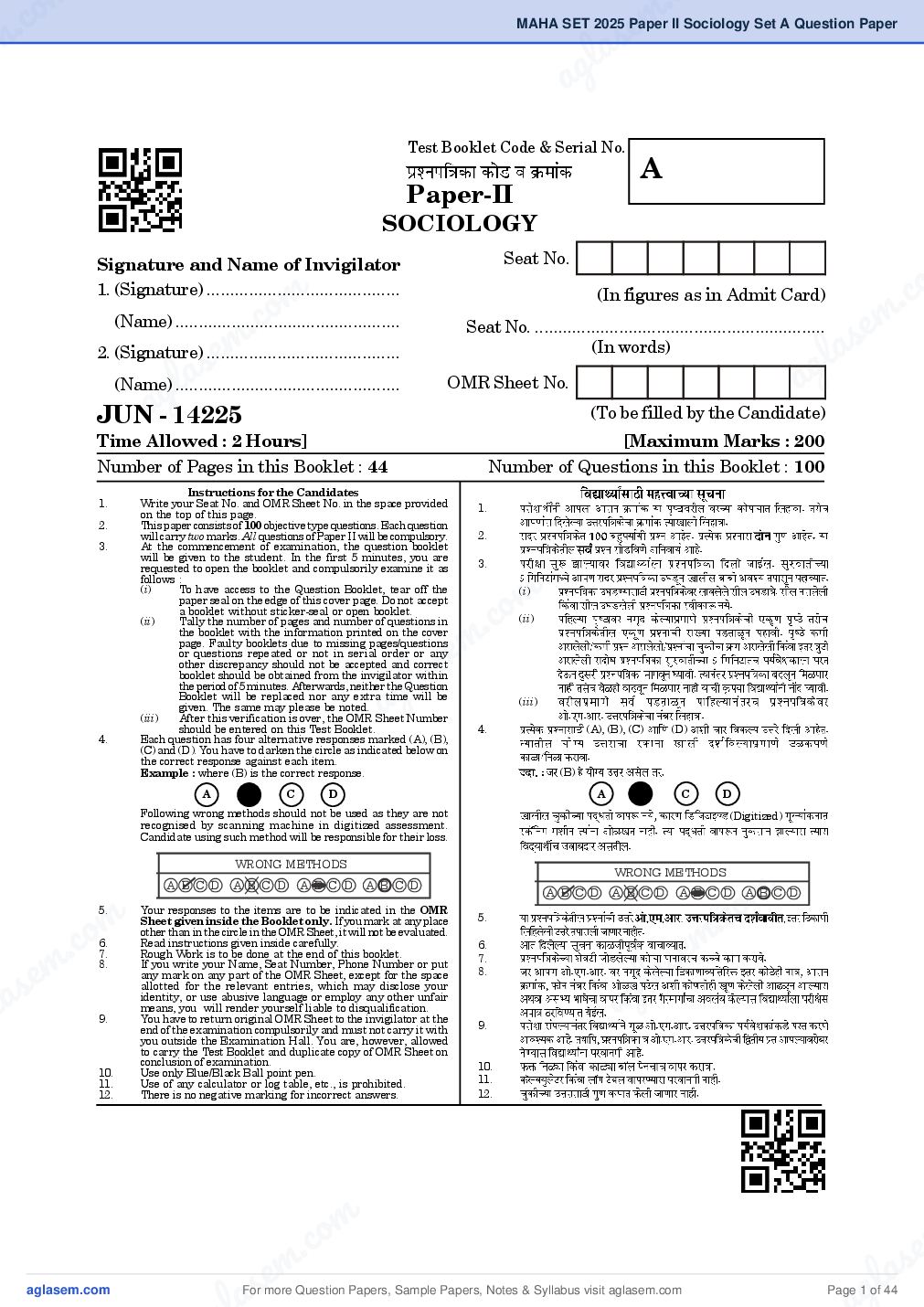
Test Booklet Code & Serial No.
A
Paper-II
SOCIOLOGY
Signature and Name of Invigilator Seat No.
m
1. (Signature) .........................................
. co
c. o
(In figures as in Admit Card)
(Name) ................................................
e m
em
Seat No. ..............................................................
(In words)
l as
la s
2. (Signature) .........................................
ag
g
(Name) ................................................
JUNa- 14225
OMR Sheet No.
(To be filled by the Candidate)
Time Allowed : 2 Hours] [Maximum Marks : 200
Number of Pages in this Booklet : 44 Number of Questions in this Booklet : 100
Instructions for the Candidates
1. Write your Seat No. and OMR Sheet No. in the space provided 1.
on the top of this page.
2. This paper consists of 100 objective type questions. Each question
will carry two marks. All questions of Paper II will be compulsory. 2.
3. At the commencement of examination, the question booklet
will be given to the student. In the first 5 minutes, you are
requested to open the booklet and compulsorily examine it as 3.
m
follows :
c. o
(i) To have access to the Question Booklet, tear off the (i)
paper seal on the edge of this cover page. Do not accept
a booklet without sticker-seal or open booklet.
(ii) Tally the number of pages and number of questions in (ii)
the booklet with the information printed on the cover
e m
s
page. Faulty booklets due to missing pages/questions
or questions repeated or not in serial order or any
l a
other discrepancy should not be accepted and correct
ag
booklet should be obtained from the invigilator within
the period of 5 minutes. Afterwards, neither the Question
Booklet will be replaced nor any extra time will be (iii)
given. The same may please be noted.
(iii) After this verification is over, the OMR Sheet Number
should be entered on this Test Booklet. 4. (A), (B), (C) (D)
4. Each question has four alternative responses marked (A), (B),
(C) and (D). You have to darken the circle as indicated below on
the correct response against each item.
Example : where (B) is the correct response. (B)
A C D A C D
Following wrong methods should not be used as they are not (Digitized)
recognised by scanning machine in digitized assessment.
Candidate using such method will be responsible for their loss.
CORRECT METHOD WRONG METHODS
CORRECT METHOD WRONG METHODS
C D A B C D A B C D A B C D A B C D
m
.co
C D A B C D A B C D A B C D A B C D
m
5. Your responses to the items are to be indicated in the OMR
.co
Sheet given inside the Booklet only. If you mark at any place 5.
other than in the circle in the OMR Sheet, it will not be evaluated.
e m
s
6. Read instructions given inside carefully. 6.
m la
7. Rough Work is to be done at the end of this booklet.
e
7.
8. If you write your Name, Seat Number, Phone Number or put
s
8.
g
any mark on any part of the OMR Sheet, except for the space
la a
allotted for the relevant entries, which may disclose your
identity, or use abusive language or employ any other unfair
means, you will render yourself liable to disqualification.
9. You have to return original OMR Sheet to the invigilator at the
end of the examination compulsorily and must not carry it with 9.
you outside the Examination Hall. You are, however, allowed
to carry the Test Booklet and duplicate copy of OMR Sheet on
conclusion of examination. 10.
10. Use only Blue/Black Ball point pen.
11. Use of any calculator or log table, etc., is prohibited. 11.
12. There is no negative marking for incorrect answers. 12.
m
.co s e
s em
For more Question Papers, Sample Papers, Notes & Syllabus visit
gl a
Page 1 of 44
Page 3
For more Question Papers, Sample Papers, Notes & Syllabus visit Page 2 of 44
Page 4
m .co s e m
l a
ag
Sociology
Paper II
om . co
. c II e m
e m l as
l as
Time Allowed : 120 Minutes] [Maximum Marks : 200
Note : This paper contains Hundred (100) multiple choice questions. Each question
ag
agcarrying Two (2) marks. Attempt All questions.
(100) (2)
1. Theory of Needs was propounded 1.
by :
(A)
m
c. o(B)
(A) Radcliffe Brown
(B) S.F. Nadel
e m
l as
(C) Bronislaw Malinowski g
(C)
a
(D) Robert King Merton (D)
2. Who among the following maintains 2.
that social structure has nothing to
do with empirical reality ?
m
m (A) C. Levi-Strauss .co
.co m
(A)
m s e
s e (B) Marion J. Levy (B)
g la
la (C) Raymond Firth (C)
a
(D) Evans Pritchard (D)
3
m
.co s e
s em
For more Question Papers, Sample Papers, Notes & Syllabus visit
gl a
Page 3 of 44
Page 5
functional unity of joint family in
Mahua ?
(A)
(A) K.M. Kapadia
(B)
(B) A.R. Desai
(C)
(C) I.P. Desai
(D)
(D) A.M. Shah
4.
4. ................... used intersubjectivity in
a larger sense to mean a concern
with the social world, especially the
social nature of knowledge.
(A) Alfred Schutz (A)
(B) Peter Berger (B)
(C) Emile Durkheim (C)
(D) Talcott Parsons (D)
5. Who authored the work, ‘The 5.
History of Sexuality’ ?
(A) Oscar Lewis (A)
(B) Michel Foucault (B)
(C) W. Ogburn (C)
(D) J. Williams (D)
4
For more Question Papers, Sample Papers, Notes & Syllabus visit Page 4 of 44
Page 6
m .co s e m
l a
ag
6. .................... views modernity as an 6.
‘unfinished project’.
m . co
c. o
(A) Jurgen Habermas (A)
s e m
m
(B) KarleManheim (B)
l a
as ag
(C)gl (C)
a Auguste Comte
(D) Immanuel Wallerstein (D)
7. Which of the following concept was 7.
not propounded by M.N. Srinivas ?
(A) Modernization (A)
m
(B) Sanskritization c. o(B)
e m
(C) Westernization
l as (C)
(D) Dominant caste ag (D)
8. Which of the following book is 8.
authored by Irawati Karve ?
(A) Hindu Society : An
(A)
Interpretation
m
m (B)
.co
.co
(B) Family and Kin in Indo-
e m
e m European Culture
las
las (C) The Structure of Indian Society ag
(C)
(D) Modernization of Indian
Tradition (D)
5
m
.co s e
s em
For more Question Papers, Sample Papers, Notes & Syllabus visit
gl a
Page 5 of 44
Page 7
is grounded in .............................
(A) Structuralism (A)
(B) Diffusionism (B)
(C) Evolutionism (C)
(D) Interactionism (D)
10. Which of the two concepts represent 10.
the essence of Hegel’s Philosophy ?
(A) Dialectic and idealism (A)
(B) Mores and folkways (B)
(C) Descent and alliance (C)
(D) Family and group (D)
11. According to Horton and Hunt, 11.
which of the following is not a
characteristic of scientific
research ? (A)
(A) Accuracy
(B)
(B) Systematization
(C)
(C) Objectivity
(D) Abstraction (D)
6
For more Question Papers, Sample Papers, Notes & Syllabus visit Page 6 of 44
Page 8
m .co s e m
l a
ag
12. Which one of the following concerns 12.
right to privacy ?
om . co
. c e m
(A) Ethical
em
(A)
l as
l as
(B) Social (B)
ag
ag
(C) Political (C)
(D) Economical (D)
13. Which one of the following is not a 13.
social research design ?
m
(A) Exploratory
c. o(A)
e m
(B) Explanatory
l as (B)
(C) Descriptive ag (C)
(D) Survey (D)
14. Which of the following types of 14.
hypotheses suggest there is no
relationship among the variable ?
m
m (A) Statistical hypothesis .co
m .co (A)
s e m
s e (B)
g la
la
(B) Working hypothesis
a
(C) Null hypothesis (C)
(D) Alternative hypotheses (D)
7
m
.co s e
s em
For more Question Papers, Sample Papers, Notes & Syllabus visit
gl a
Page 7 of 44
Page 9
traces the development of an
organisation/system overtime ?
(A)
(A) Clinical case studies
(B)
(B) Historical case studies
(C)
(C) Multi case studies
(D) Observational case studies (D)
16. Which one of the following study 16.
focuses on detailed and accurate
description ?
(A) Ethnography (A)
(B) Phenomenology (B)
(C) Archeology (C)
(D) Indology (D)
17. Which among the following is not 17.
a personal document ?
(A) Autobiography (A)
(B) Diaries (B)
(C) Letters (C)
(D) Case study (D)
8
For more Question Papers, Sample Papers, Notes & Syllabus visit Page 8 of 44
Page 10
m .co s e m
l a
ag
18. Identify kind of multivariate table : 18.
co
(A) Simple
. c om (A)
e m .
(B) Complex
e m (B)
l as
l as
(C) Linear ag
ag (C)
(D) Secondary (D)
19. Which type of scale measures the 19.
distance between each of the numbers
or units and the direction ?
m
(A) Interval scale c. o(A)
e m
(B) Ordinal scale
l as (B)
(C) Ratio scale
ag (C)
(D) Nominal scale (D)
20. ...................... is a verbal method of 20.
securing data in the field surveys.
m
m (A) Interview (A)
.co
m .co s e m
s e (B) Participant observation
(B)
g la
la (C)
a
(C) Questionnaire method
(D)
(D) Projective technique
9
m
.co s e
s em
For more Question Papers, Sample Papers, Notes & Syllabus visit
gl a
Page 9 of 44
Page 11
(A) Seniority by age (A)
(B) Caste membership (B)
(C) King of state (C)
(D) Judge in High Court (D)
22. According to whom, every person 22.
carries out the requirements of his
position through role ?
(A) Spencer (A)
(B) Smith (B)
(C) Davis (C)
(D) Durkheim (D)
23. Who has distinguished between 23.
achieved status and ascribed
status ?
(A)
(A) Ralph Linton
(B)
(B) Simmel
(C)
(C) Le Bon
(D) MacIver (D)
10
For more Question Papers, Sample Papers, Notes & Syllabus visit Page 10 of 44
Page 12
m .co s e m
l a
ag
24. Radcliffe Brown believed that social 24.
structure denotes network of :
om . co
. c e m
e m
(A) Kinship relations
l as
l as (A)
ag
ag
(B) Contractual relations
(B)
(C) Social relations
(C)
(D) Cultural relations
(D)
25. ‘‘Equality of Opportunity’’ is an 25.
example of .........................
m
(A) Right c. o(A)
e m
(B) Law
l as (B)
(C) Norm
ag (C)
(D) Value (D)
26. The practice of couvade is reported 26.
from ...........................
(A)
m
m .co
.co
(A) Santhal
e m
e m (B) Warali
(B)
las
las ag
(C) Garo (C)
(D) Khasi (D)
11
m
.co s e
s em
For more Question Papers, Sample Papers, Notes & Syllabus visit
gl a
Page 11 of 44
Page 13
marriage.
(A) Gandharv (A)
(B) Asura (B)
(C) Rakshasa (C)
(D) Paishacha (D)
28. Who is the founder of the concept 28.
of ‘Global Village’ ?
(A)
(A) R. Gilpin
(B)
(B) Malcolm Waters
(C)
(C) Marshal McLuhan C
(D)
(D) Anthony Giddens
29. Which of the following factors does 29.
not contribute to the development of
modern bureaucracy ?
(A) The development of barter
(A)
economy
(B) The development of money (B)
economy
(C)
(C) The development of
administrative task
(D)
(D) The rational interpretation of
law and legal guarantees
12
For more Question Papers, Sample Papers, Notes & Syllabus visit Page 12 of 44
Page 14
m.co s e m
l a
ag
30. Who is the author of ‘Marriage and 30.
Family in India’ ?
(A) K.M. Kapadia
om
(A)
. co
. c e m
(B) A.R. Desai
e m (B)
l as
as
(C) Uberoi Patricia
lG.S. Ghurye (C)
ag
a
(D)g (D)
31. Match List I with List II and mark 31. I II
the correct code given below :
List I (Books) I
(a) Indian Village (a)
(b) India’s Village
m (b)
(c) Rural Profiles c. o(c)
e m
(d) Village India
l as (d)
List II (Authors)
ag II
(i) D.N. Majumdar (i)
(ii) McKim Marriott (ii)
(iii) M.N. Srinivas (iii)
(iv) S.C. Dube (iv)
Codes :
o m
m (a) (b) (c) (d) .c
.co e(iv)m
(a) (b) (c) (d)
em (A) (iii) (i) (ii) (iv)
la
(A) (iii) (i) (ii) s
las (B) (iv) (iii) (i) (ii) g
a (i) (ii)
(B) (iv) (iii)
(C) (iv) (iii) (ii) (i) (C) (iv) (iii) (ii) (i)
(D) (ii) (iv) (iii) (i) (D) (ii) (iv) (iii) (i)
13
m
.co s e
s em
For more Question Papers, Sample Papers, Notes & Syllabus visit
gl a
Page 13 of 44
Page 15
Towards a New Modernity’’ is
written by ........................... (A)
(A) F.H. Buttel
(B)
(B) A. Burgess
(C)
(C) Ulrich Beek
(D)
(D) Micheal Foucault
33. Given below are two statements, one 33.
labelled as Assertion (A) and the
(A)
other one is Reason (R) :
(R) :
Assertion (A) : Green revolution in
India instead of removing the earlier (A) :
inequalities generated further
inequalities.
Reason (R) : As the benefits of
green revolution was proportionate (R) :
to resource ownership portion, large
farmers appropriated the lion’s
share of the new measures.
In the context of the above two
statements, which among the
following is correct ?
(A) Both (A) and (R) are true and
(R) is the correct explanation
(A) (A) (R)
of (A)
(R) (A)
(B) Both (A) and (R) are true
but (R) is not the correct (B) (A) (R)
explanation of (A)
(R) (A)
(C) (A) is true, but (R) is false
(C) (A) (R)
(D) (A) is false, but (R) is true
(D) (A) (R)
14
For more Question Papers, Sample Papers, Notes & Syllabus visit Page 14 of 44
Page 16
m .co s e m
l a
ag
34. Match List I with List II and mark 34. I II
co
the correct codes given below :
. c om e m .
List I (Sociologists)
e m
I
l as
l as
(a) Robert Park (a) ag
a g
(b) Henri Lefebvre (b)
(c) Ferdinand Tonnies (c)
(d) Louis Wirth (d)
List II (Perspective) II
m
(i) Right to the City c. o(i)
e m
l
(ii) Urbanism as a Way of Lifeas (ii)
a g
(iii) Human Ecology (iii)
(iv) Gemeinschaft and Gesellschaft (iv)
Codes :
(a) (b) (c) (d) (a) (b) (c) (d)
o m
m (A) (iii) (iv) (i) (ii) (A) (iii) (iv) (i) (ii) .c
m .co s em
s e (B) (i) (iii) (iv) (ii) la (ii)
(B) (i) (iii) (iv)
g
la (C) (iv) (ii) (iii) (i)
a
(C) (iv) (ii) (iii) (i)
(D) (iii) (i) (iv) (ii) (D) (iii) (i) (iv) (ii)
15
m
.co s e
s em
For more Question Papers, Sample Papers, Notes & Syllabus visit
gl a
Page 15 of 44
Page 17
schedule of the Indian Constitution ?
(A) Fourth (A)
(B) Seventh (B)
(C) Eleventh (C)
(D) Ninth (D)
36. What is the percentage of urban 36.
population in India according to
2011 census report ?
(A)
(A) 61
(B)
(B) 51
(C) 31 (C)
(D) 41 (D)
37. Who of the following is associated 37.
with the slogan ‘‘Bharat Versus
India’’ ?
(A)
(A) Mahendra Singh Tikayat
(B)
(B) Sharad Joshi
(C) Charu Majumdar (C)
(D) Sundarlal Bahuguna (D)
16
For more Question Papers, Sample Papers, Notes & Syllabus visit Page 16 of 44
Page 18
m .co s e m
l a
ag
38. In which year the National 38.
om
Commission on Urbanisation of . co
. c e m
e m l as
l as
India was constituted ?
ag
g
a 1986
(A)
(A)
(B)
(B) 1976
(C)
(C) 1966
o m
(D)
(D) 1956
c.
e m39.
a
39. Who said ‘‘The village is as bloodless
l s
ag
as the rural economy is lifeless from
rich to poor the trend is to leave the
village’’ ?
(A)
(A) Kalyan Sanyal
m
m (B) .co
m .co (B) Partha Chatterjee
s e m
s e g la
la
(C)
(C) Dipankar Gupta a
(D)
(D) Andre Beteille
17
m
.co s e
s em
For more Question Papers, Sample Papers, Notes & Syllabus visit
gl a
Page 17 of 44
Page 19
labelled as Assertion (A) and the (A)
other one is Reason (R) :
(R) :
Assertion (A) : Unplanned growth
of urbanisation in India leads to (A) :
expansion of slums, decrease in
standard of life and environmental
degradation.
Reason (R) : Lack of employment (R) :
opportunities in rural areas is the
main reason for people migrating to
cities.
In the context of the above two
statements, which among the
following is correct ?
Codes :
(A) Both (A) and (R) are true and (A) (A) (R)
(R) is the correct explanation (R) (A)
of (A)
(B) Both (A) and (R) are true (B) (A) (R)
but (R) is not a correct (R) (A)
explanation of (A)
(C) (A) (R)
(C) (A) is true, but (R) is false
(D) (A) is false, but (R) is true (D) (A) (R)
41. ................ is the politically organized 41.
people of a definite territory.
(A) Nation (A)
(B) Country (B)
(C) State (C)
(D) Border-state (D)
18
For more Question Papers, Sample Papers, Notes & Syllabus visit Page 18 of 44
Page 20
m .co s e m
l a
ag
42. The Khasis, Jaintias and Garo 42.
tribals witnessed a movement for an
om . co
autonomous state in the 1960s,
. c e m
e m
resulting in the formation of a
l as
l as
separate state of .................. in 1972.
ag
g
a Meghalaya
(A)
(A)
(B)
(B) Nagaland
(C)
(C) Tripura
(D) Bodoland (D)
43. Max Weber’s concept of bureaucracy 43.
m
is closing related to his idea
m .co
on ............. s e
l a (A)
(A) Power and Class ag (B)
(B) Power and Authority
(C)
(C) Power and System
(D)
(D) Legitimacy of Authority
44. Which type of control is prevalent 44.
m
.co
in the organizational structure of
m bureaucracy ?
m .co (A)
s e m
s e (A) Legal control
g la
la a
(B)
(B) Formal control
(C) Laissez-faire control (C)
(D) Informal control (D)
19
m
.co s e
s em
For more Question Papers, Sample Papers, Notes & Syllabus visit
gl a
Page 19 of 44
Page 21
parties adopted a major election
slogan ‘‘minimum government,
maximum governance’’, in a 2014
Lok Sabha election ?
(A)
(A) Indian National Congress
(B)
(B) Bharatiya Janata Party
(C) Samajwadi Party (C)
(D) Rashtriya Janata Dal (D)
46. The key components of Good
46.
Governance are :
(1)
(1) Public sector management
(2) Capacity building of the (2)
community
(3)
(3) Transparency and right to
information (4)
(4) Management of micro-economic
policies
Select correct codes : (A) (1), (2) (3)
(A) (1), (2) and (3)
(B) (1) (3)
(B) Only (1) and (3)
(C) (2) (3)
(C) Only (2) and (3)
(D) (1), (2), (3) and (4) (D) (1), (2), (3) (4)
20
For more Question Papers, Sample Papers, Notes & Syllabus visit Page 20 of 44
Page 22
m .co s e m
l a
ag
47. Match the following List I with 47. I II
List II and select the correct
answer :
om . co
. c I
e m
e m List I
l as
l as
(Priority areas)
ag
agLivelihood
(a)
(a)
(b)
(b) Health
(c) Poverty eradication (c)
(d) Education (d)
List II II
m
(Public Program)
m .co
(1) Udaan Scheme
s e (1)
l a
(2) Ayushman Bharat
ag (2)
(3) Kudumbashree
(3)
(4) Mahatma Gandhi National
(4)
Rural Employment Guarantee
Act
Select corred codes :
m
.co
(a) (b) (c) (d)
m (a) (b) (c) (d)
m .co (A) (4) (3) (1) (2) (A) (4) (3)
s e(2)m
(1)
s e la (1)
(B) (4) (2) g(3)
la (B) (4) (2) (3) (1)
a
(C) (1) (3) (4) (2) (C) (1) (3) (4) (2)
(D) (1) (2) (4) (3) (D) (1) (2) (4) (3)
21
m
.co s e
s em
For more Question Papers, Sample Papers, Notes & Syllabus visit
gl a
Page 21 of 44
Page 23
making hard choices among policy
alternatives ?
(A) Systems Model for Policy
Analysis (A)
(B) Institutional Approach to Policy
Analysis (B)
(C) Rational policy-making (C)
(D) Critical approach to
(D)
policymaking
49. Given below are two statements, one 49.
is labelled as Assertion (A) and the (A) (R)
other as Reason (R) :
(A) :
Assertion (A) : The political culture
approach doesn’t focus on the
attitudes of specific individuals like,
the President or Prime Minister.
(R) :
Reason (R) : Political culture
denotes how people view the political
system as a whole and is often seen
as the foundation of all political
activities.
Select the correct answer from the
codes given below :
Codes : (A) (A) (R)
(A) Both (A) and (R) are true, and (R) (A)
(R) is the reason of (A)
(B) (A) (R)
(B) (A) is false, (R) is true
(C) (A) (R)
(C) Both (A) and (R) are false
(D) Both (A) and (R) are true, but (D) (A) (R)
(R) is not the reason of (A) (R) (A)
22
For more Question Papers, Sample Papers, Notes & Syllabus visit Page 22 of 44
Page 24
m .co s e m
l a
ag
50. Which village in Maharashtra 50.
developed the slogan : ‘‘We have our
om . co
government in Delhi and Mumbai.
. c e m
e m
But in our village we ourselves are
l as
l as
the government ?
ag
g
a Hiware Bazar
(A)
(A)
(B)
(B) Ralegan Siddhi
(C)
(C) Mendha-lekha
(D)
(D) Pachgaon
51. Industrial production in the 51.
m
nineteenth century
m
was .co
s e
characterized by ..................
g l a
(A) Increasing numbers of a
women (A)
in high status positions
(B)
(B) Cottage industries and home
workers doing piece work in the
domestic sphere
(C) The ‘managerial revolution’ by (C)
m
m .co
.co m
which ownership and control
m s e
e la
becomes separate
las (D) Power-driven machinery and (D) ag
the concentration of workers in
large workplaces
23
m
.co s e
s em
For more Question Papers, Sample Papers, Notes & Syllabus visit
gl a
Page 23 of 44
Page 25
commerce, banking, finance,
insurance, transportation,
education, health, entertainment,
administration, tourism, etc. in the
city, increased means .................... is
considered to have increased.
(A)
(A) Coal sector
(B)
(B) Manufacturing sector
(C)
(C) Service sector
(D) Agriculture sector (D)
53. According to .................... the notion 53.
of ‘‘time – space compression’’
attempts to erase the sense of local
and its dynamics.
(A)
(A) David Harvey
(B)
(B) Alan Bryman
(C)
(C) Doreen Massey
(D)
(D) Pierre Bourdieu
24
For more Question Papers, Sample Papers, Notes & Syllabus visit Page 24 of 44
Page 26
m .co s e m
l a
ag
54. One of the first European countries 54.
to oppose the precess of ‘Coca-
m . co
co .......................
Colonization’ .was
s e m
e m (A)
l a
la s
(A) Spain
ag
ag (B)
(B) Poland
(C)
(C) Italy
(D)
(D) France
55. According to Castells the term 55.
m
‘Collective Consumption’’ refers
m .co
s e
to ....................
g l a
(A) The privatization of apublic
(A)
services by the state
(B) Monopoly of a few large private
(B)
corporations
m
.co
(C) Provision of health, housing (C)
m
m .co and educational services by the
s e m
s e g la
la
state
a
(D) Provision of employment by
(D)
state
25
m
.co s e
s em
For more Question Papers, Sample Papers, Notes & Syllabus visit
gl a
Page 25 of 44
Page 27
contribution to the literature of
social exchange theory by outlining
rules of reciprocity. Which one
among them is described as the
‘causal force’ in social life by him ?
(A)
(A) Transaction
(B)
(B) Belief
(C)
(C) Moral norm
(D) Altruism (D)
57. Due to globalization in civil society, 57.
economic as well as ................... is
increasing.
(A)
(A) Integration
(B)
(B) Disorganization
(C)
(C) Social inequality
(D) Egalitarianism (D)
58. ..................... authored the book titled 58.
‘‘India’s New Capitalists : Caste
Business and Industry in a Modern
Nation’’.
(A) Ramachandra Guha
(A)
(B) Amita Baviskar
(B)
(C) Harish Damodaran (C)
(D) Dipankar Gupta (D)
26
For more Question Papers, Sample Papers, Notes & Syllabus visit Page 26 of 44
Page 28
m .co s e m
l a
ag
59. In his book ‘Fraternal Capital : 59.
Peasant Workers, Self-Made Men
om
and Globalization in Provincial . co
. c e m
e m
India’, Sharad Chari examines ........
l as
as
caste networks.
l ag
g
a Reddy
(A)
(A)
(B)
(B) Gounder
(C)
(C) Lingayat
(D) Nair (D)
60. The theory of cumulative causation 60.
m
of migration was popularized by ........
c. o(A)
e m
(A) David Harvey
l as (B)
ag
(B) Myrdal Gunnar
(C)
(C) Samir Amin
(D) Saskia Sassen (D)
61. ...................... and his colleauges at 61.
university of Chicago introduced
human ecology model during the
m
m 1920s and 1930s.
.co
m .co (A) Robert K. Merton
s e m
la
(A)
s e g
la (B) Robert Park (B) a
(C) C. Wright Mills (C)
(D) R. Dunlap
(D)
27
m
.co s e
s em
For more Question Papers, Sample Papers, Notes & Syllabus visit
gl a
Page 27 of 44
Page 29
environmental destruction and
human oppression are ultimately
rooted in social hierarchy.
(A)
(A) Weberians
(B)
(B) Social ecologists
(C) Functionalists (C)
(D) Eco-biologists (D)
63. A green party is a formally 63.
organized political party based on
the principles such as ..................
(A) Forest conservation (A)
(B) Social justice, environmentalism (B)
and non-violence
(C) Livelihood and security (C)
(D) Welfare and Justice (D)
64. ........ is not a cause of Global 64.
Warming.
(A)
(A) Food Wastage
(B)
(B) Water Scarcity
(C)
(C) Loss of Biodiversity
(D)
(D) Deforestation
28
For more Question Papers, Sample Papers, Notes & Syllabus visit Page 28 of 44
Page 30
m .co s e m
l a
ag
65. .................... focuses on targeting 65.
Western cultural values and on the
om
need to reduce the size of the world’s . co
. c e m
e m
human population to achieve
l as
as
sustainability.
l ag
g
a Deep ecology
(A)
(A)
(B)
(B) Eco-demography
(C) Social Ecology (C)
(D) Orientalism (D)
66. Ensuring that excluded groups have 66.
m
.co
a voice in water planning and
distribution is an action for ............
e m
l as (A)
ag
(A) Exclusion
(B) Marginalization (B)
(C) Inclusion (C)
(D) Assimilation (D)
67. Bhopal gas tragedy took place in the 67.
city of Bhopal, Madhya Pradesh
m
m state in the year ......................
.co
.co m
(A)
m (A) 1992
s e
s e (B)
g la
la (B) 1984
(C)
a
(C) 2002
(D) 1982 (D)
29
m
.co s e
s em
For more Question Papers, Sample Papers, Notes & Syllabus visit
gl a
Page 29 of 44
Page 31
enough resources for our need but
not for our greed’ ?
(A) Mahatma Gandhi
(A)
(B) Medha Patkar
(B)
(C) Sunderlal Bahuguna
(C)
(D) Baba Amte
(D)
69. Who used the term ‘Environmental
69.
Sociology’ explicitly for the first
time ?
(A) Riley Dunlap (A)
(B) Samuel Klausner (B)
(C) William Catton (C)
(D) Robert Ezra Park (D)
70. Who among the following has 70.
identified ecologically relevant
components in Max Weber’s
works ?
(A) Robert Ezra Park and Ernest
(A)
Burgess
(B) Frederick H. Buttel (B)
(C) Patrick West and Raymond
(C)
Murphy
(D) Ulrich Beck (D)
30
For more Question Papers, Sample Papers, Notes & Syllabus visit Page 30 of 44
Page 32
m .co s e m
l a
ag
71. Choose the correct author of, ‘The 71.
Andaman Islanders’ :
(A) V.D. Savarkar
om
(A)
. co
. c (B)
e m
e m
(B) B. Malinowski
l as
as
lG.H. Mead
(C) A. Radcliffe Brown
(C)
ag
a
(D)g (D)
72. Which of the following statements 72.
is true ?
(A)
(A) Gender is biological construct
(B) Gender is numerically (B)
determined
o m
(C)
(C) Gender is a social construct
c.
e m (D)
l as
(D) Gender is the sex of the person
g
73. Sociologists suggest that how
children are linked to awork,
73.
marriage, war and death because of
the following.
Choose the correct answer :
(A) Poverty and class system in the (A)
society
m
.co
(B)
m (B) Caste system in some societies
m .co (C) Social construction of childhood
(C)
s e m
s e g la
la
organised differently across
cultures a
(D) Increasing violence and crime (D)
acroos the world
31
m
.co s e
s em
For more Question Papers, Sample Papers, Notes & Syllabus visit
gl a
Page 31 of 44
Page 33
a number of common features.
Choose the correct option :
(A)
(A) Reduction in one parent family
(B) Increase in members of family
(B)
(C) Increase in average age of
marriage (C)
(D) Increase in the size of household (D)
75. Given below are two statements. One 75.
is labelled as Assertion (A) and the
(A)
other is Reason (R) :
(R)
Assertion (A) : Mostly people
prefer marriage within their own (A)
caste.
Reason (R) : Endogamy is still
(R) :
prevalent in Indian society.
Select the correct answer from the
codes given below :
Codes :
(A) Both (A) and (R) are true and
(A) (A) (R)
(R) is the correct explanation
of the (A) (R) (A)
(B) Both (A) and (R) are true (B) (A) (R)
but (R) is not the correct (R) (A)
explanation of the (A)
(C) (A) (R)
(C) (A) is true, but (R) is false
(D) (A) is false, but (R) is true (D) (A) (R)
32
For more Question Papers, Sample Papers, Notes & Syllabus visit Page 32 of 44
Page 34
m .co s e m
l a
ag
76. Which of the following statements
is correct ? 76.
co
(A) Structural-functional theory (A)
. c om
analyses the divisions in the
e m .
society
e m (B)
l as
as
(B) Structural-functional theory
l ag
g uses micro-level orientation
a Structural-functional theory (C)
(C)
analyses individual orientation
(D) Structural-functional theory (D)
uses a macro-level orientation
77. Match the following authors in List I 77. I II
with the list of books in List II :
List I
m
(a) Shulamith Firestone
m .co I
(b) Friedrich Engles s e (a)
g l a (b)
(c) Simone De Beauvoir
(d) Ann Oakley
a (c)
(d)
List II
II
(1) Sex, Gender and Society
(1)
(2) The Second-Sex
(2)
(3) The Origins of the Family (3)
(4) The Dialectic of Sex
m
.co
(4)
m
.co
Codes :
m (a) (b) (c) (d)
s e(d)m
la (2)
(a) (b) (c)
s e (A) (4) (1) g(3)
la a
(A) (4) (1) (3) (2)
(B) (1) (2) (4) (3) (B) (1) (2) (4) (3)
(C) (4) (3) (2) (1) (C) (4) (3) (2) (1)
(D) (2) (4) (1) (3) (D) (2) (4) (1) (3)
33
m
.co s e
s em
For more Question Papers, Sample Papers, Notes & Syllabus visit
gl a
Page 33 of 44
Page 35
Conspiracy : Honor Killing’’ ?
(A) Nash Ramji (A)
(B) Sarah Key (B)
(C) Phyllis Chesler (C)
(D) S.M. Butler (D)
79. Who amongst the following argues
79.
that family performs four basic
functions in all societies ?
(A) Irawati Karve
(A)
(B) George Peter Murdock
(B)
(C) Edmund Leach
(C)
(D) James C. Scott
(D)
80. When was the Special Marriage Act
80.
passed ?
(A)
(A) 1929
(B) 1954 (B)
(C) 1955 (C)
(D) 1956
(D)
34
For more Question Papers, Sample Papers, Notes & Syllabus visit Page 34 of 44
Page 36
m .co s e m
l a
ag
81. Arrange the following technological
81.
revolutions in chronological order :
om
(1) The information revolution (1)
. co
. c e m
m
e
(2) The green revolution (2)
l as
l as
(3) The white revolution (3) ag
(4)
g
a The industrial revolution (4)
Select the correct codes :
(A) (4), (3), (1), (2) (A) (4), (3), (1), (2)
(B) (4), (2), (3), (1) (B) (4), (2), (3), (1)
(C) (1), (4), (2), (3) (C) (1), (4), (2), (3)
m
(D) (1), (2), (4), (3)
c. o(D) (1), (2), (4), (3)
82. Which one of the e m82.
following
l as
statements about technology is not
correct ? ag (A)
(A) Human interact with each other
and their environment through
technology
(B)
(B) Technology has been created to
serve human needs and desires
m
.co
(C) Technology is not one of the (C)
m
.co m
indicators to measure the
m progress of mankind
s e
s e (D)
g la
la (D) Technology shaped human
coexistence and societies and
a
has become a defining feature
of human existence
35
m
.co s e
s em
For more Question Papers, Sample Papers, Notes & Syllabus visit
gl a
Page 35 of 44
Page 37
perceptual space and time ?
(A) Imagination (A)
(B) Realization (B)
(C) Events (C)
(D) Mind (D)
84. Who is the proponent of the 84.
‘Idealistic theory of space and
time’ ?
(A)
(A) Immanuel Kant
(B)
(B) Samuel Alexander
(C)
(C) Albert Einstein
(D) Herbert Spencer (D)
36
For more Question Papers, Sample Papers, Notes & Syllabus visit Page 36 of 44
Page 38
m .co s e m
l a
ag
85. What term is employed to define the 85.
om . co
c
concept that people worldwide are
. e m
m
e l as
l as
interconnected through the utilization
ag
g
ofa new media technologies ?
(A) Multimedia (A)
(B) Global village (B)
m
c. o(C)
(C) Gemeinschaft
e m
(D) Glocalization
l as (D)
ag
86. Who did not agree with Newtonian
86.
conception of the independent
existence of space, time and motion ?
(A) Samuel Alexander (A) m
m .co
m .co (B) Immanuel Kant (B)
s e m
s e g la
la (C) Albert Einstein (C) a
(D) Herbert Spencer (D)
37
m
.co s e
s em
For more Question Papers, Sample Papers, Notes & Syllabus visit
gl a
Page 37 of 44
Page 39
variant characters of space and
time ?
(A)
(A) Thomas Newton
(B)
(B) Albert Einstein
(C) Immanuel Kant (C)
(D) Thomas Edison (D)
88. What term has been used by
88.
anthropologist Arjun Appadurai to
describe the movement of people
across boundaries ?
(A)
(A) Ethnoscape
(B)
(B) Internationalization
(C) Tourism (C)
(D) Ethnomobility (D)
38
For more Question Papers, Sample Papers, Notes & Syllabus visit Page 38 of 44
Page 40
m .co s e m
l a
ag
89. Identify the term that is used to 89.
describe an online entity where a
om . co
. c e m
group of people congregates to
em l as
l as
exchange ideas and messages via
ag
g
a networks.
digital
(A)
(A) Media Community
(B)
(B) Virtual Community
(C)
(C) Gated Community
o m
(D)
(D) Google Community
c.
e m90.
l as
90. What term is used to describe the
networks that connect ag
state
headquarters down to the Block
Area Network level through the
National Informatics Centre
Network ? (A)
m
m (A) State Wide Area Network .co
m .co (B)
s e m
s e (B) State Wired Area Network
g la
la (C) State World Wide Network
(C) a
(D) State Net Area Network (D)
39
m
.co s e
s em
For more Question Papers, Sample Papers, Notes & Syllabus visit
gl a
Page 39 of 44
Page 41
communalism as ‘the phenomena of
religious differences between groups,
often leading to tension and even
rioting between them’ ?
(A)
(A) David Killingray
(B)
(B) Donald Horowitz
(C) Harbans Mukhia (C)
(D) Earl of Minto (D)
92. Vishakha guidelines issued by the 92.
Supreme Court of India are related
to ...................................
(A)
(A) Women rights
(B)
(B) Domestic violence
(C)
(C) Sexual Harassment at workplace
(D) Political empowerment of
(D)
women
40
For more Question Papers, Sample Papers, Notes & Syllabus visit Page 40 of 44
Page 42
m .co s e m
l a
ag
93. Who argues that a rational world 93.
view is the enemy of religion ?
om (A) . co
(A) J.M. Mogey
. c e m
(B) Emilem
e Durkheim
(B)
l as
(C) l
s
a Wilson (C) ag
a g Bryan
(D) T.K. Oommen (D)
94. Who define political culture as the 94.
particular pattern of orientations to
political action ?
(A) Daniel Lerner (A)
m
(B) Gabriel Almond c. o(B)
e m
(C) Robert Michels
l as (C)
(D) Vilfredo Pareto ag (D)
95. Who among the following viewed the 95.
identification of women with their
bodies as being the root cause of
their oppression in patriarchal
society ?
m
.co
(A)
m (A) Claude-Levi Strauss
m .co s e m
la
(B) Adrienne Rich and Shulamith
s e (B)
g
la Firestone
(C)
a
(C) Rajeshwari Sunder Rajan
(D) Terry Eagleton (D)
41
m
.co s e
s em
For more Question Papers, Sample Papers, Notes & Syllabus visit
gl a
Page 41 of 44
Page 43
sociology is characterised as ..........
(A) Social Constructionist
(A)
perspective
(B)
(B) Realist Perspective
(C) Naturalist Perspective (C)
(D) Conflictual Perspective (D)
97. Who argues that education teaches 97.
the individual specific skill necessary
for his future occupation ?
(A) Mahatma Gandhi (A)
(B) Emile Durkheim (B)
(C) Max Weber (C)
(D) Talcott Parsons (D)
98. Who is the author of the book 98.
‘‘Religion in Secular Society’’ ?
(A) Max Weber (A)
(B) Emile Durkheim (B)
(C)
(C) Peter Worsley
(D)
(D) Bryan Wilson
42
For more Question Papers, Sample Papers, Notes & Syllabus visit Page 42 of 44
Page 44
m .co s e m
l a
ag
99. Who used the phrase, ‘culture is a 99.
om
design for living held by members
. co
. c e m
m
of a particular society’ ?
e l as
as ag
(A)gl (A)
a Clyde Kluckhohn
(B) Radcliffe Brown (B)
(C) Levi Strauss (C)
(D) Tom Clyde (D)
m
100. New religions are, by definition, ‘new’
m .co
100.
s e
because :
l a
ag
(A)
(A) They offer innovative religious
responses to the conditions of
the modern world (B)
(B) They are recently emerged in
m
m the 21st century
.co
m .co (C)
s e m
s e (C) They have developed new gods
g la
la (D) They have zero connection to
(D) a
traditional religion
43
m
.co s e
s em
For more Question Papers, Sample Papers, Notes & Syllabus visit
gl a
Page 43 of 44
Page 45
44
For more Question Papers, Sample Papers, Notes & Syllabus visit Page 44 of 44
Document Details
| Board / Org | Maharashtra Exams |
| Exam | MAHA SET |
| Type | Question Paper |
| Pages | 44 |
| Updated | 17 Nov 2026 |