ISC Class 11 Specimen Paper English Literature
Finished viewing? Save it for later —
Download ISC Class 11 Specimen Paper English Literature (PDF · 11 pages)About ISC Class 11 Specimen Paper English Literature
ISC Class 11 Specimen Paper English Literature is available here for free download. Published by CISCE for Class 11, this sample paper can be viewed online or downloaded as a PDF (11 pages). Candidates preparing for Class 11 can use ISC Class 11 Specimen Paper English Literature to understand the exam pattern, the type of questions asked, and the overall difficulty level.
Frequently Asked Questions
How can I download ISC Class 11 Specimen Paper English Literature?
Open this page and click the Download button to save ISC Class 11 Specimen Paper English Literature as a PDF. It is completely free on AglaSem Docs.
Is ISC Class 11 Specimen Paper English Literature free to download?
Yes. ISC Class 11 Specimen Paper English Literature can be viewed online and downloaded as a PDF free of cost on AglaSem Docs.
How many pages does ISC Class 11 Specimen Paper English Literature have?
ISC Class 11 Specimen Paper English Literature contains 11 pages, which you can read online or download together as a single PDF.
Where can I find more Class 11 study material?
You can find more Class 11 question papers, sample papers, syllabus, and answer keys on AglaSem Docs.
ISC Class 11 Specimen Paper English Literature – Text
Read the full text of this sample paper below — useful to quickly search, copy and reference the content online without downloading the PDF.
📄 View text version (11 pages)
Page 1
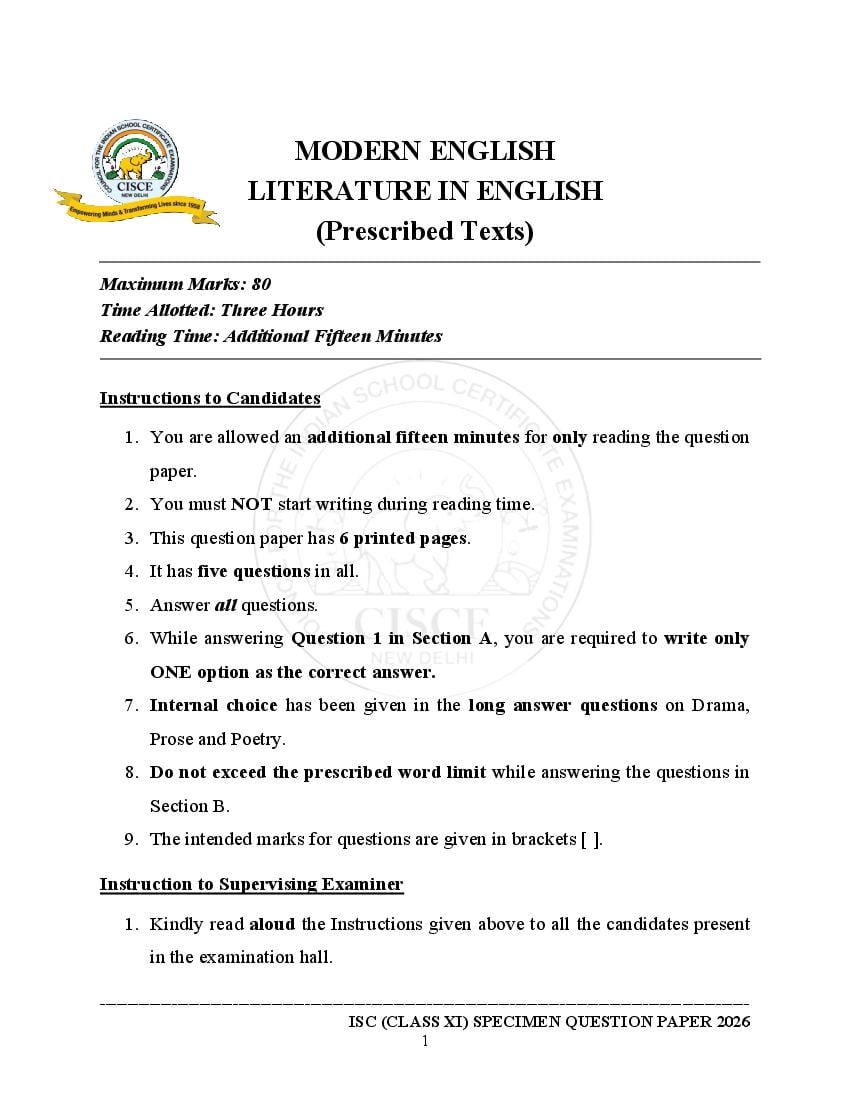
LITERATURE IN ENGLISH
(Prescribed Texts)
Maximum Marks: 80
Time Allotted: Three Hours
Reading Time: Additional Fifteen Minutes
Instructions to Candidates
1. You are allowed an additional fifteen minutes for only reading the question
paper.
2. You must NOT start writing during reading time.
3. This question paper has 6 printed pages.
4. It has five questions in all.
5. Answer all questions.
6. While answering Question 1 in Section A, you are required to write only
ONE option as the correct answer.
7. Internal choice has been given in the long answer questions on Drama,
Prose and Poetry.
8. Do not exceed the prescribed word limit while answering the questions in
Section B.
9. The intended marks for questions are given in brackets [ ].
Instruction to Supervising Examiner
1. Kindly read aloud the Instructions given above to all the candidates present
in the examination hall.
1
Page 2
Board Examination Question Paper and should be used as a practice tool. The questions for the
Board Examination can be set from any part of the syllabus, though the format of the Board
Examination Question Paper will remain the same as that of the Specimen Question Paper.
SECTION A – 20 MARKS
Question 1 [10]
Choose the correct options for the following questions.
(i) What does Freddy’s inability to catch a taxi in Act I of the play, Pygmalion tell
you about him? (Interpret)
(a) He is snobbish.
(b) He is inept.
(c) He is rude.
(d) He is helpful.
(ii) Why does Shaw place the opening scene of the play, Pygmalion in Covent
Garden? (Interpret)
(a) To create a colourful backdrop for his play
(b) To introduce the audience to the variety of English pronunciation
(c) To convey the busyness of London
(d) To introduce the main characters
(iii) In Act II of the play, Pygmalion why does Eliza ask Mrs Pearce if she had told
Prof. Higgins that she had come in a taxi? (Analysis)
(a) She wants to intimidate him.
(b) She wants to counteract Higgins’ rudeness.
(c) She wishes to indicate that she is a lady.
(d) She wants to show that she has travelled a long distance.
(iv) Why did Eliza want to take lessons from Prof. Higgins in the play, Pygmalion?
(Understanding)
(a) She wants to be genteel and ladylike.
(b) No one would be able to trick her.
(c) She wants to be educated.
(d) She wishes to impress Freddy.
2
Page 3
(a) Frivolous
(b) Tragic
(c) Ironic
(d) Humourous
(vi) In the short story, Most Beautiful, how did the narrator encounter Suresh?
(Recall)
(a) Suresh was selling mangoes in the market.
(b) He came upon Suresh being tormented by the boys in the bazaar.
(c) Suresh’s mother introduced the two.
(d) He accidentally bumped into Suresh.
(vii) Charles Lamb, in his piece Dream Children, was telling his children about:
(Recall)
(a) his childhood.
(b) their cousins.
(c) their great grandmother, Field.
(d) his parents.
(viii) Read the two statements from the poem, Father Returning Home, and choose the
correct option from the ones given below: (Understanding)
Statement I: ‘He hurries along the length of the grey platform.’
Statement II: ‘Home again, I see him drinking weak tea.’
(a) Statements I and II are similar.
(b) Statement I and II are unrelated to each other.
(c) Statement I is the result of Statement II.
(d) Statement II is the result of Statement I.
(ix) In the poem, Bora Ring, the figure of speech in the sentence, ‘the fear as old as
Cain,’ is: (Analysis)
(a) a simile.
(b) an allusion.
(c) an allegory.
(d) a metaphor.
3
Page 4
(Interpret)
(a) Unhappy
(b) Fearless
(c) Determined
(d) Steady
Question 2 [10]
Answer any five of the following subparts in 40-50 words. [2 × 5]
(i) Why does the mother become suspicious when the flower girl addresses her son
as Freddy in Act I of the play, Pygmalion? (Interpret)
(ii) Why do you think the bystander asks others to look at the Note taker’s boots in
Act I of the play, Pygmalion? (Understanding)
(iii) Why does not Billy ultimately go to the Bell and Dragon in the short story,
The Landlady? (Understanding)
(iv) What made the narrator say that he was not prepared for the boy’s mother in the
short story, Most Beautiful? (Analysis)
(v) Why are the children in the poem, Father Returning Home, described as ‘sullen’?
(Understanding)
(vi) The poet makes a reference to the Helen of Troy in the poem,
A Prayer for My Daughter. Why? (Analysis)
SECTION B – 60 MARKS
PYGMALION: GEORGE BERNARD SHAW
Question 3
(i) Describe the scene of crowd sheltering from the rain in Act I of the play. [5]
Explain the purpose of the setting of the scene.
Incorporate the following details and write your answer in a short paragraph of
80 - 100 words: (Understanding)
• Description of the crowd
• Purpose of the setting
4
Page 5
discuss his social views on class and gender.
Incorporate the following details and write your answer in a short paragraph of
80 - 100 words: (Understanding)
• Words and language used by Higgins
• His words as a reflection of social attitudes
(iii) (a) Draw a comparison between Henry Higgins and Col. Pickering with [10]
reference to Acts I and II.
Answer should be written in 150 - 200 words. (Analysis)
OR
(b) What do you conclude about Freddy’s mother and sister from the manner [10]
in which they act and behave in Act I of the play?
Answer should be written in 150 - 200 words. (Interpret)
PERSPECTIVES: A COLLECTION OF SHORT STORIES
Question 4
(i) Describe the ways in which the statue of Sir Frederick Lawley becomes a [5]
problem for the officials in the short story, Lawley Road.
Incorporate the following details and write your answer in a short paragraph of
80 - 100 words: (Understanding)
• Events leading to the removal of the statue
• Problems that followed the removal
(ii) Referring closely to the short story, The Landlady, describe the interaction [5]
between Billy Weaver and the Landlady. Why does the story make you feel
uneasy?
Incorporate the following details and write your answer in 80 - 100 words:
(Understanding)
• Conversation between Billy and the Landlady
• Reasons for feeling uneasy
(iii) (a) What feelings does the child Suresh evoke in the narrator in the short story, [10]
Most Beautiful?
Answer should be written in 150 - 200 words. (Interpret)
OR
(b) Comment on experiences of Ratan Tata when he went to study at Cornell. [10]
Answer should be written in 150 - 200 words. (Analysis)
5
Page 6
Question 5
(i) The poem, Father Returning Home, paints a moving picture of the isolation and [5]
pathos of urban life.
Discuss the observation in about 80 - 100 words incorporating the following
details. (Understanding)
• Father’s journey home
• Father’s activities in the house
(ii) Discuss how the poet presents an indomitable attitude to life in the poem, [5]
Life Does Not Frighten Me.
Write your answer in about 80 - 100 words referring to the following details.
(Understanding)
• The things that frighten children
• Purpose of the refrain
(iii) (a) Referring closely to the poem, A Prayer for my Daughter, describe the [10]
poet’s wishes for his infant daughter. What idea of the poet do you get
from this poem?
Answer should be written in 150 - 200 words. (Interpret)
OR
(b) Referring closely to the poem Bora Ring, analyse how the poem mourns [10]
the loss of culture and identity.
Answer should be written in 150 - 200 words. (Analysis)
6
Page 7
LITERATURE IN ENGLISH
(Prescribed Texts)
ANSWER KEY
SECTION A– 20 MARKS
Question 1 [10]
Candidates are required to write only one option as the answer.
(i) (b) or He is inept.
(ii) (b) or To introduce the audience to the variety of English pronunciation
(iii) (c) or She wishes to indicate that she is a lady.
(iv) (a) or She wants to be genteel and ladylike.
(v) (d) or Humourous
(vi) (b) or He came upon Suresh being tormented by the boys in the bazaar.
(vii) (c) or their great grandmother, Field.
(viii) (d) or Statement II is the result of Statement I.
(ix) (a) or a simile.
(x) (b) or Fearless
Question 2 [10]
Candidates are required to answer any five sub-parts briefly and not in detail.
Please note that the answers provided below are suggestive and not limiting and
exhaustive. Any other correct interpretation / reason will be accepted.
(i) The flower girl belongs to a lower strata of society and as such cannot be friends
with Freddy or address him by his first name.
(ii) The crowd was suspecting that the Note taker was a policeman, but his boots
were those of the upper classes and not those worn by policemen. The bystander
draws attention to his boots as they were markers of his identity.
1
Page 8
did not want to stay at the Bed and Breakfast but he felt a force compelling him
to stay there and not go to the Bell and Dragon.
(iv) The young boy was so ugly and malformed that the narrator could not imagine
that his mother would be so strikingly beautiful.
(v) The word ‘sullen’ conveys the lack of communication between the Father and
his children. They show no spark of interest or happiness when their Father
returns home.
(vi) The poet wishes to convey that great beauty can often be detrimental. He cites
Helen of Troy as an example. Her great beauty led to war and destruction.
SECTION B – 60 MARKS
PYGMALION – GEORGE BERNARD SHAW
Question 3
(i) The guidelines have been specified in the question. Candidates have to develop [5]
their answers on the prompts given in the question. They are required to answer
within the specified word limit.
(ii) Candidates must formulate their answers on the areas specified in the question. [5]
(iii) (a) Candidates are expected to elaborate on the following ideas: [10]
• Colonel Pickering and Henry Higgins are both Phoneticians.
• They are drawn together by their passion for their subject.
• Their relationship is one of mutual respect.
• Professor Higgins is so carried away by his enthusiasm for his
subject that he does not pay any attention to social norms and
niceties.
• In fact, he is quite impatient of the norms that govern polite society.
• He treats Eliza quite rudely (when she visits him at his laboratory).
• Shaw calls him an “impetuous baby”. He can be both genial and
bullying.
• He takes on the challenge thrown by Pickering but does not consider
Eliza’s feelings and emotions.
• Pickering, on the other hand, is a thorough gentleman, refined and
considerate.
• From the very beginning he treats Eliza like a lady, reminds Higgins
that he cannot treat Eliza as if he is picking a pebble off a beach.
He has to think of her parents.
• To Higgins, Eliza is not a person, just someone whom he will teach
correct speech, manners and pronunciation. He does not even think
of her future after the experiment is over.
• During her actual training, Higgins is demanding and overbearing
while Pickering is considerate and gentle.
2
Page 9
(b) Candidates will be expected to use the following approach to the [10]
question:
• Freddy’s mother and sister belong to the genteel class
• In Act I, they are waiting for Freddy to get a cab for them.
• When Freddy returns without one, his mother is quite disappointed
with him. She says that he is very helpless and sends him out in the
rain again to try for one.
• Freddy’s sister is more rude and impatient with him.
• The Mother is suspicious of the Flower girl and protective of her
son when she hears the Flower girl addressing her son by his name.
• She is not above bribing the girl with some pennies to get at the
truth.
• Both mother and daughter are representative of the upper class of
British society. But the later acts will reveal that they are not
financially well off and so exists on the fringes of polite society.
• The Daughter (Freddy’s sister) is impatient, disgruntled, dismissive
of her brother’s capabilities.
• She is rude to Higgins when he notes down her pronunciation of
‘pneumonia’ and identifies her origin in London as Epsom.
PERSPECTIVES: A COLLECTION OF SHORT STORIES
Question 4
(i) The guidelines have been specified in the question. Candidates have to develop [5]
their answers on the prompts given in the question. They are required to answer
within the specified word limit.
(ii) Candidates must formulate their answers on the areas specified in the question [5]
within the prescribed word limit.
(iii) (a) Candidates are required to focus on the following areas in their [10]
answers:
• The narrator encounters the child in the marketplace when the latter
is being heckled by other children.
• The narrator comes to the child’s aid by driving away his
tormentors.
• Suresh takes him home and the narrator meets the child’s mother
• The narrator feels protective of the child especially after he
witnesses the father’s indifference to Suresh.
• He takes the child under his wing, and they go on various adventures
together.
3
Page 10
that it had adopted in a fit of uncontrollable rage.
• Yet he does not judge the child for his cruelty and tries to understand
him.
• The association is abruptly cut off when the narrator gets a job in
Delhi.
• The narrator could not understand the boy’s indifference and lack
of reaction at his imminent departure
• He is touched to see that the child had run the gauntlet of the crowds
and had come to meet him at the station.
OR
(b) Candidates are required to focus on the following areas in their [10]
answers.
• The public stance of his dorm counsellor Dick Barger intimidated
him.
• All fresh men had to wear red pea caps with the year of enrolment
written on them.
• He felt homesick and wrote a large number of letters home.
• Ratan Tata faced discrimination because society at that time was
not very acceptable of people of colour.
• His experience with the pay phone to call home arouses our interest
as it gives us an idea of universities at that time.
• The manner in which he and his mates faced the attack on
Rockledge building shows a little known facet of his nature.
• His adeptness at the hand slap game sheds light on his abilities too.
REFLECTIONS: A COLLECTION OF POEMS
Question 5
(i) The prompts have been specified in the question. Candidates have to develop [5]
their answers on those prompts within the specified word limit.
(ii) Candidates must formulate their answers on the areas specified in the question [5]
within the prescribed word limit.
4
Page 11
• In a difficult war-torn world with danger looming on the horizon,
the poet expresses his wishes for his infant daughter.
• He hopes that she be granted beauty but not beauty that harms or
destroys and cites Helen of Troy as an example.
• He places more importance on the beauty of the heart and soul than
on external beauty.
• She should have natural kindness.
• He wishes his daughter to be trained in courtesy.
• He would like her to become like a flourishing hidden tree and like
a linnet spread happiness and joy.
• She should have stability and like a rooted laurel tree.
• She should not be rigid or opinionated.
• All hated driven hence her soul should have innocence
• She should be happy in all circumstances.
• She should live in ceremony and customs.
Candidates have to write their opinion of the poet which should be
supported by reasons.
OR
(b) Candidates have to address the following areas in their answers: [10]
• The poem mourns the disappearance of rich cultural practices, such
as songs, dances, and rituals, and reflects on the lingering impact
of this loss on the land and its people.
• The ‘song’ and ‘dance’ are metaphors for the vibrant cultural
practices of the Aboriginal people, which have now vanished. The
phrase ‘the dancers in the earth’ suggests that those who once
performed these rituals are now deceased, buried in the land they
once celebrated.
• The ‘tribal story’ being ‘lost in an alien tale’ highlights the cultural
dislocation caused by colonialism, where Indigenous narratives
and histories have been overshadowed or erased by the dominant
colonial narrative.
• The second stanza continues this theme of loss but also hints at a
faint, almost ghostly presence of the past.
• In the third stanza, Wright addresses the disappearance of the
people themselves.
• The poem concludes with a sense of unresolved tension and a
haunting presence: ‘Only the rider's heart halts at a sightless
shadow, an unsaid word that fastens in the blood of the ancient
curse, the fear as old as Cain.’ The ‘rider’ represents a modern
observer, perhaps a descendant of the colonisers, who feels an
inexplicable pause or hesitation (‘halts at a sightless shadow’).
5