ISC Class 11 Specimen Paper English Elective
Finished viewing? Save it for later —
Download ISC Class 11 Specimen Paper English Elective (PDF · 25 pages)About ISC Class 11 Specimen Paper English Elective
ISC Class 11 Specimen Paper English Elective is available here for free download. Published by CISCE for Class 11, this sample paper can be viewed online or downloaded as a PDF (25 pages). Candidates preparing for Class 11 can use ISC Class 11 Specimen Paper English Elective to understand the exam pattern, the type of questions asked, and the overall difficulty level.
Frequently Asked Questions
How can I download ISC Class 11 Specimen Paper English Elective?
Open this page and click the Download button to save ISC Class 11 Specimen Paper English Elective as a PDF. It is completely free on AglaSem Docs.
Is ISC Class 11 Specimen Paper English Elective free to download?
Yes. ISC Class 11 Specimen Paper English Elective can be viewed online and downloaded as a PDF free of cost on AglaSem Docs.
How many pages does ISC Class 11 Specimen Paper English Elective have?
ISC Class 11 Specimen Paper English Elective contains 25 pages, which you can read online or download together as a single PDF.
Where can I find more Class 11 study material?
You can find more Class 11 question papers, sample papers, syllabus, and answer keys on AglaSem Docs.
ISC Class 11 Specimen Paper English Elective – Text
Read the full text of this sample paper below — useful to quickly search, copy and reference the content online without downloading the PDF.
📄 View text version (25 pages)
Page 1
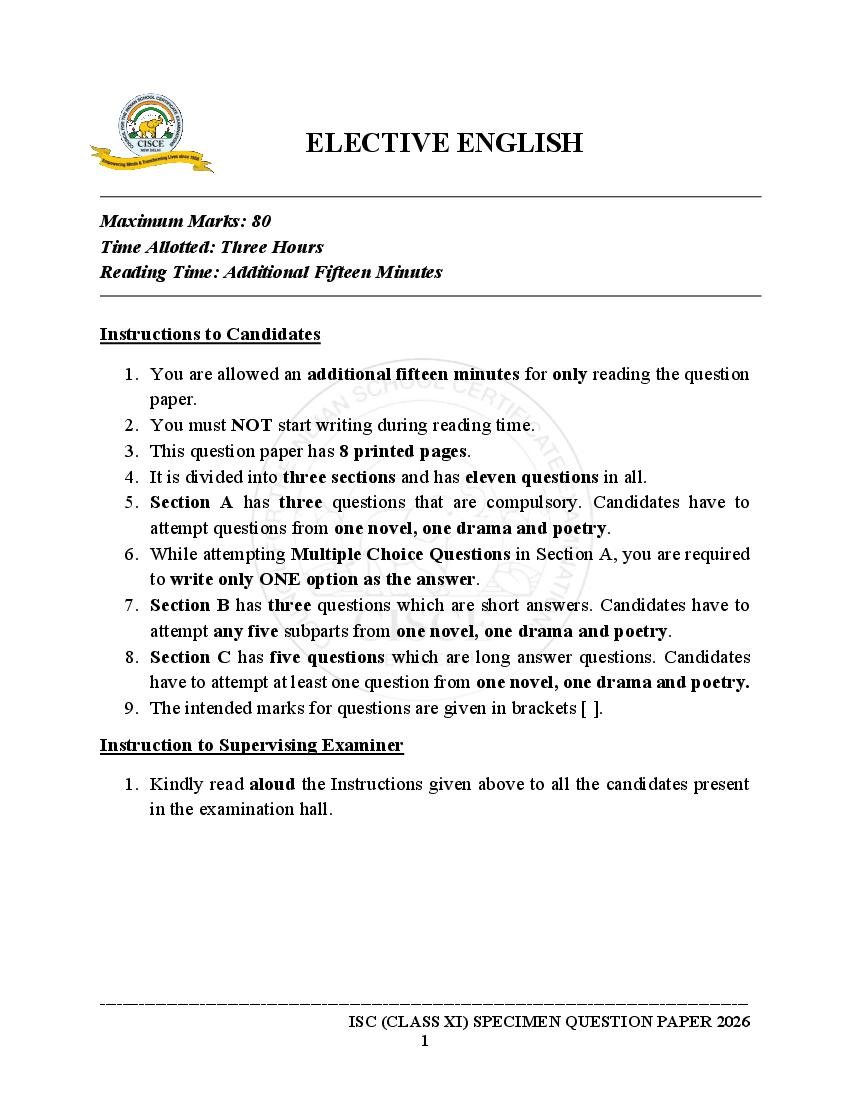
Maximum Marks: 80
Time Allotted: Three Hours
Reading Time: Additional Fifteen Minutes
Instructions to Candidates
1. You are allowed an additional fifteen minutes for only reading the question
paper.
2. You must NOT start writing during reading time.
3. This question paper has 8 printed pages.
4. It is divided into three sections and has eleven questions in all.
5. Section A has three questions that are compulsory. Candidates have to
attempt questions from one novel, one drama and poetry.
6. While attempting Multiple Choice Questions in Section A, you are required
to write only ONE option as the answer.
7. Section B has three questions which are short answers. Candidates have to
attempt any five subparts from one novel, one drama and poetry.
8. Section C has five questions which are long answer questions. Candidates
have to attempt at least one question from one novel, one drama and poetry.
9. The intended marks for questions are given in brackets [ ].
Instruction to Supervising Examiner
1. Kindly read aloud the Instructions given above to all the candidates present
in the examination hall.
ISC (CLASS XI) SPECIMEN QUESTION PAPER 2026
1
Page 2
Board Examination Question Paper and should be used as a practice tool. The questions for the
Board Examination can be set from any part of the syllabus, though the format of the Board
Examination Question Paper will remain the same as that of the Specimen Question Paper.
SECTION A – 10 MARKS
Question 1
Choose the most appropriate option to answer any three questions on any one Novel.
NOVEL - ANIMAL FARM by George Orwell
(i) How did the hens manage to attend the meeting called by Old Major despite the [1]
fact that Mr. Jones had locked up the hen-houses? (Recall)
(a) Boxer had broken the locks on the doors of the hen-houses.
(b) Mr. Jones was too drunk to remember to shut the pop-holes.
(c) The hens had managed to come out by making a hole in the roof.
(ii) Which of the following is NOT one of the original Seven Commandments? [1]
(Recall)
(a) No animal shall sleep in a bed with sheets.
(b) No animal shall kill any other animal.
(c) Whatever goes upon two legs is an enemy.
(iii) What kind of a novel is George Orwell’s Animal Farm? (Understanding) [1]
(a) An epistolary novel
(b) A political allegory
(c) A fairy tale meant for children
(iv) George Orwell created the character of Boxer to _______. (Analysis) [1]
(a) represent the condition of the upper classes of the society
(b) illustrate the benefits of propaganda
(c) portray the dumb loyalty of the working classes
OR
NOVEL - FROM HEAVEN LAKE by Vikram Seth
(v) What modes of transportation did the narrator mainly use through the course of [1]
his journey? (Recall)
(a) Car and Bicycle
(b) Bus and Bicycle
(c) Bus and truck
ISC (CLASS XI) SPECIMEN QUESTION PAPER 2026
2
Page 3
(a) Fiction
(b) Travelogue
(c) Biography
(vii) How do Chinese officials treat a foreigner in China? (Recall) [1]
(a) As a ferocious animal which can attack at any moment
(b) As a respected and welcome guest from another nation
(c) As a valuable panda given to fits of mischief
(viii) Which aspect of the narrator’s character is chiefly brought out as he travels [1]
through China and Tibet? (Analysis)
(a) His conflict with local customs and his desire to impose Western values on
the natives.
(b) His ability to adapt to local cultures while maintaining a critical distance as
a traveller.
(c) His rejection of both Western and Chinese influences in favour of
traditional Tibetan ways.
Question 2
Choose the most appropriate option to answer any three questions on any one Drama.
DRAMA - TWELVE ANGRY MEN by Reginald Rose
(i) Why has the playwright adapted the dramatic style of naturalism in [1]
Twelve Angry Men? (Evaluate)
(a) To focus on how biases and personal experiences influence decision-
making
(b) To depict real life as accurately and interestingly as possible
(c) To ensure that jurors remain calm and composed in a natural environment
(ii) Which of the following is NOT a reason for the jurors to meet in the jury room? [1]
(Understanding)
(a) To examine evidence relating to a murder by a sixteen-year-old
(b) To deliberate before reaching a verdict of guilty or not guilty
(c) To wait in the room before the judge passed his verdict
ISC (CLASS XI) SPECIMEN QUESTION PAPER 2026
3
Page 4
from the ones that follow: (Analysis)
Statement 1: “I don't believe that it is as simple as A, B, C.”
Statement 2: “No reasons – just guilty. There is a life at stake here.”
(a) Both the statements are independent of each other.
(b) Statement 1 is the reason for Statement 2.
(c) Statement 1 is the result of Statement 2.
(iv) He is demure and nervous but loses his hesitancy and becomes more active. [1]
He is Juror _________. (Recall)
(a) Twelve
(b) Two
(c) Eight
OR
DRAMA - THE IMPORTANCE OF BEING EARNEST by Oscar Wilde
(v) What was Oscar Wilde’s primary objective in the play, The Importance of Being [1]
Earnest? (Evaluate)
(a) To highlight the importance of social status in Victorian society
(b) To ridicule the follies and foibles of Victorian society
(c) To warn Victorian society about the consequences of deception
(vi) Read the two statements given below from the play and choose the correct option [1]
from the ones that follow:
Statement 1: Servants invariably drink the champagne at a bachelor’s
establishment.
Statement 2: In married households the champagne is rarely first-rate.
(Analysis)
(a) Both the statements are independent of each other.
(b) Statement 1 is the reason for Statement 2.
(c) Statement 1 is the result of Statement 2.
(vii) Which of the following is NOT a reason for Lady Bracknell’s approval of the [1]
marriage of Cecily and Algernon? (Recall)
(a) Cecily had a fortune about a hundred and thirty thousand pounds in the
Funds.
(b) Her family solicitors were Messrs Markby, Markby and Markby.
(c) Cecily was aware of Algernon’s flaws and would be able to reform him.
ISC (CLASS XI) SPECIMEN QUESTION PAPER 2026
4
Page 5
(Understanding)
(a) he used Bunbury as an excuse whenever he wanted to avoid his relatives
(b) Jack had invented a fictitious brother called Ernest and he liked the concept
(c) he had a highly imaginative bent of mind and no real friends
Question 3
Choose the most appropriate option to answer any four questions on Poetry.
POETRY - FIREFLIES (A Collection of Poems)
(i) “When I consider how my light is spent” is the opening line of ______ by [1]
Milton. (Understanding)
(a) a ballad
(b) an ode
(c) a sonnet
(ii) What does the speaker feel in the poem The Going by Thomas Hardy? [1]
(Evaluate)
(a) Regret
(b) Humility
(c) Indifference
(iii) What, according to Owen in Anthem for Doomed Youth, constitutes the choir of [1]
mourning for dead soldiers? (Recall)
(a) The rifles’ rapid rattle
(b) The monstrous angry guns
(c) The shrill wailing shells
(iv) Which statement is NOT true of Dylan Thomas’ Do Not Go Gentle into That [1]
Good Night? (Analysis)
(a) One should understand death is inevitable.
(b) Death comes gently and calmly to the wise.
(c) Good people rage against death.
(v) What does the speaker realise on seeing the swans at Coole after nineteen years [1]
in W. B. Yeats The Wild Swans at Coole? (Understanding)
(a) Time has aged and tired the speaker.
(b) The swans now fly with heavier tread.
(c) Clamorous passion no longer attends on the swans.
ISC (CLASS XI) SPECIMEN QUESTION PAPER 2026
5
Page 6
Question 4
Briefly answer the following questions from one Novel.
NOVEL - ANIMAL FARM by George Orwell
(i) What were the two questions asked by Mollie to Snowball about what would [2]
happen after the Rebellion? (Recall)
(ii) Mention two facts which signified the absolute failure of the Revolution by [2]
animals at the end of the novel. (Analysis)
OR
NOVEL - FROM HEAVEN LAKE by Vikram Seth
(iii) What dilemma about travelling from Lhasa to Delhi did the narrator face? Why? [2]
(Recall)
(iv) Discuss any two aspects of the character of the old cap seller which is brought [2]
out by his action of strengthening the cap for the narrator at Urumqi. (Evaluate)
Question 5
Briefly answer the following question(s) from one Drama.
DRAMA - TWELVE ANGRY MEN by Reginald Rose
(i) Why is Juror Nine convinced that the old man’s testimony is false? [2]
(Understanding)
(ii) What is the verdict of Juror Three? Why does he change his verdict at the end? [2]
(Evaluate)
OR
DRAMA - THE IMPORTANCE OF BEING EARNEST by Oscar Wilde
(iii) How is Lady Bracknell’s disapproval of Jack a revelation of her hypocritical [2]
nature? (Analysis)
(iv) What was the reason for Gwendolen and Cecily’s obsession with the name [2]
Earnest? (Recall)
ISC (CLASS XI) SPECIMEN QUESTION PAPER 2026
6
Page 7
Briefly answer any one of the following questions from Poetry.
POETRY - FIREFLIES (A Collection of Poems)
(i) Identify and explain any two figures of speech Shelley uses to create the image [2]
of a moon-lit and star-lit sky in The Cloud. (Understanding)
OR
(ii) What are the “spools of suffering” in Carol Ann Duffy’s War Photographer? [2]
Why does the poet describe them in this way? (Analysis)
SECTION C - 60 MARKS
Attempt either Question 7 or Question 8 on the novel
NOVEL - ANIMAL FARM by George Orwell
Question 7
(i) How does Napoleon make use of the Battle of the Cowshed as a means for [20]
propaganda to consolidate his position and denigrate Snowball? In what way does
Orwell use this battle to comment on totalitarian regimes? (Analysis)
OR
(ii) Write short notes on:
(a) Boxer’s Death (Recall) [10]
(b) Character and role of Squealer (Evaluate) [10]
NOVEL - FROM HEAVEN LAKE by Vikram Seth
Question 8
(i) Vikram Seth’s journey in From Heaven Lake transcends geographical [20]
exploration. With suitable reference to the text, narrate how his journey
influences and reshapes his worldview. (Evaluate)
OR
(ii) Write short notes on:
(a) The invaluable assistance provided by Indian cinema to Vikram Seth’s [10]
travel plans at Turfan (Analysis)
(b) Sui’s attempt at fishing before Lhasa (Recall) [10]
ISC (CLASS XI) SPECIMEN QUESTION PAPER 2026
7
Page 8
DRAMA - TWELVE ANGRY MEN by Reginald Rose
Question 9
(i) How do the jurors in Twelve Angry Men deliberate on the trial at hand? [20]
Do you think the jury ultimately makes the right decision? Why? (Evaluate)
OR
(ii) Write short notes on:
(a) The opposing perspective on justice and responsibility of Juror Eight and [10]
Juror Three. (Analysis)
(b) The knife as evidence and how it is challenged during the deliberations. [10]
(Recall)
DRAMA - THE IMPORTANCE OF BEING EARNEST by Oscar Wilde
Question 10
(i) How far is it appropriate to describe the play as a farcical comedy? (Evaluate) [20]
OR
(ii) Write short notes on:
(a) Any five instances from the play of Wilde’s wit directed against marriage. [10]
(Understanding)
(b) How the relationship between Gwendolyn and Cecily is affected by their [10]
respective “claim” on Ernest? (Analysis)
Attempt any one question on Poetry
POETRY - FIREFLIES (A Collection of Poems)
Question 11
(i) What does Shelley want to learn from the skylark in To a Skylark? How does his [20]
vivid imagery bring out his admiration for the bird? (Evaluate)
OR
(ii) Write short notes on:
(a) Thomas Hardy’s description of the person with him in his memory of [10]
“that winter day” in Neutral Tones and the lesson he has learnt. (Recall)
(b) The reason William Butler Yeats feels “some revelation is at hand” in [10]
Second Coming. (Analysis)
ISC (CLASS XI) SPECIMEN QUESTION PAPER 2026
8
Page 9
ANSWER KEY
SECTION A – 20 MARKS
(Attempt any ten subparts on one novel, one drama and poetry.)
Question 1
Candidates should select and write ONLY ONE option as the answer.
NOVEL - ANIMAL FARM by George Orwell
(i) (b) or Mr. Jones was too drunk to remember to shut the pop-holes. [1]
(ii) (a) or No animal shall sleep in a bed with sheets. [1]
(iii) (b) or A political allegory [1]
(iv) (c) or portray the dumb loyalty of the working classes [1]
OR
NOVEL - FROM HEAVEN LAKE by Vikram Seth
(v) (c) or Bus and truck [1]
(vi) (b) or Travelogue [1]
(vii) (c) or As a valuable panda given to fits of mischief [1]
(viii) (b) or His ability to adapt to local cultures while maintaining a critical distance [1]
as a traveller.
Question 2
Candidates should select and write ONLY ONE option as the answer.
DRAMA - TWELVE ANGRY MEN by Reginald Rose
(i) (a) or To focus on how biases and personal experiences influence decision-making [1]
(ii) (c) or To wait in the room before the judge passed his verdict [1]
(iii) (b) or Statement 1 is the reason for Statement 2. [1]
(iv) (b) or Two [1]
OR
DRAMA - THE IMPORTANCE OF BEING EARNEST by Oscar Wilde
(v) (b) or To ridicule the follies and foibles of Victorian Society [1]
(vi) (c) or Statement 1 is the result of Statement 2. [1]
1
Page 10
(viii) (a) or he used Bunbury as an excuse whenever he wanted to avoid his relatives [1]
Question 3
Candidates should select and write ONLY ONE option as the answer.
POETRY - FIREFLIES (A Collection of Poems)
(i) (c) or a sonnet [1]
(ii) (a) or Regret [1]
(iii) (c) or The shrill wailing shells [1]
(iv) (b) or Death comes gently and calmly to the wise. [1]
(v) (a) or Time has aged and tired the speaker. [1]
Question 4
NOVEL - ANIMAL FARM by George Orwell
(i) • Would there still be sugar after the rebellion? [2]
• Would Mollie still be allowed to wear ribbons in her mane?
(ii) • The pigs had started walking on two legs. [2]
• It was difficult to distinguish between the pigs and the men because they
had begun to resemble one another, drinking and playing cards together.
OR
NOVEL - FROM HEAVEN LAKE by Vikram Seth
(iii) • Whether he should return to Nanjing and use his Hong Kong to Delhi air [2]
ticket or continue overland to India.
• The border between India and China was disputed and being an Indian
citizen he was unlikely to get permission to cross it. He would probably
have to cross over through Nepal.
(iv) • The cap seller gives the cap at a lesser price than what was initially asked [2]
for when he realises that the narrator is an Indian. When the narrator refuses
to do him out of a Yuan the cap seller rips the cap apart and stitches it again
to make it firmer and long lasting.
• This action proves his honesty, his kindness and respect for foreigners.
(Any other relevant analysis might be accepted)
2
Page 11
DRAMA - TWELVE ANGRY MEN by Reginald Rose
(i) • Juror Nine points out that the old witness wanted attention, [2]
• and since he walked slowly, he could not have reached the door in time to
see the boy fleeing, added to the sound of the train.
(ii) • In a rage Juror Three insists that the defendant is guilty. [2]
• He changes his verdict to "Not Guilty" when he realises that his judgment
was clouded by personal bias, not facts.
OR
DRAMA - THE IMPORTANCE OF BEING EARNEST by Oscar Wilde
(iii) • She learns that Jack was abandoned as a baby in a handbag at a train station, [2]
which makes him socially unacceptable for marriage to Gwendolen,
• yet he is acceptable once it is discovered he is her late sister’s son – sudden
approval based on social class and parentage.
(iv) • Gwendolen and Cecily are obsessed with marrying a man named Ernest, as [2]
they believe that the name itself signifies honesty / morality / virtuous
/respectability / integrity – an ‘Ernest’ would make an ideal husband.
• The name inspires confidence in Gwendolen and Cecily is thrilled at the
wickedness associated with the name.
Question 6
POETRY - FIREFLIES (A Collection of Poems)
(i) • Personification – moon as a maiden walking with “unseen feet”, footsteps [2]
heard only by angels
• Simile – fleece-like floor – clouds over which moon glides and breaks
through scattered by breeze
• Metaphor – tent, roof and its “woof” – moon breaks through cloud as if
tearing the weave of a tent – the rent widened by the cloud
• Personification – stars peep, peer, whirl, flee
• Simile – stars like a swarm of golden (twinkling) bees
(Any two for sky – identification + brief explanation)
(ii) • The photographic film – pictures of war to be developed in the dark room. [2]
• The photographs on the spools depict the horrors of war, death and torment
(Any relevant analysis and comment)
3
Page 12
Attempt three questions on the prescribed textbooks. Ensure you attempt one question from
one novel, one drama, and poetry.
NOVEL - ANIMAL FARM by George Orwell
Question 7
(i) The Battle of the Cowshed in George Orwell’s Animal Farm marks the first [20]
major confrontation between the humans and the animals after the rebellion that
ousted Mr. Jones, the farmer.
Napoleon’s Manipulation:
• Initially, Snowball is given full credit for the victory, and the animals are
told that they have fought and won against overwhelming odds.
• This is used to consolidate the pigs’ power and control over the farm.
• However, as the novel progresses, Snowball’s role in the battle is
completely reversed. Squealer, instructed by Napoleon spreads the
information that he had all along been an agent of Jones and had always
tried to get the animals defeated or destroyed in the battle.
• Secret documents revealed this. Napoleon was the true hero who had
sprung forward with the cry of “Death to Humanity”.
• Squealer continues the propaganda that Snowball had always been Jones’
agent even before the rebellion.
• Finally, Napoleon awards himself with both ‘Animal Hero, First class’
and Animal Hero, Second class’.
The battle as part of an allegory:
• Orwell uses this incident as a critique of revolutions and totalitarian
regimes.
• The victory of the animals symbolizes the triumph of the oppressed over
their oppressors, but it is also a reminder of the challenges and sacrifices
required to maintain power once it has been gained.
• In the aftermath of the battle, the pigs, particularly Napoleon, begin to
manipulate the historical narrative of the event. This manipulation of
history is one of the key aspects of Orwell’s critique of totalitarian
regimes. The constant rewriting of history serves to discredit any
opposition and to create an illusion of unchallenged leadership.
• The ruling class, represented by the pigs, uses propaganda and control
over the narrative to maintain their power.
4
Page 13
twisted to serve the interests of the pigs and their growing authoritarian
rule.
• Orwell demonstrates the power struggles and the ways in which
revolutions can be corrupted by those in control.
• Allegory for the early stages of the Soviet Union and the dangers of
political manipulation, propaganda, and the erasure of history.
OR
(ii) (a) Boxer’s Death [10]
• Boxer had gone out alone to drag a load of stone down to the
windmill.
• Two pigeons came racing with the news that Boxer had fallen and
was lying on his side, unable to get up.
• Animals of the farm rushed out to check on Boxer.
• He lay between the shafts of the cart, his neck stretched out, eyes
glazed, sides matted with sweat and a thin stream of blood trickled
out of his mouth.
• Clover frantically asked one of the animals to run to Squealer and get
help.
• Squealer appeared full of sympathy and concern and conveyed that
Napoleon was very distressed at the fate of Boxer and had already
made arrangements for his treatment in the hospital at Willingdon.
• The animals were uneasy at the thought of Boxer being treated by a
human being but Squealer convinced them about how beneficial it
would be to Boxer.
• After two days a van came to take away Boxer. The animals realised
that the van belonged a horse slaughterer and glue boiler, a dealer in
hides and bone meal.
• They realised that the pigs had tricked them and were sending Boxer
to his death. They shouted to warn Boxer but it was too late.
• Three days later it was announced that Boxer had died peacefully in
the hospital at Willingdon and that Squealer had been at his bedside
during his last hours. Boxer’s last words had been “Long Live Animal
Farm! Long Live Comrade Napoleon! Napoleon is always right.”
(Any other relevant points might be accepted.)
(b) Character and role of Squealer [10]
• Squealer is a pig.
• He is extremely persuasive and has a way with words.
5
Page 14
convince the other animals.
• He serves as Napoleon’s chief propagandist and convinces the
animals about the rightness of Napoleon’s actions.
• His primary role is to manipulate language and spread propaganda to
justify the pigs' actions and control over the farm.
• He is a symbol of political manipulation and the corrupting power of
language in authoritarian regimes.
• He twists the truth, constantly changes the actual facts.
• He uses fear of the unseen future as a means to maintain control and
prevent dissent.
• Orwell clearly portrays how propaganda is used by those in power to
oppress and deceive the masses, showing how language can be a tool
for control.
(The above points must be substantiated with examples from the text.)
NOVEL - FROM HEAVEN LAKE by Vikram Seth
Question 8
(i) • The book is a first-person narrative of travels from Sinkiang, China to India [20]
through Tibet and Nepal. The journey was not an easy one as it entailed
discomforts with unavailability of public transport at places;
notwithstanding, Seth managed to hitch-hike and even walk miles through
Tibet and China – chronicle of physical journey and the joy and
transformative power of travel.
• The journey not only navigates him on unfamiliar terrains and diverse
people but also opens his eyes on the multifariousness of culture,
nationality, human conditions, man’s response to situations in a varied
manner and the vices of power and oppression.
• Seth uncovers Chinese and Tibetan life, its people and the friction between
the two countries in a realistic, satiric and ironical manner - despite the
political friction, in his narration, Seth maintains the regalness of both the
cultures.
• rather than openly condemning the Chinese government, Seth tries to bring
forth the behavioural liking of the ordinary Chinese people of the
foreigners- the friendly responses from the Chinese like Gyanseng, Sui, the
cap seller and security officials - China’s inflexible control in issues like
travel permits, border restrictions, and surveillance of foreigners-however,
the security officials though strictly abiding “regulations are regulations”
allow him to go to Tibet (which was for forbidden for foreigners)
unofficially, after hearing him sing a song from an Indian movie.
• He observes that the lives of the tribal and local people of the Xinjiang and
Tibet, contrasting their cultural expressions - traditions, clothing, and ways
of life.
6
Page 15
perspectives, such as the importance of hospitality in Tibetan culture -
interactions deepen his appreciation for human kindness that extends
beyond political and cultural boundaries - his friendship with a Tibetan
truck driver. Despite initial scepticism, the truck drivers accept Seth and
treat him with kindness. They share their food and experiences, showing
the generosity of ordinary people - The Tibetans Seth meets -monks,
traders, and villagers -are generally warm and welcoming. Despite
hardships, they offer him food, shelter, and kindness, reflecting their
generous and community-driven culture.
• The trip is physically demanding, with rough roads, high altitudes, and
extreme weather. Seth experiences discomfort but adapts, learning
resilience from the drivers. His dependence on hitchhiking itself becomes
a metaphor for the uncontrollable nature of life where chance can be both
a source of hardship and unexpected grace. This reliance on fate leads Seth
to reflect on how much of life is beyond individual control, shaped instead
by coincidence and the goodwill of others.
• These hardships foster a deeper awareness of the strength required to
navigate life’s unpredictability. His ability to adapt and persevere mirrors
a larger human capacity for resilience in challenging environments- In the
high-altitude deserts of Tibet, Seth faces physical weakness and harsh
conditions-he accepts the discomfort and continues, reflecting on the
endurance needed to confront life’s difficulties.
• Seth observes Tibetans’ deep connection to Buddhism, noting the presence
of monasteries, prayer flags, and religious practices.
• These encounters help Seth understand Tibet not just as a geographical
region but as a culturally rich place, with deep-rooted traditions and
political tensions- locals cautious in discussing politics, suggesting an
atmosphere of surveillance and restrictions in freedom of speech.
• The unpredictability of travel mirrors the uncertainties of life itself. Seth’s
acceptance of unforeseen events leads to a deeper philosophical
understanding of impermanence, fate, and the need for adaptability- When
Seth faces the uncertainty of whether he will be allowed to cross into Nepal,
he reflects on how little control one has over life’s outcomes, emphasizing
the value of patience and acceptance in the face of uncertainty.
• Seth’s journey is marked with personal experiences and his ability to read
between the lines of what people can and cannot say.
• He notes how Chinese policies impact different ethnic groups, especially
the Tibetans and Uighurs, who face cultural suppression and state control.
He presents a balanced perspective, showing both the efficiency of China’s
system and its restrictive nature.
7
Page 16
Tibetans live under political and economic pressure.
• Although he avoids strong political statements, his descriptions suggest
sympathy for the Tibetan people.
• His yearning for home, particularly in the final leg of the journey as he
approaches the Indian border, highlights his evolving sense of belonging
and personal roots.
OR
(ii) (a) Vikram Seth’s advantage of being Indian in getting the “magic seal” to [10]
Lhasa at Turfan
• Turfan led the way to Tibet for Seth – at first, it seemed near
impossible because Seth was not a wealthy tourist travelling in a
group and other student friends had been unable to obtain the
endorsement for Lhasa
• The writer succeeded in getting permission due to a song and a walk
• Troupe of local musicians in the evening – Uighur songs – foreign
students compelled to put on a show – after a performance by the
Japanese, Italian and English students, it is the writer’s turn.
• Theme song from the 1950s – ‘Awara’ – film “astonishingly popular”
in China – musicians know the tune and a local musician sings along
in Hindi.
• Seth cheered by the audience and orchestra.
• On a walk with Claire, Seth enters the local police station – confusion
and uncertainty – woman officer takes Seth to the General Police
Station, where it is discovered that the young officer who endorses
travel passes is not in.
• On Akbar’s arrival half an hour later, Seth is subjected to questions
on travel choices – Nanjing police were willing to write only sixteen
places but an issuing station could fill in the opposite page.
• Akbar asks Seth to wait until he gets permission from the provincial
capital, Urumqi – on his return, he finds Seth and Akbar’s friend, who
had seen Seth’s musical performance, discussing Indian movies and
the artistic merits and social significance of ‘Awara’.
• Akbar joins the conversation – “Lita” and “Laz” – Nargis and Raj
Kapoor and the film magazine article – approval of Raj Kapoor as a
“capitalist” with his own film studio.
• The telephone line to the capital is down – Seth says he is leaving the
next day – Akbar agrees to endorse the pass right away
• “magic seal” due to the popularity of Indian cinema and Seth’s
knowledge of it
8
Page 17
• Sui – thirty-five, vigorous smoker – truck driver driving to Lhasa –
Seth takes a lift
• Sui slams brakes and looks for something on the floor of the truck –
his wife loves fish so he wants to fish in stream – insists it will take
only half an hour
• Seth and Gyanseng not keen
• They walk to stream – dampness – yak dung – spread net and wait –
two hours later back in truck
• Sui angry – drives truck at breakneck speed – intent on how to entice
fish into net
• When they stop for a photograph, Sui rushes to a small bridge over a
stream – rushes back into driver’s seat
• Drives full tilt along pebbly road -wheel stuck – back wheel slips off
road
• All three try to free wheel watched by an amused villager and a small
crowd
• Attempt to free wheel using spades, chips – tractor from village –
invited by Tibetan couple when it gets dark – Sui continues digging
• Seth angry at delay due to desire for fish
• Locals hospitable
• Seth apologises to Sui but has no choice but to take his luggage and
leave for Lhasa without the truck
DRAMA - TWELVE ANGRY MEN by Reginald Rose
Question 9
(i) Reginald Rose’s Twelve Angry Men is set in a New York court of Law, jury [20]
room.
• Juror 8, the ethical core, man of conscience, principles, integrity, values,
and moral compass insists that the jury take their duty seriously and
examine the evidence carefully.
• At the beginning of the play, most jurors are ready to declare the
defendant guilty without much discussion, but Juror 8 argues “There
were eleven votes for guilty” - that a human life is at stake and insists on
a fair deliberation. Instead of immediately accepting the prosecution’s
arguments, he raises doubts about the evidence, encouraging the jurors
to think critically- highlighting the idea that justice is not about quick
9
Page 18
jury would likely to have reached a hasty and unjust guilty verdict.
• Through his calm and logical approach, the play suggests that justice can
only be achieved when all the jury members shut / shed their pre
conceived notions only to come to consensus after rational / unbiased
and careful considerations.
• The background plays an important role as a juror assumes that people
from poor communities can stoop to any level of immorality for their
benefit.
• Another juror’s attitude because he is blinded by his unnatural and fake
relationship with his own son, projects his personal anger onto the case.
• A juror is there mainly for attendance and shows his disregard for time -
fair justice as he is more interested in leaving quickly to attend a baseball
game.
• Several key pieces of evidence like the knife used in the crime and eye
witness testimonies is not as unique as the prosecution claimed, casting
doubt on whether it belonged to the defendant, Both the old man’s and
the woman’s testimonies are discredited—one due to physical
impossibilities and the other because of poor eyesight -the emotional
arguments about the defendant’s relationship with his father are
questioned, showing that assumptions based on anger or resentment may
not be reliable, are challenged during their deliberation.
• By the end, the jury unanimously votes not guilty.
(Opinion may include any reasonable justification of opinion may be
accepted.)
Justice is presented rightly so, as something that must be actively pursued
through reason, fairness, and moral courage.
• The word justice comes from the Latin jus, meaning right or law. The
play explores the idea of justice through the jury’s deliberation process,
showing both its strengths and vulnerabilities.
• It emphasises the jury’s struggle to reach a fair and unbiased verdict.
• Justice depends on rational thought, moral responsibility, and the
willingness to challenge personal biases - suggesting that achieving
justice is not simply a proclamation of “guilty or not guilty” but entails
patience, tolerance, and a willingness to question assumptions.
• the significant legal principle of “reasonable doubt,” protects individuals
from wrongful convictions.
• Rose suggests that justice depends on the courage of individuals who are
willing to stand up for what is right, even when they are in the minority.
10
Page 19
questionable testimonies, the jury’s final verdict aligns with the legal
standard of reasonable doubt - decision of not convicting someone
without conclusive proof.
OR
(ii) (a) The opposing perspective on justice and responsibility of Juror Eight and [10]
Juror Three.
• Differences are clearly evident in their approach to reason, personal
biases, and views on the judicial system.
• Juror 8 is the voice of reason, rationality and fairness. He is open-
minded and the only one who initially votes "not guilty," not because
he believes the defendant is innocent but because he values due
process and believes the case deserves discussion, “The burden of
proof is on the prosecution the defendant doesn't have to open his
mouth. That's in the constitution. The 5th amendment.”
• He emphasises the importance of reasonable doubt and refuses to let
personal emotions cloud his judgment reflecting his compassionate
nature.
• He is methodical in his questioning and points of discussion
/questions the evidence and encourages them to think critically,
ensuring justice is served fairly.
• Throughout the play, he remains calm and composed while others
show their impatience. His rational approach and ability to question
evidence, are the key factors that enable him to persuade other jurors
to rethink their decision.
• He stands by his beliefs and is unafraid to challenge the group’s
assumptions.
• Juror 8’s method is based on reasonable doubt—he does not claim
the accused is innocent but believes there are enough inconsistencies
in the evidence to warrant further examination which he
systematically breaks down like
o the knife—he produces an identical knife, proving the murder
weapon is not unique.
o The eyewitnesses— Juror 8 raises doubts about the credibility
of both the old man and the woman’s testimonies.
o The time of the crime— Juror 8 questions the accuracy of the
timeline given by the witnesses.
• Juror 3’s strong opinions are heavily influenced by his strained
relationship with his own son. He projects his anger and
11
Page 20
rebellious and untrustworthy. “It's the kids they don't listen. I've got
a kid, but he was eight years old, he ran away from a fight. I saw him.
I was so ashamed.”
• Juror 3 is aggressive and unwilling to reconsider his stance, showing
extreme hostility toward those who disagree
• His rigid and unyielding attitude makes him see justice as punishment
and initially dismisses the idea of reasonable doubt, believing ‘guilty’
is obvious.
• While Juror 8 believes justice is about careful deliberation, fairness,
and ensuring an innocent person is not wrongfully convicted, Juror 3
sees justice as punishment and lets his emotions override logic,
failing to separate personal pain from the case.
• While Juror 8 views responsibility as ensuring a fair trial, Juror 3
interprets it as swiftly convicting the accused based on gut feelings.
His emotional breakdown near the end reveals how his personal
issues drive his insistence.
(b) The knife as evidence and how it is challenged during the deliberations. [10]
• At the beginning of the play, eleven jurors vote “guilty” without
much discussion, but Juror 8 votes “not guilty” because he believes
the case deserves careful consideration.
• The jurors scrutinise the evidence – following the principle that a
defendant must be found guilty "beyond a reasonable doubt."
• The murder weapon -knife -is a central piece of evidence in the jury’s
deliberation. Initially, it appears to be a decisive factor pointing
toward the defendant’s guilt, but Juror 8’s careful examination raises
significant reasonable doubt about its uniqueness and how it was
used. The prosecution claims the murder weapon—a switchblade
knife—is unique and was owned by the defendant.
• A shopkeeper testified that he sold the same knife to the defendant
the night of the murder- the knife was found at the crime scene,
making it seem like direct evidence of the boy’s guilt.
• Juror 8 produces an identical knife surprising the other jurors that he
bought at a pawnshop near the defendant’s home. This immediately
challenges the idea of the murder weapon being one-of-a-kind.
• By demonstrating how easily accessible the knife is, Juror 8 suggests
that anyone could have obtained and used a similar knife. This
weakens the prosecution’s claim that only the defendant could have
committed the crime.
• Juror 5, who grew up in a rough neighbourhood, uses his personal
experience to challenge the way the knife was used explaining that
12
Page 21
motion, but the fatal wound was inflicted with a downward stab—an
unusual method for someone accustomed to using such a knife.
• This insight raises further doubt about whether the defendant, who
would likely know how to handle the knife properly, actually
committed the crime.
• By discrediting the claim that the knife is unique and highlighting the
improper stabbing motion, the jurors begin to question the strength
of the prosecution’s case.
• This piece of evidence is crucial in turning other jurors toward a “not
guilty” vote, as it reveals how circumstantial and incomplete the case
against the defendant truly is. The murder weapon becomes a symbol
of how appearances can be misleading and how a thorough
examination is vital in the pursuit of justice.
DRAMA - THE IMPORTANCE OF BEING EARNEST by Oscar Wilde
Question 10
(i) • Although the themes in The Importance of Being Earnest address [20]
Victorian social issues, the structure of the play was largely influenced by
French theatre, melodrama, social drama, and farce.
• The play conforms to the demands of farcical comedy in its plot. It has
highly improbable and absurd situations – people who do not exist, girls
falling in love with them, (elaborate – Ernest, Algernon at Woolton,
Cecily and Gwendolen) –– contains premises of make-believe material
with stock situations, brothers, concealed information about birth and
lineage.
• Farces use disguise and mistaken identity – Jack’s brother Ernest, Algy
mistaken for Ernest by Cecily, Gwendolen thinking Jack is Ernest,
fighting over engagement to Ernest
• Fast paced plot – quick movement from London to Woolton, characters
enter and exit and the action moves forward quickly (elaborate –
revelation of the confusion of Jack’s brother, Bunbury, Gwendolen and
Jack’s proposal, move to country, Cecily and Algy’s engagement,
dénouement and revelation)
• Plot subservient to witty dialogue and verbal play – epigrams
incorporating paradoxes and inversions (examples)
• A secret to be covered up – the skeleton in the closet in the 19th century
was usually an illegitimate child, a tradition Wilde pokes fun at through
Jack and Miss Prism (explain).
13
Page 22
social mores – marriage, love, materialism (Lady Bracknell’s priorities
and Cecily’s wealth), superficiality (love with a name not a person, diary),
education, literary tastes – comedy that is social satire to expose hypocrisy
and double standards (Miss Prism), deception and truth – Jack Bunburies
but does not admit it – deceives those whom he loves and who trust him,
finds truth painful. Algy for all his assumed indifference is more honest
and forthright
• Characterisation – characters are flat, no depth or complexities, more as
‘voices’ for the writer’s ideas, wit or convenience rather than studies of
any complexity or human nature. Stock characters such as the dandy, the
imperious society dragon, the moralizing prude (Algy – fashionable, with
shallow concerns, acerbic wit; Lady Bracknell – commanding,
controlling; Miss Prism – morality of words not reflected in charity of
disposition)
• Deux et machina – an improbable or artificial device introduced by writer
for convenient resolving of issues – Miss Prism being Cecily’s governess,
the bag
• Staging – just two sets – Algy’s flat and Jack’s manor – most of action in
Acts in one room with characters entering and exiting from the many
doors leading into it
• Quotes
OR
(ii) (a) Any five instances from the play of Wilde’s wit directed against marriage [10]
Wilde’s work contained a serious criticism of the very society he
entertained - usually in the form of neat, witty epigrams or striking
paradoxes, which seemed to overturn all accepted ideas on any subject
• Marriage – Lane replies to Algy’s comment on marriage being
“demoralizing”, that it is pleasant, adding that he has had “very
little experience” being married only once. The implication is that
disillusionment is not complete because he was married only once.
• Algernon later advises Jack not to surrender the advantage offered
by a fictitious brother since Bunburying is of particular benefit to
married people, both men and women.
• Algernon also turns the conventional notions of marriage and the
common idioms reflecting socially approved values on their head
with “Divorces are made in Heaven”; a comment on the
unpleasantness and indecency of flirting with one’s husband,
which is like “washing one’s clean linen in public” and
You don’t seem to realize, that in married life three is company
and two is none.
14
Page 23
the freedom of widowhood when she says that Lady Harbury, who
lives “entirely for pleasure now”, “looks twenty years younger”
after being widowed and that she “never saw a woman so altered”.
• The order of questions asked by Lady Bracknell when Jack wants
to marry her daughter is deliberately reversed. While the expected
scale of values begins with birth, income and education, hers
begins with minor vices and leads to age, education and parentage.
•
Cecily wants her engagement to have broken since it is hardly a
“really serious engagement” if it is not “broken off at least once”,
exposing the pretence behind the institution.
(Any five clear examples of witty lines about marriage – mention
+ explanation)
(b) The effect of their respective “claim” on Ernest on the relationship between [10]
Gwendolyn and Cecily
• Confusion about who is engaged to ‘Ernest Worthing’ and whose
engagement is going to be announced in the county newspaper and
Morning Post. Both resort to stiff politeness as each tries to
establish that Ernest Worthing’s affections are engaged to her.
• Change from being honest, forthright, candid, affectionate and
courteous to each other.
• They refer to each other as entrapments and entanglements into
which their innocent beau has been enticed. Gwendolen calls Cecily
“presumptuous” and witheringly points out the difference in their
social stations when Cecily wants to “call a spade a spade” by
saying she, Gwendolen, has never known an association with the
menial tool “spade”. Cecily is incensed.
• In the presence of Merriman who lays out the tea, both are stiffly
formal, with little jibes about country life being boring and
aristocracy’s “agricultural depression”. Gwendolen, in an aside,
calls Cecily “Detestable girl!” She attempts to put Cecily in her
place by reminding her of city fashions regarding sugar and cake,
both of which Cecily with perverseness heaps into her tea and plate.
• Once Merriman leaves both attack each other. Cecily swears she
will do what it takes to rescue her “trusting boy” from the
“machinations” of other girls, and Gwendolen suddenly avers her
“first impressions” of Cecily were that she was “false and
deceitful”.
• Jack and Algernon enter and clear the misunderstanding. Now they
revert to sweet amicability and sympathy. Gwendolen calls her
“My poor wounded Cecily” and Cecily responds with “My sweet
15
Page 24
call each other “sister.”
• Following this, they establish their sisterhood by deciding their
united course of action. Both wonder whether to forgive or not, and
finally decide in the spirit of their rediscovered amity to “speak at
the same time”. Both forgive their lovers together and fall into their
arms simultaneously.
POETRY - FIREFLIES (A Collection of Poems)
Question 11
(i) • Wants to learn “half the gladness”, “sweet thoughts” that exists within [20]
the bird’s mind
• Imagery of a Romantic poet who considers nature sublime – ode to a
skylark – the imagery shows admiration through an elevated style
• (explanation of stanzas) –
o Bird as heavenly, ethereal – light – similes of cloud of fire, star
of Heaven – image of bird in sky – a presence even when invisible
o the auditory imagery of song even when the bird cannot be seen
– simile of moonlight
o exaltation of melody and song – metaphor of rain of melody –
o similes of poet, maiden, glow-worm, rose – emitting pleasant
sound, colour and scent (the song)
o comparison and onomatopoeia – joyousness and freshness of
song – inadequacy of Hymeneal and triumphant tunes by
comparison
o Unknown inspiration – devoid of dark moods – humans pale
before skylark and its song
• Personal opinion – on how the above explanation is a reflection of
admiration.
• Quotes (accurate and relevant to point) mandatory
OR
(ii) (a) Thomas Hardy’s description of the person with him in his memory of “that [10]
winter day” in Neutral Tones and the lesson he has learnt
• Both stood by a pond on “that winter day”
• Searching eyes on him
• Harsh words
• The smile was dead –
• just at the end of life but with the merest strength to actually die
• Grin of bitterness
16
Page 25
• smile like a frightening bird taking off
• lesson learnt that love is deceitful
• love can be harmful (wrings with wrong)
(b) The reason William Butler Yeats feels “some revelation is at hand” in [10]
Second Coming.
• Images of loss of control and humanity (heightened answer will
provide social and political context of poem)
• Widening gyre
• Falcon out of control of falconer – significance
• “Things fall apart”
• Anarchy everywhere
• Centre ready to collapse
• Metaphor of bloody tide
• Loss (drowning) of innocence
• Loss of conviction among the nobler people
• Intense passion among the inferior
• Allusion to belief in Second Coming of saviour once a certain level
of chaos and disorder is reached
17