Shivaji University Entrance Exam 2020 Question Paper M.Sc Geology
Finished viewing? Save it for later —
Download Shivaji University Entrance Exam 2020 Question Paper M.Sc Geology (PDF · 12 pages)About Shivaji University Entrance Exam 2020 Question Paper M.Sc Geology
Shivaji University Entrance Exam 2020 Question Paper M.Sc Geology is available here for free download. Published by Default for Admission Tests, this question paper can be viewed online or downloaded as a PDF (12 pages). Candidates preparing for Admission Tests can use Shivaji University Entrance Exam 2020 Question Paper M.Sc Geology to understand the exam pattern, the type of questions asked, and the overall difficulty level.
Frequently Asked Questions
How can I download Shivaji University Entrance Exam 2020 Question Paper M.Sc Geology?
Open this page and click the Download button to save Shivaji University Entrance Exam 2020 Question Paper M.Sc Geology as a PDF. It is completely free on AglaSem Docs.
Is Shivaji University Entrance Exam 2020 Question Paper M.Sc Geology free to download?
Yes. Shivaji University Entrance Exam 2020 Question Paper M.Sc Geology can be viewed online and downloaded as a PDF free of cost on AglaSem Docs.
How many pages does Shivaji University Entrance Exam 2020 Question Paper M.Sc Geology have?
Shivaji University Entrance Exam 2020 Question Paper M.Sc Geology contains 12 pages, which you can read online or download together as a single PDF.
Where can I find more Admission Tests study material?
You can find more Admission Tests question papers, sample papers, syllabus, and answer keys on AglaSem Docs.
Shivaji University Entrance Exam 2020 Question Paper M.Sc Geology – Text
Read the full text of this question paper below — useful to quickly search, copy and reference the content online without downloading the PDF.
📄 View text version (12 pages)
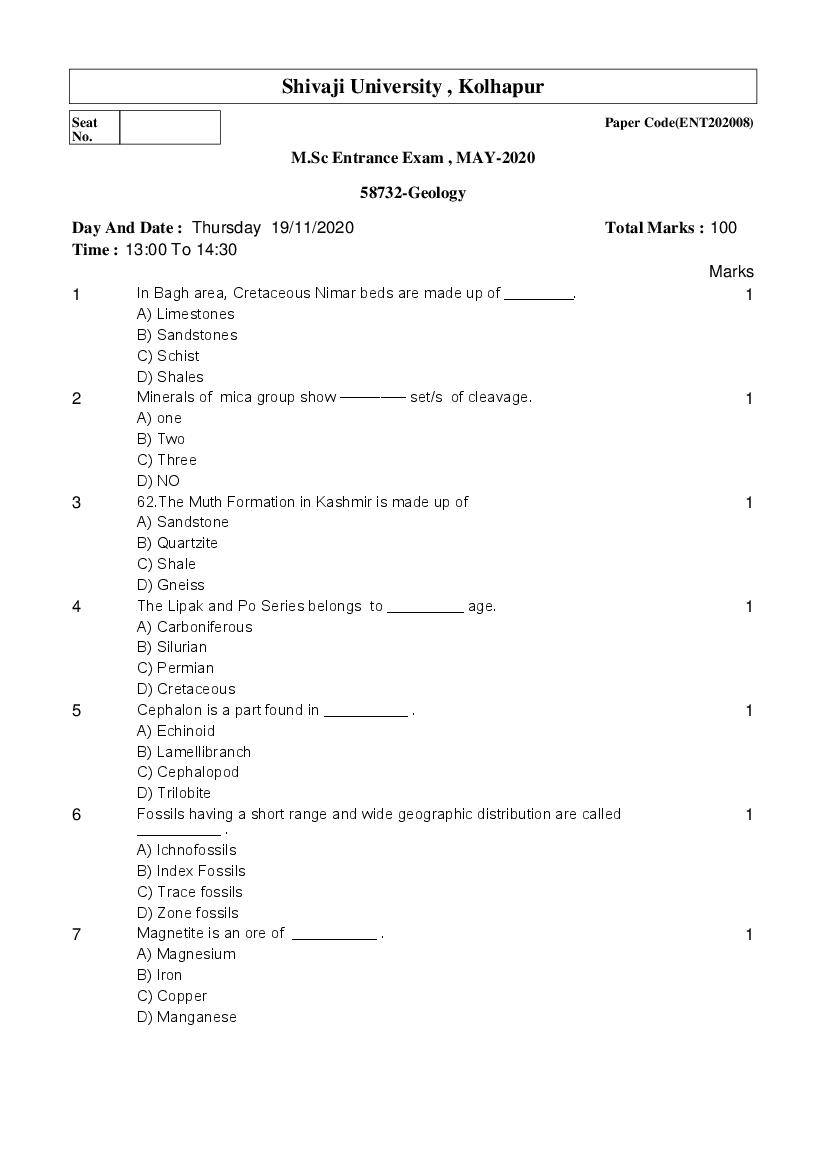
Page 1
Seat Paper Code(ENT202008)
No.
M.Sc Entrance Exam , MAY-2020
58732-Geology
Day And Date : Thursday 19/11/2020 Total Marks : 100
Time : 13:00 To 14:30
Marks
1 In Bagh area, Cretaceous Nimar beds are made up of _________. 1
A) Limestones
B) Sandstones
C) Schist
D) Shales
2 Minerals of mica group show ------------- set/s of cleavage. 1
A) one
B) Two
C) Three
D) NO
3 62.The Muth Formation in Kashmir is made up of 1
A) Sandstone
B) Quartzite
C) Shale
D) Gneiss
4 The Lipak and Po Series belongs to __________ age. 1
A) Carboniferous
B) Silurian
C) Permian
D) Cretaceous
5 Cephalon is a part found in ___________ . 1
A) Echinoid
B) Lamellibranch
C) Cephalopod
D) Trilobite
6 Fossils having a short range and wide geographic distribution are called 1
___________ .
A) Ichnofossils
B) Index Fossils
C) Trace fossils
D) Zone fossils
7 Magnetite is an ore of ___________ . 1
A) Magnesium
B) Iron
C) Copper
D) Manganese
Page 2
A) Iron
B) Coal
C) Copper
D) Silver
9 The Zawar area in Rajasthan is associated with ___________ deposits. 1
A) Cu – Ag
B) Pb - Cu
C) Pb – Zn
D) Pb – Fe
10 The Bababudan Group is associated with ___________ deposits. 1
A) Copper
B) Lead
C) Manganese
D) Iron
11 The formation of new crust takes place at the ___________ . 1
A) Subduction zone
B) Convergent boundary
C) Mid-oceanic ridges
D) Colliding plate margins
12 The oldest stage in Trichinopoly Cretaceous Formation is 1
A) Niniyur
B) Ariyalur
C) Uttatur
D) Trichinopoly
13 The sequence from older to younger formations in Gondwana Supergroup is 1
___________ .
A) Mahadeva-Rajmahal-Jabalpur-Umia
B) Umia-Jabalpur-Rajmahal-Mahadeva
C) Umia-Rajmahal-Jabalpur-Mahadeva
D) Umia-Mahadeva -Jabalpur-Rajmahal-
14 Lingula belongs to ___________ . 1
A) Lamellibranchs
B) Gastropods
C) Brachiopods
D) Trilobites
15 Streams containing water only after rainfall or snow melting and having no 1
connection with water table are called ___________ streams .
A) Intermittent
B) Permanent
C) Ephemeral
D) Ameral
16 The physical property of the rock that defines the amount of interstices is called 1
___________ .
A) Permeability
B) Yield
C) Transmissibility
D) Porosity
Page 3
A) Aquifer
B) Aquitard
C) Aquiclude
D) Artesian
18 Groundwater can move only through ……………….. rocks. 1
A) compact
B) porous
C) permeable
D) all
19 For groundwater investigation ………… method is most suitable. 1
A) electrical resistivity
B) magnetic
C) gravity
D) none of these
20 Stalactites are ……………features formed by groundwater. 1
A) erosional
B) abrasion
C) deposional
D) none of these
21 The uniaxial minerals are present in ___________ system. 1
A) Orthorhombic
B) Tetragonal
C) Triclinic
D) Monoclinic
22 The biaxial minerals are present in ___________ system. 1
A) Cubic
B) Tetragonal
C) Hexagonal
D) Monoclinic
23 The number of axes of symmetry in the normal class of the Cubic system is 1
___________ .
A) Thirteen
B) Seven
C) Five
D) Three
24 Class Pelecypoda belongs to Phyllum ___________ . 1
A) Brachiopoda
B) Mollusca
C) Echinodermata
D) Arthropoda
25 The indices of Trisoctahedron in the Isometric system are ________. 1
A) ( hhl )
B) ( hll )
C) ( hko )
D) ( hkl )
Page 4
A) Iron
B) Coal
C) Copper
D) Silver
27 The Talchir Boulders represent _____________ environment. 1
A) Deltaic
B) Desert
C) Fluvial
D) Glacial
28 The Pallial Line is found in ___________ . 1
A) Gastropods
B) Lamellibranchs
C) Trilobites
D) Brachiopods
29 The zone of ………….. occurs below the water table. 1
A) aeration
B) saturation
C) soil water
D) soil
30 The isotropic minerals belong to ___________ system. 1
A) Cubic
B) Tetragonal
C) Hexagonal
D) Orthorhombic
31 Out of the following, the positive uniaxial mineral is ___________ . 1
A) Calcite
B) Garnet
C) Quartz
D) Pyroxene
32 The number of planes of symmetry in the normal class of Hexagonal system is 1
________ .
A) Nine
B) Seven
C) Six
D) Five
33 The instrument used to measure the interfacial angle in a crystal is called 1
___________ .
A) Pyncometer
B) Angle meter
C) Goniometer
D) XRD
34 The number of faces in a normal prism is ___________ . 1
A) Two
B) Three
C) Eight
D) Four
Page 5
A) Petrification
B) Preservation
C) Carbonisation
D) Imprints
36 The removal of surface materials by the wind is called ___________ . 1
A) Deflation
B) Corrasion
C) Abrasion
D) Saltation
37 Streams containing water only after rainfall or snow melting and having no 1
connection with water table are called ___________ streams . (A)
Intermittent ( B ) Permanent ( C ) Ephemeral
( D ) Ameral
A) Intermittent
B) Permanent
C) Ephemeral
D) Ameral
38 The deposition of sands and silts at the border of the flood-plain is called 1
___________ .
A) Delta
B) Natural levees
C) Alluvium
D) River terraces
39 Frost Wedging is a type of __________ weathering. 1
A) Chemical
B) Physical
C) Biological
D) Organic
40 Drumlins are developed due to ___________ . ( A ) Glaciers 1
( B ) Winds ( C ) Rivers ( D ) Lakes
A) Glaciers
B) Winds
C) Rivers
D) Lakes
41 Barchans are a type of ___________ . 1
A) Ripple marks
B) Moraines
C) Dunes
D) Roof hangings
42 The topography dominated by limestone is known as ________ topography. 1
A) Korst
B) Karst
C) Dolines
D) Krapt
43 The Mushroom Rock is generally found in ________ . 1
A) Glaciers
B) Rivers
C) Oceans
D) Deserts
Page 6
A) Subsequent
B) Obsequent
C) Consequent
D) Insequent
45 The fold in which the axial plane is inclined and both the limbs dip in the same 1
direction is called ___________ fold.
A) Symmetrical
B) Asymmetrical
C) Recumbent
D) Overturned
46 In Echinoids, the mouth and encircling plates collectively form ___________ 1
A) Periproct
B) Corona
C) Peristome
D) Ocular Plates
47 The fold in which the axial plane is essentially horizontal is called ___________ 1
fold.
A) Isoclinal
B) Overturned
C) Recumbent
D) Asymmetrical
48 Short faults that overlap each other are called ___________ faults. 1
A) En echelon
B) Radial
C) Peripheral
D) Transverse
49 An erosional surface between two parallel rock formations is called _________ . 1
A) Angular unconformity
B) Non-conformity
C) Discontinuity
D) Diastem
50 Deposits formed by the crystallization of minerals from metal-rich solutions from 1
magmas are called ___________ deposits.
A) Syngenetic
B) Pneumatolytic
C) Metasomatic
D) Hydrothermal
51 The metal content of an ore is called ___________ . 1
A) Tenor
B) Gangue
C) Yield
D) Tonnage
52 Khetri in Rajasthan is famous for ___________ deposits. 1
A) Iron
B) Copper
C) Lead
D) Gold
Page 7
and redeposition of this metal as a higher grade deposit in a smaller volume of
rock is called _____ .
A) Magmatic segregation
B) Telethermal deposition
C) Hypothermal deposition
D) Supergene enrichment
54 Olivine alters to serpentine on the addition of ------ 1
A) H2O
B) SiO2
C) H2O+ SiO2
D) CO2
55 The Si:Al ratios in the tektosilicates are ------ 1
A) 1:1
B) 3:1
C) 1:1/3:1
D) 1:2
56 Mineral----------- represents hardness 6 in Mohs' Scale. 1
A) calcite
B) orthoclase
C) topaz
D) talc
57 Helix is an ___________ . 1
A) Cephalopod
B) Gastropod
C) Trilobite
D) Echinoid
58 Mineral 'augite' belongs to ------------ Group. 1
A) amphibole
B) mica
C) pyroxene
D) feldspar
59 Bauxite is an ore of - - - - - - -. 1
A) aluminum
B) iron
C) manganese
D) gold
60 An example of Felspathoid mineral is ________ . 1
A) Celsian
B) Leucite
C) Apophyllite
D) Microcline
61 The hardness of Fluorite is__________ . 1
A) 3
B) 5
C) 6
D) 4
Page 8
A) Almandine
B) Grossular
C) Spessartine
D) Pyrope
63 The mineral Paragonite belongs to ________ group. 1
A) Amphibole
B) Pyroxene
C) mica
D) Garnet
64 Simultaneous crystallisation of two components at the eutectic point gives rise to 1
___________ texture.
A) Porphyritic
B) Poikilitic
C) Graphic
D) Orthophyric
65 Feldspathoid bearing rocks are ___________ rocks. 1
A) Undersaturated
B) Saturated
C) Oversaturated
D) Acidic
66 Basalt is _____________________ rock. 1
A) Igneous, volcanic, acidic, calc-alkali series
B) Igneous, volcanic, basic, alkali-series
C) Igneous, volcanic, basic, calc-alkali series
D) Igneous, volcanic, ultrabasic, calc-alkali series
67 The product of decomposition and disintegration of rocks is called __________ . 1
A) Petrolith
B) Rogolith
C) Ragolith
D) Regolith
68 The face which always intersects the vertical axis is ___________ . 1
A) Prism
B) Pyramid
C) Brachy pinacoid
D) Macro pinacoid
69 The correct sequence from smaller to larger size rock fragments is __________ . 1
A) Sand – Gravel – Pebble – Cobble
B) Sand – Gravel – Cobble - Pebble
C) Sand – Cobble – Pebble – Gravel
D) Sand – Mud – Pebble – Cobble
70 Phosphatic deposit of organic origin is called ___________ . 1
A) Guano
B) Gossan
C) Diatoms
D) Radiolarian oozes
Page 9
A) Directed Pressure
B) Heat
C) Uniform Pressure
D) Chemically active fluids
72 The sequence of metamorphic facies from low grade to high grade is 1
_____________________ .
A) Hornfels – Amphibolite – Greenschist - Eclogite
B) Hornfels – Amphibolite – Eclogite – Greenschist
C) Hornfels – Greenschist – Amphibolite – Eclogite
D) Greenschist – Hornfels – Amphibolite – Eclogite
73 The formation of Himalayas is due to ___________ . 1
A) Diverging Plates
B) Colliding Plates
C) Transform Faults
D) Weathering
74 The single super continent was called ___________ . 1
A) Panthalassa
B) Gondwanaland
C) Laurasia
D) Pangaea
75 The single super ocean in the geological past was called ___________ . 1
A) Panthalassa
B) Gondwanaland
C) Laurasia
D) Tethis
76 The “ Marina Trench” is present in the ___________ ocean . 1
A) Pacific
B) Atlantic
C) Indian
D) Arctic
77 The Mantle-Core interface is marked by _________ discontinuity . 1
A) Mohorovicic
B) Gutenburg
C) Oldham
D) Lehmann
78 The concept that highly elevated mountains are made up of low density materials 1
is related to the concept of ___________ .
A) Plate Tectonics
B) Sea-floor Spreading
C) Palaemagnetism
D) Isostasy
79 A fold where both the limbs dip in the same direction is called ___________ fold. 1
A) Isoclinal
B) Recumbent
C) Overturned
D) Box
Page 10
A) Outer Core
B) Crust
C) Upper Mantle
D) Lower Mantle
81 Asthenosphere is present in the ____________ . 1
A) Upper Crust
B) Lower Crust
C) Mantle
D) Outer Core
82 Fold mountains are formed due to - - - - - - - - -type of crustal movements. 1
A) orogenic
B) epierogenic
C) denudation
D) none of these
83 In gastropods, the line between two whorls is called ___________ . ( A ) Apex 1
( B ) Spire ( C ) Sinistrel ( D ) Suture
A) Apex
B) Spire
C) Sinistrel
D) Suture
84 Saddles and Lobes are found in ___________ . ( A ) Ammonoids (B 1
) Lamellibranch ( C ) Cephalopod ( D ) Trilobite
A) Ammonoids
B) Lamellibranch
C) Cephalopod
D) Trilobite
85 The capacity of the rock formation for transmitting water is measured by the 1
coefficient of ___________ .
A) Porosity
B) Field capacity
C) Permeability
D) Specific Yield
86 The surface water that percolates down to form groundwater is called………… 1
A) juvenile water
B) connate water
C) meteoric water
D) none of these
87 Groundwater trapped in the sediments is called ___________ . 1
A) Connate
B) Meteorite
C) Juvenille
D) Saline
88 Cirque is formed due to erosional work by ___________ . 1
A) Wind
B) River
C) Sea waves
D) Glaciers
Page 11
___________ fold.
A) Chevron
B) Box
C) Normal
D) Fan
90 Folds associated with salt intrusions in arid areas are called________ . 1
A) En Echelon folds
B) Diapers
C) Suprateneous folds
D) Drag Folds
91 A fault in which the hanging wall has moved up relative to the footwall is called 1
___________ fault.
A) Normal
B) Thrust
C) Gravity
D) Wrench
92 Slickensides are associated with ___________ . 1
A) Folds
B) Faults
C) Joints
D) Unconformities
93 An angle made by fault-plane with a vertical- plane is called ___________ . 1
A) Throw
B) Dip
C) Heave
D) Hade
94 Mechanical concentration of minerals, due to gravity separation of heavy minerals 1
from light minerals, by moving water or wind gives rise to ___________ deposits.
A) Metasomatic
B) Hydrothermal
C) Placer
D) Pneumatolytic
95 Digboi in Assam is famous for____ deposits. 1
A) Coal
B) Lignite
C) Petroleum
D) Iron
96 Terra Rosa is a type of ___________ deposit. 1
A) Sedimentary
B) Residual
C) Chemical
D) Organic
97 Sandstone with abundance of feldspar and derived from granite is called 1
___________ .
A) Graywacke
B) Grit
C) Arkose
D) Freestone
Page 12
A) Vindhyan
B) Dharwar
C) Siwalik
D) Gondwana
99 60.The most common rock in the Kurnool System is 1
A) Gneiss
B) Schist
C) Limestone
D) Phyllite
100 The age of the rocks of Haimanta System in Spiti Valley is 1
A) Carboniferous
B) Permian
C) Pleistocene
D) Cambrian
Document Details
| Board / Org | Default |
| Exam | Admission Tests |
| Type | Question Paper |
| Pages | 12 |
| Updated | 22 Jul 2026 |