Goa Board Class 12 Question Paper 2025 Geology
Finished viewing? Save it for later —
Download Goa Board Class 12 Question Paper 2025 Geology (PDF · 7 pages)About Goa Board Class 12 Question Paper 2025 Geology
Goa Board Class 12 Question Paper 2025 Geology is available here for free download. Published by Goa Board for Class 12, this question paper can be viewed online or downloaded as a PDF (7 pages). Candidates preparing for Class 12 can use Goa Board Class 12 Question Paper 2025 Geology to understand the exam pattern, the type of questions asked, and the overall difficulty level.
Frequently Asked Questions
How can I download Goa Board Class 12 Question Paper 2025 Geology?
Open this page and click the Download button to save Goa Board Class 12 Question Paper 2025 Geology as a PDF. It is completely free on AglaSem Docs.
Is Goa Board Class 12 Question Paper 2025 Geology free to download?
Yes. Goa Board Class 12 Question Paper 2025 Geology can be viewed online and downloaded as a PDF free of cost on AglaSem Docs.
How many pages does Goa Board Class 12 Question Paper 2025 Geology have?
Goa Board Class 12 Question Paper 2025 Geology contains 7 pages, which you can read online or download together as a single PDF.
Where can I find more Class 12 study material?
You can find more Class 12 question papers, sample papers, syllabus, and answer keys on AglaSem Docs.
Goa Board Class 12 Question Paper 2025 Geology – Text
Read the full text of this question paper below — useful to quickly search, copy and reference the content online without downloading the PDF.
📄 View text version (7 pages)
Page 1
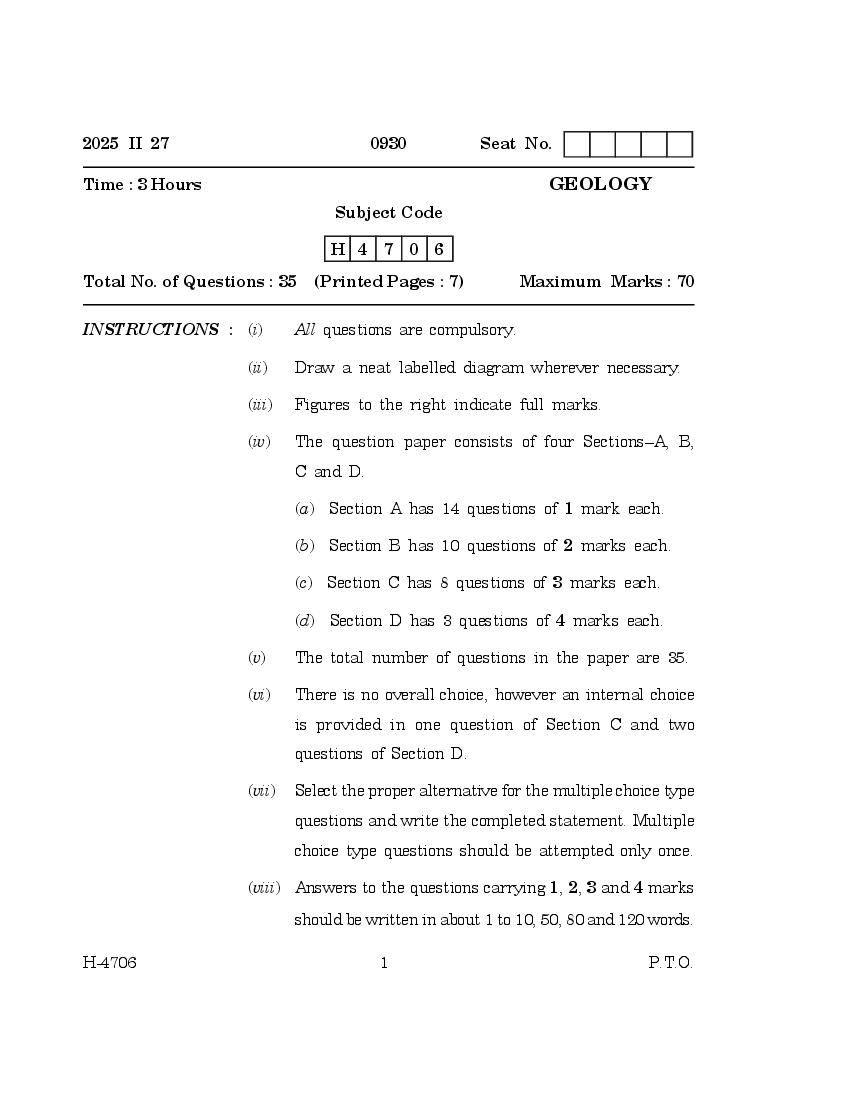
Time : 3 Hours GEOLOGY
Subject Code
H 4 7 0 6
Total No. of Questions : 35 (Printed Pages : 7) Maximum Marks : 70
INSTRUCTIONS : (i) All questions are compulsory.
(ii) Draw a neat labelled diagram wherever necessary.
(iii) Figures to the right indicate full marks.
(iv) The question paper consists of four Sections–A, B,
C and D.
(a) Section A has 14 questions of 1 mark each.
(b) Section B has 10 questions of 2 marks each.
(c) Section C has 8 questions of 3 marks each.
(d) Section D has 3 questions of 4 marks each.
(v) The total number of questions in the paper are 35.
(vi) There is no overall choice, however an internal choice
is provided in one question of Section C and two
questions of Section D.
(vii) Select the proper alternative for the multiple choice type
questions and write the completed statement. Multiple
choice type questions should be attempted only once.
(viii) Answers to the questions carrying 1, 2, 3 and 4 marks
should be written in about 1 to 10, 50, 80 and 120 words.
H-4706 1 P.T.O.
Page 2
1. An ore mineral which shows non-metallic lustre is ................. . 1
• Galena
• Hematite
• Bauxite
• Magnetite
2. Choose the ore mineral with its correct streak from the following ............. . 1
• Chalcopyrite-Greenish black
• Psilomelane-Brown
• Chromite-Cherry red
• Limonite-White
3. Landforms formed due to graben are called as ............... . 1
• Block Mountains
• Caves
• Rift Valleys
• Dome Mountains
H-4706 2
Page 3
• Inclined at 45º to the horizontal
• Vertical
• Horizontal
• Inclined at 45º to its normal
5. An example of Acid Igneous rock is .................... . 1
• Basalt
• Granite
• Syenite
• Diorite
6. A metamorphic product of Limestone is ................. . 1
• Slate
• Gneiss
• Marble
• Phyllite
H-4706 3 P.T.O.
Page 4
• Graptolites
• Cockroaches
• Trilobites
• Fishes
8. What do you mean by Gutenberg Discontinuity ? 1
9. Define the term ‘Epicentre’. 1
10. State one Arenaceous sedimentary rock. 1
11. Olivine and Quartz do not occur together in any rock. Justify. 1
12. What are Conjugate Joints ? 1
13. Name the metamorphic product of Schist ? 1
14. What are volcanic bombs ? 1
Section B
15. Explain with a neat labelled diagram, Early magmatic segregation
Deposits. 2
H-4706 4
Page 5
17. Explain with a neat labelled diagram Poikilitic texture. 2
18. What are slickensides. Give its significance. 2
19. Give a brief account of economic importance of Dharwar Supergroup. 2
20. Explain in brief Lithostratigraphic units. 2
21. State the classification of Cuddpah Supergroup. 2
22. Write a short note on Anthracite. 2
23. “Two individuals may conclude different intensities for the same earthquake
at the same time”. Justify. 2
24. Study the following diagram, identify and explain type of fault. 2
H-4706 5 P.T.O.
Page 6
25. Explain in brief : 3
(i) Principle of Intrusion
(ii) Principle of Inclusion.
26. Explain how igneous rocks are classified based upon silica saturation. 3
27. Explain with a neat diagram Throw and Heave of a fault. 3
28. Explain Strombolian and Vulcanian type of volcanic eruption. 3
Or
Explain with a neat labelled diagram, Composite cone volcano.
29. Illustrate and explain the concept of an oil trap. 3
30. Explain copper belts in India. 3
31. Give 3 points of difference between P-wave and S-wave. 3
32. Explain in brief : 3
(a) Chevron folds
(b) Non-conformity.
H-4706 6
Page 7
33. With a neat labelled diagram explain elements of fold. 4
34. Illustrate and explain various features of ocean-ocean convergent plate
interaction. 4
Or
Explain origin of Himalayas with respect to plate tectonics.
35. Describe the stratigraphy of 'Goa Group' of rocks. 4
Or
Describe any four modes of preservation of fossils.
H-4706 7 P.T.O.
Document Details
| Board / Org | Goa Board |
| Exam | Class 12 |
| Type | Question Paper |
| Pages | 7 |
| Updated | 24 Sep 2026 |