Page 1
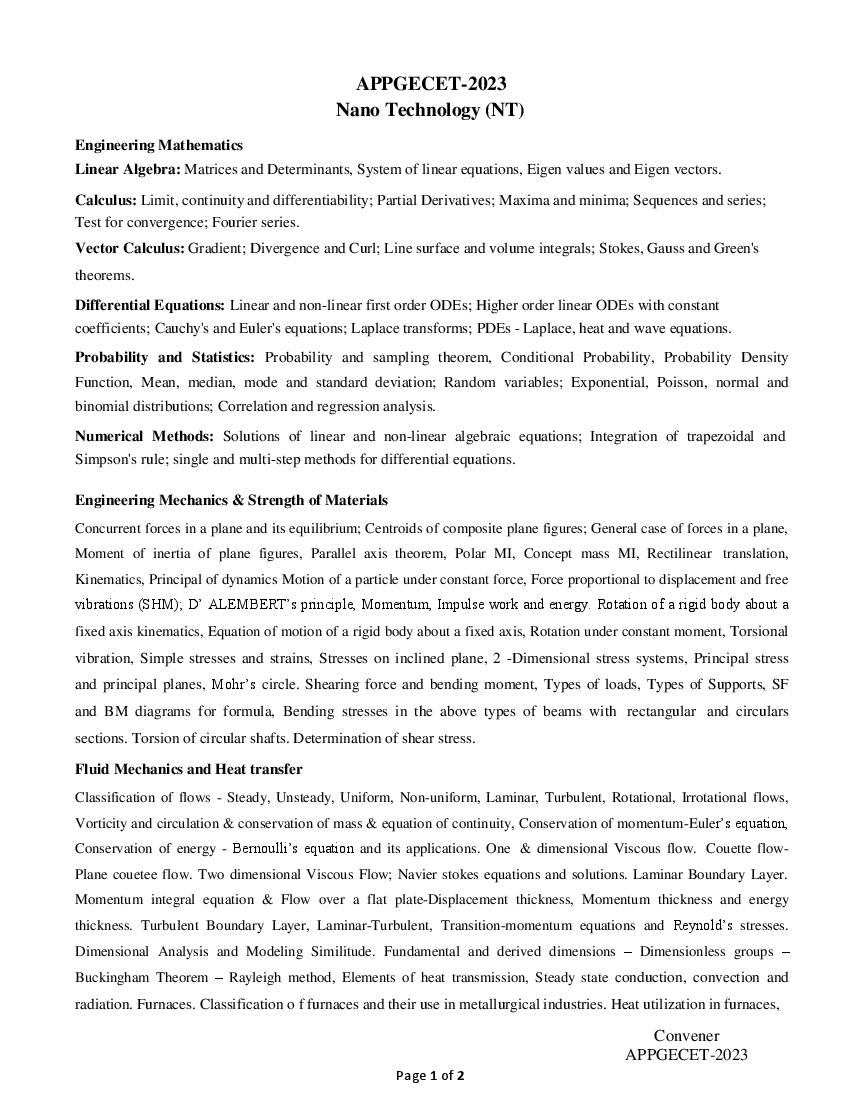
APPGECET-2023 Nano Technology (NT) Engineering Mathematics Linear Algebra: Matrices and Determinants, System of linear equations, Eigen values and Eigen vectors. Calculus: Limit, continuity and differentiability; Partial Derivatives; Maxima and minima; Sequences and series; Test for convergence; Fourier series. Vector Calculus: Gradient; Divergence and Curl; Line surface and volume integrals; Stokes, Gauss and Green's theorems. Differential Equations: Linear and non-linear first order ODEs; Higher order linear ODEs with constant coefficients; Cauchy's and Euler's equations; Laplace transforms; PDEs - Laplace, heat and wave equations. Probability and Statistics: Probability and sampling theorem, Conditional Probability, Probability Density Function, Mean, median, mode and standard deviation; Random variables; Exponential, Poisson, normal and binomial distributions; Correlation and regression analysis. Numerical Methods: Solutions of linear and non-linear algebraic equations; Integration of trapezoidal and Simpson's rule; single and multi-step methods for differential equations. Engineering Mechanics & Strength of Materials Concurrent forces in a plane and its equilibrium; Centroids of composite plane figures; General case of forces in a plane, Moment of inertia of plane figures, Parallel axis theorem, Polar MI, Concept mass MI, Rectilinear translation, Kinematics, Principal of dynamics Motion of a particle under constant force, Force proportional to displacement and free vibrations (SHM); D’ ALEMBERT’s principle, Momentum, Impulse work and energy. Rotation of a rigid body about a fixed axis kinematics, Equation of motion of a rigid body about a fixed axis, Rotation under constant moment, Torsional vibration, Simple stresses and strains, Stresses on inclined plane, 2 -Dimensional stress systems, Principal stress and principal planes, Mohr’s circle. Shearing force and bending moment, Types of loads, Types of Supports, SF and BM diagrams for formula, Bending stresses in the above types of beams with rectangular and circulars sections. Torsion of circular shafts. Determination of shear stress. Fluid Mechanics and Heat transfer Classification of flows - Steady, Unsteady, Uniform, Non-uniform, Laminar, Turbulent, Rotational, Irrotational flows, Vorticity and circulation & conservation of mass & equation of continuity, Conservation of momentum-Euler’s equation, Conservation of energy - Bernoulli’s equation and its applications. One & dimensional Viscous flow. Couette flow- Plane couetee flow. Two dimensional Viscous Flow; Navier stokes equations and solutions. Laminar Boundary Layer. Momentum integral equation & Flow over a flat plate-Displacement thickness, Momentum thickness and energy thickness. Turbulent Boundary Layer, Laminar-Turbulent, Transition-momentum equations and Reynold’s stresses. Dimensional Analysis and Modeling Similitude. Fundamental and derived dimensions – Dimensionless groups – Buckingham Theorem – Rayleigh method, Elements of heat transmission, Steady state conduction, convection and radiation. Furnaces. Classification o f furnaces and their use in metallurgical industries. Heat utilization in furnaces, Convener APPGECET-2023 Page 1 of 2
Page 2
available heat, factors affecting it. Heat losses in furnaces and furnace efficiency. Heat balance and sankey diagrams. Principles of waste heat recovery. Recuperators and regenerators. Types and applicability. AMTD and LMTD in recuperators. Protective atmosphere and their applications Salt bath furnaces. Elements of Material Science Introduction, classification of materials, Space lattice and unit cells, crystal systems. Indices for planes and directions. Structures of common metallic materials. Crystal defects: point, Line and surface defects. Dislocations, types, Burgers’ Vector, Dislocation movement by climb and cross slip. Dislocation sources, Dislocation point - defect interaction and pileups. Plastic deformation of single crystals. Deformation by slip, CRSS for slip. Deformation of single crystal. Deformation by twinning. Stacking faults, Hot working, Cold working, Recovery, recrystallization and grain growth. Hall- Petch equation. Tensile stress- strain diagrams, proof stress, yield stress, modulus of elasticity. Typical stress-strain diagrams for mild steel cast iron and aluminum alloy. Metallurgical Thermodynamics Introduction - Basic concepts in thermodynamics. Objectives and limitations of classical thermodynamics. Zeroth law of thermodynamics. First Law of Thermodynamics-Forms of Energy, Heat and Work, Joules Experiments, Conservation of Energy, Concept of Maximum Work, Isothermal Expansion, Reversible, Adiabatic Expansion, Constant Pressure Processes, Constant Volume Processes, Enthalpy. Second Law of Thermodynamics -Efficiency of cyclic process. Carnot cycle. Entropy. Thermodynamic equation of state. Statistical Entropy. Physical Meaning of Entropy, Boltzman Equation, Mixing Entropy, Stirling’s Approximation Auxiliary Functions. Fundamental Equations of State, Max well Relationships, Other Thermodynamic Relations, Chemical Potential, Gibbs- Helmholtz Equation, Criteria of Equilibria. Third law of Thermodynamics, Heat Capacity and Entropy Changes. Sensible Heats, Transformation Heats, Reaction Heats, Adiabatic Flame Temperatures, Heat Balances. Phase Equilibria in One Component Systems, Clausius-Claperyon Equation, Heats of Vaporization From Vapor Pressure Data, Shift in Transformation, Temperature with Pressure, Fugacity, activity and equilibrium constant. Vant Hoff’s isotherm. Ellingham diagrams and application. Advanced Material science Electrical and Electronic properties of materials, Electronic conductivity, free electron theory and band theory of solids. Intrinsic semi-conductors. Super conductivity. Magnetic properties, Dia, para, ferro, ferri magnetism. Soft and hard magnetic materials and applications. Optical properties of materials. Refractive index, absorption emission of light, optical fibers. Opto-electronic materials. Polymerization, cross linking glass transition, classification of polymers. Mechanical properties, dielectric behaviour of materials. Uses of polymers. Ceramics and glasses, crystalline and non-crystalline ceramics. Structure of ceramics and glasses. Major mechanical and optical properties. Composite materials. Classification. Matrices and reinforcements. Fabrication methods. Examples and applications. Nano Materials: Importance, Emergence of Nano - Technology, Bottom-Up and Top-down app roaches, challenges in Nano - Technology. Applications. ****** Convener APPGECET-2023 Page 2 of 2