Shivaji University Entrance Exam 2020 Question Paper MSc.Botany
Finished viewing? Save it for later —
Download Shivaji University Entrance Exam 2020 Question Paper MSc.Botany (PDF · 12 pages)About Shivaji University Entrance Exam 2020 Question Paper MSc.Botany
Shivaji University Entrance Exam 2020 Question Paper MSc.Botany is available here for free download. Published by Default for Admission Tests, this question paper can be viewed online or downloaded as a PDF (12 pages). Candidates preparing for Admission Tests can use Shivaji University Entrance Exam 2020 Question Paper MSc.Botany to understand the exam pattern, the type of questions asked, and the overall difficulty level.
Frequently Asked Questions
How can I download Shivaji University Entrance Exam 2020 Question Paper MSc.Botany?
Open this page and click the Download button to save Shivaji University Entrance Exam 2020 Question Paper MSc.Botany as a PDF. It is completely free on AglaSem Docs.
Is Shivaji University Entrance Exam 2020 Question Paper MSc.Botany free to download?
Yes. Shivaji University Entrance Exam 2020 Question Paper MSc.Botany can be viewed online and downloaded as a PDF free of cost on AglaSem Docs.
How many pages does Shivaji University Entrance Exam 2020 Question Paper MSc.Botany have?
Shivaji University Entrance Exam 2020 Question Paper MSc.Botany contains 12 pages, which you can read online or download together as a single PDF.
Where can I find more Admission Tests study material?
You can find more Admission Tests question papers, sample papers, syllabus, and answer keys on AglaSem Docs.
Shivaji University Entrance Exam 2020 Question Paper MSc.Botany – Text
Read the full text of this question paper below — useful to quickly search, copy and reference the content online without downloading the PDF.
📄 View text version (12 pages)
Page 1
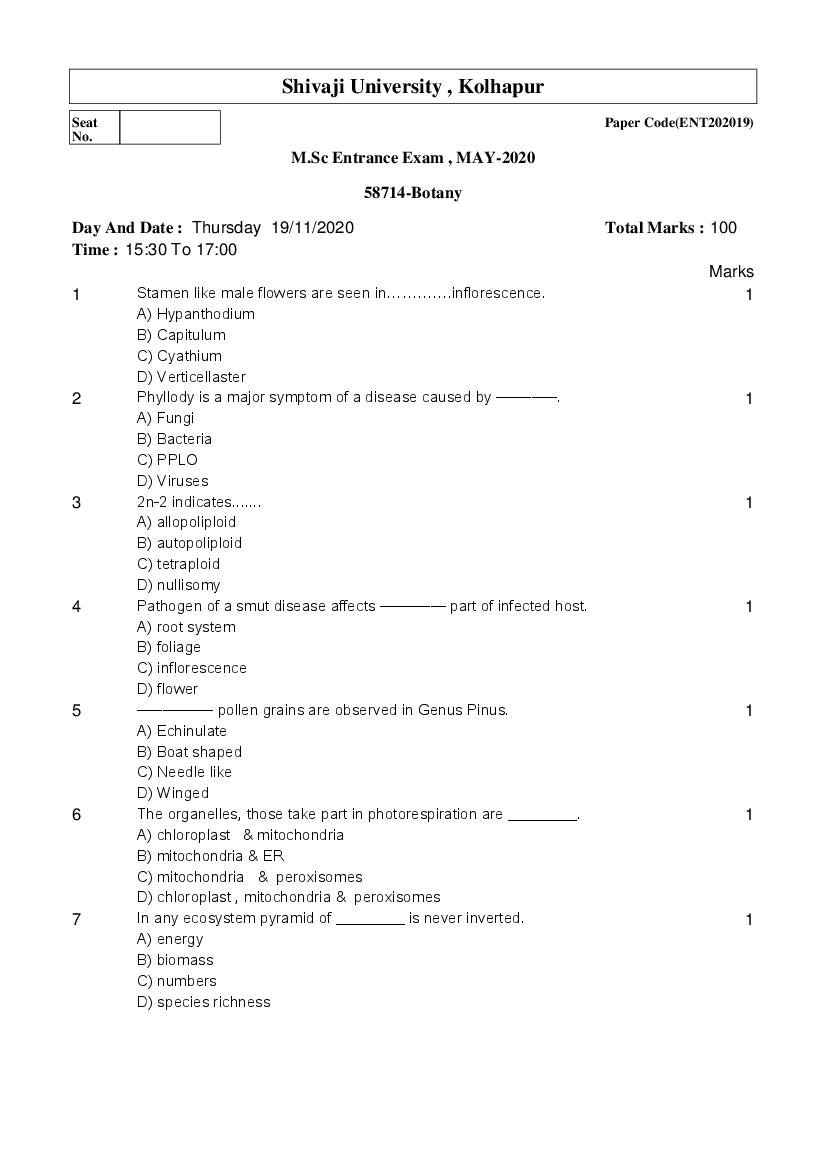
Seat Paper Code(ENT202019)
No.
M.Sc Entrance Exam , MAY-2020
58714-Botany
Day And Date : Thursday 19/11/2020 Total Marks : 100
Time : 15:30 To 17:00
Marks
1 Stamen like male flowers are seen in………….inflorescence. 1
A) Hypanthodium
B) Capitulum
C) Cyathium
D) Verticellaster
2 Phyllody is a major symptom of a disease caused by ------------. 1
A) Fungi
B) Bacteria
C) PPLO
D) Viruses
3 2n-2 indicates....... 1
A) allopoliploid
B) autopoliploid
C) tetraploid
D) nullisomy
4 Pathogen of a smut disease affects ------------- part of infected host. 1
A) root system
B) foliage
C) inflorescence
D) flower
5 --------------- pollen grains are observed in Genus Pinus. 1
A) Echinulate
B) Boat shaped
C) Needle like
D) Winged
6 The organelles, those take part in photorespiration are _________. 1
A) chloroplast & mitochondria
B) mitochondria & ER
C) mitochondria & peroxisomes
D) chloroplast , mitochondria & peroxisomes
7 In any ecosystem pyramid of _________ is never inverted. 1
A) energy
B) biomass
C) numbers
D) species richness
Page 2
Fermentation is known as_________.
A) Alcohol fermentation
B) Curing
C) Degradation
D) Lactic acid fermentation
9 Penicillin is commercially produced by_________. 1
A) P. notatum
B) P. citrinum
C) P. chrysogenum
D) P. roquefortii
10 For the production of ethanol the raw material used is____________. 1
A) Molasses
B) Cellulose
C) Sulphite waste liquor
D) Rotten fruits
11 ---------- microbes is used for commercial production of ethanol. 1
A) Clostridium butylicum
B) Streptococcus
C) Saccharomyces cerevisiae
D) Trichoderm apolysporum
12 Genus ------------ is commonly known as Peat Moss or Bog Moss. 1
A) Sphagnum
B) Plagiochasma
C) Funaria
D) Marchantia
13 During DNA replication, the sequence specificity of bases in newly synthesized 1
strand is determined by ---------------.
A) DNA polymerase I
B) Restriction endonuclease
C) DNA polymerase II
D) The template strand
14 ----------------- is a colonial alga. 1
A) Oedogonium
B) Nostoc
C) Chlorella
D) Polysiphonia
15 The most common form of diagrammatic representation of a grouped frequency 1
distribution is --------------------.
A) Pie diagram
B) Line graph
C) Histogram
D) Polygon
16 Solidification of culture media is carried out by addition of ----------------. 1
A) Agar agar
B) Out flour
C) Silica gel
D) Blood serum
Page 3
A) Amino acids
B) Sugars
C) Alcohol
D) Organic acids
18 ………is the most primitive group of vascular land plants. 1
A) Thallophyta
B) Bryophyta
C) Pteridophyta
D) Spermatophyta
19 Dimorphic roots occur in………………….. 1
A) Cycas
B) Pinus
C) Gnetum
D) Ephedra
20 The colony of Volvox is termed as…………. 1
A) Coenobium
B) Colony
C) Cystocarp
D) Palmella
21 Gymnosperms generally lacks…………… 1
A) vessels in xylem and companion cells in phloem
B) tracheids in xylem and companion cells in phloem
C) vessels of zylem and sieve tubes in phloem
D) tracheids in phloem and companion cells
22 The rules formulated by IBC are listed formally by code called as………….…….. 1
A) International code of Binomial nomenclature
B) Indian code of Biological nomenclature
C) International code of Botanical nomenclature
D) None of these
23 Citronella oil is extracted from leaves of ------------------. 1
A) Artemisia annua
B) Jasminum sambac
C) Vetiveria zizanioides
D) Cymbopogon nardus
24 A bacterium associated with production of Bio-insecticide is ---------------. 1
A) Bacillus thuringenesis
B) Agrobacterium tumefaciens
C) Bacillus subtilis
D) Agrobacterium rhizogenes
25 Premature leaf fall is caused due to the deficiency of--------. 1
A) Potassium
B) Sodium
C) Zinc
D) Phosphours
Page 4
A) in strong light
B) due to excessive respiration
C) in darkness
D) due to lack of Mg and Fe
27 …………is heterosporous. 1
A) Dryopteris
B) Selaginella
C) Lycopodium
D) Equistem
28 The order ……………..……has only fossil Gymnosperms. 1
A) Cycadales
B) Conferales
C) Gnetales
D) Cycadofilicales
29 Bentham and Hooker have classified seed plants into …………families. 1
A) 202
B) 203
C) 204
D) 205
30 In inflorescence of Bougainvillea the coloured part is -------------. 1
A) Bract
B) Corolla
C) Leaf
D) Calyx
31 The net gain of ATP molecules in glycolysis is ------------. 1
A) 0
B) 2
C) 4
D) 8
32 The pigment essential for nitrogen fixation by leguminous plants is----------. 1
A) Phycocyanin
B) Leghaemoglobin
C) Phycoerythrin
D) Antycyanin
33 In the study of Ecology, Relative density + Relative dominance + Relative 1
frequency = ----.
A) Important Value Index
B) Abundance Index
C) Fidelity Index
D) Species Diversity Index
34 The correlation between the number of stomata and epidermal cells per unit area 1
is known as -------------------.
A) Stomatal abundance
B) Stomatal frequency
C) Stomatal density
D) Stomatal index
Page 5
A) the first stable
B) the last stable
C) man made, hence unstable
D) naturally unstable
36 ……………. type of fossil is useful to study even the internal structures also. 1
A) Impression
B) Compression
C) Petrification
D) Cast
37 Morphine, Codine and Narcotin are obtained from unripe fruits of genus -------------. 1
A) Aloe
B) Rauvolfia
C) Papaver
D) Withania
38 Which colour of light gives maximum absorption peak by chlorophyll- a -------. 1
A) Yellow
B) Red
C) Blue
D) Green
39 Bordeaux Mixture consists of copper sulphate and ------------------. 1
A) Calcium carbonate
B) Sodium hydroxide
C) Calcium hydroxide
D) Sodium carbonate
40 Carrier proteins are involved in--------. 1
A) Active transport of ions
B) Passive transport of ions
C) Water transport
D) Water evaporation
41 The rate of photosynthesis is maximum in ---------- light. 1
A) Green
B) Blue
C) Red
D) None
42 The proteinaceous part of an enzyme is known as ---------------. 1
A) Proenzyme
B) Coenzyme
C) Apoenzyme
D) Prosthetic group
43 The development of fruit without fertilization is termed as ----------------. 1
A) Apomixis
B) Allogamy
C) Polyembryonae
D) Autogamy
Page 6
A) CO2
B) cytochromes
C) H2O
D) O2
45 …………. term is used to explain microhabitats. 1
A) Ecad
B) Ecology
C) Ecotype
D) Niche
46 -------------- ecosystem does not show variation depending upon geographic 1
location and rainfall.
A) Marine
B) Desert
C) Tropical
D) Fresh water
47 In Gnetum the vascular bundles are............. 1
A) conjoint collateral open and endarch
B) conjoint collateral closed and endarch
C) conjoint collateral and exarch
D) conjoint bicollateral and endarch
48 Bacterial genome contains .............. 1
A) DNA without histones
B) DNA with histones
C) RNA with histones
D) RNA without histones
49 Removal of anther from a flower bud before dispersal of pollen is called 1
as................
A) capsulation
B) sterilization
C) emasculation
D) natural selection
50 Rhizobium is ..................bacteria. 1
A) parasitic
B) commensalistic
C) asymbiotic
D) symbiotic
51 Asbestos is chemically ................ 1
A) calcium chloride
B) calcium bromide
C) magnesium silicate
D) magnesium bromide
52 Myoglobin is ...............protein. 1
A) bone
B) muscles
C) cartilage
D) hair
Page 7
called ...............
A) ecology
B) life forms
C) ecosystem
D) niche
54 Sclerospora graminicola causes .............. disease. 1
A) Grain smut of Jowar
B) Anthracnose of Bean
C) Downy mildew of Bajara
D) Citrus canker
55 Magnesium and Iron are essential for plants in the ............... 1
A) Stomatal movement
B) Energy transfer
C) Translocation of carbohydrates
D) Synthesis of chlorophyll
56 The florigen concept was proposed by ...................... 1
A) Kreb
B) Skoog
C) Thimann
D) Chailakhyan
57 -------------- is the Father of Indian Phytopathology 1
A) Sir J. D. Butler
B) J .F. Dastur
C) B. B. Mundakur
D) Prof. K. C. Mehta
58 Lithophytic algae grow on moist .................... 1
A) Roots
B) Rocks and stones
C) Trunks
D) Leaves
59 Mean is affected by ....................... 1
A) Frequency
B) Extreme values
C) Experimental design
D) Density
60 -------------- was the first botanist who cultured fungi on the pieces of watermelon. 1
A) Ashby
B) Allen
C) Micheli
D) Czapek
61 Cruciform corolla is the characteristic feature of family ---------------. 1
A) Carsaipiniaceae
B) Poaceae
C) Arecaceae
D) Brassicaceae
Page 8
A) Pre-cambrium
B) Jurassic
C) Coenozoic
D) Triassic
63 ................are absent in Gnetum. 1
A) antheridia and archegonia
B) antheridia
C) elaters
D) archegonia
64 Lyginopteris is a.......................fossil. 1
A) lower cretaceous
B) upper carboniferous
C) permanian
D) paleozoic
65 The synthesis of new DNA molecule from proexisting DNA is called as................... 1
A) DNA restrication
B) DNA conjugation
C) DNA twisting
D) DNA replication
66 Square of standard deviation is known as................ 1
A) coefficient of variance
B) correlation coefficient
C) wilting coefficient
D) concentration gradient
67 The TMV virus is ...............shaped. 1
A) sqaure
B) rod
C) circular
D) triangular
68 PPLO is associated with ----------- tissue of infected host. 1
A) Epidermal
B) Phloem
C) Xylem
D) Parenchyma
69 Adaptation to changed environment is called......... 1
A) settelement
B) aggregation
C) acclimatization
D) clamping
70 Clover leaf model is proposed to explain the structure of ------------. 1
A) r-RNA
B) m-RNA
C) t-RNA
D) Z-DNA
Page 9
A) Inside the fruit
B) below soil
C) absent
D) above soil
72 Which one is C4 plant of following......... 1
A) Pea
B) Papaya
C) Maize
D) Potato
73 ..............method of plant breeding is applied to improve plants those reproductive 1
by vegetative means.
A) Clonal selection
B) Intraspcific cross
C) Interspcific cross
D) Natural selection
74 The plants serves as measure or index are called…..... 1
A) Plant indicators
B) Environmental indicators
C) Climatic Climax
D) None of above
75 .......is present in plants and absent in animals. 1
A) cellulose
B) starch
C) sugar
D) fats
76 Exchange of chromosomal segment between non-homologous chromosomes 1
called ................
A) Dominance
B) Deletion
C) Crossing over
D) Translocation
77 The term ethnobotany was coined by ......... 1
A) Richard Evans Schultes
B) John William Harshberger
C) Gadgil and Vertak
D) Batson and Punettee
78 Yeast pink species ............... can fix atmospheric nitrogen in the soil. 1
A) Rhizobium.
B) Rhodopseudomonas
C) Rhodomonas
D) Rhodotorula
79 Smut is a ---------- borne disease. 1
A) Insect
B) Air
C) Soil
D) Seed
Page 10
is called ..................
A) Pomology
B) Landscape gardening
C) Olericulture
D) Floriculture
81 Histones are rich in ..................... 1
A) Arginine
B) Arginine and Lysine
C) Amino acids
D) Carbohydrates
82 SCP stands for ....... 1
A) Spirulina cell protein
B) Scyptococcus cell protein
C) Single cell protoplasm
D) Single cell protein
83 A cross made between an inbred line and an open pollinated variety is called as 1
....................
A) Top cross
B) Synthetic cross
C) Test cross
D) Back cross
84 The superiority of the hybrid over parents is known as........ 1
A) new combination
B) fast growth
C) hybrid vigour
D) slow growth
85 The Tunica-corpus Theory was put forth by........ 1
A) Schmidt
B) Nageli
C) Hanstein
D) Watson
86 When the data is collected from published agency then it is called as .............. 1
A) primary data
B) secondary data
C) tertiary data
D) none of these
87 The ability of each and every living cell of plant to produce a new individual is 1
known as ............
A) totipotency
B) development
C) reproduction
D) morphogenesis
88 ............. is the first CO2 acceptor in C4 plants. 1
A) RuBP
B) PEP
C) Malate
D) Succinate
Page 11
A) 5
B) 4
C) 3
D) 2
90 ------- symptom refers to the development of powdery mass on the surface of 1
infected part.
A) Mildew
B) Blight
C) Anthracnose
D) Rots
91 A cross made between the plants belonging to 2 different varieties of same 1
species is called .................
A) Intravarietal hybridization
B) Intervarietal hybridization
C) Interspecific hybridization
D) Intrograssive hybridization
92 Vernalization means treating seeds with ---------------. 1
A) Solar energy
B) weak acids
C) chilling treatment
D) hot water
93 Herbicides are used to reduce the population of ----------------. 1
A) weeds
B) insects
C) nematodes
D) fungi
94 Nilgiri Biosphere Reserve is situated on the border of ---------------- states. 1
A) Karnataka &Tamilnadu
B) Kerala &Tamilnadu
C) Karnataka & Kerala
D) Karnataka, Kerala &Tamilnadu
95 Pigment system- II is concerned with -------------. 1
A) Reducing of CO2
B) Photolysis of H2O
C) Flowering
D) None
96 Fuelgen test is specific for........ 1
A) Proteins
B) RNA
C) DNA
D) Lipids
97 Double fertilization is characterstic of............... 1
A) bryophytes
B) angiosperms
C) pteridophytes
D) gymnosperms
Page 12
A) megaspore mother cell
B) nucellus
C) megaspore
D) archesporium
99 DNA ligase is also known as.......... 1
A) polycarbons
B) polymer ligase
C) polynucleotide ligase
D) polypropylene
100 In an ecosystem bacteria are considered as………….. 1
A) Secondary Consumers
B) Primary Consumers
C) Producers
D) Micro consumers
Document Details
| Board / Org | Default |
| Exam | Admission Tests |
| Type | Question Paper |
| Pages | 12 |
| Updated | 22 Jul 2026 |