DUET 2021 Question Paper LLB
Finished viewing? Save it for later —
Download DUET 2021 Question Paper LLB (PDF · 17 pages)About DUET 2021 Question Paper LLB
DUET 2021 Question Paper LLB is available here for free download. Published by NTA for DUET, this question paper can be viewed online or downloaded as a PDF (17 pages). Candidates preparing for DUET can use DUET 2021 Question Paper LLB to understand the exam pattern, the type of questions asked, and the overall difficulty level.
Frequently Asked Questions
How can I download DUET 2021 Question Paper LLB?
Open this page and click the Download button to save DUET 2021 Question Paper LLB as a PDF. It is completely free on AglaSem Docs.
Is DUET 2021 Question Paper LLB free to download?
Yes. DUET 2021 Question Paper LLB can be viewed online and downloaded as a PDF free of cost on AglaSem Docs.
How many pages does DUET 2021 Question Paper LLB have?
DUET 2021 Question Paper LLB contains 17 pages, which you can read online or download together as a single PDF.
Where can I find more DUET study material?
You can find more DUET question papers, sample papers, syllabus, and answer keys on AglaSem Docs.
DUET 2021 Question Paper LLB – Text
Read the full text of this question paper below — useful to quickly search, copy and reference the content online without downloading the PDF.
📄 View text version (17 pages)
Page 1
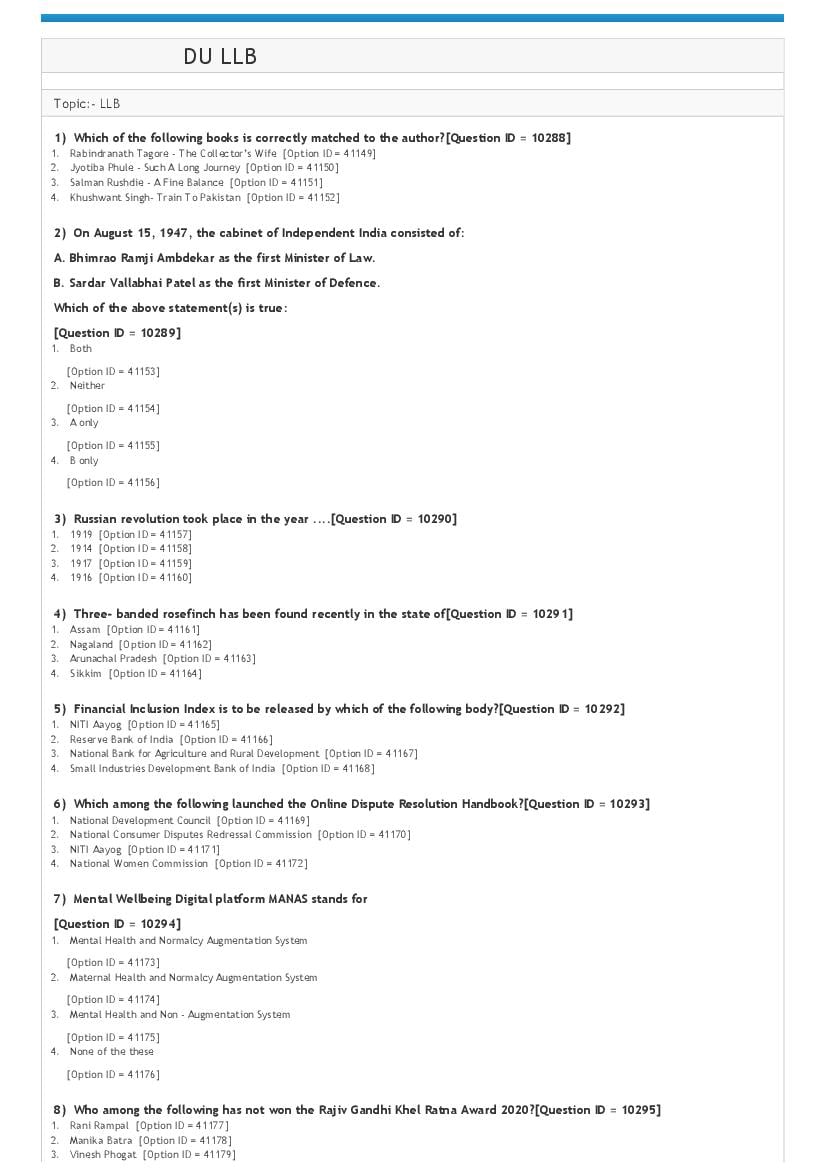
Topic:‐ LLB
1) Which of the following books is correctly matched to the author?[Question ID = 10288]
1. Rabindranath Tagore ‐ The Collector’s Wife [Option ID = 41149]
2. Jyotiba Phule ‐ Such A Long Journey [Option ID = 41150]
3. Salman Rushdie ‐ A Fine Balance [Option ID = 41151]
4. Khushwant Singh‐ Train To Pakistan [Option ID = 41152]
2) On August 15, 1947, the cabinet of Independent India consisted of:
A. Bhimrao Ramji Ambdekar as the first Minister of Law.
B. Sardar Vallabhai Patel as the first Minister of Defence.
Which of the above statement(s) is true:
[Question ID = 10289]
1. Both
[Option ID = 41153]
2. Neither
[Option ID = 41154]
3. A only
[Option ID = 41155]
4. B only
[Option ID = 41156]
3) Russian revolution took place in the year ....[Question ID = 10290]
1. 1919 [Option ID = 41157]
2. 1914 [Option ID = 41158]
3. 1917 [Option ID = 41159]
4. 1916 [Option ID = 41160]
4) Three‐ banded rosefinch has been found recently in the state of[Question ID = 10291]
1. Assam [Option ID = 41161]
2. Nagaland [Option ID = 41162]
3. Arunachal Pradesh [Option ID = 41163]
4. Sikkim [Option ID = 41164]
5) Financial Inclusion Index is to be released by which of the following body?[Question ID = 10292]
1. NITI Aayog [Option ID = 41165]
2. Reserve Bank of India [Option ID = 41166]
3. National Bank for Agriculture and Rural Development [Option ID = 41167]
4. Small Industries Development Bank of India [Option ID = 41168]
6) Which among the following launched the Online Dispute Resolution Handbook?[Question ID = 10293]
1. National Development Council [Option ID = 41169]
2. National Consumer Disputes Redressal Commission [Option ID = 41170]
3. NITI Aayog [Option ID = 41171]
4. National Women Commission [Option ID = 41172]
7) Mental Wellbeing Digital platform MANAS stands for
[Question ID = 10294]
1. Mental Health and Normalcy Augmentation System
[Option ID = 41173]
2. Maternal Health and Normalcy Augmentation System
[Option ID = 41174]
3. Mental Health and Non ‐ Augmentation System
[Option ID = 41175]
4. None of the these
[Option ID = 41176]
8) Who among the following has not won the Rajiv Gandhi Khel Ratna Award 2020?[Question ID = 10295]
1. Rani Rampal [Option ID = 41177]
2. Manika Batra [Option ID = 41178]
3. Vinesh Phogat [Option ID = 41179]
Page 2
9) Who among the following has not won the Arjuna Award 2020?[Question ID = 10296]
1. Dutee Chand [Option ID = 41181]
2. Ishant Sharma [Option ID = 41182]
3. Aditi Ashok [Option ID = 41183]
4. Virat Kohli [Option ID = 41184]
10) Which of the following is correctly matched?[Question ID = 10297]
1. Mizoram ‐ Aizawl [Option ID = 41185]
2. Manipur‐ Itanagar [Option ID = 41186]
3. Sikkim‐Shillong [Option ID = 41187]
4. Meghalaya‐Kohima [Option ID = 41188]
11) ____________ is the classical dance form of Kerala.[Question ID = 10298]
1. Bharatanatyam [Option ID = 41189]
2. Sattriya [Option ID = 41190]
3. Kuchipudi [Option ID = 41191]
4. Kathakali [Option ID = 41192]
12) The words “except the State of Jammu and Kashmir” have been omitted in section 1 of the Indian Penal Code, 1860
by:[Question ID = 10299]
1. Jammu and Kashmir Reorganisation Act, 2019. [Option ID = 41193]
2. Jammu and Kashmir Reorganisation Act, 2018. [Option ID = 41194]
3. Jammu and Kashmir Organisation Act, 2019. [Option ID = 41195]
4. Jammu and Kashmir Organisation Act, 2018. [Option ID = 41196]
13) X goes to a shop for buying an item costing 10 Rs. X gives a 10 Rs. coin to the shopkeeper, but the shopkeeper refuses
to sell the item as he does not accept the 10 Rs. coin, arguing that Rs. 10 coin is not accepted in his locality. What legal
option X has in this situation?[Question ID = 10300]
1. To file a case in the court against the Reserve Bank of India for circulating a coin which is refused by some [Option ID = 41197]
2. To file a police complaint against the shopkeeper for refusing a valid legal tender issued by the Reserve Bank of India [Option ID = 41198]
3. To file a Public Interest Litigation for declaring 10 Rs. coin as invalid [Option ID = 41199]
4. X has no legal option [Option ID = 41200]
14) A person who helps another person in the commission of an offence is a/an:[Question ID = 10301]
1. Abettor [Option ID = 41201]
2. Instigator [Option ID = 41202]
3. Accomplice [Option ID = 41203]
4. Friend [Option ID = 41204]
15) Principle: Whoever causes death by doing an act with the intention of causing death, or with the intention of causing
such bodily injury as is likely to cause death commits the offence of murder.
Facts: A, knowing that Z is labouring under such a disease that a blow is likely to cause his death, strikes him with the
intention of causing bodily injury. Z dies in consequence of the blow. A is liable for:
[Question ID = 10302]
1. Culpable homicide not amounting to murder as another person with same blow would not have died.
[Option ID = 41205]
2. Culpable homicide not amounting to murder as it was not certain the blow would kill Z.
[Option ID = 41206]
3. Culpable homicide amounting to murder as A had intention of causing such bodily injury that is likely to cause death of Z owing to his diesease.
[Option ID = 41207]
4. Culpable homicide amounting to murder as A had intention of causing Z's death.
[Option ID = 41208]
16) Who among the following has the power to issue an order under section 144 of the Criminal Procedure Code, 1973
(CrPC):[Question ID = 10303]
1. Commissioner of Police [Option ID = 41209]
2. Director General of Police [Option ID = 41210]
3. District Magistrate [Option ID = 41211]
4. Public Prosecutor [Option ID = 41212]
17) A puts jewels into a box belonging to Z, with the intention that they may be found in that box, and that this
circumstance may cause Z to be convicted of theft. A has committed the offence of:[Question ID = 10304]
1. Lying [Option ID = 41213]
2. Giving false evidence [Option ID = 41214]
3. Fabricating evidence [Option ID = 41215]
4. Cheating [Option ID = 41216]
18) Which among the following offence is committed when a person voluntarily obstructs another so as to prevent the
Page 3
1. Wrongful confinement [Option ID = 41217]
2. Criminal use of force [Option ID = 41218]
3. Wrongful restraint [Option ID = 41219]
4. Assault [Option ID = 41220]
19) Principle: Nothing is an offence by reason of any harm which it may cause to a person for whose benefit it is done in
good faith, even without that person's consent, if the circumstances are such that it is impossible for that person to signify
consent.
Facts: Z is carried off by a tiger. A fires at the tiger knowing it to be likely that the shot may kill Z, but not intending to kill
Z, and in good faith intending Z's benefit. A's ball gives Z a mortal wound.
A has committed:
[Question ID = 10306]
1. Offence as A's ball has given Z a mortal wound.
[Option ID = 41221]
2. Offence as he knew the shot may kill Z.
[Option ID = 41222]
3. Offence as A did not fire for the benefit of Z.
[Option ID = 41223]
4. No offence as A fired at the tiger in good faith for the benfit of Z and did not intend to kill Z.
[Option ID = 41224]
20) In all robbery there is:[Question ID = 10307]
1. Only Extortion [Option ID = 41225]
2. Either theft or extortion [Option ID = 41226]
3. Only Theft [Option ID = 41227]
4. Both theft and extortion [Option ID = 41228]
21) Who chaired the First Law Commission that prepared the first draft of the Indian Penal Code?[Question ID = 10308]
1. Warren Hastings [Option ID = 41229]
2. Thomas Macaulay [Option ID = 41230]
3. William Bentinck [Option ID = 41231]
4. Charles Hardinge [Option ID = 41232]
22) Criminal Procedure falls under which of the following lists of the Indian Constitution?[Question ID = 10309]
1. State List [Option ID = 41233]
2. Union List [Option ID = 41234]
3. Concurrent List [Option ID = 41235]
4. List of States [Option ID = 41236]
23) Principle: Whoever, intending to take dishonestly any movable property out of the possession of any person without
that person's consent, moves that property in order to such taking, is said to commit theft.
Facts: A sees a ring belonging to Z lying on a table in Z's house. Not venturing to misappropriate the ring immediately for
fear of search and detection, A hides the ring in a place where it is highly improbable that it will ever be found by Z, with
the intention of taking the ring from the hiding place and selling it when the loss is forgotten.
A has committed:
[Question ID = 10310]
1. Theft at the time of first moving the ring
[Option ID = 41237]
2. Theft at the time when he comes back to take the ring
[Option ID = 41238]
3. No offence
[Option ID = 41239]
4. Criminal misappropriation
[Option ID = 41240]
24) How many places of sitting the National Green Tribunal has?[Question ID = 10311]
1. One [Option ID = 41241]
2. Three [Option ID = 41242]
3. Four [Option ID = 41243]
4. Five [Option ID = 41244]
25) The World Commission on Environment and Development in its report titled ………….defined sustainable development as
‘development that meets the needs of the present without compromising the ability of future generations to meet their
own needs’. Choose the correct answer from options below.[Question ID = 10312]
1. Brundtland Report [Option ID = 41245]
Page 4
3. Agenda 21 [Option ID = 41247]
4. Caring For the Earth: A Strategy for Sustainable Living [Option ID = 41248]
26) What is the main objective of the United Nations Framework Convention on Climate Change (UNFCCC)?[Question ID =
10313]
1. Decrease of oxygen [Option ID = 41249]
2. Stabilisation of greenhouse gases [Option ID = 41250]
3. Increase of greenhouse gases [Option ID = 41251]
4. Increase of temperature [Option ID = 41252]
27) World Environmental Day is celebrated on[Question ID = 10314]
1. December 10 [Option ID = 41253]
2. April 30 [Option ID = 41254]
3. June 5 [Option ID = 41255]
4. August 15 [Option ID = 41256]
28) Advocate M.C. Mehta is known in the context of…[Question ID = 10315]
1. Public interest environmental litigations [Option ID = 41257]
2. Challenging the election of former Prime Minister Mrs Indira Gandhi [Option ID = 41258]
3. Challenging the Aadhaar project [Option ID = 41259]
4. Challenging the law that prohibited entry of women to Sabarimala temple in Kerala [Option ID = 41260]
29) Noise pollution was included in the Air (Prevention and Control of Pollution) Act, 1981 as pollution in the year…..
[Question ID = 10316]
1. 1981 [Option ID = 41261]
2. 1987 [Option ID = 41262]
3. 1982 [Option ID = 41263]
4. 2000 [Option ID = 41264]
30) A person sold a watch for Rs 1520 and thereby losses 5%. In order to gain 10% she has to sell the watch for…[Question
ID = 10317]
1. Rs. 1660 [Option ID = 41265]
2. Rs. 1760 [Option ID = 41266]
3. Rs. 1600 [Option ID = 41267]
4. Rs. 1680 [Option ID = 41268]
31) B is to the North of A, C is to the East of A, E is to the south of C, and D is to the West of A. Then, what is the position
of D in relation to C?[Question ID = 10318]
1. South [Option ID = 41269]
2. South‐West [Option ID = 41270]
3. South‐East [Option ID = 41271]
4. West [Option ID = 41272]
32) Of the three numbers, the first is half of the second and twice the third. The average of these numbers is 42. The
smallest of these numbers is[Question ID = 10319]
1. 36 [Option ID = 41273]
2. 18 [Option ID = 41274]
3. 12 [Option ID = 41275]
4. 24 [Option ID = 41276]
33) Four members have to be nominated to a Committee and there are six candidates, A, B, C, D, E and F. The following
conditions apply:
A. If A is nominated, then D does not find any place
B. If B is nominated, then either E or F has to be nominated, but not both
C. If C is nominated, then both D and B have to be nominated.
Which one of the following is an acceptable combination?
[Question ID = 10320]
1. A, B, C and E
[Option ID = 41277]
2. A, B, C and D
[Option ID = 41278]
3. B, C, E and F
[Option ID = 41279]
4. B, C, D and F
[Option ID = 41280]
34) What is the next number in this sequence? 1, 3, 9, 23, 53,
Page 5
1. 100
[Option ID = 41281]
2. 115
[Option ID = 41282]
3. 155
[Option ID = 41283]
4. 125
[Option ID = 41284]
35) What is the next number in this sequence? 1,1,2,3,5,8,?[Question ID = 10322]
1. 12 [Option ID = 41285]
2. 13 [Option ID = 41286]
3. 15 [Option ID = 41287]
4. 14 [Option ID = 41288]
36) “Only the party who has suffered damage or injury can approach the court of law”.
The above rule is based on the principle of –
[Question ID = 10323]
1. Locus standi
[Option ID = 41289]
2. Modus operandi
[Option ID = 41290]
3. Quid pro quo
[Option ID = 41291]
4. Status quo
[Option ID = 41292]
37) Which of the following is not a Directive Principle of State Policy in the Constitution of India?
[Question ID = 10324]
1. Organization of village panchayats
[Option ID = 41293]
2. Equal pay for equal work for both men and women
[Option ID = 41294]
3. To develop the scientific temper, humanism and the spirit of enquiry and reform
[Option ID = 41295]
4. Protection of monuments and places and objects of national importance
[Option ID = 41296]
38) Remedy of restitution of conjugal rights is available under the Hindu Marriage Act, 1955 to:[Question ID = 10325]
1. Husband only [Option ID = 41297]
2. Wife only [Option ID = 41298]
3. Both wife and husband [Option ID = 41299]
4. Divorced wife only [Option ID = 41300]
39) Geeta is a Jain and Shyam is a Hindu. Their marriage can be solemnized under:[Question ID = 10326]
1. Special Marriage Act, 1954 [Option ID = 41301]
2. Hindu Marriage Act, 1955 [Option ID = 41302]
3. Either 1 or 2 [Option ID = 41303]
4. Neither 1 nor 2. [Option ID = 41304]
40) Which one of the following is not a source of Muslim Law?[Question ID = 10327]
1. Quran [Option ID = 41305]
2. Sunnat [Option ID = 41306]
3. Shruti [Option ID = 41307]
4. Ijma [Option ID = 41308]
41) In which of the following cases has the Supreme Court of India made it mandatory for candidates contesting elections to
the legislatures and their spouses to declare their source of income at the time of filing nominations?[Question ID = 10328]
1. Lok Prahari v. Union of India [Option ID = 41309]
2. Jan Chaukidar v. Union of India [Option ID = 41310]
3. People's Union for Democratic Rights v Union of India [Option ID = 41311]
4. People’s Union for Civil Liberties v. Union of India [Option ID = 41312]
42) In which of the following cases did the Supreme Court of India hold that seeking votes in the name of voters’ religion
amounts to a corrupt practice?[Question ID = 10329]
Page 6
2. Prabhakaran v. Jayarajan [Option ID = 41314]
3. Lily Thomas v. Union of India [Option ID = 41315]
4. S. Subramaniam Balaji v. Govt.of Tamil Nadu [Option ID = 41316]
43) Consider the following and identify the correct statement(s).
A. A President of India is not eligible for re‐election
B. Lok Sabha is the Upper House of Parliament
C. Total number of High Courts in India at present is 25
D. There is no constitutional provision for Deputy Prime‐Minister in the Constitution of India
Choose the correct option(s) from the options given below
[Question ID = 10330]
1. A and B only
[Option ID = 41317]
2. B and C only
[Option ID = 41318]
3. C and D only
[Option ID = 41319]
4. D only
[Option ID = 41320]
44) The question regarding disqualification of the Speaker of the Lok Sabha under the X Schedule of the Constitution of
India is referred for the decision to:[Question ID = 10331]
1. Deputy Chairperson of the Rajya Sabha [Option ID = 41321]
2. Deputy Speaker of the Lok Sabha [Option ID = 41322]
3. The President of India [Option ID = 41323]
4. A member elected for this purpose by the Lok Sabha [Option ID = 41324]
45) The electoral college that elects the President of India comprises of:[Question ID = 10332]
1. All members of both the Houses of Parliament [Option ID = 41325]
2. Elected members of both the Houses of Parliament and of State Legislative Assemblies of the states [Option ID = 41326]
3. All members of both Houses of Parliament and State Legislative Assemblies [Option ID = 41327]
4. All members of both Houses of Parliament and State Legislative Assemblies and Councils [Option ID = 41328]
46) The usual process of a valid Agreement includes of different stages:
A. Acceptance
B. Agreement
C. Consideration
D. Offer
Arrange the above in sequence and choose the correct answer from the options given below
[Question ID = 10333]
1. D, C, A, B
[Option ID = 41329]
2. D, B, A, C
[Option ID = 41330]
3. D, A, C, B
[Option ID = 41331]
4. D, B, C, A
[Option ID = 41332]
47) From whom is an offer addressed to when a product is kept on the shelf of a shop with a price tag attached?[Question
ID = 10334]
1. Shopkeeper [Option ID = 41333]
2. Shop Attendant [Option ID = 41334]
3. Manufacturer [Option ID = 41335]
4. Customer [Option ID = 41336]
48) Legal Principle: Any contract made for an unlawful consideration is void in law.
Facts: Mr. X agrees to pay Rs 1000/‐ to Mr. Z for giving false evidence in the Court.
Choose the correct answer:
[Question ID = 10335]
Page 7
[Option ID = 41337]
2. The contract is void due to unlawful consideration.
[Option ID = 41338]
3. The contract is valid and Mr. Z must perform it.
[Option ID = 41339]
4. The contract is voidable at the option of Mr. X.
[Option ID = 41340]
49) The active concealment of the facts while entering into a contract is considered:
[Question ID = 10336]
1. Mistake
[Option ID = 41341]
2. Misrepresentation
[Option ID = 41342]
3. Fraud
[Option ID = 41343]
4. Coercion
[Option ID = 41344]
50) Mr. X entered into contract with A to deliver 10 kgs of mangoes to Mr. A on 20th July. On 18th July, Mr.X refused to
perform the contract. This is an instance of:[Question ID = 10337]
1. Abandonment of contract [Option ID = 41345]
2. Remission of contract [Option ID = 41346]
3. Breach of contract [Option ID = 41347]
4. Anticipatory breach of contract [Option ID = 41348]
51) The subsequent changes made in the nature of contract is known as:[Question ID = 10338]
1. Novation [Option ID = 41349]
2. Alteration [Option ID = 41350]
3. Rescission [Option ID = 41351]
4. Repudiation [Option ID = 41352]
52) If a company enters into a contract beyond the scope of its object, it becomes:[Question ID = 10339]
1. Intra vires [Option ID = 41353]
2. Infra vires [Option ID = 41354]
3. Ultra vires [Option ID = 41355]
4. Ultimo vires [Option ID = 41356]
53) Which among the following is entitled to be protected through copyright?[Question ID = 10340]
1. Facts [Option ID = 41357]
2. Ideas [Option ID = 41358]
3. Expressions [Option ID = 41359]
4. Methods of operation [Option ID = 41360]
54) The maximum term of protection for a literary work of an individual author under the Copyright Act, 1957 is[Question
ID = 10341]
1. 60 years [Option ID = 41361]
2. Lifetime of the author plus 60 years [Option ID = 41362]
3. Lifetime of the author plus 70 years [Option ID = 41363]
4. 20 years [Option ID = 41364]
55) An invention is protected by[Question ID = 10342]
1. Copyright [Option ID = 41365]
2. Trademark [Option ID = 41366]
3. Industrial design [Option ID = 41367]
4. Patent [Option ID = 41368]
56) Consider the following statements about Intellectual Property (IP) and identify correct statement(s).
A. IP refers to the creations of the mind such as inventions, literary, artistic works
B. IP includes patents and copyright
C. IP does not include trademarks
D. IP does not include industrial designs
Choose the correct answer from the options given below:
[Question ID = 10343]
1. A and C only
Page 8
2. B and D only
[Option ID = 41370]
3. A only
[Option ID = 41371]
4. A and B only
[Option ID = 41372]
57) Match List I with List II
List I List II
A. Albert Einstein I. Television
B. Alexander Fleming II. Theory of Relativity
C. Charles Darwin III. Penicillin
D. John Logie Baird IV. Theory of Evolution
Choose the correct answer from the options given below:
[Question ID = 10344]
1. A ‐ II, B ‐ III, C ‐ IV, D ‐ I [Option ID = 41373]
2. A ‐ II, B ‐ IV, C ‐ I, D ‐ III [Option ID = 41374]
3. A ‐ II, B ‐ I, C ‐ IV, D ‐ III [Option ID = 41375]
4. A ‐ II, B ‐ IV, C ‐ III, D ‐ I [Option ID = 41376]
58) Given below are two statements, one is labelled as Assertion A and the other is labelled as Reason R
Assertion A : The writing material of a pencil is generally made up of Graphite.
Reason R : Graphite is a good conductor of electricity.
In light of the above statements, choose the correct answer from the options given below
[Question ID = 10345]
1. Both A and R are true and R is the correct explanation of A
[Option ID = 41377]
2. Both A and R are true but R is NOT the correct explanation of A
[Option ID = 41378]
3. A is true but R is false
[Option ID = 41379]
4. A is false but R is true
[Option ID = 41380]
59) Who among the following is called the “Father of Artificial Intelligence”?[Question ID = 10346]
1. John McCarthy [Option ID = 41381]
2. Charles Babbage [Option ID = 41382]
3. John Brunner [Option ID = 41383]
4. JP Eckert [Option ID = 41384]
60) Histology is the study of[Question ID = 10347]
1. Fungi [Option ID = 41385]
2. Bones [Option ID = 41386]
3. Tissue [Option ID = 41387]
4. Virus [Option ID = 41388]
61) Read the statements and choose the correct answer from the options given below:
A. The chemical name of baking soda is Sodium Carbonate.
B. Baking soda forms alkaline solution with water.
Which of the above statements are true:
[Question ID = 10348]
1. Both are true
[Option ID = 41389]
2. Neither is true
[Option ID = 41390]
3. Only A is true
[Option ID = 41391]
4. Only B is true
[Option ID = 41392]
62) Choose the correctly matched option given below[Question ID = 10349]
Page 9
2. The Nobel Prize in Physiology or Medicine 2020: Alvin E. Roth and Lloyd S. Shapley [Option ID = 41394]
3. The Sveriges Riksbank Prize in Economic Sciences 2020: Paul R. Milgrom and Robert B. Wilson [Option ID = 41395]
4. Nobel Prize in Physics 2020 : Abhijit Banerjee and Esther Duflo [Option ID = 41396]
63) The Finance Minister presented the Government of India’s Budget for the year 2021‐2022 in the Parliament on:
[Question ID = 10350]
1. 1 January 2021 [Option ID = 41397]
2. 1 February 2021 [Option ID = 41398]
3. 1 March 2021 [Option ID = 41399]
4. 31 March 2021 [Option ID = 41400]
64) Nora‐al‐ Matroushi is the first female_______ from ______. Choose the correct answer from the options below:
[Question ID = 10351]
1. Astronaut, Bangladesh [Option ID = 41401]
2. Astronaut, UAE [Option ID = 41402]
3. Lawyer, Iran [Option ID = 41403]
4. Lawyer, Israel [Option ID = 41404]
65) Read the statements and choose the correct answer from the options given below. A. The Chairperson of the NITI
Aayog is the Prime Minister of India. B. Minister of Defence is an ex‐officio member of NITI Aayog. Which of the above
statements are true:[Question ID = 10352]
1. Both are true [Option ID = 41405]
2. Neither is true [Option ID = 41406]
3. Only A [Option ID = 41407]
4. Only B [Option ID = 41408]
66) Office of Economic Adviser (OEA) is an attached office of the:[Question ID = 10353]
1. Department of Economic Affairs, Ministry of Finance, Government of India [Option ID = 41409]
2. Department of Expenditure, Ministry of Finance, Government of India [Option ID = 41410]
3. Department of Commerce, Ministry of Commerce & Industry, Government of India [Option ID = 41411]
4. Department for Promotion of Industry and Internal Trade, Ministry of Commerce & Industry, Government of India [Option ID = 41412]
67) Which among the following is the apex body responsible for implementing India’s flagship public health
insurance/assurance scheme called “Ayushman Bharat Pradhan Mantri Jan Arogya Yojana”?[Question ID = 10354]
1. All India Institute of Medical Sciences [Option ID = 41413]
2. Health department of different states [Option ID = 41414]
3. National Health Authority [Option ID = 41415]
4. National Health Mission [Option ID = 41416]
68) The Nobel Peace Prize for 2020 was awarded to………….[Question ID = 10355]
1. World Health Organisation [Option ID = 41417]
2. World Food Programme [Option ID = 41418]
3. United Nations Development Programme [Option ID = 41419]
4. United Nations Environment Programme [Option ID = 41420]
69) The Nobel Prize in Physiology or Medicine is awarded by…………..[Question ID = 10356]
1. The Nobel Assembly at Karolinska Institutet, Stockholm, Sweden [Option ID = 41421]
2. The Royal Swedish Academy of Sciences, Stockholm, Sweden [Option ID = 41422]
3. The Swedish Academy, Stockholm, Sweden [Option ID = 41423]
4. The Committee of the Norwegian Parliament [Option ID = 41424]
70) Read the statements and choose the correct answer from the options given below.
A. Kangana Ranaut won the best female actor award as per the National Film Awards 2020.
B. She was awarded the National Film Award for her work in Manikarnika and Judgementall Hai Kya.
Which of the above statements are true:
[Question ID = 10357]
1. Both A and B are true
[Option ID = 41425]
2. Neither A nor B is true
[Option ID = 41426]
3. Only A is true
[Option ID = 41427]
4. Only B is true
[Option ID = 41428]
71) Given below are three statements
Statement I: India is a federal polity
Page 10
Statement III: Federalism implies horizontal distribution of power between the executive, legislature and the judiciary
In light of the above statements, choose the correct answer from the options given below
[Question ID = 10358]
1. Statement I is true
[Option ID = 41429]
2. Statements II and III are true
[Option ID = 41430]
3. Statements I and II are true
[Option ID = 41431]
4. Statements I, II and III are true
[Option ID = 41432]
72) Read the following statement(s) in the context of the ‘Socially and Educationally Backward Classes Act, 2018’ [The Act]
passed by the Maharashtra legislature:
Statement I: The Act has been challenged on the ground that it violates the maximum limit of 50 percent imposed on
reservations
Statement II: The limit of 50 percent on reservation is expressly mentioned in the text of the Article 16 of the Constitution
of India, 1950
Statement III: According to the Supreme Court judgment of Indra Sawhney v Union of India (1992), the State governments
can provide reservation beyond 50 percent in ‘exceptional circumstances’.
Statement IV: The limit of 50 percent on reservation is not mentioned expressly in the text of Article 16 of the Constitution
of India, 1950
Which of the above‐mentioned statement(s) is correct:
[Question ID = 10359]
1. I and II only
[Option ID = 41433]
2. II, III and IV only
[Option ID = 41434]
3. I, III and IV only
[Option ID = 41435]
4. III and IV only
[Option ID = 41436]
73) Which of the following principles can be located in the Constitution of India?
A. Separation of Power
B. Federalism
C. Parliamentary Sovereignty
D. Secularism
Choose the correct answer from the options given below:
[Question ID = 10360]
1. A, B and D only
[Option ID = 41437]
2. A, B and C only
[Option ID = 41438]
3. B, C and D only
[Option ID = 41439]
4. C and D only
[Option ID = 41440]
74) According to the text of Articles 19(1)(a) and 19(2) of the Constitution of India, 1950, the State can make laws to
restrict freedom of speech and expression on which of the following ground(s):
A. Hate Speech
B. Contempt of Court
C. Defamation
D. Decency or morality
Page 11
[Question ID = 10361]
1. A, B and C only
[Option ID = 41441]
2. A, B and D only
[Option ID = 41442]
3. B and D only
[Option ID = 41443]
4. B, C and D only
[Option ID = 41444]
75) Under the Citizenship (Amendment) Act, 2019, persons belonging to Hindu, Sikh, Buddhist, Jain, Parsi or Christian
community from certain specified countries are not be treated as illegal migrants. Which are those countries?
A. Afghanistan
B. Bangladesh
C. Pakistan
D. Myanmar
Choose the correct answer from the options given below:
[Question ID = 10362]
1. C only
[Option ID = 41445]
2. B and C only
[Option ID = 41446]
3. A, B and C only
[Option ID = 41447]
4. A, B, C and D
[Option ID = 41448]
76) Which of the following statement(s) is not true about the role and status of the Governor in India?
A. The Governor is elected by the State Legislature
B. The Governor is appointed by the President of India
C. A person who has completed the age of thirty years can be a Governor.
D. The same person cannot be appointed as the Governor of two or more states
Choose the correct answer from the options given below:
[Question ID = 10363]
1. A, B and D only
[Option ID = 41449]
2. A and D only
[Option ID = 41450]
3. A, C and D only
[Option ID = 41451]
4. A and C only
[Option ID = 41452]
77) Which among the following states does not have veto power in the United Nations Security Council?[Question ID =
10369]
1. The United States of America [Option ID = 41473]
2. Germany [Option ID = 41474]
3. Russia [Option ID = 41475]
4. The United Kingdom [Option ID = 41476]
78) Which International organization is hearing the case of Gambia v. Myanmar commonly referred to as the Rohingya
Genocide case?
[Question ID = 10370]
1. African Court on Human and Peoples' Rights
[Option ID = 41477]
2. International Court of Justice
[Option ID = 41478]
3. International Criminal Court
Page 12
4. United Nations High Commissioner for Refugees
[Option ID = 41480]
79) Which of the following countries has not signed the statute of the International Criminal Court?[Question ID = 10371]
1. Germany [Option ID = 41481]
2. Brazil [Option ID = 41482]
3. Australia [Option ID = 41483]
4. China [Option ID = 41484]
80) The World Health Organization (WHO) headquarters is situated in...[Question ID = 10372]
1. Paris [Option ID = 41485]
2. Geneva [Option ID = 41486]
3. The Hague [Option ID = 41487]
4. Washington DC [Option ID = 41488]
81) Which of the following countries is not a member of the South Asian Association for Regional Cooperation (SAARC) ?
[Question ID = 10373]
1. Bhutan [Option ID = 41489]
2. Bangladesh [Option ID = 41490]
3. Myanmar [Option ID = 41491]
4. Afghanistan [Option ID = 41492]
82) Which of the following alliance is created to provide collective security?[Question ID = 10374]
1. ASEAN [Option ID = 41493]
2. NATO [Option ID = 41494]
3. SAARC [Option ID = 41495]
4. NAFTA [Option ID = 41496]
83) Which organ of the United Nations has accomplished its mandate and ceased to be operational?[Question ID = 10375]
1. Trusteeship Council [Option ID = 41497]
2. General Assembly [Option ID = 41498]
3. International Court of Justice [Option ID = 41499]
4. Economic and Social Council [Option ID = 41500]
84) The recent Supreme Court judgment Nitisha v Union of India (2021) of India held that:[Question ID = 10376]
1. The Hindu Succession Act, 1956 discriminated between men and women [Option ID = 41501]
2. Denial of entry in religious places to women violated right to equality [Option ID = 41502]
3. The Indian Army’s policy on the Grant of Permanent Commission to women violated right to equality [Option ID = 41503]
4. The offence of adultery under the Indian Penal Code, 1860 violates the right to equality [Option ID = 41504]
85) Who was the first chief justice of the Supreme Court of India?[Question ID = 10377]
1. H.J. Kania [Option ID = 41505]
2. M. Patanjali Sastri [Option ID = 41506]
3. Mehr Chand Mahajan [Option ID = 41507]
4. Bijan Kumar Mukherjea [Option ID = 41508]
86) Who among the following was the shortest serving chief justice of the Supreme Court of India?[Question ID = 10378]
1. Kamal Narain Singh [Option ID = 41509]
2. Madhukar Hiralal Kania [Option ID = 41510]
3. Lalit Mohan Sharma [Option ID = 41511]
4. Mohammad Hidayatullah [Option ID = 41512]
87) Which among the following schedules of the Constitution of India deals with the distribution of legislative power
between the Parliament and state legislatures?[Question ID = 10379]
1. Schedule I [Option ID = 41513]
2. Schedule III [Option ID = 41514]
3. Schedule V [Option ID = 41515]
4. Schedule VII [Option ID = 41516]
88) Article 1 of the Constitution of India defines India as:[Question ID = 10380]
1. Federal State [Option ID = 41517]
2. Unitary State [Option ID = 41518]
3. Union of States [Option ID = 41519]
4. Quasi‐Federal State [Option ID = 41520]
89) Which among the following is related to the issuing of first compulsory licensing on pharmaceutical patent in India?
[Question ID = 10381]
1. Bayer v. Natco [Option ID = 41521]
2. Novartis v. Union of India & Others [Option ID = 41522]
3. Novartis v. Cipla [Option ID = 41523]
4. Merk v. Glenmark [Option ID = 41524]
Page 13
1. It is a civil wrong [Option ID = 41525]
2. It is only a wrong against individual [Option ID = 41526]
3. There must be a wrongful act [Option ID = 41527]
4. It is mainly developed from common law principles [Option ID = 41528]
91) Which of the following statements is not true?[Question ID = 10383]
1. Duty under tort is fixed by law [Option ID = 41529]
2. Duty under tort is a moral duty [Option ID = 41530]
3. Duty under tort is not fixed by the parties [Option ID = 41531]
4. Duty under tort is towards the whole world [Option ID = 41532]
92) Ms. Shilpa Sheg separated from Mr. Arun Sheg through a decree of divorce. Then after she married to Mr. Kunal Vesth
but continued with ‘Sheg’ title of her earlier husband without any malice. Mr. Arun Sheg filed a suit for removal of ‘Sheg’
title from the name of Ms. Shilpa Sheg. Continuing the ‘Sheg’ title by Ms. Shilpa is ...[Question ID = 10384]
1. a tort because it is a violation of the right of Mr. Arun [Option ID = 41533]
2. not a tort because it is not a violation of the right of Mr. Arun [Option ID = 41534]
3. a tort because it is a violation of duty by Ms. Shilpa [Option ID = 41535]
4. a crime [Option ID = 41536]
93) Mr. A lets out his crane and driver to Mr. B for carrying B’s business under a contract providing that the driver shall be
the servant of Mr. B. The crane driver by his negligence injured a person walking on the road. Who will be liable for the
negligence of the driver?[Question ID = 10385]
1. Mr. A [Option ID = 41537]
2. Mr. B [Option ID = 41538]
3. Both Mr A and B [Option ID = 41539]
4. Only the Driver [Option ID = 41540]
94) The enforcement of which of the following Fundamental Rights guaranteed by the Constitution of India, 1950, cannot
be suspended due to the Proclamation of Emergency on account of war or external aggression?[Question ID = 10386]
1. Right to freedom of speech and expression [Option ID = 41541]
2. Right to life and personal liberty [Option ID = 41542]
3. Right to religion [Option ID = 41543]
4. Right to equality [Option ID = 41544]
95) Which of the following rights are a part of freedom of speech and expression guaranteed by the Constitution of India,
1950?
A. Exercise of freedom of speech and expression through the medium of internet
B. Right to information
C. Right to broadcast
D. Right to remain silent
In light of the above statements, choose the correct answer from the options given below
[Question ID = 10387]
1. A, B and C only
[Option ID = 41545]
2. B, C and D only
[Option ID = 41546]
3. A, B and D only
[Option ID = 41547]
4. A, B, C and D
[Option ID = 41548]
Topic:‐ LLB B
1) In short, to give life “is to frame and make a living creature, fashion the parts, and mould and suit them to their uses;
and having proportioned and fitted them together, to put into them a living soul.” Parents do not fashion the child and most
commonly, do not even intend to create it; they do so as a by‐product of the instinctive desires God has placed in them. In
response to Filmer’s claims, Locke states, “They who say the father gives life to children, are so dazzled with the thoughts
of monarchy, that they do not, as they ought, remember God, who is ‘the Author and Giver of Life.” Parents have fiduciary
responsibility for their children on Locke’s account, but it expires upon their maturity. Parents are obliged to provide for
their children ‘‘not as their own workmanship, but the workmanship of their own maker.”
This is why Locke insists that although children are not born in a “state of equality, though they are born to it.” Adults have
“a sort of rule and jurisdiction over them when they come into the world, and for some time after; but it is a temporary
one.” The bonds of children’s subjection “are like the Swadling Cloths they are wrapt up in, and supported by, in the
weakness of their Infancy.” Developing age and reason loosen these bonds, “till at length they drop quite off, and leave a
man at his own free disposal.” The power to command ‘‘ends with nonage.” Thereafter, although ‘‘honour and respect,
Page 14
always due from a son to his parents; yet all this puts no sceptre into the father’s hand, no sovereign power of
commanding.” The only legitimate sanction at the parent’s disposal is the power to withhold inheritance, or “to bestow it
with a more sparing or liberal hand, according as the behaviour of this or that child hath comported with his will and
humor.” Parents are to “inform the mind, and govern the actions of their yet ignorant nonage, till reason shall take its
place, and ease them of that trouble.” This treatment of children reflects an inclusive view of the right to make decisions
for oneself: the only justifiable basis for paternalism is incapacity.
One reason that Locke’s view of moral equality has had staying power since he wrote is that the obvious secular analogue of
his claim that we are all God’s property is that we are nobody’s property. The workmanship model persisted in the western
intellectual consciousness long after it was cut loose from its Lockean theological moorings. If we abandon the theology yet
still embrace the workmanship ideal as most in the Enlightenment tradition since Locke—be they conservatives, liberals, or
radicals—have done, the logic of his argument against Filmer continues to hold. Indeed, it can be extended: parents cannot
own children because they do not make them, but by the same token nor can anyone else own them. In this way the
egalitarian logic of his argument against Filmer extends beyond their theological disagreements.
According to Locke, who is the creator of life?
[Question ID = 10464]
1. Parents
[Option ID = 41853]
2. Mother
[Option ID = 41854]
3. Monarch
[Option ID = 41855]
4. God
[Option ID = 41856]
2) In short, to give life “is to frame and make a living creature, fashion the parts, and mould and suit them to their uses;
and having proportioned and fitted them together, to put into them a living soul.” Parents do not fashion the child and most
commonly, do not even intend to create it; they do so as a by‐product of the instinctive desires God has placed in them. In
response to Filmer’s claims, Locke states, “They who say the father gives life to children, are so dazzled with the thoughts
of monarchy, that they do not, as they ought, remember God, who is ‘the Author and Giver of Life.” Parents have fiduciary
responsibility for their children on Locke’s account, but it expires upon their maturity. Parents are obliged to provide for
their children ‘‘not as their own workmanship, but the workmanship of their own maker.”
This is why Locke insists that although children are not born in a “state of equality, though they are born to it.” Adults have
“a sort of rule and jurisdiction over them when they come into the world, and for some time after; but it is a temporary
one.” The bonds of children’s subjection “are like the Swadling Cloths they are wrapt up in, and supported by, in the
weakness of their Infancy.” Developing age and reason loosen these bonds, “till at length they drop quite off, and leave a
man at his own free disposal.” The power to command ‘‘ends with nonage.” Thereafter, although ‘‘honour and respect,
support and defense, and whatsoever gratitude can oblige a man to, for the highest benefits he is naturally capable of, be
always due from a son to his parents; yet all this puts no sceptre into the father’s hand, no sovereign power of
commanding.” The only legitimate sanction at the parent’s disposal is the power to withhold inheritance, or “to bestow it
with a more sparing or liberal hand, according as the behaviour of this or that child hath comported with his will and
humor.” Parents are to “inform the mind, and govern the actions of their yet ignorant nonage, till reason shall take its
place, and ease them of that trouble.” This treatment of children reflects an inclusive view of the right to make decisions
for oneself: the only justifiable basis for paternalism is incapacity.
One reason that Locke’s view of moral equality has had staying power since he wrote is that the obvious secular analogue of
his claim that we are all God’s property is that we are nobody’s property. The workmanship model persisted in the western
intellectual consciousness long after it was cut loose from its Lockean theological moorings. If we abandon the theology yet
still embrace the workmanship ideal as most in the Enlightenment tradition since Locke—be they conservatives, liberals, or
radicals—have done, the logic of his argument against Filmer continues to hold. Indeed, it can be extended: parents cannot
own children because they do not make them, but by the same token nor can anyone else own them. In this way the
egalitarian logic of his argument against Filmer extends beyond their theological disagreements.
Adult’s rule and jurisdiction over children…
A. Is temporary.
B. Is based on infancy of the child.
C. Never ends with nonage.
D. Can be justified as paternalism based on incapacity.
Choose the correct answer from the options given below:
[Question ID = 10465]
1. A, B, C and D
[Option ID = 41857]
2. A and B only
[Option ID = 41858]
Page 15
[Option ID = 41859]
4. A, B and D only
[Option ID = 41860]
3) In short, to give life “is to frame and make a living creature, fashion the parts, and mould and suit them to their uses;
and having proportioned and fitted them together, to put into them a living soul.” Parents do not fashion the child and most
commonly, do not even intend to create it; they do so as a by‐product of the instinctive desires God has placed in them. In
response to Filmer’s claims, Locke states, “They who say the father gives life to children, are so dazzled with the thoughts
of monarchy, that they do not, as they ought, remember God, who is ‘the Author and Giver of Life.” Parents have fiduciary
responsibility for their children on Locke’s account, but it expires upon their maturity. Parents are obliged to provide for
their children ‘‘not as their own workmanship, but the workmanship of their own maker.”
This is why Locke insists that although children are not born in a “state of equality, though they are born to it.” Adults have
“a sort of rule and jurisdiction over them when they come into the world, and for some time after; but it is a temporary
one.” The bonds of children’s subjection “are like the Swadling Cloths they are wrapt up in, and supported by, in the
weakness of their Infancy.” Developing age and reason loosen these bonds, “till at length they drop quite off, and leave a
man at his own free disposal.” The power to command ‘‘ends with nonage.” Thereafter, although ‘‘honour and respect,
support and defense, and whatsoever gratitude can oblige a man to, for the highest benefits he is naturally capable of, be
always due from a son to his parents; yet all this puts no sceptre into the father’s hand, no sovereign power of
commanding.” The only legitimate sanction at the parent’s disposal is the power to withhold inheritance, or “to bestow it
with a more sparing or liberal hand, according as the behaviour of this or that child hath comported with his will and
humor.” Parents are to “inform the mind, and govern the actions of their yet ignorant nonage, till reason shall take its
place, and ease them of that trouble.” This treatment of children reflects an inclusive view of the right to make decisions
for oneself: the only justifiable basis for paternalism is incapacity.
One reason that Locke’s view of moral equality has had staying power since he wrote is that the obvious secular analogue of
his claim that we are all God’s property is that we are nobody’s property. The workmanship model persisted in the western
intellectual consciousness long after it was cut loose from its Lockean theological moorings. If we abandon the theology yet
still embrace the workmanship ideal as most in the Enlightenment tradition since Locke—be they conservatives, liberals, or
radicals—have done, the logic of his argument against Filmer continues to hold. Indeed, it can be extended: parents cannot
own children because they do not make them, but by the same token nor can anyone else own them. In this way the
egalitarian logic of his argument against Filmer extends beyond their theological disagreements.
The reason that Locke’s theory has survived the test of time is…
A. That we all are God’s property.
B. That we all are nobody’s property.
C. That his theory was secular.
D. That his theory’s secular analogue is accepted by intellectuals.
Choose the correct answer from the options given below
[Question ID = 10466]
1. B and C only
[Option ID = 41861]
2. A and C only
[Option ID = 41862]
3. A, B and D only
[Option ID = 41863]
4. B and D only
[Option ID = 41864]
4) In short, to give life “is to frame and make a living creature, fashion the parts, and mould and suit them to their uses;
and having proportioned and fitted them together, to put into them a living soul.” Parents do not fashion the child and most
commonly, do not even intend to create it; they do so as a by‐product of the instinctive desires God has placed in them. In
response to Filmer’s claims, Locke states, “They who say the father gives life to children, are so dazzled with the thoughts
of monarchy, that they do not, as they ought, remember God, who is ‘the Author and Giver of Life.” Parents have fiduciary
responsibility for their children on Locke’s account, but it expires upon their maturity. Parents are obliged to provide for
their children ‘‘not as their own workmanship, but the workmanship of their own maker.”
This is why Locke insists that although children are not born in a “state of equality, though they are born to it.” Adults have
“a sort of rule and jurisdiction over them when they come into the world, and for some time after; but it is a temporary
one.” The bonds of children’s subjection “are like the Swadling Cloths they are wrapt up in, and supported by, in the
weakness of their Infancy.” Developing age and reason loosen these bonds, “till at length they drop quite off, and leave a
man at his own free disposal.” The power to command ‘‘ends with nonage.” Thereafter, although ‘‘honour and respect,
support and defense, and whatsoever gratitude can oblige a man to, for the highest benefits he is naturally capable of, be
always due from a son to his parents; yet all this puts no sceptre into the father’s hand, no sovereign power of
commanding.” The only legitimate sanction at the parent’s disposal is the power to withhold inheritance, or “to bestow it
Page 16
humor.” Parents are to “inform the mind, and govern the actions of their yet ignorant nonage, till reason shall take its
place, and ease them of that trouble.” This treatment of children reflects an inclusive view of the right to make decisions
for oneself: the only justifiable basis for paternalism is incapacity.
One reason that Locke’s view of moral equality has had staying power since he wrote is that the obvious secular analogue of
his claim that we are all God’s property is that we are nobody’s property. The workmanship model persisted in the western
intellectual consciousness long after it was cut loose from its Lockean theological moorings. If we abandon the theology yet
still embrace the workmanship ideal as most in the Enlightenment tradition since Locke—be they conservatives, liberals, or
radicals—have done, the logic of his argument against Filmer continues to hold. Indeed, it can be extended: parents cannot
own children because they do not make them, but by the same token nor can anyone else own them. In this way the
egalitarian logic of his argument against Filmer extends beyond their theological disagreements.
“Parents are to “inform the mind, and govern the actions of their yet ignorant nonage, till reason shall take its place, and
ease them of that trouble.” Who is having this trouble and what is the trouble?
A. Children, inability to make decisions
B. Parents, informing the child and governing their actions
C. God, fashioning a child
D. Locke, explaining the theory.
Choose the correct answer from the options given below
[Question ID = 10467]
1. D only
[Option ID = 41865]
2. C and D only
[Option ID = 41866]
3. A, B and C only
[Option ID = 41867]
4. B only
[Option ID = 41868]
5) In short, to give life “is to frame and make a living creature, fashion the parts, and mould and suit them to their uses;
and having proportioned and fitted them together, to put into them a living soul.” Parents do not fashion the child and most
commonly, do not even intend to create it; they do so as a by‐product of the instinctive desires God has placed in them. In
response to Filmer’s claims, Locke states, “They who say the father gives life to children, are so dazzled with the thoughts
of monarchy, that they do not, as they ought, remember God, who is ‘the Author and Giver of Life.” Parents have fiduciary
responsibility for their children on Locke’s account, but it expires upon their maturity. Parents are obliged to provide for
their children ‘‘not as their own workmanship, but the workmanship of their own maker.”
This is why Locke insists that although children are not born in a “state of equality, though they are born to it.” Adults have
“a sort of rule and jurisdiction over them when they come into the world, and for some time after; but it is a temporary
one.” The bonds of children’s subjection “are like the Swadling Cloths they are wrapt up in, and supported by, in the
weakness of their Infancy.” Developing age and reason loosen these bonds, “till at length they drop quite off, and leave a
man at his own free disposal.” The power to command ‘‘ends with nonage.” Thereafter, although ‘‘honour and respect,
support and defense, and whatsoever gratitude can oblige a man to, for the highest benefits he is naturally capable of, be
always due from a son to his parents; yet all this puts no sceptre into the father’s hand, no sovereign power of
commanding.” The only legitimate sanction at the parent’s disposal is the power to withhold inheritance, or “to bestow it
with a more sparing or liberal hand, according as the behaviour of this or that child hath comported with his will and
humor.” Parents are to “inform the mind, and govern the actions of their yet ignorant nonage, till reason shall take its
place, and ease them of that trouble.” This treatment of children reflects an inclusive view of the right to make decisions
for oneself: the only justifiable basis for paternalism is incapacity.
One reason that Locke’s view of moral equality has had staying power since he wrote is that the obvious secular analogue of
his claim that we are all God’s property is that we are nobody’s property. The workmanship model persisted in the western
intellectual consciousness long after it was cut loose from its Lockean theological moorings. If we abandon the theology yet
still embrace the workmanship ideal as most in the Enlightenment tradition since Locke—be they conservatives, liberals, or
radicals—have done, the logic of his argument against Filmer continues to hold. Indeed, it can be extended: parents cannot
own children because they do not make them, but by the same token nor can anyone else own them. In this way the
egalitarian logic of his argument against Filmer extends beyond their theological disagreements.
This passage can have its “Title” as…
[Question ID = 10468]
1. Child is the Father of Man
[Option ID = 41869]
2. Infancy of Child
[Option ID = 41870]
3. Theory of Moral Equality
Page 17
4. Filmer’s Theory
[Option ID = 41872]
Document Details
| Board / Org | NTA |
| Exam | DUET |
| Type | Question Paper |
| Pages | 17 |
| Language | english |
| Updated | 30 Apr 2026 |