Telangana Class 2 Syllabus Maths
Finished viewing? Save it for later —
Download Telangana Class 2 Syllabus Maths (PDF · 7 pages)About Telangana Class 2 Syllabus Maths
Telangana Class 2 Syllabus Maths is available here for free download. Published by Telangana Board for Class 2, this syllabus can be viewed online or downloaded as a PDF (7 pages). Candidates preparing for Class 2 can use Telangana Class 2 Syllabus Maths to understand the exam pattern, the type of questions asked, and the overall difficulty level.
Frequently Asked Questions
How can I download Telangana Class 2 Syllabus Maths?
Open this page and click the Download button to save Telangana Class 2 Syllabus Maths as a PDF. It is completely free on AglaSem Docs.
Is Telangana Class 2 Syllabus Maths free to download?
Yes. Telangana Class 2 Syllabus Maths can be viewed online and downloaded as a PDF free of cost on AglaSem Docs.
How many pages does Telangana Class 2 Syllabus Maths have?
Telangana Class 2 Syllabus Maths contains 7 pages, which you can read online or download together as a single PDF.
Where can I find more Class 2 study material?
You can find more Class 2 question papers, sample papers, syllabus, and answer keys on AglaSem Docs.
Telangana Class 2 Syllabus Maths – Text
Read the full text of this syllabus below — useful to quickly search, copy and reference the content online without downloading the PDF.
📄 View text version (7 pages)
Page 1
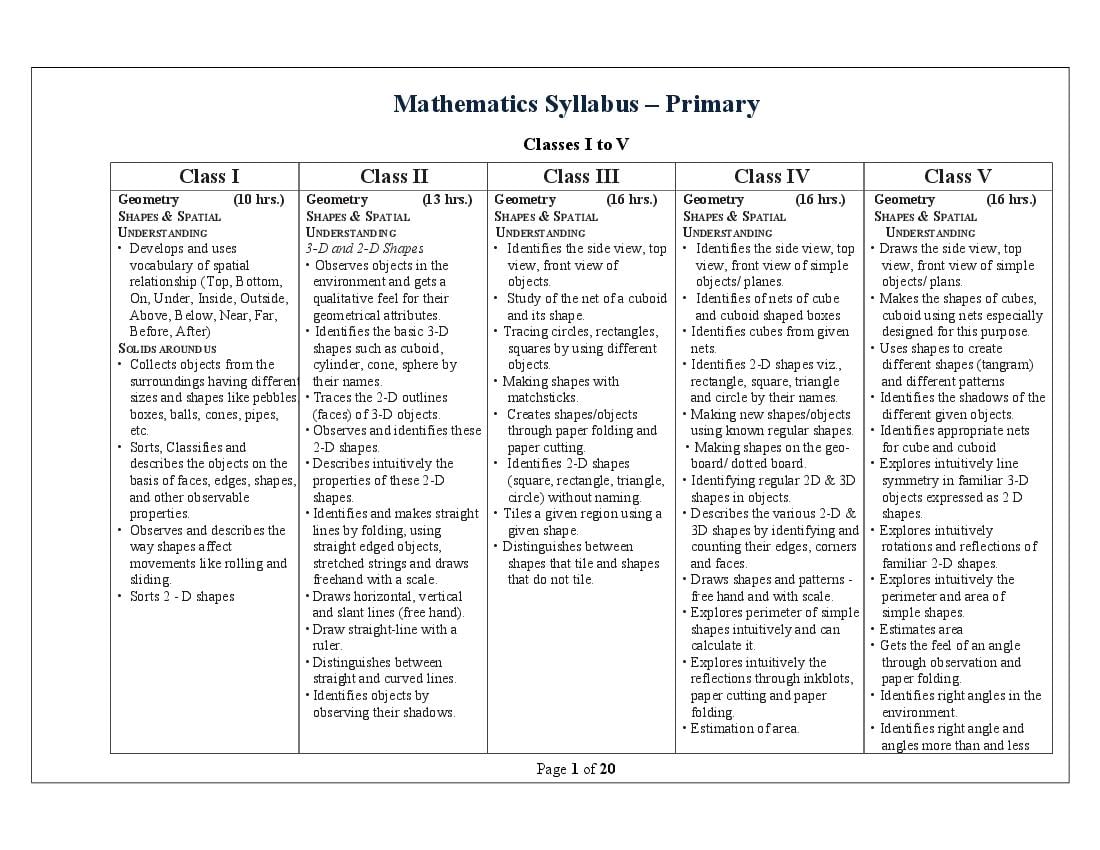
Classes I to V
Class I Class II Class III Class IV Class V
Geometry (10 hrs.) Geometry (13 hrs.) Geometry (16 hrs.) Geometry (16 hrs.) Geometry (16 hrs.)
SHAPES & SPATIAL SHAPES & SPATIAL SHAPES & SPATIAL SHAPES & SPATIAL SHAPES & SPATIAL
UNDERSTANDING UNDERSTANDING UNDERSTANDING UNDERSTANDING UNDERSTANDING
• Develops and uses 3-D and 2-D Shapes • Identifies the side view, top • Identifies the side view, top • Draws the side view, top
vocabulary of spatial • Observes objects in the view, front view of view, front view of simple view, front view of simple
relationship (Top, Bottom, environment and gets a objects. objects/ planes. objects/ plans.
On, Under, Inside, Outside, qualitative feel for their • Study of the net of a cuboid • Identifies of nets of cube • Makes the shapes of cubes,
Above, Below, Near, Far, geometrical attributes. and its shape. and cuboid shaped boxes cuboid using nets especially
Before, After) • Identifies the basic 3-D • Tracing circles, rectangles, • Identifies cubes from given designed for this purpose.
SOLIDS AROUND US shapes such as cuboid, squares by using different nets. • Uses shapes to create
• Collects objects from the cylinder, cone, sphere by objects. • Identifies 2-D shapes viz., different shapes (tangram)
surroundings having different their names. • Making shapes with rectangle, square, triangle and different patterns
sizes and shapes like pebbles, • Traces the 2-D outlines matchsticks. and circle by their names. • Identifies the shadows of the
boxes, balls, cones, pipes, (faces) of 3-D objects. • Creates shapes/objects • Making new shapes/objects different given objects.
etc. • Observes and identifies these through paper folding and using known regular shapes. • Identifies appropriate nets
• Sorts, Classifies and 2-D shapes. paper cutting. • Making shapes on the geo- for cube and cuboid
describes the objects on the • Describes intuitively the • Identifies 2-D shapes board/ dotted board. • Explores intuitively line
basis of faces, edges, shapes, properties of these 2-D (square, rectangle, triangle, • Identifying regular 2D & 3D symmetry in familiar 3-D
and other observable shapes. circle) without naming. shapes in objects. objects expressed as 2 D
properties. • Identifies and makes straight • Tiles a given region using a • Describes the various 2-D & shapes.
• Observes and describes the lines by folding, using given shape. 3D shapes by identifying and • Explores intuitively
way shapes affect straight edged objects, • Distinguishes between counting their edges, corners rotations and reflections of
movements like rolling and stretched strings and draws shapes that tile and shapes and faces. familiar 2-D shapes.
sliding. freehand with a scale. that do not tile. • Draws shapes and patterns - • Explores intuitively the
• Sorts 2 - D shapes • Draws horizontal, vertical free hand and with scale. perimeter and area of
and slant lines (free hand). • Explores perimeter of simple simple shapes.
• Draw straight-line with a shapes intuitively and can • Estimates area
ruler. calculate it. • Gets the feel of an angle
• Distinguishes between • Explores intuitively the through observation and
straight and curved lines. reflections through inkblots, paper folding.
• Identifies objects by paper cutting and paper • Identifies right angles in the
observing their shadows. folding. environment.
• Estimation of area. • Identifies right angle and
angles more than and less
Page 1 of 20
Page 2
• Measuring area using non than right angles.
standard units •Draws right angle and angles
• Comparison of big and small more than and less than
non standard units. right angles.
• Division of complete angles
into parts
• Drawing shapes on dotted
paper
• Identifies and reads floor
maps, routes/road maps
• Draws simple floor maps of
familiar locations
• Point, line, vertex, ray
• Identifies centre and radius of
a circle.
Numbers (46 hrs.) Numbers (46 hrs.) Numbers (42 hrs.) Numbers (40 hrs.) Numbers (40 hrs.)
DEVELOPING A SENSE OF • Reads and writes numerals NUMBER UPTO 1000 NUMBERS UPTO 10000 NUMBERS UPTO 1,00,000
NUMBERNESS, COUNTING AND for numbers up to ninety • Reads and writes up to 3- • Using word problems/ • Using word problems/
OPERATIONS OF NUMBERS 1 - 9 nine. digit numbers. contextual situations, reads, contextual situations, reads,
AND ZERO • Counts and regroups objects • Understands place value in writes and compares 2, 3- writes and compares 3,4,5-
• Observes object and makes into tens and ones. 3-digit numbers. digit numbers. digit numbers.
collections of objects. • Expands a number with • Expands a number using • Estimating 2, 3- digit numbers • Understands place value in
• Arranges the collection of respect to place values. place value. using the number line numbers up to 99,999
objects in order by • Uses the concept of place • Compares numbers. • Understands place value in 3- • Expands a number using
– One to one value in the comparison of • Forms numbers using given digit numbers. place value.
correspondence numbers. digits. • Expands a number using place • Forms numbers using given
– Matching • Counts in various ways: • Estimates numbers value. digits.
• Introduction of number(1-5) – Starting from any number. • Arrange the given numbers • Forms numbers using given • Skip counting in terms of
• Counts the number of – Group counting etc. in ascending and digits. hundreds, thousands and ten
objects in a collection. • Arranges numbers upto descending order. • Skip counting in terms of thousands
• Makes collection of objects hundred in ascending and ADDITION AND tens, hundreds and thousands
corresponding to a specific descending order. SUBTRACTION ADDITION AND SUBTRACTION
number. ADDITION AND SUBTRACTION
• Forms the greatest and the • Solves addition and • Using word problems/ • Using word problems/
• Introduction of numbers (6- smallest two digit numbers subtraction problems in contextual situations for a
9) contextual situations for a
with and without repetition different situations additions and subtractions up additions and subtractions up
• Recognizes and speaks of given digits. presented through pictures
numbers from 1 to 9. to 999. (compare-combination to 99999. (compare-
• Indicates and identifies the and stories. and comparison types of word combination and comparison
• Uses numbers from 1 to 9 position of an object in a • Adds and subtracts numbers types of word problems)
in counting and problems)
Page 2 of 20
Page 3
comparison. line. by writing them vertically and • Estimates sums and
• Reads and writes numerals horizontally in the following • Using word problems/ differences of 3,4 digit
from 1 to 9. ADDITION AND SUBTRACTION two cases: contextual situations for numbers through word
• Adds and subtracts using • Adds and subtracts two digit – without regrouping. addition of 3 numbers. problems and in sums.
real objects and pictures. numbers by drawing – with regrouping. • Estimates sums and • Frames word problems.
(Sum not to exceed 9 and representations of tens and • Introduction to different differences of 2,3 digit
difference not to go ones without and with strategies of addition and numbers through word MULTIPLICATION
below 1.) regrouping. subtraction problems and in sums. • Multiply by 10’s, 100’s,
• Adds and subtracts the • Adds zero to a number and • Uses the place value in • Adds and subtracts 2,3-digit 1000’s and 10,000s
numbers using symbols ‘+’ subtracts zero from a standard algorithm of numbers using the empty • Using word problems/
and ‘-’. number. addition and subtraction. number line. contextual situations
• Approaches zero through the • Solves addition, subtraction • Frames problems for • Frames word problems. multiplies 3 digit number by
subtraction pattern. problems presented through addition and subtraction • Estimates the sum and 2 digit numbers using the
NUMBERS FROM (10 - 20) pictures and verbal facts. difference between two standard (column) algorithm
• Introduction of 10 description. given numbers as well as the distributive
• Forms Number sequence • Describes orally the MULTIPLICATION MULTIPLICATION law. (array product - rate
from 10 to 20. situations that correspond to • Explains the meaning of • Using word problems/ product and grouping –
• Counts objects using these the given addition and multiplication (as repeated contextual situations revises Cartesian product types of
numbers. subtraction facts. addition). multiplication facts up to word problems)
• divides objects into a group • Identifies the sign of 10*10.(array - rate product • Frames word problems.
of 10s and single objects. PREPARATION FOR multiplication. and grouping types of word • Estimates products of 3 digit
• Develops the vocabulary of MULTIPLICATION AND DIVISION • Constructs the problems) by 1 digit and 3 digit by 2
group of ‘tens’ and ‘ones’. • Discussion of situations multiplication tables of 2, • Multiply by 10’s and 100’s digit numbers
• Shows the group of tens and involving repeated addition 3, 4, 5 and 10 • Using word problems/
ones by drawing. and situations involving • Uses multiplication facts in contextual situations DIVISION
• Counts the number of tens equal sharing. situations. multiplies 2 and 3 digit • Using word problems/
and ones in a given number. • Activities of making equal • Construct tables for 6, 7, 8, numbers by single digit and contextual situations dividing
• Writes number names ten to groups. 9 two digit numbers using the 2-digit numbers by two digit
nineteen. • Observe the cumulative • Multiplies two digit standard (column) algorithm numbers and three digit
• Writes numerals for ten to property of multiplication numbers by single digit as well as the distributive numbers by two digit
twenty. number using standard law. .(array product - rate numbers- with remainder and
• Compares numbers upto 20. algorithm and Lattice product and grouping types without remainder
multiplication algorithm. of word problems) (using both equal grouping
ADDITION AND SUBTRACTION DIVISION • Frames word problems. and sharing)
(UPTO 20) • Explains the meaning of • Estimates products 2 digit by • Understands the pattern
• Adds and subtracts of division from context of 1 digit and 2 digit, 3 digit by which emerges from
numbers the total not equal grouping and sharing. 1 digit division by 10
exceeding 20. • Uses standard division
Page 3 of 20
Page 4
NUMBERS FROM 21 - 99 • Relates division with DIVISION algorithms for two-and
• Writes numerals for multiplication. • Using word problems/ three digit numbers divided
Twenty-one to Ninety • Completes division facts: contextual situations dividing by one and two-digit
nine.· (Double digit by single 2 and 3 digit numbers by one numbers
• Groups objects into tens digit) and 2-digit numbers - with • Frames word problems.
and ones. – by repeated subtraction remainder and without • Even and odd numbers
• Draws representation for – by grouping remainder • Tests of divisibility for 2, 5
groups of ten and ones. – by using multiplication (using both equal grouping & 10.
• Groups a number orally into tables. and sharing) • Understanding of the
tens and ones. • Frames word problems. multiples and factors
• Even and odd numbers • Estimates quotients
• Estimates quotients for 2 and • Explores the relationship
3 digit numbers divided by between multiplication and
single digit numbers. division using 2 and 3 digit
• Explores the relationship numbers
between multiplication and
division using 2 and 1 digit
numbers
FRACTIONAL NUMBERS FRACTIONAL NUMBERS
• Identifies half, one fourth • Finds the fractional part of
and three - fourths of a a collection/ object
whole. • Identifies equivalent
• Identifies the symbols, fractions 2/4 and ½ ; 2/6
½,¼,¾. and 1/3, 2/8 and 1/4
• Explains the meaning of ½ , • Compares like and unlike
¼ and ¾ . fractions(without LCM)
• Identifies other fractions- • Addition and subtraction of
3/2, 5/2, 5/4 like fractions
• Appreciates equivalence of • Applies simple fractions to
2/4 and ½ ; and of 2/2 , 3/3, measurements.
4/4 and 1.
• Comparison of like fractions
• Addition and subtraction of
like fractions intuitively
Day to Day Maths (3 hrs.) Day to Day Maths (3 hrs.) Day to Day Maths (5 hrs.) Day to Day Maths (5 hrs.) Day to Day Maths (5 hrs.)
(Money, Length, Weight, (Money, Length, Weight, (Money, Length, Weight, (Money, Length, Weight, (Money, Length, Weight,
Capacity) Capacity) Capacity, Space) Capacity, Space) Capacity, Space)
• Identifies common currency • Identifies currency - notes • word problems/ contextual • word problems/ contextual • word problems/ contextual
Page 4 of 20
Page 5
notes and coins. and coins. situations using more than situations using more than situations using more than
• Puts together small amounts • Puts together amounts of one operations and/ or one operations and/ or one operations and/ or
of money. money not exceeding more than one concept more than one concept more than one concept
Rs 10/- or Rs. 50/-. and/or multiple stages of and/or multiple stages of and/or multiple stages of
solving solving solving
• Adds and subtracts small • estimation in daily life • estimation in daily life • estimation in daily life
amounts of money mentally.
• Transacts an amount using 3-
4 notes/coins.
Measurement (13 hrs.) Measurement (13 hrs.) Measurement (21 hrs.) Measurement (21 hrs.) Measurement (26 hrs.)
(LENGTH, WEIGHT, CAPACITY ) (LENGTH, WEIGHT, CAPACITY) (LENGTH, WEIGHT, CAPACITY) (LENG,TH WEIGHT, CAPACITY) (LENGTH, WEIGHT, CAPACITY)
LENGTH: LENGTH: LENGTH: LENGTH: • Relates commonly used
• Distinguishes between near, • Measures lengths & • Appreciates the need for a • Identifies meter and cm larger and smaller units of
far, thin, thick, longer/taller, distances along short & long standard unit. lengths length, weight and capacity
shorter, high, low. paths using uniform non- • Measures length using • Relates meter with cm. and converts one to the
• Seriates objects by standard units (Foot). appropriate standard units • Converts meter into cm. other.
comparing their length. WEIGHT of length by choosing • Measures length in meters, • Relates feet to inches.
• Measures short lengths in • Compares two or more centimeters. cm’s and inches. • Relates km to m; liter-ml;
terms of non-standard units objects by their weight using • Uses a scale for measuring • Estimates length of an object kg-gram; quintal-kg
(e.g. hand span etc.) non-standard units WEIGHT and distance between two • Applies simple fractions to
• Appreciates the need for a • Weighs objects using 1kg, 2 given locations. quantities.
WEIGHT simple balance. kg, 5 kg, 10 kg. • Solves problems involving • Converts fractional larger
• Compares between heavy • Compares weights of given • Estimates the weight of an length and distances in m and unit into complete smaller
and light objects. objects using simple balance. object and verifies using a cm. units.
balance. WEIGHT • Applies the four operations
• Identifies which is lighter or • Understands weight in terms in solving problems
CAPACITY CAPACITY weighter in given things. of kg and g, using actual involving length, weight
• Comparison of capacity of • Comparison of capacity of weights and their and capacity.
vessels vessels CAPACITY combinations Determines intuitively area
• Measures and compares the • Relates Kg with gram and perimeter.
capacity of different • Weighs objects using a Estimated length, weight,
containers in terms of balance and standard units. capacity of a solid body:
nonstandard units. • Appreciates the intuitively and also by
• Appreciates the conservation of weight. informal measurement.
conservation of capacity. • Estimates the weight of an
• Solves the problems on object. Verifies using a Understands the concept of
‘capacity’(in non standard balance. area
units) • Solves problems involving
Page 5 of 20
Page 6
weights using kg and g.
CAPACITY
• Understands capacity in
terms of l and ml
• Relates liter with ml.
• Measures capacity of given
liquid using containers
marked with standard units.
• Estimates the capacity of a
liquid .Verifies by
measuring.
• Determines sums and
differences of capacity.
• Solves problems involving
capacity in l and ml
Time TIME TIME TIME TIME
• Distinguishes between events • Gets familiar with the days • Reads a calendar to find a • Appreciates the difference in • Appreciates the difference in
occurring in time using terms of the week and months of particular day and date. time in terms of minutes, time in terms of seconds,
-earlier and later. the year. • Reads the time correct to hours, days, weeks and minutes, hours, days, months
• Narrates the sequence of • Sequences the events the hour. months. and years.
events in a day. occurring over longer periods • Sequences the events • Reads the calendar, identifies • Reading time in hour,
in terms of dates/days. chronologically. and correlates the number of minutes and seconds
• Compares the duration of days, weeks, months and • Converts hours into minutes
two different events. years. and minutes into seconds
• Identifies the patterns in a • Understands a leap year. • Expresses time, using the
calendar. • Reads clock time to the hours terms, ‘a.m.’ and ‘p.m.’
and minutes • Understanding 24 hour
• Solves problems on ‘time’ clock (Bus and Railway
timetable) and conversion
between 12 hour and 24
hour clocks
• Computes the number of
days between two dates.
• Uses addition and
subtraction in finding time
intervals in simple cases.
Page 6 of 20
Page 7
Data Handling (6 hrs.) Data Handling (6 hrs.) Data Handling (6 hrs.) Data Handling (6 hrs.) Data Handling (6 hrs.)
• Collects data • Collects data • Collects data • Reading data using a •Reading data using a
• Records data in a table • Records data in a table • Records data in a table pictograph pictograph
• Draws inferences from data. • Draws inferences from data. •Reads data given in the form • Reading data using a bar •Understands the importance of
of a pictograph graph an appropriate scale for
• Records data using tally • Recording data using tally pictograph
marks marks •Reading data using bar
• Draws conclusions from graphs
the data. • Organizing data using tally
marks using tally marker.
•Making bar graphs based on
data(without scale)
Patterns (10 hrs.) Patterns (10 hrs.) Patterns (6 hrs.) Patterns (6 hrs.) Patterns (6 hrs.)
• Describes sequences of • Observes and extends • Identifies simple • Identifies, carries forward • Identifies patterns in square
simple patterns found in patterns in sequence of symmetrical shapes and and makes visual patterns. numbers, triangular
shapes in the surroundings shapes and numbers. patterns. • Carries forward patterns in numbers.
and in numbers, e.g. • Searches for patterns in • Makes patterns and designs numbers based on addition, • Identifies patterns in
stamping activity using different ways of splitting a from straight lines and subtraction, multiplication multiplication and division.
fingers and thumb. number. other geometrical shapes. and division • Numbers between
• Completes a given sequence • Creates block patterns by • Identifies patterns in his consecutive square
of simple patterns found in stamping thumbprints, leaf Surroundings numbers.
shapes in the surroundings prints, vegetable prints, etc. • Symmetry through paper • Makes border strip and
and in numbers. • Creates patterns of regular folding, paper cuttings tiling patterns.
shapes by stamping.
• Complete a symmetric • Identifies the patterns in the
picture using mirror. multiples of 9.
• Draws symmetric pictures
and symmetric axis.
• Identifies the block or unit of
the pattern.
Page 7 of 20