UGC NET Public Administration Question Paper 2018
Finished viewing? Save it for later —
Download UGC NET Public Administration Question Paper 2018 (PDF · 48 pages)About UGC NET Public Administration Question Paper 2018
UGC NET Public Administration Question Paper 2018 is available here for free download. Published by NTA for UGC National Eligibility Test, this question paper can be viewed online or downloaded as a PDF (48 pages). Candidates preparing for UGC National Eligibility Test can use UGC NET Public Administration Question Paper 2018 to understand the exam pattern, the type of questions asked, and the overall difficulty level.
Frequently Asked Questions
How can I download UGC NET Public Administration Question Paper 2018?
Open this page and click the Download button to save UGC NET Public Administration Question Paper 2018 as a PDF. It is completely free on AglaSem Docs.
Is UGC NET Public Administration Question Paper 2018 free to download?
Yes. UGC NET Public Administration Question Paper 2018 can be viewed online and downloaded as a PDF free of cost on AglaSem Docs.
How many pages does UGC NET Public Administration Question Paper 2018 have?
UGC NET Public Administration Question Paper 2018 contains 48 pages, which you can read online or download together as a single PDF.
Where can I find more UGC National Eligibility Test study material?
You can find more UGC National Eligibility Test question papers, sample papers, syllabus, and answer keys on AglaSem Docs.
UGC NET Public Administration Question Paper 2018 – Text
Read the full text of this question paper below — useful to quickly search, copy and reference the content online without downloading the PDF.
📄 View text version (48 pages)
Page 1
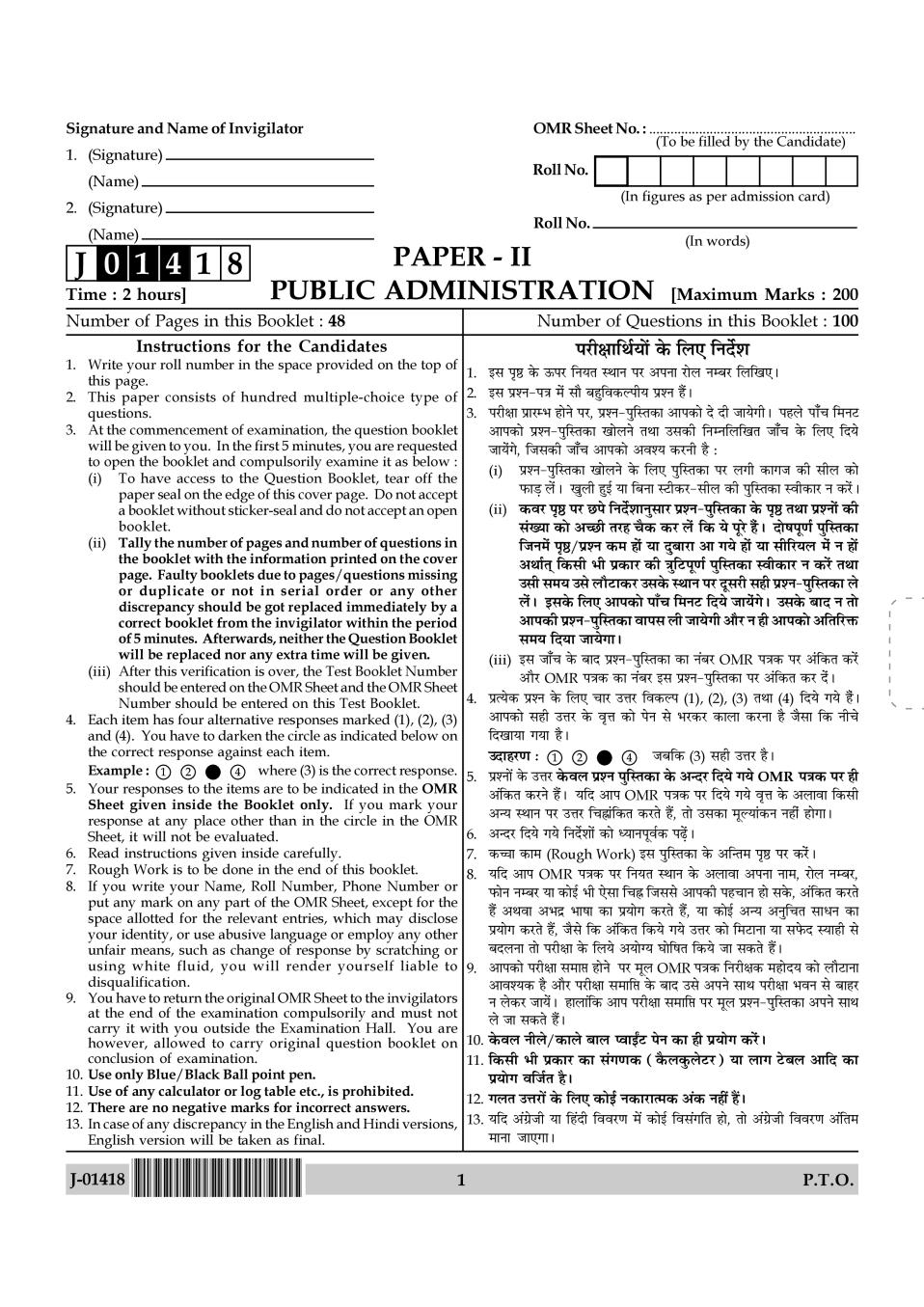
(To be filled by the Candidate)
1. (Signature)
Roll No.
(Name)
(In figures as per admission card)
2. (Signature)
Roll No.
(Name) (In words)
J 0 1 4 1 8 PAPER - II
Time : 2 hours] PUBLIC ADMINISTRATION [Maximum Marks : 200
Number of Pages in this Booklet : 48 Number of Questions in this Booklet : 100
Instructions for the Candidates ¬⁄UˡÊÊÁÕ¸ÿÙ¢ ∑§ Á‹∞ ÁŸŒ¸‡Ê
1. Write your roll number in the space provided on the top of
1. ß‚ ¬ÎDU ∑§ ™§¬⁄U ÁŸÿà SÕÊŸ ¬⁄U •¬ŸÊ ⁄UÙ‹U Ÿê’⁄U Á‹Áπ∞–
this page.
2. This paper consists of hundred multiple-choice type of 2. ß‚ ¬˝‡Ÿ-¬òÊ ◊¢ ‚ÊÒ ’„ÈÁfl∑§À¬Ëÿ ¬˝‡Ÿ „Ò¥–
questions. 3. ¬⁄UˡÊÊ ¬˝Ê⁄êU÷ „ÙŸ ¬⁄U, ¬˝‡Ÿ-¬ÈÁSÃ∑§Ê •Ê¬∑§Ù Œ ŒË ¡ÊÿªË– ¬„‹U ¬UÊ°ø Á◊Ÿ≈U
3. At the commencement of examination, the question booklet •Ê¬∑§Ù ¬˝‡Ÿ-¬ÈÁSÃ∑§Ê πÙ‹Ÿ ÃÕÊ ©‚∑§Ë ÁŸêŸÁ‹Áπà ¡Ê°ø ∑§ Á‹∞ ÁŒÿ
will be given to you. In the first 5 minutes, you are requested ¡Êÿ¢ª, Á¡‚∑§Ë ¡Ê°ø •Ê¬∑§Ù •fl‡ÿ ∑§⁄UŸË „Ò —
to open the booklet and compulsorily examine it as below :
(i) ¬˝‡Ÿ-¬ÈÁSÃ∑§Ê πÙ‹Ÿ ∑§ Á‹∞ ¬ÈÁSÃ∑§Ê ¬⁄U ‹ªË ∑§Êª¡ ∑§Ë ‚Ë‹ ∑§Ê
(i) To have access to the Question Booklet, tear off the
paper seal on the edge of this cover page. Do not accept »§Ê«∏ ‹¢U– πÈ‹Ë „È߸ ÿÊ Á’ŸÊ S≈UË∑§⁄U-‚Ë‹U ∑§Ë ¬ÈÁSÃ∑§Ê SflË∑§Ê⁄U Ÿ ∑§⁄¢U–
a booklet without sticker-seal and do not accept an open (ii) ∑§fl⁄U ¬ÎDU ¬⁄U ¿U¬ ÁŸŒ¸‡ÊÊŸÈ‚Ê⁄U ¬˝‡Ÿ-¬ÈÁSÃ∑§Ê ∑§ ¬ÎDU ÃÕÊ ¬˝‡ŸÙ¢ ∑§Ë
booklet. ‚¢ÅÿÊ ∑§Ù •ë¿UË Ã⁄U„ øÒ∑§ ∑§⁄U ‹¢U Á∑§ ÿ ¬Í⁄U „Ò¢U– ŒÙ·¬Íáʸ ¬ÈÁSÃ∑§Ê
(ii) Tally the number of pages and number of questions in Á¡Ÿ◊¢ ¬ÎDU/¬˝‡Ÿ ∑§◊ „Ù¢ ÿÊ ŒÈ’Ê⁄UÊ •Ê ªÿ „Ù¢ ÿÊ ‚ËÁ⁄Uÿ‹U ◊¢ Ÿ „Ù¢
the booklet with the information printed on the cover •ÕʸØ Á∑§‚Ë ÷Ë ¬˝∑§Ê⁄U ∑§Ë òÊÈÁ≈U¬Íáʸ ¬ÈÁSÃ∑§Ê SflË∑§Ê⁄U Ÿ ∑§⁄¢U ÃÕÊ
page. Faulty booklets due to pages/questions missing
or duplicate or not in serial order or any other ©‚Ë ‚◊ÿ ©‚ ‹Uı≈UÊ∑§⁄U ©‚∑§ SÕÊŸ ¬⁄U ŒÍ‚⁄UË ‚„Ë ¬˝‡Ÿ-¬ÈÁSÃ∑§Ê ‹
discrepancy should be got replaced immediately by a ‹¢– U ß‚∑§ Á‹∞ •Ê¬∑§Ù ¬Ê°ø Á◊Ÿ≈U ÁŒÿ ¡Êÿ¢ª– ©‚∑§ ’ÊŒ Ÿ ÃÙ
correct booklet from the invigilator within the period •Ê¬∑§Ë ¬˝‡Ÿ-¬ÈÁSÃ∑§Ê flʬ‚ ‹Ë ¡ÊÿªË •ı⁄U Ÿ „Ë •Ê¬∑§Ù •ÁÃÁ⁄UQ§
of 5 minutes. Afterwards, neither the Question Booklet ‚◊ÿ ÁŒÿÊ ¡ÊÿªÊ–
will be replaced nor any extra time will be given. (iii) ß‚ ¡Ê°ø ∑§ ’ÊŒ ¬˝‡Ÿ-¬ÈÁSÃ∑§Ê ∑§Ê Ÿ¥’⁄U OMR ¬òÊ∑§ ¬⁄U •¢Á∑§Ã ∑§⁄¢U
(iii) After this verification is over, the Test Booklet Number
•Uı⁄U OMR ¬òÊ∑§ ∑§Ê Ÿ¥’⁄U ß‚ ¬˝‡Ÿ-¬ÈÁSÃ∑§Ê ¬⁄U •¢Á∑§Ã ∑§⁄U Œ¢–
should be entered on the OMR Sheet and the OMR Sheet
Number should be entered on this Test Booklet. 4. ¬˝ àÿ∑§ ¬˝‡Ÿ ∑§ Á‹∞ øÊ⁄U ©ûÊ⁄U Áfl∑§À¬ (1), (2), (3) ÃÕÊ (4) ÁŒÿ ªÿ „Ò¢–
4. Each item has four alternative responses marked (1), (2), (3) •Ê¬∑§Ù ‚„Ë ©ûÊ⁄U ∑§ flÎûÊ ∑§Ù ¬Ÿ ‚ ÷⁄U∑§⁄U ∑§Ê‹Ê ∑§⁄UŸÊ „Ò ¡Ò‚Ê Á∑§ ŸËø
and (4). You have to darken the circle as indicated below on ÁŒπÊÿÊ ªÿÊ „Ò–
the correct response against each item. ©ŒÊ„⁄UáÊ — ¡’Á∑§ (3) ‚„Ë ©ûÊ⁄U „Ò–
Example : where (3) is the correct response. 5. ¬˝‡ŸÊ¥ ∑§ ©ûÊ⁄U ∑§fl‹ ¬˝‡Ÿ ¬ÈÁSÃ∑§Ê ∑§ •ãŒ⁄U ÁŒÿ ªÿ OMRU ¬òÊ∑§ ¬⁄U „Ë
5. Your responses to the items are to be indicated in the OMR •¥Á∑§Ã ∑§⁄UŸ „Ò¥– ÿÁŒ •Ê¬ OMRU ¬òÊ∑§ ¬⁄U ÁŒÿ ªÿ flÎûÊ ∑§ •‹ÊflÊ Á∑§‚Ë
Sheet given inside the Booklet only. If you mark your
response at any place other than in the circle in the OMR •ãÿ SÕÊŸ ¬⁄U ©ûÊ⁄U ÁøqÊ¢Á∑§Ã ∑§⁄Uà „Ò¥, ÃÙ ©‚∑§Ê ◊ÍÀUÿÊ¢∑§Ÿ Ÿ„Ë¢ „٪ʖ
Sheet, it will not be evaluated. 6. •ãŒ⁄U ÁŒÿ ªÿ ÁŸŒ¸‡ÊÙ¢ ∑§Ù äÿÊŸ¬Ífl¸∑§ ¬…∏¢U–
6. Read instructions given inside carefully. 7. ∑§ìÊÊ ∑§Ê◊ (Rough Work) ß‚ ¬ÈÁSÃ∑§Ê ∑§ •ÁãÃ◊ ¬ÎDU ¬⁄U ∑§⁄¢U–
7. Rough Work is to be done in the end of this booklet. 8. ÿÁŒ •Ê¬ OMR ¬òÊ∑§ ¬⁄U ÁŸÿà SÕÊŸ ∑§ •‹ÊflÊ •¬ŸÊ ŸÊ◊, ⁄UÊ‹ Ÿê’⁄U,
8. If you write your Name, Roll Number, Phone Number or »§ÊŸ Ÿê’⁄U ÿÊ ∑§Ê߸ ÷Ë ∞‚Ê Áøq Á¡‚‚ •Ê¬∑§Ë ¬„øÊŸ „Ê ‚∑§, •¥Á∑§Ã ∑§⁄UÃ
put any mark on any part of the OMR Sheet, except for the
space allotted for the relevant entries, which may disclose „Ò¥ •ÕflÊ •÷Œ˝ ÷Ê·Ê ∑§Ê ¬˝ÿʪ ∑§⁄Uà „Ò¥, ÿÊ ∑§Ê߸ •ãÿ •ŸÈÁøà ‚ÊœŸ ∑§Ê
your identity, or use abusive language or employ any other ¬˝ÿʪ ∑§⁄Uà „Ò¥, ¡Ò‚ Á∑§ •¥Á∑§Ã Á∑§ÿ ªÿ ©ûÊ⁄U ∑§Ê Á◊≈UÊŸÊ ÿÊ ‚»§Œ SÿÊ„Ë ‚
unfair means, such as change of response by scratching or ’Œ‹ŸÊ ÃÊ ¬⁄UˡÊÊ ∑§ Á‹ÿ •ÿÊÇÿ ÉÊÊÁ·Ã Á∑§ÿ ¡Ê ‚∑§Ã „Ò¥–
using white fluid, you will render yourself liable to 9. •Ê¬∑§Ù ¬⁄UˡÊÊ ‚◊Ê# „ÙŸ §¬⁄U ◊Í‹ OMR ¬òÊ∑§ ÁŸ⁄UˡÊ∑§ ◊„ÙŒÿ ∑§Ù ‹Uı≈UÊŸÊ
disqualification. •Êfl‡ÿ∑§ „Ò •ı⁄U ¬⁄UˡÊÊ ‚◊ÊÁ# ∑§ ’ÊŒ ©‚ •¬Ÿ ‚ÊÕ ¬⁄UˡÊÊ ÷flŸ ‚ ’Ê„⁄U
9. You have to return the original OMR Sheet to the invigilators Ÿ ‹∑§⁄U ¡Êÿ¢– „Ê‹Ê¥Á∑§ •Ê¬ ¬⁄UˡÊÊ ‚◊ÊÁ# ¬⁄U ◊Í‹ ¬˝‡Ÿ-¬ÈÁSÃ∑§Ê •¬Ÿ ‚ÊÕ
at the end of the examination compulsorily and must not
carry it with you outside the Examination Hall. You are
‹ ¡Ê ‚∑§Ã „Ò¥–
however, allowed to carry original question booklet on 10. ∑§fl‹ ŸË‹/∑§Ê‹ ’Ê‹U åflÊßZ≈U ¬Ÿ ∑§Ê „Ë ¬˝ÿʪ ∑§⁄¢U–
conclusion of examination. 11. Á∑§‚Ë ÷Ë ¬˝∑§Ê⁄U ∑§Ê ‚¢ªáÊ∑§ (∑Ò§‹∑ȧ‹≈U⁄U) UÿÊ ‹Êª ≈U’‹ •ÊÁŒ ∑§Ê
10. Use only Blue/Black Ball point pen. ¬˝ÿÙª flÁ¡¸Ã „Ò–
11. Use of any calculator or log table etc., is prohibited.
12. ª‹Ã ©ûÊ⁄UÊ¥ ∑§ Á‹∞ ∑§Ê߸ Ÿ∑§Ê⁄UÊà◊∑§ •¥∑§ Ÿ„Ë¥ „Ò¥–
12. There are no negative marks for incorrect answers.
13. In case of any discrepancy in the English and Hindi versions, 13. ÿÁŒ •¥ª˝¡Ë ÿÊ Á„¥ŒË Áflfl⁄UáÊ ◊¥ ∑§Ê߸ Áfl‚¥ªÁà „Ê, ÃÊ •¥ª˝¡Ë Áflfl⁄UáÊ •¥ÁÃ◊
English version will be taken as final. ◊ÊŸÊ ¡Ê∞ªÊ–
J-01418 !J-01418-PAPER-II! 1 P.T.O.
Page 2
PAPER - II
Note : This paper contains hundred (100) objective type questions of two (2) marks each. All
questions are compulsory.
1. Woodrow Wilson’s article, “The Study of Administration” was published in which of the
following journal in the year 1887 ?
(1) Political Science (2) Public Administration
(3) Political Science Quarterly (4) Public Administration Review
2. Who among the following advocated ‘Initiative’ as a principle of Administration ?
(1) Woodrow Wilson (2) R.B. Denhardt
(3) Henri Fayol (4) Lyndall Urwick
3. Which one of the following is not correct in relation to New Public Administration ?
(1) Value neutrality in its approach (2) Stresses for structural changes
(3) Focus on client centricity (4) Relevant to social realities
4. Which of the following are correct regarding the thurst areas of New Public Management ?
(a) Down Sizing of Bureaucracy
(b) Minimal state
(c) Maximum government
(d) New ways for delivery of Public Services
Select the correct answer from the code given below :
(1) (a), (b), (c) (2) (b), (c), (d) (3) (a), (b), (d) (4) (a), (c), (d)
5. In order to address the difficulties due to lack of coordination among governmental
institutions /agencies, the Third Minnowbrook conference introduced a new concept known
as :
(1) Interoperability (2) Collaborative governance
(3) Network society (4) Deliberative democracy
J-01418 !J-01418-PAPER-II! 2 Paper-II
Page 3
¬˝‡Ÿ-¬òÊ - II
ŸÊ≈U — ß‚ ¬˝‡Ÿ-¬òÊ ◊¥ ‚ÊÒ (100) ’„È-Áfl∑§À¬UËÿ ¬˝‡Ÿ „Ò¥– ¬˝àÿ∑§ ¬˝‡Ÿ ∑§ ŒÙ (2) •¢∑§ „Ò¥– ‚÷Ë ¬˝‡Ÿ •ÁŸflÊÿ¸ „Ò¥–
1. flÈ«˛UÊ ÁflÀ‚Ÿ ∑§ ‹π “Œ S≈U«UË •ÊÚ»§ ∞«UÁ◊ÁŸS≈˛U‡ÊŸ” ∑§Ê ¬˝∑§Ê‡ÊŸ 1887 ◊¥ ÁŸêŸÁ‹Áπà ◊¥ ‚ Á∑§‚ ¡Ÿ¸‹ ◊¥ „È•Ê
ÕÊ?
(1) ¬ÊÚÁ‹Á≈U∑§‹ ‚Êßã‚ (2) ¬Áé‹∑§ ∞«UÁ◊ÁŸS≈˛U‡ÊŸ
(3) ¬ÊÚÁ‹Á≈U∑§‹ ‚Êßã‚ Ä√ÊÊ≈¸U⁄U‹Ë (4) ¬Áé‹∑§ ∞«UÁ◊ÁŸS≈˛U‡ÊŸ Á⁄U√ÿÍ
2. ÁŸêŸÁ‹Áπà ◊¥ ‚ Á∑§‚Ÿ ¬˝‡ÊÊ‚Ÿ ∑§ Á‚hÊãà ∑§ M§¬ ◊¥ “¬„‹” ∑§Ë fl∑§Ê‹Ã ∑§Ë „Ò?
(1) flÈ«˛UÊ ÁflÀ‚Ÿ (2) •Ê⁄U.’Ë. «UŸ„Ê«˜¸U≈U
(3) „Ÿ⁄UË »§ÿÊ‹ (4) Á‹á«U‹ ©Áfl¸∑§
3. Ÿfl ‹Ê∑§ ¬˝‡ÊÊ‚Ÿ ∑§ ’Ê⁄U ◊¥ ÁŸêŸÁ‹Áπà ◊¥ ‚ ÄÿÊ ‚„Ë Ÿ„Ë¥ „Ò?
(1) ß‚∑§ ŒÎÁc≈∑§ÊáÊ ◊¥ ◊ÍÀÿ Ã≈USÕÃÊ (2) …UÊ°øʪà ¬Á⁄UfløŸÊ¥ ¬⁄U ’‹ ŒÃÊ „Ò–
(3) ª˝Ê„∑§ ∑§ÁãŒ˝ÃÃÊ ¬⁄U äÿÊŸ ŒÃÊ „Ò– (4) ‚Ê◊ÊÁ¡∑§ flÊSÃÁfl∑§ÃÊ•Ê¥ ∑§ ¬˝Áà ¬˝Ê‚¥Áª∑§
4. ÁŸêŸÊ¥Á∑§Ã ◊¥ ‚ Ÿfl ‹Ê∑§ ¬˝’㜟 ∑§ ¬˝◊Èπ ˇÊòÊ ∑§ ’Ê⁄U ◊¥ ÄÿÊ ‚„Ë „Ò?
(a) •Áœ∑§Ê⁄UËÃ¥òÊ ∑§Ê •Ê∑§Ê⁄U ∑§◊ ∑§⁄UŸÊ
(b) ãÿÍŸÃ◊ ⁄UÊíÿ
(c) •Áœ∑§Ã◊ ‚⁄U∑§Ê⁄U
(d) ‹Ê∑§ ‚flÊ•Ê¥ ∑§Ë ¬˝ŒÊÿÃÊ ∑§ Ÿ∞ Ã⁄UË∑§
ŸËø ÁŒ∞ ª∞ ∑ͧ≈U ‚ ‚„Ë ©ûÊ⁄U ∑§Ê øÿŸ ∑§ËÁ¡∞ —
(1) (a), (b), (c) (2) (b), (c), (d) (3) (a), (b), (d) (4) (a), (c), (d)
5. ‚⁄U∑§Ê⁄UË ‚¥SÕÊ•Ê¥/•Á÷∑§⁄UáÊÊ¥ ◊¥ ‚◊ãflÿ ∑§Ë ∑§◊Ë ∑§Ë øÈŸÊÒÁÃÿÊ¥ ∑§ ‚◊ʜʟ „ÃÈ, ÃÎÃËÿ Á◊ÛÊÊ’˝È∑§ ‚ê◊‹Ÿ Ÿ ÁŸêŸ ◊¥
‚ Á∑§‚ ŸflËŸ •flœÊ⁄UáÊÊ ∑§Ê ‚◊ÊflÁ‡Êà Á∑§ÿÊ?
(1) •ãÃ⁄U‚¥øÊÁ‹ÃÃÊ (2) ‚„ÿÊªË ‡ÊÊ‚Ÿ
(3) Ÿ≈Ufl∑¸§ ‚Ê‚Êß≈UË (4) Áfl◊‡Ê¸‡ÊË‹ ‹Ê∑§ÃãòÊ
J-01418 !J-01418-PAPER-II! 3 Paper-II
Page 4
communication following the Information Technology.
Reason (R) : E-governance has become acceptable form in contemporary governance,
not only because it is cost-efficient, but also because it is transparent and
time-saving.
Code :
(1) Both (A) and (R) are correct and (R) is the correct explanation of (A).
(2) Both (A) and (R) are correct but (R) is not the correct explanation of (A).
(3) (A) is true but (R) is false.
(4) (A) is false but (R) is true.
7. According to F.W. Taylor which one of the following is not a quality of a good ‘foreman’ ?
(1) Manual Dexterity and Strength
(2) Tact
(3) Judgement
(4) Competence
8. Match List - I with List - II. Select the correct answer from the code given below.
List - I List - II
(Author) (Book)
(a) George H. Frederickson (i) Modern Organization
(b) F.A. Nigro and L.G. Nigro (ii) New Public Administration
(c) Victor A. Thompson (iii) Modern Public Administration
(d) Peter M. Blau (iv) Bureaucracy in Modern Society
Code :
(a) (b) (c) (d)
(1) (i) (ii) (iii) (iv)
(2) (ii) (i) (iv) (iii)
(3) (ii) (iii) (i) (iv)
(4) (i) (iii) (iv) (ii)
J-01418 !J-01418-PAPER-II! 4 Paper-II
Page 5
©¬‹Áéœ ‚ ‹Ê÷ÊÁãflà „È•Ê „Ò–
Ã∑¸§ (R) : ߸-ªflŸZ‚ ‚◊∑§Ê‹ËŸ •Á÷‡ÊÊ‚Ÿ ◊¥ Ÿ ∑§fl‹ ‹ÊªÃ ∑ȧ‡Ê‹ÃÊ ∑§ ∑§Ê⁄UáÊ •Á¬ÃÈ ÿ„ πȋʬŸ ∞fl¥
‚◊ÿ ∑§Ë ’øà ∑§ ∑§Ê⁄UáÊ ÷Ë SflË∑§Êÿ¸ „Ò–
∑ͧ≈U —
(1) (A) ÃÕÊ (R) ŒÊŸÊ¥ ‚„Ë „Ò¥ ÃÕÊ (R), (A) ∑§Ë ‚„Ë √ÿÊÅÿÊ „Ò–
(2) (A) ÃÕÊ (R) ŒÊŸÊ¥ ‚„Ë „Ò¥, ¬⁄UãÃÈ (R), (A) ∑§Ë ‚„Ë √ÿÊÅÿÊ Ÿ„Ë¥ „Ò–
(3) (A) ‚„Ë „Ò, ¬⁄UãÃÈ (R) ª‹Ã „Ò–
(4) (A) ª‹Ã „Ò, ¬⁄UãÃÈ (R) ‚„Ë „Ò–
7. ∞»§.«UéÀÿÍ. ≈U‹⁄U ∑§ •ŸÈ‚Ê⁄U ÁŸêŸÁ‹Áπà ◊¥ ‚ ∑§ÊÒŸ-‚Ê ∞∑§ •ë¿U “»§Ê⁄U◊ÒŸ” ∑§Ê ªÈáÊ Ÿ„Ë¥ „Ò?
(1) ‡ÊÊ⁄UËÁ⁄U∑§ ÁŸ¬ÈáÊÃÊ ∞fl¥ ’‹
(2) √ÿfl„Ê⁄U ∑ȧ‡Ê‹ÃÊ
(3) ÁŸáʸÿ
(4) ‚ˇÊ◊ÃÊ
8. ‚ÍøË - I ∑§Ê ‚ÍøË - II ‚ ‚È◊Á‹Ã ∑§ËÁ¡∞– ŸËø ÁŒ∞ ª∞ ∑ͧ≈U ‚ ‚„Ë ©ûÊ⁄U ∑§Ê øÿŸ ∑§ËÁ¡∞–
‚ÍøË - I ‚ÍøË - II
(‹π∑§) (¬ÈSÃ∑§)
(a) ¡Ê¡¸ ∞ø. »˝§«UÁ⁄U∑§‚Ÿ (i) ◊ÊÚ«Ÿ¸ •ÊÚª¸ŸÊß¡‡ÊŸ
(b) ∞»§.∞. ÁŸª˝Ê ∞fl¥ ∞‹.¡Ë. ÁŸª˝Ê (ii) ãÿÍ ¬Áé‹∑§ ∞«UÁ◊ÁŸS≈˛U‡ÊŸ
(c) ÁflÄ≈U⁄U ∞. ÕÊꬂŸ (iii) ◊ÊÚ«Ÿ¸ ¬Áé‹∑§ ∞«UÁ◊ÁŸS≈˛U‡ÊŸ
(d) ¬Ë≈U⁄U ∞◊. é‹Ê™§ (iv) éÿÍ⁄UÊ∑˝§‚Ë ßŸ ◊ÊÚ«UŸ¸ ‚Ê‚Êß≈UË
∑ͧ≈U —
(a) (b) (c) (d)
(1) (i) (ii) (iii) (iv)
(2) (ii) (i) (iv) (iii)
(3) (ii) (iii) (i) (iv)
(4) (i) (iii) (iv) (ii)
J-01418 !J-01418-PAPER-II! 5 Paper-II
Page 6
English ?
(1) Robert Presthus (2) Edward A. Shils and Henry A. Finch
(3) Talcott Parsons (4) Robert Merton
10. Chronologically arrange the Elton Mayo’s studies in an ascending order.
(a) Great Illumination (b) First Inquiry (c) Social Organization
(d) Human sentiments (e) Absenteeism
Select the correct answer by using code given below :
Code :
(1) (c), (d), (e), (b) and (a) (2) (c), (b), (e), (a) and (d)
(3) (b), (a), (d), (c) and (e) (4) (a), (b), (c), (d) and (e)
11. Which of the following is not correct regarding the closeness of administrative management
to Weberian Bureaucratic Theory ?
(1) Both concern with optimal organisation of administrators than production workers.
(2) Both hold economic efficiency as its ultimate criterion.
(3) Both concern for more organisation than its man.
(4) Both consider the organisation as a unit of its environment.
12. Which one of the following stands for Impoverished Management Style as per Blake and
Mouton Managerial Grid ?
(1) Low concern for result and Low concern for people
(2) Low concern for result and high concern for people
(3) High concern for result and Low concern for people
(4) High concern for people and High concern for result
13. Match List - I with List - II. Select the correct answer from the code given below.
List - I List - II
(Main Activity) (Agency)
(a) Concerned with the object of the (i) Technical Staff Agency
organization
(b) Expert in their area of work (ii) Line Agency
(c) Prevent the executive from taking (iii) Staff Agency
hasty and wrong decisions
(d) Responsible for housekeeping and (iv) Auxiliary Staff Agency
purchasing
Code :
(a) (b) (c) (d)
(1) (i) (ii) (iii) (iv)
(2) (ii) (i) (iii) (iv)
(3) (ii) (i) (iv) (iii)
(4) (ii) (iv) (i) (iii)
J-01418 !J-01418-PAPER-II! 6 Paper-II
Page 7
(1) ⁄UÊÚ’≈¸U ¬˝SÕ‚ (2) ∞«Ufl«¸U ∞. ‚ËÀ‚ ∞fl¥ „Ÿ⁄UË ∞. Á»§ãø
(3) ≈UÊ‹∑§Ê≈U ¬Ê⁄U‚ã‚ (4) ⁄UÊÚ’≈¸U ◊⁄U≈UŸ
10. ∞À≈UŸ ◊ÿÊ ∑§ •äÿÿŸÊ¥ ∑§Ê •Ê⁄UÊ„Ë ∑˝§◊ ◊¥ ∑§Ê‹∑˝§◊ÊŸÈ‚Ê⁄U √ÿflÁSÕà ∑§ËÁ¡∞–
(a) ◊„ÊŸ ¬˝∑§Ê‡Ê (b) ¬˝Õ◊ ¡Ê°ø (c) ‚Ê◊ÊÁ¡∑§ ‚¥ª∆UŸ
(d) ◊ÊŸfl ◊ŸÊ÷Êfl (e) •ŸÈ¬ÁSÕÁÃ-¬˝flÎÁûÊ
ŸËø ÁŒ∞ ª∞ ∑ͧ≈U ‚ ‚„Ë ©ûÊ⁄U ∑§Ê øÿŸ ∑§ËÁ¡∞ —
(1) (c), (d), (e), (b) •ÊÒ⁄U (a) (2) (c), (b), (e), (a) •ÊÒ⁄U (d)
(3) (b), (a), (d), (c) •ÊÒ⁄U (e) (4) (a), (b), (c), (d) •ÊÒ⁄U (e)
11. ÁŸêŸÁ‹Áπà ◊¥ ‚ ∑§ÊÒŸ‚Ê fl’⁄U ∑§ ŸÊÒ∑§⁄U‡ÊÊ„Ë Á‚hÊãà ‚ ¬˝‡ÊÊ‚ÁŸ∑§ ¬˝’¥œŸ ∑§Ë ÁŸ∑§≈UÃÊ ∑§ ’Ê⁄U ◊¥ ‚„Ë Ÿ„Ë¥ „Ò?
(1) ŒÊŸÊ¥, ©à¬ÊŒŸ ◊¥ ‹ª ∑§Ê◊ªÊ⁄UÊ¥ ∑§Ë ’¡Ê∞ ¬˝‡ÊÊ‚∑§Ê¥ ∑§ ßc≈UÃ◊ ‚¥ª∆UŸ ∑§ ¬˝Áà Áø¥ÁÃà „Ò¥–
(2) ŒÊŸÊ¥ •ÊÁÕ¸∑§ ŒˇÊÃÊ ∑§Ê •¬ŸÊ ◊ÈÅÿ ◊ÊŸŒá«U ◊ÊŸÃ „Ò¥–
(3) ŒÊŸÊ¥ •¬Ÿ ∑§◊¸øÊÁ⁄UÿÊ¥ ∑§Ë ’¡Ê∞ ‚¥ª∆UŸ ∑§ ’Ê⁄U ◊¥ •Áœ∑§ Áø¥ÁÃà „Êà „Ò¥–
(4) ŒÊŸÊ¥, ‚¥ª∆UŸ ∑§Ê •¬Ÿ flÊÃÊfl⁄UáÊ ∑§Ë ∞∑§ ß∑§Ê߸ ◊ÊŸÃ „Ò¥–
12. é‹∑§ ∞fl¥ êÿÍ≈UŸ mÊ⁄UÊ ŒË ªß¸ ◊ÒŸÁ¡Á⁄U‹ Áª˝«U ◊¥ •‡ÊÄàÊ ¬˝’㜠‡ÊÒ‹Ë ∑§Ê •Á÷¬˝Êÿ ÁŸêŸÊ¥Á∑§Ã ◊¥ ‚ Á∑§‚‚ „Ò?
(1) ¬Á⁄UáÊÊ◊Ê¥ ¬⁄U ∑§◊ äÿÊŸ (ÁëÊãÃÊ) ÃÕÊ ‹ÊªÊ¥ ∑§ ¬˝Áà ÷Ë ∑§◊ äÿÊŸ (ÁøãÃÊ)
(2) ¬Á⁄UáÊÊ◊Ê¥ ¬⁄U ∑§◊ äÿÊŸ (ÁøãÃÊ) fl ‹ÊªÊ¥ ∑§ ¬˝Áà ©ìÊ äÿÊŸ (ÁøãÃÊ)
(3) ¬Á⁄UáÊÊ◊Ê¥ ¬⁄U •Áœ∑§ äÿÊŸ (ÁøãÃÊ) fl ‹ÊªÊ¥ ∑§ ¬˝Áà ∑§◊ äÿÊŸ (ÁøãÃÊ)
(4) ‹ÊªÊ¥ ∑§ ¬˝Áà •Áœ∑§ äÿÊŸ (ÁøãÃÊ) fl ¬Á⁄UáÊÊ◊Ê¥ ∑§ ¬˝Áà •Áœ∑§ äÿÊŸ (ÁøãÃÊ )
13. ‚ÍøË - I ∑§Ê ‚ÍøË - II ‚ ‚È◊Á‹Ã ∑§ËÁ¡∞– ŸËø ÁŒ∞ ª∞ ∑ͧ≈U ‚ ‚„Ë ©ûÊ⁄U ∑§Ê øÿŸ ∑§ËÁ¡∞–
‚ÍøË - I ‚ÍøË - II
(◊ÈÅÿ ªÁÃÁflÁœ) (•Á÷∑§⁄UáÊ)
(a) ‚¥ª∆UŸ ∑§ ©g‡ÿ ‚ ‚ê’ÁãœÃ (i) Ã∑§ŸË∑§Ë S≈ÊÚ»§ •Á÷∑§⁄UáÊ
(b) •¬Ÿ ∑§Êÿ¸ ˇÊòÊ ◊¥ Áfl‡Ê·ôÊ (ii) ‹Ê߸Ÿ •Á÷∑§⁄UáÊ
(c) ∑§Êÿ¸¬ÊÁ‹∑§Ê ∑§Ê ¡ÀŒ’Ê¡Ë ◊¥ •ÊÒ⁄U (iii) S≈UÊÚ»§ •Á÷∑§⁄UáÊ
ª‹Ã ÁŸáʸÿÊ¥ ∑§Ê ‹Ÿ ‚ ⁄UÊ∑§ŸÊ
(d) ªÎ„ ¬˝’¥œ •ÊÒ⁄U π⁄UËŒŒÊ⁄Ë ∑§ Á‹∞ ©ûÊ⁄UŒÊÿË (iv) ‚„Êÿ∑§ S≈UÊÚ»§ •Á÷∑§⁄UáÊ
∑ͧ≈U —
(a) (b) (c) (d)
(1) (i) (ii) (iii) (iv)
(2) (ii) (i) (iii) (iv)
(3) (ii) (i) (iv) (iii)
(4) (ii) (iv) (i) (iii)
J-01418 !J-01418-PAPER-II! 7 Paper-II
Page 8
Reason (R) : The success of development programmes depends to a greater extent upon
the effective functioning of the field establishments.
Code :
(1) Both (A) and (R) are correct and (R) is the correct explanation of (A).
(2) Both (A) and (R) are correct but (R) is not the correct explanation of (A).
(3) (A) is true, but (R) is false.
(4) (A) is false, but (R) is correct.
15. Match List - I with List - II. Select the correct answer from the code given below.
List - I List - II
(Kind of Authority) (Characteristic)
(a) Direct Authority (i) Intrinsic by special knowledge
(b) Delegated Authority (ii) Based on seniority
(c) Functional Authority (iii) Intermediate agency between issuer and accepter
(d) Personal Authority (iv) Unbroken line between issuer and acceptor
Code :
(a) (b) (c) (d)
(1) (iii) (ii) (iv) (i)
(2) (iv) (iii) (i) (ii)
(3) (ii) (i) (iii) (iv)
(4) (i) (iv) (ii) (iii)
16. Which one of the following leadership theories believes that “A leader is born and is not
made”?
(1) Trait theory (2) Chrismatic theory
(3) Behavioural theory (4) Situational theory
17. Arrange the following books in chronological sequence of their year of publications.
(i) ‘Policy and Administration’ by Paul Appleby
(ii) ‘Motivation and Personality’ by Abraham Maslow
(iii) ‘The Art of Administration’ by Ordway Tead
(iv) ‘Work and Nature of Man’ by Frederick Herzberg
Select the correct answer from the code given below :
(1) (i), (ii), (iii), (iv) (2) (i), (iii), (ii), (iv)
(3) (ii), (iii), (iv), (i) (4) (iii), (i), (iv), (ii)
J-01418 !J-01418-PAPER-II! 8 Paper-II
Page 9
Ã∑¸§ (R) : Áfl∑§Ê‚ ∑§Êÿ¸∑˝§◊Ê¥ ∑§Ë ‚»§‹ÃÊ ’„Èà ∑ȧ¿U ˇÊòÊËÿ ‚¥SÕÊŸÊ¥ ∑§ ¬˝÷ÊflË ∑§Êÿ¸ ‚¥øÊ‹Ÿ ¬⁄U ÁŸ÷¸⁄U
∑§⁄UÃË „Ò–
∑ͧ≈U —
(1) (A) ÃÕÊ (R) ŒÊŸÊ¥ ‚„Ë „Ò¥ ÃÕÊ (R), (A) ∑§Ë ‚„Ë √ÿÊÅÿÊ „Ò–
(2) (A) ÃÕÊ (R) ŒÊŸÊ¥ ‚„Ë „Ò¥ ¬⁄U¥ÃÈ (R), (A) ∑§Ë ‚„Ë √ÿÊÅÿÊ Ÿ„Ë¥ „Ò–
(3) (A) ‚„Ë „Ò, ¬⁄UãÃÈ (R) ª‹Ã „Ò–
(4) (A) ª‹Ã „Ò, ¬⁄UãÃÈ (R) ‚„Ë „Ò–
15. ‚ÍøË - I ∑§Ê ‚ÍøË - II ‚ ‚È◊Á‹Ã ∑§ËÁ¡∞– ŸËø ÁŒ∞ ª∞ ∑ͧ≈U ‚ ‚„Ë ©ûÊ⁄U ∑§Ê øÿŸ ∑§ËÁ¡∞–
‚ÍøË - I ‚ÍøË - II
(‚ûÊÊ ∑§Ê ¬˝∑§Ê⁄U) (Áfl‡Ê·ÃÊ∞°)
(a) ¬˝àÿˇÊ SÊûÊÊ (i) Áfl‡Ê· ôÊÊŸ ‚ •Êë¿UÊÁŒÃ
(b) ¬˝àÿÊÿÊÁ¡Ã ‚ûÊÊ (ii) flÁ⁄Uc∆UÃÊ ¬⁄U •ÊœÊÁ⁄UÃ
(c) ∑§Êÿʸà◊∑§ SÊûÊÊ (iii) ¡Ê⁄UË∑§Ãʸ •ÊÒ⁄U SflË∑§Ê⁄U∑§Ãʸ ∑§ ◊äÿ ∑§Ë ß∑§Ê߸
(d) flÒÿÁÄàÊ∑§ ‚ûÊÊ (iv) ¡Ê⁄UË∑§Ãʸ •ÊÒ⁄U SflË∑§Ê⁄U∑§Ãʸ ∑§ ’Ëø Ÿ ≈ÍU≈UŸ flÊ‹Ë ∑§«∏Ë
∑ͧ≈U —
(a) (b) (c) (d)
(1) (iii) (ii) (iv) (i)
(2) (iv) (iii) (i) (ii)
(3) (ii) (i) (iii) (iv)
(4) (i) (iv) (ii) (iii)
16. ÁŸêŸÁ‹Áπà ◊¥ ‚ ∑§ÊÒŸ-‚Ê ŸÃÎàfl ∑§Ê Á‚hÊãà ÿ„ ◊ÊŸÃÊ „Ò Á∑§ ““ŸÃÊ ¡ã◊ ‹ÃÊ „Ò, ’ŸÊÿÊ Ÿ„Ë¥ ¡ÊÃÊ””?
(1) ªÈáÊ Á‚hÊãà (2) ø◊à∑§ÊÁ⁄U∑§ Á‚hÊãÃ
(3) √ÿfl„Ê⁄UflÊŒË Á‚hÊãà (4) ÁSÕÁáãÿ Á‚hÊãÃ
17. ÁŸêŸÊ¥Á∑§Ã ¬ÈSÃ∑§Ê¥ ∑§Ê ©Ÿ∑§ ¬˝∑§Ê‡ÊŸ fl·¸ ∑§ •ÊœÊ⁄U ¬⁄U ∑§Ê‹∑˝§◊ÊŸÈ‚Ê⁄U √ÿflÁSÕà ∑§⁄¥U–
(i) ¬ÊÚ‹ ∞嬋’Ë ∑§Ë “¬ÊÚÁ‹‚Ë ∞á«U ∞«UÁ◊ÁŸS≈˛U‡ÊŸ”
(ii) •’˝Ê„◊ ◊ÒS‹Ê ∑§Ë “◊ÊÁ≈Ufl‡ÊŸ ∞á«U ¬‚¸ŸÒÁ‹≈UË”
(iii) •ÊÚ«¸Ufl ≈UË« ∑§ËU “Œ •Ê≈¸U •ÊÚ»§ ∞«UÁ◊ÁŸS≈˛U‡ÊŸ”
(iv) »˝§«UÁ⁄U∑§ „¡¸’ª¸ ∑§Ë “fl∑¸§ ∞á«U Ÿø⁄U •ÊÚ»§ ◊ÒŸ”
ŸËø ÁŒ∞ ª∞ ∑ͧ≈U ‚ ‚„Ë ©ûÊ⁄U ∑§Ê øÿŸ ∑§ËÁ¡∞ —
(1) (i), (ii), (iii), (iv) (2) (i), (iii), (ii), (iv)
(3) (ii), (iii), (iv), (i) (4) (iii), (i), (iv), (ii)
J-01418 !J-01418-PAPER-II! 9 Paper-II
Page 10
(1) Rensis Likert (2) Jane Mouton (3) Robert R. Blake (4) Peter Drucker
19. The idea that ‘an employee is responsible to only one supervisor, who in turn is responsible to
only one supervisor, and so on up the top organizational hierarchy’ is defined as :
(1) Unity of Direction (2) Subordination of Individual Interest
(3) Esprit de Corps (4) Unity of Command
20. According to Douglas McGregor, which of the following is a Perennial Question in
Management ?
(1) Successful managers are product of situation.
(2) Successful managers are born or made.
(3) Successful managers are not born but made.
(4) Successful managers are born, not made.
21. Match List - I with List - II. Select the correct answer from the code given below.
List - I List - II
(Author) (Book)
(a) Dwight Waldo (i) Development Administration
(b) Douglas McGregor (ii) The Administrative State
(c) George Gant (iii) Leadership and Motivation
(d) Nicholas Henry (iv) Public Administration and Public Affairs
Code :
(a) (b) (c) (d)
(1) (i) (ii) (iii) (iv)
(2) (ii) (iii) (i) (iv)
(3) (ii) (iv) (i) (iii)
(4) (iv) (iii) (ii) (i)
22. Which of the following is not included in conceptual approaches of comparative Public
Administration by Henderson ?
(1) Bureaucratic System Approach (2) Human Relations Approach
(3) Decision Making Approach (4) Component Approach
J-01418 !J-01418-PAPER-II! 10 Paper-II
Page 11
(1) ⁄UÁã‚‚ Á‹∑§≈¸U (2) ¡Ÿ êÿÍ≈UŸ (3) ⁄UÊÚ’≈¸U •Ê⁄U. é‹Ò∑§ (4) ¬Ë≈U⁄U «˛U∑§⁄U
19. ÿ„ ÁfløÊ⁄U Á∑§ “∑§◊¸øÊ⁄UË ∑§fl‹ ∞∑§ ¬ÿ¸flˇÊ∑§ ∑§ ¬˝Áà ©ûÊ⁄UŒÊÿË „ÊÃÊ „Ò, ¡Ê ¬ÈŸ— ∑§fl‹ ∞∑§ „Ë ¬ÿ¸flˇÊ∑§ ∑§ ¬˝ÁÃ
©ûÊ⁄UŒÊÿË „ÊÃÊ „Ò ÃÕÊ ‚¥ª∆UŸ ∑§ ¬ŒÊŸÈ∑˝§◊ ◊¥ ‡ÊË·¸ Ã∑§ ÿ„Ë √ÿflSÕÊ „ÊÃË „Ò” ß‚ ÁŸêŸÁ‹Áπà ◊¥ ‚ ÄÿÊ ∑§„Ê ¡ÊÃÊ „Ò?
(1) ÁŸŒ¸‡Ê ∑§Ë ∞∑§ÃÊ (2) flÒÿÁÄàÊ∑§ Á„à ∑§Ë •œËŸSÕÃÊ
(3) ∞ÁS¬˝≈U «U ∑§ÊÚ傸 (4) •ÊŒ‡Ê ∑§Ë ∞∑§ÃÊ
20. «Uª‹‚ ◊Ò∑§ª˝ª⁄U ∑§ •ŸÈ‚Ê⁄U ¬˝’㜟 ◊¥ ‚Êfl¸∑§ÊÁ‹∑§ ¬˝‡Ÿ ÁŸêŸ ◊¥ ‚ ∑§ÊÒŸ-‚Ê „Ò?
(1) ‚»§‹ ¬˝’ãœ∑§ ¬Á⁄UÁSÕÁà ∑§ ©à¬ÊŒ „Ò¥–
(2) ‚»§‹ ¬˝’ãœ∑§ ¬ÒŒÊ „Êà „Ò ÿÊ ’ŸÊÿ ¡Êà „Ò¥–
(3) ‚»§‹ ¬˝’ãœ∑§ ¬ÒŒÊ Ÿ„Ë¥ „Êà „Ò •Á¬ÃÈ ’ŸÊÿ ¡Êà „Ò¥–
(4) ‚»§‹ ¬˝’ãœ∑§ ¬ÒŒÊ „Êà „Ò¥, ’ŸÊÿ Ÿ„Ë¥ ¡Êà „Ò¥–
21. ‚ÍøË - I ∑§Ê ‚ÍøË - II ‚ ‚È◊Á‹Ã ∑§ËÁ¡∞– ŸËø ÁŒ∞ ª∞ ∑ͧ≈U ‚ ‚„Ë ©ûÊ⁄U ∑§Ê øÿŸ ∑§ËÁ¡∞–
‚ÍøË - I ‚ÍøË - II
(‹π∑§) (¬ÈSÃ∑§)
(a) «˜UflÊß≈U flÊÚÀ«UÊ (i) «Ufl‹åÊ◊¥≈U ∞«UÁ◊ÁŸS≈˛U‡ÊŸ
(b) «Uª‹‚ ◊Ò∑§ª˝ª⁄U (ii) ŒË ∞«UÁ◊ÁŸS≈˛U≈UËfl S≈U≈U
(c) ¡ÊÚ¡¸ ªÊ¥≈U (iii) ‹Ë«U⁄U‡Êˬ ∞á«U ◊Ê≈UËfl‡ÊŸ
(d) ÁŸ∑§Ê‹‚ „Ÿ⁄UË (iv) ¬Áé‹∑§ ∞«UÁ◊ÁŸS≈˛U‡ÊŸ ∞á«U ¬Áé‹∑§ •»§ÿ‚¸
∑ͧ≈U —
(a) (b) (c) (d)
(1) (i) (ii) (iii) (iv)
(2) (ii) (iii) (i) (iv)
(3) (ii) (iv) (i) (iii)
(4) (iv) (iii) (ii) (i)
22. „Òá«U⁄U‚Ÿ ∑§ ÃÈ‹ŸÊà◊∑§ ‹Ê∑§ ¬˝‡ÊÊ‚Ÿ ŒÎÁc≈U∑§ÊáÊ ◊¥ ÁŸêŸÊ¥Á∑§Ã ◊¥ ‚ ÄÿÊ SÊÁê◊Á‹Ã Ÿ„Ë¥ „Ò?
(1) •Áœ∑§Ê⁄UËÃ¥òÊËÿ √ÿflSÕÊ ŒÎÁc≈U∑§ÊáÊ (2) ◊ÊŸfl ‚ê’㜠ŒÎÁc≈U∑§ÊáÊ
(3) ÁŸáʸÿ ÁŸ◊ʸáÊ ŒÎÁc≈U∑§ÊáÊ (4) ÉÊ≈U∑§ ŒÎÁc≈U∑§ÊáÊ
J-01418 !J-01418-PAPER-II! 11 Paper-II
Page 12
theory of communication, cybernetics and energy conversion ?
(1) Transactional Model of Communication
(2) Information - Energy Model
(3) Communication Process Model
(4) Shannon Weaver’s Model of Communication
24. The practice in U.S.A. by which one or more senators attempt to delay or block a vote on a
bill by extending debate for an indefinite time on a proposed bill is known as :
(1) Gerrymander (2) Filibuster
(3) Capitol (4) Absolute mandate
25. Which one of the following statement is incorrect regarding F.W. Riggs theory of Prismatic
Society Revisited ?
(1) He modified his original views about the prismatic society in 1975.
(2) He adopted two dimensional approach for propounding this new theory.
(3) He introduced the degree of differentiation as the second dimension.
(4) Prismatic societies are divided into co-prismatic, orthoprismatic and neoprismatic.
26. Who among the following advocated for ISO certified ‘Sevottam’ model for strengthening
the network of ‘grievance redressal mechanism and an effective system of citizen’s charter ?
(1) Report of Sixth Pay Commission
(2) Report of the National Sub Committee of Central Information Commission 2008
(3) II ARC - 12th Report on Citizen-centric Administration
(4) Annual Convention of Central Information Commission 2017
27. Which of the following is a oldest Municipal Corporation in the World outside U.K. ?
(1) British Columbia (Canada) (2) Connecticut (USA)
(3) Paris (French) (4) Madras (Chennai India)
28. Which of the following are correct regarding the characteristics of Development
Administration ?
(a) Client - orientation (b) Time - orientation
(c) Structure - orientation (d) Action - orientation
Select the correct answer from the code given below :
(1) (a), (b), (c) (2) (a), (b), (d) (3) (b), (c), (d) (4) (a), (c), (d)
J-01418 !J-01418-PAPER-II! 12 Paper-II
Page 13
∑§ ‚¥‡‹·áÊ ¬⁄U •ÊœÊÁ⁄Uà „Ò?
(1) ‚¥øÊ⁄U ∑§Ê ∑§Êÿ¸ ‚¥¬ÊŒŸ/√ÿfl„Ê⁄U ¬˝ÊM§¬
(2) ‚ÍøŸÊ - ™§¡Ê¸ ¬˝ÊM§¬
(3) ‚¥øÊ⁄U ¬˝Á∑˝§ÿÊ ¬˝ÊM§¬
(4) ‡ÊÒŸŸ flfl⁄U ∑§Ê ‚¥øÊ⁄U ¬˝ÊM§¬
24. •◊⁄UË∑§Ê ∑§Ë ∞∑§ ¬˝Á∑˝§ÿÊ, Á¡‚◊¥ ∞∑§ •ÕflÊ •Áœ∑§ ‚ËŸ≈U‚¸ Á∑§‚Ë ¬˝SÃÊÁflà Áflœÿ∑§ ¬⁄U ◊Ìʟ ◊¥ Áfl‹¥’ ∑§⁄UŸ ∑§
Á‹∞ ’„‚ ∑§Ê •ÁŸÁ‡øà ∑§Ê‹ Ã∑§ πË¥øŸ ∑§Ê ¬˝ÿÊ‚ ∑§⁄Uà „Ò¥, ©‚ ÁŸêŸÁ‹Áπà ◊¥ ‚ ÄÿÊ ∑§„Ê ¡ÊÃÊ „Ò?
(1) ªÒ⁄UË◊ã«U⁄U (2) Á»§Á‹’S≈U⁄U
(3) ∑Ò§¬Ë≈UÊ‹ (4) ¬Íáʸ ¡ŸÊŒ‡Ê (∞é‚ÊÀÿÍ≈U ◊Òã«U≈U )
25. ∞»§.«UéÀÿÍ. Á⁄UÇ‚ ∑§ ‚◊¬Ê‡fl˸ÿ ‚◊Ê¡-¬ÈŸ⁄UÊfl‹Ê∑§Ÿ ‚¥’¥œË Á‚hÊãà ∑§ ’Ê⁄U ◊¥ ∑§ÊÒŸ-‚Ê ∑§ÕŸ ª‹Ã „Ò?
(1) ©‚Ÿ ‚◊¬Ê‡fl˸ÿ ‚◊Ê¡ ‚¥’¥œË •¬Ÿ ◊Í‹ ÁfløÊ⁄UÊ¥ ∑§Ê 1975 ◊¥ ‚¥‡ÊÊÁœÃ Á∑§ÿÊ–
(2) ©‚Ÿ ß‚ Ÿ∞ Á‚hÊãà ∑§ ¬˝ÁìʌŸ „ÃÈ Ám-•ÊÿÊ◊Ë ŒÎÁc≈U∑§ÊáÊ •¬ŸÊÿÊ–
(3) ©‚Ÿ ÁflÁèÊÛÊË∑§⁄UáÊ ∑§Ë ◊ÊòÊÊ ∑§Ê ŒÍ‚⁄U •ÊÿÊ◊ ∑§ M§¬ ◊¥ ‚Áê◊Á‹Ã Á∑§ÿÊ–
(4) ‚◊¬Ê‡fl˸ÿ ‚◊Ê¡Ê¥ ∑§Ê ‚„¬Ê‡fl˸ÿ, ¬ŒÊ¬Ê‡fl˸ÿ ÃÕÊ Ÿfl¬Ê‡fl˸ÿ ◊¥ ’Ê°≈UÊ ªÿÊ–
26. ÁŸêŸÁ‹Áπà ◊¥ ‚ Á∑§‚Ÿ Á‡Ê∑§Êÿà ÁŸflÊ⁄UáÊ ∑§ ÃãòÊ ∞fl¥ ¬˝÷ÊflË ŸÊªÁ⁄U∑§ •Áœ∑§Ê⁄U¬òÊ ∑§ Ÿ≈Ufl∑¸§ ∑§Ê ◊$¡’Íà ’ŸÊŸ ∑§
Á‹∞ •Ê߸.∞‚.•Ê. ¬˝◊ÊÁáÊà ‚flÊûÊ◊ ¬˝ÊM§¬ ∑§Ë ’Êà ∑§Ë „Ò?
(1) ·c∆◊ flß •Êÿʪ ¬˝ÁÃflŒŸ
(2) ∑§ãŒ˝Ëÿ ‚ÍøŸÊ •Êÿʪ, 2008 ∑§Ë ⁄UÊc≈˛UËÿ ©¬‚Á◊Áà ∑§Ê ¬˝ÁÃflŒŸ
(3) ÁmûÊËÿ ¬˝‡ÊÊ‚ÁŸ∑§ ‚ÈœÊ⁄U •Êÿʪ ∑§Ê ŸÊªÁ⁄U∑§ ∑§ÁãŒ˝Ã ¬˝‡ÊÊ‚Ÿ ¬⁄U 12flÊ° ¬˝ÁÃflŒŸ
(4) 2017 ∑§Ê ∑§ãŒ˝Ëÿ ‚ÍøŸÊ •Êÿʪ ∑§Ê flÊÁ·¸∑§ ‚ê◊‹Ÿ
27. ÿÍ.∑§. ∑§ ’Ê„⁄U ∑§ Áfl‡fl ◊¥ ÁŸêŸÊ¥Á∑§Ã ◊¥ ‚ ∑§ÊÒŸ-‚Ê Ÿª⁄U ÁŸª◊ ‚’‚ ¬È⁄UÊŸÊ „Ò?
(1) Á’˝Á≈U‡Ê ∑§Ê‹Áê’ÿÊ (∑§ŸÊ«∏Ê) (2) ∑§ÊŸÁÄ≈U∑§≈U (ÿÍ.∞‚.∞.)
(3) ¬Á⁄U‚ (»˝§Ê¥‚) (4) ◊Œ˝Ê‚ (øÛÊ߸ ÷Ê⁄UÃ)
28. Áfl∑§Ê‚ ¬˝‡ÊÊ‚Ÿ ∑§Ë Áfl‡Ê·ÃÊ•Ê¥ ∑§ ‚¥Œ÷¸ ◊¥ ÁŸêŸÊ¥Á∑§Ã ◊¥ ‚ ÄÿÊ ‚„Ë „Ò?
(a) ª˝Ê„∑§ - ©ã◊ÈπË (b) ‚◊ÿ - ©ã◊ÈπË
(c) ‚¥⁄UøŸÊ - ©ã◊ÈπË (d) ∑§Êÿ¸ - ©ã◊ÈπË
ŸËø ÁŒ∞ ª∞ ∑ͧ≈U ‚ ‚„Ë ©ûÊ⁄U ∑§Ê øÿŸ ∑§ËÁ¡∞–
(1) (a), (b), (c) (2) (a), (b), (d) (3) (b), (c), (d) (4) (a), (c), (d)
J-01418 !J-01418-PAPER-II! 13 Paper-II
Page 14
Reason (R) : The outcome of developmental activities are conditioned by the socio-
economic and political factors.
Code :
(1) Both (A) and (R) are correct and (R) is the correct explanation of (A).
(2) Both (A) and (R) are correct, but (R) is not the correct explanation of (A).
(3) (A) is true but (R) is false.
(4) (A) is false but (R) is correct.
30. The Administrative Development is concerned with :
(a) increasing Administrative capability and capacity
(b) modernizing bureaucracy
(c) administrative reorganization and rationalization
(d) administration of developmental programmes
Select the correct answer from the code given below :
(1) (a), (b) (2) (a), (b), (c) (3) (b), (c), (d) (4) (a), (b), (c), (d)
31. Which of the following country was first to introduce the freedom of the Press Act, 1766 ?
(1) United Kingdom (2) Sweden
(3) Denmark (4) Norway
32. Consider the following statements about Comptroller and Auditor General of India and
Select the correct answer using the code given below :
(a) C & AG is appointed by the President under Article 148(1) of the Constitution.
(b) His salary is determined by the Ministry of Finance.
(c) He takes oath according to the form set out for the purpose in the Third Schedule.
(d) The administrative expenses of his office are charged upon Consolidated Fund of India.
Code :
(1) (a), (b) (2) (a), (b), (c) (3) (a), (c), (d) (4) (a), (b), (c), (d)
J-01418 !J-01418-PAPER-II! 14 Paper-II
Page 15
Ã∑¸§ (R) : Áfl∑§Ê‚Êà◊∑§ ªÁÃÁflÁœÿÊ¥ ∑§ ¬Á⁄UáÊÊ◊ ‚Ê◊ÊÁ¡∑§-•ÊÁÕ¸∑§ ∞fl¥ ⁄UÊ¡ŸËÁÃ∑§ ∑§Ê⁄U∑§Ê¥ mÊ⁄UÊ ÁŸœÊ¸Á⁄UÃ
„ÊÃ „Ò¥–
∑ͧ≈U —
(1) (A) ÃÕÊ (R) ŒÊŸÊ¥ ‚„Ë „Ò¥ ÃÕÊ (R), (A) ∑§Ë ‚„Ë √ÿÊÅÿÊ „Ò–
(2) (A) ÃÕÊ (R) ŒÊŸÊ¥ ‚„Ë „Ò¥, ¬⁄UãÃÈ (R), (A) ∑§Ë ‚„Ë √ÿÊÅÿÊ Ÿ„Ë¥ „Ò–
(3) (A) ‚„Ë „Ò, ¬⁄UãÃÈ (R) ª‹Ã „Ò–
(4) (A) ª‹Ã „Ò, ¬⁄UãÃÈ (R) ‚„Ë „Ò–
30. ¬˝‡ÊÊ‚ÁŸ∑§ Áfl∑§Ê‚ Á∑§‚‚ ‚¥’¥ÁœÃ „Ò?
(a) ’…∏ÃË „È߸ ¬˝‡ÊÊ‚ÁŸ∑§ ‚Ê◊âÿ¸ ∞fl¥ ˇÊ◊ÃÊ
(b) ŸÊÒ∑§⁄U‡ÊÊ„Ë ∑§Ê •ÊœÈÁŸ∑§Ë∑§⁄UáÊ ∑§⁄UŸÊ
(c) ¬˝‡ÊÊ‚ÁŸ∑§ ¬ÈŸª¸∆UŸ ∞fl¥ ÿÈÄàÊË∑§⁄UáÊ
(d) Áfl∑§Ê‚Êà◊∑§ ∑§Êÿ¸∑˝§◊Ê¥ ∑§Ê ¬˝‡ÊÊ‚Ÿ
ŸËø ÁŒ∞ ª∞ ∑ͧ≈U ‚ ‚„Ë ©ûÊ⁄U ∑§Ê øÿŸ ∑§ËÁ¡∞ —
∑ͧ≈U —
(1) (a), (b) (2) (a), (b), (c) (3) (b), (c), (d) (4) (a), (b), (c), (d)
31. ÁŸêŸÁ‹Áπà ◊¥ ‚ ∑§ÊÒŸ-‚ Œ‡Ê Ÿ ‚fl¸¬˝Õ◊ ¬˝‚ ∑§Ë SflÃãòÊÃÊ •ÁœÁŸÿ◊, 1766 ∑§Ê ¬˝fløŸ Á∑§ÿÊ?
(1) ÿÍŸÊß≈U«U Á∑¥§ª«U◊ (2) SflË«UŸ
(3) «UŸ◊Ê∑¸§ (4) ŸÊfl¸
32. ÷Ê⁄Uà ∑§ ÁŸÿ¥òÊ∑§ •ÊÒ⁄U ◊„Ê‹πÊ ¬⁄UˡÊ∑§ ∑§ ’Ê⁄U ◊¥ ÁŸêŸÊ¥Á∑§Ã ∑§ÕŸÊ¥ ¬⁄U ÁfløÊ⁄U ∑§ËÁ¡∞ •ÊÒ⁄U ŸËø ÁŒ∞ ª∞ ∑ͧ≈U ∑§Ë
‚„ÊÿÃÊ ‚ ‚„Ë ©ûÊ⁄U ∑§Ê øÿŸ ∑§ËÁ¡∞–
(a) ÁŸÿ¥òÊ∑§ •ÊÒ⁄U ◊„Ê‹πÊ ¬⁄UˡÊ∑§ ∑§Ë ÁŸÿÈÁÄàÊ ⁄UÊc≈˛U¬Áà mÊ⁄UÊ •ŸÈë¿UŒ 148 (1) ∑§ •œËŸ ∑§Ë ¡ÊÃË „Ò–
(b) ©‚∑§ flß ∑§Ê ÁŸœÊ¸⁄UáÊ ÁflûÊ ◊¥òÊÊ‹ÿ mÊ⁄UÊ Á∑§ÿÊ ¡ÊÃÊ „Ò–
(c) fl„ ÃÎÃËÿ •ŸÈ‚ÍøË ◊¥ ÁŸœÊ¸Á⁄Uà ¬˝ÊM§¬ ∑§ •ŸÈ‚Ê⁄U ‡Ê¬Õ ‹ÃÊ „Ò–
(d) ©‚∑§ ∑§Êÿʸ‹ÿ ∑§Ê √ÿÿ ÷Ê⁄Uà ∑§Ë ‚¥Áøà ÁŸÁœ ¬⁄U ÷ÊÁ⁄Uà „ÊÃÊ „Ò–
∑ͧ≈U —
(1) (a), (b) (2) (a), (b), (c) (3) (a), (c), (d) (4) (a), (b), (c), (d)
J-01418 !J-01418-PAPER-II! 15 Paper-II
Page 16
the following Article of the Constitution of India ?
(1) 317 (2) 320 (3) 323 (4) 323 A
34. Match List - I with List - II. Select the correct answer from the code given below.
List - I List - II
(Training Institution) (Place)
(a) Indian Revenue Service Training (i) Vadodara
Institute
(b) All India Institute of Local Self (ii) Hyderabad
Government
(c) Railway Staff College (iii) Mumbai
(d) National Institute of Rural (iv) Nagpur
Development
Code :
(a) (b) (c) (d)
(1) (ii) (i) (iii) (iv)
(2) (i) (ii) (iii) (iv)
(3) (iii) (ii) (iv) (i)
(4) (iv) (iii) (i) (ii)
35. Chronologically arrange the submission of the Reports of Committees to Government of India
on various aspects of Civil Services.
(a) Yoginder K. Alagh Committee
(b) A. Ramaswami Mudaliar Committee
(c) Satish Chandra Committee
(d) Surinder Nath Committee
Code :
(1) (a), (b), (c), (d) (2) (b), (c), (d), (a) (3) (b), (c), (a), (d) (4) (b), (a), (d), (c)
36. Which of the following Articles of the Constitution are dealing with the ‘Office of Profit’ ?
(1) 102(1) and 312 (2) 191(1) and 197
(3) 102(1) and 191(1) (4) 312 and 197
J-01418 !J-01418-PAPER-II! 16 Paper-II
Page 17
¬˝ÁÃflŒŸ ¬˝SÃÈà ∑§⁄UÃÊ „Ò?
(1) 317 (2) 320 (3) 323 (4) 323 A
34. ‚ÍøË - I ∑§Ê ‚ÍøË - II ‚ ‚È◊Á‹Ã ∑§ËÁ¡∞– ŸËø ÁŒ∞ ª∞ ∑ͧ≈U ‚ ‚„Ë ©ûÊ⁄U ∑§Ê øÿŸ ∑§ËÁ¡∞–
‚ÍøË - I ‚ÍøË - II
(¬˝Á‡ÊˇÊáÊ ‚¥SÕÊŸ) (SÕÊŸ)
(a) ÷Ê⁄UÃËÿ ⁄UÊ¡Sfl ‚flÊ ¬˝Á‡ÊˇÊáÊ ‚¥SÕÊŸ (i) fl«∏ÊŒ⁄UÊ
(b) •Áπ‹ ÷Ê⁄UÃËÿ SÕÊŸËÿ Sfl‡ÊÊ‚Ÿ ‚¥SÕÊŸ (ii) „ÒŒ⁄UÊ’ÊŒ
(c) ⁄U‹fl S≈UÊÚ»§ ∑§ÊÚ‹¡ (iii) ◊Èê’߸
(d) ⁄UÊc≈˛UËÿ ª˝Ê◊ËáÊ Áfl∑§Ê‚ ‚¥SÕÊŸ (iv) ŸÊª¬È⁄U
∑ͧ≈U —
(a) (b) (c) (d)
(1) (ii) (i) (iii) (iv)
(2) (i) (ii) (iii) (iv)
(3) (iii) (ii) (iv) (i)
(4) (iv) (iii) (i) (ii)
35. Á‚Áfl‹ ‚flÊ•Ê¥ ∑§ ÁflÁèÊÛÊ ¬„‹È•Ê¥ ¬⁄U ÷Ê⁄Uà ‚⁄U∑§Ê⁄U ∑§Ë ‚Á◊ÁÃÿÊ¥ ∑§Ë Á⁄U¬Ê≈UÊZ ∑§ ¬˝SÃÈà ∑§⁄UŸ ∑§Ê ∑§Ê‹∑˝§◊ÊŸÈ‚Ê⁄U
√ÿflÁSÕà ∑§ËÁ¡∞–
(a) ÿÊÁªãŒ⁄U ∑§. •‹ÉÊ ‚Á◊ÁÃ
(b) ∞. ⁄UÊ◊ÊSflÊ◊Ë ◊ÈŒÊÁ‹ÿ⁄U ‚Á◊ÁÃ
(c) ‚ÃË‡Ê øãŒ˝ ‚Á◊ÁÃ
(d) ‚ÈÁ⁄UãŒ⁄UŸÊÕ ‚Á◊ÁÃ
∑ͧ≈U —
(1) (a), (b), (c), (d) (2) (b), (c), (d), (a) (3) (b), (c), (a), (d) (4) (b), (a), (d), (c)
36. ÁŸêŸÁ‹Áπà ◊¥ ‚ ∑§ÊÒŸ-‚ ‚¥flÒœÊÁŸ∑§ •ŸÈë¿UŒ/¬˝ÊflœÊŸ “‹Ê÷ ∑§ ¬Œ” ‚ ‚ê’ÁãœÃ „Ò¥?
(1) 102(1) •ÊÒ⁄U 312 (2) 191(1) •ÊÒ⁄U 197
(3) 102(1) •ÊÒ⁄U 191(1) (4) 312 ∞fl¥ 197
J-01418 !J-01418-PAPER-II! 17 Paper-II
Page 18
(1) Bazaar - Canteen Model (2) Poly - Communalism
(3) Nepotism (4) Integration
38. Which one of the following is incorrect regarding the objectives of Development
Administration ?
(1) Economic Growth (2) Social Justice
(3) Democratization of system (4) Maintaining status-quo
39. Which one of the following defined sustainable development as “development that meets
the needs of the present without compromising the ability of future generations to meet their
own needs” ?
(1) UN conference on Human Environment
(2) UN Resolution on The Future We Want
(3) Bruntland Commission’s Report-‘Our Common Future’
(4) Sustainable Development Goals
40. Consider the following about the Prime Minister’s Office (P.M.O.) in India and select the
correct answer using the code given below :
(a) It enjoys status of a department.
(b) It has replaced Prime Ministers Secretariat (P.M.S.)
(c) It has few attached and subordinate offices under it.
(d) It is a line agency.
Code :
(1) (a), (b) (2) (a), (b), (c) (3) (a), (c), (d) (4) (a), (b), (c), (d)
41. Which of the following Articles of the Constitution of India are related to the distribution of
Legislative powers between Union and the States ?
(1) Article 245 to 263 (2) Article 245 to 255
(3) Article 246 to 290 (4) Article 245 to 300
42. Which of the following is not included in Seven Point Directives issued by Supreme Court of
India in 2006 with regard to Police Reforms ?
(1) Constitution of a State Security Commission (SSC)
(2) Setting up a Police Complaints Authority (PCA)
(3) Setting up a Networking of Police Organizations
(4) Setting up a Police Establishment Board
J-01418 !J-01418-PAPER-II! 18 Paper-II
Page 19
(1) ’Ê$¡Ê⁄U - ∑Ò§á≈UËŸ ◊ÊÚ«U‹ (2) ’„È - ‚Êê¬˝ŒÊÁÿ∑§ÃÊ
(3) ÷Ê߸ - ÷ÃË¡ÊflÊŒ (4) ∞∑§Ë∑§⁄UáÊ
38. Áfl∑§Ê‚ ¬˝‡ÊÊ‚Ÿ ∑§ ©g‡ÿÊ¥ ∑§ ‚¥Œ÷¸ ◊¥ ÁŸêŸÊ¥Á∑§Ã ◊¥ ‚ ∑§ÊÒŸ‚Ê ‚„Ë Ÿ„Ë¥ „Ò?
(1) •ÊÁÕ¸∑§ flÎÁh (2) ‚Ê◊ÊÁ¡∑§ ãÿÊÿ
(3) √ÿflSÕÊ ∑§Ê ‹Ê∑§ÃÊÁãòÊ∑§⁄UáÊ (4) ÿÕÊÁSÕÁà ’ŸÊ∞ ⁄UπŸÊ
39. ÁŸêŸÁ‹Áπà ◊¥ ‚ Á∑§‚◊¥ ‚Ãà Áfl∑§Ê‚ ∑§Ë ÿ„ ¬Á⁄U÷Ê·Ê ŒË ªß¸ „Ò Á∑§ ““Áfl∑§Ê‚, ÷ÊflË ¬ËÁ…∏ÿÊ¥ ∑§Ë ©Ÿ∑§Ë •Êfl‡ÿ∑§ÃÊ•Ê¥
∑§Ê ¬Í⁄UÊ ∑§⁄UŸ ∑§Ë ˇÊ◊ÃÊ ‚ ‚◊¤ÊÊÒÃÊ Á∑§∞ Á’ŸÊ flø◊ÊŸ ∑§Ë •Êfl‡ÿ∑§ÃÊ•Ê¥ ∑§Ê ¬Í⁄UÊ ∑§⁄UŸÊ „Ò””?
(1) ◊ÊŸfl flÊÃÊfl⁄UáÊ ‚¥’¥œË ‚¥ÿÈÄàÊ ⁄UÊc≈˛U ‚ê◊‹Ÿ
(2) Œ çÿÍëÊ⁄U flË flÊã≈U ‚¥’¥œË ‚¥ÿÈÄàÊ ⁄UÊc≈˛U ∑§Ê ¬˝SÃÊfl
(3) ’˝ã≈U‹Òá«U •Êÿʪ ∑§Ë Á⁄U¬Ê≈¸U - “•Êfl⁄U ∑§ÊÚ◊Ÿ çÿÍø⁄”U
(4) ‚Ãà Áfl∑§Ê‚ ‹ˇÿ
40. ÷Ê⁄Uà ◊¥ ¬˝œÊŸ◊¥òÊË ∑§Êÿʸ‹ÿ (P.M.O.) ∑§ ’Ê⁄U ◊¥ ÁŸêŸÊ¥Á∑§Ã ¬⁄U ÁfløÊ⁄U ∑§ËÁ¡∞ •ÊÒ⁄U ŸËø ÁŒ∞ ª∞ ∑ͧ≈U ∑§Ë ‚„ÊÿÃÊ
‚ ‚„Ë ©ûÊ⁄U ∑§Ê øÿŸ ∑§ËÁ¡∞–
(a) ß‚ Áfl÷ʪ ∑§Ê SÃ⁄U ¬˝ÊåàÊ „Ò–
(b) ß‚Ÿ ¬˝œÊŸ◊¥òÊË ‚ÁøflÊ‹ÿ (P.M.S.) ∑§Ê ¬˝ÁÃSÕÊÁ¬Ã Á∑§ÿÊ „Ò–
(c) ß‚∑§ •œËŸ ∑§Áìÿ ‚¥‹ÇãÊ •ÊÒ⁄U •œËŸSÕ ∑§Êÿʸ‹ÿ „Ò¥–
(d) ÿ„ ∞∑§ ‚ÍòÊ •Á÷∑§⁄UáÊ „Ò–
∑ͧ≈U —
(1) (a), (b) (2) (a), (b), (c) (3) (a), (c), (d) (4) (a), (b), (c), (d)
41. ÷Ê⁄Uà ∑§ ‚¥ÁflœÊŸ ∑§ ∑§ÊÒŸ-‚ •ŸÈë¿UŒ ‚¥ÉÊ ∞fl¥ ⁄UÊíÿÊ¥ ∑§ ◊äÿ ÁflœÊÿË ‡ÊÁÄàÊÿÊ¥ ∑§ ÁflÃ⁄UáÊ ‚ ‚¥’¥ÁœÃ „Ò¥?
(1) •ŸÈë¿UŒ 245 ‚ 263 (2) •ŸÈë¿UŒ 245 ‚ 255
(3) •ŸÈë¿UŒ 246 ‚ 290 (4) •ŸÈë¿UŒ 245 ‚ 300
42. ¬ÈÁ‹‚ ‚ÈœÊ⁄UÊ¥ ∑§ ’Ê⁄U ◊¥ ÷Ê⁄Uà ∑§ ©ëøÃ◊ ãÿÊÿÊ‹ÿ mÊ⁄UÊ 2006 ◊¥ ¡Ê⁄UË ‚Êà ‚ÍòÊË ÁŸŒ¸‡ÊÊ¥ ◊¥ ÁŸêŸÁ‹Áπà ◊¥ ‚
∑§ÊÒŸ-‚Ê ‡ÊÊÁ◊‹ Ÿ„Ë¥ „Ò?
(1) ⁄UÊíÿ ‚È⁄UˇÊÊ •Êÿʪ (∞‚ ∞‚ ‚Ë) ∑§Ê ª∆UŸ
(2) ¬ÈÁ‹‚ Á‡Ê∑§Êÿà ¬˝ÊÁœ∑§⁄UáÊ (¬Ë ‚Ë ∞) ∑§Ë SÕʬŸÊ
(3) ¬ÈÁ‹‚ ‚¥ª∆UŸÊ¥ ∑§Ë Ÿ≈UflÁ∑Z§ª ∑§Ë SÕʬŸÊ
(4) ¬ÈÁ‹‚ ‚¥SÕʬŸ ’Ê«¸U ∑§Ë SÕʬŸÊ
J-01418 !J-01418-PAPER-II! 19 Paper-II
Page 20
expenditure during 2015-16 ?
(1) Jammu & Kashmir (2) Punjab (3) Nagaland (4) Manipur
44. According to 14 th Report of 2 nd ARC which of the following is/are the core
principle/s of Financial System in India ?
(a) Focus on results
(b) Adopting modern financial management practices
(c) Budgeting to realistic
(d) Transparency and simplicity
Select the correct answer by using code given below :
(1) (a), (d) (2) (b), (c), (d)
(3) (a), (c), (d) (4) (a), (b), (c), (d)
45. Who among following made poetic description about collector during British rule as :
“In framing rules for primary schools
on rural exploration
My active mind shall seek and find
congenial occupation”.
(1) Phillip Woodruff (2) O’ Malley
(3) Ramesh Chandra Dutta (4) Ananda ram Baruah
46. Central Vigilance Commission is a :
(1) Constitutional body (2) Statutory body
(3) Judicial body (4) Executive body
47. Which one of following is correct regarding Second Administrative Reforms Commission’s
recommendation on the tenure of the chief secretary ?
(1) 1 Year (2) 2 Years (3) 3 Years (4) 4 Years
J-01418 !J-01418-PAPER-II! 20 Paper-II
Page 21
(1) ¡ê◊Í ∞fl¥ ∑§‡◊Ë⁄U (2) ¬¥¡Ê’ (3) ŸÊªÊ‹Òá«U (4) ◊ÁáʬÈ⁄U
44. ŒÍ‚⁄U ¬˝‡ÊÊ‚ÁŸ∑§ ‚ÈœÊ⁄U •Êÿʪ ∑§Ë 14flË¥ Á⁄U¬Ê≈¸U ∑§ •ŸÈ‚Ê⁄U ÁŸêŸÁ‹Áπà ◊¥ ‚ ∑§ÊÒŸ-‚Ê ÷Ê⁄Uà ◊¥ ÁflûÊËÿ ¬˝áÊÊ‹Ë ∑§Ê
◊ÈÅÿ Á‚hÊãà „Ò/„Ò¥?
(a) ¬Á⁄UáÊÊ◊ ∑§ÁãŒ˝Ã
(b) •ÊœÈÁŸ∑§ ÁflûÊËÿ ¬˝’¥œŸ ¬hÁÃÿÊ¥ ∑§Ê •¬ŸÊŸÊ
(c) flÊSÃÁfl∑§ÃÊ ∑§ •ÊœÊ⁄U ¬⁄U ’¡≈U ÃÒÿÊ⁄U ∑§⁄UŸÊ
(d) ¬Ê⁄UŒÁ‡Ê¸ÃÊ ∞fl¥ ‚⁄U‹Ë∑§⁄UáÊ
ÁŸêŸÁ‹Áπà ÁŒ∞ ª∞ ∑ͧ≈U ◊¥ ‚ ‚„Ë ©ûÊ⁄U ∑§Ê øÿŸ ∑§ËÁ¡∞ —
(1) (a), (d) (2) (b), (c), (d)
(3) (a), (c), (d) (4) (a), (b), (c), (d)
45. Á’˝Á≈U‡Ê ‡ÊÊ‚Ÿ ∑§ ŒÊÒ⁄UÊŸ ∑§‹Ä≈U⁄U ∑§ ’Ê⁄U ◊¥ ÁŸêŸÁ‹Áπà ◊¥ ‚ Á∑§‚Ÿ ∑§Ê√ÿÊà◊∑§ fláʸŸ ß‚ ¬˝∑§Ê⁄U Á∑§ÿÊ „Ò —
““¬˝ÊÕÁ◊∑§ S∑ͧ‹Ê¥ ∑§ Á‹∞ ∑§ÊŸÍŸÊ¥ ∑§Ê ’ŸÊŸ ◊¥
ª˝Ê◊ËáÊ ¬ÿ¸flˇÊáÊ ¬⁄U
◊⁄UÊ ‚Á∑˝§ÿ ◊ÁSÃc∑§ øÊ„ªÊ ∞fl¥ ËʇʪÊ
•ŸÈ∑ͧ‹ √ÿfl‚Êÿ–””
(1) Á»§‹Ë¬ flÈ«U⁄U»§ (2) •Ê ◊Ò‹
(3) ⁄U◊‡Êø¥Œ˝ ŒûÊ (4) •ÊŸ¥Œ ⁄UÊ◊ ’L§•Ê
46. ∑§ãŒ˝Ëÿ ‚Ã∑¸§ÃÊ •Êÿʪ „Ò —
(1) ∞∑§ ‚¥flÒœÊÁŸ∑§ ÁŸ∑§Êÿ (2) ∞∑§ ‚Ê¥ÁflÁœ∑§ ÁŸ∑§Êÿ
(3) ∞∑§ ãÿÊÁÿ∑§ ‚¥SÕÊ (4) ∞∑§ ∑§Êÿ¸∑§Ê⁄UË ÁŸ∑§Êÿ
47. ◊ÈÅÿ ‚Áøfl ∑§ ∑§Êÿ¸∑§Ê‹ ∑§ ’Ê⁄U ◊¥ ÁmÃËÿ ¬˝‡ÊÊ‚ÁŸ∑§ ‚ÈœÊ⁄U •Êÿʪ ∑§Ë ÁŸêŸÊ¥Á∑§Ã ◊¥ ‚ ∑§ÊÒŸ ‚Ë Á‚»§ÊÁ⁄U‡Ê ‚„Ë „Ò?
(1) 1 fl·¸ (2) 2 fl·¸ (3) 3 fl·¸ (4) 4 fl·¸
J-01418 !J-01418-PAPER-II! 21 Paper-II
Page 22
List - I List - II
(Chairman) (Committee)
(a) D.S. Kothari (i) Committee on the Recruitment of Civil Services
(b) Satish Chandra (ii) Committee to Review in-Service Training of IAS officers
(c) Y.K. Alagh (iii) Committee on the Recruitment Policy and Selection
Method
(d) B.N. Yugandhar (iv) Committee on Civil Service Examination
Code :
(a) (b) (c) (d)
(1) (ii) (iv) (i) (iii)
(2) (i) (iii) (iv) (ii)
(3) (iii) (i) (iv) (ii)
(4) (iv) (ii) (iii) (i)
49. Assertion (A) : The Money Bill can be introduced in any House of Parliament only on the
recommendation of the President.
Reason (R) : The approval of money bill by the Rajya Sabha is, in effect, only formal and
routine process.
Code :
(1) Both (A) and (R) are correct and (R) is the correct explanation of (A).
(2) Both (A) and (R) are correct but (R) is not the correct explanation of (A).
(3) (A) is true but (R) is false.
(4) (A) is false but (R) is true.
50. Which of the following is the time period fixed for implementation of 14th Finance Commission
Report ?
(1) 2014 - 2019 (2) 2015 - 2020 (3) 2016 - 2021 (4) 2017 - 2022
51. Which of the following statements are true regarding ‘United Nations’ Sustainable
Development Goals or 2030 Agenda ?
(a) The Agenda is a broad intergovernmental agreement that acts Post - 2015 Development
Agenda.
(b) It does not distinguish between “developed” and “developing” nations.
(c) It is based on the United Nations resolution entitled “The future we want”.
(d) The role of global civil society is significantly restricted in this Agenda.
Select the correct answer from the code given below :
(1) (a), (b), (c) (2) (a), (c), (d)
(3) (a), (b), (d) (4) (a), (b), (c), (d)
J-01418 !J-01418-PAPER-II! 22 Paper-II
Page 23
‚ÍøË - I ‚ÍøË - II
(•äÿˇÊ) (‚Á◊ÁÃ)
(a) «UË.∞‚. ∑§Ê∆UÊ⁄UË (i) ‹Ê∑§ ‚flÊ•Ê¥ ∑§Ë ÷Ã˸ ∑§ Á‹∞ ‚Á◊ÁÃ
(b) ‚ÃË‡Ê ø¥Œ˝ (ii) ‚flÊ⁄Uà •Ê߸.∞.∞‚. •Áœ∑§ÊÁ⁄UÿÊ¥ ∑§ ¬˝Á‡ÊˇÊáÊ ∑§ ¬ÈŸ⁄UÊfl‹Ê∑§Ÿ ∑§
Á‹∞ ‚Á◊ÁÃ
(c) flÊ߸.∑§. •‹ÉÊ (iii) ÷Ã˸ ŸËÁà ∞fl¥ øÿŸ ¬hÁà ∑§ Á‹∞ ‚Á◊ÁÃ
(d) ’Ë.∞Ÿ. ÿȪʥœ⁄U (iv) ‹Ê∑§ ‚flÊ ¬⁄UˡÊÊ ∑§ Á‹∞ ‚Á◊ÁÃ
∑ͧ≈U —
(a) (b) (c) (d)
(1) (ii) (iv) (i) (iii)
(2) (i) (iii) (iv) (ii)
(3) (iii) (i) (iv) (ii)
(4) (iv) (ii) (iii) (i)
49. •Á÷∑§ÕŸ (A) : ∑§fl‹ ⁄UÊc≈˛U¬Áà ∑§Ë Á‚»§ÊÁ⁄U‡Ê ¬⁄U œŸ Áflœÿ∑§ ∑§Ê ‚¥‚Œ ∑§ Á∑§‚Ë ÷Ë ‚ŒŸ ◊¥ ¬˝SÃÊÁflà Á∑§ÿÊ
¡Ê ‚∑§ÃÊ „Ò–
Ã∑¸§ (R) : flÊSÃfl ◊¥, ⁄UÊíÿ‚÷Ê mÊ⁄UÊ œŸ Áflœÿ∑§ ∑§Ë SflË∑ΧÁà ◊ÊòÊ •ÊÒ¬øÊÁ⁄U∑§ ∞fl¥ ŸÒÁàÿ∑§ ¬˝Á∑˝§ÿÊ „Ò–
∑ͧ≈U —
(1) (A) ÃÕÊ (R) ŒÊŸÊ¥ ‚„Ë „Ò¥ ÃÕÊ (R), (A) ∑§Ë ‚„Ë √ÿÊÅÿÊ „Ò–
(2) (A) ÃÕÊ (R) ŒÊŸÊ¥ ‚„Ë „Ò¥, ¬⁄UãÃÈ (R), (A) ∑§Ë ‚„Ë √ÿÊÅÿÊ Ÿ„Ë¥ „Ò–
(3) (A) ‚„Ë „Ò, ¬⁄UãÃÈ (R) ª‹Ã „Ò–
(4) (A) ª‹Ã „Ò, ¬⁄UãÃÈ (R) ‚„Ë „Ò–
50. 14fl¥ ÁflûÊ •Êÿʪ ∑§ ¬˝ÁÃflŒŸ ∑§ Á∑˝§ÿÊãflÿŸ ∑§ Á‹∞ ÁŸêŸÁ‹Áπà ◊¥ ‚ ∑§ÊÒŸ-‚Ë ∑§Ê‹ÊflÁœ ÁŸÁ‡øà ∑§Ë ªß¸ „Ò?
(1) 2014 - 2019 (2) 2015 - 2020 (3) 2016 - 2021 (4) 2017 - 2022
51. ÁŸêŸÁ‹Áπà ◊¥ ‚ ∑§ÊÒŸ-‚ ∑§ÕŸ ‚¥ÿÈÄàÊ ⁄UÊc≈˛U ∑§ ‚Ãà Áfl∑§Ê‚ ‹ˇÿÊ¥ •ÕflÊ 2030 ∞¡¥«UÊ ∑§ ’Ê⁄U ◊¥ ‚„Ë „Ò¥?
(a) ∞¡¥«UÊ ∞∑§ √ÿʬ∑§ •¥Ã⁄U-‚⁄U∑§Ê⁄UË ‚◊¤ÊÊÒÃÊ „Ò ¡Ê 2015 ∑§ ¬‡øÊØ Áfl∑§Ê‚ ∑§ ∞¡¥«U ∑§Ë ÁŒ‡ÊÊ ◊¥ ∑§Êÿ¸ ∑§⁄UÃÊ
„Ò–
(b) ÿ„ ““Áfl∑§Á‚Ô” ÃÕÊ ““Áfl∑§Ê‚‡ÊË‹”” Œ‡ÊÊ¥ ∑§ ’Ëø ÷Œ Ÿ„Ë¥ ∑§⁄UÃÊ–
(c) ÿ„ ‚¥ÿÈÄàÊ ⁄UÊc≈˛U ∑§ ¬˝SÃÊfl ““ŒË çÿÍø⁄U flË flÊã≈U”” ¬⁄U •ÊœÊÁ⁄Uà „Ò–
(d) ß‚ ∞¡¥«UÊ ◊¥ flÒÁ‡fl∑§ Á‚Áfl‹ ‚Ê‚Êÿ≈UË ∑§Ë ÷ÍÁ◊∑§Ê ∑§Ê ∑§Ê$»§Ë ‚ËÁ◊à ∑§⁄U ÁŒÿÊ ªÿÊ „Ò–
ŸËø ÁŒ∞ ª∞ ∑ͧ≈U ∑§Ê ©¬ÿʪ ∑§⁄Uà „È∞ ‚„Ë ∑§ÕŸÊ¥ ∑§Ê øÿŸ ∑§ËÁ¡∞ —
(1) (a), (b), (c) (2) (a), (c), (d)
(3) (a), (b), (d) (4) (a), (b), (c), (d)
J-01418 !J-01418-PAPER-II! 23 Paper-II
Page 24
Performance Budget in India ?
(1) C. Rangrajan Committee
(2) L.K. Jha Commission
(3) First Administrative Reforms Commission
(4) Second Administrative Reforms Commission
53. Which of the following statements regarding the Whistle blowers Protection (Amendment)
Bill, 2015 are true ?
(a) The term Public Servant includes the higher judiciary.
(b) It prohibits any person to report any corrupt act if it relates to security of India.
(c) It prohibits disclosure of those acts which are prohibited under the Official Secrets
Act, 1923.
(d) Any person who makes any disclosure which is false or misleading shall be punishable
with an imprisonment upto 2 years or a time upto ` 30, 000.
Select the correct answer from the code given below :
(1) (a), (b), (c) (2) (b), (c), (d)
(3) (a), (c), (d) (4) (a), (b), (c), (d)
54. Which of the following are the principles of Budgeting ?
(a) Balanced (b) Comprehensiveness
(c) Estimates on a revenue basis (d) Rule of Lapse
Select the correct answer from the code given below :
(1) (a), (b), (c), (d) (2) (a), (b), (c)
(3) (a), (b), (d) (4) (b), (c), (d)
55. Match List - I with List - II. Select the correct answer from the code given below :
List - I List - II
(Concepts) (Explanation)
(a) Integrity (i) advice and decisions are based on rigorous analysis
of the evidences
(b) Honesty (ii) putting obligations of Public Service above personal
interest
(c) Objectivity (iii) acting solely according to merit of cause and serving
equally
(d) Impartiality (iv) truthfulness and openness
Code :
(a) (b) (c) (d)
(1) (iii) (i) (iv) (ii)
(2) (iv) (ii) (iii) (i)
(3) (i) (iii) (ii) (iv)
(4) (ii) (iv) (i) (iii)
J-01418 !J-01418-PAPER-II! 24 Paper-II
Page 25
(1) ‚Ë. ⁄¥Uª⁄UÊ¡Ÿ ‚Á◊Áà (2) ∞‹.∑§. ¤ÊÊ ∑§◊ˇʟ
(3) ¬˝Õ◊ ¬˝‡ÊÊ‚ÁŸ∑§ ‚ÈœÊ⁄U •Êÿʪ (4) ÁmÃËÿ ¬˝‡ÊÊ‚ÁŸ∑§ ‚ÈœÊ⁄U •Êÿʪ
53. Á√„‚‹ é‹Ê•⁄U ‚È⁄UˇÊÊ (‚¥‡ÊÊœŸ) Á’‹, 2015 ∑§ ’Ê⁄U ◊¥ ÁŸêŸÊ¥Á∑§Ã ◊¥ ‚ ÄÿÊ ‚„Ë „Ò?
(a) ‹Ê∑§ ‚fl∑§ ‡ÊéŒ ◊¥ ©ìÊ ãÿÊÿ¬ÊÁ‹∑§Ê ‚Áê◊Á‹Ã „Ò–
(b) ÿÁŒ ∑§Ê߸ ∑§Êÿ¸ Œ‡Ê ∑§Ë ‚È⁄UˇÊÊ ‚ ‚ê’ÁãœÃ „Ò ÃÊ ©‚∑§ ÷˝c≈UÊøÊ⁄U ∑§ ∑Χàÿ ∑§Ê Á⁄U¬Ê≈¸U ∑§⁄UŸ ∑§ Á‹∞ ÁŸ·œ ∑§⁄UÃÊ
„Ò–
(c) ÿ„ ©Ÿ ’ÊÃÊ¥ ∑§ πÈ‹Ê‚ ∑§Ê ÁŸ·œ ∑§⁄UÃÊ „Ò ¡Ê ‚⁄U∑§Ê⁄UË ªÊ¬ŸËÿÃÊ •ÁœÁŸÿ◊ 1923 ∑§ •ãê¸Ã ÁŸ·œ ∑§Ë ªß¸
„Ò–
(d) ∑§Ê߸ √ÿÁÄàÊ ∞‚Ê πÈ‹Ê‚Ê ∑§⁄UÃÊ „Ò ¡Ê ¤ÊÍ∆UÊ ÿÊ ÁŒÇ÷˝Á◊à ∑§⁄UŸ flÊ‹Ê „Ò ÃÊ ©‚ 2 fl·¸ Ã∑§ ∑§Ë ‚¡Ê ÿÊ
` 30,000 (ÃË‚ „$¡Ê⁄U) Ã∑§ ŒÁá«Uà Á∑§ÿÊ ¡Ê ‚∑§ÃÊ „Ò–
ŸËø ÁŒ∞ ª∞ ∑ͧ≈U ‚ ‚„Ë ©ûÊ⁄U ∑§Ê øÿŸ ∑§ËÁ¡∞ —
(1) (a), (b), (c) (2) (b), (c), (d)
(3) (a), (c), (d) (4) (a), (b), (c), (d)
54. ’¡Á≈¥Uª ∑§ Á‚hÊãà ÁŸêŸÁ‹Áπà ◊¥ ‚ ∑§ÊÒŸ-‚ „Ò¥?
(a) ‚¥ÃÈÁ‹Ã (b) √ÿʬ∑§ÃÊ
(c) ⁄UÊíÊSfl •ÊœÊÁ⁄Uà •ŸÈ◊ÊŸ (d) √ÿ¬ªÃ ∑§Ê ÁŸÿ◊
ŸËø ÁŒ∞ ª∞ ∑ͧ≈U ‚ ‚„Ë ©ûÊ⁄U ∑§Ê øÿŸ ∑§ËÁ¡∞–
(1) (a), (b), (c), (d) (2) (a), (b), (c)
(3) (a), (b), (d) (4) (b), (c), (d)
55. ‚ÍøË - I ∑§Ê ‚ÍøË - II ‚ ‚È◊Á‹Ã ∑§ËÁ¡∞– ŸËø ÁŒ∞ ª∞ ∑ͧ≈U ‚ ‚„Ë ©ûÊ⁄U ∑§Ê øÿŸ ∑§ËÁ¡∞–
‚ÍøË - I ‚ÍøË - II
(•flœÊ⁄UáÊÊ) (√ÿÊÅÿÊ)
(a) ‚àÿÁŸc∆UÊ (i) ¬⁄UÊ◊‡Ê¸ ∞fl¥ ÁŸáʸÿ ‚ÊˇÿÊ¥ ∑§ ‚„Ë Áfl‡‹·áÊ ¬⁄U •ÊœÊÁ⁄Uà „Ò¥–
(b) ߸◊ÊŸŒÊ⁄UË (ii) ‹Ê∑§‚flÊ ∑§ ŒÊÁÿàflÊ¥ ∑§Ê ÁŸ¡Ë Á„ÃÊ¥ ‚ ™§¬⁄U ⁄UπŸÊ
(c) flSÃÈÁŸc∆UÃÊ (iii) ∑§fl‹ ∑§Êÿ¸ ∑§Ë ªÈáÊ√ÊûÊÊ ∑§ •ŸÈ‚Ê⁄U ‚◊ÊŸÃÊ ∑§ •ÊœÊ⁄U ¬⁄U ∑§Êÿ¸ ∑§⁄UŸÊ
(d) ÁŸc¬ˇÊÃÊ (iv) ‚àÿÃÊ ∞fl¥ πȋʬŸ
∑ͧ≈U —
(a) (b) (c) (d)
(1) (iii) (i) (iv) (ii)
(2) (iv) (ii) (iii) (i)
(3) (i) (iii) (ii) (iv)
(4) (ii) (iv) (i) (iii)
J-01418 !J-01418-PAPER-II! 25 Paper-II
Page 26
world of ideas and the world of phenomena” ?
(1) P.V. Young (2) J.J. Thompson
(3) Einstein and Infeld (4) Goode and Hatt
57. Which one of the following is not a Maharatna Company Currently ?
(1) Coal India (2) Indian Oil Corporation
(3) National Aluminium Company (4) Bharat Heavy Electrical Limited
58. The main elements of Government Policy towards Public Sector Enterprises under New
Economic Policy, 1991 were :
(a) Disinvestment of Government equity in all non-strategic Public Sector undertakings to
26 percent or lower if necessary.
(b) Those Public Sector enterprises which are potentially viable have to be restructured
and revived.
(c) Welcoming Private Foreign Investment and Foreign Technology.
(d) Those Public Sector undertakings which cannot be revived would be closed down.
Select the correct answer from the code given below :
(1) (a), (b), (c) (2) (a), (b), (d)
(3) (b), (c), (d) (4) (a), (b), (c), (d)
59. Which one of the following principles provides protection against the effects of extraneous
factors in an experimental research design based study ?
(1) Principle of Replication (2) Principle of Randomization
(3) Principle of Local Control (4) Principle of Matching
60. Which of following is incorrect about the merit of interview method ?
(1) Higher yield of responses
(2) Higher reliability of responses
(3) Procurement of supplementary information
(4) Possible to ignore the effects of human equations
J-01418 !J-01418-PAPER-II! 26 Paper-II
Page 27
◊ÁSÃc∑§ ∑§Ê ¬˝ÿÊ‚ „Ò–””
(1) ¬Ë.flË. ÿ¥ª (2) ¡.¡. ÕÊꬂŸ
(3) •ÊߥS≈UÊߟ •ÊÒ⁄U ߟ»§À«U (4) ªÈ«U ∞fl¥ „Ê≈U
57. ÁŸêŸÊ¥Á∑§Ã ◊¥ ‚, ß‚ ‚◊ÿ, ∑§ÊÒŸ-‚Ë ◊„Ê⁄UàãÊÊ ∑§ê¬ŸË Ÿ„Ë¥ „Ò?
(1) ∑§Ê‹ ߥÁ«UÿÊ (2) ßÁá«UÿŸ •ÊÚÿ‹ ∑§Ê¬Ê¸ ⁄U‡ÊŸ
(3) Ÿ‡ÊŸ‹ ∞ÀÿÈÁ◊ÁŸÿ◊ ∑§ê¬ŸË (4) ÷Ê⁄Uà „ÒflË ß‹ÒÁÄ≈˛U∑§‹ Á‹.
58. Ÿß¸ •ÊÁÕ¸∑§ ŸËÁà 1991 ∑§ Äà ‚Êfl¸¡ÁŸ∑§ ˇÊòÊ ∑§ ©l◊Ê¥ ∑§Ë •Ê⁄U ‚⁄U∑§Ê⁄UË ŸËÁà ∑§ ¬˝◊Èπ Ãûfl Õ —
(a) ‚÷Ë ªÒ⁄U ‹ˇÊË ‚Êfl¸¡ÁŸ∑§ ˇÊòÊ ©l◊Ê¥ ◊¥ ÿÁŒ •Êfl‡ÿ∑§ „Ê ÃÊ ‚⁄U∑§Ê⁄UË ÁflÁŸfl‡Ê 26 ¬˝ÁÇÊà •ÕflÊ ∑§◊ „Ê
‚∑§ÃÊ „Ò–
(b) ÿ ‚Êfl¸¡ÁŸ∑§ ˇÊòÊ ©l◊ ¡Ê ‚‡ÊÄàÊ M§¬ ‚ Áfl∑§Ê‚ˇÊ◊ „Ò¥ ©ã„¥ ¬ÈŸ‚Z⁄UÁøà ∞fl¥ ¬ÈŸ¡Ë¸Áflà Á∑§ÿÊ ¡ÊŸÊ øÊÁ„∞–
(c) ÁŸ¡Ë ÁflŒ‡ÊË ÁŸfl‡Ê •ÊÒ⁄U ÁflŒ‡ÊË ¬˝ÊÒlÊÁª∑§Ë ∑§Ê SflʪÖ
(d) ∞‚ ‚Êfl¸¡ÁŸ∑§ ˇÊòÊ ©l◊ ¡Ê ¬ÈŸ¡Ë¸Áflà Ÿ„Ë¥ „Ê ‚∑§Ã ©ã„¥ ’¥Œ ∑§⁄U ŒŸÊ øÊÁ„∞–
ŸËø ÁŒ∞ ª∞ ∑ͧ≈U ‚ ‚„Ë ©ûÊ⁄U ∑§Ê øÿŸ ∑§ËÁ¡∞ —
(1) (a), (b), (c) (2) (a), (b), (d)
(3) (b), (c), (d) (4) (a), (b), (c), (d)
59. ÁŸêŸÁ‹Áπà ◊¥ ‚ ∑§ÊÒŸ-‚Ê Á‚hÊãà ¬˝ÊÿÊÁª∑§ ‡ÊÊœ •Á÷∑§À¬ •ÊœÊÁ⁄Uà •äÿÿŸ ◊¥ ’Ês ∑§Ê⁄U∑§Ê¥ ∑§ ¬˝÷ÊflÊ¥ ‚ ‚¥⁄UˇÊáÊ
¬˝ŒÊŸ ∑§⁄UÃÊ „Ò?
(1) ¬˝ÁÃM§¬ ∑§Ê Á‚hÊãà (2) ÿÊŒÎÁë¿U∑§Ë∑§⁄UáÊ ∑§Ê Á‚hÊãÃ
(3) SÕÊŸËÿ ÁŸÿ¥òÊáÊ ∑§Ê Á‚hÊãà (4) ‚È◊‹Ÿ ∑§Ê Á‚hÊãÃ
60. ‚ÊˇÊÊà∑§Ê⁄U ¬hÁà ◊¥ ªÈáÊ ∑§ ’Ê⁄U ◊¥ ÁŸêŸÁ‹Áπà ◊¥ ‚ ÄÿÊ ª‹Ã „Ò?
(1) •Áœ∑§ ©ûÊ⁄U ¬˝ÊåàÊ „ÊŸÊ–
(2) ©ûÊ⁄UÊ¥ ∑§Ë •Áœ∑§ Áfl‡fl‚ŸËÿÃÊ
(3) •ŸÈ¬Í⁄U∑§ ¡ÊŸ∑§Ê⁄UË ∑§Ê ¬˝ÊåàÊ „ÊŸÊ
(4) ◊ÊŸfl ‚◊Ë∑§⁄UáÊÊ¥ ∑§ ¬˝÷ÊflÊ¥ ∑§Ë •ŸŒπË ‚¥÷fl „ÊŸÊ
J-01418 !J-01418-PAPER-II! 27 Paper-II
Page 28
using code given below :
(a) Hypotheses should be related to a body of a theory.
(b) Hypotheses should be empirically testable.
(c) Hypotheses should be grandiose in scope.
(d) Hypotheses should be specific one.
Code :
(1) (a), (b), (c) (2) (a), (c), (d) (3) (b), (c), (d) (4) (a), (b), (d)
62. The Public Sector Undertaking (PSU)/ Public Sector Enterprise that has an average annual
turnover of more than ` 25,000 crore/an average annual net worth of more than
` 15,000 crore during last three years is called :
(1) Miniratna Category I (2) Miniratna Category II
(3) Navaratna (4) Maharatna
63. Which of following is not a characteristic of the scientific method ?
(1) Reliance on empirical evidences (2) Commitment to objectivity
(3) Value orientation (4) Generality
64. Consider the following statements on the objectives of the foundation course of Training to
the civil servants in India.
(a) Imparts basic understanding of the environment of the government.
(b) Fosters the attitudes and values required in every civil servant.
(c) Develops the professional competence.
(d) Develops the esprit de corps among officers of different services.
Select the correct answer by using the code given below :
(1) (a), (b), (c) (2) (a), (c), (d)
(3) (a), (b), (d) (4) (a), (b), (c), (d)
J-01418 !J-01418-PAPER-II! 28 Paper-II
Page 29
øÿŸ ∑§ËÁ¡∞–
(a) ¬Á⁄U∑§À¬ŸÊ Á∑§‚Ë Á‚hÊãà ∑§ ¬˝ÊM§¬ ‚ ‚¥’¥ÁœÃ „ÊŸË øÊÁ„∞–
(b) ¬Á⁄U∑§À¬ŸÊ ∑§Ê •ÊŸÈ÷Áfl∑§ ŒÎÁc≈U ‚ ¬⁄UˡÊáÊ ÿÊÇÿ „ÊŸÊ øÊÁ„∞–
(c) ¬Á⁄U∑§À¬ŸÊ ∑§Ê ŒÊÿ⁄UÊ Áfl‡ÊÊ‹ „ÊŸÊ øÊÁ„∞–
(d) ¬Á⁄U∑§À¬ŸÊ Áfl‡Ê·Ë∑Χà „ÊŸË øÊÁ„∞–
∑ͧ≈U —
(1) (a), (b), (c) (2) (a), (c), (d) (3) (b), (c), (d) (4) (a), (b), (d)
62. fl„ ‹Ê∑§ ©¬∑˝§◊/‹Ê∑§ ©l◊ Á¡‚∑§Ê •ÊÒ‚Ã flÊÁ·¸∑§ ∑§Ê⁄UÊ’Ê⁄U ` 25,000 ∑§⁄UÊ«∏ ‚ •Áœ∑§ „Ò ÿÊ Á¡‚∑§Ë Á¬¿U‹ ÃËŸ
fl·ÊZ ∑§Ë ÁŸfl‹ ¬Á⁄U‚ê¬ÁûÊ ` 15,000 ∑§⁄UÊ«∏ ‚ •Áœ∑§ ∑§Ë ⁄U„Ë „Ò, ÄÿÊ ∑§„‹ÊÃÊ „Ò?
(1) Á◊ÁŸ⁄UàŸ üÊáÊË - I (2) Á◊ÁŸ⁄UàŸ üÊáÊË - II
(3) Ÿfl⁄UàãÊ (4) ◊„Ê⁄UàãÊ
63. ÁŸêŸÁ‹Áπà ◊¥ ‚ ÄÿÊ flÒôÊÊÁŸ∑§ ¬hÁà ∑§Ë Áfl‡Ê·ÃÊ Ÿ„Ë¥ „Ò?
(1) •ŸÈ÷fl¡ãÿ ‚ÊˇÿÊ¥ ¬⁄U ÁŸ÷¸⁄UÃÊ (2) flSÃÈÁŸc∆UÃÊ ∑§ ¬˝Áà fløŸ’hÃÊ
(3) ◊ÍÀÿ •Á÷◊ÈπË∑§⁄UáÊ (4) ‚Ê◊ÊãÿÃÊ
64. ÷Ê⁄Uà ◊¥ “‹Ê∑§‚fl∑§Ê¥” ∑§Ê ÁŒ∞ ¡ÊŸ flÊ‹ ¬˝Á‡ÊˇÊáÊ ∑§ •ÊœÊ⁄U÷Íà ¬Ê∆K∑˝§◊ ∑§ ©g‡ÿÊ¥ ∑§ ‚¥Œ÷¸ ◊¥ ÁãÊêŸÊ¥Á∑§Ã ∑§ÕŸÊ¥ ¬⁄U
ÁfløÊ⁄U ∑§ËÁ¡∞–
(a) ‚⁄U∑§Ê⁄U ∑§ ¬Á⁄Ufl‡Ê ∑§Ë ◊ÊÒÁ‹∑§ ‚◊¤Ê ŒŸÊ–
(b) ©Ÿ ◊ÍÀÿÊ¥ ÃÕÊ ◊ŸÊflÎÁûÊÿÊ¥ ∑§Ê Áfl∑§Á‚à ∑§⁄UŸÊ ¡Ê ¬˝àÿ∑§ ‹Ê∑§ ‚fl∑§ „ÃÈ •Êfl‡ÿ∑§ „Ò–
(c) √ÿfl‚ÊÁÿ∑§ ˇÊ◊ÃÊ ∑§Ê Áfl∑§Á‚à ∑§⁄UŸÊ–
(d) ÁflÁ÷ÛÊ ‚flÊ•Ê¥ ∑§ •Áœ∑§ÊÁ⁄UÿÊ¥ ◊¥ ∞S¬Á⁄U≈U «UË ∑§Ê傸 ∑§Ë ÷ÊflŸÊ Áfl∑§Á‚à ∑§⁄UŸÊ–
ŸËø ÁŒ∞ ª∞ ∑ͧ≈U ‚ ‚„Ë ©ûÊ⁄U ∑§Ê øÿŸ ∑§ËÁ¡∞ —
(1) (a), (b), (c) (2) (a), (c), (d)
(3) (a), (b), (d) (4) (a), (b), (c), (d)
J-01418 !J-01418-PAPER-II! 29 Paper-II
Page 30
(a) Rethink, Redesign and Rebuild
(b) Responsive and Responsible Leadership
(c) Resilient Dynamism
(d) Creating a shared Future in a Fractured world
Select the correct answer by using code given below :
(1) (a), (b), (c), (d) (2) (b), (c), (d), (a)
(3) (a), (c), (b), (d) (4) (b), (d), (c), (a)
66. “Corporate Governance reforms are and should be seen as part and parcel of the broader
Central Public Sector Enterprises reform program rather than as a stand-alone or substitute
reform in India”. This recommendation was made by which agency ?
(1) World Bank (2) International Monetary Fund
(3) Asian Development Bank (4) Department of Public Enterprises - India
67. Match List - I with List - II. Select the correct answer from the code given below :
List - I List - II
(Commission) (Chairman)
(a) Expenditure Commission (i) A.K. Mathur
(b) Commission on Reforms (ii) K.P. Geetha Krishanan
of Criminal Justice System
(c) Second Commission on (iii) M.M. Punchhi
Centre-State Relations
(d) Seventh Pay Commission (iv) V. Malimath
Code :
(a) (b) (c) (d)
(1) (ii) (iv) (iii) (i)
(2) (i) (ii) (iv) (iii)
(3) (iii) (i) (ii) (iv)
(4) (iv) (iii) (i) (ii)
J-01418 !J-01418-PAPER-II! 30 Paper-II
Page 31
(a) ¬ÈŸÁfl¸øÊ⁄U, ¬ÈŸ—•Á÷∑§À¬ ∞fl¥ ¬ÈŸÁŸ¸◊ʸáÊ
(b) •ŸÈÁ∑˝§ÿʇÊË‹ ∞fl¥ Á¡ê◊ŒÊ⁄U ŸÃÎàfl
(c) ‹ÊøŒÊ⁄U ªÁÃflÊŒ
(d) π¥Á«Uà Áfl‡fl ◊¥ ‚ʤÊÊ ÷Áflcÿ ∑§Ê ‚ΡŸ
ŸËø ÁŒ∞ ª∞ ∑ͧ≈U ◊¥ ‚ ‚„Ë ©ûÊ⁄U ∑§Ê øÿŸ ∑§ËÁ¡∞ —
(1) (a), (b), (c), (d) (2) (b), (c), (d), (a)
(3) (a), (c), (b), (d) (4) (b), (d), (c), (a)
66. ““∑§Ê¬Ê¸⁄U≈U ‡ÊÊ‚Ÿ ‚ÈœÊ⁄UÊ¥ ∑§Ê ¬ÎÕ∑§ (S≈ÒUá«U•‹ÊŸ) •ÕflÊ flÒ∑§ÁÀ¬∑§ ‚ÈœÊ⁄U ∑§Ë ’¡Êÿ fl΄Œ˜ ∑§ãŒ˝Ëÿ ‚Êfl¸¡ÁŸ∑§ ˇÊòÊ
©¬∑˝§◊ ‚ÈœÊ⁄U ∑§Êÿ¸∑˝§◊ ∑§ ÷ʪ ∑§ ÃÊÒ⁄U ¬⁄U ŒπÊ ¡ÊŸÊ øÊÁ„∞–”” ÿ„ Á‚»§ÊÁ⁄U‡Ê Á∑§‚ •Á÷∑§⁄UáÊ mÊ⁄UÊ ∑§Ë ªß¸ ÕË?
(1) Áfl‡fl ’Ò¥∑§ (2) •¥Ã⁄Uʸc≈˛UËÿ ◊ÈŒ˝Ê ∑§Ê·
(3) ∞Á‡ÊÿÊ߸ Áfl∑§Ê‚ ’Ò¥∑§ (4) ‹Ê∑§ ©l◊ Áfl÷ʪ - ÷Ê⁄UÃ
67. ‚ÍøË - I ∑§Ê ‚ÍøË - II ‚ ‚È◊Á‹Ã ∑§ËÁ¡∞– ŸËø ÁŒ∞ ª∞ ∑ͧ≈U ‚ ‚„Ë ©ûÊ⁄U ∑§Ê øÿŸ ∑§ËÁ¡∞ —
‚ÍøË - I ‚ÍøË - II
(•Êÿʪ) (‚÷ʬÁÃ)
(a) √ÿÿ •Êÿʪ (i) ∞.∑§. ◊ÊÕÈ⁄U
(b) •Ê¬⁄UÊÁœ∑§ ãÿÊÿ ¬˝áÊÊ‹Ë ‚ÈœÊ⁄U •Êÿʪ (ii) ∑§.¬Ë. ªËÃÊ∑ΧcáÊŸ
(c) ∑§ãŒ˝ ⁄UÊíÿ ‚ê’ãœÊ¥ ¬⁄U ÁmÃËÿ •Êÿʪ (iii) ∞◊.∞◊. ¬È¥¿UË
(d) ‚ÊÃflÊ¥ flß •Êÿʪ (iv) flË. ◊Á‹◊Õ
∑ͧ≈U —
(a) (b) (c) (d)
(1) (ii) (iv) (iii) (i)
(2) (i) (ii) (iv) (iii)
(3) (iii) (i) (ii) (iv)
(4) (iv) (iii) (i) (ii)
J-01418 !J-01418-PAPER-II! 31 Paper-II
Page 32
action plan is related to which of the following period ?
(1) 2014 - 15 to 2016 - 2017 (2) 2015 - 16 to 2017 - 2018
(3) 2016 - 17 to 2018 - 2019 (4) 2017 - 18 to 2019 - 2020
69. Which of the following is correct regarding the subject matter of Ministry of Social Justice
and Empowerment ?
(a) Scheduled Castes (b) Scheduled Tribes
(c) Minorities Affairs (d) Differently Abled Persons
Select the correct answer from the code given below :
(1) (a), (b), (c) (2) (b), (c), (d)
(3) (a), (d) (4) (b), (c)
70. Which of the following State Taxes that have been subsumed within the Goods and Services
Tax ?
(a) State VAT (b) Sales Tax
(c) Service Tax (d) Entry Tax (All Forms)
Select the correct answer from the code given below :
(1) (a), (b), (c) (2) (a), (b), (c), (d)
(3) (a), (b), (d) (4) (b), (c), (d)
71. Which of the following are the key challenges listed in “Some inputs for Draft National
Education Policy, 2016” by the Ministry of Human Resource Development ?
Select the correct answer by using code given below :
(a) Quality of the education imparted
(b) Equity in education
(c) Pre-School education for children in the age group of 4 - 5 years should be declared as
a right
(d) Financial commitment to education development
Code :
(1) (a), (b) (2) (a), (b), (c) (3) (a), (b), (d) (4) (a), (b), (c), (d)
J-01418 !J-01418-PAPER-II! 32 Paper-II
Page 33
∑§Êÿ¸∑˝§◊” ÁŸêŸÁ‹Áπà ◊¥ ‚ Á∑§‚ ∑§Ê‹πá«U ‚ ‚¥’¥ÁœÃ „Ò?
(1) 2014 - 15 ‚ 2016 - 2017 (2) 2015 - 16 ‚ 2017 - 2018
(3) 2016 - 17 ‚ 2018 - 2019 (4) 2017 - 18 ‚ 2019 - 2020
69. ‚Ê◊ÊÁ¡∑§ ãÿÊÿ ∞fl¥ •Áœ∑§ÊÁ⁄UÃÊ êÊãòÊÊ‹ÿ ∑§Ë Áfl·ÿflSÃÈ ∑§ ‚¥Œ÷¸ ◊¥ ÄÿÊ ‚„Ë „Ò?
(a) •ŸÈ‚ÍÁøÃ ¡ÊÁÃ (b) •ŸÈ‚ÍÁøÃ ¡Ÿ¡ÊÁÃ
(c) •À¬‚¥Åÿ∑§ ◊Ê◊‹ (d) Áfl‡Ê· ÿÊÇÿ ¡Ÿ
ŸËø ÁŒ∞ ª∞ ∑ͧ≈U ‚ ‚„Ë ©ûÊ⁄U ∑§Ê øÿŸ ∑§ËÁ¡∞ —
(1) (a), (b), (c) (2) (b), (c), (d)
(3) (a), (d) (4) (b), (c)
70. ⁄UÊíÿ ∑§⁄UÊ¥ ◊¥ ‚ ÁŸêŸÊ¥Á∑§Ã ◊¥ ‚ ∑§ÊÒŸ ‚ „Ò¥ ¡Ê flSÃÈ ∞fl¥ ‚flÊ ∑§⁄U ◊¥ ‚◊ÊÁ„à „Ê ªÿ „Ò¥?
(a) ⁄UÊíÿ flÒ≈U (b) Á’∑˝§Ë ∑§⁄U
(c) ‚flÊ ∑§⁄U (d) ¬˝fl‡Ê ∑§⁄U (‚÷Ë ¬˝∑§Ê⁄U ∑§Ê)
ŸËø ÁŒ∞ ª∞ ∑ͧ≈U ‚ ‚„Ë ©ûÊ⁄U ∑§Ê øÿŸ ∑§ËÁ¡∞ —
(1) (a), (b), (c) (2) (a), (b), (c), (d)
(3) (a), (b), (d) (4) (b), (c), (d)
71. ◊ÊŸfl ‚¥‚ÊœŸ Áfl∑§Ê‚ ◊ãòÊÊ‹ÿ mÊ⁄UÊ ““⁄UÊc≈˛UËÿ Á‡ÊˇÊÊ ŸËÁà ¬˝ÊM§¬ „ÃÈ ∑ȧ¿U •ÊªÃ, 2016”” ∑§Ë ¬˝◊Èπ øÈŸÊÒÁÃÿÊ¥ ◊¥
ÁŸêŸÊ¥Á∑§Ã ◊¥ ‚ Á∑§Ÿ ∑§Ê ‚ÍøË’h Á∑§ÿÊ ªÿÊ „Ò?
ŸËø ÁŒ∞ ª∞ ∑ͧ≈U ∑§Ê ¬˝ÿʪ ∑§⁄Uà „È∞ ‚„Ë ©ûÊ⁄U ∑§Ê øÿŸ ∑§ËÁ¡∞ —
(a) ŒË ¡Ê ⁄U„Ë Á‡ÊˇÊÊ ∑§Ë ªÈáÊflûÊÊ
(b) Á‡ÊˇÊÊ ◊¥ ãÿÊÿ ÷ÊflŸÊ
(c) 4 - 5 fl·¸ ∑§Ë •ÊÿÈ ∑§ ’ìÊÊ¥ „ÃÈ S∑ͧ‹ ¬Ífl¸ Á‡ÊˇÊÊ ∑§Ê ∞∑§ •Áœ∑§Ê⁄U ÉÊÊÁ·Ã ∑§⁄UŸÊ øÊÁ„∞–
(d) Á‡ÊˇÊÊ ∑§ Áfl∑§Ê‚ „ÃÈ ÁflûÊËÿ ¬˝ÁÃ’hÃÊ
∑ͧ≈U —
(1) (a), (b) (2) (a), (b), (c) (3) (a), (b), (d) (4) (a), (b), (c), (d)
J-01418 !J-01418-PAPER-II! 33 Paper-II
Page 34
List - I List - II
(Policy Model) (Core Thinker)
(a) Elite/Mass Model (i) Carl J. Friedrich
(b) Group Model (ii) Arthur F. Bentley
(c) Institutional Model (iii) C. Wright Mills
(d) Organized Anarchy Model (iv) John K. Kingdon
Code :
(a) (b) (c) (d)
(1) (iii) (ii) (i) (iv)
(2) (ii) (i) (iii) (iv)
(3) (i) (iii) (iv) (ii)
(4) (iv) (ii) (i) (iii)
73. Name the organisation which has facilitated to establish a network of N.G.O.’s for setting up
grain banks in Maharashtra.
(1) Food Corporation of India (2) Amul
(3) Ministry of Agriculture, Govt. of India (4) Academy of Development Science
74. “Policy is originated, implemented, adjusted, re-implemented, re-adjusted ad-infinitum”.
The statement represents which of the following Model ?
(1) The Elite Model (2) The Group Model
(3) The System Model (4) The Institutionalist Model
75. The Constitution (97th Amendment) Act deals with which one of the following ?
(1) Office of Profit
(2) Constitutional Status to Co-operative Societies
(3) Right to Education of Children (6-14 years age Group)
(4) Provision of Goods and Services Taxes
J-01418 !J-01418-PAPER-II! 34 Paper-II
Page 35
‚ÍøË - I ‚ÍøË - II
(ŸËÁà ¬˝ÊM§¬) (◊Í‹ ÁfløÊ⁄U∑§)
(a) ÁflÁ‡Êc≈U/‚Ê◊Êãÿ¡Ÿ ¬˝ÊM§¬ (i) ∑§ÊÒ‹¸ ¡. »˝§«UÁ⁄U∑§
(b) ‚◊Í„ ¬˝ÊM§¬ (ii) •ÊÕ¸⁄U ∞»§. ’ã≈U‹
(c) ‚Ê¥SÕÊÁŸ∑§ ¬˝ÊM§¬ (iii) ‚Ë. ⁄UÊß≈U Á◊À‚
(d) ‚¥ªÁ∆Uà •⁄UÊ¡∑§ÃÊ ¬˝ÊM§¬ (iv) ¡ÊÚŸ ∑§. Á∑¥§ª«UŸ
∑ͧ≈U —
(a) (b) (c) (d)
(1) (iii) (ii) (i) (iv)
(2) (ii) (i) (iii) (iv)
(3) (i) (iii) (iv) (ii)
(4) (iv) (ii) (i) (iii)
73. ©‚ ‚¥ª∆UŸ ∑§Ê ŸÊ◊ ’ÃÊßÿ Á¡‚Ÿ ◊„Ê⁄UÊc≈˛U ◊¥ •ŸÊ¡ ’Ò¥∑§Ê¥ ∑§Ë SÕʬŸÊ „ÃÈ ªÒ⁄U ‚⁄U∑§Ê⁄UË ‚¥ª∆UŸÊ¥ ∑§Ê ∞∑§ Ÿ≈Ufl∑¸§
SÕÊÁ¬Ã Á∑§ÿÊ?
(1) ÷Ê⁄UÃËÿ πÊl ÁŸª◊ (2) •◊Í‹
(3) ∑ΧÁ· ◊¥òÊÊ‹ÿ, ÷Ê⁄Uà ‚⁄U∑§Ê⁄U (4) Áfl∑§Ê‚ ÁflôÊÊŸ •∑§ÊŒ◊Ë
74. ““ŸËÁà •Ÿ¥Ã ∑§Ê‹ Ã∑§ ©Œ˜÷Íà ∑§ÊÿʸÁãflÃ, ‚◊ÊÿÊÁ¡Ã, ¬ÈŸ—∑§ÊÿʸÁãflà ¬ÈŸ—‚◊ÊÿÊÁ¡Ã „ÊÃË „Ò–””
ÿ„ ∑§ÕŸ ∑§ÊÒŸ‚Ê ¬˝ÁÃ◊ÊŸ Œ‡ÊʸÃÊ „Ò?
(1) •Á÷¡Ÿ ¬˝ÁÃ◊ÊŸ (2) ‚◊Í„ ¬˝ÁÃ◊ÊŸ
(3) √ÿflSÕÊ ¬˝ÁÃ◊ÊŸ (4) ‚¥SÕÊflÊŒË ¬˝ÁÃ◊ÊŸ
75. 97 fl¥ ‚¥flÒœÊÁŸ∑§ ‚¥‡ÊÊœŸ •ÁœÁŸÿ◊ ∑§Ê ÁŸêŸÊ¥Á∑§Ã ◊¥ ‚ Á∑§‚‚ ‚ê’㜠„Ò?
(1) ‹Ê÷ ∑§ ¬Œ ‚
(2) ‚„∑§Ê⁄UË ‚Á◊ÁÃÿÊ¥ ∑§Ê ‚¥flÒœÊÁŸ∑§ Œ¡¸ ‚
(3) 6 - 14 fl·¸ •ÊÿÈ flª¸ ∑§ ’ìÊÊ¥ ∑§ Á‡ÊˇÊÊ ∑§ •Áœ∑§Ê⁄U ‚
(4) flSÃÈ ∞fl¥ ‚flÊ ∑§⁄U ‚¥’¥œË ¬˝ÊflœÊŸÊ¥ ‚
J-01418 !J-01418-PAPER-II! 35 Paper-II
Page 36
achievement’ ?
(1) Rational (2) Incremental (3) Mixed Scanning (4) Systematic
77. A “Nagar Panchayat” under Article 243 of the Indian Constitution means ?
(1) The biggest Gram Panchayat of a district
(2) A Transitional area from rural to an Urban area
(3) A Smaller Urban area
(4) An area of a Panchayat partially coming under a town and partially under a village.
78. Assertion (A) : Public Policy is a purposive course of action that an individual or group
consistently follows in dealing with a problem.
Reason (R) : Policy is an instrument through which society regulates and attempts to
channelize human behaviour in acceptable directions.
Code :
(1) Both (A) and (R) are correct and (R) is the correct explanation of (A).
(2) Both (A) and (R) are correct, but (R) is not the correct explanation of (A).
(3) (A) is true, but (R) is false.
(4) (A) is false, but (R) is true.
79. Arrange the following in the chronological order :
(a) Royal Commission on Decentralization
(b) Ripon Resolution
(c) Montague’s Declaration
(d) Mayo Resolution
Select the correct answer by using code given below :
(1) (b), (d), (c), (a) (2) (a), (b), (c), (d) (3) (b), (c), (a), (d) (4) (d), (b), (a), (c)
J-01418 !J-01418-PAPER-II! 36 Paper-II
Page 37
(1) ÃÊÁ∑¸§∑§ (2) ∑˝§Á◊∑§ (3) Á◊ÁüÊà Áfl‡‹·áÊ (4) √ÿflÁSÕç
77. ÷Ê⁄Uà ∑§ ‚¥ÁflœÊŸ ∑§ •ŸÈë¿UŒ 243 ∑§ •ãê¸Ã ∞∑§ “Ÿª⁄U ¬¥øÊÿÔ ‚ •Á÷¬˝Êÿ „Ò?
(1) ∞∑§ Á¡‹ ∑§Ë ‚’‚ ’«∏Ë ª˝Ê◊ ¬¥øÊÿÃ
(2) ª˝Ê◊ËáÊ ‚ Ÿª⁄UËÿ ∑§Ë •Ê⁄U ‚¥∑˝§◊áÊ ˇÊòÊ
(3) ∞∑§ ¿UÊ≈UÊ Ÿª⁄UËÿ ˇÊòÊ
(4) ¬¥øÊÿà ∑§Ê ∞‚Ê ˇÊòÊ ¡Ê •¥‡Ê× Ÿª⁄U ∑§ •œËŸ •ÊÒ⁄U •¥‡Ê× ªÊ°fl ∑§ •œËŸ „Ê
78. •Á÷∑§ÕŸ (A) : ‹Ê∑§ ŸËÁà ∞∑§ Sʬ˝ÿÊ¡Ÿ Á∑˝§ÿÊ „Ò, Á¡‚ √ÿÁÄàÊ •ÕflÊ ‚◊Í„ Á∑§‚Ë ‚◊SÿÊ ‚ ÁŸ¬≈UŸ „ÃÈ
ÁŸ⁄¥UÃ⁄U •¬ŸÊà „Ò¥–
Ã∑¸§ (R) : ŸËÁà ∞∑§ ∞‚Ê ‚ÊœŸ „Ò, Á¡‚∑§ ◊Êäÿ◊ ‚ ‚◊Ê¡ ◊ÊŸfl √ÿfl„Ê⁄U ∑§Ê SflË∑§Êÿ¸ ÁŒ‡ÊÊ ◊¥
ÁflÁŸÿÁ◊à ÃÕÊ ‚¥ÿÊÁ¡Ã ∑§⁄UŸ ∑§Ê ¬˝ÿÊ‚ ∑§⁄UÃÊ „Ò–
∑ͧ≈U —
(1) (A) ÃÕÊ (R) ŒÊŸÊ¥ ‚„Ë „Ò¥, ÃÕÊ (R), (A) ∑§Ë ‚„Ë √ÿÊÅÿÊ „Ò–
(2) (A) ÃÕÊ (R) ŒÊŸÊ¥ ‚„Ë „Ò¥, ¬⁄UãÃÈ (R), (A) ∑§Ë ‚„Ë √ÿÊÅÿÊ Ÿ„Ë¥ „Ò–
(3) (A) ‚„Ë „Ò, ¬⁄UãÃÈ (R) ª‹Ã „Ò–
(4) (A) ª‹Ã „Ò, ¬⁄UãÃÈ (R) ‚„Ë „Ò–
79. ÁŸêŸÁ‹Áπà ∑§Ê ∑§Ê‹ÊŸÈ∑˝§◊ ◊¥ √ÿflÁSÕà ∑§ËÁ¡∞ —
(a) Áfl∑§ãŒ˝Ë∑§⁄UáÊ ¬⁄U ⁄UÊÚÿ‹ ∑§◊ˇʟ (b) Á⁄U¬Ÿ ¬˝SÃÊfl
(c) ◊ÊÚã≈UÇÿÍ ÉÊÊ·áÊÊ (d) ◊ÿÊ ¬˝SÃÊfl
ŸËø ÁŒ∞ ª∞ ∑ͧ≈U ∑§Ë ‚„ÊÿÃÊ ‚ ‚„Ë ©ûÊ⁄U ∑§Ê øÿŸ ∑§ËÁ¡∞ —
(1) (b), (d), (c), (a) (2) (a), (b), (c), (d) (3) (b), (c), (a), (d) (4) (d), (b), (a), (c)
J-01418 !J-01418-PAPER-II! 37 Paper-II
Page 38
(a) It focuses on the organisation chart of government.
(b) It describes the reporting arrangements and duties of bureaus.
(c) It takes into consideration constitutional provisions, administrative and common laws.
(d) The living linkages between bureaus are also considered as important one.
Select the correct answer from the code given below :
(1) (a), (b), (c) (2) (a), (c), (d) (3) (b), (c), (d) (4) (a), (b), (c), (d)
81. Who stated that :
“Public Policy is the outcome of the struggle in government over who gets what” ?
(1) B. Guy Peters (2) Eloise F. Malone
(3) Eulan and Prewitt (4) Clarke E. Cochran et. al
82. Which one of the following states is not covered in first phase under ‘Climate Resilience
Building among Farmers through Crop Residue Management’ Project under National
Adaptation Fund for Climate Change (NAFCC) ?
(1) Himachal Pradesh (2) Uttar Pradesh
(3) Rajasthan (4) Haryana
83. Consider the items included in the Eleventh Schedule of the constitution and select the correct
answers from the code given below :
(a) Public distribution system
(b) Prevention of Cruelty to animals
(c) Non-conventional energy sources
(d) Libraries
Code :
(1) (a), (b), (c) (2) (a), (c), (d) (3) (b), (c), (d) (4) (a), (b), (c), (d)
J-01418 !J-01418-PAPER-II! 38 Paper-II
Page 39
(a) ÿ„ ‚⁄U∑§Ê⁄U ∑§ ‚¥ª∆UŸ øÊ≈¸U ¬⁄U ∑§ÁãŒ˝Ã „ÊÃÊ „Ò–
(b) ÿ„ éÿÍ⁄UÊ ∑§Ë Á⁄U¬ÊÁ≈ZUª √ÿflSÕÊ ∞fl¥ ∑§ûʸ√ÿÊ¥ ∑§Ê fláʸŸ ∑§⁄UÃÊ „Ò–
(c) ÿ„ ‚¥flÒœÊÁŸ∑§ ©¬’¥œÊ¥, ¬˝‡ÊÊ‚ÁŸ∑§ ∞fl¥ ‚Ê◊Êãÿ ∑§ÊŸÍŸÊ¥ ∑§Ê äÿÊŸ ◊¥ ⁄UπÃÊ „Ò–
(d) éÿÍ⁄UÊ¥ ∑§ ’Ëø ‚Á∑˝§ÿ ‚¥¬∑§ÊZ ∑§Ê ÷Ë ◊„ûfl¬Íáʸ ◊ÊŸÃÊ „Ò–
ŸËø ÁŒ∞ ª∞ ∑ͧ≈U ∑§Ë ‚„ÊÿÃÊ ‚ ‚„Ë ©ûÊ⁄U ∑§Ê øÿŸ ∑§ËÁ¡∞ —
(1) (a), (b), (c) (2) (a), (c), (d) (3) (b), (c), (d) (4) (a), (b), (c), (d)
81. Á∑§‚Ÿ ∑§„Ê ÕÊ Á∑§ —
““‹Ê∑§ ŸËÁà ‚⁄U∑§Ê⁄U ◊¥ ß‚ ‚¥ÉÊ·¸ ∑§Ê ¬Á⁄UáÊÊ◊ „Ò Á∑§ Á∑§‚ ÄÿÊ Á◊‹ÃÊ „Ò–””
(1) ’Ë. ªÊ߸ ¬Ë≈U‚¸ (2) ß‹Êß‚ ∞»§. ◊‹ÊŸ
(3) ßÿÍ‹Ÿ •ÊÒ⁄U ¬˝ËÁfl≈U (4) Ä‹Ê∑¸§ ߸. ∑§Êø⁄UŸ ∞≈U. •‹
82. ÁŸêŸÁ‹Áπà ◊¥ ‚ Á∑§‚ ⁄UÊíÿ ∑§Ê ¡‹flÊÿÈ ¬Á⁄UfløŸ ‚¥’¥œË ⁄UÊc≈˛UËÿ •ŸÈ∑ͧ‹Ÿ ∑§Ê· ∑§ •¥Ãª¸Ã »§‚‹ •flÁ‡Êc≈U ¬˝’¥œŸ
¬Á⁄UÿÊ¡ŸÊ ∑§ ◊Êäÿ◊ ‚ ¬˝Õ◊ ø⁄UáÊ ◊¥ ¡‹flÊÿÈ ¬˝ÁÃ⁄UÊœË ÁŸ◊ʸáÊ ∑§ Äà ∑§fl⁄U Ÿ„Ë¥ Á∑§ÿÊ ªÿÊ „Ò?
(1) Á„◊Êø‹ ¬˝Œ‡Ê (2) ©ûÊ⁄U ¬˝Œ‡Ê
(3) ⁄UÊ¡SÕÊŸ (4) „Á⁄UÿÊáÊÊ
83. ‚¥ÁflœÊŸ ∑§Ë ÇÿÊ⁄U„flË¥ •ŸÈ‚ÍøË ◊¥ SÊÁê◊Á‹Ã ÁŸêŸÊ¥Á∑§Ã Áfl·ÿÊ¥ ¬⁄U ÁfløÊ⁄U ∑§ËÁ¡∞ •ÊÒ⁄U ÁŒ∞ ª∞ ∑ͧ≈U ∑§Ë ‚„ÊÿÃÊ ‚
‚„Ë ©ûÊ⁄U ∑§Ê øÿŸ ∑§ËÁ¡∞–
(a) ‚Êfl¸¡ÁŸ∑§ ÁflÃ⁄UáÊ ¬˝áÊÊ‹Ë
(b) ¡ÊŸfl⁄UÊ¥ ∑§ ¬˝Áà ∑˝Í§⁄UÃÊ ÁŸ·œ
(c) ªÒ⁄U ¬Ê⁄Uê¬Á⁄U∑§ ™§¡Ê¸ dÊÃ
(d) ‹Êß’˝⁄UË
∑ͧ≈U —
(1) (a), (b), (c) (2) (a), (c), (d) (3) (b), (c), (d) (4) (a), (b), (c), (d)
J-01418 !J-01418-PAPER-II! 39 Paper-II
Page 40
(PMAY-G) ?
(1) PMAY-G was launched on 1st January, 2016
(2) Aims at providing a pucca house, with basic amenties to the beneficiary
(3) Specified financial assistance is extended to the beneficiary for constructing a unit
(4) The beneficiary is entitled for 90/95 person days of unskilled labour under MNREGS
85. Which one of the following is not a constraint faced by the administration of cities in India ?
(1) Insufficient generation of revenue
(2) Non-fulfilment of Municipal Personal Positions
(3) Reliability of Utility Services
(4) Adequate representation of Women
86. According to the provisions of the constitution a “Metropolitan area” means ?
(1) An area having a population of five lakh or more
(2) An area having a population of ten lakh or more
(3) An area having a population of fifteen lakh or more
(4) An area having a population of twenty lakh or more
87. Which one of the following has promised to ‘Ensure healthy lives and promote well being for
all at all ages’ ?
(1) UN Conference on Health for All
(2) Millennium Development Goals (MDGs)
(3) Sustainable Development Goals (SDGs)
(4) Common Future Report
88. Which one of the following is the recommendation of 2nd ARC in its 6th Report (Local
Governance) concerning District Rural Development Agency (DRDA) ?
(1) DRDA should be discontinued
(2) DRDA should be strengthened with more power
(3) DRDA should be merged with District Committee
(4) DRDA should work under the supervision of State Planning Board
J-01418 !J-01418-PAPER-II! 40 Paper-II
Page 41
(1) ¬Ë.∞◊.∞.flÊ߸.-¡Ë. ∑§Ê 1 ¡Ÿfl⁄UË, 2016 ‚ ¬˝Ê⁄Uê÷ Á∑§ÿÊ ªÿÊ–
(2) ß‚∑§Ê ©g‡ÿ ‹Ê÷ÊÕ˸ ∑§Ê ◊Í‹÷Íà ‚ÈÁflœÊ•Ê¥ ‚ ÿÈÄàÊ, ∞∑§ ¬Ä∑§Ê ◊∑§ÊŸ ©¬‹éœ ∑§⁄UflÊŸÊ „Ò–
(3) ∞∑§ ß∑§Ê߸ (ÉÊ⁄U) ∑§ ÁflÁŸ◊ʸáÊ „ÃÈ ‹Ê÷ÊÕ˸ ∑§Ê Áfl‡Ê·Ë∑Χà ÁflûÊËÿ ‚„ÊÿÃÊ ¬˝ŒÊŸ ∑§Ë ¡ÊÃË „Ò–
(4) ‹Ê÷ÊÕ˸ ◊Ÿ⁄UªÊ ∑§ Äà 90 - 95 ∑§Êÿ¸ ÁŒfl‚ ∑§Ë •∑ȧ‡Ê‹ ◊$¡ŒÍ⁄UË ∑§Ê „∑§ŒÊ⁄U „Ò–
85. ÷Ê⁄Uà ∑§ ‡Ê„⁄UÊ¥ ∑§ ¬˝‡ÊÊ‚Ÿ mÊ⁄UÊ ÁŸêŸÊ¥Á∑§Ã ◊¥ ‚ Á∑§‚ Áflfl‡ÊÃÊ (’ÊœÊ) ∑§Ê ‚Ê◊ŸÊ Ÿ„Ë¥ Á∑§ÿÊ ¡Ê ⁄U„Ê „Ò?
(1) ⁄UÊ¡Sfl ∑§Ê •¬ÿʸåàÊ ©à¬ÊŒŸ
(2) Ÿª⁄UËÿ ∑§ÊÁ◊¸∑§ ¬ŒÊ¥ ¬⁄U ÷Ã˸ Ÿ ∑§⁄UŸÊ
(3) ¡Ÿ ‚ÈÁflœÊ•Ê¥ ∑§Ë Áfl‡fl‚ŸËÿÃÊ
(4) ◊Á„‹Ê•Ê¥ ∑§Ê ¬ÿʸåàÊ ¬˝ÁÃÁŸÁœàfl
86. ‚¥ÁflœÊŸ ∑§ ¬˝ÊflœÊŸÊ¥ ∑§ •ŸÈ‚Ê⁄U ∞∑§ ““◊„ÊŸª⁄U ˇÊòÊ”” ‚ •Á÷¬˝Êÿ „Ò?
(1) ∞∑§ ˇÊòÊ Á¡‚∑§Ë ¡Ÿ‚¥ÅÿÊ 5 ‹Êπ ÿÊ •Áœ∑§ „Ê–
(2) ∞∑§ ˇÊòÊ Á¡‚∑§Ë ¡Ÿ‚¥ÅÿÊ 10 ‹Êπ ÿÊ •Áœ∑§ „Ê–
(3) ∞∑§ ˇÊòÊ Á¡‚∑§Ë ¡Ÿ‚¥ÅÿÊ 15 ‹Êπ ÿÊ •Áœ∑§ „Ê–
(4) ∞∑§ ˇÊòÊ Á¡‚∑§Ë ¡Ÿ‚¥ÅÿÊ 20 ‹Êπ ÿÊ •Áœ∑§ „Ê–
87. ÁŸêŸÊ¥Á∑§Ã ◊¥ ‚ Á∑§‚Ÿ “‚÷Ë ∑§Ê ‚÷Ë ‚◊ÿ SflSÕ ¡ËflŸ ‚ÈÁŸÁ‡øÔ ∑§⁄UŸ ∑§Ê flÊŒÊ Á∑§ÿÊ „Ò?
(1) ‚÷Ë ∑§Ê SflÊSâÿ ¬⁄U ÿÍ.∞Ÿ. ‚ê◊‹Ÿ (2) ‚„dÊÁéŒ Áfl∑§Ê‚ ‹ˇÿ
(3) ‚ÃØ Áfl∑§Ê‚ ‹ˇÿ (4) ‚Ê¥¤ÊÊ ÷Áflcÿ ¬˝ÁÃflŒŸ
88. ŒÍ‚⁄U ¬˝‡ÊÊ‚ÁŸ∑§ ‚ÈœÊ⁄U •Êÿʪ Ÿ •¬ŸË ¿U∆UË Á⁄U¬Ê≈¸U ◊¥ Á¡‹Ê ª˝Ê◊ËáÊ Áfl∑§Ê‚ ∞¡¥‚Ë («UË.•Ê⁄U.«UË.∞.) ∑§ ’Ê⁄U ◊¥
ÁŸêŸÁ‹Áπà ◊¥ ‚ ÄÿÊ Á‚»§ÊÁ⁄U‡Ê ∑§Ë ÕË?
(1) «UË.•Ê⁄U.«UË.∞. ∑§Ê ’¥Œ ∑§⁄U ÁŒÿÊ ¡ÊŸÊ øÊÁ„∞–
(2) «UË.•Ê⁄U.«UË.∞. ∑§Ê •ÊÒ⁄U ‡ÊÁÄàÊÿÊ° ¬˝ŒÊŸ ∑§⁄U ©‚ ‚Ȍ΅∏ Á∑§ÿÊ ¡ÊŸÊ øÊÁ„∞–
(3) «UË.•Ê⁄U.«UË.∞. ∑§Ê Á¡‹Ê ‚Á◊Áà ∑§ ‚ÊÕ Áfl‹ÿ Á∑§ÿÊ ¡ÊŸÊ øÊÁ„∞–
(4) «UË.•Ê⁄U.«UË.∞. ∑§Ê ⁄UÊíÿ •ÊÿÊ¡ŸÊ ’Ê«¸U ∑§ ¬ÿ¸flˇÊáÊ ◊¥ ∑§Êÿ¸ ∑§⁄UŸÊ øÊÁ„∞–
J-01418 !J-01418-PAPER-II! 41 Paper-II
Page 42
collected by State Governments’ was recommended by :
(1) 2nd ARC in its 6th Report
(2) 2nd ARC in its 15th Report
(3) NITI Aayog
(4) Department of Investment and Asset Management of Union Ministry of Finance
90. Which one of the following area dominates the Public Private Scenario in India ?
(1) Health (2) Telecom (3) Power (4) Roads
91. The constitution of ‘Local Body Ombudsman’ was recommended by which of the
following ?
(1) First ARC (2) Second ARC
(3) L.M. Singhvi Committee (4) NITI Aayog
92. Consider the following statements regarding Pradhan Mantri Gram Sadak Yojana
(PMGSY) :
(a) The PMGSY was launched on 25th December, 2000.
(b) The Yojana was 100 percent centrally sponsored scheme.
(c) It intended to provide all weather roads to rural unconnected habitations.
(d) The habitations of more than 500 persons in hilly and desert areas were made eligible
for the Yojana.
Select the correct answer by using code given below :
(1) (a), (b), (c) (2) (a), (c), (d) (3) (a), (b), (d) (4) (a), (b), (c), (d)
93. G.V.K. Rao Committee on Panchayati Raj Institutions was appointed in 1985 by :
(1) Ministry of Rural Development
(2) Planning Commission of India
(3) Ministry of Agriculture and Farmer’s Welfare
(4) Ministry of Social Justice and Empowerment
J-01418 !J-01418-PAPER-II! 42 Paper-II
Page 43
Á‚»§ÊÁ⁄U‡Ê Á∑§‚∑§ mÊ⁄UÊ ∑§Ë ªß¸ ÕË?
(1) ŒÍ‚⁄U ¬˝‡ÊÊ‚ÁŸ∑§ ‚ÈœÊ⁄U •Êÿʪ ∑§Ë ¿U∆UË Á⁄U¬Ê≈¸U ◊¥
(2) ŒÍ‚⁄U ¬˝‡ÊÊ‚ÁŸ∑§ ‚ÈœÊ⁄U •Êÿʪ ∑§Ë 15 flË¥ Á⁄U¬Ê≈¸U ◊¥
(3) ŸËÁà •Êÿʪ
(4) ∑§ãŒ˝Ëÿ ÁflûÊ ◊¥òÊÊ‹ÿ ∑§Ê ÁŸfl‡Ê ∞fl¥ ¬Á⁄U‚¥¬ÁûÊ ¬˝’¥œŸ Áfl÷ʪ
90. ‹Ê∑§ ÁŸ¡Ë ÷ʪˌÊ⁄UË ∑§Ê ÷Ê⁄Uà ◊¥ ÁŸêŸÊ¥Á∑§Ã ◊¥ ‚ Á∑§‚ ˇÊòÊ ◊¥ ¬˝Ê’Àÿ „Ò?
(1) SflÊSâÿ (2) ŒÍ⁄U ‚¥øÊ⁄U (3) ™§¡Ê¸ (4) ‚«∏∑§
91. SÕÊŸËÿ ‚¥SÕÊ•Ê¥ ‚ ‚ê’ÁãœÃ •ÊÚê’È«˜U‚◊ÒŸ ∑§Ë Á‚»§ÊÁ⁄U‡Ê ÁŸêŸÊ¥Á∑§Ã ◊¥ ‚ Á∑§‚∑§ mÊ⁄UÊ ∑§Ë ªß¸ ÕË?
(1) ¬˝Õ◊ ¬˝‡ÊÊ‚ÁŸ∑§ ‚ÈœÊ⁄U •Êÿʪ (2) ÁmÃËÿ ¬˝‡ÊÊ‚ÁŸ∑§ ‚ÈœÊ⁄U •Êÿʪ
(3) ∞‹.∞◊. Á‚¥ÉÊflË ‚Á◊Áà (4) ŸËÁà •Êÿʪ
92. ¬˝œÊŸ◊¥òÊË ª˝Ê◊ ‚«∏∑§ ÿÊ¡ŸÊ (¬Ë ∞◊ ¡Ë ∞‚ flÊ߸) ∑§ ‚¥’¥œ ◊¥ ÁŸêŸÁ‹Áπà ∑§ÕŸÊ¥ ¬⁄U ÁfløÊ⁄U ∑§ËÁ¡∞ —
(a) ¬Ë.∞◊.¡Ë.∞‚.flÊ߸. 25 ÁŒ‚¥’⁄U 2000 ∑§Ê •Ê⁄¥U÷ ∑§Ë ªß¸ ÕË–
(b) ÿ„ ÿÊ¡ŸÊ 100 ¬˝ÁÇÊà ∑§ãŒ˝ mÊ⁄UÊ ¬˝ÊÿÊÁ¡Ã ÿÊ¡ŸÊ „Ò–
(c) ß‚∑§Ê ©g‡ÿ Á’ŸÊ ‚¥¬∑¸§ flÊ‹Ë ª˝Ê◊ËáÊ ’ÁSÃÿÊ¥ ∑§Ê ’Ê⁄U„◊Ê‚Ë ‚«∏∑¥§ ¬˝ŒÊŸ ∑§⁄UŸÊ „Ò–
(d) ß‚ ÿÊ¡ŸÊ „ÃÈ ¬fl¸ÃËÿ ∞fl¥ ◊L§SÕ‹Ëÿ ˇÊòÊÊ¥ ◊¥ 500 ‚ •Áœ∑§ ‹ÊªÊ¥ ∑§Ë •Ê’ÊŒË flÊ‹Ë ’ÁSÃÿÊ¥ ∑§Ê ¬ÊòÊ ◊ÊŸÊ
ªÿÊ „Ò–
ŸËø ÁŒ∞ ª∞ ∑ͧ≈U ∑§Ê ¬˝ÿʪ ∑§⁄Uà „È∞ ‚„Ë ©ûÊ⁄U ŒËÁ¡∞ —
(1) (a), (b), (c) (2) (a), (c), (d) (3) (a), (b), (d) (4) (a), (b), (c), (d)
93. 1985 ◊¥ ¬¥øÊÿÃË ⁄UÊ¡ ‚¥SÕÊ•Ê¥ ‚¥’¥œË ¡Ë.flË.∑§. ⁄Êfl ‚Á◊Áà ∑§Ë ÁŸÿÈÁÄà Á∑§‚∑§ mÊ⁄UÊ ∑§Ë ªß¸ ÕË?
(1) ª˝Ê◊ËáÊ Áfl∑§Ê‚ ◊¥òÊÊ‹ÿ (2) ÷Ê⁄Uà ∑§Ê ÿÊ¡ŸÊ •Êÿʪ
(3) ∑ΧÁ· •ÊÒ⁄U Á∑§‚ÊŸ ∑§ÀÿÊáÊ ◊¥òÊÊ‹ÿ (4) ‚Ê◊ÊÁ¡∑§ ãÿÊÿ •ÊÒ⁄U •Áœ∑§ÊÁ⁄UÃÊ ◊¥òÊÊ‹ÿ
J-01418 !J-01418-PAPER-II! 43 Paper-II
Page 44
List - I List - II
(Concept) (Explanation)
(a) Hierarchy (i) Number of subordinates to be controlled by the
superior
(b) Span of Control (ii) Superior-subordinates relationship in terms of
control and communication
(c) Coordination (iii) A subordinate should get orders from one
immediate boss
(d) Unity of Command (iv) Synchronising the programmes and avoiding
duplicacy
Code :
(a) (b) (c) (d)
(1) (i) (ii) (iii) (iv)
(2) (ii) (i) (iv) (iii)
(3) (iv) (i) (iii) (ii)
(4) (iii) (i) (iv) (ii)
95. Which one of the following is not a constituent element of British Constitutionalism as per
A.V. Dicey ?
(1) Parliament Sovereignty (2) Rule of Law
(3) Judicial Supremacy (4) Constitutional Conventions
96. According to Leslie Kish which of the following is/are the basic problem/s of ‘Sampling
Frames’ ?
(a) Missing Elements (b) Foreign Elements
(c) Duplicate Entries (d) Groups/Clusters
Select the correct answer by using code given below :
(1) (a) only (2) (b), (c)
(3) (b), (c), (d) (4) (a), (b), (c), (d)
97. Which one of the following is not an advantage of the Departmental type of governmental
organisation ?
(1) It ensures efficiency in administration
(2) It facilitates the standardization of administrative procedures
(3) It re-conciles the line of authority with responsibility
(4) It enjoys autonomy and flexibility in its functioning
J-01418 !J-01418-PAPER-II! 44 Paper-II
Page 45
‚ÍøË - I ‚ÍøË - II
(•flœÊ⁄UáÊÊ) (√ÿÊÅÿÊ)
(a) ¬Œ‚ʬʟ (i) flÁ⁄Uc∆U mÊ⁄UÊ ÁŸÿ¥ÁòÊà Á∑§∞ ¡ÊŸ flÊ‹ •œËŸSÕÊ¥ ∑§Ë ‚¥ÅÿÊ
(b) ÁŸÿ¥òÊáÊ ∑§Ê ˇÊòÊ (ii) ÁŸÿ¥òÊáÊ ∞fl¥ ‚¥øÊ⁄U ∑§ ‚¥Œ÷¸ ◊¥ flÁ⁄Uc∆U-•œËŸSÕÊ¥ ∑§ ‚¥’¥œ
(c) ‚◊ãflÿ (iii) ∞∑§ •œËŸSÕ ∑§Ê ∞∑§ „Ë ÁŸ∑§≈UÃ◊ flÁ⁄Uc∆U ‚ •ÊŒ‡Ê Á◊‹Ÿ
øÊÁ„∞–
(d) •ÊŒ‡Ê ∑§Ë ∞∑§ÃÊ (iv) ∑§Êÿ¸∑˝§◊Ê¥ ∑§Ê ‚◊∑˝§Á◊∑§ ’ŸÊŸÊ ÃÕÊ ŒÊ„⁄UÊfl ‚ ’øŸÊ
∑ͧ≈U —
(a) (b) (c) (d)
(1) (i) (ii) (iii) (iv)
(2) (ii) (i) (iv) (iii)
(3) (iv) (i) (iii) (ii)
(4) (iii) (i) (iv) (ii)
95. ∞.flË. «UÊß‚Ë ∑§ •ŸÈ‚Ê⁄U ÁŸêŸÁ‹Áπà ◊¥ ‚ ∑§ÊÒŸ-‚Ê Á’˝Á≈U‡Ê ‚¥ÁflœÊŸflÊŒ ∑§Ê ÉÊ≈U∑§ Ãàfl Ÿ„Ë¥ „Ò?
(1) ‚¥‚Œ ∑§Ë ‚¥¬˝÷ÈÃÊ (2) ∑§ÊŸÍŸ ∑§Ê ‡ÊÊ‚Ÿ
(3) ãÿÊÁÿ∑§ ‚flʸìÊÃÊ (4) ‚¥flÒœÊÁŸ∑§ •Á÷‚◊ÿ
96. ‹S‹Ë Á∑§‡Ê ∑§ •ŸÈ‚Ê⁄U ÁŸêŸÁ‹Áπà ◊¥ ‚ ∑§ÊÒŸ ‚Ë ¬˝ÁÃŒ‡Ê¸ …UÊ°ø (‚Ò¥¬Á‹¥ª »˝§ê‚) ∑§Ë ◊Í‹ ‚◊SÿÊ/‚◊SÿÊ∞° „Ò¥?
(a) ‹Ê¬ÃÊ Ãàfl (b) ’Ês Ãàfl
(c) ŒÊ„⁄UË ¬˝ÁflÁc≈UÿÊ° (d) ‚◊Í„/Ä‹S≈U⁄U
ŸËø ÁŒ∞ ª∞ ∑ͧ≈U ∑§Ë ‚„ÊÿÃÊ ‚ ‚„Ë ©ûÊ⁄U ∑§Ê øÿŸ ∑§ËÁ¡∞ —
(1) ∑§fl‹ (a) (2) (b), (c)
(3) (b), (c), (d) (4) (a), (b), (c), (d)
97. ÁŸêŸÊ¥Á∑§Ã ◊¥ ‚ ∑§ÊÒŸ-‚Ê ‚⁄U∑§Ê⁄UË ‚¥ª∆UŸÊ¥ ∑§ Áfl÷ʪËÿ ¬˝∑§Ê⁄U ∑§Ê ∞∑§ ‹Ê÷ Ÿ„Ë¥ „Ò?
(1) ÿ„ ¬˝‡ÊÊ‚Ÿ ◊¥ ∑ȧ‡Ê‹ÃÊ ‚ÈÁŸÁ‡øà ∑§⁄UÃÊ „Ò–
(2) ÿ„ ¬˝‡ÊÊ‚ÁŸ∑§ ¬˝Á∑˝§ÿÊ•Ê¥ ∑§ ◊ÊŸ∑§Ë∑§⁄UáÊ ◊¥ ‚„ÿʪ ŒÃÊ „Ò–
(3) ÿ„ ¬˝ÊÁœ∑§Ê⁄U •ÊÒ⁄U ©ûÊ⁄UŒÊÁÿàfl ∑§Ë ⁄UπÊ ◊¥ ÃÊ‹◊‹ ’Ò∆UÊÃÊ „Ò–
(4) ÿ„ •¬ŸË ∑§Êÿ¸¬˝áÊÊ‹Ë ◊¥ SflÊÿûÊÃÊ •ÊÒ⁄U ‹øˋʬŸ ‚ ÿÈÄàÊ ⁄U„ÃÊ „Ò–
J-01418 !J-01418-PAPER-II! 45 Paper-II
Page 46
focus, and it concentrate on certain particular components or characteristics of an
administrative system according to Ferrel Heady ?
(1) Modified Traditional (2) Development Oriented
(3) General system model building (4) Middle Range Theory Formulation
99. Which one of the following is wrong concerning International Monetary Fund (IMF) ?
(1) It was formed at Bretton Woods Conference Primarily by the ideas of Harry Dexter
White and John Maynard Keynes.
(2) It works to foster global growth and economic stability
(3) Voting power in the IMF is based on quota system
(4) The Board of Governors of IMF consists of two governors and one alternate Governor
for each member country
100. In Union Public Service Commission, ‘X’ was appointed as Chairman on 6th October 2013.
The other two members ‘Y’ and ‘Z’ were appointed on 8th November 2012 and 12th December
2017 respectively. If the dates of birth of X, Y, Z were 2nd February 1954, 3rd June 1954 and
6th November 1958 respectively. What will be the chronological order of their retirement
from UPSC ?
(1) X, Y, Z (2) X, Z, Y (3) Y, Z, X (4) Y, X, Z
-oOo-
J-01418 !J-01418-PAPER-II! 46 Paper-II
Page 47
S¬c≈U „Ò ÃÕÊ ¬˝‡ÊÊ‚ÁŸ∑§ Ã¥òÊ ∑§ ∑§Áìÿ Áfl‡Ê· ‚¥ÉÊ≈U∑§Ê¥ •ÕflÊ Áfl‡Ê·ÃÊ•Ê¥ ¬⁄U äÿÊŸ ∑§ÁãŒ˝Ã ∑§⁄UÃÊ „Ò?
(1) ‚¥‡ÊÊÁœÃ ¬⁄¥U¬⁄Uʪà (2) Áfl∑§Ê‚Êã◊Èπ
(3) ‚Ê◊Êãÿ ¬˝áÊÊ‹Ë ¬˝ÁÃ◊ÊŸ ÁŸ◊ʸáÊ (4) ◊äÿ SÃ⁄UËÿ ÁSÊhÊãà ‚ÍòÊË∑§⁄UáÊ
99. •ãÃ⁄Uʸc≈˛UËÿ ◊ÈŒ˝Ê ∑§Ê· (•Ê߸.∞◊.∞»§.) ∑§ ‚¥Œ÷¸ ◊¥ ÁŸêŸÁ‹Áπà ◊¥ ‚ ∑§ÊÒŸ ‚Ê ª‹Ã „Ò?
(1) ◊ÈÅÿ× „Ò⁄UË «ÒUÄS≈U⁄U √„Êß≈U •ÊÒ⁄U ¡ÊÚŸ ◊ŸÊ߸ Á∑§Ÿ‚˜ ∑§ ÁfløÊ⁄U ¬⁄U ’˝≈UÊŸ flÈ«˜U‚ ‚ê◊‹Ÿ ◊¥ ß‚∑§Ê ª∆UŸ Á∑§ÿÊ
ªÿÊ ÕÊ–
(2) ÿ„ flÒÁ‡fl∑§ flÎÁh ÃÕÊ •ÊÁÕ¸∑§ ÁSÕ⁄UÃÊ ∑§Ê ’…∏ÊflÊ ŒŸ ∑§ Á‹∞ ∑§Êÿ¸ ∑§⁄UÃÊ „Ò–
(3) •Ê߸.∞◊.∞»§. ◊¥ ◊Ìʟ ∑§Ê •Áœ∑§Ê⁄U ∑§Ê≈UÊ ¬˝áÊÊ‹Ë ¬⁄U •ÊœÊÁ⁄Uà „ÊÃÊ „Ò–
(4) •Ê߸.∞◊.∞»§. ∑§ ’Ê«¸U •ÊÚ»§ ªflŸ¸‚¸ ◊¥ ¬˝àÿ∑§ ‚ŒSÿ Œ‡Ê ∑§ ŒÊ ªflŸ¸⁄U ÃÕÊ ∞∑§ flÒ∑§ÁÀ¬∑§ ªflŸ¸⁄U ‡ÊÊÁ◊‹ „ÊÃÊ
„Ò–
100. ‚¥ÉÊ ‹Ê∑§ ‚flÊ •Êÿʪ ◊¥, 6 •ÄàÊÍ’⁄U 2013 ∑§Ê ‘X’ ∑§Ê øÿ⁄U◊Ÿ ∑§ ÃÊÒ⁄U ¬⁄U ÁŸÿÈÄàÊ Á∑§ÿÊ ªÿÊ– •ãÿ ŒÊ ‚ŒSÿÊ¥ ‘Y’
ÃÕÊ ‘Z’ ∑§Ê ∑˝§◊‡Ê— 8 Ÿfl¥’⁄U 2012 ÃÕÊ 12 ÁŒ‚¥’⁄U 2017 ∑§Ê ÁŸÿÈÄàÊ Á∑§ÿÊ ªÿÊ– ÿÁŒ X, Y, Z ∑§Ë ¡ã◊ ÁÃÁÕ
∑˝§◊‡Ê— 2 »§⁄Ufl⁄UË 1954, 3 ¡ÍŸ 1954 ÃÕÊ 6 Ÿflê’⁄U 1958 „Ò ÃÊ ÿÍ.¬Ë.∞‚.‚Ë. ‚ ©Ÿ∑§Ë ‚flÊÁŸflÎÁûÊ ∑§Ê ∑§Ê‹∑˝§◊
ÄÿÊ „ʪÊ?
(1) X, Y, Z (2) X, Z, Y (3) Y, Z, X (4) Y, X, Z
-oOo-
J-01418 !J-01418-PAPER-II! 47 Paper-II
Page 48
J-01418 !J-01418-PAPER-II! 48 Paper-II
Document Details
| Board / Org | NTA |
| Exam | UGC National Eligibility Test |
| Type | Question Paper |
| Pages | 48 |
| Updated | 30 Apr 2026 |