UPSC CISF AC (EXE) LDCE 2018 Question Paper for Essay, Precis Writing and Comprehension
Finished viewing? Save it for later —
Download UPSC CISF AC (EXE) LDCE 2018 Question Paper for Essay, Precis Writing and Comprehension (PDF · 7 pages)About UPSC CISF AC (EXE) LDCE 2018 Question Paper for Essay, Precis Writing and Comprehension
UPSC CISF AC (EXE) LDCE 2018 Question Paper for Essay, Precis Writing and Comprehension is available here for free download. Published by UPSC for UPSC CISF AC LDCE, this question paper can be viewed online or downloaded as a PDF (7 pages). Candidates preparing for UPSC CISF AC LDCE can use UPSC CISF AC (EXE) LDCE 2018 Question Paper for Essay, Precis Writing and Comprehension to understand the exam pattern, the type of questions asked, and the overall difficulty level.
Frequently Asked Questions
How can I download UPSC CISF AC (EXE) LDCE 2018 Question Paper for Essay, Precis Writing and Comprehension?
Open this page and click the Download button to save UPSC CISF AC (EXE) LDCE 2018 Question Paper for Essay, Precis Writing and Comprehension as a PDF. It is completely free on AglaSem Docs.
Is UPSC CISF AC (EXE) LDCE 2018 Question Paper for Essay, Precis Writing and Comprehension free to download?
Yes. UPSC CISF AC (EXE) LDCE 2018 Question Paper for Essay, Precis Writing and Comprehension can be viewed online and downloaded as a PDF free of cost on AglaSem Docs.
How many pages does UPSC CISF AC (EXE) LDCE 2018 Question Paper for Essay, Precis Writing and Comprehension have?
UPSC CISF AC (EXE) LDCE 2018 Question Paper for Essay, Precis Writing and Comprehension contains 7 pages, which you can read online or download together as a single PDF.
Where can I find more UPSC CISF AC LDCE study material?
You can find more UPSC CISF AC LDCE question papers, sample papers, syllabus, and answer keys on AglaSem Docs.
UPSC CISF AC (EXE) LDCE 2018 Question Paper for Essay, Precis Writing and Comprehension – Text
Read the full text of this question paper below — useful to quickly search, copy and reference the content online without downloading the PDF.
📄 View text version (7 pages)
Page 1
3^ 3T % ^
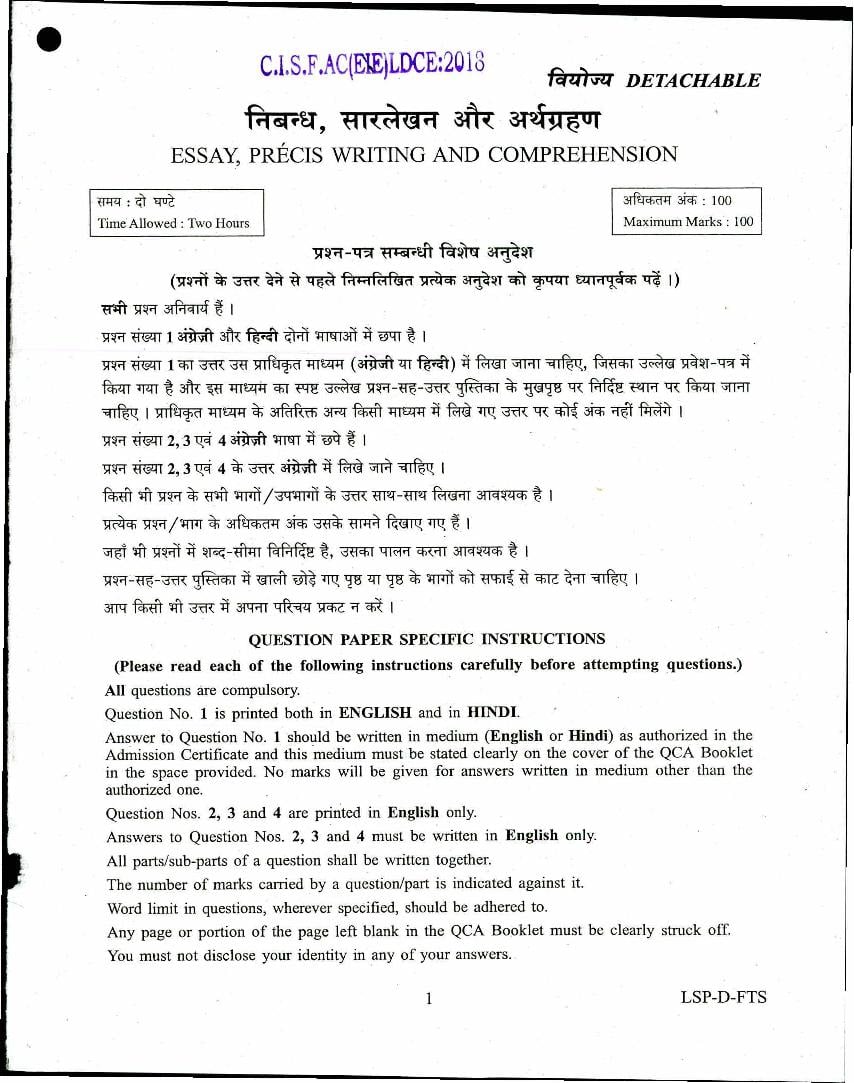
ESSAY, PRECIS WRITING AND COMPREHENSION
: 100
Time Allowed ; Two Hours Maximum Marks : 100
(TT^'^f % ^ T l r ^ 3T^^T ttI I)
3rf^T^ I I
^ Tw 1 3 ^ # T t ?n^3rr w 11
TT?^ WTT 1 ^ ^ ( 3 T ^ TT f | ^ ) ^ f ^ ^^TTTT "srT%lT, "f^m^ ^
W t 3^ ^ m m ^ ^ 3^ ^ TSr^-'?Tf-^3^ ^fWchl % ^ ‘f^Tfe FTR ^ ^5fRT
1 meJTTT % 3TfM^ 3T^ m m ^ ^ ^ ^ 3T^ ^ 1tT ^ I
WTT 2, 3 TT# 4 3 T ^ mWT ^ ^ f I
2, 3 4 % ^3^ 3 T ^ ^ ^ ^ ^^rrfttT I
f ef t ^ ^ W f r % ^ 3 ^ H FT-m ?T f e T ^ 3 T T ^ ?^ t I
3T^ Fm% fen iT I I
^ ^ ^ ^T^-’^fkr t, t I
TT^i-^-W-"^ ^ w t ^ tttt Tjig in ^ % m^rr ^ %w ^ "^r%q i
3TTT 1 ^ ^ ^ 3TW TT^ ^ ^ I
QUESTION PAPER SPECIFIC INSTRUCTIONS
(Please read each of the following instructions carefully before attempting questions.)
All questions are compulsory.
Question No. 1 is printed both in ENGLISH and in HINDI.
Answer to Question No. 1 should be written in medium (English or Hindi) as authorized in the
Admission Certificate and this medium must be stated clearly on the cover of the QCA Booklet
in the space provided. No marks will be given for answers written in medium other than the
authorized one.
Question Nos. 2, 3 and 4 are printed in English only.
Answers to Question Nos. 2, 3 and 4 must be written in English only.
All parts/sub-parts of a question shall be written together.
The number of marks carried by a question/part is indicated against it.
Word limit in questions, wherever specified, should be adhered to.
Any page or portion of the page left blank in the QCA Booklet must be clearly struck off.
You must not disclose your identity in any of your answers.
1 LSP-D-FTS
Page 2
(a ) m ^ -iv R T i^ ir ^ 3 T T f^ O T R I
(b ) ^ ^^TT ^ T % ^ 3 ff ^ 3 ? ^ I
(c) ^ 3 f t % #j[IT ^^TT ^ 3tPi^ # ^STPft
1
(d) ^.anf.'Tt. ^‘^ fd aft?: ^ 3ttit 3tt^ ^ I
(e) yfdf^ ^ t 1
Write an essay in about 500 words on any one of the following topics :
(a) India-Israel Relations : Its Political and Economic implications for India.
(b) Abolition of Triple Talaq and its likely impact on the status of Muslim
Women.
(c) Drafting in the Security Forces for at least three years should be made
mandatory for the Indian Youth.
(d) VIP culture in India and the problems faced by the common man.
(e) Adversity is the touchstone of Character.
2. Write a precis of the following passage by reducing it to one-third of its length.
Failure to adhere to the word limit may result in deduction of marks. Do not
suggest any title. The precis must be written on the space provided for it : 20
One o f the advantages of youth is that you may indulge yourself in the wildest of
fantasies. When I was young, I was an avid comic-book reader. You might say I was
a fanatic, wherever I went, my comics went with me. I anxiously awaited every new
issue. My super-heroes depicted adventurous deeds that I could easily identify
with. Their experiences were for me, at the age of ten, very.real. I portrayed,
moreover, every character that I read.
Everyone of them was capable of performing super human acts. Each was unique,
possessing specialized powers. Some were able to fly, to become invisible, or to
change their form, and some had strength far beyond that of mortals. Each super
hero was easily identifiable by his name and costume, which added to the story line
o f the particular plot.
LSP-D-FTS 2 .
Page 3
reading my favourite comic Spider Man. Nearby some rocks towered above me. I
instantly sensed danger and immediately scaled the rocks as the “wild web slinger”.
When I reached the top, my “spider sense” was tingling. I found myself face to face
with my arch enemy, “The Lizard”. We immediately became locked in a ferocious
hand-to-hand, life-to-death struggle. A large crowd gathered below, watching in
suspense. 1 blinded the reptilian creature with a face full of web. With a swift kick,
I knocked him off the cliff in defeat.
It seemed as if I was continually reprimanded for living vicariously. My mother, as
all mothers, was always concerned for my well-being. She apparently misconstrued
my mysterious behaviour. She also, however, seemed to possess the understanding
and the realization that one day 1 would outgrow it.
All of my allowance was used to purchase comic books. On many occasions I had
my comic book in class. I would secretly place the comic in a text and read and
dream while the class was in session. Although I managed to maintain a normal
class standard, 1 had to expend more effort while dividing myself between two
worlds. My teacher was suspicious of my actions and thus felt I was not giving my
all. She felt I had a better academic potential than I was showing, and she
periodically referred me to the dean for special counselling.
I recall that once in my sixth-grade math class I was very bored. In the next
moment, I was Doctor Bruce Banner, walking the streets of New York. Suddenly
people were running toward me in panic. They were screaming hysterically, fearing
for their lives. They were running from a monster terrorizing the city. I, too, started
to run away, but I was thrown to the ground by the crowd and lay helpless as the
monster approached. With my heartbeat ever increasing, I knew that transformation
would soon occur. Inseconds, I was eight feet tall, with green skin and solid
muscle. Doctor Bruce Banner once again became the Incredible Hulk.
In this period of my life, I did not have the same interest as my friends. As my
friends emulated their sports heroes, I had my super-heroes. Sometimes, in the
midst of a game, 1 would be criticized for my lack of attention. I would let a ball
slip by me, or I would miss a throw. This angered my teammates as it sometimes
led to the loss of a game.
Despite any obstaclesplaced before me, I persevered. My world was filled with
fantasy, andsuper-heroes fired my imagination with adventure. Over the years,
I have retained my vivid imagination. However, I now apply it to more practical
ends. (612 words)
3 LSP-D-FTS
Page 4
that follow, in your own words : 4x5=20
Recently 1 was informed that my seven-year-old daughter, Geri Anne, was having
difficulty in school. Her trouble stemmed from her inability to grasp learning how
to read by the use of phonics. My initial reaction was to take the child out of public
school and place her in a private one. I had always believed that the teachers
employed by the New York City Board of Education were only overpaid and
overglorified baby-sitters. This idea was reinforced when 1 visited my daughter’s
class last year and the teacher calmly walked out of the class to go to the bathroom,
neglecting to separate two little boys who had their hands around each other’s
throats.
Through speaking to one of the mothers, however, I found out that the school was
equipped to handle children with learning disabilities in a place called the
“resource” room. This room is equipped with games and toys geared especially for
children who have problems in leaming. There is also a teacher who is specially
trained to handle this type of situation. The children are taught in small groups of
five, and each child is given individual attention.
The problem with this system is that just any child cannot qualify for the resource
room. Because of the limit placed on the number of children in a group and the lack
of funds to pay for additional teachers, only a select few can benefit.
Immediately, I made an appointment with Mrs. Schwartz, the principal, and she
agreed that Geri Anne might be a candidate for this program, but I would have to
sign some forms before she could be tested. She also told me that enrolling her in
the resource room was the least she could do to help Geri Anne.
A couple of days later, I received a letter giving me an appointment with
Mrs. Linden, a social worker who would explain what the tests entailed. I then met
Mrs. Schulman, another social worker, who interviewed me about my background
and about Geri Anne’s previous experiences in school. Ironically, as a child I also
had difficulty in leaming how to read, and Mrs. Schulman explained that sometimes
this type of problem can be inherited. I was then informed that the tests would be
given within a thirty-day period and that the results were to be available to me.
LSP-D-FTS 4
Page 5
psychologist interviewed her to evaluate her emotional state and to determine if her
problem was caused by an emotional upset, becausc if a child has a high anxiet>'
level, she will sometimes test poorly. After her interview, Geri Anne was given a
test to detect if there is a malfunction in her visual perception. She was given a
series of blocks in a certain sequence and was asked to dupHcate it to detect if
there is a reversal in her seeing the letters, which would give her difficulty in
seeing and forming new words. Another test was performed to diagnose any visual
problems through hand-and-eye co-ordination.
So far, these have been the only tests given to Geri Anne, but there are still more
in the series. I was also informed that an equivalent test is given at Long Island
Jewish Hospital for a high fee.
Since our first phone conversation, Geri Anne’s teacher has called me in the
evening at least seven times to report her progress.
I do not know if Geri Anne’s problem can be solved by this program, but I do know
that 1 now believe that the taxes I am paying in New York City are not just being
thrown away on overpaid teachers and the city school system is still, as far as I am
concerned, one of the finest you could ask for.
Answer the following questions in your own words :
3.(a) What accounted for the writer’s immediate reaction to his child’s problem ?
4
3.(b) Mention three ways in which the school was capable of giving training to
children with leaming disabilities. . 4
3.(c) Describe the process through which admittance of Geri Anne was determined. 4
3.(d) Explain in the context of the passage the meaning of the expression :
“...... was equipped to handle children with leaming disabilities.” 4
3.(e) Why did the writer later change his opinion about teachers being overpaid and
overglorified baby-sitters ? 4
5 LSP-D-FTS
Page 6
that follow, in your own words : 4x5=20
Having pointed out what sort of company you should keep, I will now give you
some rules for your conduct in it : rules in which my own experience and
observation enable me to lay down and communicate to you with some degree of
confidence. I have often given you hints of this kind before, but then it has been
by snatches; I will now be more regular and methodical. I shall say nothing with
regard to your bodily carriage and address, but leave them to the care of your
dancing-master, and to your own attention to the best models : remember, however,
that they are of consequence.
Talk often, but never long; in that case, if you do not please, at least you are
sure not to tire your hearers. Pay your own reckoning, but do not treat the
whole company; this being one of the very few cases in which people do not
care to be treated, every one being fully convinced that he has wherewithal to pay.
Tell stories very seldom, and absolutely never but where they are very apt, and
very short. Omit every circumstance that is not material, and beware of digressions.
To have frequent recourse to narrative betrays great want of imagination.
Never hold anybody by the button, or the hand, in order to be heard out;- for, if
people are not willing to hear you, you had much better hold your tongue than them.
Most long talkers single out some one unfortunate man in company (commonly
him whom they observe to be the most silent, or their next neighbour) to whisper,
or at least, in a half voice, to convey a continuity of words to. This is excessively
ill-bred, and, in some degree, a fraud; conversation-stock being a joint and common
property. But, on the other hand, if one of these unmerciful talkers lays hold of
you, hear him with patience, and at least seeming attention, if he is worth obliging;
for nothing will oblige him more than a patient hearing, as nothing would hurt
him more than either to leave him in the midst of his discourse, or to discover your
impatience under your affliction.
Take, rather than give, the tone of the company you are in. If you have parts, you
will show them, more or less, upon every subject; and, if you have not, you had
better talk sillily upon a subject of other people’s than of your own choosing.
LSP-D-FTS
Page 7
conversations; which, though they should not, yet certainly do, indispose, for a
time, the contending parties towards each other; and, if the controversy grows warm
and noisy, endeavour to put an end to it by some genteel levity or joke.
Above all things, and upon all occasions, avoid speaking of yourself, if it be
possible. Such is the natural pride and vanity of our hearts, that it perpetually breaks
out, even in people of the best parts, in all the various modes and figures of
egotism.
Answer the following questions in your own words :
4.(a) Why should one not talk for a long time while conversing with others ? 4
4.(b) What is the main weakness of “long talkers” and how should it be dealt with?
4
4.(c) Why should one not speak about oneself ? 4
4.(d) Explain the statement “Take rather than give, the tone of the company you are in.”
4
4.(e) Make sentences with the following words used in the passage to bring out their
meaning: 4
(i) Reckon
(ii) Polemical
(iii) Genteel
(iv) Egotism
LSP-D-FTS
Document Details
| Board / Org | UPSC |
| Exam | UPSC CISF AC LDCE |
| Type | Question Paper |
| Pages | 7 |
| Updated | 22 Jul 2026 |