GATE 2025 Syllabus for Environmental Science & Engineering
Finished viewing? Save it for later —
Download GATE 2025 Syllabus for Environmental Science & Engineering (PDF · 4 pages)About GATE 2025 Syllabus for Environmental Science & Engineering
GATE 2025 Syllabus for Environmental Science & Engineering is available here for free download. Published by IIT for GATE, this syllabus can be viewed online or downloaded as a PDF (4 pages). Candidates preparing for GATE can use GATE 2025 Syllabus for Environmental Science & Engineering to understand the exam pattern, the type of questions asked, and the overall difficulty level.
Frequently Asked Questions
How can I download GATE 2025 Syllabus for Environmental Science & Engineering?
Open this page and click the Download button to save GATE 2025 Syllabus for Environmental Science & Engineering as a PDF. It is completely free on AglaSem Docs.
Is GATE 2025 Syllabus for Environmental Science & Engineering free to download?
Yes. GATE 2025 Syllabus for Environmental Science & Engineering can be viewed online and downloaded as a PDF free of cost on AglaSem Docs.
How many pages does GATE 2025 Syllabus for Environmental Science & Engineering have?
GATE 2025 Syllabus for Environmental Science & Engineering contains 4 pages, which you can read online or download together as a single PDF.
Where can I find more GATE study material?
You can find more GATE question papers, sample papers, syllabus, and answer keys on AglaSem Docs.
GATE 2025 Syllabus for Environmental Science & Engineering – Text
Read the full text of this syllabus below — useful to quickly search, copy and reference the content online without downloading the PDF.
📄 View text version (4 pages)
Page 1
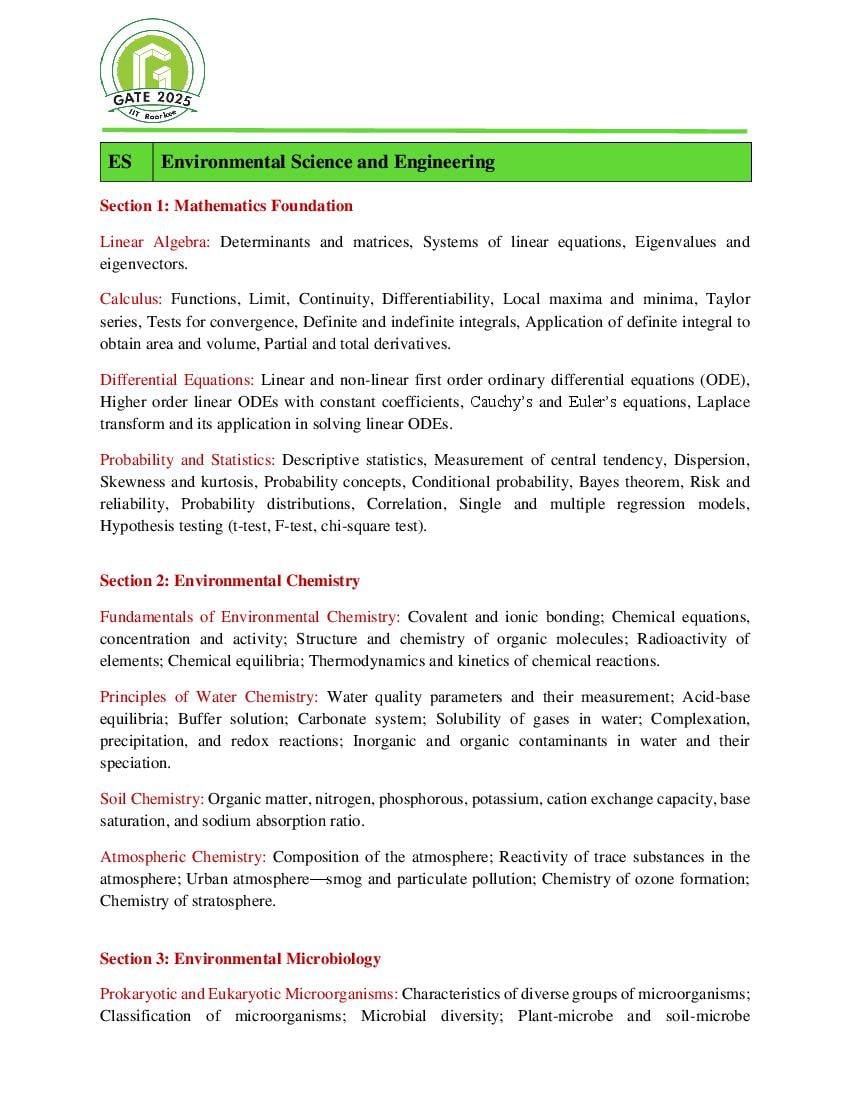
Section 1: Mathematics Foundation
Linear Algebra: Determinants and matrices, Systems of linear equations, Eigenvalues and
eigenvectors.
Calculus: Functions, Limit, Continuity, Differentiability, Local maxima and minima, Taylor
series, Tests for convergence, Definite and indefinite integrals, Application of definite integral to
obtain area and volume, Partial and total derivatives.
Differential Equations: Linear and non-linear first order ordinary differential equations (ODE),
Higher order linear ODEs with constant coefficients, Cauchy’s and Euler’s equations, Laplace
transform and its application in solving linear ODEs.
Probability and Statistics: Descriptive statistics, Measurement of central tendency, Dispersion,
Skewness and kurtosis, Probability concepts, Conditional probability, Bayes theorem, Risk and
reliability, Probability distributions, Correlation, Single and multiple regression models,
Hypothesis testing (t-test, F-test, chi-square test).
Section 2: Environmental Chemistry
Fundamentals of Environmental Chemistry: Covalent and ionic bonding; Chemical equations,
concentration and activity; Structure and chemistry of organic molecules; Radioactivity of
elements; Chemical equilibria; Thermodynamics and kinetics of chemical reactions.
Principles of Water Chemistry: Water quality parameters and their measurement; Acid-base
equilibria; Buffer solution; Carbonate system; Solubility of gases in water; Complexation,
precipitation, and redox reactions; Inorganic and organic contaminants in water and their
speciation.
Soil Chemistry: Organic matter, nitrogen, phosphorous, potassium, cation exchange capacity, base
saturation, and sodium absorption ratio.
Atmospheric Chemistry: Composition of the atmosphere; Reactivity of trace substances in the
atmosphere; Urban atmosphere—smog and particulate pollution; Chemistry of ozone formation;
Chemistry of stratosphere.
Section 3: Environmental Microbiology
Prokaryotic and Eukaryotic Microorganisms: Characteristics of diverse groups of microorganisms;
Classification of microorganisms; Microbial diversity; Plant-microbe and soil-microbe
Page 2
cycling.
Cell Chemistry and Cell Biology: Structure of proteins, nucleic acid (DNA & RNA), lipids and
polysaccharides; Bonds in biomolecules; Stereoisomerism in biomolecules; Structure of cell;
Structure and function of cytoplasmic membrane, cell wall, outer membrane, glycocalyx,
chromosomes, endospores, storage products, mitochondria and chloroplasts.
Microbial Metabolism: Anabolism and catabolism; Phosphorylation; Glycolysis; TCA cycle;
Electron transport chain; Fermentation; Anaerobic respiration; Energy balances; Enzymes and
Enzyme kinetics.
Growth and Control of Microorganisms: Bacterial nutrition and growth; Specific growth rate and
doubling time; Monod’s model; Types of culture media; Batch and continuous culture; Effects of
environmental factors on growth; Control of microbes using physical and chemical methods.
Microbiology and Health: Pathogens and modes of transmission; Indicator organisms;
Quantification of coliforms using MPN and membrane filtration techniques.
Section 4: Water Resources and Environmental Hydraulics
Global Water Resources: Structure, properties and distribution of water; Water quality; Threats to
water resources; Water conservation.
Surface Water Resources: Hydrological cycle and water balance - precipitation, infiltration,
evapotranspiration, runoff; Flow hydrographs; Unit hydrographs; Stage-discharge relationship;
Reservoir capacity; Reservoir and channel routing; Surface run-off models; Surface water
management; Rain water harvesting and storage.
Groundwater Resources: Geologic formations as aquifers; Vadose and saturated zones; Confined
and unconfined aquifers and their parameters - porosity, permeability, transmissivity and storage
coefficient; Darcy’s law and applications; Steady state well hydraulics.
Environmental Hydraulics: Concepts of mechanics; Properties of fluids; Pressure measurement;
Hydrostatic force on surfaces; Buoyancy and flotation; Laminar and turbulent flow; Flow through
pipes; Pipe networks; Boundary layer theory; Forces on immersed bodies; Flow measurement in
channels and pipes; Kinematics of flow; Continuity, momentum and energy equations; Channel
hydraulics - specific energy, critical flow, hydraulic jump, rapid and gradually varied flow; Design
of lined and unlined channels.
Section 5: Water & Wastewater Treatment and Management
Water and wastewater quality parameters; Eutrophication and thermal stratification in lakes; River
pollution - Oxygen sag curve.
Page 3
desalination, disinfection; Water distribution and storage
Point and non-point sources of wastewater; Population forecasting methods; Design of sewer and
storm water sewers; Sewer appurtenances; Preliminary, primary, secondary and tertiary sewage
treatment; Sludge generation, processing and disposal methods; Sewage farming.
Sources and characteristics of industrial effluents; Concept of Common Effluent Treatment Plants
(CETP); Wastewater recycling and zero liquid discharge.
Kinetics and reactor design: Mass and energy balance, Order and rate of reactions, Batch reactors,
Completely mixed flow reactors, Plug flow reactors.
Section 6: Air and Noise Pollution
Structure of the atmosphere; Natural and anthropogenic sources of pollution; Atmospheric sources,
sinks, transport; Indoor air pollution; Effects on health and environment; Air pollution: gases and
particulate matter; Air quality standards; Primary and secondary pollutants; Criteria pollutants,
ambient and source standards, air quality indices, visibility.
Particulate Pollutants: Measurement and control methods; Control of particulate air pollutants
using gravitational settling chambers, cyclone separators, wet collectors, fabric filters (Bag-house
filter), electrostatic precipitators (ESP).
Gaseous Pollutants: Measurement and control methods; Control of gaseous contaminants:
absorption, adsorption, condensation and combustion; Control of sulphur oxides, nitrogen oxides,
carbon monoxide, and hydrocarbons; Vapour-liquid and vapour-solid equilibria; Diffusion, Fick’s
law and interfacial mass transfer. Automotive emission controls, fuel quality, diesel particulate
filters, catalytic convertors.
Air Quality Management: Point, line and area sources; Inventory; Influence of meteorology - wind
rose diagrams, stability, mixing height, topography, dispersion modelling, monitoring.
Noise Pollution: Sources; Health effects; Standards; Measurement and control methods.
Section 7: Solid and Hazardous Waste Management
Integrated solid waste management; Waste hierarchy; Rules and regulations for solid waste
management in India.
Municipal solid waste management: Sources, generation, characteristics, collection and
transportation, waste processing and disposal (including reuse options, biological methods, energy
recovery processes and landfilling).
Hazardous waste management: Characteristics, generation, fate of materials in the environment,
treatment and disposal. Soil contamination and leaching of contaminants into groundwater.
Page 4
characteristics; Waste management practices including storage, collection and transfer.
Section 8: Global and Regional Environmental Issues
Global effects of air pollution: Greenhouse gases, global warming, climate change, urban heat
islands, acid rain, ozone hole.
Ecology and various ecosystems; Biodiversity; Factors influencing increase in population, energy
consumption, and environmental degradation.
Section 9: Environmental Management and Sustainable Development
Environmental Management Systems; ISO14000 series; Environmental Auditing: Environmental
Impact Assessment; Life cycle assessment; Human health risk assessment.
Environmental Law and Policy: Objectives; Polluter pays principle, Precautionary principle; The
Water and Air Acts with amendments; The Environment (Protection) Act (EPA) 1986; National
Green Tribunal Act, 2010; National Environment Policy; Principles of International Law and
International treaties.
Energy and Environment: Energy Sources: Overview of resources and reserves; Renewable and
non-renewable energy sources; Energy-Environment nexus.
Sustainable Development: Definition and concepts of sustainable development; Sustainable
development goals; Hurdles to sustainability; Environment and economics.
Document Details
| Board / Org | IIT |
| Exam | GATE |
| Type | Syllabus |
| Pages | 4 |
| Updated | 01 May 2026 |