GATE 2025 Syllabus for Engineering Sciences
Finished viewing? Save it for later —
Download GATE 2025 Syllabus for Engineering Sciences (PDF · 26 pages)About GATE 2025 Syllabus for Engineering Sciences
GATE 2025 Syllabus for Engineering Sciences is available here for free download. Published by IIT for GATE, this syllabus can be viewed online or downloaded as a PDF (26 pages). Candidates preparing for GATE can use GATE 2025 Syllabus for Engineering Sciences to understand the exam pattern, the type of questions asked, and the overall difficulty level.
Frequently Asked Questions
How can I download GATE 2025 Syllabus for Engineering Sciences?
Open this page and click the Download button to save GATE 2025 Syllabus for Engineering Sciences as a PDF. It is completely free on AglaSem Docs.
Is GATE 2025 Syllabus for Engineering Sciences free to download?
Yes. GATE 2025 Syllabus for Engineering Sciences can be viewed online and downloaded as a PDF free of cost on AglaSem Docs.
How many pages does GATE 2025 Syllabus for Engineering Sciences have?
GATE 2025 Syllabus for Engineering Sciences contains 26 pages, which you can read online or download together as a single PDF.
Where can I find more GATE study material?
You can find more GATE question papers, sample papers, syllabus, and answer keys on AglaSem Docs.
GATE 2025 Syllabus for Engineering Sciences – Text
Read the full text of this syllabus below — useful to quickly search, copy and reference the content online without downloading the PDF.
📄 View text version (26 pages)
Page 1
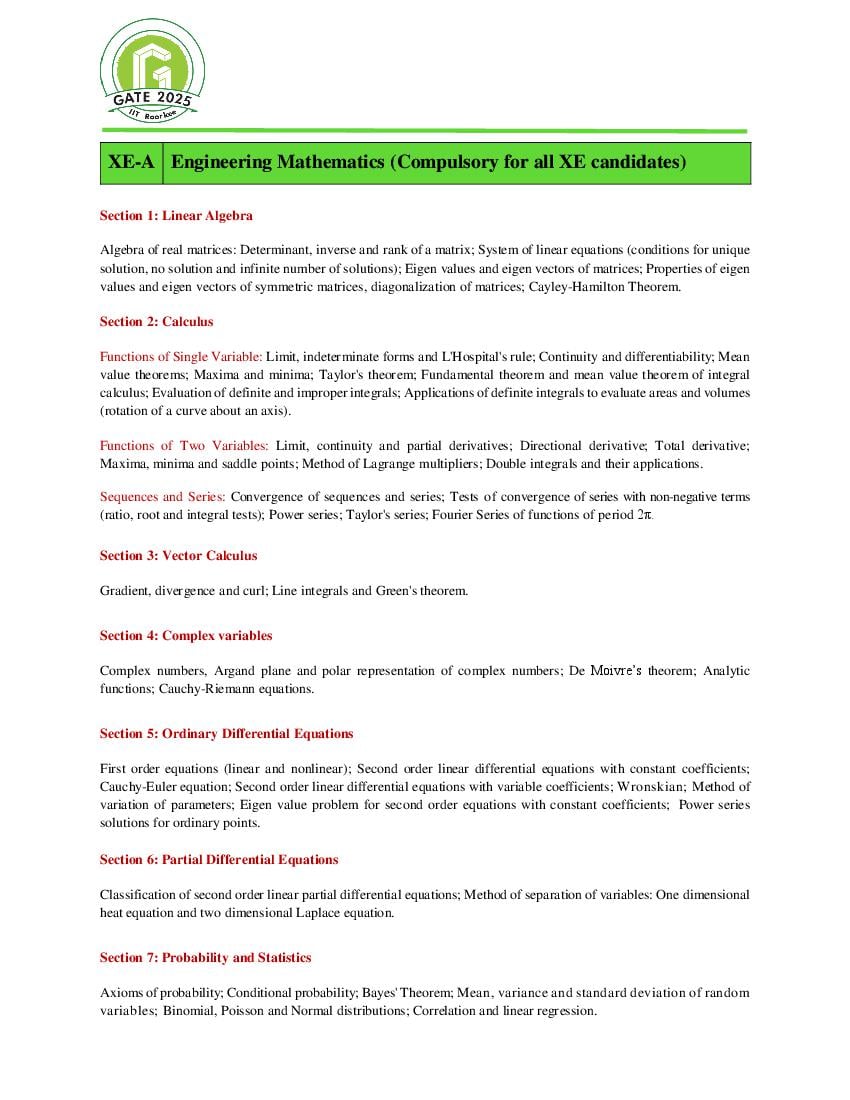
Section 1: Linear Algebra
Algebra of real matrices: Determinant, inverse and rank of a matrix; System of linear equations (conditions for unique
solution, no solution and infinite number of solutions); Eigen values and eigen vectors of matrices; Properties of eigen
values and eigen vectors of symmetric matrices, diagonalization of matrices; Cayley-Hamilton Theorem.
Section 2: Calculus
Functions of Single Variable: Limit, indeterminate forms and L'Hospital's rule; Continuity and differentiability; Mean
value theorems; Maxima and minima; Taylor's theorem; Fundamental theorem and mean value theorem of integral
calculus; Evaluation of definite and improper integrals; Applications of definite integrals to evaluate areas and volumes
(rotation of a curve about an axis).
Functions of Two Variables: Limit, continuity and partial derivatives; Directional derivative; Total derivative;
Maxima, minima and saddle points; Method of Lagrange multipliers; Double integrals and their applications.
Sequences and Series: Convergence of sequences and series; Tests of convergence of series with non-negative terms
(ratio, root and integral tests); Power series; Taylor's series; Fourier Series of functions of period 2π.
Section 3: Vector Calculus
Gradient, divergence and curl; Line integrals and Green's theorem.
Section 4: Complex variables
Complex numbers, Argand plane and polar representation of complex numbers; De Moivre’s theorem; Analytic
functions; Cauchy-Riemann equations.
Section 5: Ordinary Differential Equations
First order equations (linear and nonlinear); Second order linear differential equations with constant coefficients;
Cauchy-Euler equation; Second order linear differential equations with variable coefficients; Wronskian; Method of
variation of parameters; Eigen value problem for second order equations with constant coefficients; Power series
solutions for ordinary points.
Section 6: Partial Differential Equations
Classification of second order linear partial differential equations; Method of separation of variables: One dimensional
heat equation and two dimensional Laplace equation.
Section 7: Probability and Statistics
Axioms of probability; Conditional probability; Bayes' Theorem; Mean, variance and standard deviation of random
variables; Binomial, Poisson and Normal distributions; Correlation and linear regression.
Page 2
Solution of systems of linear equations using LU decomposition, Gauss elimination method; Lagrange and Newton's
interpolations; Solution of polynomial and transcendental equations by Newton-Raphson method; Numerical
integration by trapezoidal rule and Simpson's rule; Numerical solutions of first order differential equations by explicit
Euler's method.
Page 3
Section 1: Flow and Fluid Properties
Fluid Properties: Density, viscosity, surface tension, relationship between stress and strain-rate for Newtonian fluids.
Classification of Flows: Viscous versus inviscid flows, incompressible versus compressible flows, internal versus
external flows, steady versus unsteady flows, laminar versus turbulent flows, 1-D, 2-D and 3-D flows, Newtonian
versus non-Newtonian fluid flow.
Hydrostatics: Buoyancy, manometry, forces on submerged bodies and its stability.
Section 2: Kinematics of Fluid Motion
Eulerian and Lagrangian descriptions of fluid motion. Concept of local, convective and material derivatives.
Streamline, streakline, pathline and timeline.
Section 3: Integral Analysis for a Control Volume
Reynolds Transport Theorem (RTT) for conservation of mass, linear and angular momentum.
Section 4: Differential Analysis
Differential equations of mass and momentum for incompressible flows.
Inviscid flows - Euler equations and viscous flows - Navier-Stokes equations.
Concept of fluid rotation, vorticity, stream function and circulation.
Exact solutions of Navier-Stokes equations for Couette flow and Poiseuille flow, thin film flow.
Section 5: Dimensional Analysis
Concept of geometric, kinematic and dynamic similarity.
Buckingham Pi theorem and its applications.
Non-dimensional parameters and their physical significance - Reynolds number, Froude number and Mach number.
Section 6: Internal Flows
Fully developed pipe flow.
Empirical relations for laminar and turbulent flows: friction factor, Darcy-Weisbach relation and Moody’s chart.
Major and minor losses.
Section 7: Bernoulli’s Equation and its Applications, Potential Flows
Bernoulli’s Equation: Assumptions and applications.
Flow measurements - Venturi meter, Pitot-static tube and orifice meter.
Page 4
Uniform flow, source, sink and vortex, and their superposition for flow past simple geometries.
Section 8: External Flows
Prandtl Boundary Layer Equations: Concept and assumptions.
Boundary Layer Characteristics: Boundary layer thickness, displacement thickness and momentum thickness.
Qualitative idea of boundary layer separation, streamlined and bluff bodies, and drag and lift forces.
Page 5
1: Classification and Structure of Materials
Classification of Materials: Metals, ceramics, polymers and composites.
Nature of Bonding in Materials: Metallic, ionic, covalent and mixed bonding; structure of materials: fundamentals of
crystallography, symmetry operations, crystal systems, Bravais lattices, unit cells, primitive cells, crystallographic
planes and directions; structures of metals, ceramics, polymers, amorphous materials and glasses.
Defects in Crystalline Materials: 0-D, 1-D and 2-D defects; vacancies, interstitials, solid solutions in metals and
ceramics, Frenkel and Schottky defects; dislocations; grain boundaries, twins, stacking faults; surfaces and interfaces.
2: Thermodynamics, Kinetics and Phase Transformations
Extensive and intensive thermodynamic properties, laws of thermodynamics, phase equilibria, phase rule, phase
diagrams (unary and binary), basic electrochemistry.
Reaction kinetics, fundamentals of diffusion, Fick’s laws, their solutions and applications.
Solidification of pure metals and alloys, nucleation and growth, diffusional solid-state phase transformations
(precipitation and eutectoid), martensitic transformation.
3: Properties and Applications of Materials
Mechanical properties of metals, ceramics, polymers and composites at room temperature; stress-strain response
(elastic, anelastic and plastic deformation).
Electronic Properties: Free electron theory, Fermi energy, density of states, elements of band theory, semiconductors,
Hall effect, dielectric behaviour, piezo- and ferro-electric behaviour.
Magnetic Properties: Origin of magnetism in materials, para-, dia-, ferro- and ferri-magnetism.
Thermal Properties: Specific heat, heat conduction, thermal diffusivity, thermal expansion, and thermoelectricity.
Optical Properties: Refractive index, absorption and transmission of electromagnetic radiation.
Examples of materials exhibiting the above properties, and their typical/common applications.
4: Characterization and Measurements of Properties
X-ray diffraction; spectroscopic techniques such as UV-Vis, IR and Raman; optical microscopy, electron microscopy,
composition analysis in electron microscopes. Tensile test, hardness measurement. Electrical conductivity, carrier
mobility and concentrations. Thermal analysis techniques: thermogravimetry and calorimetry.
5: Processing of Materials
Heat treatment of ferrous and aluminium alloys; preparation of ceramic powders, sintering; thin film deposition:
evaporation and sputtering techniques, and chemical vapour deposition, thin film growth phenomena.
Degradation of Materials
Corrosion and its prevention; embrittlement of metals; polymer degradation.
Page 6
Section 1: Mechanics of rigid bodies
Equivalent force systems; free-body diagrams; equilibrium equations; analysis of determinate trusses and frames;
friction; principle of minimum potential energy; particle kinematics and dynamics; dynamics of rigid bodies under
planar motion; law of conservation of energy; law of conservation of momentum.
Section 2: Mechanics of deformable bodies
Stresses and strains; transformation of stresses and strains, principal stresses and strains; Mohr’s circle for plane stress
and plane strain; generalized Hooke’s Law; elastic constants; thermal stresses; theories of failure.
Axial force, shear force and bending moment diagrams; axial, shear and bending stresses; combined stresses;
deflection (for symmetric bending); torsion in circular shafts; thin walled pressure vessels; energy methods
(Castigliano’s theorems); Euler buckling.
Section 3: Vibrations
Free vibration of undamped single degree of freedom systems.
Page 7
Section 1: Basic Concepts
Continuum and macroscopic approach; thermodynamic systems (closed and open); thermodynamic properties and
equilibrium; state of a system, state postulate for simple compressible substances, state diagrams, paths and processes
on state diagrams; concepts of heat and work, different modes of work; zeroth law of thermodynamics; concept of
temperature.
Section 2: First Law of Thermodynamics
Concept of energy and various forms of energy; internal energy, enthalpy; specific heats; first law applied to
elementary processes, closed systems and control volumes, steady and unsteady flow analysis.
Section 3: Second Law of Thermodynamics
Limitations of the first law of thermodynamics, concepts of heat engines and heat pumps/refrigerators, Kelvin-Planck
and Clausius statements and their equivalence; reversible and irreversible processes; Carnot cycle and Carnot
principles/theorems; thermodynamic temperature scale; Clausius inequality and concept of entropy; microscopic
interpretation of entropy, the principle of increase of entropy, T-s diagrams; second law analysis of control volume;
availability and irreversibility; third law of thermodynamics.
Section 4: Properties of Pure Substances
Thermodynamic properties of pure substances in solid, liquid and vapor phases; PvT behaviour of simple compressible
substances, phase rule, thermodynamic property tables and charts, ideal and real gases, ideal gas equation of state and
van der Waals equation of state; law of corresponding states, compressibility factor and generalized compressibility
chart.
Section 5: Thermodynamic Relations
TdS relations, Helmholtz and Gibbs functions, Gibbs relations, Maxwell relations, Joule-Thomson coefficient,
coefficient of volume expansion, adiabatic and isothermal compressibilities, Clapeyron and Clapeyron-Clausius
equations.
Section 6: Thermodynamic Cycles
Carnot vapor cycle, ideal Rankine cycle, Rankine reheat cycle, air-standard Otto cycle, air-standard Diesel cycle, air-
standard Brayton cycle, vapor-compression refrigeration cycle.
Section 7: Ideal Gas Mixtures
Dalton’s and Amagat’s laws, properties of ideal gas mixtures, air-water vapor mixtures and simple thermodynamic
processes involving them; specific and relative humidities, dew point and wet bulb temperature, adiabatic saturation
temperature, psychrometric chart.
Page 8
Section 1: Chemistry of High Polymers
Monomers, functionality, degree of polymerizations, classification of polymers, glass transition, melting transition,
criteria for rubberiness, polymerization methods: addition and condensation; their kinetics, metallocene polymers and
other newer methods of polymerization, copolymerization, monomer reactivity ratios and its significance, kinetics,
different copolymers, random, alternating, azeotropic copolymerization, block and graft copolymers, techniques for
polymerization-bulk, solution, suspension, emulsion. Concept of intermolecular order (morphology) – amorphous,
crystalline, orientation states. Factor affecting crystallinity. Crystalline transition. Effect of morphology on polymer
properties.
Section 2: Polymer Characterization
Solubility and swelling, Concept of molecular weight distribution and its significance, concept of average molecular
weight, determination of number average, weight average, viscosity average and Z-average molecular weights,
polymer crystallinity, analysis of polymers using IR, XRD, thermal (DSC, DMTA, TGA), microscopic (optical and
electronic) techniques, Molecular wt. distribution: Broad and Narrow, GPC, Mooney viscosity.
Section 3: Synthesis, Manufacturing and Properties
Commodity and general purpose thermoplastics: PE, PP, PS, PVC, Polyesters, Acrylic, PU polymers. Engineering
Plastics: Nylon, PC, PBT, PSU, PPO, ABS, Fluoropolymers Thermosetting polymers: Polyurethane, PF, MF, UF,
Epoxy, Unsaturated polyester, Alkyds. Natural and synthetic rubbers: Recovery of NR hydrocarbon from latex; SBR,
Nitrile, CR, CSM, EPDM, IIR, BR, Silicone, TPE, Speciality plastics: PEK, PEEK, PPS, PSU, PES, etc. Biopolymers
such as PLA, PHA/PHB.
Section 4: Polymer Blends and Composites
Difference between blends and composites, their significance, choice of polymers for blending, blend miscibility-
miscible and immiscible blends, thermodynamics, phase morphology, polymer alloys, polymer eutectics, plastic-
plastic, rubber-plastic and rubber-rubber blends, FRP, particulate, long and short fibre reinforced composites. Polymer
reinforcement, reinforcing fibres – natural and synthetic, base polymer for reinforcement (unsaturated polyester),
ingredients / recipes for reinforced polymer composite.
Section 5: Polymer Technology
Polymer compounding-need and significance, different compounding ingredients for rubber and plastics
(Antioxidants, Light stabilizers, UV stabilizers, Lubricants, Processing aids, Impact modifiers, Flame retardant,
antistatic agents. PVC stabilizers and Plasticizers) and their function, use of carbonblack, polymer mixing equipments,
cross-linking and vulcanization, vulcanization kinetics.
Section 6: Polymer Rheology
Flow of Newtonian and non-Newtonian fluids, different flow equations, dependence of shear modulus on temperature,
molecular/segmental deformations at different zones and transitions. Measurements of rheological parameters by
capillary rotating, parallel plate, cone-plate rheometer. Visco-elasticity-creep and stress relaxations, mechanical
models, control of rheological characteristics through compounding, rubber curing in parallel plate viscometer, ODR
and MDR.
Page 9
Compression molding, transfer molding, injection molding, blow molding, reaction injection molding, filament
winding, SMC, BMC, DMC, extrusion, pultrusion, calendaring, rotational molding, thermoforming, powder coating,
rubber processing in two-roll mill, internal mixer, twin screw extruder.
Section 8: Polymer Testing
Mechanical-static and dynamic tensile, flexural, compressive, abrasion, endurance, fatigue, hardness, tear, resilience,
impact, toughness. Conductivity-thermal and electrical, dielectric constant, dissipation factor, power factor, electric
resistance, surface resistivity, volume resistivity, swelling, ageing resistance, environmental stress cracking resistance,
limiting oxygen index. Heat deflection temperature – Vicat softening temperature, Brittleness temperature, Glass
transition temperature, Co-efficient of thermal expansion, Shrinkage, Flammability, dielectric constant, dissipation
factor, power factor, Optical Properties - Refractive Index, Luminous Transmittance and Haze, Melt flow index.
Section 9: Polymer Recycling and Waste management
Polymer waste, and its impact on environment, Sources, Identification and Separation techniques, recycling
classification, recycling of thermoplastics, thermosets and rubbers, applications of recycled materials. Life cycle
assessment of polymer products (case studies like PET bottles, packaging bags).
Page 10
Section 1: Food Chemistry and Nutrition
Carbohydrates: Structure and functional properties of mono-, oligo-, & poly- saccharides including starch, cellulose,
pectic substances and dietary fibre, gelatinization and retrogradation of starch.
Proteins: classification and structure of proteins in food, biochemical changes in post mortem and tenderization of
muscles.
Lipids: Classification and structure of lipids, rancidity, polymerization and polymorphism.
Pigments: carotenoids, chlorophylls, anthocyanins, tannins and myoglobin.
Food Flavours: Terpenes, esters, aldehydes, ketones and quinines. Enzymes: specificity, simple and inhibition
kinetics, coenzymes, enzymatic and non- enzymatic browning.
Nutrition: Balanced diet, essential amino acids and essential fatty acids, protein efficiency ratio, water soluble and fat
soluble vitamins, role of minerals in nutrition, co-factors, anti-nutrients, nutraceuticals, nutrient deficiency diseases.
Chemical and Biochemical Changes: Changes occurring in foods during different processing.
Section 2: Food Microbiology
Characteristics of Microorganisms: Morphology of bacteria, yeast, mold and actinomycetes, spores and vegetative
cells, gram-staining.
Microbial Growth: Growth and death kinetics, serial dilution technique.
Food Spoilage: Spoilage microorganisms in different food products including milk, fish, meat, egg, cereals and their
products.
Toxins from Microbes: Pathogens and non-pathogens including Staphylococcus, Salmonella, Shigella, Escherichia,
Bacillus, Clostridium, and Aspergillus genera.
Fermented Foods and Beverages: Curd, yoghurt, cheese, pickles, soya-sauce, sauerkraut, idli, dosa, vinegar, alcoholic
beverages and sausage.
Section 3: Food Products Technology
Processing Principles: Thermal processing, chilling, freezing, dehydration, addition of preservatives and food
additives, irradiation, fermentation, hurdle technology, intermediate moisture foods. Food pack aging and storage:
packaging materials, aseptic packaging, controlled and modified atmosphere storage. Cereal processing and products:
milling of rice, wheat, and maize, parboiling of paddy, bread, biscuits, extruded products and ready to eat breakfast
cereals.
Oil Processing: Expelling, solvent extraction, refining and hydrogenation.
Fruits and Vegetables Processing: Extraction, clarification, concentration and packaging of fruit juice, jam, jelly,
marmalade, squash, candies, tomato sauce, ketchup, and puree, potato chips, pickles.
Page 11
spices.
Milk and Milk Products Processing: Pasteurization and sterilization, cream, butter, ghee, ice- cream, cheese and milk
powder. Processing of animal products: drying, canning, and freezing of fish and meat; production of egg powder.
Waste Utilization: Pectin from fruit wastes, uses of by-products from rice milling. Food standards and quality: FPO,
PFA, A-Mark, ISI, HACCP, food plant sanitation and cleaning in place (CIP).
Section 4: Food Engineering
Mass and energy balance.
Momentum Transfer: Flow rate and pressure drop relationships for Newtonian fluids flowing through pipe, Reynolds
number. Heat transfer: heat transfer by conduction, convection, radiation, heat exchangers.
Mass Transfer: Molecular diffusion and Flick's law, conduction and convective mass transfer, permeability through
single and multilayer films.
Mechanical Operations: Size reduction of solids, high pressure homogenization, filtration, centrifugation, settling,
sieving, mixing & agitation of liquid. Thermal operations: thermal sterilization, evaporation of liquid foods, hot air
drying of solids, spray and freeze-drying, freezing and crystallization.
Mass Transfer Operations: Psychometric, humidification and dehumidification operations.
Page 12
Section A: Atmospheric Science
Vertical Structure and Composition of the Atmosphere; Blackbody Radiation and Radiation Balance; Modes of Heat
Transfer in the Atmosphere; Greenhouse Effect; Cloud Types; Laws of Thermodynamics; Gas Laws; Hydrostatic
Equation; Clausius Clapeyron Equation; Adiabatic Processes, Humidity in the Atmosphere, Atmospheric Stability;
Weather and Climate.
Navier-Stokes and Continuity Equations; Compressible and Incompressible Fluids; Pressure Gradient, Centripetal,
Centrifugal and Coriolis Forces; Geostrophic, Gradient and Cyclostrophic Balances; Circulations and Vorticity,
General Circulation of the Atmosphere. Broad Features of Indian Monsoons, Monsoon Depressions; Tropical
Convergence Zones; Tropical Cyclones.
Section B: Ocean Sciences
Vertical Profiles of Temperature and Salinity; Stability and Double Diffusion; Equation of State, Equations for
Conservation of Mass, Momentum, Heat and Salt; Inertial Currents; Geostrophic Motion; Air-Sea Surface Fluxes;
Wind-driven Circulation, Ekman and Sverdrup Transports; Storm Surges, Tides, Tsunamis and Wind Waves; Eddies
and Gyres; Eastern and Western Boundary Currents, Equatorial Currents, Indian Ocean Current Systems;
Thermohaline Circulation.
Chemical Properties of Seawater, Major and Minor Elements, Ocean Acidification, Biochemical Cycling of Nutrients,
Trace Metals and Organic Matter. Biological Pump; Primary and Secondary Biological Productivity; Air-sea
Exchange of Biogenic Dissolved Gases; Marine Ecology.
Page 13
Section 1: Linear Algebra
Algebra of real matrices: Determinant, inverse and rank of a matrix; System of linear equations
(conditions for unique solution, no solution and infinite number of solutions); Eigen values and
eigen vectors of matrices; Properties of eigen values and eigen vectors of symmetric matrices,
diagonalization of matrices; Cayley-Hamilton Theorem.
Section 2: Calculus
Functions of Single Variable: Limit, indeterminate forms and L'Hospital's rule; Continuity and
differentiability; Mean value theorems; Maxima and minima; Taylor's theorem; Fundamental
theorem and mean value theorem of integral calculus; Evaluation of definite and improper
integrals; Applications of definite integrals to evaluate areas and volumes (rotation of a curve about
an axis).
Functions of Two Variables: Limit, continuity and partial derivatives; Directional derivative; Total
derivative; Maxima, minima and saddle points; Method of Lagrange multipliers; Double integrals
and their applications.
Sequences and Series: Convergence of sequences and series; Tests of convergence of series with
non-negative terms (ratio, root and integral tests); Power series; Taylor's series; Fourier Series of
functions of period 2π.
Section 3: Vector Calculus
Gradient, divergence and curl; Line integrals and Green's theorem.
Section 4: Complex variables
Complex numbers, Argand plane and polar representation of complex numbers; De Moivre’s
theorem; Analytic functions; Cauchy-Riemann equations.
Section 5: Ordinary Differential Equations
First order equations (linear and nonlinear); Second order linear differential equations with constant
coefficients; Cauchy-Euler equation; Second order linear differential equations with variable
coefficients; Wronskian; Method of variation of parameters; Eigen value problem for second order
equations with constant coefficients; Power series solutions for ordinary points.
Page 14
Classification of second order linear partial differential equations; Method of separation of
variables: One dimensional heat equation and two dimensional Laplace equation.
Section 7: Probability and Statistics
Axioms of probability; Conditional probability; Bayes' Theorem; Mean, variance and standard
deviation of random variables; Binomial, Poisson and Normal distributions; Correlation and
linear regression.
Section 8: Numerical Methods
Solution of systems of linear equations using LU decomposition, Gauss elimination method;
Lagrange and Newton's interpolations; Solution of polynomial and transcendental equations by
Newton-Raphson method; Numerical integration by trapezoidal rule and Simpson's rule;
Numerical solutions of first order differential equations by explicit Euler's method.
Page 15
Section 1: Flow and Fluid Properties
Fluid Properties: Density, viscosity, surface tension, relationship between stress and strain-rate for
Newtonian fluids.
Classification of Flows: Viscous versus inviscid flows, incompressible versus compressible flows,
internal versus external flows, steady versus unsteady flows, laminar versus turbulent flows, 1-D,
2-D and 3-D flows, Newtonian versus non-Newtonian fluid flow.
Hydrostatics: Buoyancy, manometry, forces on submerged bodies and its stability.
Section 2: Kinematics of Fluid Motion
Eulerian and Lagrangian descriptions of fluid motion. Concept of local, convective and material
derivatives. Streamline, streakline, pathline and timeline.
Section 3: Integral Analysis for a Control Volume
Reynolds Transport Theorem (RTT) for conservation of mass, linear and angular momentum.
Section 4: Differential Analysis
Differential equations of mass and momentum for incompressible flows.
Inviscid flows - Euler equations and viscous flows - Navier-Stokes equations.
Concept of fluid rotation, vorticity, stream function and circulation.
Exact solutions of Navier-Stokes equations for Couette flow and Poiseuille flow, thin film flow.
Section 5: Dimensional Analysis
Concept of geometric, kinematic and dynamic similarity.
Buckingham Pi theorem and its applications.
Non-dimensional parameters and their physical significance - Reynolds number, Froude number
and Mach number.
Section 6: Internal Flows
Fully developed pipe flow.
Page 16
Moody’s chart.
Major and minor losses.
Section 7: Bernoulli’s Equation and its Applications, Potential Flows
Bernoulli’s Equation: Assumptions and applications.
Flow measurements - Venturi meter, Pitot-static tube and orifice meter.
Elementary Potential Flows: Velocity potential function.
Uniform flow, source, sink and vortex, and their superposition for flow past simple geometries.
Section 8: External Flows
Prandtl Boundary Layer Equations: Concept and assumptions.
Boundary Layer Characteristics: Boundary layer thickness, displacement thickness and
momentum thickness.
Qualitative idea of boundary layer separation, streamlined and bluff bodies, and drag and lift
forces.
Page 17
1: Classification and Structure of Materials
Classification of Materials: Metals, ceramics, polymers and composites.
Nature of Bonding in Materials: Metallic, ionic, covalent and mixed bonding; structure of
materials: fundamentals of crystallography, symmetry operations, crystal systems, Bravais lattices,
unit cells, primitive cells, crystallographic planes and directions; structures of metals, ceramics,
polymers, amorphous materials and glasses.
Defects in Crystalline Materials: 0-D, 1-D and 2-D defects; vacancies, interstitials, solid solutions
in metals and ceramics, Frenkel and Schottky defects; dislocations; grain boundaries, twins,
stacking faults; surfaces and interfaces.
2: Thermodynamics, Kinetics and Phase Transformations
Extensive and intensive thermodynamic properties, laws of thermodynamics, phase equilibria,
phase rule, phase diagrams (unary and binary), basic electrochemistry.
Reaction kinetics, fundamentals of diffusion, Fick’s laws, their solutions and applications.
Solidification of pure metals and alloys, nucleation and growth, diffusional solid-state phase
transformations (precipitation and eutectoid), martensitic transformation.
3: Properties and Applications of Materials
Mechanical properties of metals, ceramics, polymers and composites at room temperature; stress-
strain response (elastic, anelastic and plastic deformation).
Electronic Properties: Free electron theory, Fermi energy, density of states, elements of band
theory, semiconductors, Hall effect, dielectric behaviour, piezo- and ferro-electric behaviour.
Magnetic Properties: Origin of magnetism in materials, para-, dia-, ferro- and ferri-magnetism.
Thermal Properties: Specific heat, heat conduction, thermal diffusivity, thermal expansion, and
thermoelectricity.
Optical Properties: Refractive index, absorption and transmission of electromagnetic radiation.
Examples of materials exhibiting the above properties, and their typical/common applications.
4: Characterization and Measurements of Properties
X-ray diffraction; spectroscopic techniques such as UV-Vis, IR and Raman; optical microscopy,
electron microscopy, composition analysis in electron microscopes. Tensile test, hardness
Page 18
techniques: thermogravimetry and calorimetry.
5: Processing of Materials
Heat treatment of ferrous and aluminium alloys; preparation of ceramic powders, sintering; thin
film deposition: evaporation and sputtering techniques, and chemical vapour deposition, thin film
growth phenomena.
6: Degradation of Materials
Corrosion and its prevention; embrittlement of metals; polymer degradation.
Page 19
Section 1: Mechanics of rigid bodies
Equivalent force systems; free-body diagrams; equilibrium equations; analysis of determinate
trusses and frames; friction; principle of minimum potential energy; particle kinematics and
dynamics; dynamics of rigid bodies under planar motion; law of conservation of energy; law of
conservation of momentum.
Section 2: Mechanics of deformable bodies
Stresses and strains; transformation of stresses and strains, principal stresses and strains; Mohr’s
circle for plane stress and plane strain; generalized Hooke’s Law; elastic constants; thermal
stresses; theories of failure.
Axial force, shear force and bending moment diagrams; axial, shear and bending stresses;
combined stresses; deflection (for symmetric bending); torsion in circular shafts; thin walled
pressure vessels; energy methods (Castigliano’s theorems); Euler buckling.
Section 3: Vibrations
Free vibration of undamped single degree of freedom systems.
Page 20
Section 1: Basic Concepts
Continuum and macroscopic approach; thermodynamic systems (closed and open);
thermodynamic properties and equilibrium; state of a system, state postulate for simple
compressible substances, state diagrams, paths and processes on state diagrams; concepts of heat
and work, different modes of work; zeroth law of thermodynamics; concept of temperature.
Section 2: First Law of Thermodynamics
Concept of energy and various forms of energy; internal energy, enthalpy; specific heats; first law
applied to elementary processes, closed systems and control volumes, steady and unsteady flow
analysis.
Section 3: Second Law of Thermodynamics
Limitations of the first law of thermodynamics, concepts of heat engines and heat
pumps/refrigerators, Kelvin-Planck and Clausius statements and their equivalence; reversible and
irreversible processes; Carnot cycle and Carnot principles/theorems; thermodynamic temperature
scale; Clausius inequality and concept of entropy; microscopic interpretation of entropy, the
principle of increase of entropy, T-s diagrams; second law analysis of control volume; availability
and irreversibility; third law of thermodynamics.
Section 4: Properties of Pure Substances
Thermodynamic properties of pure substances in solid, liquid and vapor phases; PvT behaviour of
simple compressible substances, phase rule, thermodynamic property tables and charts, ideal and
real gases, ideal gas equation of state and van der Waals equation of state; law of corresponding
states, compressibility factor and generalized compressibility chart.
Section 5: Thermodynamic Relations
TdS relations, Helmholtz and Gibbs functions, Gibbs relations, Maxwell relations, Joule-Thomson
coefficient, coefficient of volume expansion, adiabatic and isothermal compressibilities,
Clapeyron and Clapeyron-Clausius equations.
Section 6: Thermodynamic Cycles
Carnot vapor cycle, ideal Rankine cycle, Rankine reheat cycle, air-standard Otto cycle, air-
standard Diesel cycle, air-standard Brayton cycle, vapor-compression refrigeration cycle.
Page 21
Dalton’s and Amagat’s laws, properties of ideal gas mixtures, air-water vapor mixtures and simple
thermodynamic processes involving them; specific and relative humidities, dew point and wet bulb
temperature, adiabatic saturation temperature, psychrometric chart.
Page 22
Section 1: Chemistry of High Polymers
Monomers, functionality, degree of polymerizations, classification of polymers, glass transition,
melting transition, criteria for rubberiness, polymerization methods: addition and condensation;
their kinetics, metallocene polymers and other newer methods of polymerization,
copolymerization, monomer reactivity ratios and its significance, kinetics, different copolymers,
random, alternating, azeotropic copolymerization, block and graft copolymers, techniques for
polymerization-bulk, solution, suspension, emulsion. Concept of intermolecular order
(morphology) – amorphous, crystalline, orientation states. Factor affecting crystallinity.
Crystalline transition. Effect of morphology on polymer properties.
Section 2: Polymer Characterization
Solubility and swelling, Concept of molecular weight distribution and its significance, concept of
average molecular weight, determination of number average, weight average, viscosity average
and Z-average molecular weights, polymer crystallinity, analysis of polymers using IR, XRD,
thermal (DSC, DMTA, TGA), microscopic (optical and electronic) techniques, Molecular wt.
distribution: Broad and Narrow, GPC, Mooney viscosity.
Section 3: Synthesis, Manufacturing and Properties
Commodity and general purpose thermoplastics: PE, PP, PS, PVC, Polyesters, Acrylic, PU
polymers. Engineering Plastics: Nylon, PC, PBT, PSU, PPO, ABS, Fluoropolymers Thermosetting
polymers: Polyurethane, PF, MF, UF, Epoxy, Unsaturated polyester, Alkyds. Natural and synthetic
rubbers: Recovery of NR hydrocarbon from latex; SBR, Nitrile, CR, CSM, EPDM, IIR, BR,
Silicone, TPE, Speciality plastics: PEK, PEEK, PPS, PSU, PES, etc. Biopolymers such as PLA,
PHA/PHB.
Section 4: Polymer Blends and Composites
Difference between blends and composites, their significance, choice of polymers for blending,
blend miscibility-miscible and immiscible blends, thermodynamics, phase morphology, polymer
alloys, polymer eutectics, plastic-plastic, rubber-plastic and rubber-rubber blends, FRP,
particulate, long and short fibre reinforced composites. Polymer reinforcement, reinforcing fibres
– natural and synthetic, base polymer for reinforcement (unsaturated polyester), ingredients /
recipes for reinforced polymer composite.
Section 5: Polymer Technology
Polymer compounding-need and significance, different compounding ingredients for rubber and
plastics (Antioxidants, Light stabilizers, UV stabilizers, Lubricants, Processing aids, Impact
modifiers, Flame retardant, antistatic agents. PVC stabilizers and Plasticizers) and their function,
Page 23
kinetics.
Section 6: Polymer Rheology
Flow of Newtonian and non-Newtonian fluids, different flow equations, dependence of shear
modulus on temperature, molecular/segmental deformations at different zones and transitions.
Measurements of rheological parameters by capillary rotating, parallel plate, cone-plate rheometer.
Visco-elasticity-creep and stress relaxations, mechanical models, control of rheological
characteristics through compounding, rubber curing in parallel plate viscometer, ODR and MDR.
Section 7: Polymer Processing
Compression molding, transfer molding, injection molding, blow molding, reaction injection
molding, filament winding, SMC, BMC, DMC, extrusion, pultrusion, calendaring, rotational
molding, thermoforming, powder coating, rubber processing in two-roll mill, internal mixer, twin
screw extruder.
Section 8: Polymer Testing
Mechanical-static and dynamic tensile, flexural, compressive, abrasion, endurance, fatigue,
hardness, tear, resilience, impact, toughness. Conductivity-thermal and electrical, dielectric
constant, dissipation factor, power factor, electric resistance, surface resistivity, volume resistivity,
swelling, ageing resistance, environmental stress cracking resistance, limiting oxygen index. Heat
deflection temperature – Vicat softening temperature, Brittleness temperature, Glass transition
temperature, Co-efficient of thermal expansion, Shrinkage, Flammability, dielectric constant,
dissipation factor, power factor, Optical Properties - Refractive Index, Luminous Transmittance
and Haze, Melt flow index.
Section 9: Polymer Recycling and Waste management
Polymer waste, and its impact on environment, Sources, Identification and Separation techniques,
recycling classification, recycling of thermoplastics, thermosets and rubbers, applications of
recycled materials. Life cycle assessment of polymer products (case studies like PET bottles,
packaging bags).
Page 24
Section 1: Food Chemistry and Nutrition
Carbohydrates: Structure and functional properties of mono-, oligo-, & poly- saccharides including
starch, cellulose, pectic substances and dietary fibre, gelatinization and retrogradation of starch.
Proteins: classification and structure of proteins in food, biochemical changes in post mortem and
tenderization of muscles.
Lipids: Classification and structure of lipids, rancidity, polymerization and polymorphism.
Pigments: carotenoids, chlorophylls, anthocyanins, tannins and myoglobin.
Food Flavours: Terpenes, esters, aldehydes, ketones and quinines. Enzymes: specificity, simple
and inhibition kinetics, coenzymes, enzymatic and non- enzymatic browning.
Nutrition: Balanced diet, essential amino acids and essential fatty acids, protein efficiency ratio,
water soluble and fat soluble vitamins, role of minerals in nutrition, co-factors, anti-nutrients,
nutraceuticals, nutrient deficiency diseases.
Chemical and Biochemical Changes: Changes occurring in foods during different processing.
Section 2: Food Microbiology
Characteristics of Microorganisms: Morphology of bacteria, yeast, mold and actinomycetes,
spores and vegetative cells, gram-staining.
Microbial Growth: Growth and death kinetics, serial dilution technique.
Food Spoilage: Spoilage microorganisms in different food products including milk, fish, meat,
egg, cereals and their products.
Toxins from Microbes: Pathogens and non-pathogens including Staphylococcus, Salmonella,
Shigella, Escherichia, Bacillus, Clostridium, and Aspergillus genera.
Fermented Foods and Beverages: Curd, yoghurt, cheese, pickles, soya-sauce, sauerkraut, idli, dosa,
vinegar, alcoholic beverages and sausage.
Section 3: Food Products Technology
Processing Principles: Thermal processing, chilling, freezing, dehydration, addition of
preservatives and food additives, irradiation, fermentation, hurdle technology, intermediate
Page 25
and modified atmosphere storage. Cereal processing and products: milling of rice, wheat, and
maize, parboiling of paddy, bread, biscuits, extruded products and ready to eat breakfast cereals.
Oil Processing: Expelling, solvent extraction, refining and hydrogenation.
Fruits and Vegetables Processing: Extraction, clarification, concentration and packaging of fruit
juice, jam, jelly, marmalade, squash, candies, tomato sauce, ketchup, and puree, potato chips,
pickles.
Plantation crops processing and products: Tea, coffee, cocoa, spice, extraction of essential oils and
oleoresins from spices.
Milk and Milk Products Processing: Pasteurization and sterilization, cream, butter, ghee, ice-
cream, cheese and milk powder. Processing of animal products: drying, canning, and freezing of
fish and meat; production of egg powder.
Waste Utilization: Pectin from fruit wastes, uses of by-products from rice milling.
Food standards and Quality Maintenance: FPO, PFA, A-Mark, ISI, HACCP, food plant sanitation
and cleaning in place (CIP).
Section 4: Food Engineering
Mass and energy balance.
Momentum Transfer: Flow rate and pressure drop relationships for Newtonian fluids flowing
through pipe, Reynolds number. Heat transfer: heat transfer by conduction, convection, radiation,
heat exchangers.
Mass Transfer: Molecular diffusion and Flick's law, conduction and convective mass transfer,
permeability through single and multilayer films.
Mechanical Operations: Size reduction of solids, high pressure homogenization, filtration,
centrifugation, settling, sieving, mixing & agitation of liquid. Thermal operations: thermal
sterilization, evaporation of liquid foods, hot air drying of solids, spray and freeze-drying, freezing
and crystallization.
Mass Transfer Operations: Psychometric, humidification and dehumidification operations.
Page 26
Section A: Atmospheric Science
Vertical Structure and Composition of the Atmosphere; Blackbody Radiation and Radiation
Balance; Modes of Heat Transfer in the Atmosphere; Greenhouse Effect; Cloud Types; Laws of
Thermodynamics; Gas Laws; Hydrostatic Equation; Clausius Clapeyron Equation; Adiabatic
Processes, Humidity in the Atmosphere, Atmospheric Stability; Weather and Climate.
Navier-Stokes and Continuity Equations; Compressible and Incompressible Fluids; Pressure
Gradient, Centripetal, Centrifugal and Coriolis Forces; Geostrophic, Gradient and Cyclostrophic
Balances; Circulations and Vorticity, General Circulation of the Atmosphere. Broad Features of
Indian Monsoons, Monsoon Depressions; Tropical Convergence Zones; Tropical Cyclones.
Section B: Ocean Sciences
Vertical Profiles of Temperature and Salinity; Stability and Double Diffusion; Equation of State,
Equations for Conservation of Mass, Momentum, Heat and Salt; Inertial Currents; Geostrophic
Motion; Air-Sea Surface Fluxes; Wind-driven Circulation, Ekman and Sverdrup Transports;
Storm Surges, Tides, Tsunamis and Wind Waves; Eddies and Gyres; Eastern and Western
Boundary Currents, Equatorial Currents, Indian Ocean Current Systems; Thermohaline
Circulation.
Chemical Properties of Seawater, Major and Minor Elements, Ocean Acidification, Biochemical
Cycling of Nutrients, Trace Metals and Organic Matter. Biological Pump; Primary and Secondary
Biological Productivity; Air-sea Exchange of Biogenic Dissolved Gases; Marine Ecology.
Document Details
| Board / Org | IIT |
| Exam | GATE |
| Type | Syllabus |
| Pages | 26 |
| Updated | 30 Apr 2026 |