ISC Class 12 Question Paper 2020 for Economics
Finished viewing? Save it for later —
Download ISC Class 12 Question Paper 2020 for Economics (PDF · 4 pages)About ISC Class 12 Question Paper 2020 for Economics
ISC Class 12 Question Paper 2020 for Economics is available here for free download. Published by CISCE for Class 12, this question paper can be viewed online or downloaded as a PDF (4 pages). Candidates preparing for Class 12 can use ISC Class 12 Question Paper 2020 for Economics to understand the exam pattern, the type of questions asked, and the overall difficulty level.
Frequently Asked Questions
How can I download ISC Class 12 Question Paper 2020 for Economics?
Open this page and click the Download button to save ISC Class 12 Question Paper 2020 for Economics as a PDF. It is completely free on AglaSem Docs.
Is ISC Class 12 Question Paper 2020 for Economics free to download?
Yes. ISC Class 12 Question Paper 2020 for Economics can be viewed online and downloaded as a PDF free of cost on AglaSem Docs.
How many pages does ISC Class 12 Question Paper 2020 for Economics have?
ISC Class 12 Question Paper 2020 for Economics contains 4 pages, which you can read online or download together as a single PDF.
Where can I find more Class 12 study material?
You can find more Class 12 question papers, sample papers, syllabus, and answer keys on AglaSem Docs.
ISC Class 12 Question Paper 2020 for Economics – Text
Read the full text of this question paper below — useful to quickly search, copy and reference the content online without downloading the PDF.
📄 View text version (4 pages)
Page 1
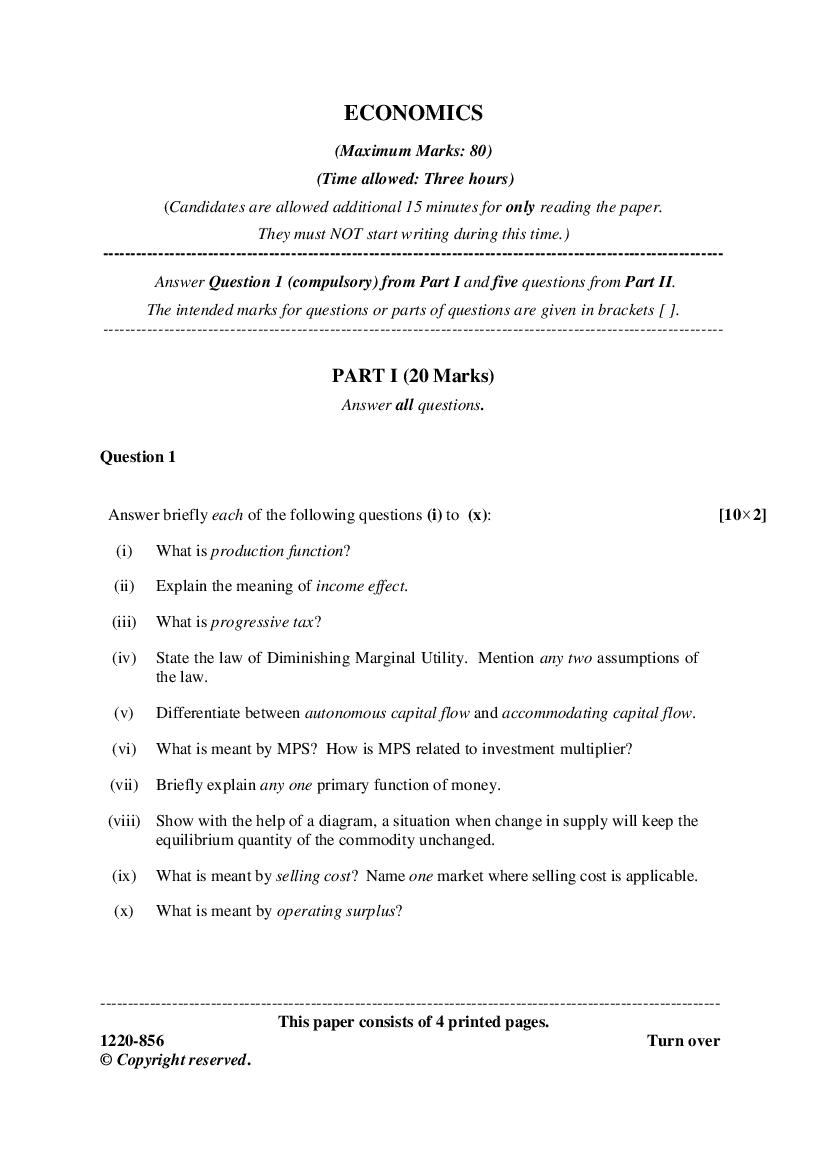
(Maximum Marks: 80)
(Time allowed: Three hours)
(Candidates are allowed additional 15 minutes for only reading the paper.
They must NOT start writing during this time.)
Answer Question 1 (compulsory) from Part I and five questions from Part II.
The intended marks for questions or parts of questions are given in brackets [ ].
PART I (20 Marks)
Answer all questions.
Question 1
Answer briefly each of the following questions (i) to (x): [10 2]
(i) What is production function?
(ii) Explain the meaning of income effect.
(iii) What is progressive tax?
(iv) State the law of Diminishing Marginal Utility. Mention any two assumptions of
the law.
(v) Differentiate between autonomous capital flow and accommodating capital flow.
(vi) What is meant by MPS? How is MPS related to investment multiplier?
(vii) Briefly explain any one primary function of money.
(viii) Show with the help of a diagram, a situation when change in supply will keep the
equilibrium quantity of the commodity unchanged.
(ix) What is meant by selling cost? Name one market where selling cost is applicable.
(x) What is meant by operating surplus?
This paper consists of 4 printed pages.
© Copyright reserved.
Page 2
Answer any five questions.
Question 2
(a) Explain the geometric method of calculating elasticity of supply. [3]
(b) Explain the concept of Diminishing Marginal Rate of substitution and show how it [3]
affects the indifference curve.
(c) The marginal utility schedule of a rational consumer is given below. If the price of a [6]
commodity is ₹ 35, explain with the help of a diagram, how the consumer attains
equilibrium.
Number of the 1 2 3 4 5
commodity bought
MU 50 45 40 35 30
Question 3
(a) Explain any two reasons for the supply curve to be positively sloped. [3]
(b) Briefly explain how equilibrium price is determined with the help of demand and [3]
supply curves.
(c) Discuss the three stages of the Law of Variable Proportions with the help of diagrams. [6]
In which stage will a rational producer like to operate?
Question 4
(a) When price of commodity X changes from ₹ 40 per unit to ₹ 20 per unit, its demand [3]
increases by 20 units. If price elasticity of demand is 0·5, calculate the initial and the
final quantity demand of commodity X.
(b) Explain with the help of a diagram, the relationship between MR and TR under [3]
imperfect competition.
(c) Using diagrams, explain the concepts of: [6]
(i) Shut-down point
(ii) Break-even point of a firm in perfect competition under short run.
Question 5
(a) Give reasons for the following: [3]
(i) TC and TVC curves do not start from the same point.
(ii) ATC and AVC curves do not touch each other.
(b) Explain any two factors affecting the demand of a commodity, other than its price. [3]
2
Page 3
market on the basis of the following:
(i) Nature of the product
(ii) Price influence
(iii) Relationship of AR and MR
(iv) Demand curve
Question 6
(a) Discuss two methods of Redemption of public debt in an economy. [3]
(b) How is fiscal deficit different from primary deficit? Explain one implication of fiscal [3]
deficit.
(c) Discuss any four causes of adverse Balance of Payments of a country. [6]
Question 7
(a) Mention the components of M1, M2 and M3 measures of money supply by RBI. [3]
(b) Explain the following functions of the Central Bank: [3]
(i) Custodian of foreign exchange reserves.
(ii) Lender of the last resort.
(c) Discuss the different ways in which commercial banks extend loans to their [6]
customers.
Question 8
(a) Briefly explain the mechanism of the investment multiplier with the help of a [3]
schedule. Take initial increase in autonomous investment as ₹ 1000 crores and MPC
as 0·8.
(b) Briefly discuss components of Aggregate Demand in an economy. [3]
(c) Explain the concept of deflationary gap with the help of a diagram. Discuss any two [6]
monetary measures to reduce the gap.
Question 9
(a) How can you obtain: [3]
(i) National income from GDPMP.
(ii) Personal disposable income from personal income.
3
Page 4
in the circular flow of income.
(c) From the following data, calculate GNPFC, NDPFC and national income: [6]
Item ₹ in crores
(i) Private final consumption expenditure 950
(ii) Gross domestic fixed capital formation 370
(iii) Consumption of fixed capital 20
(iv) Government final consumption expenditure 410
(v) Closing stock 300
(vi) Subsidy 80
(vii) Net exports (-)50
(viii) Wages and salaries 780
(ix) Net factor income from abroad (-)40
(x) Indirect tax 180
(xi) Opening stock 150
(xii) Profit before tax 200
4
Document Details
| Board / Org | CISCE |
| Exam | Class 12 |
| Type | Question Paper |
| Pages | 4 |
| Language | english |
| Updated | 22 Jul 2026 |