Goa Board Class 12 Question Paper 2025 Physics
Finished viewing? Save it for later —
Download Goa Board Class 12 Question Paper 2025 Physics (PDF · 12 pages)About Goa Board Class 12 Question Paper 2025 Physics
Goa Board Class 12 Question Paper 2025 Physics is available here for free download. Published by Goa Board for Class 12, this question paper can be viewed online or downloaded as a PDF (12 pages). Candidates preparing for Class 12 can use Goa Board Class 12 Question Paper 2025 Physics to understand the exam pattern, the type of questions asked, and the overall difficulty level.
Frequently Asked Questions
How can I download Goa Board Class 12 Question Paper 2025 Physics?
Open this page and click the Download button to save Goa Board Class 12 Question Paper 2025 Physics as a PDF. It is completely free on AglaSem Docs.
Is Goa Board Class 12 Question Paper 2025 Physics free to download?
Yes. Goa Board Class 12 Question Paper 2025 Physics can be viewed online and downloaded as a PDF free of cost on AglaSem Docs.
How many pages does Goa Board Class 12 Question Paper 2025 Physics have?
Goa Board Class 12 Question Paper 2025 Physics contains 12 pages, which you can read online or download together as a single PDF.
Where can I find more Class 12 study material?
You can find more Class 12 question papers, sample papers, syllabus, and answer keys on AglaSem Docs.
Goa Board Class 12 Question Paper 2025 Physics – Text
Read the full text of this question paper below — useful to quickly search, copy and reference the content online without downloading the PDF.
📄 View text version (12 pages)
Page 1
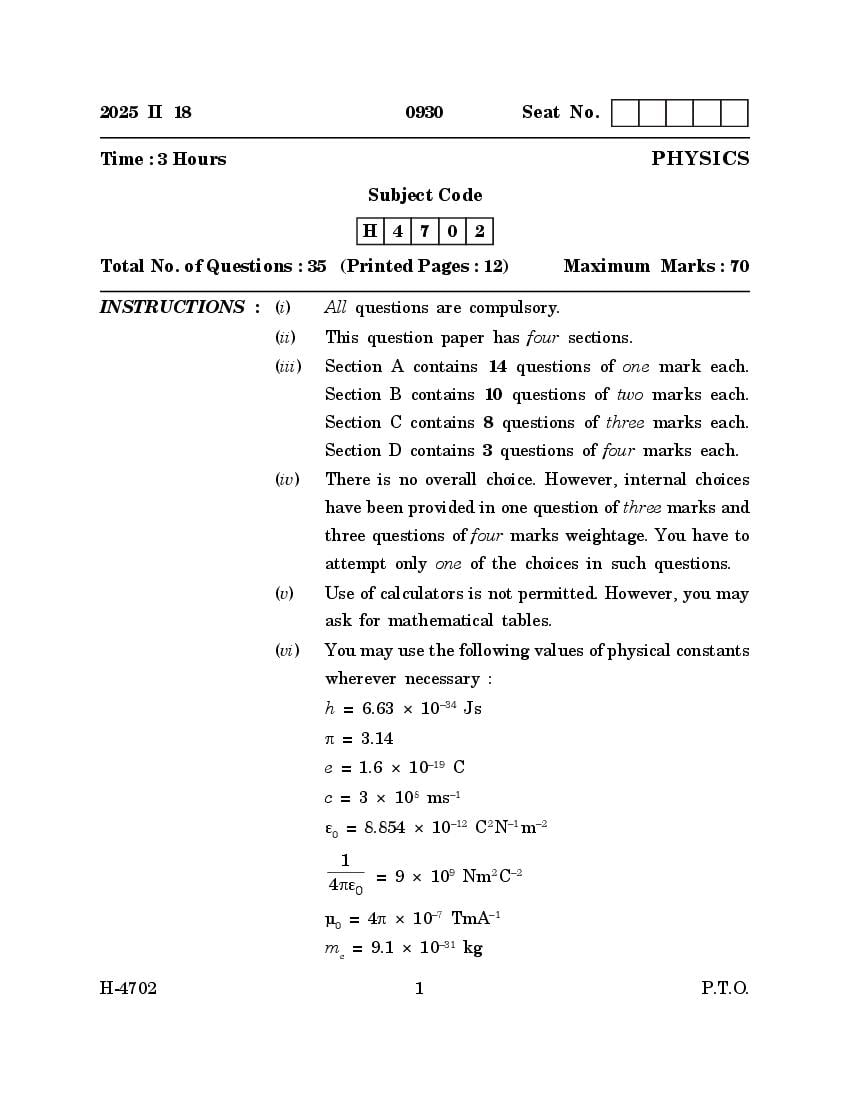
Time : 3 Hours PHYSICS
Subject Code
H 4 7 0 2
Total No. of Questions : 35 (Printed Pages : 12) Maximum Marks : 70
INSTRUCTIONS : (i) All questions are compulsory.
(ii) This question paper has four sections.
(iii) Section A contains 14 questions of one mark each.
Section B contains 10 questions of two marks each.
Section C contains 8 questions of three marks each.
Section D contains 3 questions of four marks each.
(iv) There is no overall choice. However, internal choices
have been provided in one question of three marks and
three questions of four marks weightage. You have to
attempt only one of the choices in such questions.
(v) Use of calculators is not permitted. However, you may
ask for mathematical tables.
(vi) You may use the following values of physical constants
wherever necessary :
h = 6.63 × 10⁻³⁴ Js
= 3.14
e = 1.6 × 10⁻¹⁹ C
c = 3 × 10⁸ ms–1
0 = 8.854 × 10⁻¹² C2 N–1 m–2
1
4 0 = 9 × 10 Nm C
9 2 –2
µ0 = 4 × 10⁻⁷ TmA–1
me = 9.1 × 10⁻³¹ kg
H-4702 1 P.T.O.
Page 2
1. A spherical conducting shell of radius R has a charge + q units. 1
The electric field due to the shell at a point :
• Inside is zero and varies as r–1 outside it
• Inside is constant and varies as r–1 outside it
• Inside is zero and varies as r–2 outside it
• Inside is constant and varies as r–2 outside it
2. A straight current carrying wire kept in a uniform magnetic field will
experience a maximum force when it is : 1
• perpendicular to the magnetic field
• parallel to the magnetic field
• at an angle of 45° to the magnetic field
• at an angle of 60° to the magnetic field
3. A current starts flowing from A to B as shown in the figure : 1
The direction of the induced current in the loop is :
• Clockwise
• Anticlockwise
• No current is induced
• Dependent on the radius of the loop
H-4702 2
Page 3
By = 2 × 10⁻⁷ sin (0.5 × 10³x + 3.14 × 10¹¹ t) Tesla
What is the frequency of the wave ?
• 50 GHz
• 50 MHz
• 0.5 GHz
• 5 MHz
5. If the velocity of the electron increases, then its de Broglie
wavelength : 1
• Increases
• Decreases
• Remains same
• Cannot be predicted
6. The volume of a nucleus with mass number A is proportional to : 1
• A1/2
• A1/3
• A3
• A
H-4702 3 P.T.O.
Page 4
of emf 12 volts and internal resistance 1, are connected as shown : 1
What will be the potential difference across the points A and B ?
• 30 volt
• 18 volt
• 15 volt
• 14 volt
8. The refractive indices of glass and water with respect to air are 3/2 and
4/3 respectively. What will be the refractive index of glass with respect to
water ? 1
9. Figure below shows the equipotential surfaces for two charges q1 and q2.
Identify the nature of charges q1 and q2. 1
H-4702 4
Page 5
(i) A stationary charge in a magnetic field ?
(ii) A charge moving with a velocity v parallel to the magnetic field ?
11. What is the equivalent capacitance between A and B ? 1
12. What is the critical angle for a material of refractive index 2 ? 1
13. Why is electric power transmission from power stations to sub-stations near
consumers done at high voltages ? 1
14. Distinguish between a semiconductor and an insulator based on their energy
gap. 1
Section B
15. A spherical Gaussian surface of radius R encloses a positive charge Q. What
happens to the net electric flux through the surface in the following
cases ? 2
(a) The shape of the Gaussian surface is changed into a cuboid with side
2R.
(b) The charge is doubled.
H-4702 5 P.T.O.
Page 6
17. An erect image 3 times the size of the object is obtained with a concave
mirror of radius of curvature 36 cm. What is the position of the object ? 2
18. A and B are two copper wires of same length and have diameters 0.3 mm
and 3.0 mm respectively. 2
(a) Which wire will have higher resistance ?
(b) Which wire will have lower resistivity ?
(c) What happens to the resistivity of the wire A when it is heated ?
(d) How does resistivity depend on the number of free electrons per unit
volume ?
19. Two concentric circular loops A and B of radii 3 meters and 5 meters carry
currents 3 A and 2 A respectively in opposite directions. Find the magnitude
of the net magnetic field at the centre of the coils. 2
100
20. A series LCR circuit is made by taking R = 100 , L = 2 H , and C = F .
π
This series combination is connected across an AC source of 220 V, 50 Hz.
Calculate the impedance of the circuit. 2
H-4702 6
Page 7
of the refracted wavefront ? 2
Which principle is used to predict the shape of the refracted wavefront ?
22. Distinguish between nuclear fission and nuclear fusion based on the binding
energy per nucleon of the nuclei undergoing these reactions. 2
23. 2
(a) Identify the above circuit.
(b) What is the function of the above circuit ?
24. Using amperes circuital law in magnetism, derive an expression for the
intensity of magnetic field due to a straight current carrying wire. 2
H-4702 7 P.T.O.
Page 8
25. Using Kirchhoff's rules, in the network shown in figure, find the currents I1,
I2 and I3 : 3
26. Derive an expression for the intensity of electric field for points on the
equatorial plane of an electric dipole. Draw the necessary diagram. 3
27. 3
(a) Identify the device in the above figure.
(b) How does it work ?
(c) At which position of the coil will the EMF be maximum ?
H-4702 8
Page 9
field B0 : 3
(i) In material A, the individual atomic dipole moments are aligned in
the same direction as B0.
(ii) Material B, develops a net magnetic moment in the direction opposite
to that of B0.
(iii) In material C, the domain oriented in the direction of B0 grow in size.
Identify the materials A, B, and C.
Explain what would happen to the magnetic field lines inside these
materials when placed in an external uniform field B 0.
29. The figure shows the graph between the stopping potential V, and the
frequency v of the incident radiation for two different metals P and Q
emitting photo electrons : 3
H-4702 9 P.T.O.
Page 10
graph ?
(b) Which metal will emit photo electrons with higher kinetic energy ?
Why ?
30. Monochromatic light of wavelength 589 nm is incident from air on a water
surface. What are the wavelength, frequency, and speed of : 3
(i) Reflected light
(ii) Refracted light.
31. In an atom an electron revolving around the nucleus has kinetic energy
equal to ‘K’. What will be its potential energy and total energy in terms of
the kinetic energy ‘K’ ? Why is the total energy of an electron revolving
around the nucleus always negative ? 3
32. Derive an expression for the current when an alternating EMF is connected
to a pure resistor. Also, obtain an expression for the average power. Draw
the phasor diagram. 3
Or
Derive an expression for the current when an alternating EMF is connected
to an ideal capacitor. Draw the phasor diagram. 3
H-4702 10
Page 11
33. In the figure shown below : 4
(a) Identify the gates P and Q.
(b) Write the truth table for inputs A and B and output Y.
(c) Identify the logic operation carried out with the combination of gates.
Or
How can you convert a NAND gate into a : 4
(i) NOT gate
(ii) AND gate
(iii) OR gate
Write the necessary truth tables and draw the necessary diagrams.
34. Derive an expression for the capacitance of a parallel plate capacitor. 4
State one method of increasing the capacitance of this capacitor.
Or
Derive an expression for the potential due to a point charge. Draw the
necessary diagram. Write an expression for the potential due to an electric
dipole. 4
H-4702 11 P.T.O.
Page 12
maker's formula. Also, derive the thin lens formula. Draw the necessary
diagrams. 4
Or
With the help of a neat ray diagram, derive an expression for the refractive
index of the material of a prism. Hence obtain an expression for the deviation
produced by a thin prism.
H-4702 12
Document Details
| Board / Org | Goa Board |
| Exam | Class 12 |
| Type | Question Paper |
| Pages | 12 |
| Updated | 24 Sep 2026 |