Rabindra Mukta Vidyalaya Madhyamik Model Question Paper Life Science
Finished viewing? Save it for later —
Download Rabindra Mukta Vidyalaya Madhyamik Model Question Paper Life Science (PDF · 5 pages)About Rabindra Mukta Vidyalaya Madhyamik Model Question Paper Life Science
Rabindra Mukta Vidyalaya Madhyamik Model Question Paper Life Science is available here for free download. Published by West Bengal Board for Class 10, this sample paper can be viewed online or downloaded as a PDF (5 pages). Candidates preparing for Class 10 can use Rabindra Mukta Vidyalaya Madhyamik Model Question Paper Life Science to understand the exam pattern, the type of questions asked, and the overall difficulty level.
Frequently Asked Questions
How can I download Rabindra Mukta Vidyalaya Madhyamik Model Question Paper Life Science?
Open this page and click the Download button to save Rabindra Mukta Vidyalaya Madhyamik Model Question Paper Life Science as a PDF. It is completely free on AglaSem Docs.
Is Rabindra Mukta Vidyalaya Madhyamik Model Question Paper Life Science free to download?
Yes. Rabindra Mukta Vidyalaya Madhyamik Model Question Paper Life Science can be viewed online and downloaded as a PDF free of cost on AglaSem Docs.
How many pages does Rabindra Mukta Vidyalaya Madhyamik Model Question Paper Life Science have?
Rabindra Mukta Vidyalaya Madhyamik Model Question Paper Life Science contains 5 pages, which you can read online or download together as a single PDF.
Where can I find more Class 10 study material?
You can find more Class 10 question papers, sample papers, syllabus, and answer keys on AglaSem Docs.
Rabindra Mukta Vidyalaya Madhyamik Model Question Paper Life Science – Text
Read the full text of this sample paper below — useful to quickly search, copy and reference the content online without downloading the PDF.
📄 View text version (5 pages)
Page 1
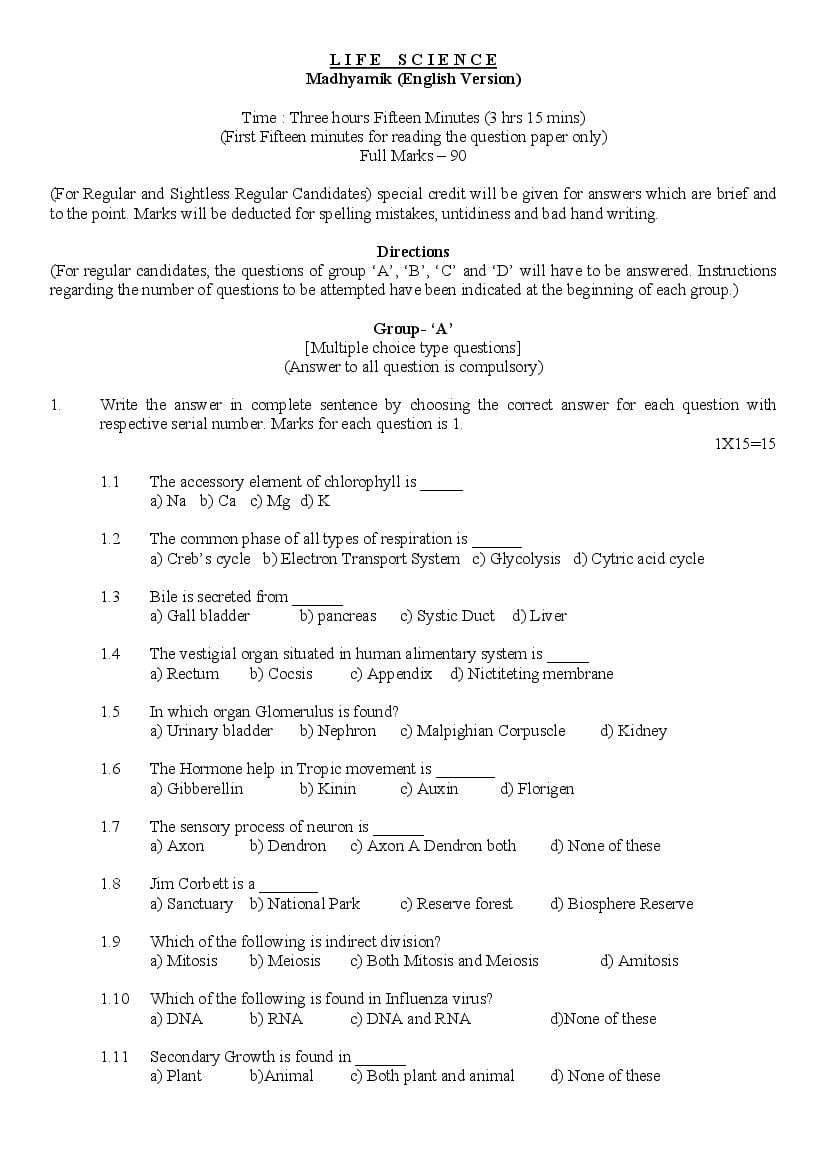
Madhyamik (English Version)
Time : Three hours Fifteen Minutes (3 hrs 15 mins)
(First Fifteen minutes for reading the question paper only)
Full Marks – 90
(For Regular and Sightless Regular Candidates) special credit will be given for answers which are brief and
to the point. Marks will be deducted for spelling mistakes, untidiness and bad hand writing.
Directions
(For regular candidates, the questions of group ‘A’, ‘B’, ‘C’ and ‘D’ will have to be answered. Instructions
regarding the number of questions to be attempted have been indicated at the beginning of each group.)
Group- ‘A’
[Multiple choice type questions]
(Answer to all question is compulsory)
1. Write the answer in complete sentence by choosing the correct answer for each question with
respective serial number. Marks for each question is 1.
1X15=15
1.1 The accessory element of chlorophyll is _____
a) Na b) Ca c) Mg d) K
1.2 The common phase of all types of respiration is ______
a) Creb’s cycle b) Electron Transport System c) Glycolysis d) Cytric acid cycle
1.3 Bile is secreted from ______
a) Gall bladder b) pancreas c) Systic Duct d) Liver
1.4 The vestigial organ situated in human alimentary system is _____
a) Rectum b) Cocsis c) Appendix d) Nictiteting membrane
1.5 In which organ Glomerulus is found?
a) Urinary bladder b) Nephron c) Malpighian Corpuscle d) Kidney
1.6 The Hormone help in Tropic movement is _______
a) Gibberellin b) Kinin c) Auxin d) Florigen
1.7 The sensory process of neuron is ______
a) Axon b) Dendron c) Axon A Dendron both d) None of these
1.8 Jim Corbett is a _______
a) Sanctuary b) National Park c) Reserve forest d) Biosphere Reserve
1.9 Which of the following is indirect division?
a) Mitosis b) Meiosis c) Both Mitosis and Meiosis d) Amitosis
1.10 Which of the following is found in Influenza virus?
a) DNA b) RNA c) DNA and RNA d)None of these
1.11 Secondary Growth is found in ______
a) Plant b)Animal c) Both plant and animal d) None of these
Page 2
a) Stem b) Root c) Bulbil d) Leave
1.13 Endosperm is always ______
a) Diploid b) Triploid c) Haploid d) Tetraploid
1.14 The total number of airsacs with two lungs in pigeon is ______
a) 9 b) 7 c) 9 pairs d) 7 pairs
1.15 Who proposed the ‘Mutation theory’?
a) Lamarck b) Hugo Devries c) Weismann s) Darwin
Group –B
(Very Short Answer type Questions)
2. Answer any twenty one questions out of twenty six questions given below as instructed. The mark
for each question is 1.
1X21=21
Fill up the blanks with proper words in the following sentences (any five) 1X5=5
2.1 The first produced carbonated permanent compound in photosynthesis is ________.
2.2 Muscle fatigue is formed due to the influence of ________ acid.
2.3 One enzymeless digestive juice is _________.
2.4 The Structural and functional unit of the Kidney is ________.
2.5 The sister chromosomal movement trend of mitosis observed in _________ phase.
2.6 The tendril of pea is the modification of ________.
Decide whether the following Statements are True of False (any five) 1X5=5
2.7 Vitamin is a caloriless food component .
2.8 Tubefeet is the locomotary organ of Star fish.
2.9 Thalamus of the brain controls the body temperature.
2.10 The innermost third layer of the eyeball is retina.
2.11 90% sand present in the sandy soil.
2.12 The phenotypic ratio of Dihybrid cros is 1:2:1.
Page 3
the correct pair mentioning the serial no. Of both columns (any five) :- 1X5=5
Column-A Column-B
2.13 Phylloclade a) Spinal Cord
2.14 Frog b) Plant cytokinesis
2.15 Fragmentation c) Spirogyra
2.16 Cell plant d) Internal ear
2.17 Reflex Action e) Cactus
2.18 Perilymph f) External fertilization
g) Animal cytokinesis
Answer in a single word or in a single sentence (any six) 1X6=6
2.19 Choose the odd one and write it :
Myopia, Hypermetropia, Cochlea, presbyopia.
2.20 Where chime is produced?
2.21 A pair of related terms is given below. On the basis of the relationship in the first pair write
the suitable word in the gap of second pair.
Carbohydrate : glucose : protein : __________
2.22 What was the ratio of Methane, Ammonia and Hydrogen of Miller and Urey’s experiment ?
2.23 What do you mean by Halophyte?
2.24 Where C.S.F is found?
2.25 Among the following four terms one includes the other three. Find it out and write it ;
National park, Sanctuary, In Situ conservation, Reserve forest.
2.26 Write the function of the Swim bladder of the fish.
Group – C
3. Answer any 12 questions in 2-3 sentences out of 17 questions given below. 2X12=24
3.1 Photosynthesis and Respiration are two opposite metabolic process. Explain it.
3.2 Write the necessity of the accessory repiratory organ . (any two)
3.3 Write the digestion process of Carbohydrate in buccal cavity.
3.4 Write any two differences between Halophytic and Halozoic nutrition.
Page 4
3.6 Write the normal Diastolic and Systolic pressure of man.
3.7 Write two objectives of locomotion and movement.
3.8 Write the cause and symptoms of Diabetes incipedus.
3.9 Write one each of the similarity and dissimilarity between Nervous System and Hormone.
3.10 Write the application of Auxin in Agriculture.
3.11 Write two demerits of air pollution.
3.12 What is food chain? Give example.
3.13 Explain the first law of Heredity.
3.14 Explain the relation between the growth and reproduction.
3.15 Explain any two application field of Genetics in human civilization.
3.16 Write the role of air sacs in the adaptation of pigeon.
3.17 Write and explain any two examples against law of inheritance of acquired characters of
Lamarckism
Group – D
4. Answe six questions or their alternatives given below. Sightless Candidates have to answer question
No. 4.1 (A) instead of 4.1 :-
4.1 Draw a neat diagram of a Nephron and label the following parts :- 3+2=5
a) glomerules b) Loop of Henley c) proximal convoluted tuble d) Bowman’s Capsule
OR
Draw a neat diagram of a typical Neurone and label the following parts :-
a) Dendrite b) Schwann Cell c) Nucleus d) Medullary Sheath
(For sightless candidates only)
4 (A) Write one function each of the following five parts of a nephron :-
a) glomerules b) Bowman’s capsule c) proximal convoluted tuble d) Loop of Henley
e) Distal convoluted tuble
OR
Write one function each of the following five parts of a neurone :-
a) Dendrite b) Cell body c) Axon d) Medullary Sheath e) Schwann Cell.
Page 5
absorbed? 3+2=5
OR
Explain the breathing process of man. Write the respiratory organs in plants.
3+2=5
4.3 Explain the water absorption process in plant. Write the process of food conduction in plant.
3+2=5
OR
Write two Structural differences between artery and vein. Write the functions of any three
valves of human heart. 2+3=5
4.4 Write the role of bacteria in N2 cycle. Discuss the characteristics of energy flow in
ecosystem. 3+2=5
OR
What is Bio-geochemical cycle? Write the role of producer and decomposer in ecosystem.
2+3=5
4.5 Describe the prophase of Mitosis in brief. Explain the significance of Meiosis.
3+2=5
OR
Describe the double fertilization process in flowering plant. What is parthenogenesis? Give
examples. 3+2=5
4.6 Describe Mendel’s monohybrid cross with checker Board by giving an example of animal.
Write two exceptions of Mendalism. 3+2=5
OR
Explain the evolution process by comparing the structures of different vertebrate heart. What
is ‘Struggle for existence’?
_____________________xxxxxxxxxxx________________________
Document Details
| Board / Org | West Bengal Board |
| Exam | Class 10 |
| Type | Sample Paper |
| Pages | 5 |
| Updated | 24 Sep 2026 |