ISC Class 12 Specimen Paper Business Studies
Finished viewing? Save it for later —
Download ISC Class 12 Specimen Paper Business Studies (PDF · 21 pages)About ISC Class 12 Specimen Paper Business Studies
ISC Class 12 Specimen Paper Business Studies is available here for free download. Published by CISCE for Class 12, this sample paper can be viewed online or downloaded as a PDF (21 pages). Candidates preparing for Class 12 can use ISC Class 12 Specimen Paper Business Studies to understand the exam pattern, the type of questions asked, and the overall difficulty level.
Frequently Asked Questions
How can I download ISC Class 12 Specimen Paper Business Studies?
Open this page and click the Download button to save ISC Class 12 Specimen Paper Business Studies as a PDF. It is completely free on AglaSem Docs.
Is ISC Class 12 Specimen Paper Business Studies free to download?
Yes. ISC Class 12 Specimen Paper Business Studies can be viewed online and downloaded as a PDF free of cost on AglaSem Docs.
How many pages does ISC Class 12 Specimen Paper Business Studies have?
ISC Class 12 Specimen Paper Business Studies contains 21 pages, which you can read online or download together as a single PDF.
Where can I find more Class 12 study material?
You can find more Class 12 question papers, sample papers, syllabus, and answer keys on AglaSem Docs.
ISC Class 12 Specimen Paper Business Studies – Text
Read the full text of this sample paper below — useful to quickly search, copy and reference the content online without downloading the PDF.
📄 View text version (21 pages)
Page 1
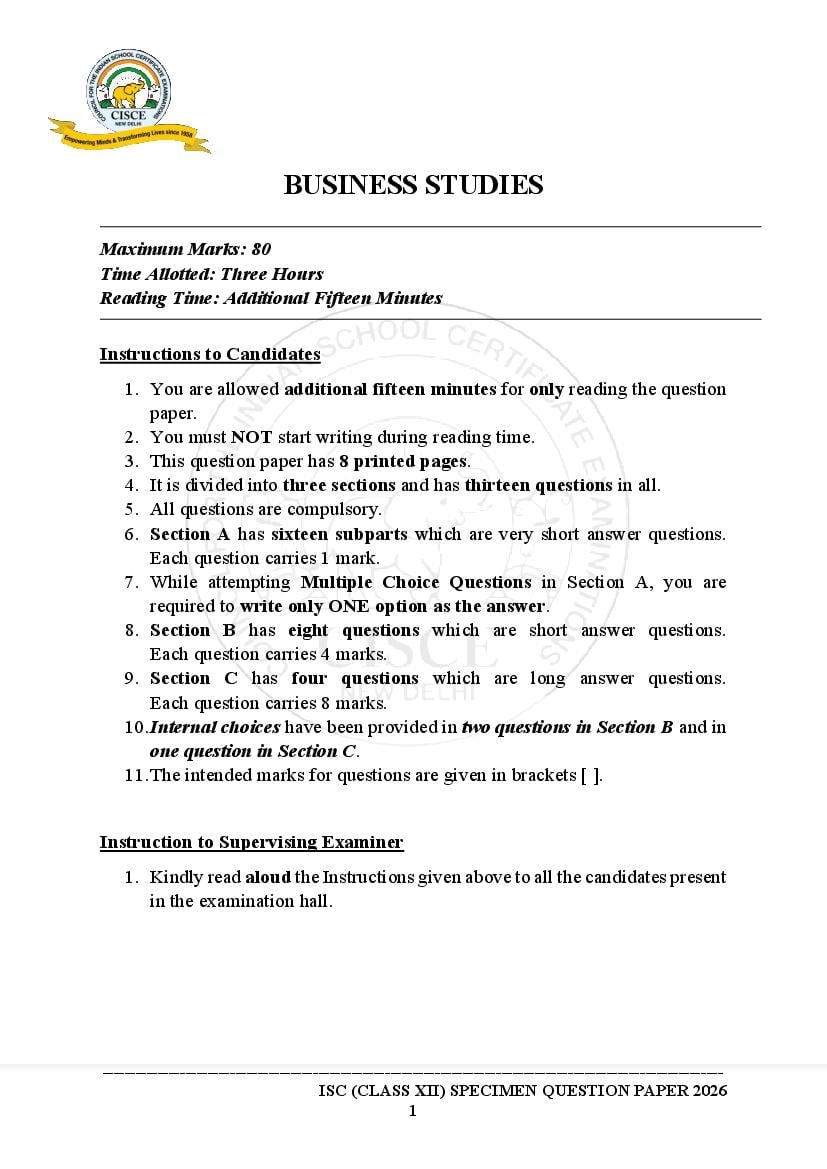
Maximum Marks: 80
Time Allotted: Three Hours
Reading Time: Additional Fifteen Minutes
Instructions to Candidates
1. You are allowed additional fifteen minutes for only reading the question
paper.
2. You must NOT start writing during reading time.
3. This question paper has 8 printed pages.
4. It is divided into three sections and has thirteen questions in all.
5. All questions are compulsory.
6. Section A has sixteen subparts which are very short answer questions.
Each question carries 1 mark.
7. While attempting Multiple Choice Questions in Section A, you are
required to write only ONE option as the answer.
8. Section B has eight questions which are short answer questions.
Each question carries 4 marks.
9. Section C has four questions which are long answer questions.
Each question carries 8 marks.
10.Internal choices have been provided in two questions in Section B and in
one question in Section C.
11.The intended marks for questions are given in brackets [ ].
Instruction to Supervising Examiner
1. Kindly read aloud the Instructions given above to all the candidates present
in the examination hall.
ISC (CLASS XII) SPECIMEN QUESTION PAPER 2026
1
Page 2
Board Examination Question Paper and should be used as a practice tool. The questions for
the Board Examination can be set from any part of the syllabus, though the format of the
Board Examination Question Paper will remain the same as that of the Specimen Question
Paper.
SECTION A – 16 MARKS
Question 1
(i) A manufacturing company files its GST returns and pays taxes through the official [1]
public portal of the income tax department.
Which type of online transaction does this represent? (Understanding)
(ii) What are the certificates issued by a company in India and traded on the London [1]
Stock Exchange known as? (Recall)
(iii) Observe the relation between the first two words and complete the analogy.
(Analysis)
(a) Long chain of command: Organisational Barrier :: Unclarified [1]
assumptions: ____________
(b) Attachment to a report: Appendix :: Attachment to a letter: _________ [1]
(iv) Job ______________ is a process of collecting and assessing data related to a [1]
job. (Recall)
(v) ______________ transfer refers to the practice of shifting employees across [1]
different roles, functions or departments in an organisation to widen their
skills. (Recall)
(vi) A _____________ report is prepared and submitted in the format as laid down [1]
by law. (Recall)
(vii) Welcoming a new employee in an organisation with a firm handshake / [1]
‘namaste’ is an example of _____________ communication. (Understanding)
(viii) Which of the following statements is INCORRECT about staff training? [1]
(Analysis)
(a) Vestibule Training involves duplication of actual job conditions.
(b) Apprenticeship Training involves only practical on-the-job experience.
(c) Classroom Training includes case studies as one of the instructional methods.
(d) Internship Training provides a good balance between theory and practice.
ISC (CLASS XII) SPECIMEN QUESTION PAPER 2026
2
Page 3
incentives as it believes that money is a great motivator. Despite receiving
handsome salaries, several managers have recently resigned from the
company.
Which one of the following is MOST likely the reason for their resignation?
(Evaluate)
(a) The managers are satisfied with only financial rewards.
(b) The managers are satisfied with non-monetary benefits.
(c) The managers feel that the monetary incentives are too high.
(d) The managers want both monetary as well as non-monetary incentives.
(x) Which of the following items are commonly included as components of an [1]
employee’s pay slip? (Analysis)
(P) Provident Fund
(Q) Gratuity
(R) House Rent Allowance
(S) Employee Stock Option
(a) Only (P) and (Q)
(b) Only (P) and (R)
(c) Only (Q) and (R)
(d) Only (R) and (S)
(xi) Given below are two statements marked Assertion and Reason. Read the [1]
statements carefully and choose the correct option.
Assertion: Globalisation implies treating the entire world as one market.
Reason: Globalisation involves cross-border movement of goods, services,
capital, technology, information and people. (Analysis)
(a) Both Assertion and Reason are true, and Reason is the correct
explanation for Assertion.
(b) Both Assertion and Reason are true, but Reason is not the correct
explanation for Assertion.
(c) Assertion is true and Reason is false.
(d) Both Assertion and Reason are false.
(xii) State whether the following are True or False:
(a) Flexible hours are beneficial to the employees but not to the employer. [1]
(Understanding)
(b) IRDA regulates the functioning of food laboratories in India. (Recall) [1]
(c) An unsolicited application letter is sent in response to a published job [1]
advertisement. (Analysis)
(d) A dividend policy of the company determines the extent to which profits can [1]
be retained in the business. (Understanding)
ISC (CLASS XII) SPECIMEN QUESTION PAPER 2026
3
Page 4
Question 2
(i) With reference to SEBI, briefly answer the following questions: (Recall)
(a) Name any two intermediaries regulated by SEBI. [2]
(b) State any two roles of SEBI as a regulator. [2]
OR
(ii) With reference to Time Rate System of Wage Payment, answer the following
questions: (Recall)
(a) Briefly explain the Time Rate System of Wage Payment. [2]
(b) Give any two situations where this system is suitable. [2]
Question 3
Arpita used her savings to start a small business in her town. Her business rapidly
gained popularity due to its prompt service and the quality of the goods. Arpita is
now considering expanding her business, without changing the ownership status.
(i) Identify the form of business ownership established by Arpita. [1]
(Application)
(ii) State any one advantage that Arpita enjoyed by using her savings to start the [1]
business. (Application)
(iii) Name any one form of business organisation other than the one formed by [1]
Arpita. (Recall)
(iv) Can Arpita invite the public to invest in her business by issuing equity shares? [1]
Justify your answer by giving one reason. (Evaluate)
Question 4 [4]
Differentiate between Job Enlargement and Job Enrichment on the following bases:
(Analysis)
(a) Nature
(b) Content
(c) Purpose
(d) Skills required
ISC (CLASS XII) SPECIMEN QUESTION PAPER 2026
4
Page 5
(i) PQR Ltd., an Indian software company, assigned its customer support
operations to an external agency based in Philippines. The arrangement
proved successful and PQR Ltd. is planning to outsource its Research and
Development (R&D) wing to the same agency.
(a) Identify the type of outsourcing used by PQR Ltd. in assigning its [1]
customer service operations. (Understanding)
(b) Specify any one benefit of the above type of outsourcing to the firm in [1]
Philippines. (Application)
(c) Give any one reason to explain why PQR Ltd. would choose to [1]
outsource a critical function like R&D. (Analysis)
(d) Briefly explain any one potential risk the company might face if they [1]
outsource their R&D wing. (Analysis)
OR
(ii) The Vice President (Marketing) of Pratiksha Ltd., Mr. Mehta, gives complete
autonomy to his team to plan and execute their work. Mr. Mehta intervenes
only when the team seeks his suggestions or support. On the other hand, the
Vice President (Production), Mrs. Kapoor regularly interacts with her team
and makes decisions collaboratively.
(a) Name the leadership style where the manager solely takes decisions [1]
and announces them. (Recall)
(b) Suggest a situation in which a centralised leadership style in an [1]
organisation could act as a morale depressant. (Application)
(c) Explain any two differences between the leadership styles [2]
demonstrated by Mr. Mehta and Mrs. Kapoor as described in the case.
(Analysis)
Question 6
Briefly explain the significance of each of the following steps in the employee
selection process:
(i) Reference check (Understanding) [2]
(ii) Placement (Understanding) [2]
Question 7
Explain the concepts of dry promotion and upgrading in employee advancement.
(Recall)
ISC (CLASS XII) SPECIMEN QUESTION PAPER 2026
5
Page 6
Study the data given below, which shows different forms of staff separation at Infotide
Ltd., and answer the questions that follow.
90
80
No of employees 70
60
50
40
30
20
10
0
Service Temporary Permanent Resignation Involuntary
completion workforce cost cutting termination
downsizing separation
Staff Separation
(i) Infotide Ltd. has temporarily reduced its workforce. Identify this form of staff [1]
separation. (Understanding)
(ii) Name the type of interview that Infotide Ltd. should conduct at the time of staff [1]
separation. (Understanding)
(iii) State any one monetary benefit available to the employees at the time of [1]
‘service completion’. (Understanding)
(iv) Which form of staff separation shown in the graph corresponds to [1]
retrenchment? (Analysis)
Question 9
Briefly explain any two benefits of e-Business to each of the following:
(i) Buyer (Understanding) [2]
(ii) Seller (Understanding) [2]
SECTION C – 32 MARKS
Question 10
Briefly discuss any two features of each of the following sources of finance available
to an organisation in India.
(i) Discounting of Bills of Exchange (Understanding) [2]
(ii) Debentures (Understanding) [2]
(iii) Venture Capitalists (Understanding) [2]
(iv) Factoring (Understanding) [2]
ISC (CLASS XII) SPECIMEN QUESTION PAPER 2026
6
Page 7
(i) Elucidate the types of communication based on area of operation. [4]
(Understanding)
(ii) With reference to staff benefits, explain the following: (Understanding)
(a) Gratuity [2]
(b) NPS [2]
OR
(iii) As per the Morale Productivity Matrix, discuss the relationship between [4]
morale and productivity when morale is high. (Understanding)
(iv) With reference to Maslow’s Theory of the Hierarchy of Human Needs,
explain the following: (Understanding)
(a) Physiological Needs [2]
(b) Social Needs [2]
Question 12 [8]
We are looking for
experienced Sales Executives
for sale of machinery. Good
communication skills and
proven sales track record are
essential. Please send your
resume to [email protected]
Draft a letter in response to the above job advertisement published in a weekly
newspaper. (Application)
ISC (CLASS XII) SPECIMEN QUESTION PAPER 2026
7
Page 8
The data given below shows the results of the survey conducted by the Human
Resources Department at ABC Ltd. It helped them determine the most suitable
sources of recruitment to meet their current manpower requirements.
Read the data carefully and answer the questions that follow.
Recruitment Sources Percentage (%)
Advertisements 28
Job Sites / Portals 23
Campus Recruitment 22
Recommendation by 11
Employees
Internal Job Posting 9
Employment Exchange 4
Casual Callers 3
(i) State any one function of an employment exchange. (Recall) [1]
(ii) With reference to the sources of recruitment used by ABC Ltd., identify one [2]
source each from: (Understanding)
(a) the Internet
(b) the Intranet
(iii) Justify the use of Campus Recruitment by ABC Ltd. (Evaluate) [1]
(iv) Suggest any two limitations of using Casual Callers to indicate why ABC Ltd. [2]
should avoid this method to fill their current requirements.
(Application)
(v) By providing any two reasons, explain why Advertisements have been the [2]
most successful source of recruitment for ABC Ltd. (Analysis)
ISC (CLASS XII) SPECIMEN QUESTION PAPER 2026
8
Page 9
ANSWER KEY
SECTION A – 16 MARKS
Question 1
In answering Multiple Choice Questions, candidates have to write either the
correct option number or the explanation against it. Please note that only
ONE correct answer should be written.
(i) B2G / Business to Government [1]
(ii) GDR / Global Depository Receipts [1]
(iii) (a) Semantic barrier [1]
(b) Enclosure [1]
(iv) Analysis [1]
(v) Versatility [1]
(vi) Statutory [1]
(vii) Gestural [1]
(viii) (b)or Apprenticeship Training involves only practical on-the-job experience. [1]
(ix) (d) or The managers want both monetary as well as non-monetary incentives. [1]
(x) (b) or Only (P) and (R) [1]
(xi) (a) or Both Assertion and Reason are true, and Reason is the correct [1]
explanation for Assertion.
(xii) (a) False [1]
(b) False [1]
(c) False [1]
(d) True [1]
1
Page 10
Question 2 [4]
(i) (a) Intermediaries
• Stock Exchanges
• Stock Brokers
• Merchant Bankers
• Depositories
• Credit Rating Agencies
(Candidates have to name any two intermediaries.)
(b) Role of SEBI
• It prohibits fraudulent and unfair trade practices. / It leads to
promotion of fair practices and code of conduct in security
market.
• It controls insider trading.
• It undertakes steps for investor protection.
• It promotes training of intermediaries of security market.
• It conducts research and publishes information useful to all
participants in security market.
• It educates investors.
• It issues guidelines to streamline allotment of shares.
• It regulates business on stock exchanges through rules and
regulations.
• It registers and regulates the working of mutual funds.
(Candidates have to write any two roles of SEBI in complete sentences.)
OR
(ii) (a) Time Rate System
• It is directly linked with the time spent by the workers on the job.
• Wages (W) = Time Spent (T) x Rate of wages per unit of time (R).
• It is simple and easily understandable.
• It gives a feeling of economic security to the workers.
• It reduces wastage.
• It ensures higher quality of work.
• It is accepted by trade unions.
• It is an encouragement to beginners.
• It makes it difficult to distinguish between efficient and inefficient
workers.
• There is a lack of incentives to the workers.
• It increases supervision.
• The labour cost is uncertain.
(Candidates have to briefly explain the Time Rate System. They may elaborate on
any two features given above.)
(b) Time Rate System is suitable where:
• quality is the main consideration.
• work cannot be accurately measured.
2
Page 11
• work is machine paced.
• the collective efforts of a group of workers are required for performing
the work.
• machines and equipment used are delicate and very expensive.
• production process is complicated and requires high degree of skill.
(Candidates have to briefly write any two situations / examples where Time Rate
System is suitable.)
Question 3
(i) Form of business: Sole Proprietorship [1]
(ii) Advantage of using Arpita’s savings: [1]
• There is no need to source business finance.
• Using own funds creates financial discipline/encourages budgeting.
• There is no stress of repayment/ lower financial pressure in the initial
stages of the business.
• There is no need to pay interest to anyone.
• It increases motivation to succeed as returns/profits will be enjoyed by
owner.
(Candidates have to write any one advantage to Arpita of using her savings.
This has to be written in a complete sentence and not as a caption or a
phrase.)
(iii) Forms of business organisations: [1]
• Partnership firm
• Private Ltd. Co.
• Public Ltd. Co.
(Candidates have to name any one form of business organisation.)
(iv) Arpita cannot invite public to invest in her business by issuing equity shares. [1]
Equity shares cannot be issued by a sole proprietorship firm. They can be issued
only by a Joint stock Company.
(Candidates have to first state their stance and then support it with a reason.)
Question 4
(i) [1]
Basis Job Enlargement Job Enrichment
Nature Horizontal loading of job Vertical loading of job
3
Page 12
Content More tasks of a similar Quality of job is
nature are added to the improved.
job.
(iii) Basis Job Enlargement Job Enrichment [1]
Purpose To reduce monotony To make jobs more
challenging and
satisfying
(iv) [1]
Basis Job Enlargement Job Enrichment
Skills May not require higher Requires higher level of
required level of skills skills
(Candidates have to give any one point of difference on the given basis.
The differences must be written in sentences.)
Question 5
(i) (a) BPO / Business Process Outsourcing [1]
(Candidates have to identify the type of outsourcing used by PQR
Ltd.)
(b) Benefits to the outsourced: [1]
• It helps the vendor grow their client base.
• It is a source of income, from contracts.
• It increases efficiency and skill of the outsourced party.
(Candidates have to specify any one benefit of outsourcing adopted by
the firm. Any other correct benefit will be accepted.)
(c) Reasons for outsourcing critical functions: [1]
• It gives access to highly skilled professionals with specialised
knowledge.
• It reduces costs related to hiring, training etc. of own employees.
• The Outsourcer can focus on core competencies.
• Compliance risk can be transferred to KPO reducing burden on
the outsourcer.
(Candidates have to write any one reason for outsourcing a critical
function.)
(d) Risk in outsourcing critical functions: [1]
• The payment of high fees.
• There is a risk of leakage of business secrets.
• Companies may become too dependent on KPOs.
(Candidates have to write any one risk involved in outsourcing a
critical function.)
OR
4
Page 13
(b) Situations where centralised leadership acts as morale depressant: [1]
• Leader makes all decisions without consulting the followers.
• They exercise tight control over tasks.
• There is a downward flow of communication/no feedback
encouraged.
• The leader expects blind obedience from subordinates.
• The leader does not delegate, leading to no opportunity for
growth / Lack of opportunity to exercise initiative and
judgement.
• The leader uses punishment rather than rewards.
(Candidates have to write any one situation where centralised
leadership acts as a morale depressant.)
(c) Leadership styles: [2]
Laissez Faire style by Mr. Democratic style by Mrs.
Mehta Kapoor
The leader takes a hands-off Here the leader actively guides,
approach and allows the group to and supports group discussions
take decisions without his and takes decisions jointly with
intervention. the group.
Informal leaders emerge to fill the There is formal leadership as
void left by lack of formal the leader retains some control.
leadership.
The group is deprived of the The group gets complete
benefit of the leader’s motivation benefit of the leader’s
and guidance. motivation and guidance
This style is effective only when This style is effective only
team members are highly skilled when team members are
and mature. willing to participate and share
ideas,
(Candidates are required to briefly explain any two differences
between the styles highlighted in the scenario given in the question.
The differences have to be written in complete sentences.)
Question 6
(i) Significance of Reference Check: [2]
• It serves to verify information given in the application form.
• It gives an insight into the candidate’s work ethics, work performance,
character etc.
• It reduces the risk of hiring unknown / unreliable candidates.
(Candidates have to briefly explain the significance of reference check in
complete sentences.)
5
Page 14
• If selected candidates are posted as per their skills and qualifications, it
ensures optimum utilisation of manpower.
• Proper placement helps improve work efficiency and satisfaction of
employees.
• Correct placement helps new employees adapt better to their workplace.
(Candidates have to briefly explain the significance of placement in complete
sentences.)
Question 7
Dry Promotion
• It involves movement of an employee from a lower- level to a higher-level job. [2]
• There is no increase in salary.
• It leads to an increase in status
• It leads to an increase in responsibility.
(Candidates have to briefly explain the concept of dry promotion in
complete sentences.)
Upgrading
• It involves movement of an employee from a lower pay scale to a higher pay [2]
scale
• It does lead to any change in status.
• It brings no change in responsibility.
• It is used to motivate employees who cannot be promoted.
((Candidates have to briefly explain the concept of upgrading in complete
sentences.)
Question 8
(i) Layoff [1]
(Candidates have to identify the form of staff separation.)
(ii) Exit Interview [1]
(Candidates have to name the type of interview to be conducted at the time
of staff separation.)
(iii) Monetary benefits: [1]
• Gratuity
• Provident Fund
• Pension
• Encashment of leave
(Candidates have to state any one monetary benefit available to staff at
the time of service completion.)
(iv) Permanent cost cutting separation [1]
(Candidates have to identify the form of staff separation that corresponds to
retrenchment.)
6
Page 15
(Candidates have to write any two benefits in complete sentences.)
(i) To the buyer: [2]
• The buyer has access to the global market.
• The buyer has a direct contact (no middleman).
• The products and services are customised.
• There is a wider selection of goods.
• The prices are competitive.
• It puts the buyer at ease in comparing prices.
• It is time saving.
• Shopping is 24/7.
• The data is secured.
• There are different modes of payment.
• The response and redressal are quick. / There are easy return and refund
policies.
(ii) To the seller: [2]
• The seller has access to the global market.
• The operating costs are lower.
• It leads to an increase in sales / Round the clock working
• The seller enjoys a direct contact as there is no middleman.
• It ensures customer Satisfaction. /Feedback
• It requires less investment.
• It allows the seller to expand their business-from local to national to
global.
• Generally, payment is received before despatching the goods.
• There is a fixed price / no bargaining.
SECTION C – 32 MARKS
Question 10
(Candidates have to write any two features of the following sources of finance. The
features have to be written in complete sentences.)
(i) Discounting of Bills of Exchange: [2]
• It is a short-term credit facility.
• Bills of exchange discounted with bank/trader
• It is discounted before the due date
• The discounting charges are applicable.
• Original holder gets access to instant cash
• The bank / trader recovers dues from the signatory of the bill on the
due date.
7
Page 16
bill to recover the dues.
(ii) Debentures: [2]
• Loan instrument / document issued under company’s seal /
acknowledgement of debt
• It is a long term credit facility.
• There is a fixed rate of interest.
• There are no ownership rights.
• They may be secured or unsecured.
• There is a charge on assets so they cannot be used as collateral.
• They may be redeemable or irredeemable.
• They are tradable.
• Priority in repayment
• They do not carry voting rights.
(iii) Venture Capitalists: [2]
• They provide funding to startups and accelerate early growth.
• They Invest in equity
• They are high-risk but high potential returns for the investor.
• There is an active supervision by investors.
• It is a long-term investment.
• It involves multiple rounds of funding.
• The focus is on high-growth sectors/preference for scalable businesses.
(iv) Factoring: [2]
• It is a short-term source of finance.
• Business sells its accounts receivable (invoices) to a third-party (the
factor) at a discount.
• There is an immediate cash flow.
• No collateral is required
• There is a charge factoring fees for administrative services
• Discount is deducted from the invoice by the factor.
• It involves three parties in factoring.
• The burden of risk is on the factor.
• It is legally binding on the client.
8
Page 17
(i) Internal Communication: [4]
• It occurs within the organisation.
• It may be vertical or horizontal.
• It can be formal or informal.
• It facilitates coordination.
• It is inexpensive.
• It encourages two-way flow
• Its aim is to improve staff relations and create a positive work
environment
External Communication:
• It takes place between people inside the organisation and outsiders.
• It is of two types – inward and outward.
• It is generally formal in nature.
• It is expensive.
• It helps in networking/building relationships with outsiders.
• Its aim is to increase sales and grow the business.
(Candidates have to explain the two types of communication. The
aforementioned features can be elaborated upon.)
(ii) (a) Gratuity: [2]
• Gratuity is a lump sum payment given by an employer to an
employee
• It is a reward for long-term service
• It is paid at the time of staff separation.
• It is paid only for continuous service of at least 5 years in an
organisation.
• The amount depends on the last drawn salary and number of
years worked
• It is governed by the Payment of Gratuity Act, 1972 (in India)
• Formula for employees covered under the Act:
Gratuity = (15 × Last drawn salary × Number of years worked) ÷
26 where salary = basic pay + dearness allowance
(Candidate are required to briefly explain the concept of gratuity.)
9
Page 18
• National Pension System (NPS) is a government-sponsored
pension scheme in India that helps individuals save for
retirement.
• It is open to all Indian citizens between 18 and 70 years of age.
• Account holders can contribute money regularly to their NPS
account while they are working
• At the time of retirement, part of the amount can be withdrawn,
and the rest is used to give a monthly pension
• It offers tax benefits.
• It is governed by the PFRDA Act, 2013.
(Candidate are required to briefly explain the concept of NPS.)
OR
(ii) High Morale High Productivity: [4]
• High morale leads to high productivity
• Good leadership / financial rewards / non-financial rewards etc. are
the causes of high productivity.
• It is an ideal situation.
• There is alignment between individual and organisational goals.
High Morale Low Productivity:
• High Morale leads to low productivity.
• Employees spend their time satisfying their personal objectives
unrelated to the company’s goals.
• Faulty machinery, lack of training, poor leadership etc. are the causes
of low productivity.
• There is no link between positive attitude and output.
• High morale combined with low productivity is not sustainable in the
long run.
(Candidates have to discuss both the situations and bring out the relationship
between high morale and productivity clearly.)
(ii) (a) Physiological Needs: [2]
• These include basic needs of food, clothing and shelter.
• These are essential for survival.
• These needs are satisfied before satisfying higher order needs.
• Organisation can satisfy these needs by giving a good pay
package/comfortable working condition etc.
(Candidates have to briefly explain the physiological needs.)
(b) Social Needs: [2]
• These focus on relationships and a feeling of belonginess.
10
Page 19
hierarchy/third level need.
• They are considered crucial for emotional well-being.
• An organisation can satisfy these needs by providing club
memberships/ team get-togethers etc.
(Candidates have to briefly explain the social needs.)
Question 12 [8]
Subject: Application for the post of Sales Executive*
From
[email protected]*
To
[email protected]*
Dear Sir/Madam*,
Ref: Your advertisement in the The Employment Times*
Date: 04.08.25*
I am writing in response to your job advertisement published in The Employment
Times dated 26.07.2025* for the position* of Sales Executive in the sale of machinery
segment.
I have attached my resume* for your kind consideration.
I look forward to the opportunity for an interview*.
Yours sincerely, *
Rahul Sharma*
Attachment *: 1
Resume/Bio-data/C.V.*
Name: Rahul Sharma*
Date of Birth/Age: 16.07.1997*
Address: 42, Green Park Colony, Delhi – 110016*
Phone: 9876543210*
11
Page 20
To work as a Sales Executive in a reputed organization.
Work Experience:*
• Sales Executive at ABC Industrial Solutions Pvt. Ltd., Delhi from March 2021 –
Present
• Sales Associate at Techno Machines Ltd., Noida from January 2019 – February
2021
Education:*
ICSE: Frank Anthony Academy, Chennai in 2013
ISC: Frank Anthony Academy, Chennai in 2015
Bachelor of Business Administration (BBA) from Delhi University in 2018
Skills:*
• Excellent communication and presentation skills
• CRM software knowledge (Zoho, Salesforce)
• Time management and teamwork
• Strong negotiation and closing techniques
Languages Known:*
• English
• Hindi
References:*
• Mr. Dubey, Manager, ABC Industrial Solutions Pvt. Ltd
• Mrs. Geetanjali, Head of Sales Department, Techno Machines Ltd.
• The application letter sent via email should be fully left aligned.
• Yours sincerely/truly/with regards should be used and not yours faithfully /
obediently / affectionately.
• Date can be on top of the letter or at the bottom.
• The subject can be either before or after the salutation, or in the body of the
letter.
12
Page 21
(i) Functions of Employment Exchanges: [1]
• Registering names and other details of job seekers
• Sharing details of relevant job seekers with employers
• Notifying job seekers about vacancies.
(Candidates have to write any one function of employment exchanges in a
sentence or two.)
(ii) (a) Internet: [1]
Job Sites / Portals
(b) Intranet: [1]
Internal Job Posting
(Candidates have to identify one source each from the internet and the
intranet.)
(iii) Reason for using ‘campus recruitment’: [1]
• It is convenient.
• It is inexpensive.
• It has access to fresh talent / well educated candidates.
• It fosters tie-up with educational institutions leading to long term access
to probable candidates
(Candidates have to justify the use of campus recruitment by ABC Ltd. by
writing a reason. At least one reason must be written. The reason should not
include benefits to students or the educational institutions.)
(iv) Limitations of recruiting Casual Callers: [2]
• Applicants may walk in without knowing the job requirements.
• These may not bring in candidates with the right experience or training.
• Screening large number of casual applicants takes time and resources.
• These are limited to lower or mid-level positions/less effective for
technical jobs.
(Candidates have to suggest any two limitations of casual callers.)
(v) Probable reasons for advertisements fulfilling manpower requirements for [2]
ABC Ltd.:
• They have a wider reach.
• Specific details of job were mentioned such as competitive pay etc.
attracted the right candidates
• Compelling advertisements stimulated even passive job seekers to apply.
• Transparency in listing the requirements of the job helped to build trust.
• Detailed information about the Company generated interest in
candidates.
• (Candidates have to write two reasons to explain the success of
advertisements as a source of recruitment for ABC Ltd.)
13
Document Details
| Board / Org | CISCE |
| Exam | Class 12 |
| Type | Sample Paper |
| Pages | 21 |
| Updated | 24 Sep 2026 |