ISC Class 12 Specimen Paper Commerce
Finished viewing? Save it for later —
Download ISC Class 12 Specimen Paper Commerce (PDF · 18 pages)About ISC Class 12 Specimen Paper Commerce
ISC Class 12 Specimen Paper Commerce is available here for free download. Published by CISCE for Class 12, this sample paper can be viewed online or downloaded as a PDF (18 pages). Candidates preparing for Class 12 can use ISC Class 12 Specimen Paper Commerce to understand the exam pattern, the type of questions asked, and the overall difficulty level.
Frequently Asked Questions
How can I download ISC Class 12 Specimen Paper Commerce?
Open this page and click the Download button to save ISC Class 12 Specimen Paper Commerce as a PDF. It is completely free on AglaSem Docs.
Is ISC Class 12 Specimen Paper Commerce free to download?
Yes. ISC Class 12 Specimen Paper Commerce can be viewed online and downloaded as a PDF free of cost on AglaSem Docs.
How many pages does ISC Class 12 Specimen Paper Commerce have?
ISC Class 12 Specimen Paper Commerce contains 18 pages, which you can read online or download together as a single PDF.
Where can I find more Class 12 study material?
You can find more Class 12 question papers, sample papers, syllabus, and answer keys on AglaSem Docs.
ISC Class 12 Specimen Paper Commerce – Text
Read the full text of this sample paper below — useful to quickly search, copy and reference the content online without downloading the PDF.
📄 View text version (18 pages)
Page 1
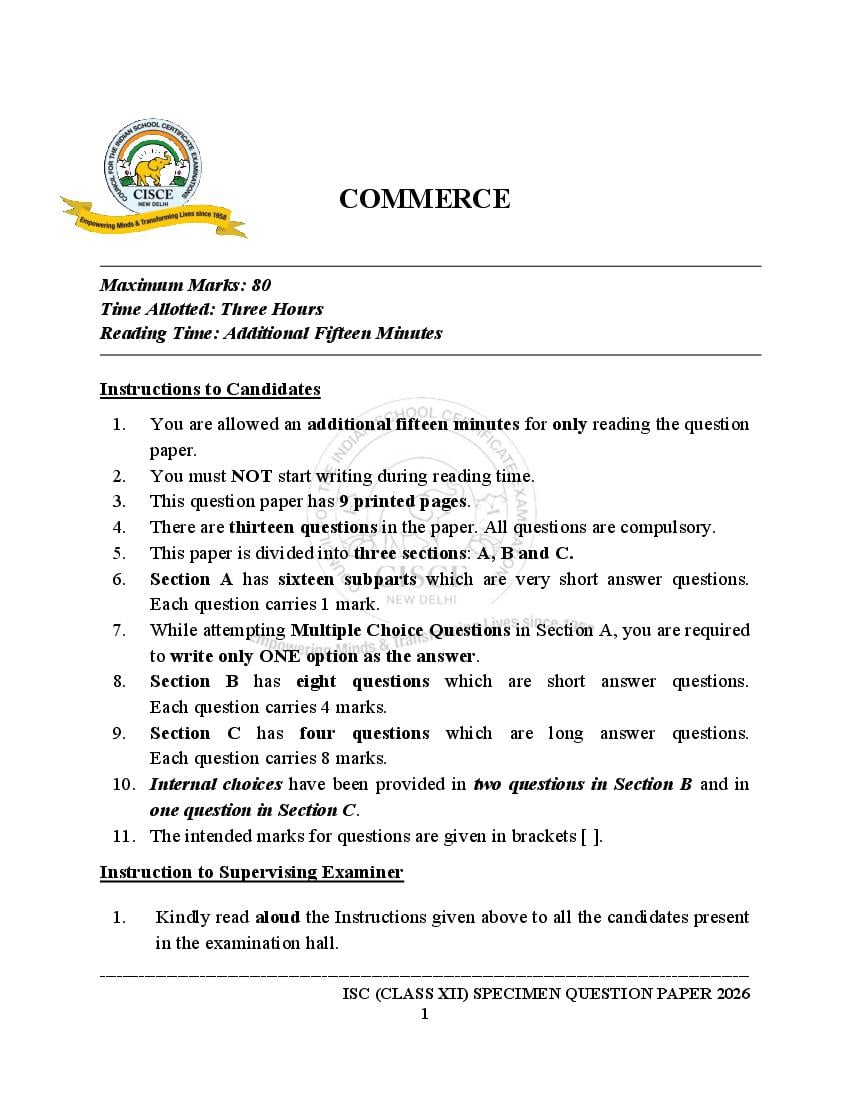
Maximum Marks: 80
Time Allotted: Three Hours
Reading Time: Additional Fifteen Minutes
Instructions to Candidates
1. You are allowed an additional fifteen minutes for only reading the question
paper.
2. You must NOT start writing during reading time.
3. This question paper has 9 printed pages.
4. There are thirteen questions in the paper. All questions are compulsory.
5. This paper is divided into three sections: A, B and C.
6. Section A has sixteen subparts which are very short answer questions.
Each question carries 1 mark.
7. While attempting Multiple Choice Questions in Section A, you are required
to write only ONE option as the answer.
8. Section B has eight questions which are short answer questions.
Each question carries 4 marks.
9. Section C has four questions which are long answer questions.
Each question carries 8 marks.
10. Internal choices have been provided in two questions in Section B and in
one question in Section C.
11. The intended marks for questions are given in brackets [ ].
Instruction to Supervising Examiner
1. Kindly read aloud the Instructions given above to all the candidates present
in the examination hall.
---------------------------------------------------------------------------------------------------------------------
ISC (CLASS XII) SPECIMEN QUESTION PAPER 2026
1
Page 2
Board Examination Question Paper and should be used as a practice tool. The questions for the
Board Examination can be set from any part of the syllabus, though the format of the Board
Examination Question Paper will remain the same as that of the Specimen Question Paper. The
weightage allocated to various topics, as given in the syllabus, will be strictly adhered to.
SECTION A – 16 MARKS
Question 1
(i) With reference to settlement of funds, what does the term ‘Real Time’ signify [1]
in RTGS? (Recall)
(a) Settlement after one hour
(b) Settlement at a fixed time every day
(c) Continuous processing and settlement
(d) Settlement only during bank hours
(ii) With reference to Macro environment, select the odd one out. [1]
(Understanding)
(a) Changes in technology
(b) Labour mobility to urban areas
(c) Political unrest
(d) Suppliers of raw materials
(iii) Sampark, a mobile company advertises its phone as having an ‘unbreakable [1]
screen’. A customer buys it, but the screen cracks after a minor fall.
He requests a replacement, but the company refuses it saying that the
advertisement was only for marketing.
Which consumer rights are MOST relevant here for the customer? (Evaluate)
(P) Right to be Heard
(Q) Right to Redressal
(R) Right to Safety
(S) Right to Information
(a) Only (P) and (Q)
(b) Only (Q) and (R)
(c) Only (P) and (R)
(d) Only (Q) and (S)
--------------------------------------------------------------------------------------------------------------------
ISC (CLASS XII) SPECIMEN QUESTION PAPER 2026
2
Page 3
among its employees and rewards them for innovative initiatives. This leads
to employee satisfaction which in turn increases their productivity.
Which internal factor of the micro environment is clearly responsible for this
outcome? (Understanding)
(a) Company’s financial position
(b) Corporate culture
(c) Marketing strategy
(d) Government regulations
(v) To boost the employees’ performance, a manager starts ‘Star Employee of the [1]
Month’ award to reward top achievers in the organisation. This results in an
increase in the efforts by employees and improves productivity.
Choose the correct function of management and its corresponding element that
the above situation refers to. (Understanding)
(a) Planning – Supervision
(b) Directing – Motivation
(c) Organising – Communication
(d) Controlling – Leadership
(vi) Sunrise Enterprise is a large company that groups its operations into separate [1]
product divisions like electronics, clothing, and furniture. Each division has
its own marketing, finance and HR departments. Within the electronics
division, a group of employees from different departments regularly interacts
during breaks and helps each other with work-related advice.
What type of organisation and organisational structure are represented here?
(Understanding)
(a) Informal organisation – Divisional structure
(b) Formal organisation – Divisional structure
(c) Formal organisation – Functional structure
(d) Informal organisation – Functional structure
(vii) Given below are two statements marked Assertion and Reason. Read the [1]
statements carefully and choose the correct option. (Analysis)
Assertion: Profit through customer satisfaction is one of the primary aims of
Marketing.
Reason: Marketing begins after production and does not end with sale.
---------------------------------------------------------------------------------------------------------------------
ISC (CLASS XII) SPECIMEN QUESTION PAPER 2026
3
Page 4
explanation for Assertion.
(b) Both Assertion and Reason are true but Reason is not the correct
explanation for Assertion.
(c) Assertion is true and Reason is false.
(d) Both Assertion and Reason are false.
(viii) Study the relation between the first and the second words given below and
complete the analogy. (Analysis)
(a) Personal skills : Art :: Ethical Code of Conduct : ____________ [1]
(b) Creates a large pool of candidates : Recruitment :: Eliminates unsuitable [1]
candidates : ____________
(ix) State whether the following are True or False:
(a) As a facilitating function of Marketing, Packaging ensures protection of [1]
a product. (Recall)
(b) According to Henri Fayol, mental revolution is a change in the attitudes [1]
of both employers and employees that increases productivity. (Recall)
(x) A company borrows a loan at 10% interest and amplifies the returns of its [1]
equity shareholders by earning 18% return on investment.
The financial concept illustrated here is _______________. (Analysis)
(xi) Chia Ltd. has earned a profit of ₹1,00,000 for the financial year ending [1]
31st March 2025. After providing the Interest on Debentures for ₹15,000,
Dividend on Preference Shares for ₹25,000 and Dividend on Equity Shares
for ₹20,000, it paid Ranjana, a shareholder a share from the residual profits
of ₹40,000 along with a fixed rate of dividend.
Identify the type of share held by Ranjana. (Analysis)
(xii) State one unique feature of the document shown below. (Recall) [1]
(Source(edited): Quora.com)
--------------------------------------------------------------------------------------------------------------------
ISC (CLASS XII) SPECIMEN QUESTION PAPER 2026
4
Page 5
model launched by an automobile company. The article highlights the car’s
eco-friendly technology, sleek design and affordability creating a positive
image and sparking public interest in the product.
Which element of promotion mix is highlighted in the above scenario?
(Understanding)
(xiv) Management can be identified as the driving force in every organisation and [1]
at every level.
Identify the feature of management highlighted in the above statement.
(Recall)
SECTION B – 32 MARKS
Question 2 [4]
Shreya owns a café in Bengaluru. She wants to explore different electronic payment
methods to streamline transactions with customers. She also weighs the pros and cons
of accepting debit cards and credit cards.
Compare these two methods of payment to help Shreya choose a suitable method of
transaction. (Analysis)
Question 3 [4]
Krishna Tech Ltd., a growing Start-up in the Robotics industry, needs finance to meet
its working capital requirements. Prerna Ltd., an Ed-Tech Company, had purchased
Robotics Training Kits and Equipment from Krishna Tech Ltd. with a credit period of
three months and is due to pay ₹15,00,000 on 30th July 2025.
Based on the above information, suggest a suitable form of short-term financing that
Krishna Tech Ltd. can opt for. Explain any three of its features. (Evaluate)
Question 4
Arjun is a Sales Manager in a company and is responsible for managing a team of five
sales representatives in the Delhi region. Every morning, Arjun assigns sales targets,
plans daily routine for his teams, checks the stock availability in retail stores and
ensures proper display of the products.
(i) State the level of management that Arjun belongs to. (Understanding) [1]
(ii) Discuss any three functions of the level of management indicated in the above [3]
scenario. (Understanding)
---------------------------------------------------------------------------------------------------------------------
ISC (CLASS XII) SPECIMEN QUESTION PAPER 2026
5
Page 6
(i) Given below is a tabular representation of the Salary structure of a few [2]
employees at Horizon Ltd.
Name of the Designation Experience Salary
Employee (in years)(In INR)
Mr. X Associate Trainer 5 5,00,000 p.a.
Ms. A Associate Trainer 5 12,00,000 p.a.
Mr. Y Associate Trainer 7 8,00,000 p.a.
Mr. B Associate Trainer 5 4,00,000 p.a.
Ms. C Associate Trainer 6 9,00,000 p.a.
Explain the principle of Henri Fayol being violated in the above case. (Analysis)
(ii) Observe the images shown below and answer the question that follows. [2]
Image 1 Image 2
Identify and explain the principle of management, as suggested by Henri Fayol,
that is not being followed in Image 1. (Understanding)
Question 6 [4]
(i) The organising function of management helps transform chaos into coordinated
structure, clarifies communication and promotes effective teamwork.
In the light of this perspective, explain any four points highlighting the
importance of organising function in management. (Understanding)
OR
(ii) A school allocates ₹10 lakhs for infrastructural upgrades, ₹5 lakhs for staff
training and ₹3 lakhs for student activities. This type of financial plan acts as a
control while helping the school prioritise its objectives.
What type of plan has the school put into action? Enumerate any three of its
inherent features. (Understanding)
--------------------------------------------------------------------------------------------------------------------
ISC (CLASS XII) SPECIMEN QUESTION PAPER 2026
6
Page 7
A Naval Academy needed to train new submarine crew members on complex
equipment and emergency procedures. To ensure safety and hands-on-experience
without risk, they created a training programme in a simulated submarine environment
before actual deployment.
Briefly discuss the method used and the type of training given to the employees in the
above case.
Question 8 [4]
A company producing weight loss pills hires a celebrity to promote the product.
This advertisement claims rapid weight loss without mentioning the need for a
balanced diet and regular physical activity. Also, it does not disclose the potential side
effects or risks associated with the pill.
Specify the provisions of the Consumer Protection Act that would protect consumer’s
interests if the claims provided in the above case are found to be false.
Question 9 [4]
(i) Many mobile phone companies charge a high price when releasing a new mobile
phone with cutting-edge technology. This allows them to generate a substantial
profit. When rivals create similar products, the price of that specific product is
dropped to gain market value and increase sales. Other electronic products, such
as fridges, televisions, and air conditioners, are priced similarly. This is because
there are a lot of competitive markets and several other brands offering similar
products.
(Source: (edited) (https://www.edrawmind.com/article/samsung-marketing-
mix-analysis.html)
Explain the pricing strategies used in the above case. (Analysis)
OR
(ii) Ms. Sheena, a graduate in Human Relations with ten years of experience in the
Corporate sector, plans to set up her start-up. She wants to set up a Soft Skills
Training Academy to train and equip fresh graduates be industry ready.
Name the type of product that she is planning to offer. Explain any three of its
features. (Understanding)
---------------------------------------------------------------------------------------------------------------------
ISC (CLASS XII) SPECIMEN QUESTION PAPER 2026
7
Page 8
Question 10
(i) Business organisations use a certain technique to diagnose and analyse their [5]
respective micro and macro environment. Name and explain the technique.
(Understanding)
(ii) Coordination is inherent in Planning, Organising and Staffing functions of [3]
management. Validate this statement by giving three suitable reasons.
(Analysis)
Question 11
(i) Ms. Surabhi wants to invest ₹2,00,000 in a debt security of a company for ten [5]
years. She prioritises safety of her investment.
Which debt security would you recommend for her investment?
Explain any four of its features. (Understanding)
(ii) State any three features of IMPS. (Recall) [3]
OR
(iii) Companies which follow a liberal dividend policy may not benefit from [5]
Self-financing method by retaining its profits.
Justify this statement by discussing any three advantages and any two
disadvantages of Retained Earnings. (Analysis)
(iv) Explain any three features of Digital Banking. (Recall) [3]
Question 12
(i) Briefly explain Physical Distribution with any three of its key elements. [5]
(Recall)
(ii) Describe the types of market on the basis of subject of exchange. [3]
(Understanding)
--------------------------------------------------------------------------------------------------------------------
ISC (CLASS XII) SPECIMEN QUESTION PAPER 2026
8
Page 9
Read the passage given below and answer the questions that follow.
XYZ Company had planned to increase its profit margin by 30% in the current
financial year. But it could not achieve the set target in the first quarter of the year due
to cases of theft by employees. The Board of Directors formulated a policy of ‘zero
tolerance’ for theft. To prevent such cases, it was decided to install CCTV cameras in
the rooms where the expensive products were stored.
The team of Senior Managers communicated the same to all the employees of the
organization. The decisions were implemented, and instructions were given to the
concerned departments to impose a penalty if an employee was found guilty.
The Human Resource department incorporated the same in the employee handbook.
(i) A few steps of Controlling have been emphasised in the above case. Discuss [2]
any two of them. (Analysis)
(ii) Mention any two objectives of Communication with reference to the above case. [2]
(Understanding)
(iii) Explain the importance of Controlling by giving any four points. [4]
(Understanding)
---------------------------------------------------------------------------------------------------------------------
ISC (CLASS XII) SPECIMEN QUESTION PAPER 2026
9
Page 10
ANSWER KEY
SECTION A – 16 MARKS
Question 1
In answering Multiple Choice Questions, candidates have to write either the
correct option number or the explanation against it. Please note that only
ONE correct answer should be written.
(i) (c) or Continuous processing and settlement [1]
(ii) (d) or Suppliers of raw materials [1]
(iii) (d) or Only (Q) and (S) [1]
(iv) (b) or Corporate culture [1]
(v) (b) or Directing – Motivation [1]
(vi) (a) or Informal organisation – Divisional structure [1]
(vii) (c) or Assertion is true and Reason is false. [1]
(viii) (a) Profession [1]
(b) Selection [1]
(ix) (a) True [1]
(b) False [1]
(x) Trading on equity [1]
(xi) Participating preferences shareholders [1]
(xii) Bank draft cannot be dishonoured. [1]
(xiii) Publicity [1]
(xiv) Universal / Universality / Pervasiveness [1]
SECTION B – 32 MARKS
Question 2 [4]
Difference between debit card and credit card
Basis Debit card Credit card
Status It is not issued to a debtor. It is issued to a debtor.
Credit facility This facility is not This facility is available.
available.
Payment It is made before using the It is made after using the
card. card.
Security It is not required. It is required.
----------------------------------------------------------------------------------------------------------------
ISC (CLASS XII) SPECIMEN ANSWER KEY 2026
1
Page 11
Interest rate is levied on the
credit, so no interest is
credit card issuer if one is
charged. unable to repay the amounts
borrowed on time.
(Candidates are required to compare the two methods on common basis.
Comparison written in a paragraph will also be accepted.)
Question 3 [4]
Trade credit: is a short-term financing method where a supplier allows a buyer to
purchase goods or services and pay for them at a later date, usually within a specified
period, without incurring interest charges if paid on time. It’s a common practice in
business-to-business transactions and is often seen as a way to manage cash flow and
build supplier relationships.
Key Features of Trade Credit:
• Short-term financing: Trade credit typically covers a period of a few weeks
to a few months, making it a useful tool for managing working capital.
• No immediate payment: The buyer receives goods or services and pays
later, often within a pre-agreed timeframe.
• Potential for interest-free credit: If the buyer pays within the agreed-upon
period, trade credit is often interest-free, making it a cost-effective financing
option.
• Flexibility in payment terms: The specific terms of trade credit (e.g., credit
period, discounts for early payment) are usually negotiated between the
buyer and supplier and can vary based on factors like relationship, the buyer’s
credit worthiness and the industry.
• Minimal documentation: It involves simple documentation like invoices or
delivery notes.
• Accounting treatment: For the buyer, trade credit appears as accounts
payable (a liability), while for the seller its recorded as accounts receivable
(an asset).
• Potential for discounts: Suppliers might offer discounts for early payment,
encouraging buyers to settle their dues sooner.
• Impact on cash flow: Trade credit helps businesses manage their cash flow
by allowing them to delay payments while still utilising the purchased goods
or services.
(Candidates have to suggest an ideal short-term financing and briefly explain any
three of its features. Headings are not mandatory.)
----------------------------------------------------------------------------------------------------------------
ISC (CLASS XII) SPECIMEN ANSWER KEY 2026
2
Page 12
(i) Middle Management [1]
(ii) Functions: [3]
• To interpret the plans and policies framed by top management.
• To monitor and control the operating performance.
• To train, motivate and develop supervisory personnel.
• To lay down rules and regulations to be followed by the supervisory
personnel.
(Candidates have to briefly discuss any three functions of the level of
management that Arjun belongs to.)
Question 5
(i) Principle of Equity [2]
Explanation:
This principle states that all the employees should be treated equally and
respectfully. There should be no discrimination on any basis like gender, caste,
position, religion etc. It is a combination of kindness and justice.
(Candidates have to briefly explain the principle of Henri Fayol that is being
violated in the given scenario.)
(ii) Principle of Order [2]
Explanation:
This principle indicates that there should be a place for everything and
everything should be in its place. / There should be both material order as well
as social order in an organisation.
(Candidates have to first identify and then briefly explain the principle of
Henri Fayol that is not followed in the given image.)
Question 6 [4]
(i) Importance of Organising
• Specialisation
• Optimum use of human resources
• Coordination and cooperation
• Security and support
• Growth and diversification
• Adaptation to change
• Training and development of personnel
• Aid to management
(Candidates have to write any four points on the areas specified above.)
OR
(ii) Type of Plan: Budget
----------------------------------------------------------------------------------------------------------------
ISC (CLASS XII) SPECIMEN ANSWER KEY 2026
3
Page 13
expenses over a specific period, like a month or a year. It serves as a roadmap
for managing finances, helping individuals and organizations allocate
resources effectively and achieve their financial goals. A good budget is
realistic, comprehensive, flexible, time-bound, and measurable.
Key Features of a Budget:
• Financial Plan: A budget is a structured document that details
income, expenses, and often includes projections for assets, liabilities,
and cash flow.
• Defined Period: Budgets are typically created for a specific time
frame, such as a month, quarter, or year, allowing for focused planning
and tracking.
• Resource Allocation: Budgets guide the allocation of resources, such
as money, time, and materials, to different activities or departments.
• Goal Setting: Budgets help in setting financial goals and tracking
progress towards achieving them.
• Performance Measurement: Budgets provide a benchmark for
measuring actual financial performance and identifying areas where
adjustments are needed.
• Control and Accountability: Budgets establish spending limits and
promote accountability for financial decisions.
• Flexibility: While budgets should be realistic, they should also be
flexible enough to accommodate unexpected changes or opportunities.
(Candidates have to first identify the type of plan and then briefly explain
any three of its features. Headings are not mandatory.)
Question 7 [4]
On the job training – vestibule - Vestibule training is a method where employees
learn job-specific skills in a simulated work environment that closely mirrors the
actual workplace. This allows trainees to practice usage of equipment and machinery
in a safe, controlled setting.
Type – safety training – It involves training given to use machinery and equipment
and safety devises while doing work. It helps to minimize accidents and damage to
machinery.
(Candidates have to first identify the method and the type of training evident in the
above case and then briefly explain the same.)
Question 8 [4]
In the above case of misleading advertisement, the following provisions of Consumer
Protection Act is empower it to:
• prohibit the endorser of a misleading advertisement from endorsing that
particular product or service for a period of up to one year. For every
subsequent offence, the period of prohibition may extend to three years.
However, there are certain exceptions when an endorser will not be held
liable for such a penalty.
----------------------------------------------------------------------------------------------------------------
ISC (CLASS XII) SPECIMEN ANSWER KEY 2026
4
Page 14
imprisonment for up to two years for a false or misleading advertisement. In
case of a subsequent offense, the fine may extend to Rs 50 lakh and
imprisonment of up to five years.
(Candidates are required to correctly identify the provisions that enable Consumer
Protection Act to protect the consumers.)
Question 9 [4]
(i) Price skimming - It is a strategy where a company sets a high initial price for
a new product to target customers who are willing to pay more. Later, the price
is gradually reduced to attract more budget-conscious buyers. This approach
helps the company maximize profits from early adopters before lowering the
price to compete in a broader market.
Competitive pricing - It is the strategy of setting prices based on competitors’
prices to gain market advantage. It is commonly used by businesses when
there are many substitutes available for their product in the market.
This type of pricing strategy is generally used once a price for a product or
service has reached a level of equilibrium, which occurs when a product has
been on the market for a long time and there are many substitutes for the
product.
(Candidates are required to correctly identify and explain the pricing
strategies indicated in the above case.)
OR
(ii) Type of Product: Service
Features of a Service:
• Intangibility: Services cannot be seen or touched. The training Ms.
Sheena offers cannot be physically handled. It is experienced by the
learner.
• Inseparability: The service is produced and consumed
simultaneously. The trainer (Ms. Sheena or her staff) must be present
to deliver the service to the trainees.
• Variability (Heterogeneity): Services differ from person to person.
Each training session may vary based on the trainer’s style,
participants, and delivery method.
• Perishability: Services cannot be stored or inventoried. If a training
session is scheduled and no one attends, that time and opportunity is
lost.
• Human Involvement: Services like training heavily depend on
human skills, personality, and communication. Ms. Sheena's corporate
experience adds value to the service.
(Candidates are required to correctly identify the product that Ms. Sheena
is planning to offer and then explain any three of its features. Headings are
not mandatory.)
----------------------------------------------------------------------------------------------------------------
ISC (CLASS XII) SPECIMEN ANSWER KEY 2026
5
Page 15
Question 10
(i) SWOT Analysis [5]
S – Strength is the inherent capability of the informal organisation which
gives the company a strategic advantage.
W – Weakness is the inherent limitation of a company which creates a
strategic disadvantage for it.
O – Opportunity is a favourable condition in the company’s external
environment which strengthened its position.
T – Threat is an unfavourable environment which damages its position.
(Candidates are required to name and explain the technique used by
business organisations.)
(ii) Coordination in Planning, Organising and Staffing [3]
• In planning, coordination is required between the master plan of the
enterprise and the plans of different departments.
• During organising, there should be coordination between the authority
and responsibility of every individual.
• While staffing, coordination is achieved by placing the right person in
right job.
(Candidates have to justify the statement by giving three reasons.)
Question 11
(i) Debentures [5]
Features:
• There is an acknowledgment of debit / borrowed funds.
• There is a specified amount of loan.
• There is a specified rate of interest.
• Interest is a charge against profits.
• They have no voting rights.
• They do not participate in management of company.
• Their investment is paid back before equity and preference share at the
time of winding up of the company.
• They generally involve a charge on the assets usually redeemable.
(Candidates are required to recommend the correct debt security and
explain any four of its features.)
----------------------------------------------------------------------------------------------------------------
ISC (CLASS XII) SPECIMEN ANSWER KEY 2026
6
Page 16
• Instant Transfers: IMPS facilitates immediate fund transfers, making
it a convenient option for urgent payments and transactions.
• 24/7 Availability: Unlike some other payment systems,
IMPS operates around the clock, including weekends and bank
holidays.
• Interbank Transfers: IMPS enables transfers between different
banks, not just within the same institution.
• Multiple Channels: You can access IMPS through various platforms,
including mobile banking apps, internet banking portals, and ATMs.
• Secure and Reliable: IMPS is managed by the National Payments
Corporation of India (NPCI), ensuring a safe and secure payment
system.
• Cost-effective: While some banks may charge fees, IMPS transactions
are generally considered cost-effective compared to other transfer
methods.
(Candidates have to write any three features in complete sentences.
Headings are not mandatory.)
OR
(iii) Advantages of retained earnings: [5]
• Dependable Source: Being an internal source, retained earnings are a
more dependable and permanent source of finance than external sources
of funds. This is because all external sources depend upon market
conditions, the preference of the creditors, etc.
• No Explicit Cost: Using retained earnings does not involve any costs to
be incurred as no expenditure is to be made on issuing prospectus,
advertising, floatation costs, etc.
• No Fixed Liability: There is no fixed liability to pay dividends or interest
on this source of funds as retained earnings are a company’s own money.
• No Interference: When a company utilises its retained profits, it does not
need to issue any new shares. As a result, there is no risk of dilution of
control in the organization.
• No Security: Unlike debentures, no charge is created on the assets of the
company. As a result, the company is free to use its assets for raising loans
in the future.
• Goodwill: Retained earnings add to the financial strength and credibility
of the company. Large reserves enable businesses to respond with ease to
any crisis or unforeseen contingency. Retained earnings may lead to an
increase in the market price of the equity shares.
Retained Earnings has the following limitations:
• Dissatisfaction: In cases of excessive ploughing back of profits, i.e.,
where a major portion of the profits has been kept in the form of reserves,
the shareholders might be disappointed by the lower amounts of dividends
paid to them.
• Uncertainty: Retained earnings are a highly uncertain method of raising
funds since the profits of a business are always fluctuating.
----------------------------------------------------------------------------------------------------------------
ISC (CLASS XII) SPECIMEN ANSWER KEY 2026
7
Page 17
retained profits is often overlooked or sometimes, not even recognised by
a lot of firms, which leads to sub-optimal usage of the funds.
(Candidates have to justify the given statement by writing relevant
advantages and disadvantages. Headings are not mandatory.)
(iv) Digital banking is the automation of traditional banking services through a [3]
digital platform.
• Digitally enabled banks allow the users to access its services 24 × 7.
• The growth of digital banking has established a new dimension to
banking services. It has led to the introduction of new banking services
such as UPI, e-wallet etc.
• It has promoted contactless and cashless payment.
• It has made the transaction swifter specially in time of pandemic.
(Candidates have to write any three features in complete sentences.)
Question 12
(i) Physical distribution encompasses all the activities involved in physically [5]
moving goods from the manufacturer to the end consumer. It's a crucial part
of the supply chain and marketing mix, ensuring products reach customers
efficiently and effectively. Key elements include transportation, warehousing,
inventory management, order processing.
Key Elements of Physical Distribution:
• Transportation: The physical movement of goods, choosing the most
appropriate mode (truck, rail, sea, air) based on cost, speed, and
product characteristics.
• Warehousing: The storage of products, ensuring safe and efficient
retrieval when needed.
• Inventory Management: Balancing stock levels to meet demand
without overstocking or understocking.
• Order Processing: The efficient handling of customer orders,
including verification, picking, packing, and shipping.
(Candidates are required to briefly explain physical distribution and any
three of its key elements. Headings are not mandatory.)
(ii) • Capital market [3]
• Money market
• Commodity market
(Candidates have to describe the markets that indulge in exchange.)
Question 13
(i) Steps of Controlling [2]
----------------------------------------------------------------------------------------------------------------
ISC (CLASS XII) SPECIMEN ANSWER KEY 2026
8
Page 18
• Taking of corrective action
(The above two steps have to be discussed in brief.)
(ii) Objectives of communication [2]
• Implementing decisions
• Carry our change
• Secure feedback
• Educate employees
• Motivate employees
(Any two of the above objectives have to be mentioned.)
(iii) Importance of Controlling [4]
• It helps in achieving organisation’s objectives.
• It ensures an optimum utilisation of resources.
• It decentralises authority and establishes a democratic work
environment.
• It is an effective means of coordination.
• It also boosts morale of employees.
• It simplifies supervision.
• It leads to better planning.
• It helps in coping with change.
(Candidates have to explain the importance of controlling by highlighting
any four points.)
----------------------------------------------------------------------------------------------------------------
ISC (CLASS XII) SPECIMEN ANSWER KEY 2026
9
Document Details
| Board / Org | CISCE |
| Exam | Class 12 |
| Type | Sample Paper |
| Pages | 18 |
| Updated | 24 Sep 2026 |