Goa Board Class 12 Question Paper June 2019 Chemsitry
Finished viewing? Save it for later —
Download Goa Board Class 12 Question Paper June 2019 Chemsitry (PDF · 9 pages)About Goa Board Class 12 Question Paper June 2019 Chemsitry
Goa Board Class 12 Question Paper June 2019 Chemsitry is available here for free download. Published by Goa Board for Class 12, this question paper can be viewed online or downloaded as a PDF (9 pages). Candidates preparing for Class 12 can use Goa Board Class 12 Question Paper June 2019 Chemsitry to understand the exam pattern, the type of questions asked, and the overall difficulty level.
Frequently Asked Questions
How can I download Goa Board Class 12 Question Paper June 2019 Chemsitry?
Open this page and click the Download button to save Goa Board Class 12 Question Paper June 2019 Chemsitry as a PDF. It is completely free on AglaSem Docs.
Is Goa Board Class 12 Question Paper June 2019 Chemsitry free to download?
Yes. Goa Board Class 12 Question Paper June 2019 Chemsitry can be viewed online and downloaded as a PDF free of cost on AglaSem Docs.
How many pages does Goa Board Class 12 Question Paper June 2019 Chemsitry have?
Goa Board Class 12 Question Paper June 2019 Chemsitry contains 9 pages, which you can read online or download together as a single PDF.
Where can I find more Class 12 study material?
You can find more Class 12 question papers, sample papers, syllabus, and answer keys on AglaSem Docs.
Goa Board Class 12 Question Paper June 2019 Chemsitry – Text
Read the full text of this question paper below — useful to quickly search, copy and reference the content online without downloading the PDF.
📄 View text version (9 pages)
Page 1
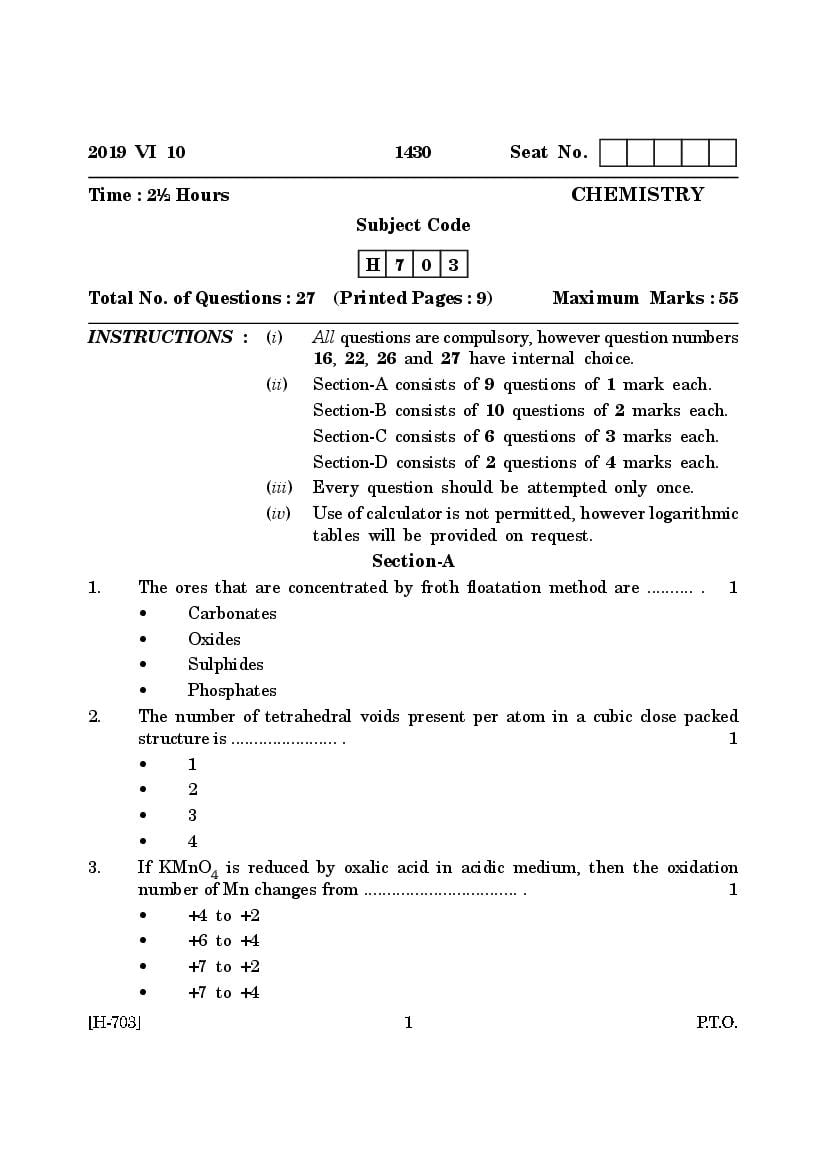
Time : 2½ Hours CHEMISTRY
Subject Code
H 7 0 3
Total No. of Questions : 27 (Printed Pages : 9) Maximum Marks : 55
INSTRUCTIONS : (i) All questions are compulsory, however question numbers
16, 22, 26 and 27 have internal choice.
(ii) Section-A consists of 9 questions of 1 mark each.
Section-B consists of 10 questions of 2 marks each.
Section-C consists of 6 questions of 3 marks each.
Section-D consists of 2 questions of 4 marks each.
(iii) Every question should be attempted only once.
(iv) Use of calculator is not permitted, however logarithmic
tables will be provided on request.
Section-A
1. The ores that are concentrated by froth floatation method are .......... . 1
• Carbonates
• Oxides
• Sulphides
• Phosphates
2. The number of tetrahedral voids present per atom in a cubic close packed
structure is ....................... . 1
• 1
• 2
• 3
• 4
3. If KMnO4 is reduced by oxalic acid in acidic medium, then the oxidation
number of Mn changes from ................................. . 1
• +4 to +2
• +6 to +4
• +7 to +2
• +7 to +4
Page 2
• A
• B
• C
• D
5. The structures of X and Y formed in the following reaction are ....... . 1
CO, HCl Zn(Hg)/
X Y
CuCl HCl
• X = ; Y =
• X = ; Y =
• X = ; Y =
• X = ; Y =
Page 3
solution by dialysis. 1
7. How much electricity in coulombs is needed to discharge 0.5 mole of Cr3+
ions ? (F = 96500 C) 1
8. Mixing acetone and chloroform occurs with reduction in volume. Name the
type of deviation from Raoult’s law shown by the above mixture and state
whether the process is endothermic or exothermic. 1
9. Arrange the following compounds in decreasing order of basic strength in
aqueous solution : 1
C2H5NH2, (C2H5)2NH, (C2H5)3N, NH3.
Section-B
10. Answer the following questions : 2
(i) Write one point of difference between calcination and roasting.
(ii) Draw a neat labelled diagram of an electrolytic cell used for the extraction
of aluminium.
11. For the reaction : 2
H
C12H22O11 + H2O C6H12O6 + C6H12O6
Write :
(i) Differential rate equation
(ii) Rate law equation
(iii) Molecularity
(iv) Order of the reaction.
12. Draw a neat labelled diagram to show Frenkel defect and write any one
condition for an ionic solid to show this defect. 2
Page 4
required for 75% completion of the reaction. 2
14. Answer the following questions : 2
(i) Write one point of difference between essential and non-essential amino
acids.
(ii) Write a chemical equation to show the action of HI on glucose.
15. Match the classes of drugs given in Column I with their action given in
Column II : 2
Column I Column II
• Analgesics • Applied to inanimate objects
• Disinfectants • Pain killing effect
• Antibiotics • Treatment of acidity
• Tranquilizers • Applied to diseased skin surface
• Treatment of stress
• Inhibit the growth of microorganisms.
16. (i) A colloidal solution of AgI is prepared by two different methods as
shown below : 2
What is the charge on AgI colloidal particles in the two test tubes (A)
and (B) ?
Page 5
(a) Zig-zag movement of colloidal particles.
(b) Removal of adsorbate from the surface of adsorbent.
Or
(i) The diagram given below represents a method for the preparation
of colloids. With reference to the diagram answer the questions that
follow :
What is the nature of the sol obtained by this method — lyophilic or
lyophobic ? Identify A in the diagram.
(ii) Name the following phenomenon/process :
(a) Migration of colloidal particles in an electric field.
(b) Converting a precipitate into colloid.
17. Answer the following : 2
(i) Fluorine forms only one oxo acid HOF. Write the reason.
(ii) Draw the structure of XeOF4.
Page 6
in presence of NaOH to give a compound Y. The compound Y reacts with
NaNO2 + HCl to form ethanol and nitrogen gas. Identify the compounds X
and Y and write the chemical equations involved. 2
19. Answer the following : 2
(i) Arrange the following polymers in the increasing order of their
intermolecular forces :
Nylon 6, Neoprene, Polyvinyl Chloride.
(ii) Write the chemical equation for the preparation of Nylon 6, 6.
Section-C
20. Draw a neat labelled diagram to show the elevation in boiling point of a solvent
when a non-volatile solute is added to it.
The vapour pressure of a 5% aqueous solution, by mass, of a non-volatile
organic substance at 373 K is 745 mm of Hg. Calculate the molar mass of
the solute.
(Given vapour pressure of water at 373 K is 760 mm Hg.) 3
2
21. State the oxidation state and coordination number of Cr in Cr NH3 5 Br
2
ion. Using valence bond theory, deduce the structure of Ni CN 4
ion. 3
22. Draw a neat labelled diagram of a Dry cell and write the cell reactions taking
place at both the electrodes.
Write any two advantages of fuel cells. 3
Page 7
Draw a neat labelled diagram of lead storage cell and write the reactions
taking place at both the electrodes during discharging of the cell.
Write the products of electrolysis of aqueous NaCl at the electrodes.
23. Answer the following questions : 3
(i) Name any two elements of the d block which are not considered as
transition elements.
(ii) Transition elements forms alloys. Write the reason.
(iii) Lu + H2O X + H2; identify X.
24. Complete the following reactions and write the names of the main product
formed : 3
AgCN
(i) CH3CH2CH2Cl ?
anhydrous
AlCl3
(ii) + CH3COCl ?
alcoholic
KOH
(iii) CH3 —CH—CH2CH3 ?
|
Cl
25. Write chemical equations for the following conversions : 3
(i) Phenol to Benzene
(ii) Acetaldehyde to Butan-2-ol
(iii) Anisole to 4-Nitroanisole.
Page 8
26. With respect to group 15 elements, answer the following : 4
(i) Comment on the trend in ionisation enthalpy giving reason.
(ii) Write any two reasons for the anomalous behaviour of nitrogen.
(iii) Draw the structure of H3PO4.
(iv) Write a chemical equation for the preparation of PH3.
Or
With respect to group 16 elements, answer the following :
(i) Comment on the trend in electronegativity giving reasons.
(ii) Write any two reasons for the anomalous behaviour of oxygen.
(iii) Draw the structure of H2SO4.
(iv) Write a chemical equation to show the action of chlorine gas on SO2
in the presence of charcoal.
27. Answer the following questions : 4
(i) Arrange the following compounds in the decreasing order of their acidic
strength :
FCH2COOH, CH3COOH, ClCH2COOH.
(ii) Write structures of X and Y in the following reaction :
ether CO2
+ Mg X H3O Y
(iii) Write a chemical equation for the preparation of Methane from sodium
acetate.
Page 9
(a) Toluene is oxidised using KMnO4, KOH followed by hydrolysis.
(b) Acetyl chloride reacts with H2 in presence of Pd and BaSO4.
Or
Answer the following questions :
(i) Arrange the following compounds in order of their increasing reactivity
towards HCN :
CH3CHO, HCHO, CH3COCH3.
(ii) Write structures of A and B in the following reaction :
H2O, H (O)
CH CH A B
HgSO4
(iii) Write a chemical equation for the preparation of Benzamide from
Benzoic acid.
(iv) Write structures of the following :
(a) Phenyl hydrazine derivative of benzaldehyde
(b) Cyclohexanone oxime.
Document Details
| Board / Org | Goa Board |
| Exam | Class 12 |
| Type | Question Paper |
| Pages | 9 |
| Updated | 22 Jul 2026 |