UGC NET Archaeology Question Paper 2018
Finished viewing? Save it for later —
Download UGC NET Archaeology Question Paper 2018 (PDF · 48 pages)About UGC NET Archaeology Question Paper 2018
UGC NET Archaeology Question Paper 2018 is available here for free download. Published by NTA for UGC National Eligibility Test, this question paper can be viewed online or downloaded as a PDF (48 pages). Candidates preparing for UGC National Eligibility Test can use UGC NET Archaeology Question Paper 2018 to understand the exam pattern, the type of questions asked, and the overall difficulty level.
Frequently Asked Questions
How can I download UGC NET Archaeology Question Paper 2018?
Open this page and click the Download button to save UGC NET Archaeology Question Paper 2018 as a PDF. It is completely free on AglaSem Docs.
Is UGC NET Archaeology Question Paper 2018 free to download?
Yes. UGC NET Archaeology Question Paper 2018 can be viewed online and downloaded as a PDF free of cost on AglaSem Docs.
How many pages does UGC NET Archaeology Question Paper 2018 have?
UGC NET Archaeology Question Paper 2018 contains 48 pages, which you can read online or download together as a single PDF.
Where can I find more UGC National Eligibility Test study material?
You can find more UGC National Eligibility Test question papers, sample papers, syllabus, and answer keys on AglaSem Docs.
UGC NET Archaeology Question Paper 2018 – Text
Read the full text of this question paper below — useful to quickly search, copy and reference the content online without downloading the PDF.
📄 View text version (48 pages)
Page 1
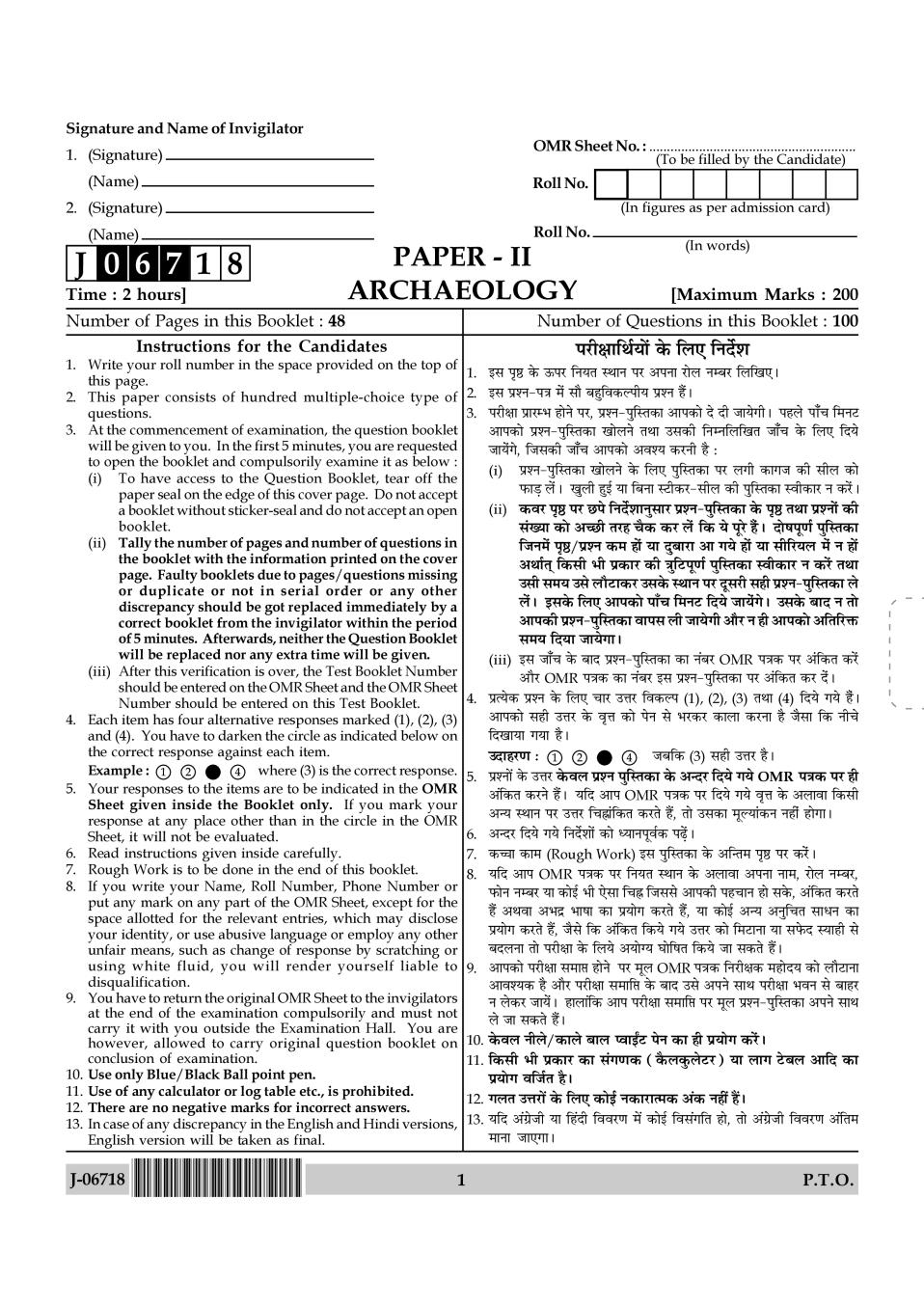
OMR Sheet No. : ..........................................................
1. (Signature) (To be filled by the Candidate)
(Name) Roll No.
2. (Signature) (In figures as per admission card)
(Name) Roll No.
(In words)
J 0 6 7 1 8 PAPER - II
Time : 2 hours] ARCHAEOLOGY [Maximum Marks : 200
Number of Pages in this Booklet : 48 Number of Questions in this Booklet : 100
Instructions for the Candidates ¬⁄UˡÊÊÁÕ¸ÿÙ¢ ∑§ Á‹∞ ÁŸŒ¸‡Ê
1. Write your roll number in the space provided on the top of
1. ß‚ ¬ÎDU ∑§ ™§¬⁄U ÁŸÿà SÕÊŸ ¬⁄U •¬ŸÊ ⁄UÙ‹U Ÿê’⁄U Á‹Áπ∞–
this page.
2. This paper consists of hundred multiple-choice type of 2. ß‚ ¬˝‡Ÿ-¬òÊ ◊¢ ‚ÊÒ ’„ÈÁfl∑§À¬Ëÿ ¬˝‡Ÿ „Ò¥–
questions. 3. ¬⁄UˡÊÊ ¬˝Ê⁄êU÷ „ÙŸ ¬⁄U, ¬˝‡Ÿ-¬ÈÁSÃ∑§Ê •Ê¬∑§Ù Œ ŒË ¡ÊÿªË– ¬„‹U ¬UÊ°ø Á◊Ÿ≈U
3. At the commencement of examination, the question booklet •Ê¬∑§Ù ¬˝‡Ÿ-¬ÈÁSÃ∑§Ê πÙ‹Ÿ ÃÕÊ ©‚∑§Ë ÁŸêŸÁ‹Áπà ¡Ê°ø ∑§ Á‹∞ ÁŒÿ
will be given to you. In the first 5 minutes, you are requested ¡Êÿ¢ª, Á¡‚∑§Ë ¡Ê°ø •Ê¬∑§Ù •fl‡ÿ ∑§⁄UŸË „Ò —
to open the booklet and compulsorily examine it as below :
(i) ¬˝‡Ÿ-¬ÈÁSÃ∑§Ê πÙ‹Ÿ ∑§ Á‹∞ ¬ÈÁSÃ∑§Ê ¬⁄U ‹ªË ∑§Êª¡ ∑§Ë ‚Ë‹ ∑§Ê
(i) To have access to the Question Booklet, tear off the
paper seal on the edge of this cover page. Do not accept »§Ê«∏ ‹¢U– πÈ‹Ë „È߸ ÿÊ Á’ŸÊ S≈UË∑§⁄U-‚Ë‹U ∑§Ë ¬ÈÁSÃ∑§Ê SflË∑§Ê⁄U Ÿ ∑§⁄¢U–
a booklet without sticker-seal and do not accept an open (ii) ∑§fl⁄U ¬ÎDU ¬⁄U ¿U¬ ÁŸŒ¸‡ÊÊŸÈ‚Ê⁄U ¬˝‡Ÿ-¬ÈÁSÃ∑§Ê ∑§ ¬ÎDU ÃÕÊ ¬˝‡ŸÙ¢ ∑§Ë
booklet. ‚¢ÅÿÊ ∑§Ù •ë¿UË Ã⁄U„ øÒ∑§ ∑§⁄U ‹¢U Á∑§ ÿ ¬Í⁄U „Ò¢U– ŒÙ·¬Íáʸ ¬ÈÁSÃ∑§Ê
(ii) Tally the number of pages and number of questions in Á¡Ÿ◊¢ ¬ÎDU/¬˝‡Ÿ ∑§◊ „Ù¢ ÿÊ ŒÈ’Ê⁄UÊ •Ê ªÿ „Ù¢ ÿÊ ‚ËÁ⁄Uÿ‹U ◊¢ Ÿ „Ù¢
the booklet with the information printed on the cover •ÕʸØ Á∑§‚Ë ÷Ë ¬˝∑§Ê⁄U ∑§Ë òÊÈÁ≈U¬Íáʸ ¬ÈÁSÃ∑§Ê SflË∑§Ê⁄U Ÿ ∑§⁄¢U ÃÕÊ
page. Faulty booklets due to pages/questions missing
or duplicate or not in serial order or any other ©‚Ë ‚◊ÿ ©‚ ‹Uı≈UÊ∑§⁄U ©‚∑§ SÕÊŸ ¬⁄U ŒÍ‚⁄UË ‚„Ë ¬˝‡Ÿ-¬ÈÁSÃ∑§Ê ‹
discrepancy should be got replaced immediately by a ‹¢– U ß‚∑§ Á‹∞ •Ê¬∑§Ù ¬Ê°ø Á◊Ÿ≈U ÁŒÿ ¡Êÿ¢ª– ©‚∑§ ’ÊŒ Ÿ ÃÙ
correct booklet from the invigilator within the period •Ê¬∑§Ë ¬˝‡Ÿ-¬ÈÁSÃ∑§Ê flʬ‚ ‹Ë ¡ÊÿªË •ı⁄U Ÿ „Ë •Ê¬∑§Ù •ÁÃÁ⁄UQ§
of 5 minutes. Afterwards, neither the Question Booklet ‚◊ÿ ÁŒÿÊ ¡ÊÿªÊ–
will be replaced nor any extra time will be given. (iii) ß‚ ¡Ê°ø ∑§ ’ÊŒ ¬˝‡Ÿ-¬ÈÁSÃ∑§Ê ∑§Ê Ÿ¥’⁄U OMR ¬òÊ∑§ ¬⁄U •¢Á∑§Ã ∑§⁄¢U
(iii) After this verification is over, the Test Booklet Number
•Uı⁄U OMR ¬òÊ∑§ ∑§Ê Ÿ¥’⁄U ß‚ ¬˝‡Ÿ-¬ÈÁSÃ∑§Ê ¬⁄U •¢Á∑§Ã ∑§⁄U Œ¢–
should be entered on the OMR Sheet and the OMR Sheet
Number should be entered on this Test Booklet. 4. ¬˝ àÿ∑§ ¬˝‡Ÿ ∑§ Á‹∞ øÊ⁄U ©ûÊ⁄U Áfl∑§À¬ (1), (2), (3) ÃÕÊ (4) ÁŒÿ ªÿ „Ò¢–
4. Each item has four alternative responses marked (1), (2), (3) •Ê¬∑§Ù ‚„Ë ©ûÊ⁄U ∑§ flÎûÊ ∑§Ù ¬Ÿ ‚ ÷⁄U∑§⁄U ∑§Ê‹Ê ∑§⁄UŸÊ „Ò ¡Ò‚Ê Á∑§ ŸËø
and (4). You have to darken the circle as indicated below on ÁŒπÊÿÊ ªÿÊ „Ò–
the correct response against each item. ©ŒÊ„⁄UáÊ — ¡’Á∑§ (3) ‚„Ë ©ûÊ⁄U „Ò–
Example : where (3) is the correct response. 5. ¬˝‡ŸÊ¥ ∑§ ©ûÊ⁄U ∑§fl‹ ¬˝‡Ÿ ¬ÈÁSÃ∑§Ê ∑§ •ãŒ⁄U ÁŒÿ ªÿ OMRU ¬òÊ∑§ ¬⁄U „Ë
5. Your responses to the items are to be indicated in the OMR •¥Á∑§Ã ∑§⁄UŸ „Ò¥– ÿÁŒ •Ê¬ OMRU ¬òÊ∑§ ¬⁄U ÁŒÿ ªÿ flÎûÊ ∑§ •‹ÊflÊ Á∑§‚Ë
Sheet given inside the Booklet only. If you mark your
response at any place other than in the circle in the OMR •ãÿ SÕÊŸ ¬⁄U ©ûÊ⁄U ÁøqÊ¢Á∑§Ã ∑§⁄Uà „Ò¥, ÃÙ ©‚∑§Ê ◊ÍÀUÿÊ¢∑§Ÿ Ÿ„Ë¢ „٪ʖ
Sheet, it will not be evaluated. 6. •ãŒ⁄U ÁŒÿ ªÿ ÁŸŒ¸‡ÊÙ¢ ∑§Ù äÿÊŸ¬Ífl¸∑§ ¬…∏¢U–
6. Read instructions given inside carefully. 7. ∑§ìÊÊ ∑§Ê◊ (Rough Work) ß‚ ¬ÈÁSÃ∑§Ê ∑§ •ÁãÃ◊ ¬ÎDU ¬⁄U ∑§⁄¢U–
7. Rough Work is to be done in the end of this booklet. 8. ÿÁŒ •Ê¬ OMR ¬òÊ∑§ ¬⁄U ÁŸÿà SÕÊŸ ∑§ •‹ÊflÊ •¬ŸÊ ŸÊ◊, ⁄UÊ‹ Ÿê’⁄U,
8. If you write your Name, Roll Number, Phone Number or »§ÊŸ Ÿê’⁄U ÿÊ ∑§Ê߸ ÷Ë ∞‚Ê Áøq Á¡‚‚ •Ê¬∑§Ë ¬„øÊŸ „Ê ‚∑§, •¥Á∑§Ã ∑§⁄UÃ
put any mark on any part of the OMR Sheet, except for the
space allotted for the relevant entries, which may disclose „Ò¥ •ÕflÊ •÷Œ˝ ÷Ê·Ê ∑§Ê ¬˝ÿʪ ∑§⁄Uà „Ò¥, ÿÊ ∑§Ê߸ •ãÿ •ŸÈÁøà ‚ÊœŸ ∑§Ê
your identity, or use abusive language or employ any other ¬˝ÿʪ ∑§⁄Uà „Ò¥, ¡Ò‚ Á∑§ •¥Á∑§Ã Á∑§ÿ ªÿ ©ûÊ⁄U ∑§Ê Á◊≈UÊŸÊ ÿÊ ‚»§Œ SÿÊ„Ë ‚
unfair means, such as change of response by scratching or ’Œ‹ŸÊ ÃÊ ¬⁄UˡÊÊ ∑§ Á‹ÿ •ÿÊÇÿ ÉÊÊÁ·Ã Á∑§ÿ ¡Ê ‚∑§Ã „Ò¥–
using white fluid, you will render yourself liable to 9. •Ê¬∑§Ù ¬⁄UˡÊÊ ‚◊Ê# „ÙŸ §¬⁄U ◊Í‹ OMR ¬òÊ∑§ ÁŸ⁄UˡÊ∑§ ◊„ÙŒÿ ∑§Ù ‹Uı≈UÊŸÊ
disqualification. •Êfl‡ÿ∑§ „Ò •ı⁄U ¬⁄UˡÊÊ ‚◊ÊÁ# ∑§ ’ÊŒ ©‚ •¬Ÿ ‚ÊÕ ¬⁄UˡÊÊ ÷flŸ ‚ ’Ê„⁄U
9. You have to return the original OMR Sheet to the invigilators Ÿ ‹∑§⁄U ¡Êÿ¢– „Ê‹Ê¥Á∑§ •Ê¬ ¬⁄UˡÊÊ ‚◊ÊÁ# ¬⁄U ◊Í‹ ¬˝‡Ÿ-¬ÈÁSÃ∑§Ê •¬Ÿ ‚ÊÕ
at the end of the examination compulsorily and must not
carry it with you outside the Examination Hall. You are
‹ ¡Ê ‚∑§Ã „Ò¥–
however, allowed to carry original question booklet on 10. ∑§fl‹ ŸË‹/∑§Ê‹ ’Ê‹U åflÊßZ≈U ¬Ÿ ∑§Ê „Ë ¬˝ÿʪ ∑§⁄¢U–
conclusion of examination. 11. Á∑§‚Ë ÷Ë ¬˝∑§Ê⁄U ∑§Ê ‚¢ªáÊ∑§ (∑Ò§‹∑ȧ‹≈U⁄U) UÿÊ ‹Êª ≈U’‹ •ÊÁŒ ∑§Ê
10. Use only Blue/Black Ball point pen. ¬˝ÿÙª flÁ¡¸Ã „Ò–
11. Use of any calculator or log table etc., is prohibited.
12. ª‹Ã ©ûÊ⁄UÊ¥ ∑§ Á‹∞ ∑§Ê߸ Ÿ∑§Ê⁄UÊà◊∑§ •¥∑§ Ÿ„Ë¥ „Ò¥–
12. There are no negative marks for incorrect answers.
13. In case of any discrepancy in the English and Hindi versions, 13. ÿÁŒ •¥ª˝¡Ë ÿÊ Á„¥ŒË Áflfl⁄UáÊ ◊¥ ∑§Ê߸ Áfl‚¥ªÁà „Ê, ÃÊ •¥ª˝¡Ë Áflfl⁄UáÊ •¥ÁÃ◊
English version will be taken as final. ◊ÊŸÊ ¡Ê∞ªÊ–
J-06718 !J-06718-PAPER-II! 1 P.T.O.
Page 2
PAPER - II
Note : This paper contains hundred (100) objective type questions of two (2) marks each. All
questions are compulsory.
1. Netankheri on Narmada is a site which yielded parts of human fossil :
(1) Left clavicle
(2) Right clavicle
(3) Left femur and humerus fragment
(4) ninth rib
2. The first scientific discovery of fossils from the Siwaliks was made by :
(1) W.F. Baker and H.M. Durand
(2) Sir Proby Thomas Cautley and Robert Smith
(3) H. Falconer
(4) R. Lydekker
3. The oldest dated middle Palaeolithic evidence without bifaces is from :
(1) Hathnora (2) Kalpi (3) Jwalapuram (4) Samnapur
4. Evidence of the earliest use of areca nut in India has been found from the site :
(1) Hallur (2) Lingsugur (3) Kupgal (4) Watgal
5. The Sohanian culture came into limelight through the Yale-Cambridge Expedition, named
after the river Sohan which is a tributary of the river :
(1) the Indus (2) the Ganges (3) the Ghagghar (4) the Narmada
6. Which of the following statement is not correct about Mesolithic culture ?
(1) The term ‘Mesolithic’ was first used by H.M. Westropp
(2) It was a transitional period between hunting-gathering to food producing economy
(3) The diagnostic tools of this culture were made by grounding and polishing technique
(4) The subsistence economy of this culture was hunting, gathering and fishing
7. Robert Bruce Foote, a major archaeological pioneer in India was served with :
(1) Geological Survey of India (2) Archaeological Survey of India
(3) Anthropological Survey of India (4) Zoological Survey of India
J-06718 !J-06718-PAPER-II! 2 Paper-II
Page 3
¬˝‡Ÿ-¬òÊ - II
ÁŸŒ¸‡Ê — ß‚ ¬˝‡Ÿ-¬òÊ ◊¥ ‚ÊÒ (100) ’„È-Áfl∑§À¬UËÿ ¬˝‡Ÿ „Ò¥– ¬˝àÿ∑§ ¬˝‡Ÿ ∑§ ŒÙ (2) •¢∑§ „Ò¥– ‚÷Ë ¬˝‡Ÿ •ÁŸflÊÿ¸ „Ò¥–
1. Ÿ◊¸ŒÊ ¬⁄U ÁSÕà ŸÃŸπ«∏Ë fl„ SÕ‹ „Ò ¡„Ê° ‚ ◊ÊŸfl ¡Ëflʇ◊ ∑§ •¥‡Ê ¬˝Êåà „Èÿ „Ò¥ —
(1) ’ÊÿË¥ „°‚È‹Ë
(2) ŒÊÁ„ŸË „°‚È‹Ë
(3) ’ÊÿË¥ ™§fl¸ÁSÕ •ÊÒ⁄U ¬˝ªÁá«U∑§Ê ∑§ ≈ÈU∑§«∏
(4) ŸflË¥ ¬‚‹Ë
2. Á‡ÊflÊÁ‹∑§ ‚ ¡Ëflʇ◊Ê¥ ∑§Ë ¬˝Õ◊ flÒôÊÊÁŸ∑§ πÊ¡ ∑§Ë ÕË —
(1) «UéÀÿÍ.∞»§. ’∑§⁄U •ÊÒ⁄U ∞ø.∞◊. «ÈU⁄UÊá«U Ÿ
(2) ‚⁄U ¬˝Ê’Ë ÕÊÚ◊‚ ∑§Ê©≈U‹ •ÊÒ⁄U ⁄UÊ’≈¸U ÁS◊Õ Ÿ
(3) ∞ø. »§Ê‹∑§ÊŸ⁄U Ÿ
(4) •Ê⁄U. Àÿ«UÄ∑§⁄U Ÿ
3. Á’ŸÊ ©÷ÿ¬ˇÊËÿ ’Êß»§‚ ∑§ ¬˝ÊøËŸÃ◊ ÁÃÁÕÿÈÄà ◊äÿ ¬È⁄UʬʷÊÁáÊ∑§ ‚Êˇÿ „Ò¥ —
(1) „ÕŸÊ⁄UÊ ‚ (2) ∑§ÊÀ¬Ë ‚ (3) íflʋʬÈ⁄U◊ ‚ (4) ‚◊ŸÊ¬È⁄U ‚
4. ÷Ê⁄Uà ◊¥ ‚ȬÊ⁄UË ¬˝ÿʪ ∑§Ê ¬˝ÊøËŸÃ◊ ‚Êˇÿ Á∑§‚ SÕ‹ ‚ ¬˝Êåà „È•Ê „Ò?
(1) „À‹Í⁄U (2) Á‹¥Ç‚ȪÈ⁄U (3) ∑ȧ¬ª‹ (4) fl≈Uª‹
5. ÿ‹-∑Ò§Áê’˝¡ •Á÷ÿÊŸ mÊ⁄UÊ ‚Ê„Ÿ ‚¥S∑ΧÁà ¬˝∑§Ê‡Ê ◊¥ •ÊÿË Á¡‚∑§Ê ŸÊ◊∑§⁄UáÊ ‚Ê„Ÿ ŸŒË ∑§ •ÊœÊ⁄U ¬⁄U „È•Ê ¡Ê ∞∑§
‚„Êÿ∑§ ŸŒË „Ò —
(1) Á‚ãœÈ ∑§Ë (2) ª¥ªÊ ∑§Ë (3) ÉÊÇÉÊ⁄ ∑§Ë (4) Ÿ◊¸ŒÊ ∑§Ë
6. ◊äÿ ¬Ê·ÊáÊ ‚¥S∑ΧÁà ‚ ‚ê’ÁãœÃ ÁŸêŸÁ‹Áπà ◊¥ ∑§ÊÒŸ-‚Ê ∑§ÕŸ ‚„Ë Ÿ„Ë¥ „Ò?
(1) ‚fl¸¬˝Õ◊ ∞ø.∞◊. flS≈˛UÊÚ¬ mÊ⁄UÊ “◊‚ÊÁ‹ÁÕ∑§” ‡ÊéŒ ∑§Ê ¬˝ÿʪ Á∑§ÿÊ ªÿÊ–
(2) ÿ„ •Êπ≈U - ‚¥ª˝„ •ÊÒ⁄U πÊl ©à¬ÊŒŸ ŒÊŸÊ¥ ∑§ ’Ëø ∑§Ê ‚¥∑˝§◊áÊ ∑§Ê‹ ÕÊ–
(3) ß‚ ‚¥S∑ΧÁà ∑§ ‹ÊˇÊÁáÊ∑§ ©¬∑§⁄UáÊÊ¥ ∑§Ê ÉÊÁ·¸Ã •ÊÒ⁄U ø◊∑§Ë‹Ê ∑§⁄UŸ ∑§Ë Ã∑§ŸË∑§ ‚ ’ŸÊÿÊ ªÿÊ ÕÊ–
(4) ¬‡ÊÈ •Êπ≈U, ‚¥ª˝„áÊ •ÊÒ⁄U ◊àSÿ •Êπ≈U ß‚ ‚¥S∑ΧÁà ∑§ ¡ËflŸ ÁŸflʸ„ ∑§ ‚ÊœŸ Õ–
7. ÷Ê⁄Uà ◊¥ ¬È⁄UÊÃàfl ∑§ ∞∑§ ¬˝◊Èπ ¬˝áÊÃÊ ⁄UÊ’≈¸U ’˝È‚ »È§≈U Ÿ Á∑§‚∑§ ‚ÊÕ ‚flÊ ∑§Ë ÕË?
(1) ÷Ê⁄UÃËÿ ÷ͪ÷¸ ‚fl¸ˇÊáÊ (2) ÷Ê⁄UÃËÿ ¬È⁄UÊÃàfl ‚fl¸ˇÊáÊ
(3) ÷Ê⁄UÃËÿ ŸÎÁflôÊÊŸ ‚fl¸ˇÊáÊ (4) ÷Ê⁄UÃËÿ ¬˝ÊÁáÊÁflôÊÊŸ ‚fl¸ˇÊáÊ
J-06718 !J-06718-PAPER-II! 3 Paper-II
Page 4
(1) the lower Pleistocene Period (2) the middle Pleistocene Period
(3) the upper Pleistocene Period (4) the Pliocene Period
9. Which of the following ware belongs to Arikamedu site ?
(1) Black and Red Ware (2) Painted Grey Ware
(3) Northern Black Polished Ware (4) Rouletted Ware
10. Which of the following Harappan sites is stated to have been destroyed by fire ?
(1) Kotdiji (2) Amri (3) Balu (4) Surkotada
11. Which of the following sites has yielded the evidence of Harappan cremation-ground ?
(1) Rakhigarhi (2) Sanauli
(3) Farmana (4) Tarkhanewala Dera
12. Which of the following Neolithic sites has yielded terracotta snake figurines ?
(1) Chirand (2) Burzahom (3) Maski (4) Marakdola
13. Which of the following temples was known as a centre of higher education ?
(1) Lingaraj temple of Bhubaneshwar
(2) Shore temple of Mamallpuram
(3) Dashavatara temple of Devagarh
(4) Trayipurusha temple of Salotagi
14. Which religion was followed by Harsha as recorded in his copper-plates ?
(1) Buddhism (2) Jainism (3) Shaivism (4) Vaishnavism
15. How much money was spent in the construction of the Mahavijaya Prasad of Kalinga ?
(1) 10 Lakhs (2) 28 Lakhs (3) 38 Lakhs (4) 56 Lakhs
16. An image of seated Buddha is represented on the stupa of which of the following ?
(1) Ajanta cave no. 26 (2) Amaravati
(3) Nagarjunikonda (4) Sanchi stupa no. 2
J-06718 !J-06718-PAPER-II! 4 Paper-II
Page 5
(1) ÁŸêŸ ¬˝ÊÁßÍß ∑§Ê‹ (2) ◊äÿ ¬˝ÊÁßÍß ∑§Ê‹
(3) ©ëø ¬˝ÊÁßÍß ∑§Ê‹ (4) •ÁßÍß ∑§Ê‹
9. ÁŸêŸÁ‹Áπà ¬ÊòÊ ¬⁄Uê¬⁄UÊ•Ê¥ ◊¥ ‚ Á∑§‚∑§Ê SÊê’㜠•Á⁄U∑§Ê◊«È ∑§ ¬È⁄UÊSÕ‹ ‚ „Ò?
(1) ∑ΧcáÊ-‹ÊÁ„à ◊ÎŒ˜÷Êá«U ¬⁄Uê¬⁄UÊ (2) ÁøÁòÊà œÍ‚⁄U ◊ÎŒ˜÷Êá«U ¬⁄ê¬⁄UÊ
(3) ©ûÊ⁄UË ∑§Ê‹Ë ø◊∑§Ë‹Ë ¬ÊòÊ-¬⁄Uê¬⁄UÊ (4) ø∑˝§Ê¥Á∑§Ã ◊ÎŒ˜÷Êá« ¬⁄Uê¬⁄UÊU
10. ÁŸêŸÁ‹Áπà ◊¥ ‚ ∑§ÊÒŸ‚Ê „«∏å¬Ê߸ ¬È⁄UÊSÕ‹ „Ò Á¡‚∑§ ’Ê⁄U ◊¥ ∑§„Ê ¡ÊÃÊ „Ò Á∑§ fl„ •ÁÇŸ ‚ äfl¥‡Ê „È•Ê?
(1) ∑§Ê≈UŒËÁ¡ (2) •Ê◊⁄UË (3) ’Ê‹Í (4) ‚È⁄U∑§Ê≈U«∏Ê
11. ÁŸêŸÁ‹Áπà ¬È⁄UÊSÕ‹Ê¥ ◊¥ ‚ „«∏å¬Ê߸ ‡◊‡ÊÊŸ ∑§ ‚Êˇÿ ∑§„Ê° ‚ Á◊‹ „Ò¥?
(1) ⁄UÊπ˪…∏Ë (2) ‚ŸÊÒ‹Ë
(3) »§⁄U◊ÊŸÊ (4) Ã⁄UπÊŸflÊ‹Ê «U⁄UÊ
12. ÁŸêŸÁ‹Áπà Ÿfl¬Ê·ÊáÊ ∑§Ê‹ËŸ ¬È⁄UÊSÕ‹Ê¥ ◊¥ ¬∑§Ë Á◊^Ë ∑§Ë ‚¬¸ ◊ÍÁøÿÊ° ∑§„Ê° ‚ ¬˝Êåà „È߸ „Ò¥?
(1) Áø⁄UÊ¥Œ (2) ’È¡¸„Ê◊ (3) ◊ÊS∑§Ë (4) ◊⁄U∑§«UÊ‹Ê
13. ÁŸêŸÁ‹Áπà ◊¥ ‚ ∑§ÊÒŸ-‚Ê ◊ÁãŒ⁄U ©ëø Á‡ÊˇÊÊ ∑§ ∑§ãŒ˝ ∑§ M§¬ ◊¥ ÁflÅÿÊà ÕÊ?
(1) ÷ÈflŸ‡fl⁄U ∑§Ê Á‹¥ª⁄UÊ¡ ◊ÁãŒ⁄U
(2) ◊Ê◊À‹¬È⁄U◊ ∑§Ê ‚◊ÈŒ˝ Ã≈UËÿ ◊ÁãŒ⁄U
(3) Œflª…∏ ∑§Ê Œ‡ÊÊflÃÊ⁄U ◊ÁãŒ⁄U
(4) ‚‹ÊÃªË ∑§Ê òÊÿˬÈL§· ◊ÁãŒ⁄U
14. „·¸ ∑§ ÃÊ◊˝-¬òÊÊ¥ ‚ ©‚∑§ Á∑§‚ œ◊¸ ∑§ •ŸÈÿÊÿË „ÊŸ ∑§Ë ‚ÍøŸÊ Á◊‹ÃË „Ò?
(1) ’ÊÒh œ◊¸ (2) ¡ÒŸ œ◊¸ (3) ‡ÊÒfl œ◊¸ (4) flÒcáÊfl œ◊¸
15. ∑§Á‹¥ª ∑§ ◊„ÊÁfl¡ÿ ¬˝Ê‚ÊŒ ∑§ ÁŸ◊ʸáÊ ◊¥ Á∑§ÃŸË ⁄UÊÁ‡Ê ∑§Ê √ÿÿ „È•Ê ÕÊ?
(1) 10 ‹Êπ (2) 28 ‹Êπ (3) 38 ‹Êπ (4) 56 ‹Êπ
16. ÁŸêŸ ◊¥ ‚ Á∑§‚ SÃͬ ¬⁄U •Ê‚ËŸ ’Èh ◊ÍÁø ’ŸË „È߸ „Ò?
(1) •¡ãÃÊ ªÈ„Ê ‚¥ÅÿÊ 26 (2) •◊⁄UÊflÃË
(3) ŸÊªÊ¡È¸ŸË∑§Êá«U (4) ‚Ê°øË SÃͬ ‚¥ÅÿÊ 2
J-06718 !J-06718-PAPER-II! 5 Paper-II
Page 6
(1) Bull (2) Elephant (3) Lakshmi (4) Vishnu
18. Which of the following kings had issued coins with figures/portrait of Lord Ganesha on the
reverse ?
(1) Kujula Kadphises (2) Vasudeva
(3) Huviska (4) Kaniska III
19. Which Muslim king issued coins with translation of Kalima in Sanskrit language ?
(1) Abu Mansur Sabuktagin (2) Mahmud of Ghazni
(3) Muhammad Ghori (4) Alauddin Khilzi
20. Which of the following coins supplies the oldest specimen of the Brahmi script and is in a
way useful for the history of script ?
(1) Coins of Dhanapala (2) Coins of Mahipala
(3) Coins of Vigrahapala (4) Coins of Anandapala
21. Quaternary period is constituted together by :
(a) Pliocene (b) Pleistocene (c) Holocene (d) Miocene
Code :
(1) (a) and (b) (2) (b) and (c) (3) (c) and (d) (4) (a) and (d)
22. Late Acheulian sites dated between 140 kya and 120 kya are :
(a) Hokra (b) Rojadi (c) Patpara (d) Bamburi
Code :
(1) (a) and (b) (2) (b) and (c) (3) (c) and (d) (4) (a) and (d)
23. The Neolithic sites associated with human burials are :
(a) Gormati-ni-khan Dhansura (b) Gandlur
(c) Ieej (d) Baijapalle
Code :
(1) (a), (b) and (c) (2) (b), (c) and (d) (3) (a), (c) and (d) (4) (a), (b) and (d)
24. Chauldari Midden in Andaman Islands revealed evidence of a tools made of :
(a) bone (b) stone (c) glass (d) iron
Code :
(1) (a), (b) and (d) (2) (b), (c) and (d) (3) (a), (b) and (c) (4) (a), (c) and (d)
J-06718 !J-06718-PAPER-II! 6 Paper-II
Page 7
(1) ’Ò‹ (2) „ÊÕË (3) ‹ˇ◊Ë (4) ÁflcáÊÈ
18. ÁŸêŸÁ‹Áπà ⁄UÊ¡Ê•Ê¥ ◊¥ ‚ Á∑§‚Ÿ •¬Ÿ Á‚Ä∑§Ê¥ ∑§ ¬Îc∆U÷ʪ ¬⁄U ªáÊ‡Ê ∑§Ë •Ê∑ΧÁà ©à∑§Ëáʸ ∑§⁄UflÊÿË ÕË?
(1) ∑ȧ¡È‹ ∑§ŒÁ»§‚‚ (2) flÊ‚ÈŒfl
(3) „ÈÁflc∑§ (4) ∑§ÁŸc∑§ ÃÎÃËÿ
19. ÁŸêŸÁ‹Áπà ⁄UÊ¡Ê•Ê¥ ◊¥ ‚ Á∑§‚Ÿ Á‚Ä∑§ ¡Ê⁄UË Á∑§ÿ Á¡‚◊¥ ∑§‹Ë◊Ê ∑§Ê •ŸÈflÊŒ ‚¥S∑Χà ÷Ê·Ê ◊¥ ÁŒÿÊ ªÿÊ?
(1) •’È ◊¥‚È⁄U ‡Ê’ÈÄàÊÁªŸ (2) ª¡ŸË ∑§Ê ◊„◊ÍŒ
(3) ◊È„ê◊Œ ªÊ⁄UË (4) •‹Ê©gËŸ Áπ‹¡Ë
20. ’˝ÊrÊË Á‹Á¬ ∑§Ê ‚’‚ ¬È⁄UÊŸÊ Ÿ◊ÍŸÊ ÁŸêŸÊ¥Á∑§Ã ⁄UÊ¡Ê•Ê¥ ◊¥ ‚ Á∑§‚∑§ Á‚Ä∑§ ¬⁄U Á◊‹ÃÊ „Ò ¡Ê Á‹Á¬ ∑§ ßÁÄʂ ∑§ Á‹∞
∑§Ê»§Ë ©¬ÿÊªË „Ò?
(1) œŸ¬Ê‹ ∑§Ê Á‚Ä∑§Ê (2) ◊Á„¬Ê‹ ∑§Ê Á‚Ä∑§Ê
(3) Áflª˝„¬Ê‹ ∑§Ê Á‚Ä∑§Ê (4) •ÊãÊ㌬ʋ ∑§Ê Á‚Ä∑§Ê
21. øÃÈÕ¸∑§ ∑§Ê‹ ‚Áê◊Á‹Ã M§¬ ‚ ’ŸÃÊ „Ò —
(a) •ÁßÍß (b) ¬˝ÊÁßÍß (c) ŸÍß (d) ◊äÿ ŸÍß
∑ͧ≈U —
(1) (a) •ÊÒ⁄U (b) (2) (b) •ÊÒ⁄U (c) (3) (c) •ÊÒ⁄U (d) (4) (a) •ÊÒ⁄U (d)
22. 140000 •ÊÒ⁄U 120000 fl·¸ ∑§ ’Ëø ÁÃÁÕflÊ‹ ¬⁄UUflÃ˸ •‡ÿÍÁ‹ÿŸ SÕ‹ „Ò¥ —
(a) „Ê∑§⁄UÊ (b) ⁄UÊ¡«UË (c) ¬≈U¬⁄UÊ (d) ’ê’È⁄UË
∑ͧ≈U —
(1) (a) •ÊÒ⁄U (b) (2) (b) •ÊÒ⁄U (c) (3) (c) •ÊÒ⁄U (d) (4) (a) •ÊÒ⁄U (d)
23. ◊ÊŸfl ‚◊ÊÁœÿÊ¥ ‚ ‚ê’h Ÿfl¬Ê·ÊÁáÊ∑§ ¬È⁄UÊSÕ‹ „Ò¥ —
(a) ªÊ⁄U◊ÃË-ÁŸ-πÊŸ œŸ‚È⁄UÊ (b) ªá«U‹Í⁄U
(c) •Êß¡ (d) ’ҡʬÀ‹
∑ͧ≈U —
(1) (a), (b) •ÊÒ⁄U (c) (2) (b), (c) •ÊÒ⁄U (d) (3) (a), (c) •ÊÒ⁄U (d) (4) (a), (b) •ÊÒ⁄U (d)
24. •á«U◊ÊŸ mˬ ◊¥ øÊ©‹Œ⁄UË Á◊«UŸ ‚ ©¬∑§⁄UáÊÊ¥ ∑§ ‚Êˇÿ ¬˝Êåà „Èÿ „Ò¥ —
(a) „aË ∑§ (b) ¬àÕ⁄U ∑§ (c) ∑§Ê°ø ∑§ (d) ‹Ê„Ê ∑§
∑ͧ≈U —
(1) (a), (b) •ÊÒ⁄U (d) (2) (b), (c) •ÊÒ⁄U (d) (3) (a), (b) •ÊÒ⁄U (c) (4) (a), (c) •ÊÒ⁄U (d)
J-06718 !J-06718-PAPER-II! 7 Paper-II
Page 8
(a) It used microliths to make compound tools.
(b) It was based on domestication of plants and animals.
(c) It started sedentary way of life.
(d) It depended on intensive gathering of wild plants and fishing.
Code :
(1) (a) and (b) (2) (b) and (c) (3) (c) and (d) (4) (a) and (d)
26. Ostrich eggshells were used for making ornamental beads at which of the following sites ?
(a) Muchchatala Chintamanu Gavi (b) Khaparkheda
(c) Bhimbetka (d) Patne
Code :
(1) (a), (b) and (c) (2) (a) and (d) (3) (b), (c) and (d) (4) (a), (b) and (d)
27. Paintings of ploughing farmers are seen in the depiction at the sites :
(a) Kupgal (b) Bhimbetka
(c) Chaturbhujnath Nala (d) Lakhajoar
Code :
(1) (a) and (b) (2) (b) and (c) (3) (c) and (d) (4) (a) and (d)
28. Which of the following are considered the indicator to distinguish the layers during an
excavation ?
(a) Colour (b) Thickness (c) Composition (d) Contents
Code :
(1) (a) and (b) (2) (b) and (c) (3) (c) and (d) (4) (a), (c) and (d)
29. Which of the following tools do not belong to the Copper Hoards ?
(a) Harpoon (b) Arrowhead
(c) Anthropomorphic figure (d) Trident
Code :
(1) (a) and (c) (2) (b) and (d) (3) (b) and (c) (4) (a) and (d)
30. Which of the following Harappan sites have revealed copper seals ?
(a) Mitathal (b) Lothal (c) Alamgirpur (d) Deshalpur
Code :
(1) (a) and (c) (2) (b) and (d) (3) (a) and (b) (4) (c) and (d)
J-06718 !J-06718-PAPER-II! 8 Paper-II
Page 9
(a) ß‚ ‚◊ÿ ‚¥ÿÈÄà ©¬∑§⁄UáÊ ’ŸÊŸ ◊¥ ‹ÉÊȇ◊∑§Ê¥ ∑§Ê ¬˝ÿʪ „È•Ê–
(b) ÿ„ flŸS¬ÁÃÿÊ¥ •ÊÒ⁄U ¬‡ÊÈ•Ê¥ ∑§ ¬Ê‹Ÿ ¬⁄U •ÊœÊÁ⁄Uà ÕÊ–
(c) ß‚ SÊêÊÿ SÕÒ⁄U ¡ËflŸ ¬˝Ê⁄Uê÷ „È•Ê–
(d) ÿ„ ∑§Ê‹ ¡¥ª‹Ë flŸS¬ÁÃÿÊ¥ ∑§ ª„Ÿ ‚¥ª˝„áÊ •ÊÒ⁄U ◊àSÿ ¬⁄U ÁŸ÷¸⁄U ÕÊ–
∑ͧ≈U —
(1) (a) •ÊÒ⁄U (b) (2) (b) •ÊÒ⁄U (c) (3) (c) •ÊÒ⁄U (d) (4) (a) •ÊÒ⁄U (d)
26. ÁŸêŸÁ‹Áπà Á∑§Ÿ SÕ‹Ê¥ ¬⁄U •Ê÷Í·áÊ ÁŸ◊ʸáÊ ◊¥ ‡ÊÈÃÈ⁄U◊Ȫ¸ ∑§ •á«Ê¥ ∑§ Á¿U‹∑§Ê¥ ∑§Ê ¬˝ÿʪ Á∑§ÿÊ ªÿÊ ÕÊ?
(a) ◊ÈëøË Áø¥ÃÊ◊ŸÈ ªÁfl (b) π¬⁄Uπ«∏Ê
(c) ÷Ë◊’Ò∆U∑§Ê (d) ¬≈UŸ
∑ͧ≈U —
(1) (a), (b) •ÊÒ⁄U (c) (2) (a) •ÊÒ⁄U (d) (3) (b), (c) •ÊÒ⁄U (d) (4) (a), (b) •ÊÒ⁄U (d)
27. Á∑§Ÿ SÕ‹Ê¥ ∑§ ÁøòÊáÊ ◊¥ „‹ ‚ ¡ÈÃÊ߸ ∑§⁄Uà „È∞ ∑Χ·∑§Ê¥ ∑§Ê ÁøòÊ ÁŒπÃÊ „Ò?
(a) ∑ȧ¬ª‹ (b) ÷Ë◊’Ò∆U∑§Ê
(c) øÃÈ÷ȸ¡ŸÊÕ ŸÊ‹Ê (d) ‹πÊ¡Ê⁄U
∑ͧ≈U —
(1) (a) •ÊÒ⁄U (b) (2) (b) •ÊÒ⁄U (c) (3) (c) •ÊÒ⁄U (d) (4) (a) •ÊÒ⁄ (d)
28. ©àπŸŸ ∑§ •ãê¸Ã SÃ⁄UÊ¥ ∑§Ê ¬„øÊŸŸ ∑§ Á‹∞ ÁŸêŸÁ‹Áπà Á∑§Ÿ ‚¥∑§Ã∑§Ê¥ ∑§Ê ‚„Ê⁄UÊ Á‹ÿÊ ¡ÊÃÊ „Ò?
(a) ⁄¥Uª (b) ◊Ê≈UÊ߸ (c) ª∆UŸ (d) ¬È⁄UÊfl‡Ê·
∑ͧ≈U —
(1) (a) •ÊÒ⁄U (b) (2) (b) •ÊÒ⁄U (c) (3) (c) •ÊÒ⁄U (d) (4) (a), (c) •ÊÒ⁄U (d)
29. ÁŸêŸÁ‹Áπà ◊¥ ‚ ÃÊ◊˝-‚¥ª˝„ ©¬∑§⁄UáÊ ∑§ÊÒŸ Ÿ„Ë¥ „Ò¥?
(a) ◊àSÿ ÷Ê‹Ê (b) ’ÊáÊʪ˝
(c) ◊ÊŸflÊ∑ΧÁà (d) ÁòʇÊÍ‹
∑ͧ≈U —
(1) (a) •ÊÒ⁄U (c) (2) (b) •ÊÒ⁄U (d) (3) (b) •ÊÒ⁄U (c) (4) (a) •ÊÒ⁄U (d)
30. ÁŸêŸÁ‹Áπà „«∏å¬Ê߸ ¬È⁄UÊSÕ‹Ê¥ ◊¥ ‚ ÃÊê’ ∑§Ë ’ŸË ◊È„⁄¥U ∑§„Ê° ‚ ¬˝Êåà „È߸ „Ò¥?
(a) ◊ËÃÊÕ‹ (b) ‹ÊÕ‹ (c) •Ê‹◊ªË⁄U¬È⁄U (d) Œ‡Ê‹¬È⁄U
∑ͧ≈U —
(1) (a) •ÊÒ⁄U (c) (2) (b) •ÊÒ⁄U (d) (3) (a) •ÊÒ⁄U (b) (4) (c) •ÊÒ⁄U (d)
J-06718 !J-06718-PAPER-II! 9 Paper-II
Page 10
(a) Utnur (b) Kupgal (c) Gufkaral (d) Kuchai
Code :
(1) (a) and (b) (2) (b) and (c) (3) (c) and (d) (4) (a) and (d)
32. Which of the following sites have revealed the overlap of Harappan and P.G.W. Cultures ?
(a) Nagar (b) Manda (c) Noh (d) Chak 86
Code :
(1) (a) and (b) (2) (b) and (c) (3) (c) and (d) (4) (a) and (d)
33. Which of the following are the extensive Harappan sites ?
(a) Kalibanga (b) Rakhigarhi (c) Ganveriwala (d) Karanpura
Code :
(1) (a) and (b) (2) (b) and (c) (3) (c) and (d) (4) (a) and (d)
34. Which of the following Harappan sites are located in Punjab (India) ?
(a) Mahorana (b) Rohira (c) Kunal (d) Karnapura
Code :
(1) (a) and (b) (2) (b) and (c) (3) (c) and (d) (4) (a) and (d)
35. The Hindu deity Karttikey is represented on the coins of Kushana King Huvishka with which
different names ?
(a) Skanda (b) Kumara (c) Visakha (d) Mahasena
Code :
(1) (a) and (b) only (2) (b) and (c) only
(3) (a), (b) and (c) only (4) (a), (b), (c) and (d)
36. Rouletted ware sherds of Roman origin have been found at which sites ?
(a) Arikamedu (b) Navadatoli (c) Rangpur (d) Tamluk
Code :
(1) (a) only (2) (a) and (d)
(3) (a), (b) and (c) (4) (b), (c) and (d)
J-06718 !J-06718-PAPER-II! 10 Paper-II
Page 11
(a) ©ÃŸÍ⁄U (b) ∑ȧ¬ª‹ (c) ªÈ»§∑§⁄UÊ‹ (d) ∑ȧøÊ߸
∑ͧ≈U —
(1) (a) •ÊÒ⁄U (b) (2) (b) •ÊÒ⁄U (c) (3) (c) •ÊÒ⁄U (d) (4) (a) •ÊÒ⁄U (d)
32. ÁŸêŸÁ‹Áπà ◊¥ ‚ Á∑§Ÿ ¬È⁄UÊSÕ‹Ê¥ ¬⁄U „«∏å¬Ê ‚¥S∑ΧÁà •ÊÒ⁄U œÍ‚⁄U ÁøÁòÊà ◊ÎŒ˜÷Êá«U ‚¥S∑ΧÁà ∑§ ’Ëø ¬Á⁄U√ÿÊÁåà ∑§ ¬˝◊ÊáÊ
¬˝Êåà „È∞ „Ò¥?
(a) ŸÊª⁄U (b) ◊Êá«UÊ (c) ŸÊ„ (d) ø∑§ 86
∑ͧ≈U —
(1) (a) •ÊÒ⁄U (b) (2) (b) •ÊÒ⁄U (c) (3) (c) •ÊÒ⁄U (d) (4) (a) •ÊÒ⁄U (d)
33. ÁŸêŸÁ‹Áπà „«∏å¬Ëÿ ¬È⁄UÊSÕ‹Ê¥ ◊¥ ∑§ÊÒŸ ’΄Ã⁄U ˇÊòÊ flÊ‹ „Ò¥?
(a) ∑§Ê‹Ë’¥ªÊ (b) ⁄UÊπ˪…∏Ë (c) ªŸfl⁄UËflÊ‹Ê (d) ∑§⁄UáʬÈ⁄UÊ
∑ͧ≈U —
(1) (a) •ÊÒ⁄U (b) (2) (b) •ÊÒ⁄U (c) (3) (c) •ÊÒ⁄U (d) (4) (a) •ÊÒ⁄U (d)
34. ÁŸêŸÁ‹Áπà „«∏å¬Ê߸ ¬È⁄UÊSÕ‹Ê¥ ◊¥ ‚ ¬¥¡Ê’ (÷Ê⁄UÃ) ◊¥ ∑§ÊÒŸ-‚ ÁSÕà „Ò¥?
(a) ◊„Ê⁄UÊŸÊ (b) ⁄UÊ„Ë«∏Ê (c) ∑ȧŸÊ‹ (d) ∑§⁄UáʬÈ⁄UÊ
∑ͧ≈U —
(1) (a) •ÊÒ⁄U (b) (2) (b) •ÊÒ⁄U (c) (3) (c) •ÊÒ⁄U (d) (4) (a) •ÊÒ⁄U (d)
35. ∑ȧ·ÊáÊ Ÿ⁄U‡Ê „ÈÁflc∑§ ∑§ Á‚Ä∑§Ê¥ ¬⁄U Á„ãŒÍ ŒflÃÊ ∑§ÊÁûʸ∑§ÿ ∑§Ê Á∑§Ÿ •‹ª ŸÊ◊Ê¥ ‚ ¬˝ÁÃÁŸÁœàfl „È•Ê „Ò?
(a) S∑§ãŒ (b) ∑ȧ◊Ê⁄U (c) Áfl‡ÊÊπ (d) ◊„Ê‚Ÿ
∑ͧ≈U —
(1) ∑§fl‹ (a) •ÊÒ⁄U (b) (2) ∑§fl‹ (b) •ÊÒ⁄U (c)
(3) ∑§fl‹ (a), (b) •ÊÒ⁄U (c) (4) (a), (b), (c) •ÊÒ⁄U (d)
36. ⁄UÊ◊Ÿ ◊Í‹ ∑§ L§‹≈U«U flÿ⁄U ∑§ ∆UË∑§⁄U Á∑§Ÿ SÕ‹Ê¥ ‚ Á◊‹ „Ò¥?
(a) •Á⁄U∑§Ê◊«ÍU (b) ŸÊflŒÊ≈UÊ‹Ë (c) ⁄¥Uª¬È⁄U (d) ÃÊ◊‹È∑§
∑ͧ≈U —
(1) ∑§fl‹ (a) (2) (a) •ÊÒ⁄U (d)
(3) (a), (b) •ÊÒ⁄U (c) (4) (b), (c) •ÊÒ⁄U (d)
J-06718 !J-06718-PAPER-II! 11 Paper-II
Page 12
Udayagiri-Khandagiri hills for the residence of Jaina monks ?
(a) Anantagumpha (b) Ganesagumpha
(c) Hathigumpha (d) Ranigumpha
Code :
(1) (c) and (d) only (2) (a), (b) and (c) only
(3) (b), (c) and (d) only (4) (a), (b), (c) and (d)
38. Which of the following are OCP culture sites ?
(a) Ahar (b) Jodhpura
(c) Saipai (d) Rajpur-Parsu
Code :
(1) (a) and (b) (2) (a) and (c) (3) (a), (b) and (c) (4) (b), (c) and (d)
39. Who among the western Chalukya kings had issued Punch-marked gold coins ?
(a) Tribhuvanmalla (b) Somesvara II
(c) Jayasimha II (d) Somesvara I
Code :
(1) (a) and (b) (2) (a) and (d) (3) (b) and (d) (4) (c) and (d)
40. Who among the following Kushana kings depicted the figures of Siva and the Buddha on
their coins ?
(a) Wima Kadphises (b) Vasudeva
(c) Kanishka (d) Huviska
Code :
(1) (a) and (b) (2) (c) and (d) (3) (b) and (d) (4) (a) and (d)
41. Consider the following statements :
Assertion (A) : After Bruce Foote, the prehistorians who brought about a qualitative change
in Indian prehistory was H.D. Sankalia.
Reason (R) : If Foote laid foundations, Sankalia erected the structure over it.
Code :
(1) (A) and (R) both are correct and (R) is correct explanation of (A).
(2) (A) and (R) both are correct and (R) is not the correct explanation of (A).
(3) (A) is correct and (R) is wrong.
(4) (A) and (R) both are wrong.
J-06718 !J-06718-PAPER-II! 12 Paper-II
Page 13
ªÈ»§Ê•Ê¥ ∑§Ê ÁŸ◊ʸáÊ Á∑§ÿÊ ªÿÊ?
(a) •ŸãêÈê»§Ê (b) ªáʇʪÈ껧Ê
(c) „ÊÕ˪Èê»§Ê (d) ⁄Uʟ˪È껧Ê
∑ͧ≈U —
(1) ∑§fl‹ (c) •ÊÒ⁄U (d) (2) ∑§fl‹ (a), (b) •ÊÒ⁄U (c)
(3) ∑§fl‹ (b), (c) •ÊÒ⁄U (d) (4) (a), (b), (c) •ÊÒ⁄U (d)
38. ÁŸêŸ ◊¥ ‚ ∑§ÊÒŸ ªÒÁ⁄U∑§ ◊ÎŒ˜÷Êá«U ‚¥S∑ΧÁà ∑§ SÕ‹ „Ò¥?
(a) •Ê„Ê«∏ (b) ¡Êœ¬È⁄UÊ
(c) ‚Ê߬Êß (d) ⁄UÊ¡¬È⁄U-¬⁄U‚Í
∑ͧ≈U —
(1) (a) •ÊÒ⁄U (b) (2) (a) •ÊÒ⁄U (c) (3) (a), (b) •ÊÒ⁄U (c) (4) (b), (c) •ÊÒ⁄U (d)
39. ÁŸêŸÊ¥Á∑§Ã ¬Á‡ø◊Ë øÊ‹ÈÄÿ ⁄UÊ¡Ê•Ê¥ ◊¥ ‚ Á∑§‚Ÿ Sfláʸ •Ê„à Á‚Ä∑§ ø‹Êÿ?
(a) ÁòÊ÷ÈflŸ◊À‹ (b) ‚Ê◊‡fl⁄U ÁmÃËÿ
(c) ¡ÿÁ‚¥„ ÁmÃËÿ (d) ‚Ê◊‡fl⁄U ¬˝Õ◊
∑ͧ≈U —
(1) (a) •ÊÒ⁄U (b) (2) (a) •ÊÒ⁄U (d) (3) (b) •ÊÒ⁄U (d) (4) (c) •ÊÒ⁄U (d)
40. ÁŸêŸÊ¥Á∑§Ã ∑ȧ·ÊáÊ ⁄UÊ¡Ê•Ê¥ ◊¥ ‚ Á∑§Ÿ∑§ Á‚Ä∑§Ê¥ ¬⁄U Á‡Êfl •ÊÒ⁄U ’Èh ∑§Ë •Ê∑ΧÁÃÿÊ¥ ©à∑§Ëáʸ ∑§Ë ªÿË¥?
(a) flË◊ ∑§ŒÁ»§‚‚ (b) flÊ‚ÈŒfl
(c) ∑§ÁŸc∑§ (d) „ÈÁflc∑§
∑ͧ≈U —
(1) (a) •ÊÒ⁄U (b) (2) (c) •ÊÒ⁄U (d) (3) (b) •ÊÒ⁄U (d) (4) (a) •ÊÒ⁄U (d)
41. ÁŸêŸ ∑§ÕŸÊ¥ ¬⁄U ÁfløÊ⁄U ∑§ËÁ¡∞ —
SÕʬŸÊ (A) : Á¡Ÿ ¬˝ÊÁªÁÄʂ∑§Ê⁄UÊ¥ Ÿ ’Í˝‚ »Í§≈U ∑§ ’ÊŒ ÷Ê⁄UÃËÿ ¬˝ÊÁªÁÄʂ ◊¥ ªÈáÊflûÊʬÍáʸ ¬Á⁄UfløŸ Á∑§ÿÊ ©Ÿ◊¥
∞ø.«UË. ‚Ê¥∑§Á‹ÿÊ Õ–
∑§Ê⁄UáÊ (R) : ÿÁŒ »Í§≈U Ÿ •ÊœÊ⁄U ÃÒÿÊ⁄U Á∑§ÿÊ ÃÊ ‚Ê¥∑§Á‹ÿÊ ◊¥ ©‚ ¬⁄U ‚¥⁄UøŸÊ ∑§Ê ÁŸ◊ʸáÊ Á∑§ÿÊ–
∑ͧ≈U —
(1) (A) •ÊÒ⁄U (R) ŒÊŸÊ¥ ‚„Ë „Ò¥ •ÊÒ⁄U (R), (A) ∑§Ë ‚„Ë √ÿÊÅÿÊ „Ò–
(2) (A) •ÊÒ⁄U (R) ŒÊŸÊ¥ ‚„Ë „Ò •ÊÒ⁄U (R), (A) ∑§Ë ‚„Ë √ÿÊÅÿÊ Ÿ„Ë¥ „Ò–
(3) (A) ‚„Ë „Ò •ÊÒ⁄U (R) ª‹Ã „Ò–
(4) (A) •ÊÒ⁄U (R) ŒÊŸÊ¥ ª‹Ã „Ò¥–
J-06718 !J-06718-PAPER-II! 13 Paper-II
Page 14
Assertion (A) : The Upper Palaeolithic period in peninsular India belongs to an intensely
cold and dry phase.
Reason (R) : Ostrich, a bird adapted to dry climate was widely distributed in India in
this period.
Code :
(1) (A) and (R) both are correct and (R) is correct explanation of (A).
(2) (A) and (R) both are correct and (R) is not correct explanation of (A).
(3) (A) is correct but (R) is wrong.
(4) (A) is wrong and (R) is correct.
43. Consider the following statements :
Assertion (A) : An interesting feature of the Indian Mesolithic is its long survival.
Reason (R) : It survived into the period when metal was introduced.
Code :
(1) (A) and (R) both are correct and (R) is correct explanation of (A)
(2) (A) and (R) both are correct and (R) is not correct explanation of (A)
(3) (A) is correct and (R) is wrong
(4) (A) is wrong and (R) is correct
44. Consider the following statements :
Assertion (A) : Absolute date gave archaeology a powerful tool and shaped it into the
science.
Reason (R) : Trapped charge dating is absolute dating techniques.
Code :
(1) Both (A) and (R) are correct and (R) is correct explanation of (A).
(2) Both (A) and (R) are correct.
(3) Both (A) and (R) are correct, but (R) is not correct explanation of (A).
(4) (A) is correct and (R) is not correct.
45. Consider the following statements :
Assertion (A) : From Neolithic stage at Burzhom pit-dwellings and post-holes around their
periphery have been found.
Reason (R) : It indicates the structure of conical roofs.
Code :
(1) Both (A) and (R) are correct, but (R) is not the correct explanation of (A).
(2) Both (A) and (R) are correct and (R) is correct explanation of (A).
(3) Both (A) and (R) are incorrect.
(4) (A) is correct, but (R) is incorrect.
J-06718 !J-06718-PAPER-II! 14 Paper-II
Page 15
SÕʬŸÊ (A) : ¬˝ÊÿmˬËÿ ÷Ê⁄Uà ◊¥ ©ëø ¬È⁄UʬʷÊáÊ ∑§Ê‹ •àÿÁœ∑§ ‡ÊËà •ÊÒ⁄U ‡ÊÈc∑§ ø⁄UáÊ ‚ ‚ê’ÁãœÃ „Ò–
∑§Ê⁄UáÊ (R) : ß‚ ∑§Ê‹ ◊¥ ‡ÊÈc∑§ ¡‹flÊÿÈ ∑§Ê •èÿSà ¬ˇÊË ‡ÊÈÃÈ⁄U◊Ȫ¸ ÷Ê⁄Uà ◊¥ ’«∏ ˇÊòÊ ◊¥ ©¬‹éœ ÕÊ–
∑ͧ≈U —
(1) (A) •ÊÒ⁄U (R) ŒÊŸÊ¥ ‚„Ë „Ò¥ •ÊÒ⁄U (R), (A) ∑§Ë ‚„Ë √ÿÊÅÿÊ „Ò–
(2) (A) •ÊÒ⁄U (R) ŒÊŸÊ¥ ‚„Ë „Ò •ÊÒ⁄U (R), (A) ∑§Ë ‚„Ë √ÿÊÅÿÊ Ÿ„Ë¥ „Ò–
(3) (A) ‚„Ë „Ò ‹Á∑§Ÿ (R) ª‹Ã „Ò–
(4) (A) ª‹Ã „Ò •ÊÒ⁄U (R) ‚„Ë „Ò¥–
43. ÁŸêŸ ∑§ÕŸÊ¥ ¬⁄U ÁfløÊ⁄U ∑§ËÁ¡∞ —
SÕʬŸÊ (A) : ÷Ê⁄UÃËÿ ◊äÿ¬Ê·ÊáÊ ‚¥S∑ΧÁà ∑§Ë ∞∑§ ⁄UÊø∑§ Áfl‡Ê·ÃÊ ß‚∑§Ë ŒËÉʸ ¡ËÁflÃÊ „Ò–
∑§Ê⁄UáÊ (R) : ¡’ œÊÃÈ ∑§Ê ¬˝ø‹Ÿ „Ê ªÿÊ Ã’ ÷Ë ÿ„ ¡ËÁflà ⁄U„Ë–
∑ͧ≈U —
(1) (A) •ÊÒ⁄U (R) ŒÊŸÊ¥ ‚„Ë „Ò¥ •ÊÒ⁄U (R), (A) ∑§Ë ‚„Ë √ÿÊÅÿÊ „Ò–
(2) (A) •ÊÒ⁄U (R) ŒÊŸÊ¥ ‚„Ë „Ò¥ •ÊÒ⁄U (R), (A) ∑§Ë ‚„Ë √ÿÊÅÿÊ Ÿ„Ë¥ „Ò–
(3) (A) ‚„Ë „Ò •ÊÒ⁄U (R) ª‹Ã „Ò–
(4) (A) ª‹Ã „Ò •ÊÒ⁄U (R) ‚„Ë „Ò–
44. ÁŸêŸÁ‹Áπà flÄÃ√ÿÊ¥ ¬⁄U ÁfløÊ⁄U ∑§ËÁ¡∞ —
SÕʬŸÊ (A) : ÁŸ⁄U¬ˇÊ ÁÃÁÕ∑§⁄UáÊ ¬È⁄UÊÃûfl ∑§Ê ∞∑§ ‚‡ÊÄà •ÊÒ¡Ê⁄U „Ò •ÊÒ⁄U ß‚∑§Ë ◊ŒŒ ‚ ÿ„ ÁflôÊÊŸ ∑§ M§¬ ◊¥
•Ê∑§Ê⁄U ‹ÃÊ „Ò–
∑§Ê⁄UáÊ (R) : ≈Ò˛Uå«U øÊ¡¸ «UÁ≈¥Uª ÁŸ⁄U¬ˇÊ ÁÃÁÕ∑§⁄UáÊ ∑§Ë Ã∑§ŸË∑§ „Ò–
∑ͧ≈U —
(1) (A) •ÊÒ⁄U (R) ŒÊŸÊ¥ ‚„Ë „Ò •ÊÒ⁄U (R), (A) ∑§Ë ‚„Ë √ÿÊÅÿÊ „Ò–
(2) (A) •ÊÒ⁄U (R) ŒÊŸÊ¥ ‚„Ë Ÿ„Ë¥ „Ò–
(3) (A) •ÊÒ⁄U (R) ŒÊŸÊ¥ ‚„Ë „Ò¥, ‹Á∑§Ÿ (R), (A) ∑§Ë ‚„Ë √ÿÊÅÿÊ Ÿ„Ë¥ „Ò–
(4) (A) ‚„Ë „Ò •ÊÒ⁄U (R) ‚„Ë Ÿ„Ë¥ „Ò–
45. ÁŸêŸÁ‹Áπà flÄÃ√ÿÊ¥ ¬⁄U ÁfløÊ⁄U ∑§ËÁ¡∞ —
SÕʬŸÊ (A) : ’È¡¸„Ê◊ ∑§ Ÿfl¬Ê·ÊáÊ ø⁄UáÊ ‚ ªÃ¸-•ÊflÊ‚Ê¥ •ÊÒ⁄U ©Ÿ∑§Ë ¬Á⁄UÁœ ∑§ øÊ⁄UÊ¥ Ã⁄U»§ ‚ SÃê÷ ªÃÊZ ∑§Ë
¬˝ÊÁåà „È߸ „Ò–
∑§Ê⁄UáÊ (R) : ÿ„ ‡Ê¥ÄflÊ∑§Ê⁄U ¿UÃÊ¥ flÊ‹Ë ‚¥⁄UøŸÊ ∑§Ê ‚¥∑§Ã ∑§⁄UÃÊ „Ò–
∑ͧ≈U —
(1) (A) •ÊÒ⁄U (R) ŒÊŸÊ¥ ‚„Ë „Ò¥, Á∑§ãÃÈ (R), (A) ∑§Ë ‚„Ë √ÿÊÅÿÊ Ÿ„Ë¥ „Ò–
(2) (A) •ÊÒ⁄U (R) ŒÊŸÊ¥ ‚„Ë „Ò¥ •ÊÒ⁄U (R), (A) ∑§Ë ‚„Ë √ÿÊÅÿÊ „Ò–
(3) (A) •ÊÒ⁄U (R) ŒÊŸÊ¥ ‚„Ë Ÿ„Ë¥ „Ò–
(4) (A) ‚„Ë „Ò, ‹Á∑§Ÿ (R) ‚„Ë Ÿ„Ë¥ „Ò–
J-06718 !J-06718-PAPER-II! 15 Paper-II
Page 16
Assertion (A) : The domestication of plants and animals marked a kind of human
interference in nature.
Reason (R) : It marked a new stage in the relationships between human, and plants and
animals.
Code :
(1) Both (A) and (R) are incorrect.
(2) (A) is correct, but (R) is wrong.
(3) Both (A) and (R) are correct and (R) is correct explanation of (A).
(4) Both (A) and (R) are correct, but (R) is not correct explanation of (A).
47. Consider the following statements :
Assertion (A) : The dental structure of primitive man is connected to subsistence and food
patterns.
Reason (R) : Scanning electron microscopic (SEM) analysis of tooth enamel can help to
identify the kinds of food.
Code :
(1) Both (A) and (R) are correct and (R) is correct explanation of (A).
(2) Both (A) and (R) are incorrect.
(3) Both (A) and (R) are correct, but (R) is not correct explanation of (A).
(4) (A) is correct and (R) is not correct.
48. Consider the following statements :
Assertion (A) : Almost all the Malwa culture settlements are located along the banks of the
rivers.
Reason (R) : These settlements present a linear settlement pattern.
Code :
(1) Both (A) and (R) are correct and (R) is correct explanation of (A).
(2) Both (A) and (R) are correct, but (R) is not correct explanation of (A).
(3) Both (A) and (R) are correct .
(4) Both (A) and (R) are incorrect.
49. Consider the following statements :
Assertion (A) : During P.G.W. period people normally used burnt bricks for construction
of houses.
Reason (R) : The technique to fire bricks was known to the people and was used on a
large scale.
Code :
(1) Both (A) and (R) are correct and (R) is correct explanation of (A).
(2) Both (A) and (R) are correct but (R) is incorrect explanation of (A).
(3) Both (A) and (R) are correct .
(4) Both (A) and (R) are incorrect.
J-06718 !J-06718-PAPER-II! 16 Paper-II
Page 17
SÕʬŸÊ (A) : flŸS¬ÁÃÿÊ¥ •ÊÒ⁄U ¬‡ÊÈ•Ê¥ ∑§Ê ¬Ê‹Ÿ ◊ŸÈcÿ mÊ⁄UÊ ¬˝∑ΧÁà ∑§ √ÿÁÃ∑§⁄UáÊ ∑§Ê ÁøÁqà ∑§⁄UÃÊ „Ò–
∑§Ê⁄UáÊ (R) : ÿ„ ◊ŸÈcÿ ÃÕÊ flŸS¬ÁÃÿÊ¥ •ÊÒ⁄U ¬‡ÊÈ•Ê¥ ∑§ ’Ëø ∑§ ‚ê’ãœÊ¥ ∑§ ∞∑§ Ÿ∞ ø⁄UáÊ ∑§Ê ÁøÁqà ∑§⁄UÃÊ
„Ò–
∑ͧ≈U —
(1) (A) •ÊÒ⁄U (R) ŒÊŸÊ¥ ‚„Ë Ÿ„Ë¥ „Ò–
(2) (A) ‚„Ë „Ò, Á∑§ãÃÈ (R) ª‹Ã „Ò–
(3) (A) •ÊÒ⁄U (R) ŒÊŸÊ¥ ‚„Ë „Ò¥ •ÊÒ⁄U (R), (A) ∑§Ë ‚„Ë √ÿÊÅÿÊ „Ò–
(4) (A) •ÊÒ⁄U (R) ŒÊŸÊ¥ ‚„Ë „¥Ò, Á∑§ãÃÈ (R), (A) ∑§Ë ‚„Ë √ÿÊÅÿÊ Ÿ„Ë¥ „Ò–
47. ÁŸêŸÁ‹Áπà flÄÃ√ÿÊ¥ ¬⁄U ÁfløÊ⁄U ∑§ËÁ¡∞ —
SÕʬŸÊ (A) : ¬˝Ê⁄¥UÁ÷∑§ ◊ÊŸfl ∑§ ŒÊ°ÃÊ¥ ∑§Ë ‚¥⁄UøŸÊ ©‚∑§ ¡ËflŸ ÁŸflʸ„ •ÊÒ⁄U ÷Ê¡Ÿ ¬˝áÊÊ‹Ë ‚ ¡È«∏Ê „Ò–
∑§Ê⁄UáÊ (R) : S∑Ò§ÁŸ¥ª ß‹Ä≈˛UÊÚŸ ◊Êß∑˝§ÊS∑§ÊÁ¬∑§ (SEM) mÊ⁄UÊ ŒãÃflÀ∑§ (ŒÊ°Ã ∑§Ë ™§¬⁄UË ¬⁄UÃ) ∑§ Áfl‡‹·áÊ
∑§Ë ◊ŒŒ ‚ ÷Ê¡Ÿ ∑§ ¬˝∑§Ê⁄UÊ¥ ∑§Ë ¬„øÊŸ ∑§Ë ¡Ê ‚∑§ÃË „Ò–
∑ͧ≈U —
(1) (A) •ÊÒ⁄U (R) ŒÊŸÊ¥ ‚„Ë „Ò¥ •ÊÒ⁄U (R), (A) ∑§Ë ‚„Ë √ÿÊÅÿÊ „Ò–
(2) (A) •ÊÒ⁄U (R) ŒÊŸÊ¥ ‚„Ë Ÿ„Ë¥ „Ò¥–
(3) (A) •ÊÒ⁄U (R) ŒÊŸÊ¥ ‚„Ë „Ò¥, ‹Á∑§Ÿ (R), (A) ∑§Ë ‚„Ë √ÿÊÅÿÊ Ÿ„Ë¥ „Ò–
(4) (A) ‚„Ë „Ò •ÊÒ⁄U (R) ‚„Ë Ÿ„Ë¥ „Ò–
48. ÁŸêŸ flÄÃ√ÿÊ¥ ¬⁄U ÁfløÊ⁄U ∑§ËÁ¡∞ —
SÕʬŸÊ (A) : ◊Ê‹flÊ ‚¥S∑ΧÁà ∑§ ‹ª÷ª ‚÷Ë ¬È⁄UÊSÕ‹ ŸÁŒÿÊ¥ ∑§ Á∑§ŸÊ⁄UÊ¥ ¬⁄U ÁSÕà „Ò¥–
∑§Ê⁄UáÊ (R) : ß‚ SÊ¥S∑ΧÁà ∑§ ¬È⁄UÊSÕ‹ ∞∑§ ⁄UπÊ¥∑§Ëÿ ¬˝ÊM§¬ ¬˝SÃÈà ∑§⁄Uà „Ò¥–
∑ͧ≈U —
(1) (A) fl (R) ŒÊŸÊ¥ ‚„Ë „Ò¥ •ÊÒ⁄ U(R), (A) ∑§Ë ‚„Ë √ÿÊÅÿÊ „Ò–
(2) (A) fl (R) ŒÊŸÊ¥ ‚„Ë „Ò¥ ‹Á∑§Ÿ (R), (A) ∑§Ë ‚„Ë √ÿÊÅÿÊ Ÿ„Ë¥ „Ò–
(3) (A) fl (R) ŒÊŸÊ¥ ‚„Ë „Ò¥–
(4) (A) fl (R) ŒÊŸÊ¥ ª‹Ã „Ò¥–
49. ÁŸêŸ flÄÃ√ÿÊ¥ ¬⁄U ÁfløÊ⁄U ∑§ËÁ¡∞ —
SÕʬŸÊ (A) : ¬Ë.¡Ë.«UéÀÿÍ. ∑§Ê‹ ◊¥ ‹ÊªÊ¥ Ÿ ‚Ê◊Êãÿ ÃÊÒ⁄U ¬⁄U ◊∑§ÊŸ ’ŸÊŸ ∑§ Á‹∞ ¬∑§Ë ßZ≈UÊ¥ ∑§Ê ¬˝ÿʪ Á∑§ÿÊ „Ò–
∑§Ê⁄UáÊ (R) : ßZ≈UÊ¥ ∑§Ê ¬∑§ÊŸ ∑§Ë Ã∑§ŸË∑§ ∑§Ë ¡ÊŸ∑§Ê⁄UË ‹ÊªÊ¥ ∑§Ê ÕË •ÊÒ⁄U ß‚∑§Ê ’«∏ ¬Ò◊ÊŸ ¬⁄U ¬˝ÿʪ Á∑§ÿÊ
ªÿÊ–
∑ͧ≈U —
(1) (A) fl (R) ŒÊŸÊ¥ ‚„Ë „Ò¥ •ÊÒ⁄U (R), (A) ∑§Ë ‚„Ë √ÿÊÅÿÊ „Ò–
(2) (A) fl (R) ŒÊŸÊ¥ ‚„Ë „Ò¥ ‹Á∑§Ÿ (R), (A) ∑§Ë ‚„Ë √ÿÊÅÿÊ Ÿ„Ë¥ „Ò–
(3) (A) fl (R) ŒÊŸÊ¥ ‚„Ë „Ò¥–
(4) (A) fl (R) ŒÊŸÊ¥ ª‹Ã „Ò¥–
J-06718 !J-06718-PAPER-II! 17 Paper-II
Page 18
Assertion (A) : There is an overlap between the Harappan and P.G.W. deposits at many
excavated sites.
Reason (R) : The people of both the cultural groups lived simultaneously.
Code :
(1) Both (A) and (R) are correct .
(2) Both (A) and (R) are incorrect.
(3) (A) is correct but (R) is wrong.
(4) (A) is wrong but (R) is correct.
51. Consider the following statements :
Assertion (A) : During second urbanisation period people used ringwells at almost all the
sites in rural as well as urban areas.
Reason (R) : Civic facilities expanded on a big scale during this period.
Code :
(1) Both (A) and (R) are correct and (R) is correct explanation of (A).
(2) Both (A) and (R) are correct but (R) is incorrect explanation of (A).
(3) (A) is correct but (R) is wrong.
(4) Both (A) and (R) are wrong.
52. Consider the following statements :
Assertion (A) : The process of development could not reach to the level of urbanisation
during the Chalcolithic period.
Reason (R) : Climatic conditions were not conducive to accelerate the pace of development.
Code :
(1) Both (A) and (R) are correct and (R) is correct explanation of (A).
(2) Both (A) and (R) are correct but (R) is incorrect explanation of (A).
(3) (A) is correct and (R) is incorrect.
(4) (A) is incorrect and (R) is correct.
53. Consider the following statements :
Assertion (A) : During the Kushana period burnt bricks were used for house construction
on a large scale.
Reason (R) : Climatic conditions were very moist.
Code :
(1) Both (A) and (R) are correct and (R) is correct explanation of (A).
(2) Both (A) and (R) are correct but (R) is not correct explanation of (A).
(3) (A) is correct but (R) is wrong.
(4) (A) is wrong but (R) is correct.
J-06718 !J-06718-PAPER-II! 18 Paper-II
Page 19
SÕʬŸÊ (A) : •Ÿ∑§ ©àπÁŸÃ ¬È⁄UÊSÕ‹Ê¥ ¬⁄U „«∏å¬Ê fl ¬Ë.¡Ë.«UéÀÿÍ. ‚Ê¥S∑ΧÁÃ∑§ ¡◊ÊflÊ¥ ◊¥ ¬⁄US¬⁄U ¬Á⁄U√ÿÊÁåà „Ò–
∑§Ê⁄UáÊ (R) : ŒÊŸÊ¥ „Ë ‚¥S∑ΧÁÃÿÊ¥ ∑§ ‹Êª ∞∑§ ‚ÊÕ ⁄U„à Ֆ
∑ͧ≈U —
(1) (A) fl (R) ŒÊŸÊ¥ ‚„Ë „Ò¥–
(2) (A) fl (R) ŒÊŸÊ¥ ª‹Ã „Ò¥–
(3) (A) ‚„Ë „Ò ‹Á∑§Ÿ (R) ª‹Ã „Ò
(4) (A) ª‹Ã „Ò ‹Á∑§Ÿ (R) ‚„Ë „Ò–
51. ÁŸêŸ flÄÃ√ÿÊ¥ ¬⁄U ÁfløÊ⁄U ∑§ËÁ¡∞ —
SÕʬŸÊ (A) : ª˝Ê◊ËáÊ fl ‡Ê„⁄UË ˇÊòÊÊ¥ ◊¥ ‹ª÷ª ‚÷Ë ¬È⁄UÊSÕ‹Ê¥ ¬⁄U ÁmÃËÿ Ÿª⁄UË∑§⁄UáÊ ∑§ ŒÊÒ⁄UÊŸ fl‹ÿ∑ͧ¬Ê¥ ∑§Ê
¬˝ÿʪ ‹ÊªÊ¥ Ÿ Á∑§ÿÊ–
∑§Ê⁄UáÊ (R) : ß‚ ŒÊÒ⁄U ◊¥ ¡Ÿ ‚ÈÁflœÊ•Ê¥ ∑§Ê ÁflSÃÊ⁄U ’«∏ ¬Ò◊ÊŸ ¬⁄U „È•Ê–
∑ͧ≈U —
(1) (A) fl (R) ŒÊŸÊ¥ ‚„Ë „Ò¥ •ÊÒ⁄U (R), (A) ∑§Ë ‚„Ë √ÿÊÅÿÊ „Ò–
(2) (A) fl (R) ŒÊŸÊ¥ ‚„Ë „Ò¥ ‹Á∑§Ÿ (R), (A) ∑§Ë ‚„Ë √ÿÊÅÿÊ Ÿ„Ë¥ „Ò–
(3) (A) ‚„Ë „Ò ‹Á∑§Ÿ (R) ª‹Ã „Ò–
(4) (A) fl (R) ŒÊŸÊ¥ ª‹Ã „Ò¥–
52. ÁŸêŸ flÄÃ√ÿÊ¥ ¬⁄U ÁfløÊ⁄U ∑§ËÁ¡∞ —
SÕʬŸÊ (A) : ÃÊ◊˝-¬Ê·ÊáÊ ∑§Ê‹ ◊¥ Áfl∑§Ê‚ ∑§Ê Á‚‹Á‚‹Ê Ÿª⁄UË∑§⁄UáÊ ∑§ SÃ⁄U Ã∑§ Ÿ„Ë¥ ¬„°Èø ¬ÊÿÊ–
∑§Ê⁄UáÊ (R) : Áfl∑§Ê‚ ∑§Ë ªÁà ∑§Ê á ∑§⁄UŸ ∑§ Á‹∞ ¡‹flÊÿÈ ©à‚Ê„flœ¸∑§ Ÿ„Ë¥ ÕË–
∑ͧ≈U —
(1) (A) fl (R) ŒÊŸÊ¥ ‚„Ë „Ò¥ •ÊÒ⁄U (R), (A) ∑§Ë ‚„Ë √ÿÊÅÿÊ „Ò–
(2) (A) fl (R) ŒÊŸÊ¥ ‚„Ë „Ò¥ ‹Á∑§Ÿ (R), (A) ∑§Ë ‚„Ë √ÿÊÅÿÊ Ÿ„Ë¥ „Ò–
(3) (A) ‚„Ë „Ò •ÊÒ⁄U (R) ª‹Ã „Ò–
(4) (A) ª‹Ã „Ò •ÊÒ⁄U (R) ‚„Ë „Ò–
53. ÁŸêŸ flÄÃ√ÿÊ¥ ¬⁄U ÁfløÊ⁄U ∑§ËÁ¡∞ —
SÕʬŸÊ (A) : ∑ȧ·ÊáÊ ∑§Ê‹ ◊¥ ◊∑§ÊŸ ’ŸÊŸ ∑§ Á‹∞ ¬∑§Ë ßZ≈UÊ¥ ∑§Ê ¬˝ÿʪ ’«∏ ¬Ò◊ÊŸ ¬⁄U Á∑§ÿÊ ªÿÊ–
∑§Ê⁄UáÊ (R) : ¡‹flÊÿÈ ‚ê’ãœË ¬Á⁄UÁSÕÁÃÿÊ° ’„Èà Ÿ◊ ÕË¥–
∑ͧ≈U —
(1) (A) fl (R) ŒÊŸÊ¥ ‚„Ë „Ò¥ •ÊÒ⁄U (R), (A) ∑§Ë ‚„Ë √ÿÊÅÿÊ „Ò–
(2) (A) fl (R) ŒÊŸÊ¥ ‚„Ë „Ò¥ ‹Á∑§Ÿ (R), (A) ∑§Ë ‚„Ë √ÿÊÅÿÊ Ÿ„Ë¥ „Ò–
(3) (A) ‚„Ë „Ò ‹Á∑§Ÿ (R) ª‹Ã „Ò–
(4) (A) ª‹Ã „Ò ‹Á∑§Ÿ (R) ‚„Ë „Ò–
J-06718 !J-06718-PAPER-II! 19 Paper-II
Page 20
Assertion (A) : Two crop system in one calendar year was the standard norm during
the mature Harappan period.
Reason (R) : People fully appreciated and harnessed the then climatic cycle.
Code :
(1) Both (A) and (R) are correct and (R) is the correct explanation of (A).
(2) Both (A) and (R) are correct but (R) is not the correct explanation of (A).
(3) (A) is correct but (R) is wrong.
(4) (A) is incorrect but (R) is correct.
55. Consider the following statements :
Assertion (A) : Frightened by the northern campaign of king Kharavela, the Yavana king
Dimita retreated to Mathura.
Reason (R) : Dimita wanted to challenge Kharavela from a strategic place like Mathura.
Code :
(1) Both (A) and (R) are true and (R) is the correct explanation of (A).
(2) Both (A) and (R) are true, but (R) is not the correct explanation of (A).
(3) (A) is true, but (R) is false.
(4) (A) is false, but (R) is true.
56. Consider the following statements :
Assertion (A) : Archaeological sources are sometimes our only records to know about the
achievements of great rulers.
Reason (R) : The achievements of Samudragupta are known to us only from his
inscriptions and coins.
Code :
(1) Both (A) and (R) are true and (R) is the correct explanation of (A).
(2) Both (A) and (R) are true, but (R) is not the correct explanation of (A).
(3) (A) is true, but (R) is false.
(4) (A) is false, but (R) is true.
J-06718 !J-06718-PAPER-II! 20 Paper-II
Page 21
SÕʬŸÊ (A) : „«∏å¬Ê ∑§Ê‹ ◊¥ ∞∑§ fl·¸ ◊¥ ŒÊ »§‚‹¥ ©ªÊŸ ∑§Ê ◊ÊŸ∑§ ÕÊ–
∑§Ê⁄UáÊ (R) : ‹ÊªÊ¥ Ÿ ©‚ flÄà ∑§ ¡‹flÊÿÈ ø∑˝§ ∑§Ë ¬Í⁄UË ¬˝‡Ê¥‚Ê ∑§Ë fl ÷⁄U¬Í⁄U »§ÊÿŒÊ ©∆UÊÿÊ–
∑ͧ≈U —
(1) (A) fl (R) ŒÊŸÊ¥ ‚„Ë „Ò¥ •ÊÒ⁄U (R), (A) ∑§Ë ‚„Ë √ÿÊÅÿÊ „Ò–
(2) (A) fl (R) ŒÊŸÊ¥ ‚„Ë „Ò¥ ‹Á∑§Ÿ (R), (A) ∑§Ë ‚„Ë √ÿÊÅÿÊ Ÿ„Ë¥ „Ò–
(3) (A) ‚„Ë „Ò ‹Á∑§Ÿ (R) ª‹Ã „Ò–
(4) (A) ª‹Ã „Ò ‹Á∑§Ÿ (R) ‚„Ë „Ò–
55. ÁŸêŸ flÄÃ√ÿÊ¥ ¬⁄U ÁfløÊ⁄U ∑§ËÁ¡∞ —
∑§ÕŸ (A) : ∑§Á‹¥ª Ÿ⁄U‡Ê πÊ⁄Ufl‹ ∑§ ©ûÊ⁄UË •Á÷ÿÊŸ ‚ ÷ÿ÷Ëà „Ê∑§⁄U ÿflŸ ⁄UÊ¡Ê ÁŒÁ◊à ◊ÕÈ⁄UÊ ø‹Ê ªÿÊ–
∑§Ê⁄UáÊ (R) : ÿÈh ∑§ Á‹∞ •ŸÈ∑ͧ‹ ◊ÕÈ⁄UÊ ¡Ò‚ SÕ‹ ‚ ÁŒÁ◊à πÊ⁄Ufl‹ ∑§Ê øÈŸÊÒÃË ŒŸÊ øÊ„ÃÊ ÕÊ–
∑ͧ≈U —
(1) (A) •ÊÒ⁄U (R) ŒÊŸÊ¥ ‚„Ë „Ò¥ •ÊÒ⁄U (A) ∑§Ë ‚„Ë √ÿÊÅÿÊ (R) „Ò–
(2) (A) •ÊÒ⁄U (R) ŒÊŸÊ¥ ‚„Ë „Ò¥ Á∑§ãÃÈ (A) ∑§Ë ‚„Ë √ÿÊÅÿÊ (R) Ÿ„Ë¥ „Ò–
(3) (A) ‚„Ë „Ò Á∑§ãÃÈ (R) ª‹Ã „Ò–
(4) (A) ª‹Ã „Ò Á∑§ãÃÈ (R) ‚„Ë „Ò–
56. ÁŸêŸ flÄÃ√ÿÊ¥ ¬⁄U ÁfløÊ⁄U ∑§ËÁ¡∞ —
∑§ÕŸ (A) : ∑§÷Ë-∑§÷Ë ¬È⁄UÊÃÊÁàfl∑§ dÊà „Ë ◊„ÊŸ ‡ÊÊ‚∑§Ê¥ ∑§ Áfl·ÿ ◊¥ „◊Ê⁄UË ¡ÊŸ∑§Ê⁄UË ∑§ ∞∑§◊ÊòÊ ‚ÊœŸ
„ÊÃ „Ò¥–
∑§Ê⁄UáÊ (R) : ‚◊ÈŒ˝ªÈåà ∑§Ë ©¬‹ÁéœÿÊ¥ ∑§ Áfl·ÿ ◊¥ „◊ ∑§fl‹ ©‚∑§ •Á÷‹πÊ¥ ÃÕÊ Á‚Ä∑§Ê¥ ‚ „Ë ¡ÊŸ∑§Ê⁄UË
¬˝Êåà ∑§⁄Uà „Ò¥–
∑ͧ≈U —
(1) (A) •ÊÒ⁄U (R) ŒÊŸÊ¥ ‚„Ë „Ò¥ •ÊÒ⁄U (A) ∑§Ë ‚„Ë √ÿÊÅÿÊ (R) „Ò–
(2) (A) •ÊÒ⁄U (R) ŒÊŸÊ¥ ‚„Ë „Ò¥ Á∑§ãÃÈ (A) ∑§Ë ‚„Ë √ÿÊÅÿÊ (R) Ÿ„Ë¥ „Ò–
(3) (A) ‚„Ë „Ò, Á∑§ãÃÈ (R) ª‹Ã „Ò–
(4) (A) ª‹Ã „Ò, Á∑§ãÃÈ (R) ‚„Ë „Ò–
J-06718 !J-06718-PAPER-II! 21 Paper-II
Page 22
Assertion (A) : Counter-striking is the phenomenon of coins issued by one authority being
re-struck by another authority.
Reason (R) : An interesting example of counter-striking comes from certain coins issued
by Nahapana with counter-striking marks of a Satavahana king Shiva
Satakarni.
Code :
(1) Both (A) and (R) are true and (R) is the correct explanation of (A).
(2) Both (A) and (R) are true, but (R) is not the correct explanation of (A).
(3) (A) is true, but (R) is false.
(4) (A) is false, but (R) is true.
58. Consider the following statements :
Assertion (A) : The Mahasthan Stone Plaque inscription and Sohgaura copper plate
inscription make reference to the provision for relief to the famine stricken
people.
Reason (R) : Famine was recurrent and state was ready to provide succour to the people.
Code :
(1) Both (A) and (R) are correct .
(2) (A) is correct, (R) is wrong.
(3) Both (A) and (R) are wrong .
(4) Both (A) and (R) are correct and explanation (R) is also correct.
59. Consider the following statements :
Assertion (A) : Several Kharosthi characters were identified from the correspondence
between the kings name in the Greek and the Kharosthi script.
Reason (R) : Large number of bilingual coins of Indo-Greek and Indo-Scythian kings
with Greek legend on the obverse and Kharosthi on the reverse were reported
in the 19th century.
Code :
(1) (A) is correct (R) is false. (2) (A) is false (R) is correct.
(3) Both (A) and (R) are correct . (4) Both (A) and (R) are false.
60. Consider the following statements :
Assertion (A) : The two chaityas at Ajanta Cave No. 19 and 26 stand apart from the cave
shrines of earlier period.
Reason (R) : Because they have richer sculptural ornamentation both inside and outside
and profusion of figures from the Mahayana Pantheon.
Code :
(1) (A) is correct (R) is false. (2) Both (A) and (R) are correct.
(3) Both (A) and (R) are false. (4) (A) is false (R) is correct.
J-06718 !J-06718-PAPER-II! 22 Paper-II
Page 23
∑§ÕŸ (A) : ¬ÈŸ◊ȸŒ˝áÊ Á‚Ä∑§Ê¥ ‚ ‚ê’ÁãœÃ fl„ Ãûfl „Ò Á¡‚◊¥ Á∑§‚Ë ∞∑§ ‚ûÊÊ mÊ⁄UÊ ¬˝øÁ‹Ã Á‚Ä∑§ ∑§Ê Á∑§‚Ë
•ãÿ ‚ûÊÊ mÊ⁄UÊ ¬ÈŸ¬˝¸øÁ‹Ã Á∑§ÿÊ ¡ÊÃÊ „Ò–
∑§Ê⁄UáÊ (R) : Ÿ„¬ÊŸ mÊ⁄UÊ ¬˝øÁ‹Ã Á∑§∞ ª∞ ∑ȧ¿U Á‚Ä∑§Ê¥ ∑§Ê ‚ÊÃflÊ„Ÿ Ÿ⁄U‡Ê Á‡Êfl ‚ÊÃ∑§Ááʸ mÊ⁄UÊ ¬ÈŸ¬˝¸øÁ‹Ã
Á∑§∞ ª∞ Á‚Ä∑§ ¬ÈŸ◊ȸŒ˝áÊ ∑§Ê ⁄UÊø∑§ ©ŒÊ„⁄UáÊ ¬˝SÃÈà ∑§⁄Uà „Ò¥–
∑ͧ≈U —
(1) (A) •ÊÒ⁄U (R) ŒÊŸÊ¥ ‚„Ë „Ò¥ •ÊÒ⁄U (A) ∑§Ë ‚„Ë √ÿÊÅÿÊ (R) „Ò–
(2) (A) •ÊÒ⁄U (R) ŒÊŸÊ¥ ‚„Ë „Ò¥ ‹Á∑§Ÿ (A) ∑§Ë ‚„Ë √ÿÊÅÿÊ (R) Ÿ„Ë¥ „Ò–
(3) (A) ‚„Ë „Ò, Á∑§ãÃÈ (R) ª‹Ã „Ò–
(4) (A) ª‹Ã „Ò, Á∑§ãÃÈ (R) ‚„Ë „Ò–
58. ÁŸêŸ flÄÃ√ÿÊ¥ ¬⁄U ÁfløÊ⁄U ∑§ËÁ¡∞ —
SÕʬŸÊ (A) : ◊„ÊSÕÊŸ ¬˝SÃ⁄U •Á÷‹π •ÊÒ⁄U ‚Ê„ªÊÒ⁄UÊ ÃÊ◊˝¬òÊ •Á÷‹π ◊¥ •∑§Ê‹ª˝Sà ‹ÊªÊ¥ ∑§Ê ⁄UÊíÿ ∑§ mÊ⁄UÊ
⁄UÊ„Ã ÁŒÿ ¡ÊŸ ∑§Ê ¬˝ÊflœÊŸ „Ò¥–
∑§Ê⁄UáÊ (R) : ÄÿÊ¥Á∑§ •∑§Ê‹ ’Ê⁄U ’Ê⁄U „ÊÃ Õ •ÊÒ⁄U ⁄UÊíÿ ‹ÊªÊ¥ ∑§Ê ⁄UÊ„Ã ¬„È°øÊŸ ∑§ Á‹∞ ÃÒÿÊ⁄U ⁄U„ÃÊ ÕÊ–
∑ͧ≈U —
(1) (A) •ÊÒ⁄U (R) ŒÊŸÊ¥ ‚„Ë „Ò¥–
(2) (A) ‚„Ë „ÒU (R) ª‹Ã „Ò–
(3) (A) •ÊÒ⁄U (R) ŒÊŸÊ¥ ª‹Ã „Ò¥–
(4) (A) •ÊÒ⁄U (R) ŒÊŸÊ¥ ‚„Ë „Ò¥ •ÊÒ⁄U √ÿÊÅÿÊ (R) ÷Ë ‚„Ë „Ò–
59. ÁŸêŸ flÄÃ√ÿÊ¥ ¬⁄U ÁfløÊ⁄U ∑§ËÁ¡∞ —
SÕʬŸÊ (A) : ª˝Ë∑§ •ÊÒ⁄U π⁄UÊc∆UË Á‹Á¬ÿÊ¥ ◊¥ ⁄UÊ¡Ê•Ê¥ ∑§ ŸÊ◊ ◊¥ ‚Êêÿ ∑§ •ÊœÊ⁄U ¬⁄U •Ÿ∑§ π⁄UÊc∆UË fláÊÊZ ∑§Ë
¬„øÊŸ „È߸–
∑§Ê⁄UáÊ (R) : ©ãŸË‚flË¥ ‡ÊÃÊéŒË ߸.‚Ÿ. ◊¥ ∑§Ê»§Ë ‚¥ÅÿÊ ◊¥ ßã«UÊ-ª˝Ë∑§ •ÊÒ⁄U ßã«UÊ-‚ËÁÕÿŸ ÁmÁ‹¬Ëÿ Á‚Ä∑§
Á¡Ÿ∑§ ◊ÈÅÿ ÷ʪ ¬⁄U ª˝Ë∑§ ◊ÈŒ˝Ê‹π •ÊÒ⁄U ¬Îc∆U ÷ʪ ¬⁄U π⁄UÊc∆UË ◊ÈŒ˝Ê‹π ÕÊ, ¬˝∑§Ê‡Ê ◊¥ •Êÿ–
∑ͧ≈U —
(1) (A) ‚„Ë „Ò (R) ª‹Ã „Ò– (2) (A) ª‹Ã „Ò (R) ‚„Ë „Ò–
(3) (A) •ÊÒ⁄U (R) ŒÊŸÊ¥ ‚„Ë „Ò¥– (4) (A) •ÊÒ⁄U (R) ŒÊŸÊ¥ ª‹Ã „Ò–
60. ÁŸêŸÁ‹Áπà flÄÃ√ÿÊ¥ ¬⁄U ÁfløÊ⁄U ∑§⁄¥U —
SÕʬŸÊ (A) : ¬Ífl¸∑§ÊÁ‹∑§ ªÈ„Ê ◊ÁãŒ⁄UÊ¥ ‚ •¡ãÃÊ ªÈ»§Ê ‚¥ÅÿÊ 19 •ÊÒ⁄U 26 ∑§ ŒÊŸÊ¥ øÒàÿ •‹ª ÁŒπà „Ò¥–
∑§Ê⁄UáÊ (R) : ÄÿÊ¥Á∑§ ÷ËÃ⁄U •ÊÒ⁄U ’Ê„⁄U ŒÊŸÊ¥ Ã⁄U»§ ‚◊Îh ◊ÍÁø∑§‹Ê Áfl·ÿ∑§ ‚í¡Ê •ÊÒ⁄U ◊„ÊÿÊŸ œ◊¸ ∑§Ë
•ÁÂ¥Åÿ •Ê∑ΧÁÃÿÊ° „Ò¥–
∑ͧ≈U —
(1) (A) ‚„Ë „Ò (R) ª‹Ã „Ò– (2) (A) •ÊÒ⁄U (R) ŒÊŸÊ¥ ‚„Ë „Ò¥–
(3) (A) •ÊÒ⁄U (R) ŒÊŸÊ¥ ª‹Ã „Ò¥– (4) (A) ª‹Ã „Ò (R) ‚„Ë „Ò–
J-06718 !J-06718-PAPER-II! 23 Paper-II
Page 24
(a) Ancient India (b) Ancient Pakistan
(c) Ancient Ceylon (d) Ancient Nepal
Code :
(1) (a), (b), (c), (d) (2) (d), (c), (b), (a) (3) (c), (d), (a), (b) (4) (b), (a), (d), (c)
62. Arrange the following sites in chronological order :
(a) Hokra (b) Ranyakkhen
(c) Athankara (d) Pilikarar
Code :
(1) (d), (c), (b), (a) (2) (a), (b), (c), (d) (3) (d), (a), (c), (b) (4) (b), (c), (a), (d)
63. Arrange the following sites in chronological order :
(a) Morgaon (b) Borra (c) Sayapuram (d) Renigunta
Code :
(1) (d), (c), (b), (a) (2) (a), (b), (c), (d) (3) (c), (d), (b), (a) (4) (a), (b), (d), (c)
64. Arrange the following sites in chronological order :
(a) Tikoda (b) Dhaba (c) Riwat (d) Budha Pushkar
Code :
(1) (c), (a), (b), (d) (2) (d), (b), (a), (c) (3) (a), (b), (c), (d) (4) (d), (c), (b), (a)
65. Arrange the following tool making traditions in chronological order :
(a) Acheulian (b) Aurignacian (c) Mousterian (d) Olduwan
Code :
(1) (a), (d), (b), (c) (2) (a), (d), (c), (b) (3) (d), (c), (b), (a) (4) (d), (a), (c), (b)
66. Arrange the following Mesolithic sites from Westward to Eastward sequence in Indian
map :
(a) Adamgarh (b) Bagor (c) Ratanpura (d) Bhimbetka
Code :
(1) (b), (c), (d), (a) (2) (c), (b), (d), (a) (3) (b), (c), (a), (d) (4) (a), (b), (c), (d)
J-06718 !J-06718-PAPER-II! 24 Paper-II
Page 25
(a) ∞Áã‚ÿá≈U ßÁá«UÿÊ (b) ∞Áã‚ÿá≈U ¬ÊÁ∑§SÃÊŸ
(c) ∞Áã‚ÿá≈U ‚Ë‹ÊŸ (d) ∞Áã‚ÿá≈U Ÿ¬Ê‹
∑ͧ≈U —
(1) (a), (b), (c), (d) (2) (d), (c), (b), (a) (3) (c), (d), (a), (b) (4) (b), (a), (d), (c)
62. ÁŸêŸÁ‹Áπà ¬È⁄UÊSÕ‹Ê¥ ∑§Ê ÁÃÁÕ∑˝§◊ÊŸÈ‚Ê⁄U √ÿflÁSÕà ∑§ËÁ¡∞ —
(a) „Ê∑§⁄UÊ (b) ⁄Uãÿ∑§πŸ
(c) •ÕŸ∑§⁄UÊ (d) ¬Ë‹Ë∑§⁄UÊ⁄U
∑ͧ≈U —
(1) (d), (c), (b), (a) (2) (a), (b), (c), (d) (3) (d), (a), (c), (b) (4) (b), (c), (a), (d)
63. ÁŸêŸÁ‹Áπà ¬È⁄UÊSÕ‹Ê¥ ∑§Ê ÁÃÁÕ∑˝§◊ÊŸÈ‚Ê⁄U √ÿflÁSÕà ∑§ËÁ¡∞ —
(a) ◊Ê⁄UªÊ°fl (b) ’Ê⁄Uʸ (c) ‚ÊÿʬÈ⁄U◊ (d) ⁄UŸËªÈá≈UÊ
∑ͧ≈U —
(1) (d), (c), (b), (a) (2) (a), (b), (c), (d) (3) (c), (d), (b), (a) (4) (a), (b), (d), (c)
64. ÁŸêŸÁ‹Áπà ¬È⁄UÊSÕ‹Ê¥ ∑§Ê ÁÃÁÕ∑˝§◊ÊŸÈ‚Ê⁄U √ÿflÁSÕà ∑§ËÁ¡∞ —
(a) Á≈U∑§Ê«UÊ (b) …UÊ’Ê (c) Á⁄UflÊà (d) ’Í…∏Ê ¬ÈS∑§⁄U
∑ͧ≈U —
(1) (c), (a), (b), (d) (2) (d), (b), (a), (c) (3) (a), (b), (c), (d) (4) (d), (c), (b), (a)
65. ÁŸêŸÁ‹Áπà ©¬∑§⁄UáÊ ÁŸ◊ʸáÊ ¬⁄Uê¬⁄UÊ•Ê¥ ∑§Ê ∑§Ê‹∑˝§◊ÊŸÈ‚Ê⁄U √ÿflÁSÕà ∑§ËÁ¡∞ —
(a) •‡ÿÍÁ‹ÿŸ (b) •ÊÚÁ⁄UªŸÁ‚ÿŸ (c) ◊ÈS≈UÁ⁄UÿŸ (d) •ÊÀ«ÈUflÊŸ
∑ͧ≈U —
(1) (a), (d), (b), (c) (2) (a), (d), (c), (b) (3) (d), (c), (b), (a) (4) (d), (a), (c), (b)
66. ÁŸêŸÁ‹Áπà ◊äÿ¬Ê·ÊáÊ ∑§Ê‹ËŸ SÕ‹Ê¥ ∑§Ê ÷Ê⁄UÃËÿ ◊ÊŸÁøòÊ ¬⁄U ¬Á‡ø◊ ‚ ¬Í⁄U’ ÁŒ‡ÊÊ ∑§ ∑˝§◊ ◊¥ √ÿflÁSÕÃ
∑§ËÁ¡∞ —
(a) •ÊŒ◊ª…∏ (b) ’ʪÊ⁄U (c) ⁄U߬È⁄UÊ (d) ÷Ë◊’Ò∆U∑§Ê
∑ͧ≈U —
(1) (b), (c), (d), (a) (2) (c), (b), (d), (a) (3) (b), (c), (a), (d) (4) (a), (b), (c), (d)
J-06718 !J-06718-PAPER-II! 25 Paper-II
Page 26
(a) The Rise of Civilisation in India and Pakistan
(b) Man Makes Himself
(c) South Asian Prehistory : A Multidisciplinary Study
(d) The Birth of Indian Civilization
Code :
(1) (b), (d), (c), (a) (2) (b), (d), (a), (c) (3) (b), (c), (d), (a) (4) (a), (d), (b), (c)
68. Arrange the following sites according to the year of excavations in ascending order :
(a) Taradih (b) Imlidih (c) Senuwar (d) Lahuradewa
Code :
(1) (a), (d), (b), (c) (2) (d), (c), (b), (a) (3) (a), (b), (c), (d) (4) (a), (c), (b), (d)
69. Arrange the following sites in chronological order :
(a) Manda (b) Bhirrana (c) Ahichchhatra (d) Taxila
Code :
(1) (b), (a), (c), (d) (2) (c), (d), (b), (a) (3) (d), (a), (c), (b) (4) (a), (c), (d), (b)
70. Arrange the following sites in chronological order :
(a) Diamabad (b) Jodhapura
(c) Pandurajar Dhibi (d) Kuchai
Code :
(1) (b), (c), (d), (a) (2) (c), (d), (a), (b) (3) (d), (b), (a), (c) (4) (a), (c), (b), (d)
71. Arrange the following sites in chronological order :
(a) Dholavira (b) Padri
(c) Raja Karan ka Qila (d) Rangamahal
Code :
(1) (d), (c), (b), (a) (2) (c), (b), (a), (d) (3) (b), (a), (d), (c) (4) (a), (b), (c), (d)
72. Arrange the following sites in chronological order :
(a) Jorwe (b) Junagarh (c) Kakoria (d) Mahurjhari
Code :
(1) (b), (c), (a), (d) (2) (c), (d), (b), (a) (3) (d), (a), (c), (b) (4) (a), (d), (b), (c)
73. Arrange in the chronological order the following Chalukyan temples located at Pattadakal
starting from the oldest :
(a) Galaganatha (b) Mallikarjuna (c) Papanatha (d) Virupaksha
Code :
(1) (a), (b), (c), (d) (2) (a), (c), (d), (b) (3) (c), (d), (b), (a) (4) (c), (b), (a), (d)
J-06718 !J-06718-PAPER-II! 26 Paper-II
Page 27
(a) ÁŒ ⁄UÊß¡ •ÊÚ»§ Á‚Áfl‹Êß¡‡ÊŸ ߟ ßÁá«UÿÊ ∞á«U ¬ÊÁ∑§SÃÊŸ
(b) ◊ÒŸ ◊∑§‚ Á„◊‚À»§
(c) ‚Ê©Õ ∞Á‡ÊÿŸ ¬˝ËÁ„S≈˛UË — ∞ ◊À≈UËÁ«U‚ËÁå‹Ÿ⁄UË S≈U«UË
(d) ÁŒ ’Õ¸ •ÊÚ»§ ßÁá«UÿŸ Á‚Áfl‹Êß¡‡ÊŸ
∑ͧ≈U —
(1) (b), (d), (c), (a) (2) (b), (d), (a), (c) (3) (b), (c), (d), (a) (4) (a), (d), (b), (c)
68. ÁŸêŸÁ‹Áπà SÕ‹Ê¥ ∑§Ê ©Ÿ∑§ ©àπŸŸ fl·¸ ∑§ ’…∏à ∑˝§◊ ◊¥ √ÿflÁSÕà ∑§ËÁ¡∞ —
(a) ÃÊ⁄UÊ«UË„ (b) ß◊‹Ë«UË„ (c) ‚ŸÈ•Ê⁄U (d) ‹„È⁄UÊŒflÊ
∑ͧ≈U —
(1) (a), (d), (b), (c) (2) (d), (c), (b), (a) (3) (a), (b), (c), (d) (4) (a), (c), (b), (d)
69. ÁŸêŸ ¬È⁄UÊSÕ‹Ê¥ ∑§Ê ∑§Ê‹ÊŸÈ∑˝§◊ ◊¥ √ÿflÁSÕà ∑§ËÁ¡∞ —
(a) ◊Êá«UÊ (b) Á÷⁄U«UÊŸÊ (c) •Á„ë¿UòÊ (d) ÃˇÊÁ‡Ê‹Ê
∑ͧ≈U —
(1) (b), (a), (c), (d) (2) (c), (d), (b), (a) (3) (d), (a), (c), (b) (4) (a), (c), (d), (b)
70. ÁŸêŸ ¬È⁄UÊSÕ‹Ê¥ ∑§Ê ∑§Ê‹ÊŸÈ∑˝§◊ ◊¥ √ÿflÁSÕà ∑§ËÁ¡∞ —
(a) ŒÊÿ◊Ê’ÊŒ (b) ¡Êœ¬È⁄UÊ
(c) ¬Êá«ÍU⁄UÊ¡Ê⁄U œË’Ë (d) ∑ȧøÊ߸
∑ͧ≈U —
(1) (b), (c), (d), (a) (2) (c), (d), (a), (b) (3) (d), (b), (a), (c) (4) (a), (c), (b), (d)
71. ÁŸêŸ ¬È⁄UÊSÕ‹Ê¥ ∑§Ê ∑§Ê‹ÊŸÈ∑˝§◊ ◊¥ √ÿflÁSÕà ∑§ËÁ¡∞ —
(a) œÊ‹ÊflË⁄UÊ (b) ¬ÊŒ⁄UË
(c) ⁄UÊ¡Ê ∑§⁄UáÊ ∑§Ê Á∑§‹Ê (d) ⁄¥Uª◊„‹
∑ͧ≈U —
(1) (d), (c), (b), (a) (2) (c), (b), (a), (d) (3) (b), (a), (d), (c) (4) (a), (b), (c), (d)
72. ÁŸêŸ ¬È⁄UÊSÕ‹Ê¥ ∑§Ê ∑§Ê‹ÊŸÈ∑˝§◊ ◊¥ √ÿflÁSÕà ∑§ËÁ¡∞ —
(a) ¡Êfļ (b) ¡ÍŸÊª…∏ (c) ∑§Ê∑§ÊÁ⁄UÿÊ (d) ◊„È⁄U¤Ê⁄UË
∑ͧ≈U —
(1) (b), (c), (a), (d) (2) (c), (d), (b), (a) (3) (d), (a), (c), (b) (4) (a), (d), (b), (c)
73. ¬^Œ∑§‹ ÁSÕà øÊ‹ÈÄÿÊ¥ ∑§ ÁŸêŸ ◊ÁãŒ⁄UÊ¥ ∑§Ê ¬˝ÊøËŸÃ◊ ‚ ¬˝Ê⁄Uê÷ ∑§⁄Uà „È∞ ∑§Ê‹ÊŸÈ∑˝§◊ ◊¥ √ÿflÁSÕà ∑§ËÁ¡∞ —
(a) ª‹ªŸÊÕ (b) ◊ÁÀ‹∑§Ê¡È¸Ÿ (c) ¬Ê¬ŸÊÕ (d) ÁflL§¬ÊˇÊ
∑ͧ≈U —
(1) (a), (b), (c), (d) (2) (a), (c), (d), (b) (3) (c), (d), (b), (a) (4) (c), (b), (a), (d)
J-06718 !J-06718-PAPER-II! 27 Paper-II
Page 28
(a) Jorwe culture (b) Malwa culture
(c) NBP ware culture (d) Sothi culture
Code :
(1) (a), (b), (c), (d) (2) (d), (b), (a), (c) (3) (d), (a), (b), (c) (4) (b), (d), (a), (c)
75. Arrange the following stone inscriptions in the chronological order starting from the oldest :
(a) Ayodhya Stone Inscription
(b) Mahasthan Fragmentary Stone Plaque Inscription
(c) Mandsor Stone Inscription
(d) Sanchi (Kakanadabota) Stone Inscription
Code :
(1) (b), (a), (d), (c) (2) (b), (d), (a), (c) (3) (d), (b), (c), (a) (4) (a), (d), (b), (c)
76. Arrange the following pillar inscriptions in chronological order starting from the oldest :
(a) Basenagar Pillar Inscription (b) Bhitari Pillar Inscription
(c) Mathura Pillar Inscription (d) Sarnath Minor Pillar Inscription
Code :
(1) (a), (c), (d), (b) (2) (b), (a), (c), (d) (3) (d), (a), (c), (b) (4) (d), (a), (b), (c)
77. Arrange the following temples in chronological order :
(a) Mahabodhi temple (b) Martanda temple
(c) Bhumra temple (d) Lingaraja temple
Code :
(1) (a), (b), (c), (d) (2) (b), (d), (a), (c) (3) (c), (a), (b), (d) (4) (d), (a), (c), (b)
78. Arrange the following Director General of the Archaeological Survey of India in order of
correct succession :
(a) Sir John Marshall (b) Rao Bahadur K.N. Dikshit
(c) James Burgess (d) Rao Bahadur Daya Ram Sahni
Code :
(1) (b), (a), (d), (c) (2) (c), (b), (d), (a) (3) (c), (a), (d), (b) (4) (d), (b), (a), (c)
79. Arrange the following acts in chronological order :
(a) Ancient and Historical Monuments and Archaeological sites and Remains (Declaration
of National Importance Act)
(b) Ancient Monuments Preservation Act
(c) Antiquities and Art Treasure Act
(d) Treasure Trove Act
Code :
(1) (b), (c), (a), (d) (2) (b), (a), (d), (c) (3) (d), (b), (c), (a) (4) (a), (b), (c), (d)
J-06718 !J-06718-PAPER-II! 28 Paper-II
Page 29
(a) ¡Ê⁄Ufl ‚¥S∑ΧÁà (b) ◊Ê‹flÊ ‚¥S∑ΧÁÃ
(c) ∞Ÿ.’Ë.¬Ë. ◊ÎŒ˜÷Êá«U ‚¥S∑ΧÁà (d) ‚ÊÕË ‚¥S∑ΧÁÃ
∑ͧ≈U —
(1) (a), (b), (c), (d) (2) (d), (b), (a), (c) (3) (d), (a), (b), (c) (4) (b), (d), (a), (c)
75. ÁŸêŸ ¬˝SÃ⁄U •Á÷‹πÊ¥ ∑§Ê ¬˝ÊøËŸÃ◊ ‚ ¬˝Ê⁄Uê÷ ∑§⁄Uà „È∞ ∑§Ê‹ÊŸÈ∑˝§◊ ◊¥ √ÿflÁSÕà ∑§ËÁ¡∞ —
(a) •ÿÊäÿÊ ¬˝SÃ⁄U •Á÷‹π
(b) ◊„ÊSÕÊŸ π¥Á«Uà ¬˝SÃ⁄U ¬Á^∑§Ê •Á÷‹π
(c) ◊㌂Ê⁄U ¬˝SÃ⁄U •Á÷‹π
(d) ‚Ê°øË (∑§Ê∑§ŸÊŒ’Ê≈U) ¬Ê·ÊáÊ •Á÷‹π
∑ͧ≈U —
(1) (b), (a), (d), (c) (2) (b), (d), (a), (c) (3) (d), (b), (c), (a) (4) (a), (d), (b), (c)
76. ÁŸêŸ SÃê÷ •Á÷‹πÊ¥ ∑§Ê ¬˝ÊøËŸÃ◊ ‚ ¬˝Ê⁄Uê÷ ∑§⁄Uà „È∞ ∑§Ê‹ÊŸÈ∑˝§◊ ◊¥ √ÿflÁSÕà ∑§ËÁ¡∞ —
(a) ’‚Ÿª⁄U SÃê÷-‹π (b) ÷ËÃ⁄UË SÃê÷-‹π
(c) ◊ÕÈ⁄UÊ SÃê÷-‹π (d) ‚Ê⁄UŸÊÕ ‹ÉÊÈ SÃê÷-‹π
∑ͧ≈U —
(1) (a), (c), (d), (b) (2) (b), (a), (c), (d) (3) (d), (a), (c), (b) (4) (d), (a), (b), (c)
77. ÁŸêŸÁ‹Áπà ◊ÁãŒ⁄UÊ¥ ∑§Ê ‚„Ë ∑§Ê‹∑˝§◊ÊŸÈ‚Ê⁄U √ÿflÁSÕà ∑§⁄¥U —
(a) ◊„Ê’ÊœË ◊ÁãŒ⁄U (b) ◊ÊÃZ«U ◊ÁãŒ⁄U
(c) ÷Í◊⁄UÊ ◊ÁãŒ⁄U (d) Á‹¥ª⁄UÊ¡ ◊ÁãŒ⁄U
∑ͧ≈U —
(1) (a), (b), (c), (d) (2) (b), (d), (a), (c) (3) (c), (a), (b), (d) (4) (d), (a), (c), (b)
78. ÷Ê⁄UÃËÿ ¬È⁄UÊÃàfl ‚fl¸ˇÊáÊ ∑§ ÁŸêŸÊ¥Á∑§Ã ◊„ÊÁŸŒ‡Ê∑§Ê¥ ∑§Ê ‚„Ë ∑§Ê‹∑˝§◊ÊŸÈ‚Ê⁄U √ÿflÁSÕà ∑§⁄¥U —
(a) ‚⁄U ¡ÊÚŸ ◊ʇʸ‹ (b) ⁄UÊfl ’„ÊŒÈ⁄U ∑§.∞Ÿ. ŒËÁˇÊÃ
(c) ¡ê‚ ’ª¸‚ (d) ⁄UÊfl ’„ÊŒÈ⁄U ŒÿÊ ⁄UÊ◊ ‚Ê„ŸË
∑ͧ≈U —
(1) (b), (a), (d), (c) (2) (c), (b), (d), (a) (3) (c), (a), (d), (b) (4) (d), (b), (a), (c)
79. ÁŸêŸÁ‹Áπà •ÁœÁŸÿ◊Ê¥ ∑§Ê ∑§Ê‹∑˝§◊ÊŸÈ‚Ê⁄U √ÿflÁSÕà ∑§⁄¥U —
(a) ∞Áã‚ÿã≈U ∞«¥U Á„S≈UÊÚÁ⁄U∑§‹ ◊ÊŸÈ◊ã≈U˜‚ ∞¥«U •ÊÁ∑¸§ÿÊ‹ÊÁ¡∑§‹ ‚Êß≈U˜‚ ∞¥«U Á⁄U◊ã‚ ∞Ä≈U (Á«UÄ‹⁄U‡ÊŸ •ÊÚ»§
Ÿ‡ÊŸ‹ ∞¥«U ßê¬Ê≈¸Uã‚ ∞Ä≈U)
(b) ∞Áã‚ÿã≈U ◊ÊÚŸÈ◊ã≈˜U‚ ¬˝Ë¡fl¸‡ÊŸ ∞Ä≈U
(c) ∞ã≈UËÄflË≈Ë¡ ∞¥«U •Ê≈¸U ≈˛U¡⁄U ∞Ä≈U
(d) ≈˛U¡⁄U ≈˛UÊfl ∞Ä≈U
∑ͧ≈U —
(1) (b), (c), (a), (d) (2) (b), (a), (d), (c) (3) (d), (b), (c), (a) (4) (a), (b), (c), (d)
J-06718 !J-06718-PAPER-II! 29 Paper-II
Page 30
(a) Aphsad Stone Inscription of Adityasena
(b) Nalanda Stone Inscription of Yasovarman
(c) Deo Barnarka Inscription of Jivitagupta II
(d) Kahaum Stone Pillar Inscription of Skandagupta
Code :
(1) (d), (a), (c), (b) (2) (d), (a), (b), (c) (3) (d), (b), (c), (a) (4) (d), (a), (c), (b)
81. Match the books of List-I with their authors of List-II and select the correct answer from the
code given below :
List-I List-II
(a) Prehistory and Protohistory of India (i) A.H. Dani
(b) Prehistory and Protohistory of Eastern India (ii) D.H. Gordon
(c) The Geo-Political Orbits of Ancient India (iii) K.C. Jain
(d) The Prehistoric Background of Indian Culture (iv) D.K. Chakrabarti
Code :
(a) (b) (c) (d)
(1) (i) (iii) (ii) (iv)
(2) (iii) (i) (iv) (ii)
(3) (iv) (iii) (ii) (i)
(4) (i) (ii) (iii) (iv)
82. Match the items of List-I with those of List-II and select the correct answer from the code
given below :
List-I List-II
(Recent discoveries) (Site)
(a) Recovery of ostrich eggshell fragment in Thar desert (i) Gopnath
(b) Richest known Acheulian site in Central India (ii) Kondapeta
(c) Fossil vertebrate in coastal western India (iii) Katoati
(d) Excavation of Acheulian site in Andhra Pradesh (iv) Tikoda
Code :
(a) (b) (c) (d)
(1) (iii) (iv) (i) (ii)
(2) (ii) (i) (iv) (iii)
(3) (i) (ii) (iii) (iv)
(4) (iv) (iii) (ii) (i)
J-06718 !J-06718-PAPER-II! 30 Paper-II
Page 31
(a) •ÊÁŒàÿ‚Ÿ ∑§Ê •»§‚«∏ ¬˝SÃ⁄U •Á÷‹π
(b) ÿ‡ÊÊfl◊¸Ÿ ∑§Ê ŸÊ‹ãŒÊ ¬˝SÃ⁄U •Á÷‹π
(c) ¡ËÁflêÈåà ÁmÃËÿ ∑§Ê Œfl fl⁄UáÊÊ∑¸§ •Á÷‹π
(d) S∑§ãŒªÈåà ∑§Ê ∑§Ê„ÊÒ◊ ¬˝SÃ⁄U SÃê÷ ‹π
∑ͧ≈U —
(1) (d), (a), (c), (b) (2) (d), (a), (b), (c) (3) (d), (b), (c), (a) (4) (d), (a), (c), (b)
81. ‚ÍøË-I ∑§Ë ¬ÈSÃ∑§Ê¥ ∑§Ê ‚ÍøË-II ∑§ ©Ÿ∑§ ‹π∑§Ê¥ ‚ ‚È◊Á‹Ã ∑§ËÁ¡∞ •ÊÒ⁄U ŸËø ÁŒ∞ ∑ͧ≈U ‚ ‚„Ë ©ûÊ⁄U ∑§Ê øÿŸ
∑§ËÁ¡ÿ —
‚ÍøË-I ‚ÍøË-II
(a) ¬˝ËÁ„S≈˛UË ∞á«U ¬˝Ê≈UÊÁ„S≈˛UË •ÊÚ»§ ßÁá«UÿÊ (i) ∞.∞ø. ŒÊŸË
(b) ¬˝ËÁ„S≈˛UË ∞á«U ¬˝Ê≈UÊÁ„S≈˛UË •ÊÚ»§ ߸S≈UŸ¸ ßÁá«UÿÊ (ii) «UË.∞ø. ªÊ«¸UŸ
(c) ÁŒ Á¡ÿÊ-¬ÊÁ‹Á≈U∑§‹ •Ê⁄UÁ’≈˜‚ •ÊÚ»§ ∞Áã‚ÿã≈U (iii) ∑§.‚Ë. ¡ÒŸ
ßÁá«UÿÊ
(d) ÁŒ ¬˝ËÁ„S≈UÊÁ⁄U∑§ ’Ò∑˜§ª˝Ê©á«U •ÊÚ»§ ßÁá«UÿŸ ∑§Àø⁄U (iv) «UË.∑§. ø∑˝§’Ã˸
∑ͧ≈U —
(a) (b) (c) (d)
(1) (i) (iii) (ii) (iv)
(2) (iii) (i) (iv) (ii)
(3) (iv) (iii) (ii) (i)
(4) (i) (ii) (iii) (iv)
82. ‚ÍøË-I ∑§ ◊ŒÊ¥ ∑§Ê ‚ÍøË-II ∑§ ◊ŒÊ¥ ‚ ‚È◊Á‹Ã ∑§ËÁ¡∞ •ÊÒ⁄U ŸËø ÁŒÿ ∑ͧ≈U ‚ ‚„Ë ©ûÊ⁄U ∑§Ê øÿŸ ∑§ËÁ¡∞ —
‚ÍøË-I ‚ÍøË-II
(ŸÍß πÊ¡¥) (¬È⁄UÊSÕ‹)
(a) ÕÊ⁄U ∑§ ⁄UÁªSÃÊŸ ◊¥ ‡ÊÈÃÈ⁄U◊Ȫ¸ ∑§ •á«UÊ¥ ∑§ Á¿U‹∑§Ê¥ ∑§ ≈ÈU∑§«∏ (i) ªÊ¬ŸÊÕ
(b) ◊äÿ ÷Ê⁄Uà ◊¥ ôÊÊà ‚’‚ ‚ê¬ÛÊ •‡ÿÍÁ‹ÿŸ SÕ‹ (ii) ∑§Êá«Uʬ≈UÊ
(c) ‚◊ÈŒ˝Ã≈UËÿ ¬Á‡ø◊ ÷Ê⁄Uà ◊¥ ⁄UË…∏œÊ⁄UË ∑§ ¡Ëflʇ◊ (iii) ∑§≈UÊ•ÃË
(d) •Êãœ˝¬˝Œ‡Ê ◊¥ •‡ÿÍÁ‹ÿŸ ¬È⁄UÊSÕ‹ ∑§Ê ©àπŸŸ (iv) Á≈U∑§Ê«Ê
∑ͧ≈U —
(a) (b) (c) (d)
(1) (iii) (iv) (i) (ii)
(2) (ii) (i) (iv) (iii)
(3) (i) (ii) (iii) (iv)
(4) (iv) (iii) (ii) (i)
J-06718 !J-06718-PAPER-II! 31 Paper-II
Page 32
given below :
List-I List-II
(a) Baijapalle (i) Odisha
(b) Banehalli (ii) Andhra Pradesh
(c) Deulga hills (iii) Tamilnadu
(d) Paiyampalli (iv) Karnataka
Code :
(a) (b) (c) (d)
(1) (iv) (ii) (iii) (i)
(2) (ii) (iv) (i) (iii)
(3) (i) (ii) (iii) (iv)
(4) (iv) (i) (ii) (iii)
84. Match the items of List-I with those of List-II and select the correct answer from the code
given below :
List-I List-II
(a) Gormati-ni-Khan Dhansura (i) Acheulian
(b) Chinnamarur (ii) Soanian
(c) Kondapeta (iii) Mesolithic
(d) Toka (iv) Neolithic
Code :
(a) (b) (c) (d)
(1) (iii) (iv) (i) (ii)
(2) (iv) (iii) (ii) (i)
(3) (i) (ii) (iii) (iv)
(4) (iv) (i) (ii) (iii)
J-06718 !J-06718-PAPER-II! 32 Paper-II
Page 33
‚ÍøË - I ‚ÍøË - II
(a) ’ҡʬÀ‹ (i) •ÊÁ«‡ÊÊ
(b) ’ÊŸ„À‹Ë (ii) •Êãœ˝ ¬˝Œ‡Ê
(c) Œ©ÀªÊ Á„À‚ (iii) ÃÊÁ◊‹ŸÊ«ÈU
(d) ¬Òƒÿ◊¬À‹Ë (iv) ∑§ŸÊ¸≈U∑§
∑ͧ≈U —
(a) (b) (c) (d)
(1) (iv) (ii) (iii) (i)
(2) (ii) (iv) (i) (iii)
(3) (i) (ii) (iii) (iv)
(4) (iv) (i) (ii) (iii)
84. ‚ÍøË - I ∑§ ◊ŒÊ¥ ∑§Ê ‚ÍøË - II ∑§ ◊ŒÊ¥ ‚ ‚È◊Á‹Ã ∑§ËÁ¡∞ •ÊÒ⁄U ŸËø ÁŒÿ ∑ͧ≈U ‚ ‚„Ë ©ûÊ⁄U ∑§Ê øÿŸ ∑§ËÁ¡∞ —
‚ÍøË - I ‚ÍøË - II
(a) ªÊ⁄U◊ÃË-ÁŸ-πÊŸ œŸ‚È⁄UÊ (i) •‡ÿÍÁ‹ÿŸ
(b) ÁøÛÊÊ◊ÊL§⁄U (ii) ‚Ê•ÊÁŸÿŸ
(c) ∑§Êá«Uʬ≈UÊ (iii) ◊äÿ¬Ê·ÊÁáÊ∑§
(d) ≈UÊ∑§Ê (iv) Ÿfl¬Ê·ÊÁáÊ∑§
∑ͧ≈U —
(a) (b) (c) (d)
(1) (iii) (iv) (i) (ii)
(2) (iv) (iii) (ii) (i)
(3) (i) (ii) (iii) (iv)
(4) (iv) (i) (ii) (iii)
J-06718 !J-06718-PAPER-II! 33 Paper-II
Page 34
given below :
List-I List-II
(a) Potassium-argon (i) Study of fossil pollen
(b) Palynology (ii) Used on volcanic rock
(c) Electron spin resonance (iii) Used on any organic material
(d) Radiocarbon (iv) Used on bone or shell
Code :
(a) (b) (c) (d)
(1) (ii) (i) (iv) (iii)
(2) (ii) (iv) (i) (iii)
(3) (iii) (iv) (i) (ii)
(4) (iii) (iv) (ii) (i)
86. Match the region/sites of List-I with human types of List-II :
List-I List-II
(a) Olduvai region (i) A. anamensis
(b) Laetoli (ii) A. robustus
(c) Lake Turkana (iii) A. africanus
(d) Transvaal (iv) A. afarensis
Code :
(a) (b) (c) (d)
(1) (i) (ii) (iii) (iv)
(2) (iii) (iv) (i) (ii)
(3) (iv) (iii) (i) (ii)
(4) (iv) (iii) (ii) (i)
87. Match the scholars of List-I with their works of List-II :
List-I List-II
(a) Davidson Black (i) Australopithecus africanus
(b) Pierre Mercellin Boule (ii) Pithecanthropus erectus
(c) Raymond Asthur Dart (iii) Sinanthropus Pekinensis
(d) Eugena Dubois (iv) Neanderthal
Code :
(a) (b) (c) (d)
(1) (iii) (iv) (ii) (i)
(2) (iii) (iv) (i) (ii)
(3) (ii) (i) (iv) (iii)
(4) (iv) (iii) (i) (ii)
J-06718 !J-06718-PAPER-II! 34 Paper-II
Page 35
‚ÍøË - I ‚ÍøË - II
(a) ¬Ê≈UÊÁ‚ÿ◊-•Êª¸Ÿ (i) ¡ËflÊÁ‡◊∑§ ¬Èc¬ ¬⁄Uʪ∑§áÊÊ¥ ∑§Ê •äÿÿŸ
(b) ¬ÒÁ‹ŸÊ‹ÊÚ¡Ë (ii) íflÊ‹Ê◊ÈπËÿ ¬Ê·ÊáÊ ¬⁄U ¬˝ÿʪ
(c) ß‹Ä≈˛UÊÚŸ ÁS¬Ÿ ⁄U¡ÊŸ¥‚ (iii) Á∑§‚Ë ¡ÒÁfl∑§ ‚Ê◊ª˝Ë ¬⁄U ¬˝ÿʪ
(d) ⁄UÁ«UÿÊ∑§Ê’¸Ÿ (iv) •ÁSÕ ÿÊ ‡Ê¥π ¬⁄U ¬˝ÿʪ
∑ͧ≈U —
(a) (b) (c) (d)
(1) (ii) (i) (iv) (iii)
(2) (ii) (iv) (i) (iii)
(3) (iii) (iv) (i) (ii)
(4) (iii) (iv) (ii) (i)
86. ‚ÍøË - I ∑§ ˇÊòÊ/SÕ‹Ê¥ ∑§Ê ‚ÍøË - II ∑§ ◊ÊŸfl ¬˝∑§Ê⁄UÊ¥ ‚ ‚È◊Á‹Ã ∑§ËÁ¡∞ —
‚ÍøË - I ‚ÍøË - II
(a) •ÊÀ«ÈUflÊÿ ˇÊòÊ (i) •. •ŸÊ◊ŸÁ‚‚
(b) ‹ÊÿÃÊ‹Ë (ii) •. ⁄UÊ’S≈U‚
(c) ‹∑§ ÃÈ∑§Ê¸ŸÊ (iii) •. •Á»˝§∑§Ÿ‚
(d) ≈˛UÊã‚flÊ‹ (iv) •. •»§⁄UÁã‚‚
∑ͧ≈U —
(a) (b) (c) (d)
(1) (i) (ii) (iii) (iv)
(2) (iii) (iv) (i) (ii)
(3) (iv) (iii) (i) (ii)
(4) (iv) (iii) (ii) (i)
87. ‚ÍøË - I ∑§ ÁflmÊŸÊ¥ ∑§Ê ‚ÍøË - II ∑§ ©Ÿ∑§ ∑§ÊÿÊZ ‚ ‚È◊Á‹Ã ∑§ËÁ¡∞ —
‚ÍøË - I ‚ÍøË - II
(a) «UÁfl«U‚Ÿ é‹Ò∑§ (i) •ÊS≈˛U‹ÊÁ¬Õ∑§‚ •Á»˝§∑§Ÿ‚
(b) Á¬ÿ⁄U ◊‚¸‹ËŸ ’Ê©‹ (ii) Á¬Õ∑§ŸÕ˝Ê¬‚ ß⁄UÄ≈U‚
(c) ⁄U◊á«U •SÕ⁄U «UÊ≈¸U (iii) Á‚ŸŸÕ˝Ê¬‚ ¬Á∑§ŸŸÁ‚‚
(d) ÿÍÁ¡Ÿ «ÈUéflÊ‚ (iv) ÁŸÿá«U⁄UÕ‹
∑ͧ≈U —
(a) (b) (c) (d)
(1) (iii) (iv) (ii) (i)
(2) (iii) (iv) (i) (ii)
(3) (ii) (i) (iv) (iii)
(4) (iv) (iii) (i) (ii)
J-06718 !J-06718-PAPER-II! 35 Paper-II
Page 36
List-I List-II
(a) Urban Decay (i) V.K. Thakur
(b) The Personality of India (ii) B. Subbarao
(c) Urbanisation in Ancient India (iii) R.S. Sharma
(d) Kaveripattinam Excavations (iv) K.V. Soundra Rajan
Code :
(a) (b) (c) (d)
(1) (iii) (ii) (i) (iv)
(2) (ii) (i) (iv) (iii)
(3) (i) (iv) (iii) (ii)
(4) (iv) (iii) (ii) (i)
89. Match books of List-I with authors of List-II :
List-I List-II
(a) Advent of Aryans (i) M.K. Dhavalikar
(b) Saraswati Flows On (ii) Suraj Bhan
(c) Mitathal Excavations (iii) R.S. Sharma
(d) The First Farmers of the Deccan (iv) B.B. Lal
Code :
(a) (b) (c) (d)
(1) (iii) (ii) (iv) (i)
(2) (ii) (iv) (i) (iii)
(3) (iv) (i) (iii) (ii)
(4) (iii) (iv) (ii) (i)
J-06718 !J-06718-PAPER-II! 36 Paper-II
Page 37
‚ÍøË - I ‚ÍøË - II
(a) •’¸Ÿ Á«U∑§ (i) flË.∑§. ∆UÊ∑ȧ⁄U
(b) Œ ¬‚¸ŸÁ‹≈UË •ÊÚ»§ ߥÁ«UÿÊ (ii) ’Ë. ‚Èé’Ê⁄UÊfl
(c) •⁄U’ŸÊß¡‡ÊŸ ߟ ∞Áã‡Êÿã≈U ߥÁ«UÿÊ (iii) •Ê⁄U.∞‚. ‡Ê◊ʸ
(d) ∑§fl⁄UˬûÊËŸ◊ ∞Ä‚∑§fl‡ÊŸ˜‚ (iv) ∑§.flË. ‚ÊÒãŒ˝Ê ⁄UÊ¡Ÿ
∑ͧ≈U —
(a) (b) (c) (d)
(1) (iii) (ii) (i) (iv)
(2) (ii) (i) (iv) (iii)
(3) (i) (iv) (iii) (ii)
(4) (iv) (iii) (ii) (i)
89. ‚ÍøË - I ∑§Ë ¬ÈSÃ∑§Ê¥ ∑§Ê ‚ÍøË - II ∑§ ‹π∑§Ê¥ ∑§ ‚ÊÕ ‚È◊Á‹Ã ∑§ËÁ¡∞ —
‚ÍøË - I ‚ÍøË - II
(a) ∞«Uflã≈U •ÊÚ»§ •Êÿ¸Ÿ˜‚ (i) ∞◊.∑§. œfl‹Ë∑§⁄U
(b) ‚⁄USflÃË ç‹Ê¡ •ÊÚŸ (ii) ‚Í⁄U¡ ÷ÊŸ
(c) ◊ËûÊÊÕ‹ ∞Ä‚∑§fl‡ÊŸ˜‚ (iii) •Ê⁄U.∞‚. ‡Ê◊ʸ
(d) Œ »§S≈¸U »§Ê⁄U◊⁄U •ÊÚ»§ Œ ŒÄ∑§Ÿ (iv) ’Ë.’Ë. ‹Ê‹
∑ͧ≈U —
(a) (b) (c) (d)
(1) (iii) (ii) (iv) (i)
(2) (ii) (iv) (i) (iii)
(3) (iv) (i) (iii) (ii)
(4) (iii) (iv) (ii) (i)
J-06718 !J-06718-PAPER-II! 37 Paper-II
Page 38
List-I List-II
(a) Khirsara (i) Nardak
(b) Bagasra (ii) Upper Ganga Plain
(c) Hulas (iii) Saurastra
(d) Balu (iv) Kachchh
Code :
(a) (b) (c) (d)
(1) (iv) (iii) (ii) (i)
(2) (iii) (ii) (i) (iv)
(3) (ii) (i) (iv) (iii)
(4) (i) (ii) (iii) (iv)
91. Match sites of List-I with districts of List-II :
List-I List-II
(a) Jhusi (i) Ballia
(b) Bhunadih (ii) Allahabad
(c) Imlidih Khurd (iii) Vaishali
(d) Chechar-Kutubpur (iv) Gorakhpur
Code :
(a) (b) (c) (d)
(1) (ii) (i) (iv) (iii)
(2) (i) (iii) (ii) (iv)
(3) (iii) (iv) (i) (ii)
(4) (iv) (ii) (iii) (i)
J-06718 !J-06718-PAPER-II! 38 Paper-II
Page 39
‚ÍøË - I ‚ÍøË - II
(a) πË⁄U‚⁄UÊ (i) Ÿ⁄UŒ∑§
(b) ’ª‚⁄UÊ (ii) ™§¬⁄UË ª¥ªÊ ◊Ҍʟ
(c) „È‹Ê‚ (iii) ‚ÊÒ⁄UÊc≈˛U
(d) ’Ê‹Í (iv) ∑§ë¿U
∑ͧ≈U —
(a) (b) (c) (d)
(1) (iv) (iii) (ii) (i)
(2) (iii) (ii) (i) (iv)
(3) (ii) (i) (iv) (iii)
(4) (i) (ii) (iii) (iv)
91. ‚ÍøË - I ∑§ ¬È⁄UÊSÕ‹Ê¥ ∑§Ê ‚ÍøË - II ∑§ Á¡‹Ê¥ ∑§ ‚ÊÕ ‚È◊Á‹Ã ∑§ËÁ¡∞ —
‚ÍøË - I ‚ÍøË - II
(a) ¤ÊÍ‚Ë (i) ’Á‹ÿÊ
(b) ÷ÍŸÊ«UË„ (ii) ß‹Ê„Ê’ÊŒ
(c) ß◊‹Ë«UË„ πÈŒ¸ (iii) flÒ‡ÊÊ‹Ë
(d) øø⁄U-∑ȧÒ¬È⁄U (iv) ªÊ⁄Uπ¬È⁄U
∑ͧ≈U —
(a) (b) (c) (d)
(1) (ii) (i) (iv) (iii)
(2) (i) (iii) (ii) (iv)
(3) (iii) (iv) (i) (ii)
(4) (iv) (ii) (iii) (i)
J-06718 !J-06718-PAPER-II! 39 Paper-II
Page 40
List-I List-II
(a) Seated Buddha image (i) Sarnath
(b) Standing Buddha image (ii) Sultanganj
(c) Copper statue of Buddha (iii) Kanheri cave no. 66
(d) Avalokiteshvara (iv) Mathura
Code :
(a) (b) (c) (d)
(1) (ii) (iii) (iv) (i)
(2) (i) (iv) (ii) (iii)
(3) (iii) (ii) (i) (iv)
(4) (iv) (i) (iii) (ii)
93. Match the items of List-I with those of List-II :
List-I List-II
(a) Besnagar Pillar Inscription (i) Boar Incarnation of Vishnu
of Heliodorus
(b) Rummindei Pillar Inscription (ii) Vaisnavism
of Ashoka
(c) Karmadanda stone Pillar (iii) Buddhism
Inscription
(d) Eran Boar Inscription of (iv) Saivism
Tormana
Code :
(a) (b) (c) (d)
(1) (iv) (iii) (ii) (i)
(2) (ii) (i) (iv) (iii)
(3) (ii) (iii) (iv) (i)
(4) (iii) (i) (ii) (iv)
J-06718 !J-06718-PAPER-II! 40 Paper-II
Page 41
‚ÍøË - I ‚ÍøË - II
(a) ’Ò∆U „È∞ ’Èh ∑§Ë ◊ÍÁø (i) ‚Ê⁄UŸÊÕ
(b) π«∏ „È∞ ’Èh ∑§Ë ◊ÍÁø (ii) ‚ÈÀÃÊŸª¥¡
(c) ’Èh ∑§Ë ÃÊ◊˝ ◊ÍÁø (iii) ∑§ã„⁄UË ªÈ»§Ê ‚¥. 66
(d) •fl‹Ê∑§ËÇfl⁄U (iv) ◊ÕÈ⁄UÊ
∑ͧ≈U —
(a) (b) (c) (d)
(1) (ii) (iii) (iv) (i)
(2) (i) (iv) (ii) (iii)
(3) (iii) (ii) (i) (iv)
(4) (iv) (i) (iii) (ii)
93. ‚ÍøË - I ◊¥ ÁŒÿ ªÿ ◊ŒÊ¥ ∑§Ê ‚ÍøË - II ∑§ ◊ŒÊ¥ ‚ ‚È◊Á‹Ã ∑§⁄¥U —
‚ÍøË - I ‚ÍøË - II
(a) „Á‹ÿÊ«UÊ⁄U‚ ∑§Ê ’‚Ÿª⁄U SÃê÷‹π (i) ÷ªflÊŸ ÁflcáÊÈ ∑§Ê fl⁄UÊ„ •flÃÊ⁄U
(b) •‡ÊÊ∑§ ∑§Ê L§Áê◊ŸŒß¸ •Á÷‹π (ii) flÒcáÊfl œ◊¸
(c) ∑§◊¸Œ¥«UÊ ¬˝SÃ⁄U SÃê÷‹π (iii) ’ÊÒh œ◊¸
(d) ÃÊ⁄U◊ÊáÊ ∑§Ê ∞⁄UáÊ fl⁄UÊ„ •Á÷‹π (iv) ‡ÊÒfl œ◊¸
∑ͧ≈U —
(a) (b) (c) (d)
(1) (iv) (iii) (ii) (i)
(2) (ii) (i) (iv) (iii)
(3) (ii) (iii) (iv) (i)
(4) (iii) (i) (ii) (iv)
J-06718 !J-06718-PAPER-II! 41 Paper-II
Page 42
List-I List-II
(Temples of South India) (Location)
(a) Padmanabha (i) Hampi
(b) Srirangam (ii) Kanchipuram
(c) Vaikunthaperumal (iii) Tiruvanantapuram
(d) Vitthalaswami (iv) Vijaynagaram
Code :
(a) (b) (c) (d)
(1) (i) (ii) (iv) (iii)
(2) (i) (ii) (iii) (iv)
(3) (iii) (iv) (ii) (i)
(4) (iii) (ii) (iv) (i)
95. Match List-I with List-II and select the correct answer from the code given below :
List-I List-II
(North Indian Temples) (Location)
(a) Ekalingji (i) Gwalior
(b) Mahadeva (ii) Khajuraho
(c) Sun temple (iii) Patan
(d) Teli-Ka-Mandir (iv) Udaipur
Code :
(a) (b) (c) (d)
(1) (iv) (ii) (iii) (i)
(2) (ii) (iii) (iv) (i)
(3) (iv) (iii) (i) (ii)
(4) (iii) (i) (ii) (iv)
J-06718 !J-06718-PAPER-II! 42 Paper-II
Page 43
‚ÍøË - I ‚ÍøË - II
(ŒÁˇÊáÊ ÷Ê⁄UÃËÿ ◊ÁãŒ⁄U) (SÕÊŸ)
(a) ¬kŸÊ÷ (i) „ê¬Ë
(b) üÊË⁄¥Uª◊˜ (ii) ∑§Ê¥øˬÈ⁄U◊˜
(c) flÒ∑ȧá∆U ¬L§◊‹ (iii) ÁÃL§flŸ¥Ã¬È⁄U◊˜
(d) Áfl_‹SflÊ◊Ë (iv) Áfl¡ÿŸª⁄U◊˜
∑ͧ≈U —
(a) (b) (c) (d)
(1) (i) (ii) (iv) (iii)
(2) (i) (ii) (iii) (iv)
(3) (iii) (iv) (ii) (i)
(4) (iii) (ii) (iv) (i)
95. ‚ÍøË - I ∑§Ê ‚ÍøË - II ‚ ‚È◊Á‹Ã ∑§ËÁ¡∞ •ÊÒ⁄U ŸËø ÁŒ∞ ª∞ ∑ͧ≈U ‚ ‚„Ë ©ûÊ⁄U ∑§Ê øÿŸ ∑§ËÁ¡∞ —
‚ÍøË - I ‚ÍøË - II
(©ûÊ⁄U ÷Ê⁄UÃËÿ ◊ÁãŒ⁄U) (SÕÊŸ)
(a) ∞∑§Á‹¥ª¡Ë (i) ÇflÊÁ‹ÿ⁄U
(b) ◊„ÊŒfl (ii) π¡È⁄UÊ„Ê
(c) ‚Íÿ¸ ◊ÁãŒ⁄U (iii) ¬Ê≈UŸ
(d) Ã‹Ë ∑§Ê ◊ÁãŒ⁄U (iv) ©Œÿ¬È⁄U
∑ͧ≈U —
(a) (b) (c) (d)
(1) (iv) (ii) (iii) (i)
(2) (ii) (iii) (iv) (i)
(3) (iv) (iii) (i) (ii)
(4) (iii) (i) (ii) (iv)
J-06718 !J-06718-PAPER-II! 43 Paper-II
Page 44
List-I List-II
(Coin Legend) (Relevant King)
(a) Apratigha (i) Chandragupta I
(b) Apratirathah (ii) Chandragupta II
(c) Chakravikramah (iii) Kumaragupta I
(d) Lichchhavayah (iv) Samudragupta
Code :
(a) (b) (c) (d)
(1) (iv) (iii) (ii) (i)
(2) (iii) (ii) (iv) (i)
(3) (ii) (iii) (iv) (i)
(4) (iii) (iv) (ii) (i)
97. Match the places in List-I with rivers of List-II :
List-I List-II
(a) Ahar (i) Kali Sindhu
(b) Mehargarh (ii) Bolan
(c) Chechar-Kutubpur (iii) Banas
(d) Kayatha (iv) Ganga
Code :
(a) (b) (c) (d)
(1) (iv) (i) (iii) (ii)
(2) (iii) (ii) (iv) (i)
(3) (ii) (iii) (iv) (i)
(4) (iii) (i) (iv) (ii)
98. Match the items of List-I with those of List-II :
List-I List-II
(a) Pratham Kayastha (i) Rock Edict III
(b) Appointment of Yuktas, (ii) Damodarpur copper plate inscription
Rajukas and Pradesikas
(c) Kahapana (iii) Hathigupha cave inscription
(d) Maharajena Meghavahnen (iv) Nanaghat cave inscription of Naganika
Code :
(a) (b) (c) (d)
(1) (ii) (i) (iii) (iv)
(2) (iii) (ii) (iv) (i)
(3) (ii) (i) (iv) (iii)
(4) (iv) (ii) (iii) (i)
J-06718 !J-06718-PAPER-II! 44 Paper-II
Page 45
‚ÍøË - I ‚ÍøË - II
(◊ÈŒ˝Ê-‹π) (‚ê’ÁãœÃ ⁄UÊ¡Ê)
(a) •¬˝ÁÃÉÊ (i) øãŒ˝ªÈåà ¬˝Õ◊
(b) •¬˝ÁÃ⁄UÕ— (ii) øãŒ˝ªÈåà ÁmÃËÿ
(c) ø∑˝§Áfl∑˝§◊— (iii) ∑ȧ◊Ê⁄UªÈåà ¬˝Õ◊
(d) Á‹ë¿Uflÿ— (iv) ‚◊ÈŒ˝ªÈåÃ
∑ͧ≈U —
(a) (b) (c) (d)
(1) (iv) (iii) (ii) (i)
(2) (iii) (ii) (iv) (i)
(3) (ii) (iii) (iv) (i)
(4) (iii) (iv) (ii) (i)
97. ‚ÍøË - I ◊¥ ÁŒÿ ¬È⁄UÊSÕ‹Ê¥ ∑§Ê ‚ÍøË - II ◊¥ ÁŒÿ ªÿ ŸÁŒÿÊ¥ ‚ ‚È◊Á‹Ã ∑§ËÁ¡∞ —
‚ÍøË - I ‚ÍøË - II
(a) •„Ê«∏ (i) ∑§Ê‹Ë Á‚ãœÈ
(b) ◊„⁄Uª…∏ (ii) ’Ê‹Ÿ
(c) øø⁄U-∑ȧÃÈ’¬È⁄U (iii) ’ŸÊ‚
(d) ∑§ÊÿÕÊ (iv) ª¥ªÊ
∑ͧ≈U —
(a) (b) (c) (d)
(1) (iv) (i) (iii) (ii)
(2) (iii) (ii) (iv) (i)
(3) (ii) (iii) (iv) (i)
(4) (iii) (i) (iv) (ii)
98. ‚ÍøË - I ◊¥ ÁŒÿ ªÿ ◊ŒÊ¥ ∑§Ê ‚ÍøË - II ∑§ ◊ŒÊ¥ ‚ ‚È◊Á‹Ã ∑§⁄¥U —
‚ÍøË - I ‚ÍøË - II
(a) ¬˝Õ◊ ∑§ÊÿSÕ (i) Á‡Ê‹Ê‹π ‚¥ÅÿÊ III
(b) ÿÈÄÃÊ¥, ⁄UÊ¡È∑§Ê¥ •ÊÒ⁄U ¬˝ÊŒÁ‡Ê∑§Ê¥ ∑§Ë ÁŸÿÈÁÄà (ii) ŒÊ◊ÊŒ⁄U¬È⁄U ÃÊ◊˝¬òÊ •Á÷‹π
(c) ∑§„ʬŸ (iii) „ÊÕ˪Ȼ§Ê •Á÷‹π
(d) ◊„Ê⁄UÊ¡Ÿ ◊ÉÊflÊ„ŸŸ (iv) ŸÊªÁŸ∑§Ê ∑§Ê ŸÊŸÊÉÊÊ≈U ªÈ„Ê •Á÷‹π
∑ͧ≈U —
(a) (b) (c) (d)
(1) (ii) (i) (iii) (iv)
(2) (iii) (ii) (iv) (i)
(3) (ii) (i) (iv) (iii)
(4) (iv) (ii) (iii) (i)
J-06718 !J-06718-PAPER-II! 45 Paper-II
Page 46
List-I List-II
(a) Banavali (i) Rajasthan
(b) Sannauli (ii) Haryana
(c) Daimabad (iii) Maharastra
(d) Balathal (iv) Uttar Pradesh
Code :
(a) (b) (c) (d)
(1) (ii) (i) (iv) (iii)
(2) (iii) (ii) (i) (iv)
(3) (ii) (iv) (iii) (i)
(4) (iv) (i) (iii) (ii)
100. Match the items of List-I with those of List-II :
List-I List-II
(a) Dangawada (i) A.K. Sharma
(b) Gufkaral (ii) M.K. Dhavalikar
(c) Walki (iii) S.A. Sali
(d) Daimabad (iv) V.S. Wakankar
Code :
(a) (b) (c) (d)
(1) (ii) (iv) (i) (iii)
(2) (iii) (iv) (i) (ii)
(3) (iv) (i) (ii) (iii)
(4) (ii) (i) (iv) (iii)
-oOo-
J-06718 !J-06718-PAPER-II! 46 Paper-II
Page 47
‚ÍøË - I ‚ÍøË - II
(a) ’ŸÊfl‹Ë (i) ⁄UÊ¡SÕÊŸ
(b) ‚ŸÊÒ‹Ë (ii) „Á⁄UÿÊáÊÊ
(c) ŒÊÿ◊Ê’ÊŒ (iii) ◊„Ê⁄UÊc≈˛U
(d) ’Ê‹ÊÕ‹ (iv) ©ûÊ⁄U ¬˝Œ‡Ê
∑ͧ≈U —
(a) (b) (c) (d)
(1) (ii) (i) (iv) (iii)
(2) (iii) (ii) (i) (iv)
(3) (ii) (iv) (iii) (i)
(4) (iv) (i) (iii) (ii)
100. ‚ÍøË - I ◊¥ ÁŒÿ ªÿ ◊ŒÊ¥ ∑§Ê ‚ÍøË - II ◊¥ ÁŒÿ ªÿ ◊ŒÊ¥ ‚ ‚È◊Á‹Ã ∑§ËÁ¡∞ —
‚ÍøË - I ‚ÍøË - II
(a) Œ¥ªflÊ«∏Ê (i) ∞.∑§. ‡Ê◊ʸ
(b) ªÈ»§∑§⁄UÊ‹ (ii) ∞◊.∑§. œflÁ‹∑§⁄U
(c) flÊ‹∑§Ë (iii) ∞‚.∞. ‚Ê‹Ë
(d) ŒÊÿ◊Ê’ÊŒ (iv) flË.∞‚. flÊ∑§¥V⁄U
∑ͧ≈U —
(a) (b) (c) (d)
(1) (ii) (iv) (i) (iii)
(2) (iii) (iv) (i) (ii)
(3) (iv) (i) (ii) (iii)
(4) (ii) (i) (iv) (iii)
-oOo-
J-06718 !J-06718-PAPER-II! 47 Paper-II
Page 48
J-06718 !J-06718-PAPER-II! 48 Paper-II
Document Details
| Board / Org | NTA |
| Exam | UGC National Eligibility Test |
| Type | Question Paper |
| Pages | 48 |
| Updated | 30 Apr 2026 |