Goa Board Class 12 Question Paper 2025 Political Science
Finished viewing? Save it for later —
Download Goa Board Class 12 Question Paper 2025 Political Science (PDF · 10 pages)About Goa Board Class 12 Question Paper 2025 Political Science
Goa Board Class 12 Question Paper 2025 Political Science is available here for free download. Published by Goa Board for Class 12, this question paper can be viewed online or downloaded as a PDF (10 pages). Candidates preparing for Class 12 can use Goa Board Class 12 Question Paper 2025 Political Science to understand the exam pattern, the type of questions asked, and the overall difficulty level.
Frequently Asked Questions
How can I download Goa Board Class 12 Question Paper 2025 Political Science?
Open this page and click the Download button to save Goa Board Class 12 Question Paper 2025 Political Science as a PDF. It is completely free on AglaSem Docs.
Is Goa Board Class 12 Question Paper 2025 Political Science free to download?
Yes. Goa Board Class 12 Question Paper 2025 Political Science can be viewed online and downloaded as a PDF free of cost on AglaSem Docs.
How many pages does Goa Board Class 12 Question Paper 2025 Political Science have?
Goa Board Class 12 Question Paper 2025 Political Science contains 10 pages, which you can read online or download together as a single PDF.
Where can I find more Class 12 study material?
You can find more Class 12 question papers, sample papers, syllabus, and answer keys on AglaSem Docs.
Goa Board Class 12 Question Paper 2025 Political Science – Text
Read the full text of this question paper below — useful to quickly search, copy and reference the content online without downloading the PDF.
📄 View text version (10 pages)
Page 1
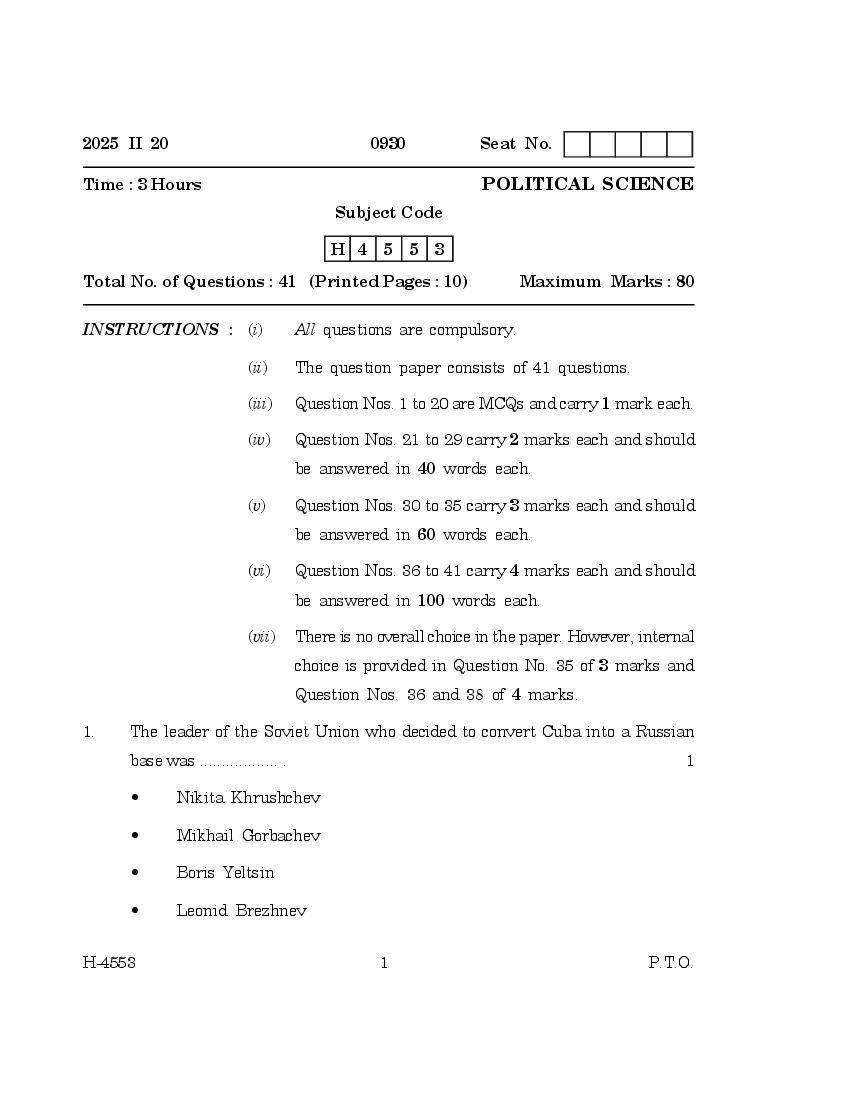
Time : 3 Hours POLITICAL SCIENCE
Subject Code
H 4 5 5 3
Total No. of Questions : 41 (Printed Pages : 10) Maximum Marks : 80
INSTRUCTIONS : (i) All questions are compulsory.
(ii) The question paper consists of 41 questions.
(iii) Question Nos. 1 to 20 are MCQs and carry 1 mark each.
(iv) Question Nos. 21 to 29 carry 2 marks each and should
be answered in 40 words each.
(v) Question Nos. 30 to 35 carry 3 marks each and should
be answered in 60 words each.
(vi) Question Nos. 36 to 41 carry 4 marks each and should
be answered in 100 words each.
(vii) There is no overall choice in the paper. However, internal
choice is provided in Question No. 35 of 3 marks and
Question Nos. 36 and 38 of 4 marks.
1. The leader of the Soviet Union who decided to convert Cuba into a Russian
base was .................. . 1
• Nikita Khrushchev
• Mikhail Gorbachev
• Boris Yeltsin
• Leonid Brezhnev
H-4553 1 P.T.O.
Page 2
America dropped two atomic bombs on the Japanese cities of Hiroshima
and ..................... . 1
• Kyoto
• Tokyo
• Nagasaki
• Yokohama
3. The first non-aligned summit was held in 1961 in ................... . 1
• Warsaw
• Brussel
• Dortmund
• Belgrade
4. Mikhail Gorbachev became General Secretary of the ................ . 1
• Conservative Party
• Capitalist Party
• Communist Party
• Democratic Party
H-4553 2
Page 3
• France
• China
• United States of America
• India
6. In August 1990, Iraq invaded .................. . 1
• Iran
• Kuwait
• Afghanistan
• Syria
7. The US power lies in the overwhelming superiority of its ................... . 1
• Military power
• Economic power
• Agricultural power
• Health care
H-4553 3 P.T.O.
Page 4
Singapore and .................... . 1
• Thailand
• Nepal
• Burma
• Sri Lanka
9. The ‘open door policy’ was announced in China by ................. . 1
• Mao Ze Dong
• Zhou Enlai
• Deng Xiaoping
• Li Xiannion
10. In 1987 the Government of India sent the Indian Peace Keeping Force
(IPKF) to ................... . 1
• Bangladesh
• Pakistan
• Sri Lanka
• Nepal
H-4553 4
Page 5
• India
• Russia
• US
• France
12. Security implies freedom from .................... . 1
• Internal dispute
• Riots
• Internal crisis
• Threats
13. In 2002, India, China and developing countries were exempted from the
requirements of the .................. . 1
• Beijing Protocol
• Tokyo Protocol
• Kyoto Protocol
• Shanghai Protocol
H-4553 5 P.T.O.
Page 6
called ..................... . 1
• Political globalization
• Cultural globalization
• Economic globalization
• Social globalization
15. The first state of lndia to hold an election based on Universal Adult
Franchise was .................... . 1
• Mizoram
• Sikkim
• Assam
• Manipur
16. The Second Five Year Plan was drafted by a team of economists and
planners under the leadership of ................... . 1
• K. N. Raj
• Jawaharlal Nehru
• Rajendra Prasad
• P. C. Mahalanobis
H-4553 6
Page 7
colonial system of ................. . 1
• Zamindari
• Mukhiyagiri
• Sahukari
• Kingship
18. The main architect of India’s foreign policy between 1947 and 1964
was ................... . 1
• Jawaharlal Nehru
• Sardar Patel
• V. Krishna Menon
• Dr Rajendra Prasad
19. In 1974 the leader of the students movement in Bihar was ................. . 1
• Raj Narain
• Dr. Ram Manohar Lohia
• Jayprakash Narayan
• Morarji Desai
H-4553 7 P.T.O.
Page 8
• Uttar Pradesh
• Uttarakhand
• Andhra Pradesh
• Karnataka
21. Why did the superpowers have military alliance with smaller countries ? 2
22. Explain the 9/11 attack. 2
23. Discuss the criteria to become a permanent member of the Security Council
of the United Nations. (any four) 2
24. Explain the role of the UN in a unipolar world. 2
25. Explain any two new sources of threats. 2
26. Discuss the environmental concerns in global politics. 2
27. Explain the dominance of the Indian National Congress in the first three
general elections in India. 2
28. Explain the electoral verdict of the fourth general elections of 1967. 2
29. Explain the demands of the Bhartiya Kissan Union. 2
H-4553 8
Page 9
31. Explain the causes of globalization. 3
32. Discuss the challenges faced by the Election Commission of India during the
first general elections held in 1952. 3
33. Explain the key areas of the First Five Year Plan. 3
34. How did the Presidential elections of 1969 lead to the formal split of the
Congress ? 3
35. Explain the factors which led to the movement against outsiders in
Assam. 3
Or
Explain the lessons that can be drawn from the regional aspirations in
India.
36. Analyse the causes of disintegration of the USSR. 4
Or
Analyze the consequences of shock therapy.
37. Examine the areas of conflict between India and Pakistan. 4
H-4553 9 P.T.O.
Page 10
India. 4
Or
Examine the consequences of the partition of India in 1947.
39. Explain the impact of the Chinese invasion of 1962 on India. 4
40. Analyse the consequences of emergency in India. 4
41. Explain the political rise of Other Backward Classes. 4
H-4553 10
Document Details
| Board / Org | Goa Board |
| Exam | Class 12 |
| Type | Question Paper |
| Pages | 10 |
| Updated | 24 Sep 2026 |