CBSE Class 11 Enterprenuership Syllabus 2021-22
Finished viewing? Save it for later —
Download CBSE Class 11 Enterprenuership Syllabus 2021-22 (PDF · 8 pages)About CBSE Class 11 Enterprenuership Syllabus 2021-22
CBSE Class 11 Enterprenuership Syllabus 2021-22 is available here for free download. Published by CBSE for Class 11, this syllabus can be viewed online or downloaded as a PDF (8 pages). Candidates preparing for Class 11 can use CBSE Class 11 Enterprenuership Syllabus 2021-22 to understand the exam pattern, the type of questions asked, and the overall difficulty level.
Frequently Asked Questions
How can I download CBSE Class 11 Enterprenuership Syllabus 2021-22?
Open this page and click the Download button to save CBSE Class 11 Enterprenuership Syllabus 2021-22 as a PDF. It is completely free on AglaSem Docs.
Is CBSE Class 11 Enterprenuership Syllabus 2021-22 free to download?
Yes. CBSE Class 11 Enterprenuership Syllabus 2021-22 can be viewed online and downloaded as a PDF free of cost on AglaSem Docs.
How many pages does CBSE Class 11 Enterprenuership Syllabus 2021-22 have?
CBSE Class 11 Enterprenuership Syllabus 2021-22 contains 8 pages, which you can read online or download together as a single PDF.
Where can I find more Class 11 study material?
You can find more Class 11 question papers, sample papers, syllabus, and answer keys on AglaSem Docs.
CBSE Class 11 Enterprenuership Syllabus 2021-22 – Text
Read the full text of this syllabus below — useful to quickly search, copy and reference the content online without downloading the PDF.
📄 View text version (8 pages)
Page 1
CLASS XI-XII (2021-22)
(CODE NO. 066)
Rationale
School curriculum is a dynamic process. It continuously evolves itself reflecting the needs and
aspirations of learners. In recent times, our society is influenced by knowledge creation and
technological advancements. Competencies affecting Innovation and creativity have become
important in all walks of life, including business context. This makes entrepreneurship education
even more important for enhancing quality of life.
Entrepreneurship plays an influential role in the economic growth and development of the
country. As the world economy is changing so is the dynamism of the business world. The aim
of this course is to instill and kindle the spirit of Entrepreneurship amongst students. The idea of
this course is to create “job providers rather than job seekers”.
Objectives:
To develop Entrepreneurial mindset among Higher Secondary School children.
To encourage school children to opt for self-employment as a viable option for earning
dignified means of living.
To enable students to appreciate the dynamic changes happening in the economy.
To acquaint the students about the role of Entrepreneurship in the growth and economic
development of the nation.
To promote Entrepreneurship as life-skills to improve quality of life, skills of creation and
management of entrepreneurial pursuits.
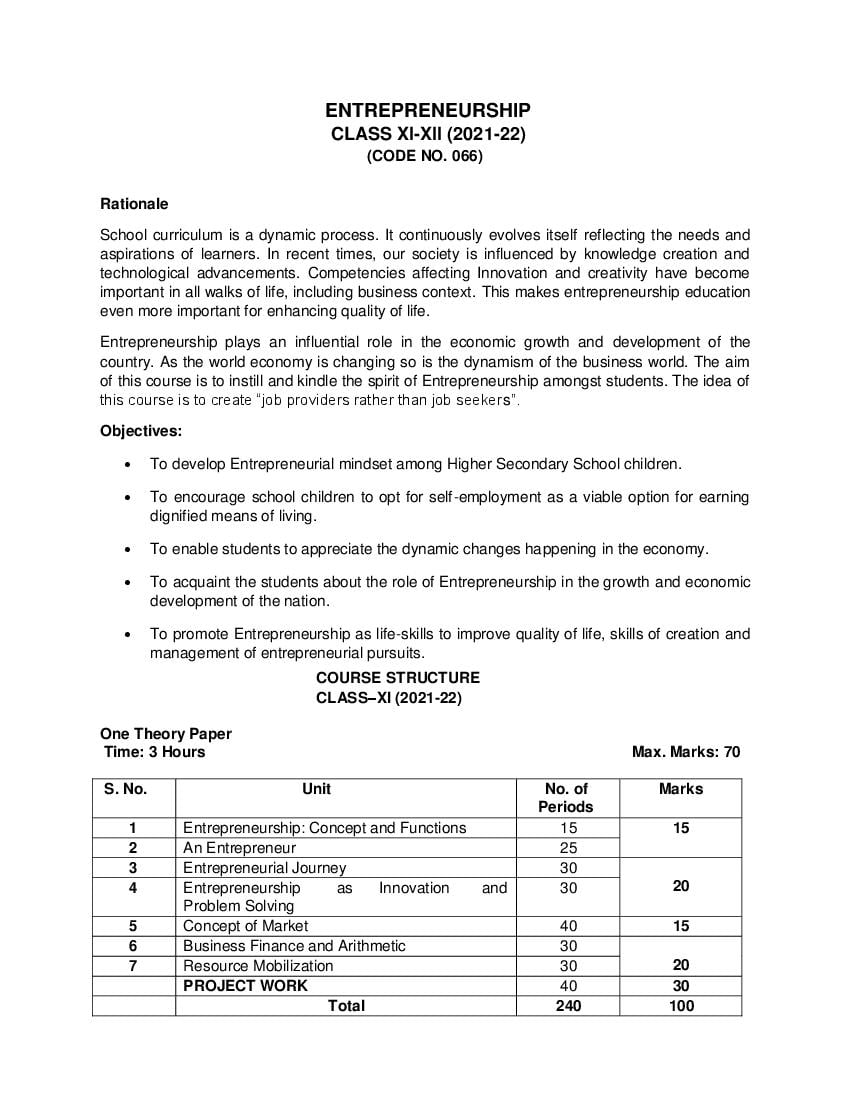
COURSE STRUCTURE
CLASS–XI (2021-22)
One Theory Paper
Time: 3 Hours Max. Marks: 70
S. No. Unit No. of Marks
Periods
1 Entrepreneurship: Concept and Functions 15 15
2 An Entrepreneur 25
3 Entrepreneurial Journey 30
4 Entrepreneurship as Innovation and 30 20
Problem Solving
5 Concept of Market 40 15
6 Business Finance and Arithmetic 30
7 Resource Mobilization 30 20
PROJECT WORK 40 30
Total 240 100
Page 2
Unit 1: Entrepreneurship: Concept and Functions 15 Periods
Contents Learning Outcomes
Competencies- Vision, Decision making,
Logical, Critical and Analytical Thinking,
Managing Skills
Entrepreneurship – Concept, After going through this unit, the student/
Functions and Need learner would be able to:
Myths about Entrepreneurship Understand the concept of
Entrepreneurship
Advantages and Limitations of
Entrepreneurship Explain the functions of an
Entrepreneur
Process of Entrepreneurship
Appreciate the need for
Entrepreneurship – The Indian Entrepreneurship in our economy
Scenario
Assess how entrepreneurship can
help shape one’s career
State the myths, advantages and
limitations of Entrepreneurship
Discuss the steps in the process of
Entrepreneurship
Describe the current scenario of
Entrepreneurial activity in India
Unit 2: An Entrepreneur 25 Periods
Competencies: Need Achievement, Motivation, Ethics, opportunity seeking, Passion,
Independence
Contents Learning Outcomes
Why be an Entrepreneur After going through this unit, the student/
learner would be able to:
Types of Entrepreneurs
Understand the motivation to become an
Competencies and characteristics entrepreneur
Entrepreneurial Values, Attitudes and Differentiate between various types of
Motivation entrepreneurs
Intrapreneur: Meaning and Importance Explain the competencies of an
Entrepreneur
Appreciate the importance of values,
attitude and motivation for an
Entrepreneur
Appreciate the difference between
Entrepreneur and Intrepreneur
Page 3
Competencies:
Scanning the environment; Information seeking; creativity; Innovativeness;
divergent thinking; Perseverance
Contents Learning Outcomes
Self-Assessment of Qualities, Skills, After going through this unit, the student/
Resources and Dreams learner would be able to:
Idea generation Assess their own entrepreneurial
qualities and competencies
Feasibility Study and opportunity
assessment Understanding ways of idea generation.
Business Plan: meaning, purpose and Discuss the concept of types of
elements feasibility study
Execution of Business Plan Draft a basic business plan
Understand the reasons for success and
failure of business plan
Unit 4: Entrepreneurship as Innovation and Problem Solving 30 Periods
Competencies: Risk taking; Determination; Initiative; problem solving ability;
Adaptability to changing technologies
Contents Learning Outcomes
Entrepreneurs as problem solvers After going through this unit, the student/
learner would be able to:
Innovations and Entrepreneurial
Ventures – Global and Indian Understand the role of entrepreneurs as
problem solvers
Role of Technology – E-commerce and
Social Media Appreciate the role of global and Indian
innovations in entrepreneurial ventures
Social Entrepreneurship - Concept
Understand the use of technology and
Risk Taking-Concept and types
digitization for new businesses.
Discuss the concept of social
entrepreneurship
Analyse the risk in entrepreneurial
ventures
Page 4
Competencies: Task oriented, Opportunity seeking, resourcefulness, organizational
skills, Analytical and logical reasoning
Contents Learning Outcomes
Market; Concept, Types After going through this unit, the student/
learner would be able to:
Micro and Macro Market Environment
Understand the market and its types
Market Research - Concept,
Importance and Process Scan the market environment in the light
of factors affecting market environment
Marketing Mix
Learn how to conduct market research
Understand the elements of marketing
mix
Unit 6: Business Finance and Arithmetic 30 Periods
Competencies: Arithmetic skills, critical analysis, decision making, self-confidence,
problem solving.
Contents Learning Outcomes
Unit of Sale, Unit Price and Unit Cost - for After going through this unit, the student/
single product or service learner would be able to:
Types of Costs - Start up, Variable and Discuss- Unit Cost, Unit of Sale, Unit
Fixed Price of a product or service
Break Even Analysis - for single Understand the components of COST -
product or service Start-up and operational costs
Calculate break even of single product
and service
Page 5
Competencies: Resourcefulness; Collaboration; Managing Risk; Organizational Skills;
Informed Decision Making
Contents Learning Outcomes
Types of Resources –Physical, Human, After going through this unit, the student/
Financial and Intangible. learner would be able to:
Selection and utilization of human Identify the different types of resources
resources and professionals like tools – Physical and material, Human,
Accountants, Lawyers, Auditors, Board Financial, Intangibles
Members, etc. Discuss the methods to secure business
Estimating Financial Resources finance.
requirement Appropriate use of debt and equity in
Methods of meeting the financial estimating the financial requirements of
requirements an enterprise
Size and capital based classification of Explain the difference, advantages and
business enterprises. disadvantages of Debt and Equity
Estimate the financial requirements of an
enterprise
Understand the meaning of fixed capital
and working capital
Understand the classification of business
enterprise on the basis of size and capital
Project Work (Any Two files) 40 Periods
1. Visit of the District Industries Centre and prepare a report of activities and programmes
undertaken by them
2. Conduct a case study of any entrepreneurial venture in your nearby area.
3. Field Visit: Visit any business firm near your locality; interact with the owner of the
business firm and prepare a field report on parameters like: type of business, scale of
business, product/service dealing in, target customer, problems faced and measures to
solve the faced challenges.
4. Learn to Earn
5. Know your State Handicraft and Handlooms as a means of economic activity for the
livelihood of people and intellectual property rights attached to them for the promotion of
local specific skills.
10 Marks each for 02 Projects
5 Marks for Numerical Assessment
5 Marks for Viva
Note: Students need to complete two projects. Guidelines for project are given in the
CBSE Textbook.
Page 6
QUESTION PAPER DESIGN
CLASS XI (2021-22)
Time: 3 Hours
Max Marks: 70 Theory+ 30 External Assessment (Project Based+ VIVA by an external examiner)
S.No. Typology of VSA - SA -I SA-II LA- I LA Total %
Questions Objective (2 (3 (4 (5 Marks
Weightage
Type marks) Marks Marks) Marks)
(1 mark)
1. Remembering: 16 - - 01 - 20 28.5%
Exhibit memory
of previously
learned material
by recalling facts,
listing elements,
terms and basic
concepts
Understanding:
Demonstrate
understanding of
facts and ideas by
organizing,
comparing,
translating,
interpreting,
giving
descriptions, and
stating main ideas
2. Applying: Solve - 5 2 1 2 30 43%
problems to new
situations by
applying acquired
knowledge, facts,
techniques and
rules in different
ways.
3. Analysing and - 2 1 2 1 20 28.5%
Evaluating:
Examine and
break information
into parts by
identifying
motives or causes.
Make inferences
and find evidence
to support
Page 7
integrated
learning; Present
and defend
opinions by
making judgments
about information,
validity of ideas,
or quality of work
based on a set of
criteria.
Creating:
Compile
information
together in a
different way by
combining
elements in a new
pattern or
proposing
alternative
solutions
16 Q 7Q 3Q 4Q 3Q 33 100%
Questio
TOTAL ns
RUBRICS FOR QP 2021-22
Section 1 2 3 4 5 Total no. Marks %
mark marks marks marks marks of
Questions
Section A 16 -- -- 01 -- 20 20 28.5 %
This Section includes:
5 Multiple choice
questions
5 Fill in the blanks
10 Questions based on
remembering and
understanding basis with
elements of application
and identification.
Page 8
This section includes 2,3,4
and 5 marker questions
that are source based ,
case study based ,
paragraph based,
integrated approach of
the text.
Section C -- 2 1 2 1 6 20 28.5%
This section includes 2,3,4
and 5 marker questions
that are evaluative,
analytical, creating,
contracting.
No. of Questions 16 7 3 4 3 33
Total marks 70 100%
Document Details
| Board / Org | CBSE |
| Exam | Class 11 |
| Type | Syllabus |
| Pages | 8 |
| Updated | 22 Jul 2026 |