NCERT Book Class 10 Maths Chapter 4 Quadratic Equations
Finished viewing? Save it for later —
Download NCERT Book Class 10 Maths Chapter 4 Quadratic Equations (PDF · 11 pages)About NCERT Book Class 10 Maths Chapter 4 Quadratic Equations
NCERT Book Class 10 Maths Chapter 4 Quadratic Equations is available here for free download. Published by NCERT for Class 10, this books can be viewed online or downloaded as a PDF (11 pages). Candidates preparing for Class 10 can use NCERT Book Class 10 Maths Chapter 4 Quadratic Equations to understand the exam pattern, the type of questions asked, and the overall difficulty level.
Frequently Asked Questions
How can I download NCERT Book Class 10 Maths Chapter 4 Quadratic Equations?
Open this page and click the Download button to save NCERT Book Class 10 Maths Chapter 4 Quadratic Equations as a PDF. It is completely free on AglaSem Docs.
Is NCERT Book Class 10 Maths Chapter 4 Quadratic Equations free to download?
Yes. NCERT Book Class 10 Maths Chapter 4 Quadratic Equations can be viewed online and downloaded as a PDF free of cost on AglaSem Docs.
How many pages does NCERT Book Class 10 Maths Chapter 4 Quadratic Equations have?
NCERT Book Class 10 Maths Chapter 4 Quadratic Equations contains 11 pages, which you can read online or download together as a single PDF.
Where can I find more Class 10 study material?
You can find more Class 10 question papers, sample papers, syllabus, and answer keys on AglaSem Docs.
NCERT Book Class 10 Maths Chapter 4 Quadratic Equations – Text
Read the full text of this books below — useful to quickly search, copy and reference the content online without downloading the PDF.
📄 View text version (1 page)
Page 1
QUADRATIC EQUATIONS 4
4.1 Introduction
In Chapter 2, you have studied different types of polynomials. One type was the
quadratic polynomial of the form ax2 + bx + c, a 0. When we equate this polynomial
to zero, we get a quadratic equation. Quadratic equations come up when we deal with
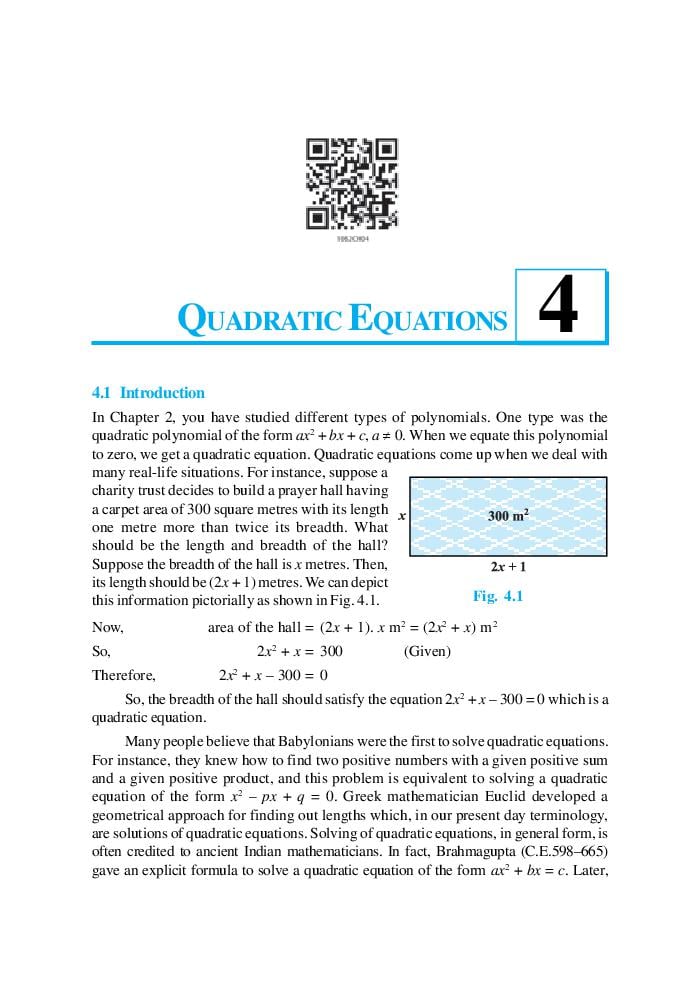
many real-life situations. For instance, suppose a
charity trust decides to build a prayer hall having
a carpet area of 300 square metres with its length
one metre more than twice its breadth. What
should be the length and breadth of the hall?
Suppose the breadth of the hall is x metres. Then,
its length should be (2x + 1) metres. We can depict
this information pictorially as shown in Fig. 4.1. Fig. 4.1
Now, area of the hall = (2x + 1). x m2 = (2x2 + x) m2
So, 2x2 + x = 300 (Given)
2
Therefore, 2x + x – 300 = 0
So, the breadth of the hall should satisfy the equation 2x2 + x – 300 = 0 which is a
quadratic equation.
Many people believe that Babylonians were the first to solve quadratic equations.
For instance, they knew how to find two positive numbers with a given positive sum
and a given positive product, and this problem is equivalent to solving a quadratic
equation of the form x2 – px + q = 0. Greek mathematician Euclid developed a
geometrical approach for finding out lengths which, in our present day terminology,
are solutions of quadratic equations. Solving of quadratic equations, in general form, is
often credited to ancient Indian mathematicians. In fact, Brahmagupta (C.E.598–665)
gave an explicit formula to solve a quadratic equation of the form ax2 + bx = c. Later,
Showing the first page only. Download the PDF above for the complete document.
Document Details
| Board / Org | NCERT |
| Exam | Class 10 |
| Type | Books |
| Pages | 11 |
| Language | english |
| Updated | 29 Aug 2026 |