NCERT Book Class 6 Social Science (History) Chapter 3 In the Earliest Cities
Finished viewing? Save it for later —
Download NCERT Book Class 6 Social Science (History) Chapter 3 In the Earliest Cities (PDF · 11 pages)About NCERT Book Class 6 Social Science (History) Chapter 3 In the Earliest Cities
NCERT Book Class 6 Social Science (History) Chapter 3 In the Earliest Cities is available here for free download. Published by NCERT for Class 6, this books can be viewed online or downloaded as a PDF (11 pages). Candidates preparing for Class 6 can use NCERT Book Class 6 Social Science (History) Chapter 3 In the Earliest Cities to understand the exam pattern, the type of questions asked, and the overall difficulty level.
Frequently Asked Questions
How can I download NCERT Book Class 6 Social Science (History) Chapter 3 In the Earliest Cities?
Open this page and click the Download button to save NCERT Book Class 6 Social Science (History) Chapter 3 In the Earliest Cities as a PDF. It is completely free on AglaSem Docs.
Is NCERT Book Class 6 Social Science (History) Chapter 3 In the Earliest Cities free to download?
Yes. NCERT Book Class 6 Social Science (History) Chapter 3 In the Earliest Cities can be viewed online and downloaded as a PDF free of cost on AglaSem Docs.
How many pages does NCERT Book Class 6 Social Science (History) Chapter 3 In the Earliest Cities have?
NCERT Book Class 6 Social Science (History) Chapter 3 In the Earliest Cities contains 11 pages, which you can read online or download together as a single PDF.
Where can I find more Class 6 study material?
You can find more Class 6 question papers, sample papers, syllabus, and answer keys on AglaSem Docs.
NCERT Book Class 6 Social Science (History) Chapter 3 In the Earliest Cities – Text
Read the full text of this books below — useful to quickly search, copy and reference the content online without downloading the PDF.
📄 View text version (1 page)
Page 1
IN THE EARLIEST CITIES
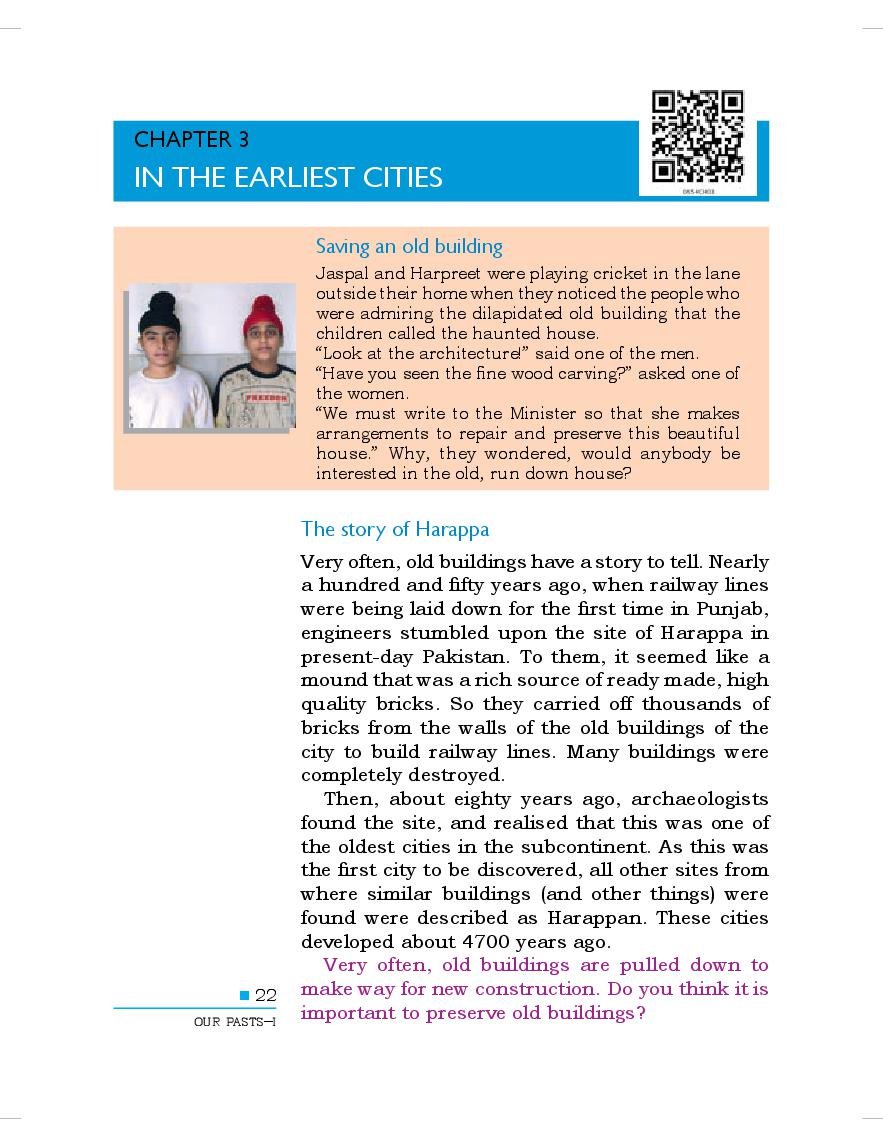
Saving an old building
Jaspal and Harpreet were playing cricket in the lane
outside their home when they noticed the people who
were admiring the dilapidated old building that the
children called the haunted house.
“Look at the architecture!” said one of the men.
“Have you seen the fine wood carving?” asked one of
the women.
“We must write to the Minister so that she makes
arrangements to repair and preserve this beautiful
house.” Why, they wondered, would anybody be
interested in the old, run down house?
The story of Harappa
Very often, old buildings have a story to tell. Nearly
a hundred and fifty years ago, when railway lines
were being laid down for the first time in Punjab,
engineers stumbled upon the site of Harappa in
present-day Pakistan. To them, it seemed like a
mound that was a rich source of ready made, high
quality bricks. So they carried off thousands of
bricks from the walls of the old buildings of the
city to build railway lines. Many buildings were
completely destroyed.
Then, about eighty years ago, archaeologists
found the site, and realised that this was one of
the oldest cities in the subcontinent. As this was
the first city to be discovered, all other sites from
where similar buildings (and other things) were
found were described as Harappan. These cities
developed about 4700 years ago.
Very often, old buildings are pulled down to
22 make way for new construction. Do you think it is
our pasts–i
important to preserve old buildings?
Chapter 3-4.indd 22 22 April 2022 03:21:57
Showing the first page only. Download the PDF above for the complete document.
Document Details
| Board / Org | NCERT |
| Exam | Class 6 |
| Type | Books |
| Pages | 11 |
| Updated | 30 Apr 2026 |